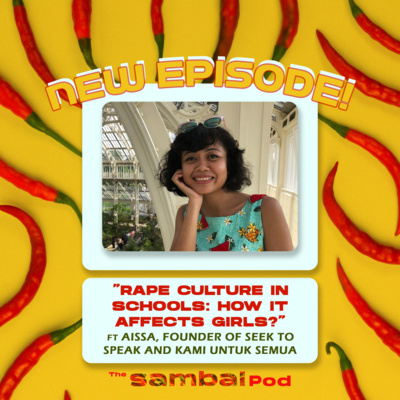
#sambalpodcasts: Rape Culture in Schools-How it Affects Girls? (ft Aissa, Founder of Seek to Speak)
37m 33s
The Sambal Podcast episode by the Sambal Pod addresses sensitive topics like real culture and sexual harassment, highlighting potential triggers and the importance of seeking help. The discussion delves into the impact of Aya Nusniza's case on Malaysian schools, emphasizing the need for safer environments and policy changes. Gender issues, sexual harassment, and rape are described as emotional topics with survivors facing challenges in reporting incidents due to survivor backlash and systemic barriers. The conversation underscores the importance of understanding these issues, promoting dialogue, and advocating for change to address harassment and abuse in various settings, including schools and workplaces.
Transcription
6072 Words, 32662 Characters
I am Aisa from Seek To Speak and you are listening to Sambal Podcast by the Sambal Pod. Woohoo!
I mean, I hope that's okay.
I would like to warn our listeners that this episode speaks about real culture and sexual harassment.
Plastic may trigger unpleasant memories and trauma to some of us.
Remember, it is totally fine to hit the pause button when it gets too uncomfortable for you.
Because even for me as the editor of this episode, I definitely struggled with editing some of this
audios. Fun fact, it actually took me four days to edit this which is the longest I've spent for
any podcast episode. So it's totally fine to hit pause when you're not ready for these conversations.
But remember to also seek help if you need it because all help lines and links are in our
episode description. Now better episode, this is A.G. and you're listening into #SambalPodcast
by the Sambal Pod. This is a platform where we invite local youths and youth initiatives
to discuss their views and impacts of their work in the local landscape.
Tune in to this episode as we speak to Aya and Aisa, the founder of Seek To Speak,
a local youth initiative that aims to empower expression through its events.
Welcome to Aya Nusniza's case. We have been more aware than ever about how unsafe our Malaysian
schools are. We have seen the hashtag #MalaysiaSchoolsBetterPlace have movements like Save To School
Malaysia. So how is the situation today? Last year about what Aya and Aisa has to say on the matter.
Yeah, we have two Ayaans here. One Aya Nusniza from her from a very famous case last year and
our guest Aya and Aisa on to the show today. So yes, we have two Ayaans being betters families.
So we also spoke about how the government denied this method first
and how we actually see changes and impacts today. Within the conscious of people, it's like,
oh I didn't know that was a bad thing but now people are having conversations about it. People
are being more and more aware that some things are inappropriate that teachers, educators should
act in a certain way, especially because of the level of trust that we have towards them and not
just in terms of awareness of things that are right and wrong but I think in terms of systems as
well, the impact that it has had because a lot of people are saying, you know, things are not being
done, laws are not changed but since the movement last year, we have seen the government for example
saying that period spot checks is now illegal to be done in schools. Whether or not it is followed,
is another issue but the fact that there is a top-down policy that is telling public schools,
public universities that this is now not allowed to be done by teachers, I think it's a big deal
and I think it was only or could have only been done because of the traction that the Make School
of Safer Place campaign had done because if you look at the government's reaction when it just
first started out, the first thing that they said was show me the numbers. Does this really happen?
The woman's ministry said, oh it doesn't happen in school. I never, she said herself,
I think it was Rina who said that, oh I was in a boarding school, it never happened to me.
Yeah, so first what they did was deny it. The director general of NUTP which is National Union
of the Teaching Professions says it doesn't exist. In fact, he says there is no rape culture
because he seems to think that rape culture just means people raping each other.
So we saw from the get go, the women's ministry, the education ministry, the teaching profession
saying that this is not a problem and one year on, period sport checks is banned and one year
on, a government is saying that they're actually going to set up a special committee to check on
whether or not harassment really happens and if it does happen. When we talk about gender issues,
right, like sexual harassment, rape, it is always a very emotional topic because I think a lot of us
at either witness cases like this or became survivors ourselves. Some of us I believe would
just decide to hate the world in silence without realising how common this is and that you're not
truly alone. I am not sharing my personal story today but as a student about to enter the working
world, I realised that the torment does not end and it's more of an issue of me thinking that it
is my fault in some way. How long is this torture? Yes, I use the word torture. It's going to haunt
more girls and women like me. Things is not clear for so many people and which is a shame because
it's easily explained through comprehensive sexual education or through conversations
but because it's not something that we talk about because it's so embarrassing to so many people,
teachers are not properly trained to talk about it, parents don't like to talk about it, it is a
taboo topic, it just never gets addressed so nobody really understands what it really means
for a victim when they get raped. It is terrible and it can come in many forms
and that doesn't mean their hurt or trauma is any less terrible just because it wasn't done
by a stranger violently. Several months before the Iron Housniza's case last year,
the whole Malaysia had soon became familiar with the term period sports checks.
As a former boarding school student myself, this is not an uncommon culture to me
where female students were asked to show their pets or underwear as proof of demonstration,
slash periods. This had become some sort of practice in ashrama schools relating to religion
as religious educators also known as ustazas to some of us would command this practice
to ensure that these students do not skip their prayers. I remember calling this practice crazy
the first time I've witnessed it and heard of it but later on I just became a blended background
not having the courage to report this out of fear and only last year I realised how this
barbaric practice I became became a tradition for so many decades in many boarding schools
so many places for us where these schools were actually second homes for so many of us.
Even outside of boarding schools, it can't really happen to anyone and I think that's what
everybody has to understand that it doesn't just happen to girls who don't do a certain thing or
bad girls it can happen to anyone and the second thing is everybody needs to understand is if
something is uncomfortable and something is awkward and it makes you feel embarrassed, ashamed
then there's something wrong there and if you have to ask your students to carry out something
you don't want to do or if you have to turn against other students because of some perceived
sense of justice because you hate what is being done for you so you want to take down other people
with you then there's something wrong there as well and if you can't voice out your discomfort
and you are not taken seriously when you voice out your discomfort when logic goes out the window
because honestly there was no rationale for them to check you absolutely not but if you can't
question it if logic is not taken seriously then I understand how helpless students may feel
how they feel like it's pointless to say anything how it's just better to just blend in
and I think that is the saddest thing to have happened in our education systems where you
not only don't feel safe where as you said is your second home where you're supposed to be
concentrating on learning where you can turn on your friends where your prefects or people whom
you think you should look up to become agents of harassment and when you fear your warden so much
that you can't even tell them that this just does not make sense that is just really sad
for me and it really pains me to say it and it um and I think even now for example even if
period sport checks is illegal a harassment can come in many forms and if there isn't an avenue
for girls to speak up and to make complaints on certain teachers I think then the system is far
from fixed and I think we're definitely not there yet um so unfortunate or I I have not experienced
this myself but when I hear about this yeah it is terrible back to Ainut Nisa's case again
how did this case impact Malaysia in terms of courage amongst survivors this feeling that women
are secondary is something that exists in every part of not just our education system it's in our
working force it's in our ministry it's in the government sentiments so it's kind of hard to
feel empowered and I think that's why Ainut Nisa's case feels so different or feels so empowering
because wow and I honestly feel like Ainut Nisa is um an amazing example of an accidental activist
where something bad happened to you you decided to tell a friend or in this case you decided to
post a take talk about it and then um without realizing it so many people feel the same even
the people coming out going behind Ainut Nisa taking part in activism and more importantly
telling their story I think that's the great impact that this movement has created um can we
do more definitely are we doing enough nowhere near enough but I think if we keep moving if we
keep having conversations like this agey I think we are going to get to the place where maybe we'll
do justice to our girls survival backlash hmm incidents where survivors of any harassment
or rape cases where they face negative backlash as they try to go public with their most intimate
trauma and stories you might think that it's weird to see the public so divided on this matter
but I am personally not surprised thinking about it because obviously we are talking about one of
the most taboo unspoken topics in our conservative rooted in tradition Asian society survival
backlash sadly just portrays the the reality of the ignorance of people around us the ignorance
of our dear right yet about this issue as a whole even the reported cases that we have it is severely
under reported because the system doesn't make it easy for victims or survivors to come out
and tell their story for example if you made a report a lot of officers don't take it seriously
even if you were a domestic violence victim if you go to the officers they'll likely say this is a
masala rumatanga let alone harassment where you can't it's a he said she said situation where you
don't have bruises on your body and then you have to go through the court process and it's difficult
you know it's really difficult because you need to tell your story over and over again
you need to make sure that after you make a report people actually believe you that investigations
take place that you are you will be protected against the person you are making a report against
it's very traumatizing so when you don't decide to go through the legal process when you don't
decide to make a police report and instead find closure in your friends your family or tell the
public about this harass so that other women don't actually are protected from this person then you
get survivor backlash then people tell you oh why didn't you report even though the system is already
against them so it's and then these people and when they do tell their stories they get slapped
with defamation suits and that fear so you you have and other than okay so there are several
ways that you can tell your story you can seek justice by going through the legal process of
making a police report if it's a crime that's another thing if it's a crime huh because the sexual
harassment bill was just table so stalking is still not a crime and it's just really said that
we're at that point where the system has failed us and what people don't see is that there's actually
a third option that is not really exercised is when there are systems in place in education
institutions or companies where you can make a complaint so it'll be like a civil suit
or like a civil proceeding so for example uh in a a lot of MNCs or public companies have
a way of making a complaint so if you've been harassed by a colleague you can make
a anonymous complaint an investigation is done and then after that that person who did
the harassment can either be suspended aka punished or things like that so there is some
kind of complaint process but that process is non-existent in education system and it's definitely
non-existent in many other companies but that is that third option and I think that third option
can be done if in schools and in fact especially in places like private universities or private
schools because there's actually political will in these institutions so I think that's an option
that we can actually explore but we're not exploring and therefore it's it's because it's not hard
it isn't it isn't hard to have a complaint system in place as we are halfway throughout the episode
I can imagine some guys some male some of our fellow boys being very defensive about what
we are conversing as now it always is that we speak about cases like this on social media
which is very odd to me we are talking about the pain of fellow survivors but oddly in similar
stories like this some men just find it necessary to prove or justify that this is only the work of
some man and that cases like this do not represent the whole male sex like am I the only one confused
on why you need to justify that in a place where fellow women and know your female friends are
talking about their most inner pain anyway we do sadly have male survivors so does that make sexual
harassment or rape not a gender issue firstly I really do think it's a gender issue because first
of all I do understand that there are male victims and survivors out there but I do believe that girls
are disproportionately affected by harassment and abuse cases in schools in other schools simply
because women are seen to be better praised or more likely to accept the abuse because
of sentiments like that that if somebody in power is above me and is asking me to do something
that feels uncomfortable I have to say yes if my husband wants to have sex with me I can't say no
because it's not deemed as rape if somebody stalks me on the street I can't do anything
because it's not considered a crime if my boss is something inappropriate in the workforce
it's very hard for me to say something about it because he has power over me so yes I do believe
there are male victims but if you look at the cases women are disproportionately affected simply
because people think that either they want it as in like girls are asking for it because of the way
they dress because no actually means yes but also because they have little regard for women
in the law for example a lot of our girls or girls in general are still seen as property
you know and like for example when we have marriage the the age of consent for guys are 18
but you can go as low as 16 for girls yeah so you have this kind of laws that still exist
that shows that or shows how women should be treated or viewed but second of all I also think
that it's a gender issue because if you look at the survey done by Awam as in conjunction with
Save the Schools done by if you look at the cases that were done on men they are a lot more violent
and there are a lot more humiliating which is a really sad case and the reason why this is so is
because I honestly think it's because of toxic masculinity this idea that men should act a certain
way okay so the idea that women should act a certain way also means the opposite is true for men
that men should act a certain way they should be tough they should be aggressive so if men
don't conform to these ideals they get bullied we have had so many bullying cases that involve
either those individuals who they think are trans or who exhibited soft quote unquote characteristics
you know we had that I forgot his name that sadly that high school student who was basically beaten
to death and then a lot of it is not just because the victim does not conform to the standard of
what is male enough but also because the perpetrators feel like they need to be tough you know they need
to be they need to exert authority they need to have control over someone that comes in the form of
that are those are examples of toxic masculinity and those those sentiments exist because we gender
traits women are supposed to be soft-spoken are supposed to be caregivers are supposed to be
pretty but not too forward yeah like all of those things so men are expected to be the same way and
sometimes when people fall short they get they become victims of abuse or because they want to
exhibit masculine traits they become the abuses themselves so I do think it's a gender issue I
do think obviously that anybody can be a victim of abuse but I do think that women are disproportionately
abused and the same reason why women are disproportionately abused is the same reason why
male victims also exist probably one of the most controversial questions in this episode
are harassment and rape the fault of survivors who are commonly girls/women whose fault is it
actually or because she walked out late at night because she wore sexy things because to their minds
if I don't do those things then I will yeah I'll be safe and therefore they have to rationalize this
but in the process of rationalizing this they take away or they put the blame on the victims rather
than the perpetrators actually if you think about it even the way we report things it's like
women get raped after going back home late why is that the case why is it reported that way when it
should be man rapes women that's it why does it have to be why when you say things like women got
raped women got harassed then you put it you put a duty on the woman or the victim to be responsible
for their safety when the perpetrators are the ones at fault we should tell our boys not to rape we
should tell our men not to harass not tell our girls to wear better clothes quote unquote or to
not go out late at night because it can happen to anyone I'm telling you it can happen to you
even if you're fully clothed it's the light of day there's so many instances where it's happened
victims are random and it happens because there are bad people out there and not because the victims
are bad and they were asking for it I have to stress this enough it isn't the victim's fault
and when we created a for sick to speak when we created a program in order to empower girls
and we did focus groups with a lot of NGOs when we asked them why do people not care about women's
rights when they're in schools like why did it have to be like something happening something viral
happened in order for us to get out of this funk of consciousness that this is actually wrong
is because people think that bad things won't happen to them people think that they will be
protected from discrimination or gender bias and only later in the workforce do they realize
that this is this is an issue and unfortunate enough that a lot of girls actually already face
gender discrimination harassment abuse in schools but a lot of other girls face it in
university so we have to universities they face it in work life so we have to understand that
it can happen to anyone if it doesn't happen to us it can happen to our daughter it can happen to
our mom it can happen to our friends and the more we realize that this is a problem even if it
doesn't affect us the more we can mobilize for change let's dive on about rape jokes
free training one was a very odd year as we had witnessed another viral case involving a local
public figure some of you sure know what i'm talking about and who i'm talking about but let's
recap it for the benefit of those who haven't in a local television show we had an actor who had
responded to an interviewer's question exposing details of a deleted rape scene featuring a fellow
actress who is now the mother of two kids the actor along with the host of the show could be seen
laughing on the clip as they made very inappropriate remarks when they discussed the rape scene
which is really frustrating i'm sorry it is really frustrating and what makes me so frustrated
is how many people still find this kind of locker room conversations funny like where is the humor
in conversations like this because i personally have witnessed and listened into these jokes
when i've played male dominated computer games a few years back and i don't understand why us
conversations like this why are rape jokes funny to boys and men to any boys or men listening into
this episode can you tell me why is the human it because i don't really understand what i'm missing
on when you joke about a victim's trauma or you joke about rape you even joke about how the victims
at fault i think that is a rape joke and i think it shouldn't it definitely should not be done
there's nothing funny about it and i just i'm just shocked that when i watched the clip about this
actor explaining it that they all found it funny somehow um yeah and i think it's like they didn't
get it the the rape scene was cut because the parents thought it was inappropriate it was
uncomfortable to do and yet none of this like indicated to his mind that this is something
that we should joke about you know what i mean like it's so obvious there were so many signs already
so yeah um that is and okay so long story short what is an example of a rape joke is
anything that trivializes rape or the crime anything that trivializes a victim or survivor's
trauma anything that makes light out of the issue anything that even makes a joke out of blaming
the victim or that the victim was at fault for doing it i think that is a rape joke and is
inappropriate and it should not be done said or repeated what can we do in a rape joke i
saw shares of simple pointers that we can do if you're able to master up the courage in situation
sectors like one just don't laugh because if you don't laugh you don't react to it then it doesn't
egg them on like what happened with the actor in the talk show in fact if you could go further
just say it's not funny and it's not a laughing matter so that's first don't give them what they
want which is amusement the second thing that i think would be useful is to just ask them why
like why did you make that joke uh like and but i think i think when i say ask why don't say like
like you're attacking or that you want to make a point but just genuinely ask because i honestly
think it's important to find out or get curious like hey why did you make that joke uh like you
don't have to say it like you are like a person in a court case and say like why do you think that's
funny so just say hey um what do you think of that joke are you honestly think it's funny um and then
if they get defensive just say no you're genuinely interested to know and most of the time this stops
them in their tracks or if they actually feel like sharing you actually get their point of view
and once you get their point of view oh i thought it's funny because um of the way she reacted let's
say then you say why do you think her reaction is funny and then when you rationalize why they
would say that and tell them that is actually wrong or me because most of the time a lot of these
sentiments are a product of society something like like you said misogyny is deeply entrenched
in not just like greek mythology in our culture in our religion and the way that we look so we
are just a product of what was brought up or fed to us by the media by our parents by our friends
by our leaders right so when you ask them why do you think it's funny a lot of the time these people
will think it's funny because of something else that was fed to them and they may not even necessarily
feel that way so once you find out why they think it's funny you understand that it's not just them
but rather the kind of information that was fed to them you can rationalize or tell them
that that's not the case the reason why you think it's funny is because you think that women are
lesser or that women should act a certain way so when they don't and they get punished it's hilarious
because they get what they deserve so tell them that this is why you think it's funny
and then the third step is you educate them actually when you say things like that is really
terrible you know because for example you have a daughter right it makes her feel like it's okay
to be treated like this imagine talking about this or joking about this when your mom or your sister
has been victimized what do you think would be the effect you trivialize the issue you make
it harder for victims to come out so honestly tell them about the harms of this joke because
it isn't just a joke if you say this joke enough time it becomes a culture and I think it's already
a culture that's why people think it's funny people think there's nothing wrong within and the last
thing that you need to do is you need to take action so let's say it's step two which is asking
why or educating them did not go well because maybe you became it became a heated debate or
the person didn't want to tell you the reasons then what you can do instead is either not to tell them
to say it anymore or say man that's not funny can you not say that in front of me I feel very
uncomfortable so the action would be if you can't tell them not to do it anymore tell them not to do
it in front of you so then they know that this is something that makes people like you uncomfortable
or in general can make people uncomfortable and I think I think honestly girls should get used to
telling people not to do things because it makes them uncomfortable we are constantly told to we
are honestly we are built to be to be people pleaser to make sure everyone is okay provided for
to try and like you say blend in to not take up so much space but I think this time you
really need to to protect your mental health to establish boundaries you need to tell people
don't make that joke anymore especially in front of me if you if you can't direct that person to
not make that joke so I think those are four very simple steps that you can do don't give them what
they want ask why would they make the joke why do they think it's funny educate them on the harms
of the joke and lastly take action and if you do just any one of these steps it's really good enough
honestly please don't beat yourself up if you didn't manage to tell them off or didn't manage to
educate them just not laughing is already goes a long way in making sure that that joke is never
repeated we are towards the end of another heavy episode and we have discussed about the sad reality
of our rape culture and harassment cases in schools and also in the local Malaysian scene
unfortunately as pathetic as it sounds I believe that our government and society
had failed us the younger generations in so many ways but the emergence of any sort of effort
to spread awareness show some slack hope to me to seek some sort of justice and safety for
fellow girls and women as we bid farewell to Aisa on this episode let's hear what she has to say
on the latest program through the seek to speak platform called Kita Untuk Semua after do is we're
doing a bottoms up approach we are equipping our girls with the necessary tools in order to protect
themselves stand out for themselves but also stand out for others so the program is very simple
it is a capacity building program that ends with a campaigning process so what we are looking for
is actually female students between the ages of 13 to 23 to join our program where they will be
exposed to four capacity building workshops surrounding equal equality and dignity basically
a know your rights workshop secondly a mental resilience workshop so everything that we've
been talking about about victim blaming survivor backlash it gives girls the tools in order to
be mentally resilient in difficult situations thirdly confident communication it allows them or
give them the vocabulary as well as the confidence to speak up and establish those boundaries to
tell their friends when they're uncomfortable to report to positions of authority about what's
happening and lastly the last workshop is community advocacy so that it doesn't just stop at them
meaning that we don't want it to be the case that girls should only protect themselves
when something bad happens to them they should protect themselves when they see a gap in the
system when they see that there are a lot of harassment cases in their schools to actually
do something about it to campaign in their schools to have an impartial investigative system or
reporting sorry complaint system uh the second thing that they should do is to be able to campaign
and stand up for the girls that have been harassed or who will be harassed if nothing is done so that
is the last workshop that we will be teaching our participants and then after these four workshops
that are happening in august we will give our participants participants three weeks to do a
campaign and campaign can be anything it can be it'll be it can be about sharing what they've
learned during the program it's about spreading awareness and when i say it can be anything it
can come in any form it could be writing an article to the newspaper it can be setting up
an instagram account having a podcast like the sambal pod it can be about holding a class with
your friends to teach them about what you've learned so anything basically and the reason
for this is because we want to teach our girls that activism can come in any form and it can be
an easy as as easy as writing on a blog post or as grand as holding a class with your peers and
telling them about their rights and we're hoping that they keep passing it on so whoever reads that
article whoever attends that class whoever listens to their podcast will keep passing on the message
and how we incentivize our participants to do well in the campaign process is we're actually giving
2000 ringgit to five campaigns that we think had the most impact and had the most reach meaning
was very innovative and affected maybe a lot more people than we thought they would
so this top five campaigns will get 2000 ringgit and whoever applies for this program it is
absolutely free there's nothing that you need to pay in order to be exposed to these workshops
yeah and we're also trying to assign a buddy for each group of girls because when we conducted our
focus group in order to tailor this program we found that a lot of students actually want a safe
space to talk about these issues and I know a workshop may seem too formal so after every workshop
there'll be a discussion with their buddies in order for them to actually talk about what was
learned and we will also want to do an event called taboo talks where participants can participate and
talk about things that happen to them talk about things that they discuss and we're also hoping to
have a panel talk during the program girls in activism where we invite young activists in
order to share their activism journey to inspire participants during the campaign process so yes
in a nutshell coming into sumo hopes to empower Malaysian students to be advocates for equality
through campaigning as well as capacity building and registration is still open I'll pass you the
link ag you can sign up in the show notes we will be extending the application deadline so 15 July
please apply by 15 July I'm hoping this episode gets out before then so so please do I look forward
to having more conversations with our participants on this and I look forward to seeing more of you
converse about issues like this yeah I'm sure this has been a very hard episode for some of us to
listen in and to our fellow listeners I thank you for lending your years as difficult as it is please
do not hesitate to seek some help if you are a fellow survivor and do join programs like Kita
Untuk Semua which is free and only takes up two hours of your weekend the last day of registering
is on 15 August sorry 15 July actually 15 July and you may access the links on our podcast description
on any platform you are listening this to to my fellow girls and women
this is this has been a very emotional episode I'm sure to many of us and all I can say is
we are stronger than what society defines us so let's continue doing our part to make Mother Earth
safer for all of us thank you so much for listening this is #SumberPodcast by The SumberPod
and I'll see you in the next episode, goodbye!
Podcast Summary
Key Points:
The episode discusses real culture and sexual harassment, potentially triggering unpleasant memories and trauma.
The discussion covers the impact of Aya Nusniza's case, focusing on the safety of Malaysian schools and changes in policies.
Gender issues, sexual harassment, and rape are emotional topics with survivors facing backlash and challenges in reporting incidents.
Summary:
The Sambal Podcast episode by the Sambal Pod addresses sensitive topics like real culture and sexual harassment, highlighting potential triggers and the importance of seeking help. The discussion delves into the impact of Aya Nusniza's case on Malaysian schools, emphasizing the need for safer environments and policy changes. Gender issues, sexual harassment, and rape are described as emotional topics with survivors facing challenges in reporting incidents due to survivor backlash and systemic barriers.
The conversation underscores the importance of understanding these issues, promoting dialogue, and advocating for change to address harassment and abuse in various settings, including schools and workplaces.
FAQs
The episode discusses real culture, sexual harassment, and the impact of movements like #MalaysiaSchoolsBetterPlace.
Listeners are encouraged to pause the episode if it becomes uncomfortable and seek help if needed.
Period spot checks in schools have been banned, and the government is setting up committees to address harassment.
Sexual harassment is seen as a gender issue due to the disproportionate impact on women, toxic masculinity, and societal views on gender roles.
The fault lies with the perpetrators, not the survivors. Blaming survivors based on their actions or attire is unjust.
Victims can seek justice through legal processes like making a police report or utilizing complaint systems in organizations.
Chat with AI
Loading...
Pro features
Go deeper with this episode
Unlock creator-grade tools that turn any transcript into show notes and subtitle files.
 PodcastTranscript AI