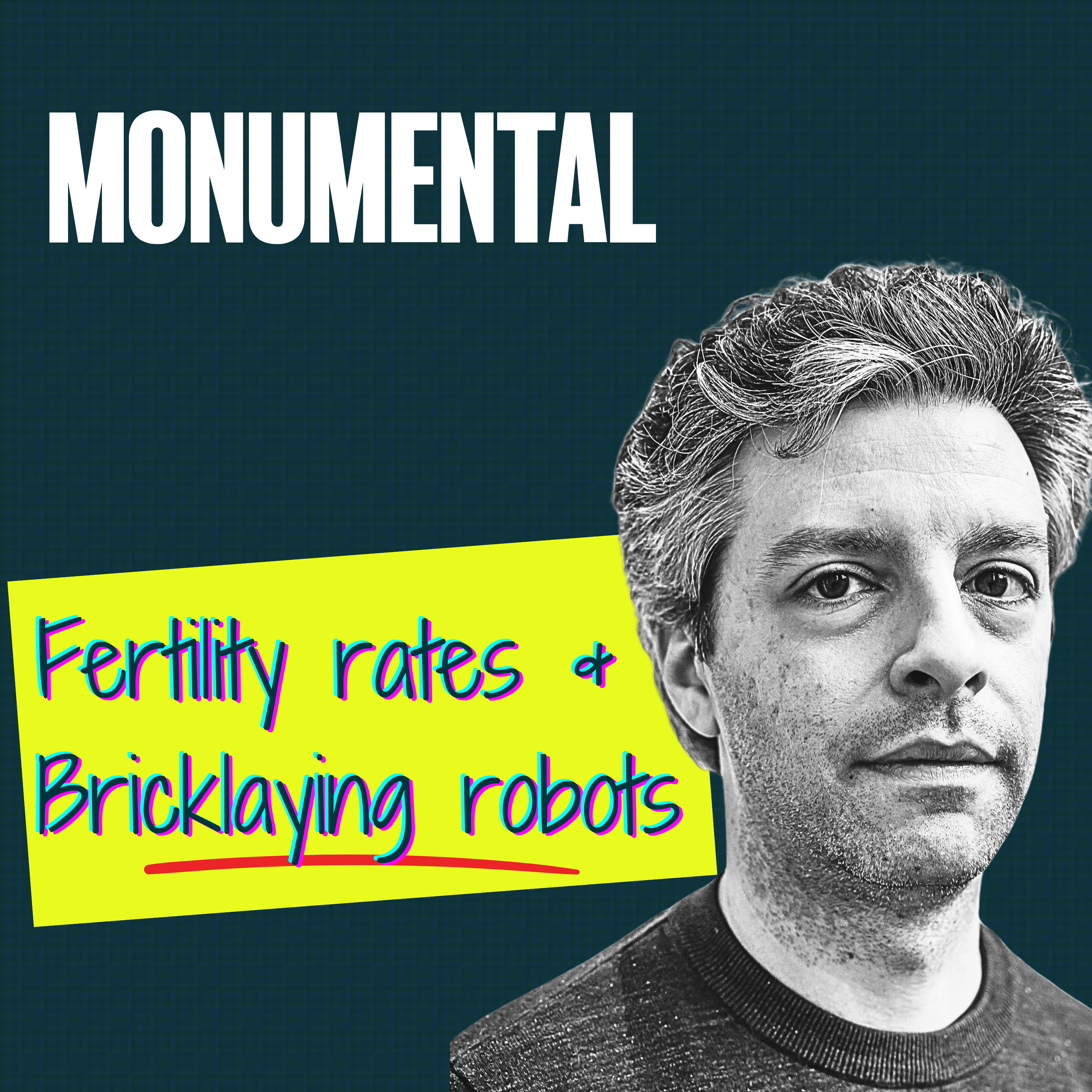
Salar al Khafaji - Autonomous on-site construction robots, Construction ~10-15% of GDP but low productivity, How affordability affects fertility rates, Learnings from selling his startup to Palantir
29m 53s
The transcription features an interview with Salar Al-Kafaji, founder of Monumental, a robotics company revolutionizing construction. Al-Kafaji highlights that construction is one of the few industries where productivity has declined, despite being a significant portion of GDP. Monumental’s robots—teams of bricklaying and supply units—work around the clock to build affordable, high-quality homes, with a vision of software-defined construction that enables bespoke designs without added cost. The company has raised $23 million and currently deploys about 30 robots.
Al-Kafaji discusses the challenge of managing infinite demand: customers are eager but need education on robot capabilities, and scaling production to meet large projects is a key operational hurdle. As a second-time founder, he reflects on mistakes from his first company, Silk, such as relying on freemium models for B2B and wasting time on networking. He learned from Palantir the importance of culture, which he now applies at Monumental by fostering rapid iteration—encouraging quick prototyping, real-world testing, and celebrating failures that lead to faster learning. This culture, he argues, is critical for hardware startups to survive and thrive.
Our entire world is a built up world, right? Do you look around you and we live in buildings? We work in buildings like we need beautiful cities. And I really think we've lost a big part of that, right? And I think every country you go, every industrialized country, I think if you look at their top three problems, wherever you are, like Romania, the Netherlands, the US, housing is one of the biggest problems. It's like such a big problem that there's like research that shows that fertility rates are partly dropping because young people can't afford bigger houses or houses at all with our technology with approach we're taking, that you can have fast, much more affordable, but also beautiful construction because robots can actually do artisanal things without actually increasing cost, right? Like you can have like 10 buildings built, each with a size of a different brick pattern, with different colors, with all these kind of different features, without actually making them slower or the building more expensive. So all these things coming together, that's our vision and not just for bricks for anything in construction. - Hello everyone, welcome to a new episode of the Venture Europe show with me, Colleen Fabriar, yesterday is Salar Al-Kafaji, founder and CEO of Monumental. At Monumental they are developing a suite of autonomous electric robots, which can work around the clock. So everyone can afford a high quality house or apartment in a beautiful city or village. Last year they've raised a 23 million year round from Hummingbird, Nordzone, Plurro, and other investors with a mission to make construction primarily software defined and work towards a future where beautiful bespoke buildings are built within a single day with minimal labor. Wouldn't that be awesome? Prior to Monumental, Salar built and sold the data company Silk to volunteer. During this episode we discuss about the construction market and how it is the only industry where the productivity has decreased. His mistakes from his first business Silk and the biggest current bottleneck at Monumental. Enjoy, let's start jamming, Salar. Welcome to the show, how are you doing? I'm good, excited to do this. Like why is it? We met an Amsterdam a couple of months ago, right? And I think one of your biggest challenge was, I remember you saying it's like, yeah, I think we have like infinite demand. It's just we need to qualify our customers very well and maybe just manage expectations on what they can build with a robot, where are you now? Similar phase, honestly, we're basically building out the pipeline. So I think the interesting thing about building, I don't know if this is true for every heart tech or robotics company, but you're solving a heart problem so the demand is there, at least in our case, it's there. And but the challenge is some people want to work. They start to be like, initially everyone's skeptical. Oh, we've heard the story over and over again, robotics will do things. And then you show them it works and then they get excited. But it obviously isn't work for everything in every use case and every context. So then you have to like actually educate, you're almost like doing anti-stills, right? Oh, but we can do this just to be clear, we can do that. This is what we're focusing on. Like we have a specific go to market. And so that's part one, then the other part is, we're building construction robots to build houses. And now we're getting customers who are like, oh, we're doing this 150 house development project, whatever like six months from now, can you do it? And we're like, hold on, we only have that many, we only build 10 robots. We can't actually scale up within a couple of months that life then X or so. Now it's actually like telling the customers what we can and can do, getting the projects and then making sure that they're aligned with our pipeline to build more capacity, build the robots and deliver. We don't want to like over deliver or under deliver, right? So it's like there's this Goldilocks zone that we need to get tried, which is a really interesting kind of operational challenge that we need to get tried this year. And if I understand correctly, you have 10 robots right now deployed. So when I say robots, I actually mean even three times that number because if you look at our videos, you see what we've built. We actually have a team of three robots always working together. So there's the bricklaying robot, the one that picks a break, but it's a down lace motor, does the actual building. But we also have two other robots that drive separately and can like supply motor, supply breaks because we've discovered that supply chain is a really important part of what we're doing. So it's actually like 30 like AGVs, robots on AGVs that work together. And that's the number that we have built and are deploying on constructions right now, yes. You mentioned that if you decide to focus to tackle a hard problem, then you have demand. And you also found it silk, which sold to Palantir. How do you look for problems? Since you're a second time founder, you've built a business before, is there a different way that you look at problems? Do you then search what is a problem worth solving? What is a hard problem? Because that's the only problem that actually it's worth trying to solve. Yeah, to be clear, for me, it's not like the same playbook. So with silk, I feel like I stumbled into a problem which stumbled into a business or like a company. And it was a more kind of like organic, less intestational process. After we sold to silk to Palantir and after leaving Palantir, I knew very quickly that I did want to start a new company again, which is step one. A lot of people don't make that decision. And then I also knew I wanted to like solve a real problem, like really in the physical, something in the real world. So I didn't want to do another solve for a company. I spent a bit of time thinking, say, about biotech. There's a really interesting set of problems there. But I've always been interested in like construction, infrastructure, like the physical realm. So I spent some time thinking about that and I tried to approach, so I think if you want to work on something meaningful and you're ready to do it, and you know it's going to be harder, but like you're excited by the challenge. Instead of it's not like, scaring me more than exciting you as some like threshold. I thought about like economic impact. So one way to just think about, I was just thinking about the whole economy, right? Like GDP level, where like the big chunks, right? And the big chunks aren't like whatever some like HR, automation, SaaS, like that. When you actually go, when your software looks huge, right? But when you use the value, like, oh, that's actually like a tiny piece. And when you use the value, you discover the big chunks are like healthcare, education, energy, construction, construction is like 10 to 50% of GDP in almost every country. And then you're like, how much technology goes into them? And that's for me like in construction, the crazy thing, right? Again, 10 to 15% of GDP, how much like startups, innovation, like money, or any money flows into these industries, like almost nothing, right? Completely out of whack. And I think that makes it really interesting for me. And then if you feel like some person like interested or excitement by the space, which I do for like construction in general, that actually like all these things add up, right? So that was at least for me like the starting point. And I definitely encourage people to think, if they're at a position to think intentionally about what is my next thing, to think of that skill basically. I remember I read a report, it must have been like three years ago, that construction is one of the only industries that productivity levels went down, with technology and not up. Yeah, I think we have the start, yeah, we have the start on our website as well. Like it's, again, I think if you think about intuitively, people know this, right? But if you think, try to think about your grandparents or your grandparents, right? Like even like a huge amount of time ago, think about how much work they need to do, like how much labor, like a month of work, or a year of work, to the Ford at car, a Ford at TV, a Ford at close either, right? Just like how much that has changed, right? Like we've actually gotten returned so many dimensions, right? Aggregate, food got cheaper like cloth. And all this is true for almost everything that you can imagine, except construction. That's actually crazy thing, right? There's almost like no other industry that's been like this bad. And then there's like actually actual metrics where we actually went backwards, right? So taking more time for the same type of construction, spending more money even when you adjust for inflation, to complete the same amount of buildings, like it is kind of insane. And construction has gotten a bit better in the sense that of course, we're building slides of nicer houses, like they're better insulated, heating is better, there's maybe AC, but fundamentally it's the same product, and it hasn't gotten much better in the last century. Why do you think investors usually like to invest in second time founders? What have you learned with silk that now you're just much better position not to do the same mistakes? And maybe second, do you have some memories from your time at Palantir or also with silk, with some mistakes that you've done? I guess I think on the investor side, it seems almost obvious, right? Like it's, you've just gained experience. I think I've seen some stats. I don't know how accurate they are that every type of second time founder does do better. I think except consumer where it seems to be more like almost like just like getting lucky and just finding something that like hits, or maybe you need to be young and hit the mesh with consumer demand. I think for me personally, lessons learned, I think there's interesting, there's like the lessons, the things you usually focus on, things you didn't do well, which makes sense. I think for silk specifically, I think the biggest mistake I would say that we made was, we started with the product, initially the product struggled a bit, but we actually found something we got traction, but honestly, we never figured out like the proper business model and go to market. So again, like if you go back like 10, 15 years, maybe we started the company in 2010, 2011. And if I'm really honest back then, I was like cargo culting, the, there was like freemium model, people were just like, oh, we'll grow like user numbers. And even VCs were like into just like user growth, like those kinds of things. And you know, we'll figure out some like freemium, some percentage will pay, and like we'll figure out that part. And we never actually made that really work. And when you zoomed in, like when I, again, looking backwards, if you zoom in on the industry, we're in, we're making all these analogies with Dropbox and GitHub and like those kinds of things. But if you looked at the product we were making, which was like data, and like the people who would be willing to pay for it, which were companies, the trajectory was very different, right? Like a freemium model was very unlikely to work at scale. And I think that was a part that almost was an afterthought for us. And I think that's maybe for me like the biggest mistake or biggest learning or something we could have done much better. I think, and then the other one, which I think a lot of second time founders would also acknowledge, but that was like the biggest issue, but is you become so much better at optimizing your time. So I think on hindsight, I wasted so much time on networking events, VCs,
dinners, just like this kind of generic. And to some degree, I think it's unfair actually to be too critical about it because you start with no network. So it's hard to know, like it's hard to build filters and you don't know how to like reach out to people. So you need some parts, some amount of it. But I definitely think probably most first time founders do too much of that. A second time founders, I think all everyone of them that I know is just like completely, you go through like math modes. You don't talk to anyone just folks on our company to some degree. So I think those were like maybe the biggest kind of like lessons for me looking back. The thing I'd say about getting into volunteers, one thing I've let me say one positive thing I've learned about my silk experiences. I always assume that I was like a good product person. Like I'm good at product and I was just like my own framework of what I was good at. And the rest was just like an after like you're just like trying to fundraise, you're trying to like build a team, you're trying to do those things. I think by benchmarking later on, I discovered we were actually quite good at hiring. Like we actually had the high bar and actually like just leaned harder into that. But you just like realize we were not bad at those things. And I think the biggest thing I've learned from Palantir is what culture meant. I'd sell people, some people advisor or some, you see, she's would tell me culture is really important. You should focus on culture. And I'd do like cultures really important. We're really into that. But honestly, I didn't really know what that meant. Like I, if I'm really like honest, I think I probably thought it was something about like lunch or something like that. But I then Palantir, I think is like a company that has such a strong culture like at every level that permeates through everything that after spending time there, I really understood what there's this phrase culture is strategy for breakfast. What it really means, how works, how it affects people. And that's something that's really changed the way I think about like company building. And how do you go about setting the culture now with all this learnings? Yeah. So I think the interesting thing is I don't think there's a very obvious like immediate playbook. Like it's just it's not like this is how you like make the whole thing about the culture. I actually think it's quite hard to like shape. But it's a bunch of things. So it's obviously what do you constantly talk about? What do you feel like you're personally almost get bored of reiterating? But that's just like the only way to make it happen. What are the things you you acknowledge in your team or you basically promote on or you actually you even want like some shocking examples in your company, right? Where you're like you actively accept or don't accept something to the degree that feels like unreasonable. So that almost becomes folklore so that people talk about is oh, remember when we did this like thing. And I think you have to like have all these versions. It's definitely not just that we wrote down like cultural values, which we actually haven't done even like, but it's a lot about like setting examples, iterating on them. And of course, the starting point is thinking about what is the culture you care about? What are the things you want to like highlight for your own team or pull out of them? You have some examples. Yeah, for sure. I think one thing obviously we're building a company that's around like construction, automation, robotics. But what I spent quite a lot of time trying to understand where like why this hard work company is honestly don't do that well, right? Like hardware robotics. It's just like a hard place to be in a startup. And my one of my theories is that a big part of that is just like iteration speeds are so important. A lot of hard work startups just end up in this very slow iteration mode because hardware just makes you move slow. And that actually gives you like only a couple of attempts at iterating on with customers are hardware. And so with the same amount of funding, like you can try to three things and then you die based there. And so I became obsessed with speed, like speed of iteration, speed of validating things, basically going even like validating things that look like shitty prototypes with duct tape and tie wraps everywhere. And we actually celebrate those right? It's actually like I tried to elevate that concept of the highest level of all like duct tape around. And you know the examples I use I love this concourse. This entity within Lockheed that after World War II, just this amazing things with a small amount of people in a short amount of time. And what is an example? is when we hire hardware engineers, there's an onboarding week. And we basically tell them you literally come in on Monday and then we tell you this on Friday, you will ship an order, for example, a folded steel or something like that. Like we'll you will send it off and we'll order it and we'll pay money. And people are like shocked by this. Surely you can't expect someone to join and do this in five days. And the whole point is you're allowed to make mistakes. Like we are willing to pay money to buy something that might be like a faulty prototype. And it just like almost shocks this like sensibility into you. This is what is expected. And it's not going to go through like months of design reviews and like whatever like analysis like just like figure out something, make a work. We also have a workshop where you can amend things and just like start iterating. And there are like again many examples of that. But this is probably one of the best. Absolutely. I think like startups have to iterate and you have to move fast. How like how do you do you have within a meeting where someone that made a mistake communicates how they made a mistake? Like how do you make it so that people are not afraid to try? How do you build that within the culture? Yeah. I think it's not even about meetings. It's about actually willing. So the real that I think the non obvious part which everyone people are like, oh, we're about iteration speed. The really honest part is this only works in my view if you actually are willing to push you to the customer, right? If you're in our case, you go to construction site, you try it like in the real world context. So it's not just about iterating in a lab setting. You have to actually push it close to like as close as you can and get ground truth. The second part that's honestly hard is it is painful when you fill in front of customers. Right? So you have to be willing to do that, right? And you have to actually understand what that means. And also by the way, I have to understand like what failure means because we wouldn't be taking the same issue. You probably need to take very different risks. We're building like medical devices, right? I'm not saying everyone should be doing this or if you're putting people in like in a plane that could crash. You have to be very intentional about what happens, but the reality is you might build a prototype, it might go to construction site and it might not work like I'm thinking you're trying to to prototype and that feels like failure. And I think like telling people that's actually expected or like that is good is important. But the flip side of it is what we emphasize is it's the thing that's not okay here in our company is to spend three months on something outfills. The thing that's totally okay is to spend a week on something outfills and another week and then end up with something that works. And that's when people really see the magic of compounding like just by by experimenting or how quickly you can get there. So I think it's both about celebrating that. I don't think just celebrating failure in a vacuum is like a thing that cheese anything, right? So it's about yeah, you filled with love. You know, where are we going to next week? If you just push through let's forget about the pain of last week. What are the lessons learned? Let's try something again next week. Well done. Let's just keep the pace. And I think that doing that a couple times everyone sees that actually meanders into something that works. You get a lot of insights that you don't get from sitting down and like speccing a product. And that that is I think like our approach that has worked for us. And what are some experiments that are that you guys are currently doing? Let me give you to categories. So we've built something that works basically now, right? Which is different from if you've interviewed me a year and a half ago. And that's why I waited. But exactly. Good time. But like one of our most important levers is speed. So if our robots could lay down twice as many breaks in the same amount of time without reducing quality, right? Which is actually quite important. Then we just literally with the same machine when she's or like the same capital out like you're doubling your revenue with our business model. And so that's a big experiment where there's like a lot of moving parts. There's like software. There's hardware. There's like Chris can supply chain that we're starting to learn more and more about. So figuring that all these things out and experimenting with sub modules because we don't want to that's how you move fast is a big part of it. The other one I'll mention, which I think is really interesting is we lay mortar in an automated way. We laid the bricks, but then the scraping the point pointing as it's called the mortar is still a manual process today. And that still hasn't been fully automated. And we're we are working on automating that. And we have multiple like bets experiments on that. And there again, like small kind of like experiments like driven by just one or two engineers together. And that's like an example of something where we're iterating on a weekly basis. And again, the cool thing about our model that I want to add is just like you can push this to you build something in the office. You tried to want you tried here. If it works, you can actually take it with you on a live construction side as we're rebuilding. If it doesn't work, it's not oh, you've ruined the wall. You still have a human who can just like backfill the work that we haven't automated. But if it works, you're like, Oh, this works. Let me just refine refine and then scale up and just like deploy throughout our robot fleet, which is just such a magical thing to be able to do. And how do you communicate with your, let's say, design partners or your clients that this is going to be an iterative process? There are some things that you have to grow out. But from time to time, we're going to come on the construction side just to see how this particular experiment, how do you manage the expectations? Is it based on bricks? We're going to lay this many bricks, but it's going to take us this much time. Yeah. To be honest, this is not easy. So I think it's like a couple things, but we basically try to over communicate the nice thing about our model again is because we're delivering the service at some level. There's a level where all the customer cares about is are you delivering the wall, the amount of bricks that I asked for the amount of square meters and the quality that I expect in the right amount of time. And as long as we do a good job there, we communicate how we do it. People are like generally fine with it. And if we have to backfill with mason's or human scraper, or like whatever, again, at some level, you don't really care. But at another level, they do care because they are obviously like intrigued by what we're doing. And there's always we're set at the stage where the CEO or like even the their customer, whoever the developer is, oh, I want to drop by. And then they drop by. And if it doesn't look like what they expect, it is weird. The example I was used, which is so counterintuitive to people of construction is when things go really well for us, you're basically like, you reach like close to full autonomy. There's a robot. It's building. And there's basically like almost no one around it. There's maybe like a robot operator overseeing it. They're maybe having a coffee or like doing something else on their laptop. And the robot is literally just building away. And it's amazing. And when it's the robot is not working, when we have friction and we have problems, we might have three or four engineers like looking, debugging it. Free. I was happening. And that's the opposite of what construction people are used to, right?
because they're like, oh, you put them, you're throwing more people at the problem. You're gonna go faster now. Usually when we have four people around a robot, it's not for a good, like we have a problem. It's explaining to them, like, no, we're fixing a problem. Like we're debugging it, where our understanding what happens. That requires actually a lot of communication. And you realize there's like a complete kind of cultural difference there. What's your philosophy around building a good product? You mentioned a little bit briefly when you were building silicon, you sold to Palantir and the culture there and the product there. And now we are building, when you're mental, what's your philosophy of building a great product? I honestly don't even know if I have an overarching philosophy because I think it's so different, it's so different in different ways. I think the magic of building a good product is, like, unlike let's say, just like hardcore engineering is finding that right balance of like, over-engineering, not under-engineering, like just finding the thing that solves if born in problems for people. And however, I think in the case of a lot of consumer or BTP products, I do actually think there's like, this other, let's call it like magical element, which is you want to like users, you want to go almost unreasonably deep on some things where it just feels so polished, so good that some people want to fall in love with your product. And it feels like just a joy to use, right? Like I think we all know this. Like you're just using this product as just like a nice animation or an obviously Apple said it's that gold is that in there. So I think that that's where like, sometimes you want to go unresible and there's like a psychological element to this. I think with like, hard to products like what we're building, it's slightly different because you're already tackling a really hard problem. You don't, I don't think you can afford the time or the resources of just going like a reasonably deep on whatever it's like designing a beautiful whatever like melody when the robot would sub or something. Like maybe it would be like the light fold, like maybe we should do, maybe something we're going to do it, but it just feels like a huge distraction right now. You just want to focus on the right stuff. But I do think it's like taking a very broad view into what you're resolving. So we actually emphasize quite a lot. We don't think of ourselves as a robotics company. We are building robots and like it's a key part of what we're doing. A lot of people in our team are working on robots, but we try to like, it's just look at the big picture. Think about where you're trying to deliver. You're delivering like a clean, nice, high quality wall or whatever way we want to do that. Like maybe you need to build a hose that cleans it or something like that. Like maybe that's part of the product. And you can just be like, I'm only thinking about this actuator and this arm or about robot topologies or something like that. That's not acceptable with the approach we're taking. How did the product vision change since you started? So you started, you saw this big problem. You looked at construction. You saw maybe the robotics trend or what's possible within robotics. And then what did you imagine then that you were going to build and what are you building now? To be really honest, I think once we decided to work with what we're to go into the direction of like bricklaying, like we picked the go-to-market, we decided we were clear. We, the high level of product vision hasn't actually changed that much. So the main driver, the way I see it, wasn't really robotics. In the hardware sense, it was autonomy, right? So you look at autonomy, self-driving cars, like the smaller self-driving, like delivery bots and like that technology. Or like we think we can apply this on construction side. We think we can use computer vision to detect the dimensional object on construction side. Like all those things coming together. And I think what did we not immediately like fully see or understand is how do you like move around in different dimensions. So we already envisioned that we were going to build something like an HEV, but I think going deeper on the use case, it was like, yeah, you can build like the robot that does the work, but the supply chain actually matters a lot. If you actually look at construction people at a huge part of their days, just like walking around with a wheelbarrow with stuff and getting it from like point to point, or like using a crane to move it or whatever the construction side is doing. So logistics, supply chain is really important. Moving up, like how do you go up? There's different ways, there's generational scaffolds, there's like mask climbers. We're still doing a lot of research there like to figure out like what works for us, but what is also compatible with like the way people want to do construction because we're not the only people on the construction side. Other things need to happen. So I think those are like the biggest kind of like learnings or insights for spending more and more time on construction sites. And how did you go about the pricing and business model? Did you feel that you had more confidence since the mistake with Silk? You're like, no, there's no freemium. We don't want to try it out. We already built, we know that we can build like this type of wall. This is the price. Yeah, so definitely. So we definitely put with the business model. And I think one inside that we had very early on, which is again, a construction company is still like buying technology. So you want to look like some contractor, like a services company to them. But the other one is they actually hate spending money. That's not a project money, right? They take on a project, it might be like a multi-million euro or whatever development. And that money, all of that money, almost all of it's close to others. Like they're used to that. Oh, that goes to the plumbing subcontractor. That goes to the roofers. That goes to, and so if you look like one of those things, a lot of money can flow to you. Like they're very comfortable with that. If you're, for our going to say, a SaaS or some other company that has to take a subscription that goes from the company's revenue, like they absolutely hate it. It's just like the worst of them. It's like they're thin margin and you're like taking more from that. So that's, that was like a big part of it. We thought initially that we probably wanted to, we need to underprice from traditional self-contractors by some percentage, like whatever, five or 10%. So we were like, we need to get close to that number, but we probably need to be slightly more competitive to get the jobs basically, what else would people try? And then we started talking to people and they were like, they didn't care. They were like, no, there's a lack of labor. There's a shortage of labor. In fact, like when there's like a lot of pressure, the prices go up very quickly because it's like such an elastic industry base could go like the supply. So it was trained. And so we basically discovered that they are happy to pay like we, some of our prices. So we basically bit with market prices and we get the jobs on market prices, which is really nice. So we don't have to spend that much time on pricing right now. - Awesome. And can it go like 24/7? Are you compared like with a team of humans? Did you make a test? Can you go 24/7 when do you have to charge the robot? - Yeah, we could definitely, like it's definitely like our vision that we could go 24/7. So that actually goes into like lots of things, both like our own logistics, like charging, and running multiple shifts, but also every country or every region or even like where you're building there. Obviously like rules are out like noise. And so it also makes a difference if you're doing something near like in a completely greenfield plot where nothing else is happening. We've done experiments now where we do double shifts. So that means that we run the robots for like 16 hours a day with two different like shifts overseeing them. That works really well. It's pretty amazing to actually be able to do that. So in theory, like there's no reason why you couldn't do like a third shift as well. And I think where like the markets and the rules will allow it, we'll definitely start doing that, probably like in the coming years. It's definitely my personal goal to push 'cause structure productivity up in every way. So just components, make them faster, run them 24/7. Anything we can do to build more faster, cheaper we should be doing. - Love it. And when you look at a vision, what's the vision with monumental? And let's say what's the plan for the next two to three years? Where do you want to get? - Yeah, so the vision is everything, our entire world is a built up world, right? But you look around you and just like we let, you know, we live in buildings, we work in buildings, like we need beautiful cities. The thing I always like, and it's like such a big problem that there's like research that shows that fertility rates are partly dropping because young people can't afford bigger houses or houses at all. So you're like, you're get married and you're like, I can't actually have a family because I can't get a house. That is really serious, right? People are starting to make those kinds of family decisions. So our vision is to solve that, but we don't want to solve it in a way where we're going to end up with like terrible, really ugly, like concrete, pre-fabbed, almost like prison-like blocks, just because that's the only way to like use cost or something like that. So we think that with our technology, with the approach we're taking, that you can have fast, much more affordable, but also beautiful construction because robots can actually do artisanal things without actually increasing cost, right? Like you can have 10 buildings built, each with a slots of different brick pattern, with different colors, with all these kind of different features, without actually making them slower or the building more expensive. So if you're asking about art two to three year roadmap, where laser focused on just nailing bricks, right? We just want bricks to work. We want this to be kind of like scalable and reliable. But once that works, it's so obvious that from bricks, you go to other blocks. There's construction, concrete masonry units, limestone blocks. There's all these kinds of like other objects that you know, dimensional objects that just need to be moved around and processed in a specific way. Once you've done all kinds of blocks, you go to lentils, the things that go on top of windows, window frames, door frames, some other like features. If basically done the entire facade of the building, which is a really like a sizable part of what a building is. So from there, that's like how we think about sequencing. You could think about some other elements like roofing. The thing that clarifies our vision, there's like still a mismatch between our current roadmap and the full visions. If you ask me how are you gonna do plumbing, I don't know, we'll figure that out maybe in a decade. Like maybe that's not gonna be in the next three years. So it doesn't address everything in construction, but we think we can take on like a serious part of the job. - I really like your point on beauty. And also, of course, I'm doing the steps up from Bucharest and that it's a tale of two cities. - Yes. - Before communism, right, and after communism. And also it then a couple of weeks ago in Sicily, and just being surrounded by beautiful buildings has such a big impact on you as a person. So I really like the point on creating beauty and letting this robots also create beautiful things. How to set.
Podcast Summary
Key Points:
Construction is a major global problem, contributing to housing crises and declining productivity, unlike other industries.
Monumental develops autonomous electric robots for bricklaying and material supply, aiming for fast, affordable, and beautiful construction.
The company faces challenges in managing customer demand, educating clients on robot capabilities, and scaling production.
Founder Salar Al-Kafaji emphasizes solving hard, physical problems with high economic impact, like construction.
Key lessons from his first startup (Silk) include avoiding freemium models for B2B and focusing on time optimization.
Culture at Monumental prioritizes rapid iteration, real-world testing, and embracing failure to accelerate progress.
Summary:
The transcription features an interview with Salar Al-Kafaji, founder of Monumental, a robotics company revolutionizing construction. Al-Kafaji highlights that construction is one of the few industries where productivity has declined, despite being a significant portion of GDP. Monumental’s robots—teams of bricklaying and supply units—work around the clock to build affordable, high-quality homes, with a vision of software-defined construction that enables bespoke designs without added cost. The company has raised $23 million and currently deploys about 30 robots.
Al-Kafaji discusses the challenge of managing infinite demand: customers are eager but need education on robot capabilities, and scaling production to meet large projects is a key operational hurdle. As a second-time founder, he reflects on mistakes from his first company, Silk, such as relying on freemium models for B2B and wasting time on networking. He learned from Palantir the importance of culture, which he now applies at Monumental by fostering rapid iteration—encouraging quick prototyping, real-world testing, and celebrating failures that lead to faster learning. This culture, he argues, is critical for hardware startups to survive and thrive.
FAQs
Monumental develops autonomous electric robots for construction to make building affordable, high-quality, and beautiful homes possible, aiming for a future where bespoke buildings are built in a single day with minimal labor.
Construction is one of the few industries where productivity has declined, and housing is a top problem in industrialized countries. Monumental aims to make construction faster, more affordable, and more beautiful using robotics.
Monumental uses a team of three robots working together: a bricklaying robot that places bricks and applies mortar, plus two supply robots that deliver mortar and bricks, all operating as autonomous AGVs on construction sites.
The main challenge is managing customer demand and expectations, as they have to qualify customers, educate them on what the robots can and cannot do, and align projects with their capacity to scale up robot production.
After selling his previous company Silk to Palantir, Salar wanted to solve a real-world problem with economic impact. He identified construction as a huge sector (10-15% of GDP) with little technology innovation, which excited him.
Salar's biggest mistake was not figuring out a proper business model and go-to-market strategy, relying on a freemium model that didn't work for their B2B data product. He also wasted time on networking events instead of focusing on the company.
Chat with AI
Loading...
Pro features
Go deeper with this episode
Unlock creator-grade tools that turn any transcript into show notes and subtitle files.
 PodcastTranscript AI