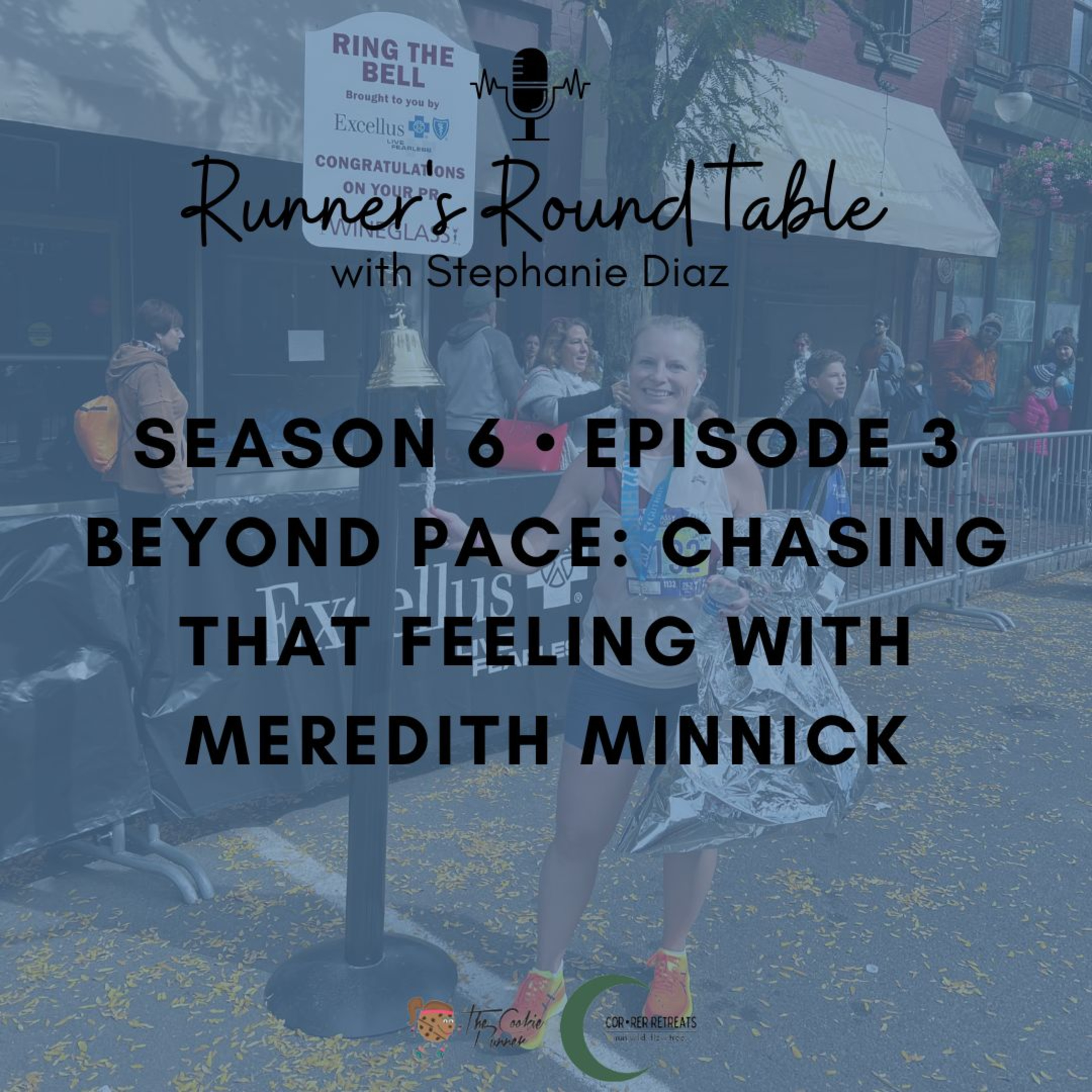
S6E3 - Beyond Pace: Chasing That Feeling with Meredith Minnick
from Runner's Round Table
39m 32s
In this episode of The Runner's Roundtable, host interviews guest Meredith Minick, a running coach and mother of two who started running as an adult in 2012. Meredith shares her favorite running memory: finishing her first marathon, the 2019 Philadelphia Marathon. Initially signed up for the half, she impulsively upgraded to the full for just $10, despite doubts about balancing training with motherhood. With a coach's reassurance that her weekly mileage wouldn't drastically change, she trained diligently and never missed a run. Race day was unforgettable—starting with a hug from a familiar face, passing a singing Baptist choir in the rain, and seeing friends and family multiple times along the course. The emotional highlight was spotting her children at mile 20 and crossing the finish line in tears. This experience, six years later, remains powerful and shapes her running philosophy. She now chases the same feeling of joy and accomplishment, even while pursuing time goals like a Boston Qualifier. Meredith emphasizes that running, though often solo, is enriched by community support, and she now enjoys cheering for others at the same race. The memory taught her that seemingly impossible goals are achievable with persistence and support.
Welcome to season 6 of The Runner's Roundtable. This is the Beyond Paces incident and features stories that capture each guest's favorite running memory. I'll be joined by inspiring female runners, coaches, and business women who are invested in seeing the running space grow to include everyone who wants to take up the edible sport of running. Enjoy this episode and thanks for listening. Welcome everyone to season 6 of The Runner's Roundtable. It is the Beyond Paces season and each episode is going to feature a conversation with a female runner sharing her favorite running memory and today I am joined by Meredith Minick and she's been on the podcast before. So if you hear her voice and it sounds familiar because you've heard her voice before and we're gonna start off how we always start off which is gonna be I'm tossing it to you right away. Meredith can you tell us a little bit of your running story but also if you had a superhero running name what would it be based off of your running story? Wow that's a good one. So yes, right is Meredith Minick. I am happy to be back. I have been running since 2012 was not a runner growing up. I did actually do one season of middle school track but I hit in the bathroom during the mile warm-up. So I wouldn't necessarily call that much of a career in my childhood but yeah I got into running as an adult because I really liked having a goal and I had a goal of running a 5K and I accomplished that goal and it felt really good. So I kind of stuck with it and now I'm a soon to be eight-time marathoner running my eighth marathon on Saturday. It's exciting and I am a certified running coach with I've certified through the RRCA and I love to work with all types of runners from beginners to BQ hopefuls to everyone in between men women mostly moms I coach a lot of women and mothers and I really like that group because I find running to be such an important part of helping me be a better mom and a better wife. So yes so I enjoy long distance and I'm excited to be back. So what would my superhero name be? I don't know many what's this super like super woman I'm trying to think I'm like I have a girl who not or not into like super heroes I'm like what's a superhero name? Mary Mary Miles. Oh I love that Mary Miles. So Mary Miles what I guess what makes your miles so Mary? Well I just think I feel so like alive and connected to my body when I'm running and that makes me feel happy and strong. I do a lot of my best thinking when I'm running so I'm kind of getting clarity around whatever issues causing me any kind of stress. So that makes me happy when I've kind of thought through a work problem or a coaching problem or a life problem and I just am always happy. You know not every run is going to be an amazing run and feel great but you know there's it hasn't been very many runs at all that I regretted going you know getting out the door for so even the bad ones I'm like grateful to my body and and my life for like getting me into this hobby. Do you feel because I often think about this where I though older I become as a runner I and by older I just mean like the more years of running I have under my belt I find that I appreciate running more so each run even the bad runs truly like the awful runs yeah even those runs I somehow my brain I love the way my brain works but it somehow reframes those runs into like I learned something new about myself or it was an opportunity for growth or even sometimes the reframe is just well I survived that one like yeah yeah 100% like for me a lot of my tough toughest runs are in the summer I'm not someone who enjoys running in the heat but each summer that I have completed training for something either a marathon or half marathon just but logging lots of miles and those days that are just really really hot and humid and I come home and and I you know I'm well like wow I'm like stronger for that you know it wasn't as bad as I was gonna think it was gonna be and I'm and I'm just like learning to be able to push through hard situations when I get out the door and it's one of those runs that you just feel like this is not gonna go well yeah yeah I mean I feel like even those runs that don't go well I always think at least it's happening on a practice run and I'm like I'll take all the bad runs in a training cycle yeah give me can I can I somehow spare race day and that be the day where it's even if it's not a great run can I just have an okay run on that yeah and I and I think that that's one of the things that I tell my runners to do too but prior to a goal race I'm like I want you to look at three of your hardest runs like your hardest workouts or even a long run that wasn't necessarily hard piecewise but something made it difficult for you and like go back to those runs and be like okay I've done all of these things and push through when it got tough so I know come race day I'm gonna be able to push through when it gets hard because I've done it yeah that's what I I mean that's what I try to tell myself as well and like my athletes where it's like this is if bad things are gonna happen or if the unexpected is gonna happen you're training run is is where you want that yeah to happen because then you're able to build the tools to come back whereas if it happens during a race especially like a marathon it's not like you can go out the following weekend I mean some people do yeah but it's not like you can go out the following weekend and be like all right let's try again you can do that on your training runs it's really hard when it comes to your races yeah I was just curious about that all right back to what this podcast is supposed to be about is Meredith can you share with us your favorite running memory my favorite overall running memory now in terms of inclusive of time goals or just any kind or just you know run that what's not the time goal and it was just feeling good so when I ask you what's your favorite memory of all time what comes up for you um definitely finishing my first like marathon you know because I didn't actually have a time goal for that you know your goal for your first marathon is to finish and just that feeling of crossing the finish line was just like amazing and that's part of the reason why I love working with first-time marathon or so much just because I know they're gonna have that feeling and it's just like you it's undescribable it was just you know something that I never thought I would do and I did it and I worked really hard to be able to complete the race so when it happened it was just a magical moment what marathon was it it was the 2019 Philadelphia marathon is that hilly or is that flat so the course has changed since I ran it now it's slightly hilly or um but it's at at that point um it wasn't too too bad it was there was a few hills um but nothing like I've run some harder marathons like I've run the Pittsburgh marathon and that's a lot hilly or yeah so just out of curiosity had you ran other distances before that first marathon oh yeah yeah okay okay I started out with five k's then I ran um the broad street tonne myler which is a very popular race um and then I ran a half marathon that so the broad street was in May then I ran a Philly half marathon in November and I ran quite a bit of half marathon I would say I probably ran maybe 13 half marathons prior to running the full I just never thought I would have the time to put into a to full marathon training and I didn't honestly think I could do it um so so yeah it was quite a bit of years in my into my running like so I started running 2012 and the first marathon I ran was 2019. Can you walk us through because I think this is part of the story that that I'm always fascinated especially because I I speak to so many women can you tell us where were you in life as a woman?
in 2019. So I had had my second child in 2017 so she was a toddler and then I had like a six-year-old. I was working part-time and I was training for I originally decided to do that half-and-filly that year and I just wasn't excited about that goal anymore and I thought you know what? My kids are a little older like she was my youngest was two but I felt like I had the bandwidth to do it and it was like you know not even knowing what was going to happen with COVID in 2020 which was only like three months later. But I was I just remember like being like I think you know it was one night I had maybe a glass of wine too many or something and I was like maybe I should maybe I should sign up for the full because I just was like not excited about the half and I was like maybe I'll just do it. And I think it cost me $10 more like I went on the website website for the registration and I was like how much more is it to switch in and it was ten bucks. And I was like I'm going to do it it's ten bucks and then I kind of was like what did I get myself into. I had friends who were amazing marathoners you know runners who have run you know very close to sub three hour marathons and I see them out running you know 14 miles on a Tuesday and I'm like I don't have time to run 14 miles on a Tuesday I don't run six minute miles you know I run like nine to ten minute miles so I had a coach at that point and and we sat down and talked about it and and he said you know honestly with the base I had he's like the only thing that's really going to change for you for your first is your long run like that obviously is going to get longer but my weekly you know Monday through Friday mileage not that much different from what I was doing. He's like you don't have you're not going to run 14 miles on a Tuesday like you'll go up to you know maybe 10 you know one time so it kind of made it manageable so so yes so I you know did all training I don't think I missed one run that cycle just was so excited to like each long distance goal like you know I had a the first 15 mile run I did I was like oh my god like that that point I'd never run more than 13 so every time you reach the new I reached a new distance PR I just so exciting and then race day was just magical so and I was so glad looking back after you know the pandemic happened that I had done that because I was like wow like so lucky I did this because who knows like at that time when I would have the chance to do it again. Yes especially because I don't know what your your home situation was but I know in my household I had two young kids at home and that was a huge energy yeah like that was just I you know I I realized I love my children but I cannot be their teacher and so I there is something I think really special about your timing with this. I mean with it because then you had more time to reflect on it as well right it's not like it's not like you did this marathon you're like that's awesome let me go sign up for 10 more you know I fortunately things shut down so I feel like you had this very special bubble of really meaning all of yourself and of what I did and managing first of all just even training for a marathon is so much which is why I wanted to ask about you know what was life looking like for you because oftentimes and I'm one of those people who thought oh I can never do it I can never run a marathon there's no way I can do it and I have people around me that were like yeah you can like just me and a mom doesn't mean you can't do the thing it means it in my life. It means it might look a little bit differently it means you might need more support to do it but doesn't mean you can't do it so I just this timing seems very very serendipitous for you yeah and I'm curious as to your memories of that day like do you remember any of the thoughts you had while you were on the course or like any feelings you had when you were waiting to start when you finish because I know like my first marathon those things are so vivid in my mind that it's the mind is just amazing too yeah yeah for sure I remember in the start car I was so nervous and there was you know probably 13 or 14,000 runners that day and I'm walking into my car out and who do I see but my husband's co-worker who gave me a big hug so like that was amazing to me. It was amazing to see a familiar face when I was so nervous and then you know once the race started because it wasn't Philly which is local to me it's my local race. I knew I was going to see so many friends along the way and being familiar with the city like like seeing the landmarks and be like okay I'm here and like I remember it was like early on the race was probably like three or four miles in there was just an amazing Baptist choir that they were out singing and it was raining at that point it was cold and it was raining and this in this church choir was singing and it was amazing. It was singing and it was beautiful and it just was like I just remember thinking this is so special like this is so cool and then getting through center city and just like the crowds of people who are like three and four people deep and they're cheering for you know everybody but then you can see like other runners finding their people like their family and like the reunions along the course and I was like oh I can't wait to see my friends like as I knew. Like at mile nine I would see like a couple of my friends and so I was like well I can't wait to get to mile nine and then I saw my friends and I didn't even stop so I was like feeling so good I was like I'm not gonna stop like. No I'm gonna be like all I was so excited to see them and it was such a mood boost but I like was like no I'm not gonna stop and then you know the way the Philly course was laid out like I was able to see the same people multiple times so they saw them at 13 and then at the turn around at 20. I'm sure people are if people are listening to this and are familiar with the Philly marathon course. Mile 20 is a turn around where you head back into the city you're out in Manionk which is kind of like part of the city but it's it's more of like the suburbs of the city. But the crowds are amazing and that's where my kids are going to be with my husband and my mother-in-law and sister-in-law and like seeing my kids was so emotional it was so cool because it was just like. I love it I have a video of me that my sister-in-law talk of me like running to see my kids and I did stop and like I'm a hug but it was just it was just amazing and and like. And then that final turn like you get you turn around in Manionk and you head back into the city and it was it's like kind of it can be a little bit quieter. It's a lot of these drives I'm like crying oh my god. Yeah, I know I'm like. Yeah, but like it's like it was a little quieter. Like we had all the weather that day it was like back to raining and sleeting and my air like my air pods died so I had no music and there wasn't any crowds really at that point. Until you get like maybe another mile or so to this to the finish line and I saw my friends again in my coach who had I'd seen several times in places along the course and I just remember like seeing them and like being like I can't believe they're still out here like cheering for me and it was amazing. I'm going to cry again it was amazing. And then I finished and just cried and felt so like emotional and then I came home and we had a big party and it was great. So I I love this entire story because we're talking about an event that happened six years ago. Yeah, and it's still that powerful. Right. Like it's just it's. So it brings me to this question. How has that race and the memory of that race shaped who you are as a runner today. So I think how it's like I mean I just was like I was like how could like how can anything top this day and I'm still trying to top it like I've improved I have since improved my time like my PR but that feeling I'm like chasing that that feeling you know again of that just complete like satisfaction and and and just overwhelm me like the joy of doing something that seemed so hard and so out of reach and then actually doing it and like feeling good like I had felt good the entire race like I never hit the wall I felt. amazing the entire
time and I'm ever thinking, oh, it's hard. Marathons are hard. And then I learned. I ran my second marathon and I learned it. They are very hard. But what it taught me was just, you know, like, just like, like, your goals are always like, they're so fun to work towards. And I love, like, when I accomplish a goal, you know, it's kind of like, like, you're just chasing that high again, like, and look, and like, I'm like, you know, I have big goals. Like, I want to qualify for Boston. I'm still like 15 months, like, keep changing the time. I'm probably like 20 minutes away from it at this point. But I also think to myself, like, if I ever, like, like, if I keep family and family is not a great word to describe, you know, not achieving that BQ time or whatever. But I just have so much fun, like chasing those goals, you know, sometimes it makes me wish, like, you know, it's like, I don't, like, if I don't make it, like, you know, if I don't ever make that goal, well, it's not always did. It just been so much fun along the way, you know, and it's just, you know, again, just chasing that high from the first race of just accomplishing something so cool. Yeah, there's really something special about that first distance, right? Like, the first time you do any distance, right? Like, I still remember my first five gig. I remember my first half marathon. I definitely remember my first marathon. I have memories of those races. There's been a lot of races in between, like, from the end of now. And I feel like that's kind of where I'm trying to get back to as a runner in terms of like, I just want, I want to re-experience the awe of those things. And that all really comes from, for me, that achieving something that I didn't think I could do, like, I didn't think I could mentally do it. I didn't think I could physically do it. I didn't think my body could do it, right? Like, there's, there's all these stories that I told myself of, like, I'm not athletic and I don't like to eat and things like that. And then I go and I ran a marathon and I was like, okay, we, I have to redefine what these terms are because they no longer apply to me. So I love that because that is your, for you, that's your foundation, right? Like that, that is where it seems to me very much so this, this spirit of curiosity and stuff. Even though you're chasing time goals, it seems like more than anything, it's you are chasing that feeling, that, that, that joy, that, just the like, having all these people, and I'm sure that's, that's part of what made that day so special is that you're on a course where you were able to see so many people who are important to you. Yeah. Over and over again, you don't really get that, like, depending on the course that you're running, you really don't get that. I mean, you have to have some very like, transportation savvy people. And on some of these race courses in order to see them multiple times and the bigger the race, sometimes the harder it is to see. So that's also something that talk about, like I often say, you know, running feels very solo a lot of the times. But hearing the way you're talking about it, but you had so much support. Yeah. Right. And that's what I try to create with the runners that I coach, like as many like, I don't even run the Philly marathon anymore because I have so many runners that do like run the fat, the full end that I want to be out there to support them and see them. So, so now I just love to cheer at that race. And like, I like with my, you know, community of my running friends, you know, it's, it feels like, yes, running is solo. But like, when you have this group of people that you train with, then you're doing your easy runs and stuff and you're all just kind of sharing like the the shared joy and passion and and because everyone has their own goals or work towards them and being able to work towards them together, even though they're different goals. I never feel like it's a solo endeavor and, you know, having the support of my family, you know, my husband, like, being in charge of the girls for their swim practices on Saturday and Sunday mornings when I'm out running and then he gets them to swim and he like will show up when he can with the races when it when it works logistically. And a lot of times now it doesn't because the kids have their own activities. So, and that's important for them to to do as well. But and then I have a very collaborative coach myself who I always feel like it's a team with him. It's never like he tells me, like, yes, he gives me my plan, but he's open to me being like, what about this? What if we write this? And then we talk through it and sometimes what I'm suggesting is not going to work. And that's good. To have someone like check you, you know, and have that support. Yeah, absolutely. I mean, listen, as if we can have as many layers of support as possible, it's great because it really, it improves your longevity, right? You have that your coach is someone who can check you so that you don't get overtrained and overworked, right? Your family, I lost because in my household demo, like I always tell people I'm like, I'm the only runner, even though my oldest is starting to run with me. No one humbles you faster than the people you live with. Like, yes, I'm a runner and it's like, okay, but I still have to come home and like be mom or this will pick up or like they don't care if I woke up at four o'clock in the morning to get a run done. Like there's none of that. So it's like, you need that too because if not, it's really, really easy to get caught up in like the metrics of your runs to get caught up in the comparison game of running. When it's like those people that I live with and I'm sure it's the same in your household, they just want you to be happy and whether that happy looks like, you know, an eight-minute mile or a 12-minute mile or a 15-minute mile, they don't really care, right? Like those are those things that they don't care. Obviously, we care about them, but it's nice to have that of like, all right, that's remember that running is important, but it's not the end game. Oh yeah, it's definitely like when you finish a 16-mile run, like I had to do a couple times on Fridays and then get my eight-year-old school and like get there on time for the bus for the car line and I'm like, oh man, I just, you know, it's like, like that's such a big win, is being able to get that run in and then get in the car line, not be late. So it's a zoltine, listen, it's a zoltine big time. All right, I have a few questions left for you. I think, okay, it's like five questions. So the first question is, if you, how do I want to say this? All right, if you could go back in time to give a message to your younger runner self, what would that message be? I honestly think I would just be like, keep doing, like just keep showing up and that's what I say to my runners all the time. Consistency is key and that's what, you know, fancy workouts, supplements, shoes, gear. Okay, like that's all great, but like getting out the door or getting on the treadmill is the consistency is what's going to make you a better runner. And I think I would just say to myself, like, you know, as a younger runner, like just keep showing up, keep doing what you're doing, you know, and and I think that would be it. So I want to, I have to pivot to another question here, because I find that like consistency is one of the things that people struggle with the most. Did you ever experience difficulty being consistent yourself? And if so, how did you, how did you manage that? So I really like plans and I like checking things off with and things like that. But when I first started running, I followed like a couch 5K plan and it was like a three day a week thing. So it seemed and it was like it would go up to like 30 minutes or 40 minutes or whatever. It seemed very manageable. So like it was easy to build that consistency early because it wasn't like I was setting myself up to go out for an hour immediately after I started running like one week, I'm going to go run for an hour or two hours. Like that is way too, too much. And that's hard to set the consistent schedule if you're if you're thinking like you need to conquer these long distances when you're just starting out, like make it manageable. A consistency also means if I have 10 minutes today, I can go out for 10 minutes.
five minutes, you know, and that's still laying the foundation and getting yourself into the schedule and the habit. We need the megaphone on that one. I'm a generic megaphone. And I'm so glad I asked that because I find that a lot of people think that they have to do the most and the people will often get caught up of, well, if I can't do the most, then I'm not going to do anything at all. And it's like, no, but wait, who said, who said you had to do the most when a 10 minute run is still a 10 minute run. And it's all about proving to yourself that you can be distant. And then from there, you can always add, right? That 10 minute today, maybe next week, you're like, you know what? That 10 minute felt good or it felt like I still had more to give. And then you go up to that 15. So I love, I love that you said that. And I'm so I'm happy with myself for asking the question. That was a good question. Okay. So now we're going to kind of flip the script in terms of looking forward. What hopes do you have for your future runner self? I just hope I never lose the joy and the, and like, I love laying out my clothes for my run the next morning. The night, like when I go to bed, I always lay out what I'm wearing the next day. And then I'm always excited at the possibility of another run. And I just hope that doesn't change. I hope I don't ever lose that anticipation and excitement. How? How do we do that? Like, like, what are some practical tips for not losing that? Going back to like the summer months. Yeah. Yeah. I think it's surrounding yourself with people who like support you and support your goals, but then also setting reasonable goals and expectations and not comparing yourself to, you know, well, who, what influencers doing what on Instagram? And just, you know, accepting, like, like, what makes you happy? And it could be, you know, the past year at now or like trying to get to the pace that you want to be at or the mileage that you want to be at. And, and just like letting yourself be your true authentic self when it comes to running and not trying to do it for anyone else, just doing it for you. Yeah. It's like, can you quiet the noise enough to check in with how you're feeling, right? Yeah. How like, like, what is, what does running do for you? Right. And running does a lot. So, right. All right. How do you celebrate yourself as a runner? Um, I think by, you know, doing the things that make me feel good when I'm running. So that would be doing my PT every morning before I go out the door. That's celebrating and, and, um, celebrating and honoring like what it takes and the toll of running that running does take on your body. But like setting myself up for success by doing my PT. Um, when I'm done a hard run, like that cup of coffee, you know, when you come in from the cold, like that feels like, like I did it, you know, um, and, and just, uh, you know, like I said, like, like, wearing the stuff that makes you feel good and feel like, like good on the run. So like what that's like the shoes, like, you know, or a piece of gear or whatever. But, um, but yeah, I think, I think the biggest thing would be doing the work, the, the pre-workout work, um, that allows me to keep doing what I like to do. I love that. And that's such a, like a unique answer to that because most of the time people think, "Oh, how do I celebrate myself? I celebrate myself after." But yeah, it's like this invitation of seeing the, the pre-work, which can sometimes feel like a chore, but to see it as like, "No, I'm doing this because I'm, I'm honoring that my body can do hard things." And so I absolutely love that. Okay. All right. So can you remind us or tell us where can we find out more about you? How can we connect with you more? Just let us know, let us know how to get more of you. Sure. So, um, I have my website for, um, run coaching, which is levelupyourrun.com. Um, you can also find, um, that on Instagram, which is level up your run on Instagram. That is, um, kind of like my coaching page. And then my personal Instagram is at marijuana runs a marathon. And I am not cool enough to do reels. I don't have time to set up very aesthetic. Uh, Instagram shots, they're mostly me standing on my deck after my run. Um, but that account is just solely kind of like my diary of, of my training. And, um, you know, it's, you know, sometimes like I don't always have something really inspiring to say. Um, not every run you're going to have a, a mental breakthrough of something, some epiphany of, you know, some crazy thought that's going to, you know, like promote world peace or whatever. But it's just, just me, my diary, but I have heard from people that it is motivating for them because that's nice to hear. Um, so that's kind of like where you can see more about my training and connect with me there. Yeah, sometimes it's, those are the most impactful things to see, right? Like the keeping it real. Yeah, it's just, it's, it's, again, like I find that it's pretty easy to think that everyone's having fun while they're running and that everything's great when the reality is like, no, sometimes it really sucks. Yeah, I'm going to keep on showing up because because there is a feeling that we're chasing because there is potential that we're chasing because there is that knowledge that a better run is right around the corner. You just have to keep showing up for it, right? Yeah. Yeah. I definitely, um, I'm not afraid to say when something was really bad, if it was a bad run, you know, not everyone's going to feel great. So I don't sugarcoat anything. Um, I try to keep it like so that when I do go back and look through my training, like prior to a race, I'm be like, oh, yeah, I remember that run. It's really sucked, but I got through it. But you got, you got to be through it. All right, the final question is what are your final words for us? Oh gosh. Well, I just hope, um, you know, everyone out there listening um, would just, you know, take a moment on your run or right after your run and admire something that's, um, beautiful or something that you see on your run that like the other day I stopped and like this, like I could see the sunrise in the window. I was facing the opposite direction of the sunrise and I could see it in this window reflection of a house. I turn around and it was just like the most beautiful sky. And I just felt so lucky that I like my hobby lets me see things like that. So I would say just remember when you're out, like, pick your head up and look around and try to find something that is beautiful or inspiring and then take that with you the rest of the day. That's called taking the work you do on the run with you off the run. And I just, Meredith, thank you so much for joining me again on the podcast and for sharing your story and your just just love, love of running and love of noticing the details of running, right? And I think that's where that's how we expand what running is. It's never just to run when you get to notice something different each time you go out. So thank you so much. Everyone, we'll see you next time. Bye. Thank you so much. That was great. Thank you so much for listening to this episode. I would love to hear about your favorite running memory. You can reach out to me on Instagram at the cookie runner to share. You can find this episode's guest information in the show notes. You can also support this podcast with the rating, review, or share. Until next time, run happy, run strong, and run true to you.
Podcast Summary
Key Points:
The podcast is season 6 of The Runner's Roundtable, featuring female runners sharing favorite running memories.
Guest Meredith Minick, an RRCA-certified running coach and soon-to-be eight-time marathoner, began running in 2012 as an adult.
Her favorite running memory is finishing her first marathon, the 2019 Philadelphia Marathon, without a time goal—just aiming to finish.
She switched from a half marathon to the full marathon on a whim, encouraged by a coach who made training manageable for her as a working mother of two.
The race day was emotional and magical, with support from family, friends, and a familiar face at the start, plus choir singing and crowds.
The experience shaped her as a runner
Summary:
In this episode of The Runner's Roundtable, host interviews guest Meredith Minick, a running coach and mother of two who started running as an adult in 2012. Meredith shares her favorite running memory: finishing her first marathon, the 2019 Philadelphia Marathon. Initially signed up for the half, she impulsively upgraded to the full for just $10, despite doubts about balancing training with motherhood.
With a coach's reassurance that her weekly mileage wouldn't drastically change, she trained diligently and never missed a run. Race day was unforgettable—starting with a hug from a familiar face, passing a singing Baptist choir in the rain, and seeing friends and family multiple times along the course. The emotional highlight was spotting her children at mile 20 and crossing the finish line in tears.
This experience, six years later, remains powerful and shapes her running philosophy. She now chases the same feeling of joy and accomplishment, even while pursuing time goals like a Boston Qualifier. Meredith emphasizes that running, though often solo, is enriched by community support, and she now enjoys cheering for others at the same race.
The memory taught her that seemingly impossible goals are achievable with persistence and support.
FAQs
Season 6 is the Beyond Paces season, featuring conversations with female runners who share their favorite running memories.
Meredith Minick is a certified running coach and soon-to-be eight-time marathoner who started running in 2012 as an adult, beginning with a 5K goal.
Her superhero running name is 'Mary Miles,' reflecting how running makes her feel alive, connected, happy, and strong.
Her favorite memory is finishing her first marathon, the 2019 Philadelphia Marathon, because she achieved something she never thought she could do.
She switched from a half marathon to the full marathon for only $10 after feeling unexcited about the half, with encouragement from her coach.
She saw familiar faces, a Baptist choir singing in the rain, and friends and family multiple times along the course, creating a magical, supportive experience.
Chat with AI
Loading...
Pro features
Go deeper with this episode
Unlock creator-grade tools that turn any transcript into show notes and subtitle files.
 PodcastTranscript AI