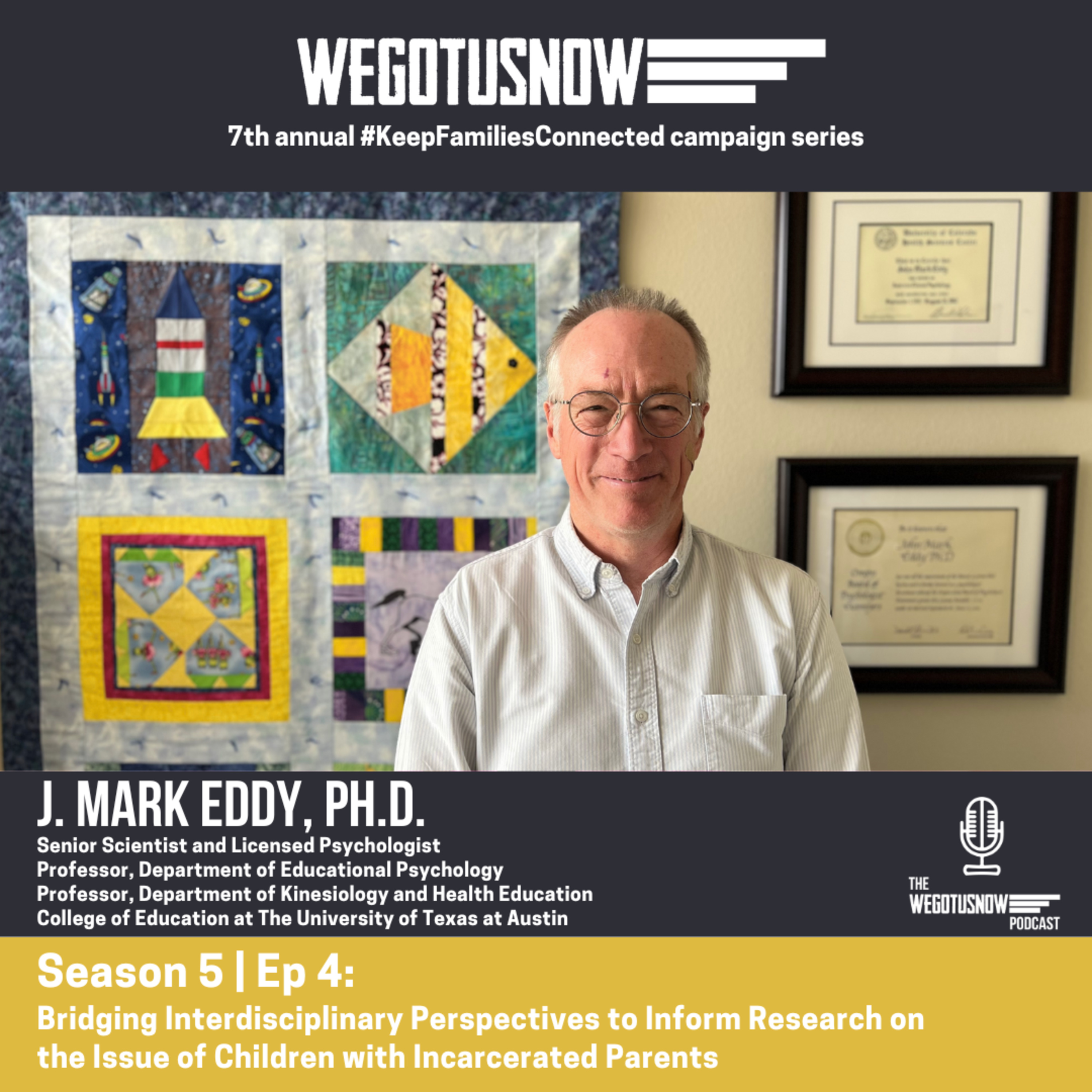
S5| EP4: J. MARK EDDY ~ Bridging Interdisciplinary Perspectives to Inform Research on the Issue of Children with Incarcerated Parents
73m 18s
The discussion centers on the impact of parental incarceration on children and the research trajectory of Dr. J. Mark Eddy. He explains how his focus shifted to this population after realizing many young fathers in his longitudinal studies were imprisoned. His work, including the LIFT study, found that while children of incarcerated parents face elevated risks, most do not develop the severe conduct or aggression problems often stereotypically assumed, challenging pervasive myths about their likely outcomes.
Dr. Eddy emphasizes the importance of creating interventions within systems committed to sustained implementation. This led to the development of Parenting Inside Out (PIO), an evidence-based program created with input from incarcerated parents. PIO focuses on strengthening parenting skills to foster child resilience and has been widely adopted. The conversation underscores that effective support involves working with caregivers and teachers within supportive systems like corrections or schools, rather than solely targeting the individual child, to promote positive long-term outcomes.
Mass incarceration in the U.S. is the great tsunami that has ripped apart families and destroyed communities. At the epicenter of this destruction are the children of those incarcerated. My name is Ebony Underwood. I am the founder CEO of We Got Us Now. We Got Us Now is the first of its kind, national, nonprofit, nonpartisan organization, built by, led by, and about children and young adults who have been impacted by parental incarceration. These are our stories. I am in Austin, Texas. Welcome to The We Got Us Now podcast with Ebony Underwood. I'm here with Dr. J. Mark Eddie, who is a professor in the Department of Educational Psychology and the Department of Kinesiology, and help education within the College of Education at the University of Texas at Austin. As a prevention scientist, he develops and regularly tests prevention and intervention programs intended to benefit children and families, particularly those who are living in stressful circumstances. Welcome to The We Got Us Now podcast, Mark. Thank you. I really appreciate you saying yes. I've been wanting to do this for a long time. So when we had the opportunity to be together, I said, "I've got to take the opportunity and ask him, hopefully he'll want to be a part of this podcast." Absolutely. Yeah, we appreciate you. Thank you. So, how do I want to start this conversation? I guess I would love to know what drew you to study the lives of children with incarcerated parents, and how did that initial spark shape the early direction of your career? I studied to be a clinical and community psychologist, and I chose to go into the nonprofit world. And my job was totally funded by grants for most of my career, actually. And I started learning how to work with families who would bring their kids into a mental health clinic because they were concerned about things that were happening with their kids. And I worked in a clinic that focused on kids who were acting out, in particular, elementary school-aged kids, or having trouble at school, and not getting along so well with their peers and having trouble with the teacher, and often at home, having trouble on things like, you know, not cooperating when people ask you to do something, or getting into fights, or getting into arguments, those kinds of things. And so, the initial work that I did was studying families and kids that were in that kind of circumstance, and what was going on in the family, how are parents and other caregivers being parents and caregivers with kids who are having difficulty, and what is it like for those kids to be with those parents and caregivers and teachers and peers. And so, I did that work for a while, and then I moved up as kids in the study were getting older into the middle school years, and some of the kids started getting into serious trouble and being involved in juvenile justice. So then I started to do research around juvenile justice. And then those kids in the study got older, so one year we had some visitors from the Vera Institute in New York City, and they came to see us around Christmas time, and they said to us, you know, what do you know about incarcerated fathers? So this was like 1999, and they said, you know, we just got this grant from the US Department of Justice. We're going to be studying incarcerated fathers, tell us everything that you know. And I was with a group of people all of whom were older than me, because I was the early career person, and we all kind of looked at each other, and we said, well, we don't really know that much, because we had just been focusing on these kids in this longitudinal study as they were growing up. And they're families, but we weren't, we were thinking more about the kids and family interactions than we were about characteristics of the parents or experiences of the parents. And so it was kind of embarrassing, because we didn't have much to say, but that, after that meeting, I went back to my office, and in the office was this big pile of holiday cards. And every year we would send holiday cards to people in our studies, and I had just started the study of kids who had been involved in juvenile justice beginning kind of early in adolescence, and then we were looking at, and they were in the study intervention study, and then what happened to them when they became young adults. And so in the stack of cards, who were all going to kids, young adults in that study, they were 18, 19, 20 years old. I noticed that like over half the cards were going to institutions, like prisons, before I went home, I wrote a little note, because it was note time, not email time, or text time. And I said to a data, I want to say, work with me, could you please tell me how many of these young men are fathers. And so she came in, Alice came in in the morning, she ran it off, and it turned out that a lot of them were fathers. And I said, well, so when I came back to talk to the very institute, I said, people, I said, well, actually it looks like we do know something about incarcerated fathers. And so that kind of peaked my interest and thought, golly, that's why weren't we thinking about that. And then after Christmas time, this letter appeared at our center, and it got passed on to me, and it was inviting somebody from our center to go to this meeting with the state capital and meet with people who wanted to meet with researchers and practitioners. And advocates about how this new women's prison that was going to be built could be a different place. I don't know if that's possible with the prison, but they were thinking, how could this be a place that's focused on reentry and not focused on, you know, punishment. Right. This is a 99, too. Yeah, well, around then, and 2000. And I thought, okay, this is interesting. And they said we're particularly interested in incarcerated parents. And I thought, okay, so this is two messages to incarcerated parents in one month. So I couldn't go to this meeting because I had to go to something else, but I caught up a friend of mine who I just met and he had worked in the prison system for his whole career. And he kind of had seen it all, you know, and he had come to meet with me because he was advocating for better child abuse prevention services on the state and I had helped him kind of get some stuff together and he made a VHS tape that he sent around all the legislators and was trying to advocate for stuff. And I said to my friend, Rex, I said, Rex, can you go to this meeting? You know, I can't go. It looks promising. And he said, you know, they're always doing this stuff. It's not going to go anywhere. It's not. And I said, Rex, just do it for me. See, it's just go. And so he did. And then he called me up when he got home from that meeting. And he said, Mark, I think really something might happen here. Wow. That seems like there's some energy in the room. And he said there was like 100 people there. And there was a lot of people from the corrections department. And I think it's maybe different. He said, we should do this. And I said, okay. So anyway, that was the beginning. That was the spark. That was the spark. I know eventually that you worked on lift, which was linking the interests of families and teacher study where you explored like long term outcomes for children who were at risk, including those with a course repair. What key findings from lift steered your leader research? So that project actually was the first project I worked on back in the early 90s. But it was a longitudinal study that followed kids from early elementary until their 20s. Is that part of what evolved into what you were just talking about? Well, it was happening in parallel. And so after this experience, I had someone who was going to Portland State University, who met me through an interview for something else related to early childhood. She contacted me and said, you know, I heard about that incarcerated, you know, working with incarcerated populations. I'm really interested in that. Is there any data that you have that could that I could use for registration after that this was a bit after that it happened. And I started looking at that data set. And we were still doing that study encoding, you know, I've done some rudimentary coding of who was incarcerated and who was it. I said, I just tried to do this. You know, if you want to pick it up and run with that. Welcome to do that. And so her name is Jean Gelstrand. And she's now a professor at University of Oregon. She picked that up for her dissertation. And then out of that work, we did papers together. We did papers with some like Wendy Rankine, Missouri, other people. This was a sample of almost 700 children who were from neighborhoods in this moderate society in Oregon, where there was higher than average juvenile detention rates. And so we selected this neighborhood. And then we did this preventive intervention study that was focused on trying to decrease acting out behaviors and aggression and that sample. She found in her work and I was, you know, part of it was that most of the children with incarcerated parents did not have these problems. But it was an elevated as an incidence. But most were not having the kind of problems that everybody says they should be having because there was this myth out there and it's still out there that if you're the child of incarcerated, you're much more likely to have aggression problems be involved in juvenile delinquency to be aggressive all that stuff. Well, that's not true. And the statement that often gets out there, which is totally not true. We just don't have the data is that, you know, children with incarcerated with incarcerated parents are like seven times more likely to end up in prison. That's also false. I did spend a long time trying to track down where that piece of information came from and it was said by an advocate back I think in the seventies, who I think probably was well meaning and trying to get people to put money into this issue. But it came out of nowhere and I never have managed to talk to that individual that I've tried and who that is and now lost in a box back in my house. But anyway, the point is not not true. And so anyway, in those papers, yeah, in those papers, we basically found that most children with incarcerated parents don't end up having conduct disorder, oppositional divide disorder or all these kind of things that people think they do that are related to being involved in juvenile justice and being involved in a kind of justice. And that's what came out of the lift. So that's one thing that came out of this. What really interesting thing about lift right now is that lift is now part of this consortium where folks from Johns Hopkins have brought together like 25 or 30 studies like lift and pulled all the data together. The sample is in multiple thousands and we're able to look at things that are really hard to study like development of like psychotic kind of behaviors or or suicidality or suicide with funding from the nationalists. She's a felt work currently doing that study and it's being being led by the school public health at Johns Hopkins. That's awesome. So lift is still alive and moving. Congratulations. I know that was impactful work. I want to talk about interventions like for you know, this resilience that I know that exists because I recognize it in myself, but your work it emphasizes resilience in children, right? It's an essential incarceration. So I would love to hear from you what interventions have you found most effective and fostering resilience and how did these insights build on your early studies? I have ended up doing a lot of work around parents who are actually incarcerated because of that work on lift that was done in school systems. I realize that even if we created a program that fit within a system and seemed to have some good outcomes because lift did have a variety of positive preventive outcomes in terms of you know, difficult kind of interaction behaviors that we're talking about substance use things like that. But yet we couldn't get school systems to pick it up. So at the time that all that was happening with your institute and the letter from the Department of Corrections to come to this meeting, I was feeling very much like I needed to find a system that wanted to try not only to create a program to promote resilience and study it. But they also actually wanted to deliver it and keep it going, you know, and I was quite surprised after going to this meeting that Rex went to and then I followed and coming back, I spent something like 60 days that year I tracked it in the capital at meetings related to this and I only could do that because they worked at a nonprofit and we had gotten some money that allowed us to do that kind of work. It would have been impossible to do as a professor. It's a lot of time. But I realized after that time that this system, the leaders and the system at that time really did want to create something different that would last. And in fact, testament to that today, that program that was created in the early 2000s is still used in Oregon and is now used in one form or another in like 46 states. So it's spread around. No, I'm parenting. Oh, right. We've got to get to that. But parenting in a site was influenced by lives and by other projects, including the work that was done with kids heavily involved in juvenile justice. So it all kind of mesh work together. It's a trajectory. Yeah. Okay. Okay. No, no, this is helpful to me. I mean, understanding the trajectory of all these things. Okay. Okay. But the resilience work that I've done really has mostly focused on working with parents and other people who spend a lot of timeless kids. And so parents, other caregivers, teachers, most of my work is focused on that more than just developing an intervention for a child individual child pulled out. Although I do have a project I could tell you about that has done that. But wait, wait, wait, wait, wait. Let me wait. I got to step back. You don't want a lot of me right now. Wait a minute, wait a minute. The interventions piece around resilience was for the caregivers, the parents and the teachers. Again, I don't just work within the criminal justice system. I also still work in school systems and in kind of a nonprofit world. Okay. And I've worked in child welfare. You know, so it's when you work in a nonprofit for a long time, which I did, you know, for 30, well, 25, 30 years. You know, and you have no salary and you just have to make it on grants. You have to be very creative, right? And put in a lot of grants and if you're lucky, some of them will get funded and you keep going. So, you know, I had like a hit rate of 25%, which it's okay, you know, but that means I was writing for grants for everyone that I actually got. Right. And if I didn't get one. That was it. I didn't have a salary. So, anyway, that's why you get involved in a lot of different activities. So that explains the whole interdisciplinary approach to your work. It's survival. Right. Yeah, I get it. Okay. That makes sense. I had a question about that. But now, but now you answer that. Okay. Wait, wait, wait. So I got to go back to lift for a second. Yeah. Because you talked about how, and I know that it incorporates the schools. And again, it's been very challenging to, as you shared, right, to get schools to even because every, every school has a different system and just in the way that they operate with administrators and all things. And so, but that was successful in Oregon. However, as a way to, I guess, even what you just shared, right, expand your word, putting in different grants to see what, you know, what would stick. Right. What involved out of all of your work was the parenting inside our program. That was one of the things. He's like, that's just one. This is that. No, but it is a big thing. It's a big deal. It's a big deal. It's a big thing. But I mean, as that program was developing, then, you know, also, you know, I got to meet colleagues like you and, you know, and there were opportunities to say, okay, if this is a place that I'm going to be working. And then what can I do to try to help push that along? And so that led to, you know, book writing with Julie Pullman or, you know, Mary and Harris or other people it led to, you know, getting involved with conferences like the national, you know, conference on Christian parents that we were just out and. Yeah, we were together. So, you know, and it's like other things like, you know, working with, Temary Willis and then her going off to do that policy fellowship in Washington DC and the work that she did with Congress there. Yeah. You know, so it's like that is one area. And, you know, if this is going to be my garden to 10, you know, then how can you help it flourish? Right. So, anyway, so can you tell our audience just for those that have no idea what parenting inside out is, I want to say before you go into it that it is just a transformative program. And has been a transformative program that has been. I guess like a wildfire going across the United States because other states have kept have decided to take it on it. So, yeah, you, you please explain, please explain what it is for audience. So it grew out of the, you know, back to that meeting that Rex went to and came back and said this is going to go somewhere. Then, then we both started to go to these meetings on a monthly basis and then more than that because I told you I was there for a lot of time for during that first year. And we broke up in all these subgroups and Rex and I were on a subgroup that was focused on, okay, what could be done differently in this new prison for women cut it was called coffee creek to support family relationships to support parents. What are the, what is the kind of the plethora of things that we could do. And so we brainstormed all kind of things and the first thing that we did was well, let's go find out what's out there, you know. So the first thing that Rex and I did was the internet was very underdeveloped right that was not really that helpful. So we had to look at anything published that we could find. We spent a lot of time in the library. We did look at whatever we could find on the internet. And we ended up calling and talking to people all over the country that we're working with in Christchurch appearance and what we were looking for was, you know, is there good research out there about what is the right thing to do. What is the best thing to do given what we know. And we were really disappointed at the quality of the research. And so after doing that for a long time and actually we talked to everybody in Oregon at the time for example that was working with in Christchurch appearance everybody. And we visited the classes and it was everything from, you know, a librarian in a prison that's at the end of the runway in Portland to a developed a program on his own didn't have any training in that area. But you know, it was a neat thing. He was bringing parents together to talk and, you know, and, you know, to people who had gone to a workshop on this program or whatever and then kind of brought it back and adapted it. But nobody was using anything that had really brought all of the research to bear that we had on working with parents. And I said to them, well, you know, this center I work with in Oregon, social learning center in Eugene, that's what we've done for the last 25 years is just develop programs for parents. So some of the programs that we've developed really are truly evidence based like they show positive outcomes for kids and families. Why don't we make up our own thing, you know, and so they said, well, okay, go for that. And so then the first thing that we did was we spent a lot of time talking with incarcerated mothers and incarcerated fathers across the state. And then finding every advocacy group that we could find in the state to talk to people that loved those folks and talk to them. And we continued to try to find other people out there hoping that there was going to be like a holy girl that was really going to help us you know. So we kept looking. So anyway, it was from all of those conversations that we had with people with lived experience with whether it was being incarcerated, being on the outside while your loved one was incarcerated. You know, being a caregiver to a child in different kinds of situations and then practitioners who had been working with people. We brought that to the table and mixed it with the research base that we had. And then on top of that, we did another thing that was unique, which was I hired an instructional designer who actually was trained to write curriculum because a lot of the curriculum out there is this written by people who have a good idea. It's a great idea, but they don't have like training on how to do that. So there was a person that we hired to teach in a pilot and she was actually a graduate school to learn how to be a curriculum writer. She said, you know, work, what you've done so far is interesting, but it's not that great. I could be a lot better. And I said, okay, go for it. And so we hired her. And so Tracy Schiffen. And so anyway, she did a wonderful job and brought some professionalism to the work. Yeah, so it was kind of this much broader team because before that really most of the curriculum that we learned about not only didn't have research, but it usually was developed by a person who was inspired great stuff, but didn't have, I think, as broad of access to all these different sources of wisdom. The wisdom from lived experience, wisdom from being a practitioner and trying to do the work, the wisdom from scientists who have something to say to, but it's really different than the other two sets. And then the wisdom of somebody who actually knows how to create curriculum. Yeah. So that came together to create learning inside out. And the top of that we did from the beginning, the corrections department said, well, you all know how to do this parenting stuff. You should create this program and you should, you know, you should be the one to deliver it. And I said, well, we know some things, but these other groups need to be at the table too. And I said, and we don't want to deliver it because if you have a research center deliver it, then when the grants over it goes away, you need to figure out a way from the beginning to fund this through regular means so that when we're all done with this, it's not tied to a grant. And so I said, where can you get money? And they said, well, we could go to the state legislature and I said, go for it. You know, and I said, you know, when we get done with all this, let's we can share ownership 50 50, you know, with the nonprofit and with you all. And the neat thing about going to the legislature is I was actually in a field trip with one of my kids at the state capital and we went into the house up above just to watch for five minutes. And when I was in there, they passed the bill. No way. And it was like, give your chills because it's like, whoa, okay, this is going to happen. Wow. Yes, that was cool. Yeah, I forget which kid that was. But anyway, yeah, but we were there, you know, walking around. So, yeah, so anyway, the state did agree to fund preliminary work on this. And then my job was to convince a foundation to help us fund it. They did the Edna McConnell Clark Foundation. We spent three years developing and pilot testing this thing in prisons with women and men, multiple prisons. And then the task was to convince a funder to fund a randomized controlled trial, which would let us really rigorously look at the outcomes. And so we proposed this study and it took, I don't know, three submissions and a couple of years to get it funded. But we actually convinced the purifiers and national and mental health funded this study for us to do randomized trial. And we recruited people when they had a bit of a year out before release. And then we followed them for a year after release. Oh, good. And it's the largest study that's been done like this with this population. And we really wanted to be able to say something about multiple groups of people. And we really over recruited people of color. But anyway, we wanted to try to be able to look at about both men and women because, you know, maybe five percent of people in prison are women. But we recruited over recruited women. So it's 50 50. And then we over. So we're trying to at least be able to say something about a variety of experiences, a diversity of experiences that people might have had. And so that study we did find some really positive outcomes in terms of people being able to do better on the inside and have better relationships with their kids and caregivers on the inside. And then on the outside we found that people who had been randomly assigned to get the program were less likely not only to report, you know, engaging in anti-social behaviors, but to get picked up by the police to be using substances. And to be, you know, again, getting along better with their caregivers or their kids. So it was very promising findings. Science is all about replication. So it needs to be replicated. But doing one of those studies does make you realize how hard it is to do one of those studies because there are so many pieces that have to fit together. And it only happened like it did because we really did have very strong support from the director and all the people around the director in the Oregon Department of Corrections who really were supportive of this work and really did want to do something different in coffee creek. But also in the other institutions around the state. So, you know, it was initially delivered in these institutions that were part of the study, which I think was four or five. And then it spread to other institutions. Oh, no, you being so modest. You got to talk about how much it's grown across. Well, it has grown. Yeah, I mean, it is. Yeah, where else was it picked up? Well, a key thing on the growth part is that we did make a decision me and the people in the corrections and then some state legislators and some nonprofit folks in Oregon to create a new nonprofit that would be. It was called the Children's Justice Alliance and the idea was to advocate for children of encouraged. Yeah. And so this was unfortunately a bad timing that because it was a couple years before the great recession. But we created this institution and one of the ideas was that this institution would be the one this nonprofit would be the one to. To disseminate the program, the parenting inside our program. So we created that and it that work was getting started and then the recession hit really hard on the nonprofit sector. And we decided we just had to close, but we folded the activities into this group called Pathfinders Network. Right. Okay. There we go. And Pathfinders had been involved. When I said no, the researchers should not be delivering this program. You need to find someone else to deliver it. The corrections department said, well, we do a lot of work with Pathfinders. They deliver other cognitive skills training programs. They should deliver it. I said it's up to you. You guys know. So they had chosen Pathfinders to be our partner. And then Pathfinders was our partner and the testing of the program when CJA folded in with Pathfinders and then Pathfinders has been the one to carry on the program. And so it's their efforts that have been disseminating it. So I'm not part of that. I'm just their cheerleader. I mean, but come on. You did like, yeah, you wrecks, you know, your whole team. Yeah. Yeah. Yeah. Yeah. Yeah. You know, I mean, really, Charles Martinez, he's here at the end of that. He was part of that. And. Okay. Yeah. So yeah, I mean, it was a, it was a collective effort. Many, many people didn't need a hardware. Who was our project coordinator. Anyway. So all of these folks that worked with us have all gone on to do great things. Pathfinders network that you all were a part of. It has now, right? It's taken. Yeah. It's, it's gone. It's gone. It's gone. It's gone. It's gone. It's gone. It's gone. It's gone. It's gone. It's gone. And not just in America, right? Yeah. There's in a few other countries here. You're the same. You have the status where. Yeah. How many, how many, how many places? You know these states? Well, I think it's 46 states and like four countries or something like that. But I, but I'm not, you don't have to talk to Latisse and get all the details. So she does. But anyway, I, I am a cheerleader and I do what I can't do. Well, I need you to cheerlead that. Yeah. That's a big deal. Yeah. Yeah. It's, it's me. The only reason I feel like it's worthwhile is that there is all of those sources of wisdom that came into it. And I do think that's different. And I do think that's the contribution really is to not just have a researcher in an office like this sitting down and writing something and saying we want to know, you know, you've got to be out there working with all these parties. And even though it may be difficult to work with correction systems, they've got to be at the table too. You know, yeah. And so they very much were and have been so and are today. So that's fantastic. Yeah. So anyway, that that work did lead, you know, to something else called the Strength and Families program that includes parenting inside out plus other interventions as well. And that that work is still ongoing in the state of Washington with the Washington Department of Corrections. And. But in that one, we are trying to bring together multiple evidence based programs and then add on top of that a case manager and an education and employment navigator. So two different people that would be involved with people as they were getting ready to leave and back to their community. And we made it a place based thing. So it's like we chose specific communities and rural areas that really have been struggling financially. And we worked with people who are leaving these institutions to go back to those communities and what could we do to help give them a, you know, some supports that would be helpful. That's so important. That piece of it is so important. Post incarceration. That is just a significant piece for so many people trying to navigate, you know, what happened. And that's still going on right now. Strengthening. It is. Yeah, I just talked actually just a couple days ago. I talked to someone who just met with the new Department of Corrections director and and that program is still going. That's excellent. Yeah. Yeah. That was that was exciting work. The work for me within carcerto parents, you know, started inside. But I think the most important work is stuff like this that goes outside right. So, and yeah, and so like the case manager is helping on issues like transportation and housing employment navigator is or education navigator is, you know, jobs career. How can you do something that's going to be not just barely get you by, but how can you set yourself up to be something, you know, be in a job that you want and you like. And I was also going to earn you enough money so that you are above a subsistence level. So anyways, thinking of all of those things together and not just parenting isn't just about parenting skills right. That's right. Yeah. That's right. That's it. That's it's an important part of it. Relationships are vital. But you also have to do these other things. It's true. It's a big juggling after it is and there aren't any instructions. So if you have like, you know, this model that people can look to or be a part of and participate in. That's fantastic to get those skills and those tools so that people can be better prepared. So there's so Jean, Jill Strenen, and I have continued to work together as she has gone on to her career. And she had her husband's a documentary filmmaker and a professor in journalism in University of Oregon. And there were these students of his, I think, that had parents in prison and they wanted to make a documentary about parents in prison. We had some money to do this grant from the administration for children and families and we hired them to make a couple like five minute videos of the strength and families for them off just to look like that. It's really great work. Oh, you got to send it to me. Yeah, please. Yeah, but it kind of gets at the heart. The heart of it. Yeah. Yeah. Yeah. I can imagine you said that as a result of right now being immersed in this work, you were able to do a bunch of different things. One is co-editing the handbook on children with the Carson parents, which is a landmark in the field. And it invited not just me, but many others to contribute a chapter to the to the second edition because you all did the first. So I want to just ask, I mean, I think you said some of it, but I would love to hear if you have an answer to like what inspired the handbooks creation and its evolution. And then you also just explain bringing those into disciplinary perspectives. But how did you feel like that shapes, you know, shapes is direction. Julie Pullman and I were the creditors on that and so we both were different trajectories. But for mine, it was when I was faced with trying to figure out what would be the best thing to do with incarcerated parents in this new prison that's going to be built. And I was doing talking to all those people trying to find answers, looking at the literature, not getting a lot of answers. I thought there's got to be more answers here that I'm finding. So we've done all this work. Let's do some more work and see let's pull together whatever you get. It wasn't that there wasn't anything out there. There were people like I don't know if you ever met Chrissy Finney-Herson, who's the dean of the Jane Adams School of Social Work at University of Illinois at Chicago. So she was kind of like the grandmother of this field and had written some great things and you know, inspired all of us in various ways. And there were other people that had written some books like Denise Johnston, but I felt like and Julie did too that there was more stuff out there that was that we just needed to pull together in one place and get it out there. But when we did that, we also needed to look backwards, but we also need to look forwards. And so as we were thinking about this book, it actually, Julie and I were at this meeting that was at the National Institutes of Health. It was during the George W. Bush administration and they just announced that they're going to spend a lot of money on mentoring children or parents and like put a lot of money into that. And so we both spoke at that meeting and there was an Urban Institute book that came out of that meeting that is a good book that I'll have to show you after this, but anyway, it's on the shelf there. But it talked about issues related to incarcerated parents, but it didn't focus enough in our opinion on children and families. And so we thought, you know, there's got to be something better that will help future people that are researchers kind of get a lay of the land to start off and then go rather than to how to spend a whole bunch of time trying to figure out what the land is. So we just thought if we could bring it all together, it would be a way to kind of help future people know what's there and then go forward rather than having to spend a lot of time searching through the basement, through the boxes. Exactly. It was supposed to be an upgrade on what existed and yeah, we had, you know, so we did that first edition and then a second edition, you know, we had great. Yeah, that's how we first met. That's right. And so, yeah, so honored to be invited. I was like, yeah, that's great. Yeah, so you were writing with Whitney Harms and it's Tonya. Yeah, yeah, yeah. Yeah, yeah. Yeah, yeah. Yeah, yeah, and at the time was I, was I at NYU then? I think you were. Yeah, yeah, you were. You were, I think you were leaving though. Yeah, yeah, yeah. Yeah, you're right. I think that's right. Yeah, so anyway, I did get to visit Tonion first and then take this away over to Brooklyn and hopefully. Anyway, so yeah, that was a fun time. But yeah, so we felt like, you know, and as we think about the third edition now, there's like, there's been a lot of work again that's been done. And we just want to kind of chronic lit put it in one place, make it easy to access so that it can help the field kind of really kind of. Be aware of where we are and then kind of keep moving forward. Right. Right. We definitely need more high quality research, but we also need to think as a field on how to focus that and get answers that we need like one particular area that's troubling to me is that. You know, there is a has been a big push in last few decades about evidence space practice and what that means really depends on who you think those words. Sure. There's not really a clear definition, although there are entities that do have clear definitions about what that is. And it's throwing out kind of loosely and not very responsibly and it's not always true because sometimes there isn't really any evidence. Right. But what I think is the biggest difficulty with evidence space practices that it's kind of focused on this idea of what works as if there's one thing that works for all of us. That's just not true. And a really better definition is one that this guy Gordon Paul wrote about in the 1960s, which is like what works for whom with what specific problem delivered by what specific person in what specific context context. You know, something like that that acknowledges a complexity that you know, there's not one thing that is going to work for each of us. Right. Individuals, but we're individuals within a context or individuals within families. And how do we really help and individual because as often an individual that's before you, not a group of people that's before you. And often there's much more variation within a group of people than there is between groups of people. And so anyway, but to get answers to that question, you really have to have a lot of people out there doing good quality research that can be pulled together so that you can be truly wise. And my hope would be that as we do that kind of work, there are a lot of different people all over the place during that work and not just a few people because I think the way the research system has been set up. It's often been that there are a few places around the country that do does a whole lot of work. But then you're missing out on every piece of work that gets done has its own biases and they're done. You know, so you need to have a broad spectrum of work and information coming in to help us really learn what's best to do with this particular child or family or incarcerated parent rather than encarshered parents in general. So anyway, the whole book idea is to help like here's the lay of the land and we need to know a lot more and a lot of places for a lot of people that are applying good science and scientists. Yeah, no, you're right. You're right about that. You know, you say this and it makes me think about today in 2025 what you've learned doing all this research and how you believe that your learnings or your teachings or your research has helped to evolve. Well, when I started I was at a center that did really high quality of research but it was really research or driven. It wasn't really community based work. And so I do think that that's where I started but that's not where I ended up. And very early on in my career I had a kind of guttural and negative reaction to that. And so I was part of a really large trial that was being conducted at the University of Pittsburgh Medical Center as part of a psych seven or eight different medical schools around the country focused on ADHD. The study was a randomized control trial that was very complicated and included a wide variety of interventions. But there was opportunities in there I think to do some more community grounded work and the decision, I know I was just a postdoc, you know, that didn't have a voice at the table. Literally, but there were opportunities and there were people at the table that were talking about, you know, more community focused kind of work but there was more interest in kind of keeping it in the clinic. You know, keeping the having the study be very much focused on, you know, one-on-one kind of interventions and including medications and not really kind of the prevention side of the house. And so I didn't really like that very much. And when an opportunity came to jump to a newly funded prevention research center it was like, okay, signing up, that's what I want to do. So it happened that it was back in Oregon where I did my graduate work. It could have been somewhere else but it was there. So it's like, okay, let's hop. So we literally we rented a U-Ha truck and we took us 10 days to drive from Pittsburgh back to Oregon because you stopped. Yes, but we had two, three little kids in the car and the truck we had had a governor on it and you couldn't go more than 40 miles per hour. Oh, no. So we had a truck all the way across to get back there. But anyway, we did finally get back there. It was kind of a miracle. It was Halloween. We got back on Halloween. And now we're back in Oregon and then that's where I stayed in that nonprofit for many years. But during my time there I went from doing mostly work that was kind of researcher driven to getting to a place where research or part researchers or partners rather than partners in the enterprise in a meaningful way but not a way that it's totally driven by researchers. And so I did move in that direction over the years. What about this research impact on policy because you made an important note and I know that you are serious about research, research helping to inform policy or connect to policy. And you made an important note earlier in this conversation about your fear around, and you were always thinking about this. I guess very forward thinking about if we do this work from just this lens, then it won't be able to continue. And that's part of like how I really feel about the work. Like I want the work to live on beyond me. You know, because you find I'm just fine. There's like a handful of people that are completely passionate about the work and wanted to live beyond them and are dedicated to it. So, you know, having, you know, had your journey and your years of experience in this work. Have you seen, you know, the connection to policy and it being implemented and continued? Or like, are they do you see the challenges and if there are challenges, what are some of those challenges? Well, I think one of the best efforts in that regard that I was involved with. So after I did this work, you know, it spent years working with the Oregon Department of Corrections. I was nominated by the governor to be on the criminal, Oregon criminal justice commission. Oh, and I was on there for something like eight years. And I was the only researcher on that group at the time. We would do a variety of activities, but related to criminal justice in the state. But one of the things that we did play a part in was coming up with this policy to encourage counties to not send people to prison. And the more people they didn't send to prison, the more money that would come back to the county to do new work that would also not send people to prison. So it was set up to be kind of this, you know, positive cycle, right? And but part of the money coming back is that there was a segment of that money that would be designated to do research, and particularly to encourage more rigorous research like randomized controlled trials where half of the people are randomly chosen. And people that want to be in the study, half of them get something and half of them don't get that something because you want to know does that something make a difference. And then a lot of the research that we do as psychologists or social scientists, we have no control over anything we're just looking at is something related to something else, but we don't know whether it causes something else. And if you do a randomized trial and you totally randomly, so people get something or not, then you can draw some conclusions about if there is a difference between those two groups that, oh, well, maybe it was due to the fact that I flipped the coin and something new happened. So anyway, I do think that we do need more work done. And I think it mostly needs to be done at the local level by local community members and local scientists. And this is an example of something that encouraged that, you know, and so I really am happy about that kind of thing. But that is an area of policy that as a scientist, I think I only can provide useful information to policy makers to make good decisions about the limited amount of funds they have available. If there is some funding to find rigorous research, you know, and I do think it's, it's great if states are involved in that activity, because what happens at the federal level often about things like this is that very large, like, you'll be part of a large set of grants. And the feds will like give a contract to a large, you know, beltway based research firm to look at outcomes in that set of grants. But those people are very disconnected from the local experience. And they also can only do limited research and they generally can't do really rigorous research. Because to do really good quality research, you actually need somebody on the ground face to face that's there is understanding the context that is a partner with all the people in that community doing the work. So anyway, I do think that a key kind of policy issue is how do local entities fund local work that can inform how best to use resources at the local level. I'm not saying that it's not important at larger levels, but I think since most of the people that are incarcerated in this country are in jails that are local are in state prisons. That it is really important that you take into consideration what's happening in that state in that locality and engage and train people in that state to do that work and partner with people in that state. Okay, wait, let's throw in on this now because you're making a great, great point about the impact and I'm sure you can see this too. And you have seen this, the impacts of in person visits and how unfortunately, post pandemic and even a little prior to the pandemic, but more so, post pandemic. That is slowly but surely being removed from a lot of jails and state prisons, I mean, even in federal prisons too. And so I just love now, right, taking more of a zero in approach, but also a deep dive approach into the population and the significance, if you will explain about how significant it is and important it is for families to remain connected or for children and people to do that. And you can talk about it from the parents perspective because a lot of your work focused on the parents. When we were first getting involved in this work, we really part of the original grant we submitted was specifically focused on this issue of in person visits. And we had kind of a neat part of the grant that was going to collect data to what we call parent daily report fun calls before and after visits to see what was it like for a child, how are they kind of behaving before a visitor and after a visit. Because there's all kinds of reasons that people use for not having in person visits, you know, there's a whole list of them. But one of them that you sometimes hear is that well, they're it's bad for kids to have in person visits. And then you have this other idea that you know, in the children and Christian parents feel the right. So it's a right for a child, how they need to have a visit. So they need to be able to touch the parents and their parents need to be able to touch that. So anyway, we were at this whole thing lined out where we're going to collect a lot of data and visits and we were kind of inspired by this paper from the 1970s. And so I was done by a guy who was on the board of directors of Oregon, social learning server, or to his physician and he had done some work at the Oregon State Penitentiary and published a few papers. Anyway, I do think that it has been scary watching that happen, how with the pandemic restrictions, there already was that move to go to televises and other things to try to kind of, you know, make things safer in terms of all the reasons that are used about security, the worry about passing things, all that, you know, all that stuff. And so there already was this trend and you know, it's like, oh, it's so much easier to have a video visit. But we know that anytime you go to a video visitor or a phone call or whatever, we know what typically happens is that the expenses go up really high, right? And during the pandemic, there were some institutions that didn't have that, they didn't charge, you know, but then you know they're going to charge eventually because there's often that. Right. The high cost of communicating when you can't, it's a high cost, whether you're communicating, kidding that way, or you have to drive across the state to get there. It's always going to be expensive. Anyway, I do think that it's absolutely vital for people to actually be able to see each other and I do believe that that idea that that's part of a bill of rice that's meaningful and important for a child, you know, that came in a San Francisco right? Yeah. The research on visits is somewhat limited. There was a paper that I did a couple years ago as Paja Charles visits need to be in person. People need to be able to see each other. They need to be able to touch each other and it's not the same to have a phone call or do a video visit. I think people think video is somehow like almost as good, but any of us who have spent a lot of time on Zoom know that that's not right. That is not true. And there's nothing that can replace the hog from your parents or just to see them and know that they're okay. Yeah. They're like talking to you here in person. It's just better, right? It's so much better. We're a species that needs to be with each other. Connection. We need to talk to each other. We need to see each other. And especially as a parent child. Absolutely. I mean, you know, as a psychologist, you know, you can speak to the importance of what that is, right? One thing that we did do in those early days is that we had this deal with the prison system that if they graduated from the period and said out program, they were eligible for this other support group that was ongoing. And the idea there was that people in that group would get special visits in like a lawyer room, so not in a big room. And that we would, if they were willing, we would videotape the visit. And then after the visit, they would watch it with the group leader and they would pick out three examples of something in the visit. That they really thought went well and a little clip and three things that were a challenge that they wanted advice on. And then they would take it to their group about their incarcerated parents. They would show that and be proud of the stuff that went good and get good positive feedback from people. That's great. And then for the stuff that they have challenged, they would say, you know, what should have done there? You know, and then benefit from the wisdom of the group. So anyway, that was kind of a neat thing where you got some more visit opportunities, but you also got to get specific like you had to focus in on the on yourself and watch the tape and choose examples. And then you got to get, you know, you got to get feedback from your colleagues about how can I do my next visit better? So anyway, so that was called, it was like perining inside out phase two or something. Therapy to visitation, I think we call it or something. What is it called? Therapy to a visitation, I think. Okay, okay. And how well did that work out? I was good. I mean, people really liked it. But it was limited, it's gone. There was actually Latissia told me they did another try in that recently. So it's not, I don't know, it's totally gone. But, you know, back to like my work right and writing all these grants. Like, you know, you like write the grant, you do it, you do the work, you try to keep something going like with the books, but then you got to go into the next thing. Yeah. Yeah. And one of those, actually, one of those is just finishing up right now. It started right as this project was ending in the mid 2000s. And we're just finishing data analysis here in 2025. It's a randomized controlled trial of a 12 year long professional youth mentoring program called Friends of the Children. We had sites in Harlem and Dorchester Heights in Boston in King County Seattle and in Northeast Portland. Kids were randomized to either get a mentor for 12 years or not. And so now we're just doing the analysis on what happens. Really? Yeah. But it shows you how slow things were. Yeah. Because that was 20 years ago. Wow. But you know, the people in the study are now 19, 2021 years old, but we did assess 95% of them. Well, that's fantastic. Yeah. And they were enrolled when they're six years old. So we followed them for 20 years. Yeah. And so, you know, the research kind of moves slow. It's kind of like building an airplane. You know, you said I'd build a new airplane. It's going to take you two decades to get it off the ground. That's kind of hot. So us and research are the slow folks. And you have the advocacy. You could be the fast. The fast. Yeah. I guess public awareness and public education. I try to get as much awareness and public education out there as possible. And so, you know, the thing is, if you're not aware of that, you can't just let it go. But, you know, the thing is, the thing is, the thing is, you know, if you're not aware of that, you can't do it. And so, you know, I think that's a great thing. I think it's great. And so, you know, the thing is, you know, it's a great thing. Thank you. How have insights from your research on children with incarcerated parents shaped your own parenting? And what's one lesson you've applied at home? Being a parent is just a very humbling experience. In working with incarcerated parents, I can imagine like we're in a room and like a bunch of dads come in the room. And they're all, you know, wearing the same clothes and they're walking out of the general population where you have to act in a certain kind of way. And then you come into the room and we would have like a kind of a meditative moment to just kind of go from what you have to be out there. So what you want to be when you're with your kid and you're not out there in this system. And once that happens and you get a parenting group going. And in my mind, like all the kids that were in a prison go away and I'm just with these people talking about parenting. A parenting group in prison to me is just like a parenting group anywhere else. I mean, the kind of things that people talk about the things they worry about. The things that they aspire for their kids to be. It's not any different, right? It's the same. So I think working with incarcerated people give me an opportunity to see incarcerated people as people. As people just like me with the same kind of problems that I have with some strengths. It's just kind of a moment that when you are a parent talking about being a parent, you're just on the same plane that's challenging. You know, and also has this choice. So I do not say some of the times I think that. Did you see any correlation? Because you have six kids. Yeah. So I mean, you know, I can imagine some maybe, you know, maybe some joy that you've ever heard from some of these parents. Yeah. You cover it relate to maybe some challenges that you've heard. Yeah, absolutely. I think one thing for me that really there was a period of time when I commuted 500 miles a week from my home to work for five years. And we were living in Oregon and I was driving up or flying up to Seattle to work. And the reason that I did that is because a bunch of our kids were in high school and they'd been in this same program with Spanish immersion public high school program that starts in first grade and goes to 12th grade. Okay. And so they were part of this cohort of kids. We liked where we lived. You could walk to box to school. I mean, it was very good setup. Right. When I was doing that, I was going to Seattle. I was living really cheaply up there and like people's basements are in in a small little apartment that had nothing in it except one room and white walls and. And I was away from my family and I was sad and missing them and it did make me think about what it's like to be a mother or father in prison and that way. And you know, after I was living in not the greatest neighborhood, there was a lot of noise and stuff. And so when I think about two, like how hard it is to sleep when you're in prison. Anyway, I mean, I think it's just like having spent enough time talking to people who were in prison and visiting, you know, going inside and being there and then, you know, having this experience of being far away from my family, and missing them of being in a place that doesn't have a quilt on the wall. It's what, you know, it just feeling like and then having all the noise and everything else. It just and having that gone for five years. It wasn't anything like being in prison, but there were cues that made me kind of feel like boy, I'm so lucky that I get to get go home and drive another 250 miles on Thursday night and see my kids over the weekend. Before I have to come back, you know, so I think the experiences of working with the Christopher parents may realize, you know, we're all people. We all have similar kinds of challenges. We all have our own specific unique challenges. And all of us have some really, really hard challenges. We all do, you know. But on top of that, you add the isolation and all these other things that I was experiencing really minor ways by being away from my family every week. And it did make me come home and feel like, you know, I just need to feed present when I'm home and enjoy the fact that I can have three days a week when I'm actually with my kids in person. And that's such a blessing to have that. So I think during the work just made me realize that I was very privileged to have that experience and get even when I was far away to get to go back again and how important it is to be with the people that you love and you have to cherish that. That's right. Thank you for sharing that. I appreciate that. Okay, this is the last question. I want to ask you for students or young researchers, inspired to study children with incarcerated parents or parents who are incarcerated. What advice would you offer about entering this field and making a meaningful difference? Finding people who are doing work that you think you really would like to do and asking not only to talk to them, but asking to talk to them repeatedly is a really good idea. And see if you can try to not repeat some of the same errors that they had in the field finding mentors is a really important thing. And I do think that those of us who are doing research and continue to do it really do feel passionate about it and do, you know, do hope that other people take the baton from us and keep it going. And so I really do think that having multiple mentors is good. I do think it's really, but it takes work from you to get out and find those people and then to maintain relationships with them and to find people that really are going to care about you and feel like their role with you is to support you and not to make you do something that is just helping them. Because there is that problem in academics like, oh, I've got all these people. They're going to help me write papers and I'm going to be the first author and all this stuff and all that. And you know, you got to find people who are going to give you the chance to be the first author to give you the chance to, you know, but I also think that, you know, the funding situation and research is very difficult. And so part of mentorship is not only about all the things you need to do to conduct good research, but also do you find that research, you know, and so finding people who have experience doing that and not just getting it from one place because clearly what can be seen right now with the way it's going with the federal funding is if you don't know how to get research funding from individual donors from private foundations from the federal government from state sources from international sources, you know, if you're not aware of that you need to be because sometimes sources go dry like it likes, you know, and so then you need to go somewhere else. If you really want to keep the fire burning right. That's right. Well, I appreciate you giving those words of wisdom. Thank you. Are there any other parting words that you want to share with our audience? Well, I do really appreciate the work that you've been doing has really been inspiring to watch, you know, where you've come in terms of they got us now and there's so many different things that you're doing right now. I mean, this podcast is just one of them, but it's really wonderful. So thank you for doing the work. Thank you for coming to visit me here and for being interested in the work that's been going on. But, you know, I do want to say that like anything that I've done is just I just have a bit part in all this. I mean, it's really that there's so many different people that make an effort like this work. And, you know, so I'm just thankful for all those people in my life, all the mentors, my family members, everybody that has helped me get to where I am, but just, you know, to be to be one of the people that's helping keep that fire going. So anyway, thank you for being another one of those people and for keeping us all on our toes. Thank you for your kind words. I'll say this to you. Your consistency in this work is very inspiring. And so I just want to say personally, Dr. Mark Eddie, thank you so much. Thank you. I appreciate you. Thank you for taking the time to spend some time with me today. Mass incarceration in the US is the great tsunami that has ripped apart families and destroyed communities. We got us now as the first of its kind, national nonprofit, nonpartisan organization, built by, led by, and about children and young adults who have been impacted by parental incarceration. To learn more, to join, to donate, go to We Got Us Now.
Podcast Summary
Key Points:
Mass incarceration in the U.S. disproportionately impacts children of incarcerated parents, though research debunks the myth that most will inevitably develop severe behavioral problems or become incarcerated themselves.
Dr. J. Mark Eddy's research evolved from studying children with behavioral issues to focusing on families affected by incarceration, sparked by noticing many young fathers in his studies were imprisoned.
The Parenting Inside Out (PIO) program was developed from this work, becoming a widely adopted, evidence-based intervention for incarcerated parents that promotes resilience by focusing on caregivers and systemic support.
Effective interventions for fostering resilience in children often target parents, caregivers, and teachers within supportive systems, rather than isolating the child, as demonstrated by programs like PIO and the earlier LIFT study.
Summary:
The discussion centers on the impact of parental incarceration on children and the research trajectory of Dr. J. Mark Eddy. He explains how his focus shifted to this population after realizing many young fathers in his longitudinal studies were imprisoned. His work, including the LIFT study, found that while children of incarcerated parents face elevated risks, most do not develop the severe conduct or aggression problems often stereotypically assumed, challenging pervasive myths about their likely outcomes.
Dr. Eddy emphasizes the importance of creating interventions within systems committed to sustained implementation. This led to the development of Parenting Inside Out (PIO), an evidence-based program created with input from incarcerated parents. PIO focuses on strengthening parenting skills to foster child resilience and has been widely adopted. The conversation underscores that effective support involves working with caregivers and teachers within supportive systems like corrections or schools, rather than solely targeting the individual child, to promote positive long-term outcomes.
FAQs
We Got Us Now is the first national, nonprofit, nonpartisan organization built by, led by, and about children and young adults impacted by parental incarceration.
A common misconception is that these children are much more likely to have aggression problems or end up in prison themselves, but research shows most do not develop such issues.
His interest was sparked after noticing many young men in his study were fathers and incarcerated, followed by an invitation to a meeting about creating a prison focused on reentry for parents.
Parenting Inside Out is an evidence-based program developed for incarcerated parents to support family relationships, which originated in Oregon and is now used in many states.
The LIFT study found that most children with incarcerated parents do not develop conduct disorders or oppositional defiant disorders, challenging the myth of inevitable negative outcomes.
His resilience work primarily focuses on interventions for parents, caregivers, and teachers, rather than individual child interventions, to create supportive environments.
Chat with AI
Loading...
Pro features
Go deeper with this episode
Unlock creator-grade tools that turn any transcript into show notes and subtitle files.
 PodcastTranscript AI