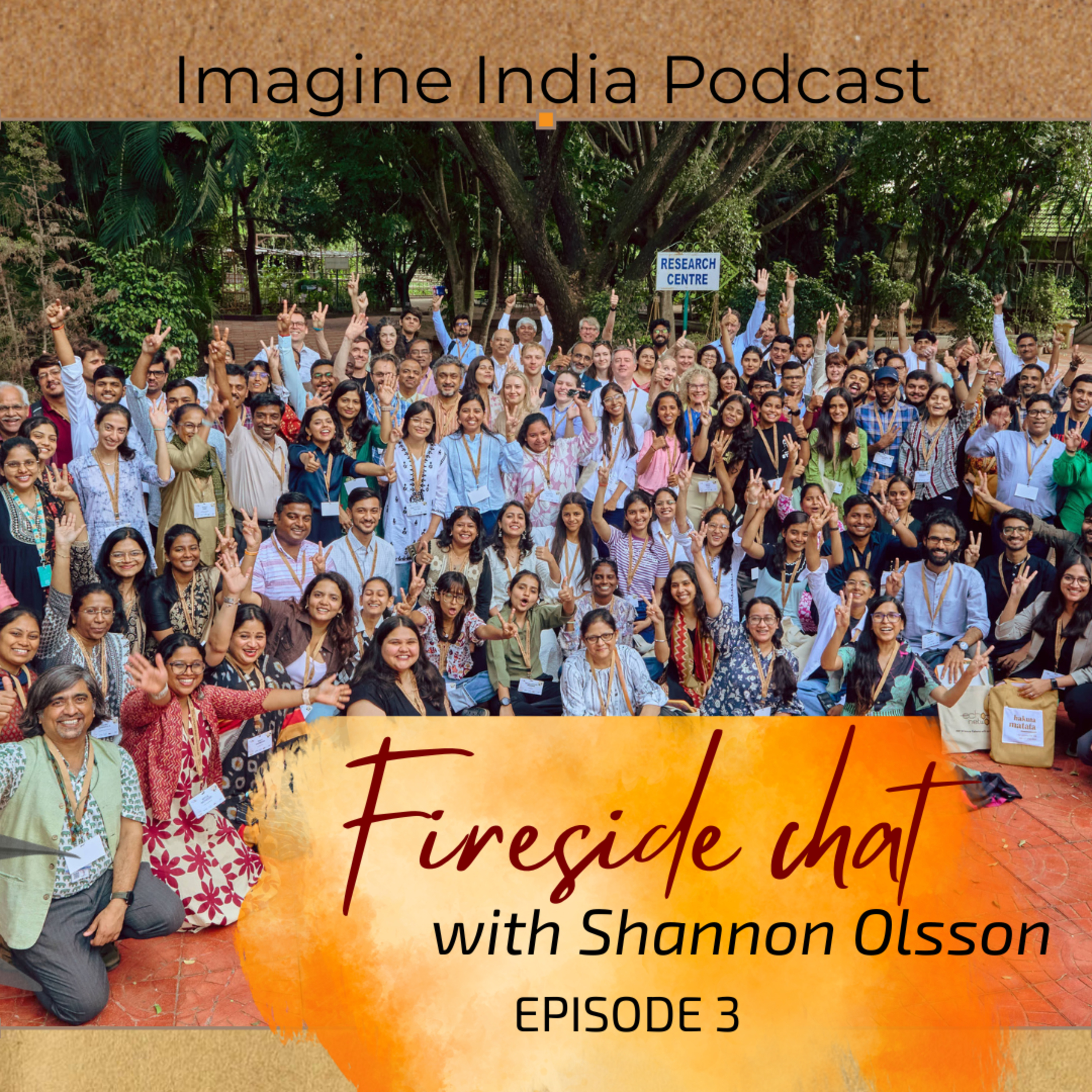
[Music] Hello everyone and welcome to Imagine India's Fireside chats. I'm your host, Shannon Olson. For four years I've had the honor to imagine along with our world light bringers and to listen to their dreams for India and for the world. But this year we are proud to present how the project consortia of the echo network are turning those dreams into reality. We're listening to the stories, the struggles, and the successes of how our brilliant students and network members are turning knowledge into action on the ground. So let's start now. [Music] Today's guests are all part of our One Health Forum project for the Sustainability Ambassadors Global Exchange Program. The Sage Program is an ambitious, three-tiered training and engagement experience with over 150 alumni from 17 countries where undergraduate junior ambassadors gather on-ground community insights and outcomes in local communities. Postgraduate senior ambassadors contextualize these insights through focused data analysis and PhD fellows translate the combined findings into field validated practical knowledge and innovations. All of these impact leaders are trained in collaboration with echo network members across academia, companies, NGOs, and government sectors. Dr. Prasanthanas from the Institute of Public Health Bangalore, Kranti, Visaraju, also from IPH and Dr. Nora Engel from Vrijan University in Amsterdam. Welcome to our program. Thank you. Yeah, so I think I'll start by actually asking each of you to introduce yourselves rather than me introducing you. And tell us a little bit about what drove you to be part of this particular forum project. Nora, let me start with you. Thank you so much, Shannon. So my name is Nora Engel and I'm an associate professor in Transdisciplinary Global Health here at the Vrijan University in Amsterdam. And would drove me to this project, I guess, was my long-standing collaboration with IPH and Bangalore. For many, many years we have done research together on social science research on topics of health, public health, infectious disease, control. And through that, I was introduced to the echo network. How about you, Kranti? Thank you. Thank you, Shannon. My name is Kranti, Visaraju. I am a PhD student in the Center for Health Systems at Institute of Public Health Bangalore. And I am also a supervisor of Prashant in Nora. I register my PhD at the Vrij University in London. Prior to this, I've been a researcher scientist in infectious diseases, but more from a bench science point of view. And Prashant. Yeah, hi, Shannon. Hi, everyone. Thanks for this conversation. My name is Prashant. I'm a senior fellow at the Institute of Public Health Bangalore in southern India. I am a medical doctor, but largely working on what we call health policy and health systems research. Trying to understand really how the wider system of health is shaped and can be shaped and nudged towards more equitable and towards more efficient design. I had a privilege of joining very early on when the echo network was trying to bring together people from across several sectors. At first. Yes. Being a very fantastic set of conversations with people from so many different sectors. So continue to learn and happy to be here. I mean, you were actually the very first, the first 10 people that we ever gathered as kind of the birth of the network at the very beginning of the pandemic, right? So and this project is very reflective of even those initial discussions about having community engagement and community participation and health. And that's actually the question I wanted to start with because I think that, you know, for most of our listeners and myself included when you're sick, you just go to the doctor. And it doesn't really make sense from a health perspective why you'd need for a why you'd need citizens for a and what what it can do to help our listeners, not only in India, but across the world. So so maybe, um, Khandi, let me, let me go to you. Why do why do we need citizens for a? I wanted to say that the consortium approach is integrating the knowledge and experiences from different disciplines disciplines in design engineering public health and also across sectors in the waste, water management, surveillance, public engagement. And all of it with the aim to identify sustainable and innovative solutions for one health systems and infrastructure in urban settings, settings and in the clean healthies, city's consortium. So the project uses a transdisciplinary lens. So the insights of both science and society, bear weight, the forum project, which I'm part of is a part of the clean healthy cities consortium that's looking to, sort of develop the one health systems and infrastructure for the urban context. And within that project, we're looking at waste management, we're looking at surveillance, we're looking at water management, but the crux of all of it is engaging with communities. So you might have a brilliant intervention. You might have a great scientific, you know, breakthrough. But when it comes to implementation in the community, if you don't have the buy-in of the community in terms of even problemizing, it's very likely it will not get implemented or it will not sustain itself. And especially in the case of a vector bond disease like Dengie, which I am studying, it is extremely contextual. So even just from one street to the next street, it's not the same context. For me, it might be a waste issue for the person next to me, it might be a water supply issue, which is why they're storing water. So when you're trying to control the vector, you need different kinds of interventions. So for that, who knows better than the community themselves who live there or who work there, right? But also in terms of solutions, you might come up with a brilliant solution that is not sustainable. Maybe you have some NGO money or some philanthropy money coming in for a particular intervention. But if you cannot sustain it through the years, we fall back into the same loop. And so for that reason, we need platforms where communities can come together and you know, have these conversations. And for the city of Bangalore, that's like a spectrum. There's a different kind. There's a plethora of kinds of platforms that are there. But in the urban setting, it's usually more difficult to have communities come together, participate as compared to rural settings is what I understand. So Nora, you're coming from the social science standpoint. And when I think about community engagement, right? So when there's a problem, that's always pretty easy to get engagement because they'll come and complain about whatever's going wrong and you know, see how they can fix it. But I think as far as I understand from the project that this is more about the prevention and the monitoring of these issues so that they don't become problems. So how do you engage communities effectively on this level where actually there isn't a current disaster in place, ideally, and that it's something that you hopefully will prevent from happening. Yeah, thanks Shannon. So what I what I really like about this project is that it is not trying to set up new community structures. But it is trying to understand what are current ways that communities govern themselves in an urban context, what are current platforms, what are current issues that people come together and care about. And is there a space and in which issues of public health are being dealt with or talked about. And if so in what way are they being talked about in these platforms in these existing platforms and sort of governance relationships. And can we together with these communities then find a way to possibly transform on call create these platforms in a way that they're amenable to solving public health issues, which often means preventing ill health. And we know that this is very difficult to do for policy makers because it's hard, it's a hard political cell to sell the absence of disease. But it might be different for communities. And so that's really what excites me about the work and that we can learn from that also. So what I'm really interested in is to find ways in which we can make social science research useful for these types of transdisciplinary collaborations. And what are some of the methods that we can develop to cross different disciplines and different societies stakeholders in there. Very different understandings of what the problem of for instance, dinghies and how it should be solved. So Prashant, as you said in your introduction, you are a doctor, right? right? So you do work directly with the
in the public health context. How do you see the citizen engagement taking place already since Norm mentioned that the intention is to work with an existing structure. So could you talk a little bit about those existing structures and how we might build on those in terms of what Kranti was talking about increasing this engagement at different levels? Being healthy is not only about not having to see it, right? So you living in a neighborhood which feels can be and feeling like you belong to that place and that you have a caring community around you. Of course, all this sounds romantic, right? In the hustle and bustle of the tea, the sounds like, oh, this theme aren't attainable. But what I have seen in my experience is that communities and people who face a lot of adversity on a daily basis, they derive energy and really, the spirit of living merely by leaning on each other through conversations. So imagine a hand system that can facilitate the coming together of people in cities around the topics, it could be something around solid waste in my neighborhood. Or you'd be merely thinking about how do we be healthy in our neighborhood? How do we keep our path more clean and nice? So it can be far beyond our imagination if we are able to trigger this kind of coming together. And I think that's the promise for me to create cities which can nurture these kind of spaces for people to come together. So I think that this brings a different spin on the public health context from which the conversations often are placed. And do you see that communities are ready to engage in that way? Do they-- one of my questions is, do they see this connection at the local level between these different issues and their health and well-being? I think for me, it's a little bit of a chicken and egg. I don't see that there is widespread demand for, oh, we need to have community participation platforms. And then they will help us address climate change, waste management. I don't see that. But it's also quite possible that these kind of platforms have not emerged. And people have not felt that the sense of community is built over very many generations. But cities are not like that. A sense of community needs to emerge. And we cannot wait for several generations to pass before the sense of community happens. So it becomes, I think, imperative that academia, policymakers, NGOs, institutions like us create a sense of community and help people discover the sense of community. And that's the direction in which I think the forum project goes. Like any city, Bangalore is very diverse in terms of the people that it accommodates. And their needs are very different. By profession, people are going to different platforms. By where you live, you're going to different platforms. So it's become not just a platform. There's not just a physical space. It's also very much a virtual space now. It's very-- a lot of these engagement happens virtually in digital platforms. Whether it is citizen-led papers, newspapers, WhatsApp groups, social media handles. But also platforms where there is consultation, the government is opening doors for consultation, for example. Not just a word, but an area has its own little community engagement platform where there's really engaged in waste management, for example. So it's very diverse in Bangalore, the kind of platforms there are. But I think what will come out of the project is essentially an empirical question of how and where people are willing and able to engage with questions of health. And so this mapping of these very many different platforms is sort of the first step in county's project to really understand, well, what is actually already going on? And where are people meeting and where are people talking about, which aspects of the problem of Dengue and what form that? I mean, and to that. It seems like the typical entry point doesn't become health. It becomes everything else around it. It becomes climate, it becomes waste, it becomes water inequality also. It becomes everything else then ultimately. I think we bring in that ultimately also affects your health. But I think when people in general are meeting, they're not necessarily always coming in with that entry point. So actually, just in the past few years, if you just look at Dengue, there's been a lot of discussion around it. But the entry point has almost always been something else. Heat, water, climate. And this also just so beautiful currently, because it also shows how people embracing this complexity in their daily life in a very different way than in which we have set up our governance and institutions, where we have compartmentalized. And you know, there's a health sector, there's a sanitation sector, there's a building sector. It's all differently managed. And what people don't experience and don't talk about things in this way. And so maybe on these community platforms is where that sort of meeting between the community embracing complexity and the more sectoral and institutionalized governance systems has to happen in a way. So I think for me, also an interesting question will be of the existing platforms. What data are or value are they already creating? That the government, the municipal leadership is interested in is maybe already collecting and using. So Nora, I'd like to stand up because that's actually another question that I had. So looking forward, right? Because I mean, like all of our projects, but especially this one, this is not something that you can solve within the space of a PhD, right? And the problem's going to change tomorrow, because we're going to have new shocks. What do you hope that this project will provide that can help us? And hopefully the communities that we're working with in Bangalore, but ideally even other communities as well, be better equipped to handle these shocks, because these shocks are happening to everyone everywhere in the planet now. It's not just in India. So-- Yeah, so on outputs on many very different levels. So for instance, what are the ingredients for a functioning community platform? What contributes to resilience in communities that could be more practical, but also more theoretical, conceptual contributions, right? To the scholarly literature, but also hands on tools. Then metallurgical contributions. How do you actually study and co-develop with citizen platforms or community platforms and work with them on issues of public health concerns that maybe are not their concerns initially, but that are a kind of concern of a government, for instance. So I see there's a lot of potential outputs on very many different levels that will maybe bring us in a few steps forward. Yeah, absolutely. Prashan, what about you? What do you see coming out of this project that you're excited about? And hopefully we'll be able to take forward in your own work? Well, I feel like how to build community engagement, or how to build community engagement platforms in large cities, appears like a simple question. It appears like bring people together, give them a conversation that can initiate it and participate and then watch them engage. But we all know that in any city, not in Indian cities, in any cities we can do more. We could do more in terms of bringing people together. So for me, I think for our institute, given that we have a long term interest in trying to understand an institutionalized community engagement and community participation, we are looking at this as an important launch path for us to deep dive into long term trained action on the city of the nation. Yeah. And Kranti, you probably have the longest vision because you're doing this for your PhD. So I mean, why are you doing your PhD on this topic? I've been waiting to answer this question. So one factor is that I currently live in Bangalore with my family after moving around for my entire life. So I can finally call a place home, which is Bangalore. And I've also moved around disciplines a little bit throughout my life. And I can finally call public health my home also. Which is quite transdisciplinary. And coming together of both of them is what was the main driving factor for me that I really was looking forward to this project. I think there's a lot of potential to this project because Dengie becomes a case. And then you can replace Dengie with anything else once you understand the community engagement platforms of the city. So kind of stemming from this question, I just asked, so if you imagine 10 years from now, and you.
imagine that everything you've done worked great and what kind of community engagement would you like to see happening at different scales? And what would you need to make that happen? And I'll start with you, Prashant. Well, I think for me, 10 years later, I would think of a Bangalore where there are very formal committees, which even today exists. These formal committees are claimed. There are people there who are talking and solving problems, but also demanding accountability. Sometimes it's about, OK, how do we better gain from the governance and the stuff? So that's my vision. That the meetings are happening. Diverse people are coming together. They are not just beautifully engaging. Sometimes they're having differences of opinion, their listening, and they're figuring out how to integrate multiple perspectives and acting at neighborhood level. What about you, Nore? Would you like to see? Well, I would add to that, Prashant, that it would be nice to, in addition, have a set of, first, maybe a lively scholarly discussion research that accompanies these efforts that has somehow set up maybe frameworks, additional methodologies and tools, subscripts for workshops and whatnot that can accompany scissors and engagement platforms for public health in cities. Yeah, and also locally, too. I mean, that's something that the Akone works really trying to do is get local institutes to engage better with the communities around them. What about you, Kranti? What do you want to see a decade from now? I hope that we have a more balanced society in the sense that we have precious resources that are now going down. But I hope that there is a little bit more equitable distribution of that and we realize more the precious resources that we have, like the clean air, the water, the soil, the food. But I feel like if there is somewhat of an equity there then we're a bit less selfish and less reckless about how we use some of these resources. And I want to add to what Prashan said, I hope that there are more intersectoral policies also. There are policies now, but I feel like maybe they can be better implemented, better enforced, some accountability for how they are enforced. Mostly, I think I hope for a society that's really looking out for one another. And finally, I think I shouldn't be in a position to explain why I'm doing this work even to my own family. It should just come naturally that we all are looking out for one another. That's very beautifully said, Kranti. The idea of studying community engagement and the role of scholarship and researchers in this space, I think, has to be claimed, like you said, by many, many, many local institutions. I just want to say this idea of the process of changing, studying the processes to which change occurs are actually as important as innovating and finding a product. And I think that kind of scholarship needs to increase a lot more. Like at the Athena Institute, we are invested in all of us study and also try to develop ways of intervening and improving and transforming spaces of knowledge generation. I mean, this is one of my big outcomes of being part of the network is finding people like the three of you who are all invested in this idea of sharing information and providing an equitable environment for everyone, no matter with the background, to share knowledge and learn from each other. And I think it's very uplifting to me. It's something that keeps me, you know, with all of the things going on in the world really being positive because I meet people like you who all have this in their mind and who are all working in your own spheres of influence on this issue. So I'm really, I'm really grateful to each of you and to the work that you're doing both in your individual personal lives but also together in this consortia. It is really, really important. And I just want to say thank you so much for sharing this time with us today. And I've really enjoyed all of the conversations that we've had so far in this project and learning so much from you. If you're interested in the work that that crunchy Nora Pshant are doing and you would like to contact them to get more information about this work, you can of course check out our Sage website, go to the forum section and you can also write to us at
[email protected] and we will happily connect you to them if you have specific questions. And I want to thank everyone out there all of our listeners for being with us today and I hope you'll please tune in next month for our fireside chats and we share more dreams about India and the world with you. And until then, we wish you love and hope and keep dreaming. Bye everybody.
 PodcastTranscript AI