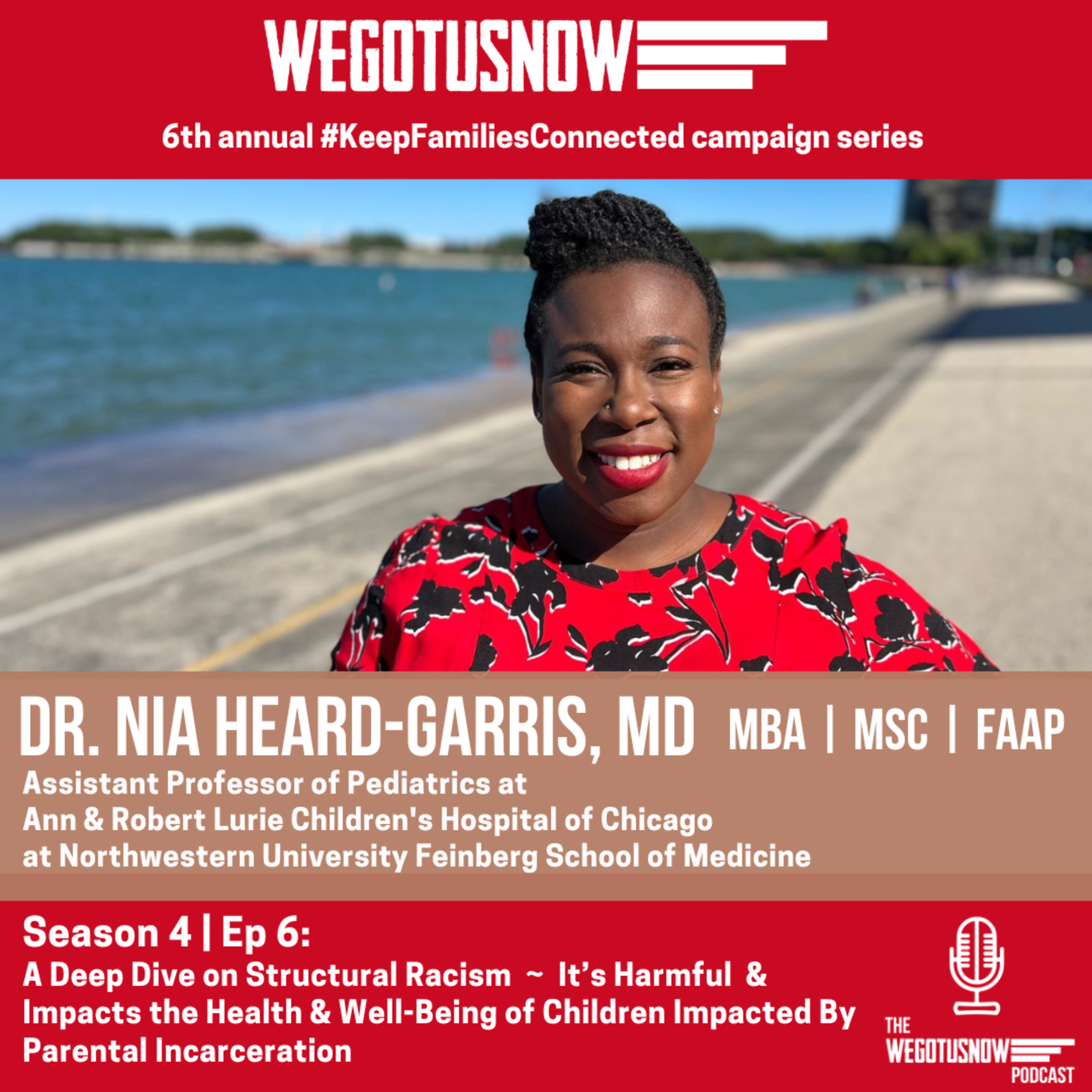
S4 | EP 6: DR. NIA HEARD-GARRIS, MD, MBA | MSc | FAAP: A Deep Dive on Structural Racism ~ It’s Harmful & Impacts the Health & Well-Being of Children Impacted By Parental Incarceration
50m 18s
The discussion highlights the profound impact of mass incarceration on children, framed through the lens of Adverse Childhood Experiences (ACEs). Dr. Nia Heard-Garris, a pediatrician, explains how ACEs—such as abuse, neglect, and household dysfunction—are linked to long-term health issues like stroke, cancer, and mental health disorders. The original ACEs study has been expanded to include systemic factors like racism, community violence, and parental incarceration, which disproportionately affect marginalized groups. These experiences create barriers to health, education, and well-being, with effects persisting into adulthood. The conversation also addresses healthcare disparities, noting how implicit bias and structural obstacles (e.g., limited insurance acceptance, long wait times) hinder access to care. Emphasis is placed on shifting harmful narratives, recognizing community strengths, and advocating for systemic change to support children of incarcerated parents and dismantle the structures that perpetuate these inequities.
Mass incarceration in the U.S. is the great tsunami that has ripped apart families and destroyed communities. At the epicenter of this destruction are the children of those incarcerated. My name is Ebony Underwood. I am the founder CEO of We Got Us Now. We got us now as the first of its kind. National, non-profit, non-partisan, organization, built by, led by, and about children and young adults who have been impacted by parental incarceration. These are our stories. So Dr. Neaheer Gareth is a pediatrician and a physician investigator at the Anne and Robert H. Lurie Children's Hospital of Chicago. And in the Department of Pediatrics at Northwestern Universities, Fineberg School of Medicine. That's me. What I want the audience to know is, I know you're not originally from Chicago. No, we were recently at a conference in Ohio. Yeah, that's from Ohio. Yeah, that's from from from from Cincinnati. Yeah, so I want to know how did you get into pediatrics? We're a doctor to you. You know, well, the truth is, and you'll appreciate this because my mom is a fierce, phenomenal woman. But when I was like five, I said, oh, mom, I want to be a nurse. And she said, no, you want to be a doctor. I was like, I was great. Thankfully, she knew more than I knew about myself. And she was right. I wanted to be a doctor. I wanted to make some of the medical decisions and stuff like that. So I went to college in men's school, whatever. And she was totally right. Nurses do an amazing job in healthcare for our kids. I couldn't have cut it. She knew that. She knew that. I went to Howardford Med School. And my husband actually pushed me to go into pediatrics because I really did love kids. But I was letting people get in my head about your woman. Of course, you're going to do pediatrics. And so I was like, pushing it against that a little bit. Yeah. And people would say, well, you're smart. Don't do pediatrics. It's just like that. These little aggressive sort of comments are really pushed away from pediatrics. I looked at pretty much everything else. And he's like, who cares what other people think? Like, do what you're passionate about. Do what's great. He's obviously such a great partner. He's always pushed me forward. And it's like, who cares? Like, at the end of the day, it's your career. You've got to be happy to build in the work. So do pediatrics. And he was right. I just surround myself with smart people. You know what I mean? Let them guide my life. But he was right. And so that's how I ended up being a doctor and then more specifically in pediatrician. Okay. So how did you get here? Yeah. A Chicago. Yeah, I feel like I kind of like fell into it, honestly. Because I was a pediatrician working in DC. I really liked it. I was doing my residency there at the big children's hospital. Okay. And I had my son in residency is what happened. So working 80 hours a week with this new baby and I was feeling burnt out. I was like, is this all? Like, I've gone to med school this whole time and done all this work. And I feel like I'm not making enough of an impact. Like I'm seeing patients 101. And I think they're grateful and their families are grateful. But what am I doing for the larger community? What am I doing for the larger society? And so when I had my son, around the time I had my son, Trayvon Martin was killed. And I was devastated. So Trayvon Martin was a teen that was just walking around in his dance neighborhood, had a hoodie on. And because he looked suspicious, he was murdered. And it really affected me because I was bringing this black boy, black son in a world that really wasn't ready for him. And I was like, I don't know Trayvon, I don't know his family, but I feel so connected. And I feel so sad about the loss of this life and what this means for future black boys. But I was talking to some of the pediatricians that I was training with. And they were like, you should be happy. You should be happy. You're having a baby. This is great. They just didn't get it. And pediatricians are some of the nicest, most empathetic people you will ever, ever meet. And I was like, wow, if these people don't get it, we have a lot of work to do. We have a lot of work to do. And so that pushed me towards thinking about how do I pair my medical knowledge with other things like policy or research or something to have a bigger impact on society. So I did a fellowship in Michigan of Robert Wajons' IntelliShift and they taught me about research. They taught me about policy and how you can use research for policy change as well. And so as I was coming out of Robert Wajonson, I thought that I would work on the Hill and go back to DC. You know, we're some of my adult roots were, but it was around the time of the Trump administration that I didn't want to be in the administration. And I was like, oh, I can actually ask questions that are important to me. Research does not have to be this certain thing. It can be anything, especially questions that are important to me in my community. And one day, one of my friends asked me, do you know how many of your patients' parents have been incarcerated or are incarcerated? And I had never thought about that. And it's like, you know, when people say, mom and dad are away or they're not with them, do you ever ask why and where they are and stuff like that? And I had never. And so as I started to look more into it, I was really shocked. And so one of these research as a way to impact change in those places. Absolutely. Absolutely. That's fantastic. We're now going to undermine some of your other accomplishments. Okay. And I think that's a very important thing. And they don't even recognize it. The bias that they carry, right, with them. So then, they don't even recognize it. And he found certain experiences were common and actually really bad for your health. So they're kind of broken up into three main categories. It's abuse, neglect. And he called it back then, household dysfunction. I don't really like that. So I don't say, like, household circumstances, basically. And so, abuse would be like physical or sexual abuse. And neglect is physical or emotional, sort of neglect. of a household member falls in there. But so does the substance abuse of a parent or caregiver, as well as like divorce, and those sort of big household circumstances. So anyway, he found that those experiences were connected to stroke, and cancer, and hard attack, all of these really, really big devastating health like events and episodes. And those things happened when they were before 18. And the people that he was doing the work and were adults, like weighed down the life course and said, oh, I'm seeing these patterns here. So these must be important. And since then, there's been thousands of studies since that point that have shown the relationships, right? But then Dr. Marie Wade at CHOP, it's a black man who did additional work and said, yeah, this is important, but you did this work in white middle class meals, mostly in California. And we know that there are other things that impact a well-being of children, especially for those that are from urban areas, those are racial and ethnic minorities, so black, Latino, native indigenous populations. So he, like, looked further and tried to understand what additional factors those were. So like racism, the death of a parent, parents that have mental health issues or conditions, especially those that are untreated, community violence also was in there. So he said, all of these things impact the health of a child. And so when you look at those things together, kids that have ACEs are more likely to have mental health challenges, behavioral health challenges, social challenges being able to graduate from high school, even on time or graduate at all, they face a lot of barriers in their health and whether that's physical, mental or well-being. And as they grow up, those challenges don't go away. If they continue to have higher risk of like cancer and diabetes, stroke, even preterm birth and pregnancy, so there's so many different avenues in which the social experience, social life impacts their health. - Thank you for giving the death, because I didn't even know there was the initial study and then the addition to go more in-depth and bond out how. So thank you for that. - Yes. - Wow. - For it's, oh my God. - Yeah, it was pretty mind blowing. And I think it's taken a really long time for physicians. So that was like the first study in the '90s. But to really recognize social experiences impact health. And in fact, you're asking about the pushback with the section, but that's just pushback in general. When I started research thinking about racism, thinking about incarceration, people would say, "But you're a doctor." Like, why are you looking at these social experiences? And like, 'cause they impact health, they're so important. But until recently, people are like, that's not science, that's not medical, that's not health, they're separate. Your social history and your medical history are not one and the same. And so we've pushed back people that have done this research and really cared about ACEs and social determinants of health have been pushing back for a really long time. And so now, I think things are starting now. It makes sense, has been clicked for the medical community. - That's probably because of a challenge. - Yeah, seriously, because of you and your work and our work that we got us now because we have explicitly shared about the trauma stigma in shame. I mean, that's a large part of why I even decided to get into this because I was like, I mean, I personally needed to yield. - Yeah. - And by finally, being able to build community and find others and being community with other people and not having a live in shame and being able to share was like a weight lifted off of me. So, oh my goodness. And then it's true, only social determinants of health are like the housing and stability of these. The economic instability has caused when a parent is in car swing. The lack of educational opportunities. Just so many different things. And then even healthcare, right? Having proper healthcare, having proper dental care, being able to go to your appointments. A lot of that goes out the window because you're moving all over. - Right, who's gonna say, yeah, who's gonna take you? So, oh my gosh. - Yeah, that just opened up all over the thing for me. - Yeah, I wanted to get your insight about the implicit bias, but also based on your research, what are some of the root causes of the disparities that children of incarcerated parents face? Or even just marginalized populations generally face within the healthcare system? - I think it's a really good question. I don't know that I have all the answers to it. I think implicit bias is one thing. And I think it's an important aspect that many people are starting to realize this is a thing. Like at first I'm like, I'm not racist or I'm not this or I'm not that. And then as more research comes out, more testing comes out, people have all sorts of biases. I have my own biases. And so does everybody else on the planet? And you don't check those at the door when you clock in the work. You don't check those at the door when you're caring for your patient. You have to be really intentional about that. And so there's been work that has found when people are stressed and have many patients tired. Those biases rise up to the top, right? And so especially if you think about high traffic areas like the emergency room or the ICU, when you're carrying a lot of patients and your medical decision making is really, really important in those spaces. It may be hard, right? And you have to rely on these brain shortcuts to make decisions. And so that trickles down to every sort of aspect of medicine. So implicit bias absolutely plays a part in thinking about healthcare disparities for this population, every population, every sort of marginalized minor or Torres group, right? If you're not seen as the dominant group in America, which is usually white men, but white people in general, then you're gonna be seen as less than, right? So I think implicit biases play a part, but I think there are very real structural things too, right? So implicit bias is how people kind of interact with thing about this one-on-one dynamic, but when you think about the structures, like who's even able to come to the doctors, right? Like what insurance do we take? And not everybody takes public insurance, right? How are physicians paid at these different places? They may get paid lower at a place that takes Medicaid, for example, 'cause Medicaid doesn't pay more, they don't reimburse properly. And so you don't have as many physicians that want to work with Medicaid populations, for example. And so that bottlenecks how many people can even be seen. So your wait times might be longer, right? Your ability to get in and where these healthcare places are situated, they're not all in communities that are under-resource there, in communities that are low resource, 'cause they wanna cater to this patient. So where healthcare is, how long it takes you to get there? All of those things are part of the structure. It was intentionally designed that way. So implicit bias is important, and also we gotta think about these structural things, like to keep certain people out, or to keep certain groups, kind of adjacent to the best kind of healthcare that they should be getting. So I think about those things a lot too. And when it comes to marginalized groups, especially those of incarcerated kids, they already are dealing with so much. So to have an additional barrier, of having a healthcare institution far away, that doesn't take their insurance, that can't get an appointment for six months to a year. Like, how are you supposed to navigate all of those different things? That is really, really hard to overcome. So it's not shocking to me that the disparities in their health are different, that they're more likely to have PTSD and anxiety and stress and asthma, 'cause they can't, they can't even get into to be seen, right? And so we've gotta think about ways to dismantle that and change those structures, so that people can come and can get the healthcare that they need, and the treatment and afford it. And like all of those things are important for the system. And plus the biases one piece, and then for me, the structural piece is the bigger piece that it's gonna take a lot for us to dismantle. It goes back to just the ACEs, right? And then what they experience, right? Because of these structures that are in place or not in place, and not supporting our communities in this specific community, in a way in which they need to be supported. A lot of what we experience is that, I guess, yeah, it goes back to what you're saying, that structural racism, where ultimately these ACEs arrive. And you don't even know that your impact is until you're in your 20s or early 30s, and you're like, wait a minute. What, you know, trying to figure out life, and thinking that you can, you know, you have a great job. You know, you may have a wix of school, because again, you know, we'll talk about this later, we talk about some of the harmful narratives that have occurred, but you've done all the things, right? - Right, right, right. - Trying to check all the boxes, trying to avoid meaning what your parent was like. But at the same time, mentally, emotionally, you know, even physically, you know, maybe not eating right, or, you know, just like, dealing with, or coping with, you know, this weight of this experience. And then you're like, why is my life not like everything looks in on the outside, but on the inside. - Yeah, it's so much pain, and I don't even know where it's coming from. - Yeah. - And it goes back to your 100-person career. I can't tell you the number of times after a talk or I've introduced ACEs, it happens less now because people are more aware of it, thankfully. But before we'd come up and be like, that makes so much sense. Like, I directly have been impacted by this. And, you know, like you said, everything on the surface, I've gone to high school, I graduated, I've gone to college, we have a job, but like I was abused, or, you know, this thing happened to me, or my parent wasn't incarcerated or whatever it was, it makes so much sense. And in some ways, that information is really powerful 'cause it's rearing, right? It's not your fault, right? Like, this thing happened to you, or these things happened to you. And it's not like you said, we'll talk about it later, it's not the end of the story for you, but maybe it helps us to explain some of the barriers you run up against, right? It's not you, like you were not the problem, the system is the problem, how your community was researched, how your family was helped or not helped is the problem, right? And thinking about that. So that part of the work has been nice and that people can have some sense of like, it's so cute, I mean, literally for the community. Like that's literally the relief, right? It's that on a moment where you're like, oh, thank God. Yeah, but it was me, but no, it's not me. It's not me, it's me, like, and that was the thing. I think that's been so rewarding for us, and we understand is that our community is like, you see me, you can understand, you hit it on an entire different level. And so what can we do as a collective to change things? And so thank you so much for the work that you're doing because it's like a bright light. Where, yeah, really, it really truly is, I wanna go into the harmful narratives. We explicitly, that we got us now, explicitly worked at the bunk, these harmful narratives that have been, I mean, in research, in media, in the justice system, in the criminal justice system, just really we've worked to shift this from the public discourse because it has just been so detrimental and it's so challenging, even to find this community because people don't wanna be associated with that at all. - I'm sorry. - Right? And so it's wanting to make sure that we eliminate that and shift that from the public discourse by really educating people about, if this narrative about them more likely to end up incarcerated, it's not the majority, right? That's the minority of the population, but we've been blanketed with this extremely harmful narratives as if it's everybody and so many of us are like, no, that's not my. - That's not my trajectory. - Yeah, why are you saying that? So then again, they're paralyzed, the fact that this is a population that is like hidden in plain sight. And so I just wanted to ask you because I love that your work is strength space, right? And looking at the strengths. And so I wanted to ask you about the harmful narratives and recognizing that media and social media and commercials are like compounding the stress and trauma, right, the stressors for children. - Yeah. - Why did you decide to talk about it in this way? Because this is the work that we do. - And the cops are doing the work. - No, no, no, no, no. - Your research on it just gives it all the more validation. - I mean, I appreciate you saying that 'cause I also feel like there's so much room for growth, especially in my work and other people's work to censor the strengths more. I think the most harmful is that you do research or you do policy work or whatever it is, advocacy without context, right? So I just told you children that having incarcerated parents are more likely to have anxiety and PTSD and whatever, but let's talk about why that is, right? And so I think situating the findings which are so heartbreaking and devastating within the context, again, saying that this is not the person's fault, this is not the kids' fault or the family's fault or whatever, this is the system in which we've created, right? And then focusing on changing the system, which is what you do and what your group does, right? It's like we need to talk about how do we change the system 'cause the people aren't that people. The people aren't the things that we need to work on. They're not the projects. It is the system that is the problem, right? The mass incarceration system, the system of sentencing, parole, like all of those things are the problem. And so how do we talk about yes, these findings are really terrible, but it's because we've created that, right? It's nothing about the people. So I think that's the first thing it's talking about the context, just like any sort of research that I see, I get really upset when they find a difference between let's say black and white people about something and they say, oh, maybe it's genetics again. And here later something wrong with the person, like, oh, my genes aren't as good as your genes. No, there are structural races on there, are systems in which allow and perpetuate inequities to exist. And that's the same thing here. And so when you have narratives that are other more likely to enter into, let's say the carceral system and then period, maybe they're more likely some or more likely to enter the carceral system because we allow that to happen. We don't make sure that our schools are well-resourced. We don't give them the financial supports that we need. We are locking too many people up period, right? Like, let's have that conversation, right? And so I think the narratives are really problematic and with ACEs work similarly, you can't just talk about all the bad things. So I always try to talk about the resilience and the strength. Like despite all this terrible stuff, like most people actually do great and are not their path, right? Not the path of their father, mother, sister, brother, whatever, they overcome and they end like how? Like let's figure out, let's study that. Like one of the tools that we need to put in a place so that all these kids can thrive, right? So having mentors, like having people that believe in them, having strong schools that support their educational growth, like let's do that. Let's have policy conversations about funding that. You know? And so I think you can't just have a one-sided conversation about all the negatives. You can't have a conversation without the context. And then you also can't not bring in strengths and resilience. Like that's a part of the work. That's the mission, right? Mm-hmm. Thank you. (laughing) It's all about the thriving, right? And resilience because that is so important. It creates a lifting of the weight for the community. When we know that, wow, okay, people out there care. In your opinion, what are some sort of practices that you believe the field of pediatrics, public health, and school of medicine can provide us and we got us now. Mm-hmm. Our efforts to ensure long-term health equity for children with a classroom. We got us now just such impactful work that I would want it to be sustainable forever and ever, no matter who sits in the chair that you're sitting in, right? And so I think about it in three veins. One is obviously funding, but other is thinking about research. And then I think the last would be about policy and advocacy. So I would want, you know, in those three veins, there to be partnership on every level. So funding, are there people that can either support grant writing, help write grants and secure big, you know, big, big grants that endow you forever? So that would be one. And there's healthcare people that know how to do that. And researchers obviously that know how to do that. And then from a policy standpoint, right? Like we advocate for children of incarcerated. We should be doing that, right? And if we're not doing that, we need to work with you, right? And support and go to the hill every time we go to the hill and talk about obesity or go to the hill and talk about something mental health. We should have that conversation about kids of incarcerated parents as well. And create policy statements on how do we care for these kids effectively, right? And then the third thing research is how can we help share the message with people outside of we got us now, the people that may never go to your website or never listen to your podcast or see your amazing talks, which would be a shame. But you know, like that only release journals, right? Like how can we show the effectiveness and the impact from a research standpoint on the work, right? And disseminate that because I think seeing we got us now is a site to behold. And then also numbers paired with it comes funding and people listening in different ways that may have never come to the message, right? So I think on this three days, that's something easily healthcare should be doing. - I love that. (laughing) - And that's what I'm continuing our conversation. - Okay, so now I'm gonna talk to you about you personally. - Oh, okay. - So how long have you actually been doing this work? As a pediatrician and researcher, how long has it been for you? - About nine years. - Oh wow. - Yeah, about nine years. I always started my program in Michigan in 2015. My colleague shortly after that asked me the question about incarceration. 'Cause he was interested in adult incarceration and was like, do you know what's happening? Did these people impact it by incarceration? And I was like, no. So it's been, she's been a long time. (laughing) It's been almost 10 years. - Yeah, that's fantastic. - Yeah. - That's fantastic. We're highly focused on wellness and wellbeing. Like that is like part of the foundation of our work because I don't know how familiar you are with the way that we do this work, but as a nationwide network of daughters and sons, we don't just choose people to be a part of our network because they have had the experience with parental incarceration. It's really them wanting to advocate and support and uplift and be informed and educated about this work so that they in turn can come on and be a part of this work and help us to continue the needle forward because we got us now our intention is to be around for as long as Jail's and prisons are in existence and so that all these systems that affect the child's life, they never forget about these children. So we want to be that institution to ensure that we're never forgotten. In order for us to do that, because we know through lived experience, how traumatizing this could be, we want to make sure we're dealing with and putting forth and presenting people that are whole individuals. And so there's so many aspects of what that can look like for an individual, it can be therapy or it can be exercise or it can be eating right or it can be journaling. - Sure. - Or it can be work to some degree. I'd love to hear from you as an ally. What do you do personally for your own wellness and what'll be? (laughs) It's a journey I'm working on it and hopefully we'll be at a place some point soon that I can give you some really concrete things. I love the way we got us now works because or one of the reasons I love there are many reasons. My new line of research is activism. How can you use activism, which we should talk about later, as a tool for mental health? So to lower the life depressive symptoms and anxiety. So we've done some studies that have shown that when you do empower people, especially people impacted by these systems, and you teach them and form them and help them become resistors, that actually can help to lower their depression and anxiety because they feel like they're part of the solution, right? But it has to be balanced with exactly what you're saying and thinking about self-care, right? And you can do too much and feel like the world will never change. You can do too much and feel, you know, burnt out by the work. But self-care specifically for me, what does it look like? I feel like I do work that. But I lost when I told my son, I have an 11-year-old and he is bright and he keeps through my toes and he's giving me all the slang, you know, about rizz and things being made and like all the words that I thought I was cool. And then I had a 11-year-old that realized I didn't know all the things. But playing with him, we love doing game nights and movie nights and stuff. That gives me a lot of energy. I'm having a baby soon. And so I am leaning into my sausage. That's right, yeah. So I wanted him to do that. But before then, I was like exercising a lot. So that was like my time. And I kind of felt like before, especially as black people, black women in America, it's like you spend so much time caring for other people, whether it's your work or your family, or you significant other, that I kind of felt like I didn't have enough time in the day to care for myself. And therapy is a big part of my self-care. Therapist was like, there are 24 hours in the day. You can find one hour for yourself. If you want to frame it in terms of helping your family, like you need to do stuff for you so that you are alive and you are well to continue spend time with them, do the things that you want to do with them. And I'm like, you know what, you're right. Like one hour a day, like I can find time to do something for myself for one hour a day. So exercise used to be a really big part of that. Now think about other sort of ways to be healthy, whether that's walking, whether that's doing yoga or just like sitting down, like sitting down watching TV is a luxury for me. So that's part of my self-care, trashy reality shows. (laughing) - I love the things that I like. - That's my part, sure. - Whatever gives you, what makes you feel for having that moment, right? - You can't leak a friends. - Absolutely. - I can. (laughing) - Totally totally getting it. - That's wonderful. - Oh wow, so okay. I'm glad to hear that you do things for yourself 'cause it's so important. And I want not just the messaging of the word that we do, but we're mean too, right? As a black woman and just as a woman in general, just us, just people. Like we, you know, caring for ourselves is critical. - It's critical. - Like right, how can you be your best self if you're not doing what's necessary for your own personal self-care? So, sure, yeah. But you have beautiful smile. - Oh, thank you. - That's the one with the beautiful smile. - I know how you ate it. - That smile is so beautiful. Okay, oh my goodness. It is, no. I know your patience must be like, oh yeah. (laughing) - You know, in light of like the pandemic and what had been, and even now with social media, I'm finding that so many young people are now kind of removed from it. Like they've intentionally made decisions to not be so much on social media because I guess it's just so noisy. - Yeah. - I'm just trying to explain. - Are you sure? - I personally also have like taken a set back. I used to be so active on Twitter, which is I guess now X, and I posting every day multiple times a day. Just about lots of different things, mostly about research and health and stuff. But it became a place that was not fulfilling, it didn't empower me. It was really toxic, especially given who took over. But we did a study a couple years ago about racism in media and how kids were navigating that. And so it was during, I'm trying to remember what happened. It was like during Trump's administration and Van Dyke trial and all of these different big social things were coming out and teens were expressing like a lot of concern. So first they felt like they couldn't tell what was real and what was fake. So they started to not trust social media as much anymore. So that could be maybe a potential explanation and then the other thing was it was too much. And they were getting so much news and so much. And people would cut, you know, if they posted something, they had fear that people were gonna comment and try to drag them, take them down whatever. And so they also were like, "Whoah, I'm scared, I'm writing thing, I can't write anything because if I write the wrong thing, somebody's gonna come after me, like all the trolls and stuff." I don't know what the stats are, like how many kids as compared to before the pandemic, if it's less involved in social media, but just remembering that setting and what the teens said and how they would read the stories and one of them developed a new term called melanin collie. Like every time there was something that happened, like the killing of a black person by the cops or of something tragic that happened, she'd be like, "I'm melanin, I have melanin collie just because I'm black and this I'm feeling sad." It's not surprising, right? Like having all this stuff bombarding you, it's constantly being bombarded, right? Yeah, us as adults. We're like, "Okay, we can turn it off." We gotta turn this off. Right, right. Yeah, I try not to even, you know, talk about self-care, like I have to get my news through certain venues, usually my husband. Because it is so triggering for me. It's so hard to watch sometimes that I can't, I can't just sit there and watch the news. It's true, yeah. And so then how is that ultimately affecting our kids because, you know, I'm hearing about the suicide rates of children and I don't have the stats, but you know, just recently I read, like, you know, social media has really impacted the way kids view themselves. Do you see that in your work? Yeah, and I think for adults too, right? Like you said, it's hard to navigate what's real. And that's not real in social media, right? Because people photoshop things and change things. And so you're thinking that you're living at a real human way, actually, AI or some editing software has made this human thinner or prettier or hair longer or whatever. And so that really alters the way we see others and then in turn how we see ourselves. And we use social media as an impossible standard. I don't do social media work as much, so I don't know. But there are some good things about social media. Obviously people can find each other and groups, especially, you know, groups that are isolated or hidden, right? Can find each other, create, you know, Facebook groups or Instagram, you know, sort of collectives or whatever. But you do have to be really careful about the media you consume and for how long you consume it. There has been a lot of work recently about trying to delay when kids get phones, when there are a lot of social media from parents or caregivers because of what exactly what you're saying, some of the harms that social media and access to the internet in your pocket all the time can cause, like, do you think about what's happening and like, in God's own stuff and the headings and wars and, you know, like, to be able to just push play and watch that as a 14 year old or 12 year old, 16 year old even. That's really hard. So is there a-- Where? So people are calling for, and I don't know, the solid research. So this is just me as a personal citizen. People are calling for not having your first phone until 14 and then starting social media when you're 16. Once you-- more of your sense of self is developed. It's still not all the way there, but, you know, not super early. So I don't know. I guess they'll have to do some more work to see if that's effective. It's hard because, you know, like I said, I'm 11 year old. They all have phones. My son doesn't. And he feels like he's the only one. Yeah. That doesn't have a phone. And that's how they communicate. Right. It's like, group chats and all that stuff. And so he's like one of the few that doesn't have a phone. And he's 11. So 14 feels-- You know, it feels difficult. But I remember having my first phone in, like, maybe about 14, but that's when phones had just really saturated the market. So it's a different time. It's such a different time. But now I mean your context is valid. So invaluable. So thank you. Yeah. All right. So this will be my final question. OK. What type of impact and legacy do you want to be? You know, you came in like a ball of fog with your research. And now you want to, like, you know, make a real dent in the way that we look at equitable health equity for children and particularly more than the last children. Yeah. So what kind of impact and legacy? Be here with the hard questions today. What? Oh, no. So what's interesting in my career path is I told you that I went to be a doctor. I said I went to be a nurse at my mom told me. I went to be a doctor. So I've always known that. Like I knew I like health care. I knew I like medicine. I knew I like helping people. Research kind of fell into my lab, right? Because I thought I was going to do policy. I was going to go back to DC. We're going to hell and then given the administration. I was like, oh, I'm not sure about that. And so research, I never saw that for myself. And I think that's probably why I'm a little bit of an atypical researcher. Because this was not the career that I saw myself in. I always saw myself making change on the policy level, like in federal government or local government or whatever. And so for me, research has to fulfill that. Like it has to be a tool for policy change. It has to be a tool to expanding health care for kids. It has to be a tool to help us to be more healthy, right? And so it's not just like research because it's like for the sake of knowledge. Like it has to have some sort of action item or action coupling with it. So I think for me, I really wanted to bring this focus of structural racism and pediatrics. I wanted pediatricians to care about what happens in people's social lives so that, like, for example, when I was pregnant with my son, they could understand what I was so sad when she had my mom got killed, right? Like, and understand that that probably impacted my health or impacted the health of my unborn son. Because I was so sad about it. Like it really impacted me. And I was so far away from him. I never wanted to have anybody else to have to explain that to people again, especially in pediatrics. So I think my legacy ultimately would be some sort of like mother of social racism and pediatrics or something with documented policy and societal impact and change for the kids that most he did. And for me, that's black and Latin-ass American Indian populations so that they can be their healthiest selves and thrive. [LAUGHTER] You're welcome. Thank you, Nancy. Thank you. Thanks for coming. All the way to Chicago. I'm happy to be here. Do you have any last words? Like, have people found you anywhere? Is there anything you want to lift or anything? I guess you can kind of-- I'm not really on Twitter that much anymore. It's like, said Dr. Herd Gears. But I have an Instagram that I'm kind of on. I'll just say, thank you, Dr. Herd Gears. My lab would be remiss without saying like, it is not just me. It's like a whole team of people at the Rise Health Lab that does all of-- does everything and really keeps this work going. I just am so moved by them. A lot of them happen to be Gen Z, who really want the work to be accessible, really want to change their community. And that just keeps me going. And I love, love, love the energy that they bring to the work. So go to the Rise Health Lab.org. And you'll see those people. You'll see some of the work. And I'm just grateful for them. I'm so grateful for you and grateful for your work. I'm so happy to know you and know that people are out there. I think sometimes it's hard because people will ask, usually young people, my son included, we'll be like, this is so sad. Racism is so sad. And the conversation is so sad. And so what gives me energy and helps me to answer that question about like, how can you do something that's so sad? I'll point to people like you. And I'll be like, these people are out here trying to make the world better for you, for the next generation. Like that gives me so less in a world that can be so hard sometimes. I'm like, these people are fighting for us. Like amazing. Like I know her. Like you are so funny. Oh my god. Right? Like to be able to point to people that really care about sustainable change and change for the communities we care about is like the most incredible thing. So I want to lift you up. Thanks for having me. Oh my god. I'm like, you're so much for your words. I really do really, really appreciate them. I mean, this started for me literally in my bedroom on my laptop. I like, I got to get my dad out. Like maybe I can get him out. And it's just evolved into this incredible thing. And so you, I'm very prominent. So today that to me, I'm like, wow, thank you for seeing me. And understanding. But I wanted to do to help to just be in service. It's like a permanent leader that I, for sure. Yeah, thank you. Thank you. Thank you. So appreciate you for this. No problem. Oh, sorry. Yes. Is there anything in relationships, equity, and fathers, or things that we should uplift? Gosh. OK, so a couple of things. One is my father's birthday was just yesterday. But that is like really special because he passed away. And also, we didn't talk about this. And I don't think I'm sure this was with anybody. So just your podcast listeners is that my dad had a very severe cancer, a very aggressive cancer in the pandemic. So it was a really tough time. But also because of an administrative thing, he got incarcerated. He was put in jail for I can't remember how long it was. But he was very sick. He's a cancer patient in jail. And they wouldn't give him his medicine. It was awful. So that's something like I don't know a lot about because I don't do like adult incarceration. But I was beside myself that he was in jail. I can't remember how long it was. I want to say it was maybe a little less than a week, but didn't have any of his chemo medicines. Didn't have anything. And I was already doing this work. But I was like, oh my god. This is just system. It's just wild. And so I just I think about that. And I think about all the patients, you know, all the people that are in prison or jail that have health conditions aren't getting the health care that they need. It makes me like, infuriates me. So I definitely think we need to highlight like fathers in jail in prison and fathers that especially have like health care needs that are not always being met by the systems in which they're impacted by. And then the other thing I would want to say is with my research, like when I first started out, I had this hypothesis that, you know, there was a rising rates of women and mothers being incarcerated that it really was going to be moms who when kids had moms go away that their health would be worse. But I actually found my first study. I actually found it was like the opposite that moms, you know, kids that had moms go away had a whole host of medical issues, but those and had dads go away. They were even more at the time. And I think maybe some of that was just like, there were more fathers that were away, right, that were incarcerated than women at the time or moms at the time. But also there's something I'm thinking about Dr. Craig Garfield's work. There's something special there, right? About having a father figure, whether it's that emotional connection in addition to the financial, because sometimes they tend to be the head of households, financial, economic, there's something special there. And so fathers and their presence are so needed. And so thinking about activities where fathers can stay connected to their kids when they're incarcerated, as well as mothers obviously. But for the fathers and fathers, thinking about how do we keep that connection? Because it's so important, right? Absolutely. It was my dad. My dad was there. I was born for 33 years and so many fathers, so I appreciate you. I'll be back in Chicago. Mass incarceration in the US is the great tsunami that has ripped apart families and destroyed communities. We got us now as the first of its kind, national, nonprofit, nonpartisan organization built by, led by, and about children and young adults who have been impacted by parental incarceration. To learn more, to join, to donate, go to We Got Us Now. dot org.
Podcast Summary
Key Points:
Mass incarceration in the U.S. severely impacts children of incarcerated parents, affecting their health and well-being.
Adverse Childhood Experiences (ACEs), including parental incarceration, abuse, neglect, and household dysfunction, are linked to long-term negative health outcomes like chronic diseases and mental health challenges.
Research has expanded ACEs to include factors like racism, community violence, and parental mental health issues, which disproportionately affect marginalized communities.
Implicit bias and structural barriers in healthcare, such as insurance limitations and geographic access, exacerbate health disparities for these children.
There is a need to shift harmful narratives, focus on community strengths, and change systemic structures to support affected children and families.
Summary:
The discussion highlights the profound impact of mass incarceration on children, framed through the lens of Adverse Childhood Experiences (ACEs). Dr. Nia Heard-Garris, a pediatrician, explains how ACEs—such as abuse, neglect, and household dysfunction—are linked to long-term health issues like stroke, cancer, and mental health disorders.
The original ACEs study has been expanded to include systemic factors like racism, community violence, and parental incarceration, which disproportionately affect marginalized groups. These experiences create barriers to health, education, and well-being, with effects persisting into adulthood. , limited insurance acceptance, long wait times) hinder access to care.
Emphasis is placed on shifting harmful narratives, recognizing community strengths, and advocating for systemic change to support children of incarcerated parents and dismantle the structures that perpetuate these inequities.
FAQs
We Got Us Now is a national, non-profit, non-partisan organization built by, led by, and focused on children and young adults impacted by parental incarceration.
She was encouraged by her mother to pursue being a doctor instead of a nurse, and later her husband supported her passion for working with children, leading her to choose pediatrics.
The killing of Trayvon Martin and the birth of her son made her want to have a broader societal impact, pairing medical knowledge with research and policy to address community issues.
ACEs are traumatic events like abuse, neglect, or household dysfunction before age 18, linked to long-term health issues such as stroke, cancer, and mental health challenges.
Factors like racism, community violence, and parental incarceration are social determinants that increase risks for mental health issues, educational barriers, and chronic diseases in children.
Implicit bias affects medical decision-making, especially under stress, and can lead to unequal treatment for marginalized groups, including children of incarcerated parents.
Chat with AI
Loading...
Pro features
Go deeper with this episode
Unlock creator-grade tools that turn any transcript into show notes and subtitle files.
 PodcastTranscript AI