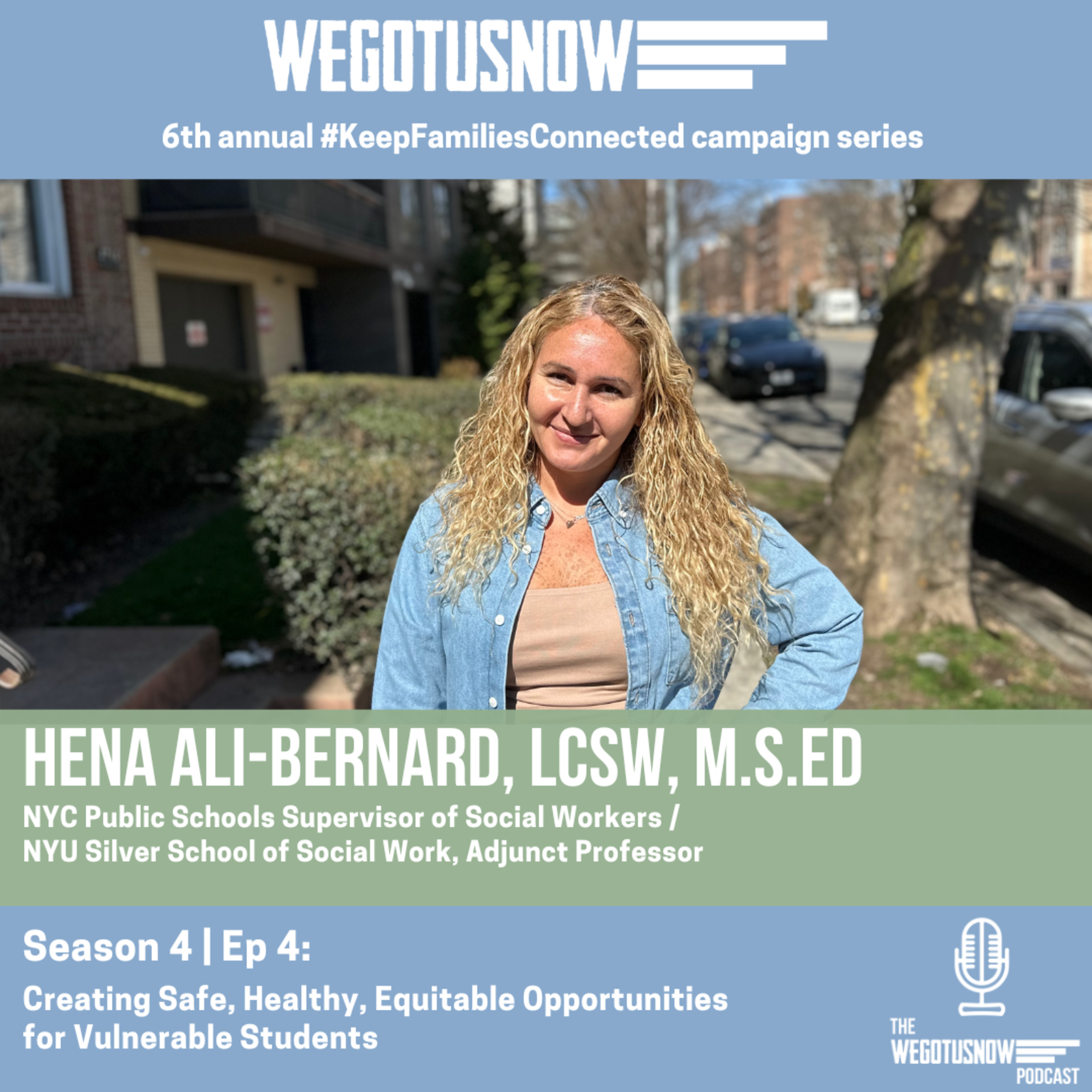
S4 | EP 4: HENA ALI-BERNARD ~ Creating Safe, Healthy, Equitable Opportunities for Vulnerable Students
43m 8s
WE GOT US NOW #KeepFamiliesConnected campaign series
WELCOME to Season 4 of the WE GOT US NOW Podcast series POWERED by The Just Trust
HOSTED by Ebony Underwood
For our 6th annual #KeepFamiliesConnected multimedia campaign series that runs from Mother's Day through Father's Day, WE spotlight voices from our community, and uplift our allies working across the field to create a just and equitable society that seeks to keep justice-impacted families connected.
Hena Ali-Bernard, is a Licensed Clinical Social Worker with a Masters in Educational Leadership, an Adjunct Professor at the NYU Si...
Transcription
7372 Words, 39475 Characters
Mass incarceration in the US is the great tsunami that has ripped apart families and destroyed communities. At the epicenter of this destruction are the children of those incarcerated. My name is Ebony Underwood. I am the founder, CEO of We Got Us Now. We got us now as the first of its kind, national, nonprofit, nonpartisan organization, built by, led by, and about children and young adults who have been impacted by parental incarceration. These are our stories. This is The We Got Us Now podcast, and I am sitting here with Ms. Hanna Ali Bernard. Hello, hello, hello. This is a really special conversation today because of who you are. Hanna and I met many years ago. Over 10, I would say maybe. Yeah, as soon as we met, we knew this is, we're last. Yeah, this is my girl, and this is forever. And it's been like that. She's been true to form and just a great, great person, great spirit, and the commonality that we share is that we both have had our fathers incarcerated. So, I'm gonna let Hanna tell you all more about who she is. So, to start, I am a daughter to two immigrants. My dad is from Pakistan and my mom is from Russia, and my dad was incarcerated when I was eight months old, and he was sentenced when I was two, and he served 10 years post-sensitant, so 12 and total. How did I cope? We were just talking about routines and how it's so important for children when we talk about early childhood development, which is a course that I teach, that children thrive in routine. They don't need surprises. They really do well when they know what's coming before and after, right? Adults as well. We need to know. It helps us get our mind right around the day, and that was the routine for my whole early childhood life. It was, you grind it all week. Your parents did what they had to do for you during the week. Basic needs were met. You went to school. People didn't know what you went through, because you didn't look like what you were going through. And I want to share a little bit more about that just in recent times. If I have an opportunity to, so my mom was working. My dad had a twin brother, who is my angel. And he's still here with me. His twin brother really stepped up and supported my mom and raising me. And he plays an identical twin. And their identical twins. And he played a critical role in my life. But more recently, I'm seeing the adversities that he's experiencing now based on his brothers and incarceration and the time he had lost supporting his non-biological family, like non-nuclear family, which was us. So, experiences. Through my whole elementary and early middle school years, my dad was incarcerated. We can visit, trailer visits, appeal hearings, like the whole nine. I just want to emphasize that it was New York State. It was New York State. People don't have trailer visits. Okay, so trailer visits are rewarded to those that have good behavior. It's literally a trailer, but a pretty trailer. It's in like a lot where they maybe have 10 or 12 trailer houses. And you get to spend time with your family for the weekend, so Saturday, Sunday. Does it like decorate it like a home? Like how is it? It's decorated like a home. I mean, a little on the sterile side. You bring everything that you need from food, to linens, to all of that. You go through very extensive searches. When you come in, I remember that. It was a clear, bob wired fence. And you definitely heard the rating of it opening and closing. You know, when you were coming and you knew when you were going. And then you had the guards up on top. That did checks throughout the day. They would come in periodically. And then the inmates would have to come out periodically. And you see the guards above. That would do count. So they would have count throughout your visitation time. I remember it vividly in the morning and in the evening. And it would be me, my mom, and my dad. Did you enjoy those? I really did enjoy those. On the sadder note, I actually really enjoyed my time in comparison to my dad being away here because my family then suffered when he was supported. So it was time lost here, but it was routine here. So I just really want to go back to the critical point that we don't know what we don't know. And so what I knew was that on weekends, I got to see my dad. I got to see my dad and his brothers. Like a sink sink for those that are familiar or not is a very family-friendly facility. Probably one of the more family-friendly facilities that do have a visiting area that's very supportive for children. And you get to have contact with your father in those spaces. And we would do arts and crafts. And my uncles were in the space with their children. And so I remembered that experience being normal. Like that was family time, right? Like supper for many of us that are viewing in at home this family time. And I got to have family time and routine on the weekends with my dad. And so he served the time. And there was a legislation or a policy that was put in place for all non-US citizens that committed a nonviolent crime were being supported. And so my dad fell into that category and was supported. And truly that was the extent that damaged my family because he never came back and our family broke then. Visited my dad once in his native country and my mom made a choice that she was not going to raise me there. She wanted opportunity for me as an immigrant herself. So it really all ends it there. And so my lived experience, again, back to that word routine, was here. He was here. And I got to see him in school. No one knew because I did not look like what I was going through. I was clean. I closed my wallet together. My uncle was very prideful around Jordans. I had to have all of them. They were clean. They were up to date, pre-release. And he took a lot of pride in making sure that there were no assumptions that could ever be made. And unless you knew he was my uncle because I didn't call him dad, I call him an Arabic word Ty John. People would have never thought. They thought they saw mom and they saw dad. And they saw a happy kid. And I was happy because I thought everybody went to visits on the weekends. And I thought everybody went to the Chinese store and avenue to get the canned fish that the inmates love to cook. I thought everybody did that. And so until my later years, and I started to really unravel and unpack the trauma of what incarceration did for my family. So I hope to come back to that piece around week. Don't look like what we went through. And many people out there are suffering. And whatever we assume people that are going through trauma or family separation look like, don't always look like that. That's absolutely true. You know that also well. You said that you began to really unpack how incarceration affected your family once you became a little bit older. Were you in your career? Because I'd love for you to talk about your career or even what led you to social work. So high school, what I would say was a pivotal time in my life. So my dad was released when I was in early middle school. So middle school, we were still trying to figure it out. There was like visitation, travel plan. So it was still that honeymoon stage of all of it. And then high school came and it was just like, yeah, we're not moving. That thing's happening. Hannah has to go to college. She has to do great things. And I started to look like what I had gone through. So the acting out, the fighting, that I'm going to come for you before you come for me mentality. My uncle at that point, I just want to say I love his family. But when I was an adolescent that sort of had like some delay trauma around everything that I was going through when my uncle got married, I was at a loss. I had now lost a dad twice. And I could not deal with the separation. He was my end of the year. So when he got married, when I was in high school, so he waited a really long time to make sure that I was OK. And then I was on my feet before he started his life. And I could not deal. I couldn't cope with really feeling that loss and having to share him. And so I was cutting school. My grades were suffering behavioral concerns. Like I was the one suspended regularly. Mom and him were coming up to school, all of it. And I had a really amazing team. And I just want to preface. I don't look like with the majority of children of incarcerated parents look like. And I hope that me saying that brings increased awareness, that not all people look like what they go through. And so we have to be extremely aware. And it shouldn't be that I had more support than my counterpart or my friends that were going through the same thing and overlooked. And so that really influenced my decision to be a voice, my decision to ensure that our black and brown youth are seen because I had a level of privilege that I know that my friends did it. And so I was wrapped in support. Like what's wrong, Hannah? What do you need Hannah? And like here, summer school. And my family was able to put me in private summer school for extra credits. And I was able to double up in classes. And I know that those opportunities aren't awarded for anyone. So I was really wrapped in support in high school. And I really want to shout out the team there. And my school, but that's not equitable everywhere. But why didn't you ask me something about that? So was it the fact that the educators in the school or the administration in the school knew your circumstance or was it your mother being proactive and finding supports within the school? So my mom wasn't proactive, not because she didn't want to be, but because she didn't know what was accessible. And folks didn't know my story until much later. Maybe when I was almost graduating that I actually did have a parent that was formally incarcerated. It was just, we expect better from you. And like this is not you when you have potential and that reassurance and validation. Like what is the barrier? What is it that you need? I was my own barrier. I wasn't in it. And so people saying like, well, what interests you? Like if it's not this, then is it this? And can we get you an activities and what's your bigger picture? And like, what do you want to do after this? I was not interested in going to college. I was like, I'm going to get my GED and I'm just going to figure it out. Shout out to my best friend, Angela, who you probably remember. She did my college application. She's like, yeah, I don't know. But you're going to do something with all of this kinds of energy that you have. And I got accepted to John Jay. And I was certain that I was going to be a correctional counselor. Like I was going to rehabilitate my dad's of the world. Oh, wow. And somebody was like, yeah, I don't think you're going to do that. And I don't think you're actually going to be good at it. I think you're going to burn out before you even start. And there was a non-for-profit that was doing some work on bikers that I applied for and I didn't get the job. And they were like, you got to work do some stuff. And this is just not how this is going to work. And you're not a good fit. And I was like, oh my god, so my whole lived experience is not going to make me an expert in this work. I took that really hard and I went to the drawing board and I was like, OK, so I have to make sure that all kids are as successful as I ended up being around opportunities and equity. And so I applied. I finished my bachelor's and I applied to NYU for my school social work degree. And that's when I know kids are in school for 12 years. We have kids for 12 years. If we're going to make and ensure kids are safe, healthy, emotionally well and successful, this is where it happens. And so I found my way under an incredible leadership team that has always supported me. And I believe in the work that New York City Public School is striving to achieve and is doing and is making their way there. And that's how I ended up in school social work because I didn't have a bad experience because I didn't have a lot of adversities that kids face with administration and with opportunity. I was given options. I was given chances. And I wanted to make sure that all students receive that. I was never asked where is your father. And it could have been, as I mentioned, the assumption that there was a male in my life. That was very present. And a mom that was very present. So there was a working assumption. But had someone asked me, I would have loved to say yes. And going back to we don't look like what we go through. I'm not sure what a child's of an incarcerated parent looks like. But we often do know what a child's of a divorced parent looks like. So why is that any different? And in all of my courses that I teach, I always categorize. I try to align the two. So when a child's from a divorce or a separated household struggles on Friday and Mondays, we wrap them in all the support in the world. So I maybe give them extra work. We talk about strategies. We talk about things that they can do around self soothing and self care. But we can be categorized in that bucket as well. Because we're going to visit. We're also separating from what we know Monday to Friday. We're getting ready for something on Friday. We have to come back Sunday night and get ready for something on Monday. And so we also struggle with the same adaptation of when we have to come back with all of the trauma that we're experiencing in unknown settings and get ready for eligible class. Like it is still very real for us. So I hope that school social workers in general become more comfortable with just asking the question. In New York state, is it legal to ask a child? Is it apparent as a car story? For those that do this work or are familiar with trauma work, there's an assessment tool that's called ACES. And ACES expanded now includes parental incarceration as one of the factors. And so I can't answer to the fact that it's legal or not, but I can preface that relationships supersede all of that. If you have relationships with those that you're serving, those questions can be asked. And you will know that information. I toyed with the idea that if we were able to screen everyone, there's so much we would know. There are some children based on their geographical location of their home that have one ace before they even get into the school building because of community violence. So if you factor in parental incarceration, if you factor in students in temporary housing, you have kids walking in with four ACES. So legality is real, right? I remember what we can ask, but support is also real. So what we don't know, we can't do anything with. So it's really about relationships and equipsing school social workers to be able to ask the questions, not always directly, but like, what did your weekend look like? What did you see this weekend? Is that something that you do often? There's nothing wrong with asking like, tell me more about your nuclear family. Who does that include? And sometimes what you don't hear is an answer. And then you can do the work there. I love that. Thank you for that. That was actually going to be, you know, some of my next question about what are ways that you believe that social workers can support students with parents and jails and prisons. I mean, are there other things that you feel like they could be doing? So I think assessments are huge, asking the questions, parent engagement, what do parents need? Like surveys, survey your community. Ask them what the needs are, bring the community into the school. We oftentimes, we always talk about, you know, the regular things, like the importance of school and tutoring and studying practices. But when we look at Maslow's hierarchy of needs, like we have to address basic needs. We have to make sure that students are able to learn. And if a child is worried about their parent and solitary confinement, I'm not quite sure that, you know, the ELA test matters. When you also talk about generational trauma and students that feel like they do have to walk in the path of the story that we've already created for them based on their parents' experiences. And so relationships, asking the questions, being extremely in tune with your community, being extremely in tune with changes that happen with your families, and asking families genuinely, like, what do you need? And asking students what they need. Do they even know they can tell you? I think if spaces are set up, students know. And students love to tell us what we want to hear. They sure do. I'm good. I don't need anything. A kiddo told me, "You showing up for us makes me want to show up for myself." And so I think if opportunities lend themselves to that, kids will be able to learn and identify what they need. Just like instead of asking what's wrong with you, ask the kiddo what's right with you. Have the adults that we work with wouldn't even be able to answer that, right? And doing some very intentional work around helping students identify their strengths. We often say they're resilient, they're resilient, they are. But how do we help students identify their strengths so that when they are faced with adversities, they're like, yeah, I'm not just loud in the hall. I'm actually really strong advocate. So what I do well is elevate my voice to work a room. OK, so you've got to tell us about how you became. How I became the supervisor of social workers throughout all Brooklyn schools. And Brooklyn is world renowned, OK? Brooklyn. [LAUGHTER] Why did you act for Brooklyn? You for Brooklyn. Yes, I'm from Brooklyn. I will always remain in Brooklyn. It is my roots. Yes, Brooklyn is a soft spot for me. So I came in the DOE as a district coordinator supporting one specific district in Brooklyn. So we are not the DOE anymore. We are New York City public schools, formally the New York City Department of Education. So we've changed our names to New York City public schools. I came in from foster care, so I worked in foster care with high rescues and reunifying families, supporting families have visitation, and ensuring that those that are incarcerated are still a part of children's educational plans and IEPs, which are individualized educational plans, because parents still have rights. Until they don't, they still have rights. And so I am proud to say that we've pushed every effort to make sure that our parents were part of that process. And it was actually extremely healing for a lot of the children to see, and I think we really modeled, the walls should not be a barrier. So that was that work. And then I was like, OK, guys, this is something next. And so I applied to a position supporting one particular school district in a very high needs community in Brooklyn, where I was able to support social workers. And that was through the first influx of hiring additional social workers for schools. And so what we did was pair them with school counselors, formerly guidance counselors, to support kids by adding social emotional lens to all things academia. So coming from the place of not what's wrong with you, but what's happened to you, how we can help, and really wrapping the child's up in support. The cases were very small. So there was no child loss in the sauce. I would hope to say we saw all children. And we had a great success rate. That program morphed into another program, which led into the pandemic, which was really just trying to put social workers in as many schools as possible. Did that work during that time? I went back to school to get my master's and educational leadership. I'm currently in a doctoral program for my educational leadership as well. Congratulations. Thank you. And as I said before, leadership that I work for, they see me. There was an opening for Brooklyn. And here I am, really, just like scaling the work and supporting students. And I got to say, we have the best administration in place right now to do that work. That is so cool. They believe in the kids. They see the kids and they will do anything for the kids. So talk to me about how your lived experience helped to even shake the way that you are now doing this work. Yeah. So vulnerable youth, right? Like, not all kids need the same support. And New York City Public School English, we always talk about tiered supports. Not all kids are going to need that tier three individual I support. Who does that mean? So when you think about tiered, you think about a triangle or ice cream. Everyone gets vanilla. Not everybody needs chocolate or likes chocolate. Not everybody wants the cherry. So you really scaffold the support needed. But it's about assessing what your community needs. So on a base level, everyone gets something. So whether it's advisory, a big brother program, push in lessons, until a classroom around anti-bullying or respect for all like every kiddo in the building receives a level of support. And then you're able to track trends to see what your other students need. Is there a trend exhibiting around like bullying or gang violence? And so then you group students together to provide group support, other targeted interventions, and then you have your kiddos on top. Us, the tier three kids that are having an experience that requires them to just have someone else, right? A warm person, additional level of support. They still get all the other things, right? They still get that lesson. They still get that advisory. They still get whatever it is that the school community is able to provide. They still get the additional check in. They still get maybe the mentoring. And then there's someone else. There's that something else that really follows you through to make sure that you are OK. And it doesn't have to last forever. Like I probably needed it in the sixth grade. And I probably didn't get it until the 12th grade, right? And it's to no fault to anyone, but really like understanding where kids are at, knowing your case load, like having integrity and the work that you do to know all your students to say, this is not baseline. For everything, this is not baseline for Hannah. I need to check in and do some additional work. And so I think being a vulnerable youth, not looking like what I went through, potentially being one that would have skated through without anyone knowing anything. We have a lot of kids that just know how to get by. I'm good. Miss Hannah, I'm good. Really? Because Monday, this was happening. Tuesday, I observed this. I'm a host face for you. What do you need? Who do you need? What does that look like? And so there's a lot of children that don't want to alarm people. They don't know what support looks like. So destigmatizing, the work of a social worker, destigmatizing, what it might look like with your peers to have additional support. And what do you do that? Relationships. Kids have to see themselves in those around them. And kids are really good readers. Their gauge on who's real and what's up is on a hundred. And also being able to show them opportunity. Like a lot of our kids don't leave their neighborhoods, which is fine. But how do we entice them about the opportunities available? Right, like how do we bring in successful local folks, people that they shop from, your local vendors, your grocery stores, your restaurant owners. You got to show kids success. You have to believe in their own success. Like you have to believe in their success. I'd rather them to believe in their own success. And so I think being a vulnerable youth really struggling to find my own place, right? Like I don't look like I'm from Pakistan. I definitely don't look like I'm from Russia. The community I felt safe and was flat-bush. And so I was always a one-off of the kinds. And I always felt really safe within my community, but I often think that other people might not have been so seen, right? Like I do stand out amongst those that I choose to surround myself with. And so I'll be seen before anyone else, but there are kids that are not seen and we have to see them. And so I think just knowing that and seeing that, my passion to ensure that the system doesn't fail the kids and then give them on a silver platter to the criminal justice system is I think how my dad's experience has shaped me. I mean, yes, I'm well for advocating for shorter sentences and keeping families together, but like let's take that back. Like how about we just don't incarcerate? How about we restore? How about we don't put people in positions where they feel like they don't have a choice? If I do nothing else and I can have kids not be there, I want to do that. That's incredible. I'm still happy to hear. So let's now go to the class that you're teaching at NYU. Yes, so we're still so sure. Yes, yes. So I graduated from Silver So it's literally an honor to be back there full circle. Like full circle. A guy is great, full circle, full circle. So I teach a course there. It's called Human Behavior on the Fawn School, School of Social Work and Adolescence in the spring, which is currently going on. And one portion of the work is trauma. And so we look at ACES expanded. We look at asking the questions around community, assessing community. So like if you ever put in your children's zip codes, like say you don't work in the community you live on privilege enough to work in the community that I live. So I know many of our students and educators don't. So being able to like put in your kids' zip codes and do an assessment of the community to see what the graduation rate is, what the crime rate is, what the food insecurity rate is. And being more aware of the students that are coming to you. So teaching that to those that are coming into the work, we hope prepares them better. So we don't have that massive learning curve when our students come in. And so they love it. They embrace it. I think there's a lot of our home moments that we don't know until we know. And so talking about trauma, talking about adversity, and then talking about a stress-based perspective and how you move the needle. So we say they're resilient. They're resilient. They'll get through it by how. Like where's the stress in all of it? How do we take a problem and find solutions while seeing the child? So culturally responsive practices, making sure that we embed culture. And that's a teammate of mine is really spearheading that work around culturally responsive practices and ensuring that when you have no one asked me if I had any affiliation in school with my last name, had anyone ask me, like, is your father Muslim? Would have changed so much because he studied Islam heavily in prison until all of my calls with my dad was him trying to recite prayers. And I just wanted to talk to my dad. And so when you think about culturally responsive practices, are we asking something like that? Like tell me where you come from. Tell me where your family comes from. How does the culture impact you in this space? And so we talk about students' own experiences of their culture and their ability to be in a graduate program at such a prestigious school. And that is opportunity for them. But other students that they might eventually work with, culturally, maybe not value school as much. So how do you want that at all? How do you provide psychoeducation for the family or bring resources in for the family so that the child can maybe not be a part of a child. And do work. How do we create plans where the child maybe does work in school? So really, like you get the whole adolescent life at all of the barriers that they might face during their time in school and figuring out how we put those systems in place and assess what our kids need. That's awesome. So now I want to go to your personal advocacy. Number one, I want to thank you for inviting me. And we got us now to come and be a part of this event that you produced or hopes to call stand together this week in our seat. Yes, we can talk about that. So you can talk about stand together? I can talk about it now because it was super successful and partners in the work, such as yourself, really came through for the kids. So as you know, community violence, unfortunately, many of our broken communities, our New York City communities, are not-- it's not a foreign topic. And so there was a student that was shot and killed in the community. And coming to just do our regular visit in the community in the schools which I often do, it just sparked a conversation of like we need to celebrate kids. And co-located campuses are a beautiful place to do that because you get to have all the different cultures in the community. I mean, all schools are great. But it's like so nice to see kiddos coming together. And we really wanted to do a targeted piece of our game prevention because some of our kids are vulnerable to that. And I reached out to a local community organization that's called Taylor Made by a King who are all formerly incarcerated people. And I was like, all right, so I need the kids to hear the message. Most importantly, I need them to be celebrated. I need the kids to be seen. But also really wanting them to talk to people that have walked a different life. Show them how things come full circle, also be able to talk about their lived experiences. On the other end of that, it would be a disservice to make an assumption that the whole community would be impacted by this. So we had about 28 workshops going between educators and students that had nothing to do with game prevention and incarceration. We had yoga and mindfulness. We had a room of therapy. You talked to students about parental incarceration. We got us now. It definitely did their thing. We had trauma-informed practices. We had vision boards. So kids got to choose wherever they wanted to go. So if the topic hit, they were in it. If it didn't, they got to choose whatever they wanted. And they were able to have a different type of instructional day. They learned-- I strongly, strongly believe that they learned and they got a lot out of whichever workshops they decided to go to. And we were able to provide lunch, thinking New York City public schools for covering that for the students. They had a DJ. They had a dance off at the end. I mean, they had a time. The event went down without a hitch. Kids were incredible. I stayed back and talked to some of the kids. And they were like, this hit. Like, we really appreciated this. And one of the young women said, you guys showed up for us. And it makes me want to show up for myself more. So it was incredible. So it really just built in community awareness. Plus, it began prevention peace to show kids other options. We also had folks come in and do money management. There were a couple of gamers to talk about alternative interest. I'm not very well-versed around that. There was somebody that did some stuff around beats and music and fashion. So we really tried to run the gamut so that kids were inspired and excited. And it was a huge success. So really, really, really happy about that. The kids were so sweet. They were very, very sweet. And they gave me some great feedback, too. I got a lot of great feedback. Thank you for inviting us. Thank you for being there. Why do you believe that the work we got us now is so important. It should be in spaces. One, I don't think it's talked about enough. I think incarceration is minimized and it's stigmatized. And it's always aligned with a particular group of people that make particular choices. And those are the choices that they can never be rehabilitated from. And the children have to follow in the path of those choices and in communities such as Conorcy. Where there's a lot of assumptions about what's going on there, right? And if you geographically look at it, it can be super residential and one block. And you have some housing complexes on another block. And so, incarceration doesn't have a face. Family incarceration doesn't have a face. And I think children need to see people that might have the same list of experiences as them so that they have permission to be. And they have a place to be. And if they are not themselves impacted by it, but they are friends with someone, giving the friends the voice and the vocabulary and the permissions to say, like, I see you and I know you've never talked about it, but I went to a workshop and I just want to let you know. I know some things different and I think I could talk about it. I think I could be the person that you can talk about it with, right? When we do grief counseling, right? Like we normalize some things. We give people the tools, we give them the strategies. And it's an assumption that like everybody will lose somebody one day. And so this is the tool that everyone should have. It should be the same thing as we got us now. It should be the same thing with parental incarceration because anyone can be impacted by that. White, black, purple, green, right? Like young, old, it can happen to anyone. And people should be aware that that is also a type of loss. It is also a type of separation. And most importantly, it's a major trauma. And it doesn't just happen in the walls. It happens post-sense and saying, like, for me, I'm unraveling now things that, like I thought I was accepting of. And I'm not. And so it's something that comes in it goes. So we got us now a needs to expand this voice. It needs to give everyone the vocabulary, the grace, the space, and the education to be able to support those that are struggling with incarceration, they themselves that might be impacted and realize that we can be in any room. With the pretty stool, or with the sneakers, or with the babies in our hands, or the baby in someone's hands. Like, we are everywhere. It's so true. You know it, you know it. And we don't look like what we've been through. OK, did she not say that? We don't look like what we've been through. You know that with us wholeheartedly, people like, wait, what? You went through that all the time. What are we supposed to look like? Is that what we're in now? Yes, I want to know. There is no face. There is no face. We're having had a parent incarcerated, or being a daughter, or son, with the impact of our own own incarceration. And so I thought it was really important to have this conversation with you just because of not only your lived experience, but your expression of empathy and care and devotion and commitment to this work. You are shining light. Thank you for standing up strong in what people consider some of the worst parts of this city. Being there, right, and seeing the children that are there. And that's so powerful on so many levels. Because, yeah, the narratives are not necessarily true. I was there. It's not necessarily true. Those kids are wonderful. And they're interested, and they just need to be seen. So thank you for the work that you're doing, Hannah. You, again, very, very, very much so inspired by you, and really uplifted by the work that you're continuing to do. Thank you. Thank you. It takes a team, and we have a village, and I'm holding that. Is there anything that you want to share beyond this? Is there any words of wisdom that you want to leave our listeners with? I'll share something very personal last night. I went to my mom's house, and I said, "Mom, do you have any of the hats like paperwork, his dockets, his proceedings, his transcriptions?" And she's like, "Yeah, I do land the box over there." So I took him home, and I was up online reading it. I had never read my dad's paperwork. I just have it, and I am 35. I've never read it, and he's been home for over 20 years, and I'm reading it, and I can't put it down. And there are a couple of things that really stood out to me. I'll start with the end. After he was sentenced, there was a few concurrent sentences that he served. He would have never come out. And I said, "Thank you, Jerry, for deliberating and for reaching the consensus." And then someone says, "Judge, may I ask for the pedigree?" And I reread that sentence about five times, and I was like, "Pedigree, I have a cat at home. I know my cat's pedigree." I was like, "Pedigree." In the documents, they often reference my mom, a one-year-old baby, 15-month-old baby, 18-month-old, so on and so forth, and brother that are at every court hearing. And so when I think about pedigree, I want to visualize the kennel that he would be going into, and then the little tags that say pedigree and what it is. And then you think about the pedigree stems from somewhere. So if he is pedigree, so am I, right, like I am an extension of that. And to know that the system can just move so swiftly from taking everything away from the people in the courtroom, to just being so factual with like, "What's your name, your date of birth, your address?" And then just closing the book. And it ends it there. It ends it with, you know, the period after the address. And so what I want to say to anyone listening that is experiencing the serenosis is that it doesn't end. It doesn't end when it's distancing is over, it doesn't end when the people, when the families are reunited, it never ends, and the trauma comes in waves. You think you're okay. The event on Monday was remarkable, but it left me with a lot of questions that I didn't think I was going to want to revisit and reading those documents makes me have more and more questions. And has really opened up some wounds for me that I hope can help me get the closure, but if you are impacted or you're supporting someone, just give grace, build awareness because we are forever in some form of a process, and many of us are always in service of others. And so you never know where we might be sitting with any of it. So just give us grace and know that we see you, we got us now, I see you, and we are all here for you. So I will leave you all with that. Thank you for that. Thank you for being a part of we got us now, of course, forever, forever in our community. With we got us now, I still appreciate you. And what you've been able to share today, it really, wow, just really touched my heart, what you're saying, because it's so true, you know, you begin to like digest this information and begin to really like see it for what it truly is, and it's so unfortunate, you know, we released our report last year, and we released it during May, when the US Surgeon General said that isolation and loneliness is a public health crisis, and you know, just talking about trauma and stigma and shame. We know that all too well, right through our experience, but as you said, we often show up in our own service of people or others, I think a large part of that, I'll speak for myself from so much of my life to just kind of ignore the circumstance I was going through, but also to just be able to say to some people like that we see you. So I'm just so happy that we got us now with such a vast community, and we have, you know, superstars like yourself doing the work and being able to share. Thank you so much. Thank you for having me. Yeah. Thank you so much. My name is Ebony Underwood, I am the founder, CEO of We Got Us Now. We got us now as the first of its kind, national, nonprofit, nonpartisan organization built by, led by, and about children and young adults who have been impacted by parental incarceration. To learn more, to join, to donate, go to We Got Us Now dot org.
Podcast Summary
Key Points:
Summary:
Chat with AI
Loading...
Pro features
Go deeper with this episode
Unlock creator-grade tools that turn any transcript into show notes and subtitle files.
 PodcastTranscript AI