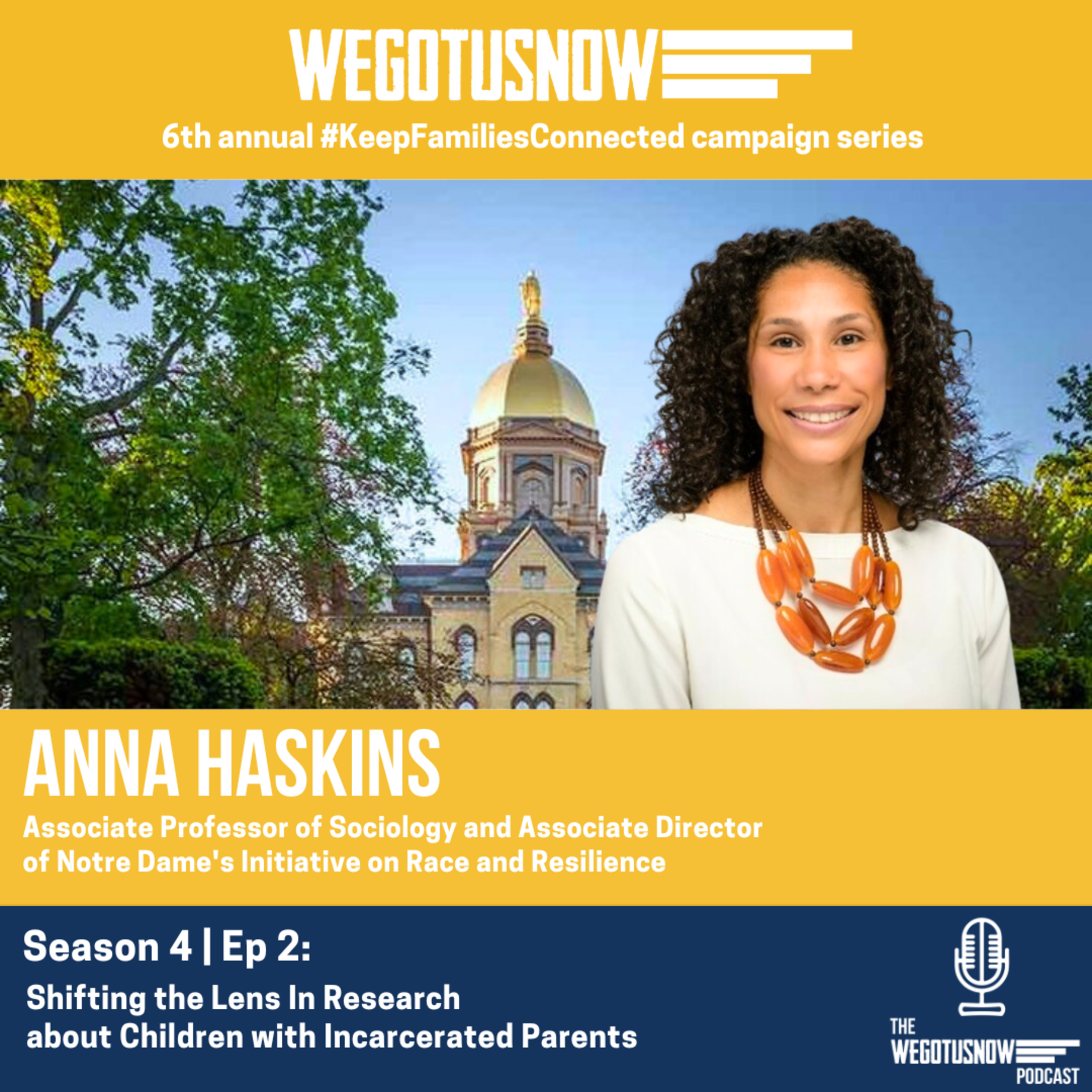
S4 | EP 2: ANNA HASKINS ~ Shifting the Lens In Research about Children With Incarcerated Parents
39m 46s
WE GOT US NOW #KeepFamiliesConnected campaign series
WELCOME to Season 4 of the WE GOT US NOW Podcast series POWERED by The Just Trust
HOSTED by Ebony Underwood
For our 6th annual #KeepFamiliesConnected multimedia campaign series that runs from Mother's Day through Father's Day, WE spotlight voices from our community, and uplift our allies working across the field to create a just and equitable society that seeks to keep justice-impacted families connected.
Anna R. Haskins is the Andrew V. Tackes Associate Professor of Sociology and Associate Director of Notre Dame's Ini...
Transcription
6345 Words, 35641 Characters
Mass incarceration in the U.S. is the great tsunami that has ripped apart families and destroyed communities. At the epicenter of this destruction are the children of those incarcerated. My name is Ebony Underwood. I am the founder CEO of We Got Us Now. We got us now as the first of its kind, national, non-profit, non-partisan organization built by, led by, and about children and young adults who have been impacted by parental incarceration. These are our stories. I am here in South Bend, Indiana. This is the We Got Us Now podcast. It is January 18th, very, very special week here in South Bend and for me personally. We are here at Notre Dame and I'm here sitting here with the esteemed Anna R. Haskins. She is the Andrew V. Tax Associate Professor and the Department of Sociology. She's a sociologist. And she's also the Associate Director of the Initiative on Race and Resilience here at Notre Dame. Anna, welcome. Thank you and welcome to you to Notre Dame. Well, I am thrilled to be a part of the group that brought you here. We were working with the Center for Social Concerns and the Initiative on Race and Resilience to raise awareness for those that are most impacted, vulnerable populations because Catholic social teaching focuses on really wanting to raise awareness and support those that are most marginalized. And so with that as the frame for Walk the Walk week, which is a week that Notre Dame does every year to honor Dr. Martin Thurking. We thought the Center for Social Concerns and the Initiative on Race and Resilience thought it would be really great to focus on a population that is often marginalized and vulnerable in the United States and that is children on incarcerated parents. And so, drawing on you and coming to your nonprofit and really connecting to bring you out, to talk to our student body, our faculty, our university. This week was really important. We are so honored to be here and they have welcomed us in this really cold time snowy history. Wanted to talk about the issue of children of incarcerated parents and why this issue in particular resonates with you in your research. I'll just give a little history. I discovered Anna through an article that she wrote that was focused on education and the trajectory of children of incarcerated parents, particularly black children that had experienced parental incarceration and their trajectory. From school into college. As I was reading this article, I was like, "Who is this person? I got to find this person. This is fantastic." I reached out, I found you and come to find out you actually cite. Yeah, you cite us in a published work. Oh my gosh, I was like, see, the synergy was there immediately. And so we connected and then like, "Well, once later, here we are." Yeah, yeah, yeah. Well, I'll be happy to share my interest in this population. I am not personally impacted by parental incarceration. But I come to wanting to study this through thinking about racial disparities and educational outcomes and thinking about what other social institutions does the United States have racial disparities in. And that drew me to the criminal justice system and thinking about the impact of why do black and white students still have disparate test scores in educational outcomes? We have to look to other social institutions where we see racial disparities and ask, "How are these interacting with each other?" So the work that I do looks at the intersection between families, schools, and the criminal justice system. And I primarily focus on black and white disparities and I look at fathers incarceration on children's educational outcomes. And that comes from a personal aspect. I was raised by a single black father. And so I think a lot about race in those ways. I think a lot about fatherhood in those ways and I know how important my dad is to my life. And then thinking about the systematic removal of black men from communities due to mass incarceration has implications for kids because of how important it was to have my dad in my life. So this idea of father absence through death, father absence through military service, but there's another massive form of father absence in the United States that is created by our criminal legal system and that's the removal of parents, fathers, and parents from their families. And so that really led me down this path of really wanting to understand the impact of a parents incarceration, a father in particular, on children's educational outcomes, and then disentangle and understand the race component to it. And I've studied this from children as young as three to the paper that you referenced, which is looking at 15 year olds. And so across early childhood adolescence and into young adulthood. Yeah, fantastic. And I think the lens in which you look at it is for us when we got us now is just so refreshing because it is not deficit based. And it's not calling what we experience a problem, but looking at the surrounding experiences and circumstances that have created, you know, situations for children of incarcerated parents. So, you know, kudos to you as an ally to us in this work. It really is important and necessary, especially as a researcher and as a sociologist. And so I know prior to being here in Notre Dame, you've only been here for three years. This is my third year here. I was an assistant professor at Cornell University. And you studied the same thing. And you also prior to this was a word teacher. Yeah, yes, yes. So my other background and really interested in education is because I am trained as an elementary school teacher and I taught for several years before I went to graduate school to study sociology of education. And so as you have been researching and studying this issue right and as a sociologist studying people, what have you found to be a narrative that you felt like you want to uncover or just or bring more light and awareness to. Yeah, I think for me, it's been the narratives that are out there that I want to dispel are the ones that I'm most interested in with my research addressing, right? So there's ideas that men aren't good fathers or there's a lot of narratives, particularly around black men as uninvested fathers, particularly around if they're not married to the child's mother. And so these ideas that these dads weren't involved in their kids lives anyway. So why would their absences due to incarceration have any impact on the kids? And so my work really tried to show that that's not the narrative that the data shows. The data shows that dads, regardless of what we call residential status, are very involved in their kids lives, whether that be financially, emotionally, physically in the way that playing with their kids, they're seeing their kids regularly. Including monetarily or they're contributing in kind, diapers, shoes, things like that, right? This idea that they're supporting their families in ways that show care when the narrative, the stereotypical narrative out there is that these dads that are criminally involved and more likely to be incarcerated are bad dads. And that's why their kids are performing poorly. It's not because of anything else. My work really tries to switch the narrative away from this individual narrative about behavior to a broader understanding of how society structures, opportunity, and views, fatherhood, and that there are ways in which we can show that these dads are involved. And that their absence through mass incarceration has negative impacts on kids, educational, behavioral, mental, and social outcomes. God is so important, the work and the way in which you are really helping the shift of narrative around this. So much of our work involves children, young adults who have parents, particularly a father that has incarcerated, particularly a black father who has been incarcerated. And when we do speak about this issue more often than not, the fathers are present, the fathers are making an effort, even despite the barrier of a prison wall. Most people hear it from us and may think that, oh, we're biased because it's our lived experience and it's our parent. But to hear it from someone like yourself, it just validates and really brings to light what we as an organization want to also bring to light. And the fact that, you know, what we need to look at this in a more humane way. So I love that the focus is around that. I know you and I spoke to around like race and how race has played a significant part in the way that we incarcerate in this country. Yes. I'd love for you to speak more about, you know, you're getting trouble. Scholars that study mass incarceration will say that there are lots of ways in which a society can create a justice system or confine those that are breaking the law, right? So that's, you know, what we think about in terms of imprisonment. And so there's often a comparison to Scandinavian countries that have a very different way in which they think about justice. Their prisons are much more humane. They allow for family connection. It's not punitive in the same ways. It's not completely sort of demoralizing the way that is in the United States. And I think there's always an argument of why can't we do that here, right? Like why can't we look more like some of these other Scandinavian countries in terms of the way in which we incarcerate or imprisonment or conceptually think about the criminal legal system. And my argument, the conversation that I always want to engage in when people have that bring that up is to say we don't racially look like Scandinavian countries. And so one of the reasons why the United States criminal legal system is the way that it is is historically we have had to find a need to marginalize black and brown bodies. And we started our country with slavery as that way when slavery was abolished through the Constitution, we found another way through Jim Crow laws. When Jim Crow laws were struck down, we found another way to figure out how to continually contain and and marginalize black bodies. Many scholars, it's not me historians and scholars of the criminal legal system will say that the rise of mass incarceration is not coincidental to needing to find another way to maintain white supremacy in the United States. And so in your classes, right, and you have a class on some of this time. Yeah, I teach a class called the social consequences of mass incarceration here at Notre Dame. Most people know that it sucks to be incarcerated from the individual person's experience, but no one really then thinks beyond that. And they don't we don't talk broadly enough. And I think we're getting a little bit better now as a country. But 10 years ago, 20 years ago, when I was really starting to do this work, it wasn't a conversation that we thought that this had any implications for anybody else other than the imprisoned individual. And so now the point of this class is to say, we're not going to talk about the imprisoned individual at all. We're not going to read any work about what impacts this has lots of negative impacts for the imprisoned individual. The class's purpose is to focus on all of the other kind of concentric circles around the imprisoned individual and think about and read research that shows the impacts of mass incarceration on the family, if we start thinking about it, the relationship, the incarcerated person and their romantic partner relationship. Then you think about how that impacts families and children. Then you can even think about how that impacts communities living in a high incarceration community. Even if you yourself have never experienced incarceration has implications for your economic, social and political work, activism, access and agency. And so to start with the individual kind of is important, but if we end there, you ignore all of these broader social consequences. So having had a family member incarcerated in one generation can predict less economic opportunity and lower education and less and worse health for the next generation and the next generation. Or opportunities for these things. The class really tries to focus on all of the other areas and start thinking about how mass incarceration impacts, how the institution of mass incarceration in the United States impacts individuals, families, communities, romantic relationships and beyond. And society. What do you get from the students? Cornel students and Notre Dame students are similar in the sense that these are elite private schools and so many of the students don't have experience firsthand experience with the criminal justice system. And so the information is surprising to them. The reaction is often I had no idea. By the time they leave the class that little nugget of initial interest has grown to being something that they want to then be a change agent in whatever aspect of the social problem that they're interested in too. So it could be to support families. It could be to really change policy. Many students go to law school or want to pursue thinking about these broader issues from a transformative legal standpoint. And many students just leave feeling more informed about the country that they live in. The reason why I think that what you're talking about in this particular class is important. That is so often the narrative that we get from people that are that ever hear about our experience as daughters and sons. Who had a parent that's incarcerated like oh my god I never knew or oh my god like how is this happening or where is this happening and then hearing the stats about who we are they're just blown away. So allies like yourself are a necessary component to unveiling you know what has been this stain as I call it a mass incarceration in our country and like beginning to you know really get rid of it. Because if we don't talk about it how are we ultimately going to get rid of this problem for us. It's about looking at the root issues and seeing how we can begin to slowly like an onion take off the layers and really look at it. So very similarly are doing that in your work which is fantastic that is great to hear some of the work I'm doing right now is really trying to understand the role of other supportive institutions in either addressing these issues or making them worse. And so I'm looking at schools for young kids and thinking about how schools can sometimes be a place of refuge for children experiencing any sort of childhood trauma. And it could be lots of things including parental incarceration but also schools could make that worse for kids because either they're not creating supportive environments because this isn't talked about and it's a stigmatized issue then teachers aren't saying hey let's talk about this. And so we talked a little bit about how recently Sesame Street has had really has come out with two I mean it's been really interesting because they now they have the newer opioid muppet right so so they have these they created these muppets to really share opportunities for kids to be able to say I have an incarcerated parent these are the feelings that I experienced thinking about them. And helping parents caregivers and teachers really just community members support members help young kids through understanding this experience and now they're doing that for kids who have parents with addiction because kids in our day and age are truly dealing with these hard issues. They really are. And it was hidden before but now you know thanks to your work and the work of the folks that are really kind of trying to make this something that's more talked about at the surface we're really starting to address them bring more voice to traditionally or historically invisible or invulnerable populations. Yeah we definitely acknowledge you and our most recently released vision and impact report and because of just the way in which you shape the narrative primarily because the narrative has been so deficit based for our community we've been known as a historically invisible population. I don't know how much of that you knew prior to our work like how much of it being a historical invisible population how much you knew about that and if the way in which you do frame this work where you cognizant of like you know what I'm going to make a cognizant effort to really reframe and shift the narrative about this community because. Yeah you just even in the way your approach to this class right it's not again it's not looking at the deficit is looking at things around the structure the structure yeah yeah I mean we talked a little bit about this earlier where the invisibility of the population makes people think it's such a small population so one of the things I really pushed against when I was starting to do this research was an argument that this is a niche population why should you care about this it's only a handful of people how can this impact society right. So where I come to Ebony's work is because I was looking for resources I could cite to show that this wasn't just I mean I knew it wasn't but to have a citation or some evidence or research because again I'm a researcher right so we have to kind of have our receipts for the claims that we make right that there is a large population. So I was looking for something that looked reliable that I could you know use as a claim to say look at this population is much larger than we think so 10 million is really one in 35 kids. Now there's more work that can show with population estimates that it's one in four black children experience parental incarceration one in ten Latino children experience incarceration and one in 25 white children experience parental incarceration. And so those numbers when you mush it all together come out to be about one in ten American children have experienced in some point in their life appearance incarceration. There are you know pretty significant racial disparities within that number to show that this is an experience that's primarily felt by kids of color. But it's not to say that there aren't white kids that experience it there are many you know one in 25 is a lot still. I think it's probably closer to one in 15 or one in 10 now with the opioid epidemic really kind of ravaging more rural white areas of the country that that number has increased. Something that's experienced more you know more often than than not through childhood from any children. Yeah and the separation of these families in the way in which we separate these families has not been helpful to our community at all. It's actually been very harmful so having studies and having articles and having research that can pull out what these harms are these structures that we talk about that are causing harm and figuring out how do we do better. That's part of the work that we're looking to do for the future of we got us now everything about what we've been able to do thus far you know has been fantastic for us right being able to put past policies being able to build a nationwide network. Being able to be in community with you and at different universities across the country to really like find our community because as you share it right. We know that of the incarcerated population over 50% of them are parents yeah of those 93% are fathers most incarcerated individuals are men and so out of that 50% that are parents most of those parents are fathers children need their parents. Yes right and parents need their children yes and as a parent yeah you know you recognize how how traumatic the other side of that separation is as well right. We often talk about the impacts on the children the impacts on the young adults and there are absolutely those but that's just one side of that kind of a dietic relationship and just thinking about as a parent now how trying to even be empathetic about how it might feel. To be separated from your children that's incredibly hard yeah it's just challenging with these numbers and with these statistics. It just makes it all the more pressing about if that is the population that's incarcerated imagine how many children are actually impacted and have been impacted and as you shared. These numbers are an underestimate right so 10 million is probably vastly greater especially in light of the opioid epidemic that's happening in our country. And the way that you know it seems like some of what has happened over the last 10 years which to me is deemed successful in all of the reform that's happening to some degree. We have much more to go but some of it feels like it's rolling back and so I love to hear you know your insight about what you've seen over the last 10 years with the reform and then even like now today where we currently are with the reform. If we stopped incarcerating tomorrow and never did it again how many generations would it take for communities and families to recover from that trauma so many. It's so true and so I mean there's always a part of me that's like yes reform is good yes we've made progress but it doesn't actually erase the fact that there are still 10 million or however many number we want to say children families and so many communities that are still impacted. The impact doesn't go away when we just pass a reform it doesn't mean that that's alleviated off people's you know backs or memories or experiences reform is good reform is needed movement forward is what we need and want but it doesn't stop us from still thinking about what have we done already and what kind of lasting existing trauma there is. We can't rest on our laurels if we reform like as it even if we abolish the carceral state tomorrow we still have to fix and address and recreate sort of structure to support the families that we have harmed yesterday and 50 years from yesterday so thinking about when mass incarceration really started ramping up and thinking about all of those families and generations and communities that have been impacted so we can't just do reform movements that look forward. We also have to have reform and restorative movements that address the historical harm absolutely without a doubt if we cut out the criminal justice system and it was done right no more incarceration is so true we still have 50 years of policies that have been in place and that have surged then what the heck I mean me knowing from personal experience that institution really is divisive to families. The families and you know the destruction of families and the ripping apart of families and what that has caused and normalized for so many families that is absolutely not normal we talked about this a little bit with some of our our community we talked about just in the way that as a coping mechanism so many of us have just kind of ignored the experience or just been you know treating it as if it was wrote being able to visit in humane way or being able to like yeah. What people are now calling video visits as if that's a replacement. Yeah for the length of some way to yeah to visiting and person and that should never ever ever be the case. I would love to for you to expand upon that because you know now a technology just exploding yeah that has been the digital experience which I think is great to be able to have it right but to never be a replacement. So I would love to hear your inside about that especially as it relates to younger children. I'm trained as a sociologist but I dabble a tiny bit in developmental psychology and this idea that at every developmental stage there are needs that a human has right so an early childhood you need a type of so physical touch and intellectual development and that changes as we grow old for me. All of these technological change are sort of what the policies that we might want I think have to be thought more carefully there's not like a one size fits all right so as we move to thinking about digital engagement with family members that are incarcerated humans rely on physical touch and rely on social interaction. That's what makes us human and so to remove those things in particular from you know solitary removes one from social interaction right and this idea of digital communication as the replacement for in person visits removes the idea of regular physical touch from loved ones. From the equation is dehumanizing right like this idea of humans as a species need these things and we're removing those things from the lived or day to day experiences you know my take on is is a form of dehumanization when it's. I think communication is really important and it's amazing that we don't have to rely on telephones anymore to have communication and videos are great for that you want to be able to face time people the pandemic taught us that but the but it doesn't replace this however many times the people that are policy makers or wardens and prisons or. For a correctional officers may not themselves experience parental or familial incarceration and so they don't know the experience they don't know how it would feel and that's where we got us now comes in terms of a voice and the advocacy to talk about how important it feels from the perspective of children and young adults I'm incarcerated parents and so raising awareness and having to be able to speak from your experiences are really important for pushing policy and convincing. Policy makers researchers and those that have power to think more humanely about the decisions that they make what is. Something that you found in this work that has been most surprising to you not so much from the directly impacted population or more so from. The people that you're sharing with maybe stakeholders or you know people some of your students. I absolutely have a robust body of literature and research that talks about this I don't talk to stakeholders very much not a lot of stakeholders come ask me about my research but I think there is a disconnect very much so between policy and policy makers and academic researchers who study. Any academic researchers I think a lot of criminal justice policy is often put forward by economists who think you know as a kind of a different way of thinking about policies policy makers like to have like switches or lovers that they can say like let's do this thing and it'll fix this problem. I think sociologists are kind of like there's not really a quick fix we're kind of more nuanced we're like well I think it's this I think it's that and that makes it really hard to translate my research into a pretty neat clear. I think it's a very important thing to do in this work. Across a number of educational outcomes. Children with similar backgrounds poverty or wealth race. Two parent household single parent household kids that look similar and always except for one is experienced incarcerated parent a father and the other hasn't the kids that have experienced incarcerated father. Parents are do worse and educational measures of success and that's not surprising it's very consistent in the work that I do one of the things that I find is that that is not commiserate with their actual intellectual ability. And so what you know what's really important in the work that I do is to show how one is performing in school is not matched to their you know intelligence but oftentimes the things that are we use as measures are someone else's opinion or assessment of that child. And so teachers assess kids with incarcerated parents as less capable even though their test scores or intellectual ability is equivalent or higher right so we can think about what are the kind of agents that are crafting or putting kids on particular trajectories right. One of the other things that I study is a special education placement and grade retention so that was our not based just on test scores it's a teacher saying well I think the student should go into special letter I think the student should be retained and sometimes it's also based on parents advocacy or inability to advocate for their child. So what I study is often not you know what I would say is that kids are intellectually their smart kids with incarcerated parents are smart kids they're the structure set up against them they have less access to resources that then puts them on paths that lead them on educational trajectories that are not as successful as similar kids without incarcerated parents and that then brings an eye on what is the education system doing to me I try to take it away from it's not anything there's it's not deficit based on the kid. It's like how is this system schools for example or teachers or society not supporting the success of this kid and what I find as I travel as I follow kids through schooling starting with school readiness and moving now to high school is that kids with incarcerated fathers are equally optimistic about the future. They absolutely see worth and value in themselves there's something about what society is telling them about college and their likelihood to go to college that changes their perspective in ways that we don't see in kids with incarcerated parents and that's that that last paper that we kind of started this conversation about. So it's trying to show that there's optimism there's hope there's resilience there's joy but there still is this dampening effect of the criminal justice system through appearance and incarceration that kind of hinders kids holistic view of success at least when it comes to thinking about is college for them. And it goes back to the stain. It's that stain that's forever there and you like trying to get that stain out in the midst of trying not to be what the stain has told you to be like this is your destined to be. So yeah I love that you pulled that out of there because it's so true I often struggle with that with the with the notion that you know these narratives continue to be perpetuated about who this community is and they're just they're just untrue they're just untrue. But all of these members of our society take it because it's there as data and research and believe it and hold on to it that's why voices like yours are so important because it definitely begins to give a different lens that is not only necessary right because it's the truth. But also it's necessary to the well being of these children's lives I mean in our report we have a timeline where we break down how do we get here with mass incarceration right beginning from the 70s and in that timeline what we discovered is that it took from when the sensing guidelines were put into place in the 80s. Up until 2007 so 1987 to 2007 it took 20 years for Congress to even recognize that this was an issue that innocent children were being affected and that's when they decided to pour tons of money into research. And I have to tell you we sat back and watch as an organization we've like studied you know the landscape and we've seen that most of that research which to me is very fragmented it's all over the place. It was all deficit base right and it was pointing the finger on to the children right as if they were the problem and then we need to save them yeah before they turn into they grow into versions of their parents right as if there's some you know criminogenic factor. Associated with having a parent incarcerated and so the fact that it's a 20 years was a big deal right for them to even recognize us. But then when it was recognized it's still was harmful this is often kind of in my mind why researchers we need to get more people into graduate school to do this research that I've experienced these things themselves. Because they won't ask the same questions as someone who has never experienced it and the question we need to answer is why are these kids this way and then you find the answer that you want by you know through these deficit models or these blaming the kids themselves are blaming the victims. And so I mean part of it is we need more diversity in the research arena and I think that's really really important. Well you are a shining voice and I'll say this we got us now as well has been identifying people with lived experience who are researchers and are bringing forth their expertise. Not only as professionally as a researcher but also as a research specialist but also as a daughter or son that has had this lived experience and thankful to you for you shifting the lens and really bringing light to something that has been historically invisible for so long. We need like a hundred thousand of you. And I think we think you can imagine that we need more politicians and policymakers that have experienced this themselves to start thinking because you have a body of knowledge and experience that can help craft policy right you have a body of knowledge and experience that can help craft research questions better research questions than the ones that are crafted from someone that does not come from that that experience. And it's not the say that I think anybody that does research on children of incarcerated parents has to be a child of an incarcerated parent right. But this idea that more voices that have experienced it will add to the types of questions and the knowledge that we're drawing from to be able to come up with better policies and stronger research to support kids because I think where I come from all of this is that I want everybody to be treated humanely. I want a society that supports its citizens and I don't think that is representative in American society right now. And so like, you know, you can choose the one path that you're going to go to try to work towards that need more people thinking about this population and among other things. Yeah, thank you so much for this. Thank you. Is there anything that you want to share with our community? We have, you know, we're rated at top 10. Congratulations. Thank you. So yeah, we would love is there anything that we should be doing? Is there anything anything? No, I have the same questions like, I told you like, is there anything I should be doing? How can I help you? You know, like, I think that's how I feel, right? Like, I don't think there's anything that I could say what you should be doing, right? I think, I mean, I think maybe the one thing I would say when we were talking is that collective action and vocal advocacy is really important. So I just hope that if there are people that are watching this that haven't yet joined your organization that are experienced, you know, that are a part of the community to speak up to join to say, you know, to raise their voice. And then if there is anything I can do, please come find me. I'm over here at Notre Dame. Well, I would say, thank you. You have helped to visualize this population tremendously and even for this week, right? Walk the walk week here at Notre Dame University and being able to have, we got us now, be representative and being able to be exposed to this community. Again, it's helping us to really build awareness across the country and spaces. I don't know how we would have been in Indiana otherwise. We are happy. I'm so glad we're talking. Yeah, we are happy to be here. Thank you, Kudos to you for being an ally and other allies. This is how you show up. Like Anna, thank you so much. Thank you. I really appreciate you. Mass incarceration in the US is the great tsunami that has ripped apart families and destroyed communities. We got us now as the first of its kind, national nonprofit, nonpartisan organization, built by, led by, and about children and young adults who have been impacted by parental incarceration. To learn more, to join, to donate, go to WeGotUsNow.org.
Podcast Summary
Key Points:
Summary:
Chat with AI
Loading...
Pro features
Go deeper with this episode
Unlock creator-grade tools that turn any transcript into show notes and subtitle files.
 PodcastTranscript AI