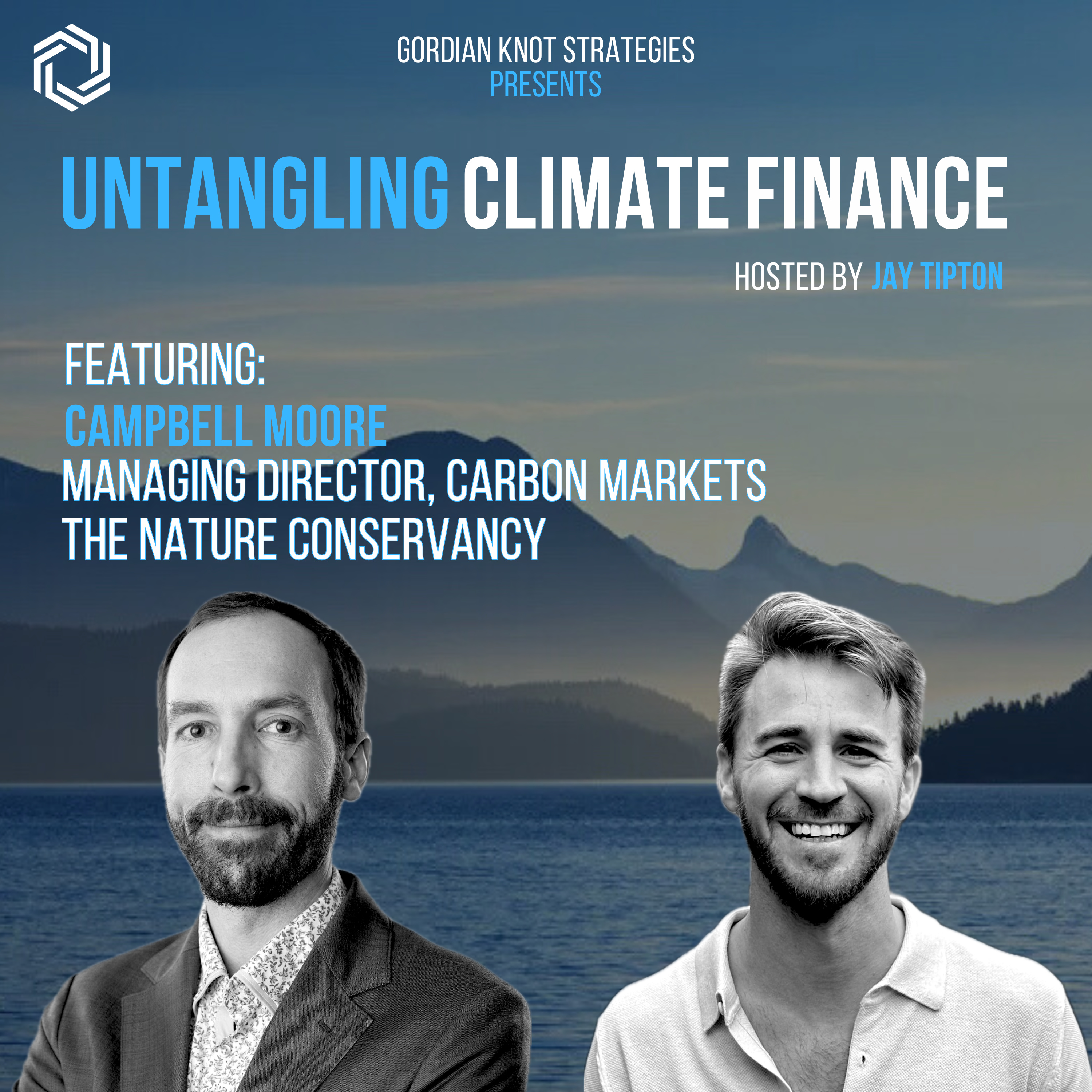
S4 E4: Campbell Moore on Turning Carbon Projects into Investable Businesses
from Untangling Climate Finance
42m 19s
In this conversation, Jay Tipton hosts Campbell Moore, managing director of carbon markets at the Nature Conservancy (TNC). Moore brings over 15 years of experience, including auditing nature-based carbon projects globally and protecting forests in the central Appalachians. He admits to being more skeptic than supporter for much of his career, but now says he has never been more excited about carbon markets. The discussion highlights the urgent need for carbon markets: over 80% of the world's largest companies are off track for net zero, and no country aligns with a 1.5°C pathway. Carbon markets can bridge this gap by channeling climate finance across borders to fund unfunded climate solutions, especially in developing countries. Moore emphasizes that if done right, these markets could direct tens or hundreds of billions of dollars to indigenous groups, smallholder farmers, and forest owners, making them a powerful poverty reduction tool. However, most nature-based carbon projects fail to scale because they get stuck in a "Valley of Death" between early philanthropic support and commercial investment. To address this, TNC launched its Natural Climate Solutions Accelerator and Carbon Business Incubator, which helps launch 15-20 projects by turning them into investable businesses. This involves shifting from NGO-owned projects to for-profit special purpose vehicles (SPVs) that can attract equity investment. The goal is to prove what good looks like, learn from real-world implementation, and shape global policy and finance, ultimately demonstrating that carbon projects can operate as viable businesses.
(upbeat music) - Howdy everybody, welcome back to Untangling Climate Finance. As you probably know by now, I'm Jay Tipton from GordyNot Strategies. Today I'm joined by Campbell Moore, the managing director of carbon markets at the Nature Conservancy, which is one of the world's largest and most impactful conservation organizations. Cam has spent the better part of two decades in this space, auditing nature-based carbon projects around the world, protecting climate-resilient forests and the central Appalachians, and now leading TNC's global carbon market strategy. And by his own admission, he's been more skeptic than supporter for at least half that time. So when somebody like Cam says he's never been more excited about carbon markets than he is right now, that's worth paying attention to. Here's why our conversation today matters. Over 80% of the world's largest companies are currently off track for net zero. No country is fully aligned with a 1.5 degrees Celsius pathway. And 2030, the milestone that we've all been pointing to for years is now only four years away. Carbon markets won't solve that gap alone, but they are one of the most powerful tools we have to direct climate finance across borders and into the communities and ecosystems that need it most. We're talking about the potential for tens, but hopefully hundreds of billions of dollars to float to developing countries, indigenous groups, smallholder farmers, and forest owners around the world. Done right, this isn't just a climate solution. It's one of the most powerful poverty reduction tools on the table, but here's the problem. Most nature-based carbon projects never make it. They get stuck, caught between early stage philanthropy and the commercial investment they need to scale. Cam calls it the Valley of Death and crossing it requires something the market hasn't always prioritized. Turning carbon projects into actual businesses. That's exactly what TNC's NCS accelerator and carbon business incubator is trying to do. And in this combo, we dig into how that works in practice, what it takes to make a carbon project look and feel like an investable business to a serious investor, and why interoperability between voluntary and compliance markets could be the unlock the whole sector has been waiting for. Okay, enough from Jay. Let's hear from Cam. Hey, Cam, welcome to the show. How you doing? Good. Hey, Jay. It's good to be here. Thanks for having me. Of course, and where are you calling in from today? I live in a little town up in the mountains in West Virginia, about maybe three hours away from Washington, DC. Beautiful. And you've been there for some time? About 10 years. Yeah, this was my escape from the city, escape from DC, I guess, before COVID made it cool. With it here, it's a town of 650 people with my wife and my two little kids, and it's an amazing place to be. Lots of nature around. Yeah, you can't beat that, and you certainly beat the trend because that was the post-COVID trend to get out of the cities. Although I think people are starting to flood back into the cities, and that's what I'm not sure if it was long lasting. Yeah, people missed the good food. Absolutely. Awesome. Well, Cam, obviously I know a bit about your background, but to get us started, why don't you give our listeners a sense of what you've done and where you come from and how someone goes from working in forestry and the central appellations to leading carbon market strategy for, as you know, one of the world's largest conservation organizations. Yeah, good question. And like the talking heads, I do sometimes wonder, how did I get here? So to answer that fairly briefly, I think for me, it really starts actually, when I was at Peace Corps Volunteer in the Gambia and West Africa. So that was about 20 years ago at this point, the Gambia is a small, pretty densely populated, extremely deforested, very poor country. And I worked there for about two and a half years, I guess, on Reforestation and Agroforestry. And I lived in this little community of 18 households and with a family there. And there was a nearby forest reserve, a pretty small one, and it was pretty degraded. But regularly my family that I live with went to that forest reserve to illegally cut fuel wood for their own use and to sell it to others. And sometimes I helped them because of what we had do to help them make a living. And that didn't feel great. I'm a lifelong conservationist. So I left that experience, I think, quite humbled by the challenges and the reality of feelings people around the world living in developing countries and living close to the ground, really. And the struggles that they have in trying to care for themselves, their families, but also the environment and meet their needs. So I left really wanting to find something that could be used to simultaneously restore and protect nature, but also make people's lives better at the same time. And I stumbled upon carbon markets not long after that. And I've been doing it in one form, another pretty much ever since. So yeah, Peace Corps. And then after that, actually, I'm going to graduate school for forestry, forest management with a pretty strong emphasis on carbon accounting and climate. And then my first significant job, I guess, after I just been working the Philippines for a bit. But after that, I joined Brain Force Alliance and I ran their Global Carbon Object Auditing Program, Auditing Nature-based Carbon Credits around the world for about five years. Then I got very burned out on that and on carbon markets. And I said, I'm out of here. And so me and my wife moved up here in the mountains in West Virginia. And I joined the Nature Conservancy and worked actually on protecting climate resilient forests in the central Appalachians that are incredibly important part of the world for several years. But carbon markets kept pulling me back in. So about four years ago, the opportunity came up to lead TNC's Global Carbon Market team and really build the team and lead the strategy. And here I am. And I've never been more excited about carbon markets. I think with that background, starting as an auditor of the 15 or so years I've been working in the space, I guess, a bit longer. You know, I've been more skeptic than supporter, at least half the time. But I'm just extremely excited about this space and where it's headed right now. So, Kim, obviously, 15 plus years, you've seen a lot. You've seen all the iterations of the carbon markets, the ebbs and flows, the challenges, and then the responses to the challenges. But let's look at this from like a bird's eye view or a high level, why do carbon markets matter? - Yeah, great question, Jay. And I think we all need to get better at this about making the argument for why carbon markets matter before we jump into the latest and greatest with Article 6.4 or other kind of fine details. And if climate is your number one priority, you should be really excited about the potential of carbon markets right now. So there has been issues in the past with carbon markets, for sure, we know that. So what I'm talking about here is like the potential of the carbon markets that are coming into being right now, which is a new level of integrity, a new level of science, a new level of scalability. That's what's really exciting. So if climate is your number one priority, we need to all be realistic about the reality that if you look at the 4,000 largest companies in the world, this report from Accenture, a couple months ago says 84% of them are off track for net zero. And if you look at countries, no country is fully aligned with a 1.5 degree pathway, right, to net zero, right? So we're falling behind. We have made progress. Don't lose hope. We've made a lot of progress. But there's a really, really big gap between the progress that we're making and the much faster progress we need to make for companies, people, and governments to really align with our global climate goals. And that's a big deal. And carbon markets can help because what a carbon market does, if you think about it, is it allows that government to find sources of climate solutions around the world beyond their narrow national borders, right, and to finance those. And to use that to help them meet their climate goals. And it allows a CEO or a CSO at a company to find climate solutions around the world beyond the narrow scope of their value chain, basically, right? And so to finance those climate solutions. And so they have this incredibly important role in helping bend the curve of our emissions by helping close that gap. One thing I would be clear about first and foremost, like internal decarbonization by companies and governments. So investing in decarbonizing their countries and their businesses, that is priority number one. But this gap is so large that we're not going to close that realistically on a climate relevant timeline, which means years and a decade. Without a tool like this, that can play that global matchmaking role of allowing climate finance in one part of the world to float unfunded climate solutions in another part of the world. So carbon markets can help us close that gap. It's like super important. So that's the climate argument. So then if you care about poverty, if poverty is your number one priority reducing poverty, you should be excited and you should get involved. Because we're talking about the potential, like it's not guaranteed, we have a lot of work to do. But we are talking about the potential of tens or hopefully hundreds of billions of dollars to be invested into flow through these markets over the next five, 10, 20, 30 years, right? And if we build--
Nature-based carbon markets. So that doesn't mean only nature, but that means nature is included. And those markets have good rules and norms for equitable finance, right? From making sure that everybody benefits from the line that flows through. Then this is an opportunity for billions of dollars to flow to the communities and the countries that have comparative advantage when it comes to nature-based solutions, natural climate solutions. So we're talking about developing countries, we're talking about indigenous groups, we're talking about smallholder farmers, we're talking about forest owners. So there's an opportunity for billions of dollars to be invested in the ability of these people to unlock climate solutions. So this is a way to democratize access to climate finance at a global scale, which I just think is profoundly exciting when we think about how to fight poverty. Alright, last one. If you care about nature, which everybody should care about it, you know, we know that natural climate solutions like reinforced station, like restoring wetlands, etc. The IPCC tells us that this is the second largest set of climate solutions after the energy transition. So we need this and there's the potential for those tens of billions of dollars to literally make our planet greener and cleaner and restore ecosystems at scale and protect them at scale. And when you add it all up, to me, this is of metaphysical importance, right? We're just 8 billion people floating around on some rock and outer space that somehow has life on it. And this is a solution that can help stabilize the atmosphere that makes that life possible, make people's lives better, and make this incredibly beautiful planet that somehow miraculously has life greener. So it's a big deal. And I think everybody should be excited. It is a big deal. And to your point on the last one, which is like nature, everybody should care about it. And I think that sometimes we take that for granted. And I was just at the park over the weekend and there were probably 2,000 people at this park playing games, having barbecues, green, whatever. And it's just like, I think sometimes we don't connect like those nice moments that we have on a Sunday with our family or our friends as to being hand in hand with nature. Even though we know we're physically outside under the sun, enjoying the weather, taking shade from a tree, all of those things. But it's just like it sometimes just so obvious, but also we take it for granted. And so I like how you framed it that way because I do think that that is such like a big part of the challenge, but also just like the reward that we get by getting involved or by like actually putting these things on our own minds. Definitely. Yeah, as the world grows, we certainly need more of it. And we do. We value it. Whether we realize it or not. So anyways, that was brilliantly framed, Cam. I loved all of those very well done. Thanks, Matt. And obviously, you know, it was a very nice transition because I think this teases us up well for one of your, well, two of your initiatives at TNC. Of course, TNC is involved in a lot of different projects and initiatives across the globe, but I would like for us to talk about your natural climate solutions accelerator and carbon business incubator. So what are these and at a high level, what problem are they trying to solve? Let me root this in our overarching strategy for carbon markets. So as you kind of can tell from my a little feluliquy there, like we have a vision for carbon markets and what they can do for the world if they're done, right? And we are trying to make that vision real as the nature conservancy and a global portfolio of projects. So that's our natural climate solutions accelerator and business incubator. Yeah. But then we're also trying with others to make that vision real in the systems that govern these markets, right? And we'll shape where there's 10 to billions dollars go. So science policy and finance. So the accelerator and our carbon business incubator, which is it's the same program at this point. This is really about helping us build that portfolio that represents our vision, build that portfolio of projects. And I think it's maybe helpful to start with like, why do we do this? So carbon markets can help the nature conservancy finance conservation. But that's not the main reason why we have this accelerator and why we're helping launch these projects around the world. The main reason we're doing this is to sort of show what good looks like to make that vision real. And to prove the art of the possible and frankly also to learn to like make dumb mistakes and also come up with good innovations. So that when we are helping shape that science policy and finance at the global level, we're doing it rooted in the perspective of like a real world practitioner that has real people working on the ground. And partnership with communities and NGOs and businesses in 81 countries. So we think that's really important to like not only be at the high global theoretical level, but really to find that tension between that and being an actual implementer. Yeah. So most of the projects in the accelerator are ones where we're helping a Indigenous group or an NGO in East Africa or a group like that actually stand up and launch their project. So basically we're like a semi-pro bono developer and then business launcher here and our goal jokingly says to lose money strategically. You know, we're not trying to compete with the four-profit developers in this space. We're trying to find the carbon projects that are a few years ahead of the market and then maybe have a risk profile that those developers or investors might say. So I'm not sure what you're risky like I'm not ready to try to pull off that big project in San Bia with a local NGO that's never done a carbon project before. We think that's like a really important role for an NGO. It's like absorbed some of that risk. So with the accelerator goal is to launch 15 projects around the world. We have 20 we're working on right now, not all of them will succeed. We're going to support them from the earliest possible idea all the way up to the point that they secure long-term investment or long-term finance on good terms that benefit people and then they're sort of off to the races from there. And I guess maybe that hopefully helps capture it at a big picture. Yeah, absolutely. So then just to be clear, the NCS accelerator and the carbon business incubator are a joint program. They're not too separate initiatives. Yeah, they're a joint program at this point. I mean, this kind of gets to my point about learning as we implement, right? So we started the accelerator maybe three and a half years ago. And our mental model was we're going to help launch carbon projects. And so we're going to support these projects up to validation basically. So up to like the first certification the project needs. Well, the carbon market has changed a lot and matured a lot, right? Which is good. And now for most carbon projects, if you want to stand up a large scale and nature based carbon project around the world, you need to raise $10, $20, $30 million for that project. Yeah. So maybe less than 18 months ago, we were like, oh no. Projects aren't good enough. We need businesses that look and feel like a business to an investor. So that's where the incubator came from and we've since sort of emerged those two programs. Got it. That makes sense. And this is great because in our past conversations, you've actually framed the effort as turning carbon projects into investable carbon businesses. So I love if you can unpack that like, what does a carbon business look like versus a carbon project and why does that distinction matter? Yeah. Yeah. Good question. So I think like the carbon market of 70 and 12 years ago, you know, the market I was auditing when I was at Rainforest Alliance. You had a lot of projects that were being launched by NGOs and sort of owned and operated by NGOs for the long term. That wasn't the whole market, but that was a big part of the market. And the way, you know, the projects were often financed by a lot of philanthropy. And then the way the project sold credits was typically, you know, in the spot market, right? So we're in use this philanthropy. We're going to produce the product carbon credits and we're going to sell it as it comes in with that money back into the project. Yeah. Or if you could get upfront money, it was sort of a form of project finance. So I commit to give you 100,000 credits. You give me $2 million or whatever it is right now. And I'll give you those credits when they come up. And I think that market, it still exists a little bit, but it's just not again, it's not sophisticated enough for the investors of today's market that want to put in 20 million dollars on a project. That market can't support equity investment in projects. And so the difference really is like taking that NGO owned and operated project and spinning it out as a special purpose vehicle as an SPV. That is a for profit entity. And that can raise that investment and that has a CEO that looks like a CEO of a business and is a CEO of a business. And then really operating it as a business that needs to generate returns for investors for communities and for everybody else involved. So to big shift, it's sort of a mine shift state. It's also a shift in the staffing, the type of people that work there. Yeah. This shift and the legal entity status. So getting like an SPV stood up. Right. And that's really what this is. So true. And also like a good sign, right? Because it's just obviously like a sector maturing. Exactly. Right. As it goes from the way that you explain it to a much more, it looks like a business. It feels like a business. It talks like a business with the right people in there. So it's a good evolution. And it's a natural one, obviously, but it's one that we need this to happen. Yep. Exactly. I would love to like hear something in practice. So if you can do that, that'd be great. So maybe the first one I'll share is I think a good example of how we try to like support the projects that maybe the private sector isn't totally ready for yet because there's just a risk profile. We're really excited about a project that we're partnering with international Indian carbon coalition and the boys for band of the Chippewa Northern Minnesota. This project is called Akin Ashaan, which means take back the land. And this project, yeah, we started out there.
process. So we're starting to be more public about it now. But the sort of innovative aspects of it that the accelerator makes possible are one. It's the first standalone project in the world to use this dynamic baseline improved forest management methodology under Vera called VM45. This is the one that TNC and Terra Carbon and American Forest Foundation developed for the Family Forest Carbon Program. Yeah. So that's like a big program and rolling hundreds of landowners. And we said, all right, does this work on one large property, basically? So that's a real innovation that we're bringing to the market and it looks like it is working quite well. And the other piece is this will be a tribal owned project, right? So it's not like I'm going to own this project and I'm going to have some nice benefit sharing. We're helping them build and own and operate their own carbon business. So that's just some exciting innovations there. That's awesome. Another one in East Africa and Tanzania and the Eastern Arck mountains, you know, super important, global biodiversity hotspot. We're working with a group called Eden People and Planet on a combined red and reforestation project. And this one, we've already, well, Eden has already spun out the a for-profit enterprise called Compassionate Carbon because they're an NGO to make it possible. And then we're working with them right now on like what is the right type of legal entity to stand up in Tanzania that complies with local regulations there? And how do we raise their requisite investment in that SPV to help this project really scale up and function as a business? That was in our pilot for our business incubator and we're already in talks with major global investors to support that project. So good proof of concept. Yeah, that's great. Both interesting projects too. And I like the global reach. I imagine a part of it is like, of course these, you know, the indigenous group, for example, they know what they're doing in terms of forestry and taking care of the land, but they probably don't have the technical know how of what makes this a carbon project, right? Or how is this qualifier? You know, what are the certain requirements? And so it's nice that you have this balance where you can come in and help them through that. And then hopefully give them the keys to the kingdom so that when you step back, they've learned everything that they need to know and then going forward they are in the driver's seat. Yeah, that's exactly right. Right. And so we're bringing in this project early and then we're providing the scientific and technical and financial modeling advice and expertise into the project. And obviously they have much of their own expertise as well. For sure. And then we're also bringing in some funding, right? Because like this stuff costs money to get up and running. So we have a phased financing approach of like philanthropy at the beginning and then low interest loans as the next step and then full on commercial finance at the end of that when the project is graduate from the incubator. Nice. Can you actually go a little bit more into that? Because that's what I was going to ask or my next question was going to be like, obviously you know that in today's carbon markets, buyers for probably for the better are a lot more cautious. scrutiny is higher. And so the capital has stepped back in some ways, but it's more that they're just looking at these projects with rate or risk portfolios, which again, not a bad thing at all. And so there needs to be a lot more sophistication, I think, from the project. So you kind of just skimmed this, but I would love to hear more of like actually how the incubator model unlocks finance that wouldn't have otherwise flowed to the project or the project developer. Yeah, great question. So let me go back to the point I just made about financing strategy, right? So I think just risk exists right in the carbon markets. We should just acknowledge that it exists. You got to identify it. You got to figure out where it's held and how you reduce that risk. Yeah, and pretty much any project, honestly, or many of them, but certainly the ones we're working on, they come in sometimes very early, I jokingly say, someone's like, I saw a forest. Is that a carbon project? So they come in quite early and we put philanthropy in that early stage because over half of them don't pass our feasibility, right? To absorb that risk. And then we move on to that low interest loans, like bridge finance basically, and that supports the initial implementation. So I think like, cool, you have a nice PDD for a Reforestation project, but can you actually plant a million trees? So getting trees in the ground, for example, if it's a Reforestation project and that transformation from a project to a business, so the whole incubator phase. And what that's doing is increasing the professionalism of the project, as a business, making it a business, and decreasing the risk profile. Again, figuring out, like working with the right legal support to stand up the right type of legal entity to receive an equity investment in Argentina, right? That's just like something you have to do and full stop, but to make this thing look like an B and invests full business. Higher and equality CEO, getting the business plan in place and having the team be able and trained on like how to pitch the business, right? Understanding the long term financial model. How are you actually going to return, returns to communities into shareholders in your company? So all of that, right? Making this increasing the business functionality. The piece around the bridge finances so critical, and again, that's one of our learnings we didn't have two years ago, because what that allows you to do is build that track record to the project, lower risk capital. If a project goes straight from, at least the ones who are working with straight from like philanthropy to full on commercial investment, they just have a high risk profile and they're going to need the investor might need a 24% IRR to justify that risk profile. But what that means is there's in practical terms, there's less money available to make people's lives better and to actually produce the outcomes on the ground. So if we can use low single digit to mid single digit loans to support the project for three years to actually get a track record on the ground, plant trees at scale, get the community benefit sharing agreements done, get all that ready, then you can come to that investor and you've traveled a good way down that risk profile curve and all of a sudden a very different IRR profile is viable for the investor. The philanthropy, whether it's TNC or someone else, the philanthropy and then the bridge finance, it comes in early, that is making it possible for the returns of carbon projects, like a bunch of money that happens when carbon credits are sold to go to communities and conservation rather than to just financing costs. So it's like a tremendous thing for a donor to think about doing with their money. It really is and I think that I know that you know this but like so many projects get caught at that early phase where that finance is so crucial and that bridge can really make or break the future of the project beyond five, ten years and so it's just like those first couple of years where the risk is higher but every like dollar matters so much more that's just like where a lot of momentum is lost unfortunately and some projects just don't make it past that. It's so it's absolutely vital that exact period. Yeah that's how you get across the Valley of Death like that's what you're bridging. You know yeah that's a great way of putting it really is the Valley of Death and unfortunately you see it a lot you know and I think I just read a survey I can't remember who it was the other day but it was basically you know it surveyed 70 different companies that are involved in markets one way or another and that Valley of Death was basically it was true it was basically like we are we've got a great model we've got a great plan we've confident we have a great product and you know there's like high integrity but it's just like we're struggling to go from year one to year three essentially. Yeah totally. It's a big deal. It's a very big deal. All right Cam so we've obviously been talking a lot about voluntary carbon markets but of course Twin is the compliance carbon markets which are very large more and more coming online on the national level I think there's like 30 something that are currently active or in development or on the five yard line and you of course have flagged numerous times in your past the inner operability between both voluntary and compliance markets and how that is a massive opportunity so I would love to explain for listeners who aren't really deep in the weeds why is this hard and why does the inner operability between the two matter. Great question and I think inner operability is like the word of 2026 so first sure first sure be interesting year okay so first thing I should actually I would say is like the projects we're standing up in the NCS accelerator I hope that those projects which will generate carbon credits for 20 30 40 years will sell a lot or maybe the majority of their credits into compliance markets right that's kind of proof point of interoperability if we reach that but first let's define like what does this mean versus wonky term really mean so I guess I would put it this way when we say interoperability what we mean is that across the major voluntary carbon markets and major compliance markets so think of the market under the Paris agreement that's coming into shape think of national and subnational compliance markets where governments regulate use of carbon credits that there's enough share DNA across all these markets in the fundamental science and in the fundamental rules and the fundamental like investment norms of these markets that I don't know maybe in 2032 something like that we wake up and we say you know what I guess there are multiple voluntary and compliance markets in the world but it doesn't feel like that anymore so it starts to feel more like global currency markets right where I can buy stuff around the world and I I don't have to like fly to India with like a satchel of dollars and then figure out how to get rupees and then change it and like you know it's just like way too complicated so just feel like I can buy stuff from India I don't know what's going on the currency
conversion. I don't know where about that. I can just buy it. And I think we need the carbon markets to feel like that. And what that will do is that will allow a project to sell credits into voluntary and multiple compliance markets. And that makes that project more successful, much more predictable, financial model, and investors need to be able to invest in all of these markets or several of these markets and have it really feel like it's a single global market. They can't learn the rules of like a thousand business small carbon markets. That means we're not going to scale up. Yeah, 100%. And it's been done as you just explained, like from spices, all sorts of imports, exports, coffee, you name it, most commodities, like operate on a very cohesive global market. So there's no reason why we can't get there with some work. And I think, again, using a concrete example is helpful. Singapore's market has become a bit of a test case here. And I know that TNC is developing a few nature based projects as part of the accelerator. So maybe you can go into what makes Singapore's approach interesting. And what are you learning from it that could apply more broadly? Yeah. So a couple of really key things about what Singapore is doing. First, they are an undisputed thought leader on global carbon markets. So awesome. How they've sort of seized the wide open field and they're going to have a huge impact on the future of the world because of that. But a couple of things they've done, you know, one they didn't reinvent the wheel. They didn't say we're going to send a group of experts off to the top of the mountain for 10 years to like start from scratch and think about what carbon market rules should look like. They adopted the best methodologies that already exist. And I think they have a real culture within this of like improvement of a time, right? So they're getting started right now with the best opportunities, the best methodologies that exist. So that's super important. They didn't reinvent the wheel. Number two is they are integrating credits into their market basically through article 6.2. So this is one of the flavors of credit trading under the Paris agreement that allows country to country level trading, right? Where two countries get together and decide their own rules on what the credits should look like and how to trade them. By that bilateral, that country to country trading creates great flexibility. But to be totally frank, it does also create the risk of lower quality. And Singapore is sending a clear signal that they want very high integrity and high quality, right? And that nature plays a really important role. So I love that. I think they're just helping really shape the future of article 6.2. On the project side, TNC was really honored to be the recipient of some grant funding from the Singapore Economic Development Board nine months ago. I think so that we could help develop some pipeline projects to go into their system, right? To sell credits into their system. So these could be projects in one of I think it's 12 countries around the world where they've basically set up the framework for trading credits into the Singapore system. So just like a great thought leader example. Yeah, absolutely. And I love how you said that they're not reinventing the wheel because I think that is key. Key to a lot of things. The market now is at a place where it's obviously been focused on building the integrity, both in the voluntary and the compliant spaces. As more countries get involved, it's just more time efficient. It's more resource efficient. And it's just like the clear mind thing to do, which is borrowed from the best practices that are out there versus spending five years reinventing something that's kind of already been done for you by other entities, use 15, 20 years of experience such as you have. I love that approach and I'm encouraged to see other countries that are getting involved doing a similar thing that are saying, you know what? We're going to work with Vera. We're going to work with gold standard. We're going to allow their ICBCM CCP approved methodologies to generate credits here versus Brazil's doing, which is like creating all of their new methodologies and things like that. I'm just like, is that the right move? I don't really know. Something I think about a lot is like, if you're going to say we're in a climate emergency, then you have to also act like that. So what that means is like the litmus test for all of the decisions that we make and we talk about this in my team. But I'm going to think for all of us around the world, there are climate advocates, the litmus test for our actions should be, is this going to help us fight climate change better or faster on the timeline that matters? Which again, is like years, not decades. Yeah. And I mean, Cam, it's crazy. It's 2026, right? Like, this is that decade we're supposed to be doing it. Yeah, we're supposed to be doing it exactly. This is the decade we need to be doing it. 2030 is only four years away. I remember when we were saying by 2030, we're going to have all of these things figured out. And I'm like, well, we're over halfway there. So we can't spend two, three years deliberating anymore, like because the window is closing. And we know this based off all of the signs the planet earth is showing us. So yeah, I'm with you. I'm absolutely with you. It's an emergency and usually an emergency is you tend to move quick. Yeah. It doesn't mean you have to do it carelessly or recklessly, but certainly with speed. Yeah. This is like a weird thought I have. But I often think about with climate action and carbon markets within that, when are we going to get to like the movie montage moment? Right. So if you think about right any of these like big disaster movies, there's always like a lot of conflict and everybody's arguing for their own specific solution. And then people say, you know what? Screw it. Like let's just get it done. Let's have some innovative and novel partnerships and strange bedfellows and be flexible in our thinking. And then you get to the montage, which is the really fun part, right? And so I'm waiting for that. That's why I hope that happens in my career. Yeah. Yeah. I appreciate that because I used to work in filmmaking. And so it's like with the montage, you always kind of show 30 pages of script in about four minutes of that because everything's moving. It's getting things done exactly. So you're like, we don't need to drag this out. Let's just boom, boom, boom, boom, boom. So I like that take montage moment. Hopefully it's around the corner for us. Cam. So we obviously spoke about supply. We just talked about interoperability. And I think the other part of this is the challenges with demand. So the demand for credits, we're lacking sufficient incentives to act in the voluntary space, right? Like it's also the world, the companies that are doing this in a voluntary way is tremendous. But we do need to address demand. And of course, Corsias helping that there are some avenues. But from the demand side, what is something that you would change to basically incentivize demand? Yeah. So I think companies, supposed to talk about voluntary markets, I think companies actually do have very strong incentives to act. The business case, we know the business case for doing this is very strong. But the problem is there's also a very strong disincentives, right? Good companies are worried that they may take climate action in good faith and then have some reputational risk or litigation risk because of that. So I think the most important thing we need to do is define what is the right way to use carbon credits on the journey towards net zero, on the journey towards climate goals and define what is the wrong way and make rules for that. This is not a new idea this is just called regulation, right? Whether it's voluntary regulation through voluntary standards for government regulation. But it really frustrates me that the debate over what is and what isn't greenwashing plays out in the media and on LinkedIn. And I think we just need to make some damn rules, right? Let's define this and then companies will know, okay, this is how I'm supposed to act. This is how I'm supposed to use carbon credits. Here's how I'm not supposed to use it. Right. And as we make those rules again, everybody should be asking themselves that litmus test question, given that huge gap that I mentioned at the beginning between climate progress, we're making companies and governments and the much faster climate progress we need to make. We should be asking like, if I make really, really restricted rules that mean you basically can't use carbon credits or you can use them in a very limited restricted way, is this actually going to accelerate climate progress? I would say it is not. So we need those rules and we need those rules to recognize where an emergency. Yeah. Couldn't agree more. All right. So if we're looking ahead and I have you back 12 months from today for season five in 27, Cam, what's the headline that you'd love to be able to share with listeners? Yeah. So on the TNC side, there's some really exciting work that we're doing in the innovative finance space that should become public this calendar year. And so I'm really excited to share that when it's out. But I think for the world, you don't make good headlines because they're wonky, right? But like the things we need to accomplish are one, make further progress on that interoperability. So I don't think the New York Times isn't going to put up a headlines that says, you know, interoperability achieved. But we need the fundamental rules and norms of voluntary markets. Corecia article 6.4, the way countries use credits under 6.2, the EU 2040 commitments, the new open coalition on compliance markets that was launched at COP. We need all of these rules to converge quite a bit to scale up. So that's one. And then the second one, which maybe the New York Times would actually do something on, you never know, is like we figured out the right way to use carbon credits. We've left the green washing debate in the media behind us. Credible actors have said, this is the right way to use it. It's 20%, or 25%, or whatever it is, of your progress towards net zero where you can use this tool. Like let's just answer that question so we can all move on. Yeah, I would love to see that too. And if not the York Times, maybe Bloomberg would come out. Yeah, yeah, yeah, absolutely. That's probably more practical. Yeah, yeah, absolutely. This was great. If you have any last words, here's your moment to say it. And if not, it's been a pleasure. Yeah, maybe I'll just say three things, you know, maybe just repeating some things I said. Yeah, give it the summary. One is we are.
in an emergency, we need to start acting like it, right? So we need to make decisions, move ahead, use adaptive management to get better over time. But we need to do stuff. Let's point number one. Point number two, I would say is like everything I talked about here, we do with partners, TNC does with partners with like visionary communities, business groups, local communities around the world. But then also some of these big global scale partners like the VSAM Plus Coalition, I knew you had Madeline on several months ago, it takes a village. And then I think the third thing is just, I think this is really exciting. I don't know if we're going to achieve our goals here, but I think we really do have the potential to change the world. And I feel so humbled and grateful to be a part of it. You're right, it definitely takes a village and I think that there is a strong village and it seems as if we're making progress and that's a good means for optimism. So anyways, you're a big part of it, Cam and the work you guys are doing is incredible. So we wouldn't be making this progress without you, TNC and all your hard work. So grateful to have you on and for the cool work you guys are doing. Yeah, thanks Jay, it's great to be here. Have a good rest of your week and we'll talk soon. Sounds good. Cheers. And there you have it folks. Kudos and massive thanks to Cam for joining me and for breaking down what it really takes to turn a nature based carbon project into an investable business. And why getting that right could reshape the flow of climate finance to the communities and ecosystems that need it most. If you'd like to dig deeper into TNC's carbon markets work, I've linked their carbon markets page in the show notes. And if you want to connect with Cam, you can find them on LinkedIn. The link is also in the show notes. If you've enjoyed this conversation, please follow, rate and share the show on Apple and Spotify. It really, really helps others find us. For more on climate finance, carbon markets and impact investing, don't miss our weekly audio brief sliced right here on this feed. Well, thanks for listening and I'll be back again next month with another episode of Untangling Climate Finance. This podcast is brought to you by Gordianod's Strategies.
Podcast Summary
Key Points:
Over 80% of large companies and no countries are on track for net zero or a 1.5°C pathway, creating a large gap that carbon markets can help close.
Carbon markets can direct tens to hundreds of billions of dollars to developing countries, indigenous groups, and smallholder farmers, serving as both a climate and poverty reduction tool.
Most nature-based carbon projects fail because they get stuck between early-stage philanthropy and commercial investment—a gap called the "Valley of Death."
The Nature Conservancy's NCS Accelerator and Carbon Business Incubator aims to turn carbon projects into investable businesses by launching 15-20 projects and absorbing early risk.
A key shift is moving from NGO-owned projects to for-profit special purpose vehicles (SPVs) that can attract equity investment and operate like real businesses.
Summary:
In this conversation, Jay Tipton hosts Campbell Moore, managing director of carbon markets at the Nature Conservancy (TNC). Moore brings over 15 years of experience, including auditing nature-based carbon projects globally and protecting forests in the central Appalachians. He admits to being more skeptic than supporter for much of his career, but now says he has never been more excited about carbon markets.
5°C pathway. Carbon markets can bridge this gap by channeling climate finance across borders to fund unfunded climate solutions, especially in developing countries. Moore emphasizes that if done right, these markets could direct tens or hundreds of billions of dollars to indigenous groups, smallholder farmers, and forest owners, making them a powerful poverty reduction tool.
However, most nature-based carbon projects fail to scale because they get stuck in a "Valley of Death" between early philanthropic support and commercial investment. To address this, TNC launched its Natural Climate Solutions Accelerator and Carbon Business Incubator, which helps launch 15-20 projects by turning them into investable businesses. This involves shifting from NGO-owned projects to for-profit special purpose vehicles (SPVs) that can attract equity investment.
The goal is to prove what good looks like, learn from real-world implementation, and shape global policy and finance, ultimately demonstrating that carbon projects can operate as viable businesses.
FAQs
It's the gap between early-stage philanthropy and the commercial investment needed to scale. Most projects get stuck here because they aren't structured as investable businesses.
They help close the gap between current climate progress and the 1.5°C pathway by directing finance to unfunded climate solutions globally, and they can also reduce poverty and protect nature.
To launch 15-20 nature-based carbon projects by supporting them from idea to long-term investment, showing what good looks like and learning from real-world practice.
A carbon business is a for-profit entity (like an SPV) with a CEO and a business model that can attract equity investment, while a carbon project is often NGO-owned and relies on philanthropy or spot sales.
Over 80% of the world's largest companies are currently off track for net zero.
He lives in a small town in West Virginia. He was a Peace Corps volunteer in the Gambia, later worked as a carbon project auditor, and now leads TNC's global carbon market strategy.
Chat with AI
Loading...
Pro features
Go deeper with this episode
Unlock creator-grade tools that turn any transcript into show notes and subtitle files.
 PodcastTranscript AI