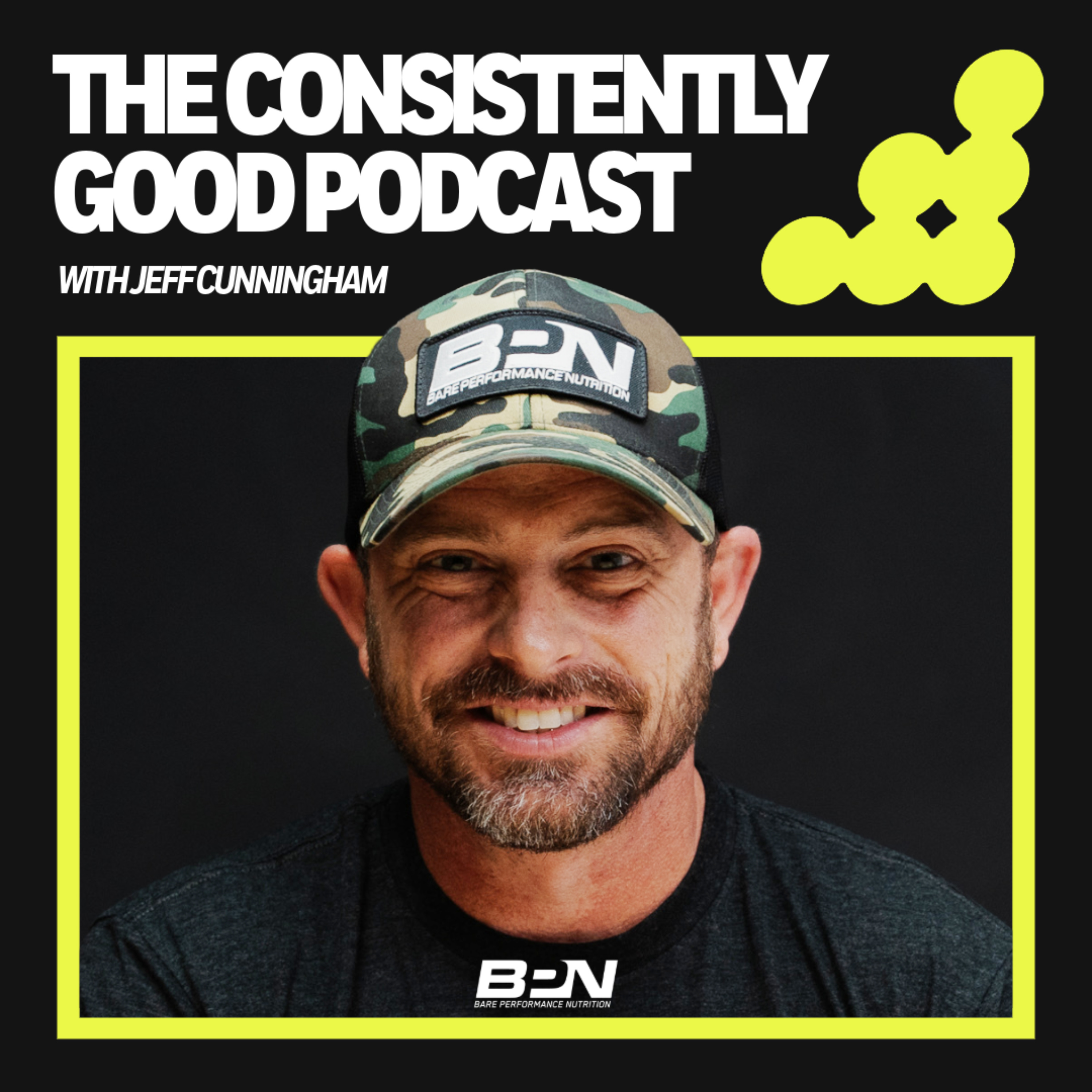
S3E10: How to Build the Perfect Marathon Training Block
53m 7s
The podcast host, Jeff Cunningham, addresses when marathon training should start, declaring it begins now for fall races like Chicago, New York, and Indianapolis. He explains that the "marathon block" is a mesocycle within periodization, lasting 10–16 weeks, with 13 weeks as his preferred duration for most runners. Beginners may need 14–16 weeks to build fitness, while elite or highly fit runners can succeed with 9–11 weeks to prevent neurological and physical burnout. The training focuses on marathon specificity, including repeat workouts (e.g., 800s, 1Ks) at critical velocity pace—typically 30–60 seconds per mile faster than goal marathon pace—with short recoveries, and tempo runs to build endurance. Track sessions should occur every other week, alternating with threshold workouts, and volume can gradually increase. He emphasizes the importance of non-running factors like strength, mobility, rest, and diet, and warns against overtraining, which leads to a "gray behind the eyes" fatigue. Instead, runners should feel fresh and motivated. The host provides specific pace examples for different goal times and advises structuring workouts to avoid excessive strain, ensuring runners arrive at the starting line with a glimmer in their eyes, ready to attack the marathon.
[Music] Guys, perhaps the question that I get asked the most often is when does marathon training start? And the answer today on the consistently good podcast is now. Guys, we are about 11 1/2 12 weeks out from the Chicago marathon. We're 13 14 weeks out from New York and from Indianapolis. The fall marathon season is upon us. It's time to train. We're going to go through everything. Gut training, interval training, tempo running. When we're going to be doing our long run workouts, we're going to go through what I refer to is the marathon block. It starts today. It starts now. Let's get to it. Welcome to the consistently good podcast. I am your host, Jeff Cunningham. Now listen, when does my marathon block start? Is the question that I get from a lot of you guys? And I always say, well, you know, we got to do the block before the block. We have to do the prep before the prep, right? I've already done an entire episode on that about running the economy, showing up your foot speed, making sure that we're getting in the weight room. We're doing strength and mobility stuff, doing some, quote, non-specific types of training, lots of farlet, shorter speed workouts, hopping into firecracker 5K. I've already talked about all of that. Well, all of that stuff is mostly behind us at this point. We're right here at the very, very end of July, early August, right? And all of a sudden, you're looking at September, October, November, and it's time to get moving. But there is some nuance to it. There are some specifics that I want to get with you guys on in sort of the variability. The variances, variances, variability. Hey, once again, I was like to tell you guys, it's my podcast. I say what I want between each of you. Okay. For some of you, you look at this and you say, okay, well, how does periodization work here? I'm not racing till November or mid-November. My buddy is racing in early October. How does this look? Okay. And I'm going to go back to some of the stuff that I've hit on before. First of all, we're talking about periodization. We're now in going to be a more of a specific phase. Okay. We are now done with sort of non-specific speed training, although we're going to leave some of the components of all of that in. I always tell everybody, you've got to leave certain components of your training in. Essentially year round. And you know, no bar to a canova. Okay. Probably maybe one of the three greatest marathon coaches in the world has talked about the need to make sure that we don't fall into this jogging base phase, right? Where we just go jog a whole bunch of easy miles and then suddenly expect to start running fast. Well, I think that hopefully I've helped remedy some of that for some of you guys by talking about the prep before the prep in doing hill reps, doing speed work, strength and mobility work. So there were not neglecting sort of our speed, not neglecting those white fibers, not neglecting the components of this that's going to make us more economical in our running. We need to look at where we are right now, though, in our periodization. Now I'll remind you, periodization is the process of dividing training into smaller periods where emphasis or the target of the training is altered during each period. That's where you are right now. Now if you're running Berlin, okay, or you have got Sydney on tap here in about four weeks, you could be in basically the middle of a marathon block. But for most of you, we're talking about fall marathon session, Western Europe and in the United States, when it comes online October and November. Okay. Now once again, we've got the acronym that I use. We're diving into the training, which means we got a look at density, intensity, volume and then the non-running aspects, those being and I will go back over those with you, strength and mobility, rest and recovery and diet. Those are the three biggies. Okay. Now we have cycles and I've talked to you about periodization in the past. Okay. You've got macro cycles that are 20 to 30 weeks. You have a meso cycle in your training, which is like a little four to six weeks segment, a micro cycle, which is just seven to 14 days and then you have an actual session. Which in and of itself can have some periodization even within a 12 mile workout on a Wednesday. So where do we put us when we're talking about marathon training? I'm going to call it a meso cycle. It's kind of like sort of an amalgamation of micro cycle, which is one to two weeks. Okay. It did you've got macro cycles, which is 20 to 30 weeks and then you've got a meso cycle right in the middle. So I'm sort of amalgamating this into like a 12 to 14 week sort of time frame that we're talking about maybe 10 to 16 weeks max. So we're going to call it a meso cycle. It sounds like an illegal drug, but it's not. I just made it up. Okay. Now listen. Why 10 weeks? Why 16 weeks? Because one of the things that I think proliferates out there is this notion that a marathon cycle or a marathon block is 16 weeks. And everything before that is not training for a marathon and everything before that is something that's vastly different. I would challenge that because everybody is different in experience. Everybody is different in ability and everybody is different in current fitness. Right? Because all of that affects how long you want to spend training for a marathon. How long you should. And that's one thing I'm going to get to should be training for a marathon. But suffice it to say we're in that 10 to like 18 week period where we're looking at whether or not we're going to do Chicago, maybe Twin Cities, maybe I'm looking at wine glass, maybe a week or two before that all the way up through let's call it CIM, right? And the marathon project in December. That is sort of our fall season. We could extend it out to the Houston marathon in January, but you know October to December, right? Now listen, if you are a beginner marathoner or you are in maybe a first-timers marathon training program, a couch to marathon, I hate to call it couch because that sort of has this implication that you know you went from lazy to running. But the point is you're going from not as fit to trying to get fit enough to go and run 26 miles. You might need 16 weeks. You might need 14 weeks, right? Now if you don't have that, you used the time that you have up to the race day as effectively as possible with a real focus on not overdoing any of the three first things of my acronym. Don't overdo your density, your intensity or your volume. Well, we'll get there. Listen, if you're you know a council marathon, you've got 12 weeks, we can get that done. But 14 to 16 weeks may be better. Why? You're going to spend a significant part of your block trying to get fit or fit enough to handle the real rigors, the actual rigors of training for a marathon where you might spend six to seven weeks of that block actually really doing the bigger stuff and spending maybe the first 40 to 50% of that block just trying to really work your way into it. Don't cry, I'm committed, man. Right? We're all in this space. We all have a right to go and pay our money and go to the starting line. Now if you're a super fit, perpetually fit high level endurance athlete anywhere from a high functioning high performing age group or all the way up to a professional runner, you might only need a 10 week marathon quote unquote block. Why? Because if you're already running 70 miles a week, it's not very hard to get to 80 to 85 miles a week, right? For like sort of a high level pro level or super experienced sort of person's training program, you're not very far from being an exquisitely good marathon shape. If not PR shape, that might be nine to 11 weeks, right? Because you know, 14, 15 weeks, you just in a gray behind the eyes and neurologically fatigue completely broken down. If you just spend too much time grinding out what I refer to is marathon specificity. What's marathon specificity? A lot more volume of the harder stuff, whether it's MBO2 work, critical velocity work or lactate threshold work. You're just doing a lot of volume of it. It's incredibly fatiguing. And if you're already super fit, you don't need to grind your bones into the dust spending 14 weeks at 100 miles a week. You'll just end up fried, man. All right. So when looking at this, we can look at the structure and sort of when we're getting started. Listen, I love 13 weeks. Don't ask me why. Maybe it's because I'm trying to sort of be counter culture and not use nice even weeks. Because if you noticed, people always talk about it in terms of 12, 14 and 16 weeks. I'm like, why doesn't everybody use odd weeks? Can't we use 11, 13, 15? You know, so it's funny that we sort of function in this world of even weeks. I like 13 weeks. Why? Because
just 13 weeks is actually a quarter of a year, right? Every 13 weeks is a quarter. I tend to say, "Hey, man, if we could use about a quarter to train for a marathon, that's probably pretty good, guys." That's probably pretty good. So what does it look like? What are the hallmarks? And once again, I'm talking about Jeff Cunningham's perspective on the marathon. I'm talking about the way I've done things that have worked for the most part really well for most people. And that's where I've landed on this. 13 weeks just works really well for the generally fit, who have a solid base, 30, 40 miles a week, even 25 miles a week, up to 50, 60 miles a week, going into a marathon. And 13 weeks, you can generally, as long as you're paying attention to your strength and mobility recovery and diet, right? If you cover those things, we can bump your volume up. We can hit some great repeat workouts. We can hit some great threshold workouts. We can go and script out your long run workouts 24/6, and then maybe eightish, you know, a long run with some spice and 18 to 21 mile with some spice eight weeks before, you have plenty of time to get all that done in 13 weeks without getting you fried and gray behind the eyes. When I say gray behind the eyes, you ever seen somebody that's just dead? They just look tired and they have that sort of exhausted look. It's like deep in the core of their being, and you could just see it in their eyes. That's what I mean when I say gray behind the eyes, right? You don't want to be in that state when you show up. You want to have a little glimmer in your eye. You want to have excitement. You want to have that sort of emotional sort of radiness to go into attack mode rather than, I just want to get this over with mode. Do you see what I'm talking about? It's a difference in the way your processing data and it's a different in your thought processes in your motivation as you go into the last days and weeks prior to what marathon. We don't want to be gray behind the eyes. We want to have a glimmer in our eyes. Okay? Now listen, a lot of you might actually be chuckling because it might be this week, especially if you are running a mid to late October in an early November marathon, you got your first workout. It's the first time when I said, "All right, I need you to run these repeats in this split and it's bulkier and it is sort of marathon-esque." It might be eight to 10 times an 800. It might be seven to nine times a thousand meters, but a lot of you will recognize that's sort of like, "Ah, this is when it starts." We go from fart-leck work, maybe to shorter speed work sessions where we do 200s and then some 1Ks and then some 200s. All of a sudden now it's like, "Oh, we're doing a bunch of 1Ks. We're doing a bunch of 800s." That's sort of that transition. When we get to mid late July and early August, that I start making for everybody. Now, I'm gonna tell you exactly what I believe you need to be doing pace-wise on certain workouts and I'm gonna help you structure the next 10 to 16 weeks essentially here in the next several minutes, okay? Now, I, this is Jeff Cunningham's view of the marathon running world, don't think that doing a hard track workout every single week makes a lot of sense. We're running 26.2 miles, 42.2K. This needs to be an emphasis on high anaerobic development and emphasis on extensibility when it comes to maintaining paces at or below marathon speed, okay? And you've got to be able to harden your soul. You've got to be able to harden your legs to the realities of doing this for two and a half, three, three and a half up to four hours at a time with no walking breaks on race day. The only way to do that is to train a lot, run a lot, do big workouts, generally speaking. Now, looking at repeat sessions for beginners, I would tell you guys would start out with maybe five to, I think 7,000 meters of track work, okay? And I recommend doing anything from one case down to 600 meter reps with really, really short recovery, generally a minute, okay? Per thousand meters run, but once you get down to like 800 to 600, take one minute recovery, okay? Do these at mostly critical velocity pace, okay? Which is the pace that essentially you can run all out for about 25 minutes, okay? Up to, I would say 35 minutes, okay? It's faster than lactate threshold pace, which is the pace that you can run all out for an hour, okay? Now, to simplify this, if you're like, well, I still, I'm swimming in it, I don't know what to do. Hey, here's a really, really simple way to get you guys started. If your goal marathon pace is to run nine minute pace, which would be 357 for the marathon, do your track workout at 745 pace up to eight flat pace, okay? So if you start out with eight times an 800 and four flat down to 355, you're probably doing okay on one minute recovery, all right? Now, as your marathon pace gets faster, the differential between your repeat work and your marathon pace might go down, all right? If you're looking to run, even three hours of marathon, I would still tell you that that is 650 pace. So let's do your workouts at 550 to six minute pace on your repeat sessions, okay? Nine, 10 times an 800 maybe, and 256 to 256 to 58 on a minute recovery could be good. Now, it's super hot where you are right now. If you're in Atlanta, right? Or if you are in Tuscaloosa, okay? What about Hattiesburg? Y'all been to Hattiesburg, okay? Home of Southern Mississippi University, okay? It might be real hot. So, you know, maybe you need to do those reps in 301, 302, so that you're not sitting there with the drill going from the bottom of your lip and connected with the track. That's when you know you're running hard when that drill connects and you have to get a pair of scissors to cut it, all right? Be careful with it. Generally speaking though, if you're looking to run 650 pace for a marathon, you need to be doing your repeat work, 550 to six minute pace on a minute recovery, generally speaking. 342 to 345 for your case, 255 to 3 minutes for your 800 meter reps. Go a little faster, maybe 2, 10 to 12, if you're doing 600 meter reps, still on a minute recovery, okay? Let's hit some volume. Now, you can increase every other week. That's what I recommend doing is let's do track workout every other week, okay? Alternate weeks, okay? You're gonna do a threshold workout, tempo run, do tempo run, right? One week and then we can come back the next week. Let's get chippy with it, let's get a little crisp, let's get a little quick, let's get on that track and let's run some reps at about a minute faster than goal race pace. Now, if you're trying to run down 245, 252, 30 of the marathon, the differential between your paces on your repeat work and race pace might only be maybe 30 to 40 seconds per mile speed, right? So if you're looking to run six minute pace for a marathon, which would be 237, 20, I think technically, okay? Maybe you're only doing your repeat work at 530 pace 'cause 530 pace is fast guys. So maybe you're doing repeats in 325 to 326 up to 327 on your 1K reps. Maybe you're running 240, I don't know, 242 to 245, 245 ishaunt to 800 meter reps, you're probably five on a minute recovery. We don't have to get so crazy with this where we end up having to just lie our hair on fire because we're just making ourselves crazy, all right? For you more advanced folks, maybe we could start out at maybe 10,000 meters of work and we can work our way up to 12 to 13,000 meters of work. 12 times a K in 340 on a minute recovery. If you're looking to run 250 in the marathon, it makes a lot of sense, right? Maybe 14 times an 800, not come out in 252 to 254 on a minute recovery. If you're looking to run in the 240s up to 250 flat, it's about right? Every other week, every other week. My suggestion is this, let's add anywhere from, you know, maybe 200 meters up to 800 meters of total volume once every two weeks through your block in your track sessions. So if you start out with, you know, maybe eight times and 800, that's 6400 meters of work. Maybe the next time you do it, you go and run seven times a thousand, which should be 7,000 meters of work, which is 600 meters more than you did two weeks before that, right? And then you may want to try to go up to doing nine to 10 times an 800 anywhere from 7,200 meters to 8,000 meters of work. Two weeks after that, come back and do eight to 100s. You see what I'm saying? Stare, step it up. All right? In the middle weeks, what are we doing? Guys, this is where you got to train your body to go long into fuel marathon pace, right? You could start off with progression style running. If you're looking to run seven minute pace for a marathon, you might want to start off maybe with a five or six mile or starting at 7, 15 to 7, 10 pace and then work down to 650 the last mile, progress through a five mile tempo run, like that. Being careful, measure out your resources, meet out your resources. You can really, really feather that accelerator effectively where you don't get out over your skis. You don't want to get out over your skis in life. Because you do that, you just end up going as over T-Cettle. You don't want to do that. Okay? And if you ever see anybody go as over T-Cettle, go to some, go to a ski resort in the middle of the winter and watch somebody go in and do and forward flips down the mountain. That's what I'm talking about, right? And then baby.
After that five mile progression run, sip of water, let's go down. Let's run maybe a four, five times 800 meter repiece and do those. It's 640 to 645 pace on a minute and a half, two minute jog or maybe do two or three times a mile rep in 650 on two minute jog after you've averaged maybe seven to seven, oh two pays, maybe for a five to six mile tempo stuff like that. Come back maybe two weeks later. Maybe you could do something a little bit different, right? Maybe you can go and do, you know, I don't know, a four mile tempo run at like 650 pace and then maybe you can go and run two times a mile repete in 640 and then another three or four mile tempo run, okay? At like 650 to seven minute pace. I like for beginners, okay? Anywhere from six to seven miles total on these tempo type sessions and when I say total, I mean, a total accelerated running with warmness and cool down, you might be at 10 miles. But when I'm saying I like seven miles, I mean seven miles will work. So it might be five miles of tempo and two by a mile rep or five by five mile tempo and then four by an 800 rep. That'd be seven miles and then work up to eight, sometimes up to nine, but work up to maybe eight miles on that kind of work and you're doing pretty good for more advanced runners. 10, sometimes 11 miles of work makes some sense, right? Go do a four mile tempo run, do four by an 800 and then do another four mile tempo run. Suddenly you're at 10 miles of work at anywhere from five seconds a mile faster than marathon pace down to 20 seconds per mile speed faster on some shorter reps in the middle of the workout, okay? But you don't ever need to be going down to the pace that you're doing on your track sessions. That's too fast that work on your track sessions, the critical velocity pace ish. You really don't need to be running more than anywhere from 1200 up to 1500 meters at a time at that pace without recovery because it's too fast. Does that make some sense? All right. I like doing that every other week. Now, here's the question, coach, when do I start running fast on my long runs? My recommendation is maybe eight weeks out, okay? Sometimes six, it just depends on your time runs, what kind of a run way we have out in front of us to work with. Guys, maybe we go and we run, you know, 18 miles with what I refer to as spice. Maybe you do just do four times one mile repeats with an 800 meter easy float recovery during an 18 mile run and do those mile reps at about maybe 10 seconds per mile speed faster than what goal marathon pace would be. That might be all you need to do eight weeks out, but then when we get six, four, and then two weeks out, I would recommend not necessarily doing your last workout exactly two weeks out. Maybe do it 15, 16 days out that way. With each day there, you're building in and about anywhere from six to 8% more recovery with each extra day that you add into your taper without having to go all the way to a three weeks taper, which leaves people feeling sort of out of sorts and sort of so out of rhythm. And I've gravitated in a lot of instances away from a three week taper 15, 16 days are really like sometimes when you're running Boston, we can do a 17 day taper because we could do our last longer on workout on a Friday and then we race on Monday, but that's unique to that race that's run on Patriots day. Most marathon are on Sundays of fewer on Saturdays, like Indianapolis, for instance, right? All right. We'll be back to the episode in just a second. I want to talk to you about what I refer to as coach Jeff's endurance stack. We got four unbelievable endurance products offered by VPN that is going to help with your training. Then ultimately it's going to help you have the best races you've ever had. We have G1M Sport, which is 350 milligrams of sodium, 20 grams of carbohydrate, cluster dextrin, super, super, bioavailable, really, really easy on the GI tract when it comes to carbohydrate. G1M Sport Plus, we're adding in neutropics, we're adding 150 milligrams of caffeine to give you a boost on race day. This is going to be able to get you to the finish, but guys, it's super hot. We're training through August and September. Electrolytes are key. Sodium is our friend, 500 milligrams of sodium, per scoop in BP and electrolytes and a multitude of flavors. Get you some. This literally should be central to almost something that you're doing every day. Then we have the gels. We have three caffeinated gels. We have mix berry. We have watermelon. We have apple cinnamon. Then we have multitude of flavors in the non-caffeinated gels. They have carbohydrates, 110 milligrams of sodium, go and get a huge box of these, get multiple boxes of these. Go and click on the link. Go to bpnsubs.com. Get your BP in endurance stack today so that you can have the training that's going to benefit you and the racing that you deserve. All right, back to the episode. When you are doing this, I would recommend this. If you're running a hard workout and you have either a repeat session or a tempo session, you're suddenly on that eight week into six week, four week timeline where we're going to start adding some marathon pace or even faster into your long runs. If you can, sometimes it's okay to run your workout on a Tuesday and then do your long run, workout on a Saturday. That way we can build an extra 24 hours of recovery. That way you can show up and you can rip and you can roar on that long run workout without having some lag without having some fatigue that has sort of rolled with you into that Saturday where you might come up feeling not so great, right? So go suck down some G1M sport, right? Go and drink your electrolytes, get out there on long run Saturday and if your last hard effort was maybe on Tuesday, you're going to probably show up feeling pretty good. I am a huge fan of feeling good on your workout days. Now I know that generally speaking we're going to be tired-ish through a marathon block because you're going to be running a lot. Most of you guys will be running anywhere from 45 or 50 up to 90, even 100 miles a week, depending on who you are and how much training we can get done based on your experience, your injury, resilience, all that. It's still a lot, no matter how you slice it. So generally you're going to be kind of fatigued a lot, but I don't want aberrant levels of fatigue. I don't want overwhelming fatigue rolling into these workouts. And so I tend to say, hey, let's build in recovery so that we can then maximize the benefits that we're going to be able to get. We can get the adaptations that we're seeking from the training so that when we're done throwing a lot of paint almost all of it has stuck to the wall. That's the way I see running. So if you do an interval workout or a temple workout on a Tuesday, then run easy Wednesday and Thursday and Friday, you're going to get to a 20 mile workout on a Saturday. Probably feeling better. Now when we're looking at these long run workouts, I would tell you that building in anywhere from 8 to 12 miles of work, depending on your experience and your resilience and your ability to do it makes a lot of sense. If you're doing eight miles of work, maybe we do five miles at five seconds a mile faster than the goal marathon pace, then you can go and run an easy mile, float it, not jog it, but float a mile. And then go and do maybe, I don't know, a two mile at 10 seconds to 15 seconds faster than the goal marathon pace. And then go and run a mile in control, maybe 20 seconds faster than go marathon pace, right? Maybe 15 seconds faster than go marathon pace. That might be mile 19 of a 20 mileer, going to run an easy mile of the tail end. You've got to 20. I like to front load some of your miles rights. You might do five, six, seven miles early, okay? And then miles eight, nine, and 10, 11 and 12. Those might be sort of a five mile segment where suddenly you get on pace. Let's say goal pace is seven minute pace. Let's run six, 55 pace, right? But also we need to be mindful of this. If it's over 55 degrees, it is stark and I have a little bit of a deletrious effect, a deletrious impact on your ability to quote unquote hold pace under those conditions. It's not an excuse. Heat humidity or an explanation for why you should and why you need to run faster, run slower, run slower, okay, on your set paces. That's not give up. That's not weakness. That's not infirmity, okay? That's just what we call smart, okay? And so don't be maverick to the numbers on your watch when you start doing maybe some hard long run workouts and some harder workouts midweek here in August and then into September because guys, I got news for you whether it's in Oxford, Mississippi, right? Or whether it's in Augusta, Georgia, it's warm guys. It's warm in Iowa city. I mean, try going to traverse to traverse city Michigan for instance, right? It's still a humid mess in August there. So give yourself grace and understand that you might need to slow your paces down by 10 up to 15 seconds of mile on tempo runs. And run workouts if that mercury is up in the 70s and your dew point is up, you know, in the high 60s into the mid 70s in some cases, you need to pull back on your paces and understand that he did this the physiologic equivalent of running at
or below marathon pace if it were 54 degrees outside, right? So just be mindful of that. Okay, every other week, let's do critical velocity work down to some MBO2 paces toward the end, okay? I've a couple of these workouts and then maybe go jog a little bit, go spin off maybe four, 200s, three or four times a 400 fast out where you can get just a little bit of a speed stimulus where you'd been doing maybe a lot more of that in your prep before the prep in June and July, even maybe as far back as May, you might have been doing a lot more 200s, a lot more 30 second, maybe one minute repeats during pharlic sessions where you might do 14 times 30 seconds fast a minute and a half off, right? That's more of a speed stimulus stuff. So I had a little bit of that in. Sometimes like on your track workouts, four times a 200 fast, three or four times a 400 hell, do five times a 300 meter nice and quick, down at about what might be your mile race, pace 3K race, pace, so you're turning over, all right? Do that. You can even do that a couple of days after your easy runs, do six times 30 second, a mildly uphill strides, or maybe do eight times a flat 100 meter strides with walk-bath recoveries after an easy eight or nine mile run. Maybe do that one or two days a week, keeps a little bit of that speed stimulus in. It keeps those white fibers quote unquote activated. It keeps your speed sort of at the fore without having to do full on, dedicated, blood squirting out the corners of your eyes speed workouts, right? All right, because that can induce a lot of neuro muster fatigue. And you don't want to spend too much time training a system that you don't use very much during the marathon, but you never want to absolutely neglect it because it increases your running economy and you're running efficiency by just being able to run fast. So do little bits of that through your 10, 12, 13, 14 weeks into your marathon. Now, when you get to the long run workouts and you come out the other side of them, those are hard days. So I'm an advocate of either taking a day off or if you're a seven day runner, make sure that that might be only a three to six mile, max seven mile jog the day after a long run workout. But if you're a six day a week runner or a five day a week runner, my recommendation is let's take the whole Sunday off because what we know is, what we know is, is that the Washington commanders, okay? And the San Francisco 49ers are gonna start playing ball. Probably I think the first week in September, and you've got to be able to sit on your couch and watch your team either lose or obliterate an opponent without having to worry about some pesky run on that day, all right? Sunday is off. Now, if you wanna run on Sunday, do your long runs, if a group meets on those days, then you can shift your off day to Monday. In some cases, maybe take Saturday off, right? And that way you can go watch the Alabama Crimson Tide meet somebody, right? But then maybe push your workouts, if you're doing your long runs on a Sunday, you might wanna push your workouts to Thursdays on your typical midweek sections. That way you keep nice spacing and we don't start rolling that undue, aberrant fatigue that I was talking about earlier into your subsequent sessions, okay? Now, everybody is going to have work. Everybody is gonna have kids going back to school. Everybody is gonna have said kids bringing home micro organisms and those microbes, okay? Then end up making you get a cough, a runny nose, have to go down to the dock in the box to go and get you some horse steroids or some or some antibiotics to clear up your sinus infection, that little Claire Bell brought home. Listen, it's gonna have been in September, maybe, maybe August, maybe October. It's okay. We gotta roll with it. If you rolled in to your marathon block, having executed a prep before the prep in your baseline fitness was good, you have more leash length, you have more room for quote error, and I hesitate to call it error because then suddenly it's like you made a mistake. No, listen, you don't get sick on purpose. You don't have, you know, suddenly you have a wedding that you needed to get to and it threw off your training a little bit, maybe back to school stress, if you're a school teacher, it's really tough. Hey, there's gonna be a couple of workouts that might not go well. There might be a couple of workouts that you just flat out miss. Hey, put it in the review mirror, get on schedule, check your boxes, don't try to spend time quote making up the missed workout or making up the missed volume. As I've said on an Instagram story a couple of weeks ago, don't take the stress that made you have to miss a workout, don't take the stress in the fall that maybe had you truncating a workout or cutting it short, so to speak, make you then try to quote, then go make it up by creating additional stress on another day that then compounds the problem. If you have a seven mile or set for Friday and a 19 mile or set for Saturday, don't go and try to add the five miles that you missed on Monday to Friday and suddenly you've got a 12 mile day and then a 20 mile day, okay? Because you're running the risk of injury, chronic fatigue, adrenal fatigue, all the stuff that then could roll into the next week or the next two weeks, so just be careful there. Things are not going to go perfectly, it's an axiom for life. Not gonna go perfectly, we want it to try to go as perfectly as possible. Control your controllables, but this is just a caveat I wanted to add in here is there are gonna be a couple of bumps, it's okay, okay? But perfectly scripted, let's do some repeat work one week. Then I recommend doing a threshold, a regression, aerobic threshold, down to lactate threshold, okay, and then maybe even down to possibly even half a marathon down to 10K pace toward the end of these workouts on some reps, that's fine, okay? Now listen, one of the things that we need to be mindful of is that it's gonna be a long autumn, it's gonna be a relatively long bill going into your marathon. Try to wrestle as much sleep as possible. There is no cup of coffee and there is no set of compression but that is a substitute for good old fashioned sleep. So let's do the keep it simple thing. Let's eat wholesome foods, high-end carbohydrate, high-end protein, let's sleep as much as possible. You do those two things, these are the non-running things that I was talking about on the acronym for diving. Let's do those things and recovery and diet are really gonna be your best friend. Now when I'm on the subject of diet, do not wait until two weeks, three weeks, even four weeks before your marathon, to then suddenly get some urgency when it comes to putting go gels on your stomach, drinking G1M sport while you're running at marathon pace deep into a long run. Do not neglect it, do not put yourself behind the eight ball where you're failing actually to reap the benefits of your training by failing to fuel early in the fall. It feels good to feel good. I will repeat that. It feels really good to feel really good. We have a lot more control of that than perhaps we think about. If you eat the carbohydrates, if you recover with proper amounts of carbohydrates, so your muscle stops stealing glycogen from your bloodstream and you eat protein, possibly use creatine for muscle repair and recovery, okay, and we are sleeping. Trust me when I tell you that you are going to feel good. Now, in workout, how do we use gels? Guys, anywhere from 50 to 80 grams of carbohydrates, carbohydrate per hour got tongue tied there, right? Anywhere from 400 up to 800 milligrams of sodium an hour, if you're a sweater and you're in a warmer environment, you will feel better. It's not hocus pocus. It's not magic. Taking calories, taking sodium during your long runs, during your workouts is going to train your gut. Your gut can be trained to handle stuff that it previously could not handle. So if you tried to eat and you tried to fuel once and it didn't go perfect, that doesn't mean I can't handle it. That's who I am. I'm just going to sip water and I'm going to let hope and pixie dust be my plan. No, you can train your gut. So do it a little bit at a time. Let's eat a third of a gel. Then let's try to eat a half a gel. Then let's see if we can get down a whole gel over the course of a minute and a half during our long runs in August of September so that we can then have magic in November when it matters, right? When you are putting carbohydrates in, your body's going to function really well because it is going to have fuel to burn. The same way we have to put gas in our car if we're driving on a cross-country vacation. Sodium is massive. We lose massive amounts of it in sweat. Sodium is vital. It's a vital component of what we need to have coursing through our blood veins at all times. That's why blood tastes salty. When we cut our finger and we all the sudden we go and we lick our finger and go out, right? That's why it's salty. If you're wearing your salt, if the salt is on you, they need it in you. So let's make sure that we're focusing on the floor.
know your marathon, know which one you're running. Not the name of it, I get that. Not the city where it is, I get that. I mean, know your marathon. Go on the website. They, okay, does this marathon serve Gatorade at the age stations? Do they serve new hydration? Do they serve BP and electrolytes at the age stations? Understand that there may be a time when you have to grab a cup of that because you don't have access to the electrolytes in the sodium and the carbohydrates, the things that you need bid rays. So possibly look at your marathon and say, I'm gonna buy some of that. I'm not gonna use it extensively every day, but I'm gonna put some of it on my stomach so that I can get myself used to the emergency exigency as it were, where I might have to scoop a cup of Gatorade, scoop a cup of new hydration off of a table. That's what this race has contractually on that they're gonna have with their age stations. Know how hilly it is. Know over the last decade, what the average starting temperature is at your race. Is the average starting temperature 63 or is it 43? Am I running a marathon in Anchorage, Alaska? Or am I gonna be running a marathon in Florida somewhere, right? Am I gonna be running a marathon in Huntsville, Alabama in December? Or am I gonna be running a marathon in upstate New York at the beginning of October, wine glass, as I've talked about before. So look at your temps, look at your topography, know if it's a hilly course. Know typically what the humidity is in that part of the world or that part of the country that you're running in so that you can just know what it is you have signed up for, what you're getting yourself into and what you need to be doing preparationally August, September, October, so that when you get to November, right, and you show up in Philadelphia, the weekend before Thanksgiving, you know exactly what you're getting yourself into. Now, looking at this in your long runs, my recommendation would be trying to get in 20 plus mile runs in multiples prior to your race. But if you're a beginner, 120 mile run might suffice, right? Maybe you can get in an 18 or a 19 and maybe you can get into 17. That might do it. If you're looking to get out there, complete your first marathon, feel good about it, come down the home stretch, hands of the air going, man, I'm hurtin', but this is exhilarating. This is fun. This is soul-filling. This is what makes me want to come back for more. If you're a more experienced runner and you've got Boston qualifying goals, you've got, dare I say it, Olympic trials qualifying goals. Well, we need to be looking at this. I mean, you might get in 620 plus mile runs, right? With four of them with big segments of 10, 12 miles of pace work in them, you know, five miles at 50 pace, two miles at 540 to 545 pace, and then five miles at 550 pace. If you're looking to hit the women's Olympic trial standard on a 23 mile run, you might do that 16, 17 days before your goal race in the fall, all right? But understand, I still like this sort of, you know, eight weeks, six weeks, four weeks, and then, you know, about 15, 16 days out, if you can put your long run efforts there, I like that a lot. Now, on your repeat sessions, 1200s, sometimes you can do 2Ks, 1K, 2K, 1K, 2K, 1K stuff like that, but generally speaking, repeats anywhere from 600 meters up to 1200 meters, usually will suffice really, really well for eight to up to 12, 13,000 meters of work. Now, your threshold sessions going back to that, yeah, you could do straight tempo runs, but also there's paces that you can do on shorter reps with short recoveries, okay, but do a big bulky sort of block of it, like eight times one mile repeated a pace, 20 seconds faster than goal marathon pace with two minute recovery. Love that workout, okay? I had the Hebner twins do up to 10 times a mile repeat before they ran in the Boston marathon, where they both ran, you know, in the, in the two 30s, okay, back in April, but they're super experienced runners, you know, and Olympic trials, qualifiers, and so you're looking at that, but if you're more of a beginner, maybe you do six times a mile repeat at 20 to 25 seconds a mile under goal race pace, right? And you can do that instead of just doing like a straight tempo run, every single week, okay? Seven times a two K, that's a great one, right? You can go out and do six times a mile and a half repeat, five by two mile repeat. You can get pretty, pretty inventive with this, as long as you adhere to the principles that the paces need to be marathon specific. And when I say marathon specificity, what I mean is training at paces that are specifically tailored to make you faster at your marathon at the pace you're seeking to run. So specificity would entail doing your repeat work at a buy about anywhere from a minute, or maybe even 70 seconds per mile speed faster if your goal pace is nine or 10 minutes of mile in a marathon, down to 30 to 40 seconds per mile speed faster if you're running under three in a marathon. But see, that's specificity as it relates to training the systems that you're gonna need to be able to then whole marathon pace, okay? And then specificity on your threshold sessions is gonna be at race pace, maybe a little slower on your watch if it's 75 degrees with a 72% dew point, you might be running 15 seconds a mile slower, okay? On a day like that, on your tempo run, but that's the equivalent of running race pace if it was 20 degrees cooler, right? But that's very specific, that's very specific, okay? So if your goal's nine minute pace, let's run 845 to nine minute pace on your tempo runs, maybe with some repeats 20 seconds faster than that, but never get rolling down unless it's specifically prescribed for a purpose, okay? That might be unique to that day. You don't need to be ripping and roaring way faster than that because you're just gonna end up leaving your races in practice and you're gonna show up and gray behind the eyes. Now, for you super fit people, I think 10 weeks can really, really work, 11 week marathon block up to 12, right? You super fit people who may be already at a really high level who had a really good racing season through the summer running 10Ks like Peach Tree, running Deseret News, you know, out in Utah, right? Woff to Woff, six mile, just ripping and roaring on that. We can be careful with how long your blocks are. If you're in your second marathon, maybe you haven't run one in eight months, maybe you took much of the summer almost off or were very low volume running 10, 15 miles a week, you might need 14 to 16 weeks into your marathon to actually really get your aerobic system revved up, get the fitness stick into your bones so to speak so that when you show up, you're really ready, okay? Here's what I'm here to tell you. I want you all to dream really big. Every one of you has talent, every one of you does have a glass ceiling, but that glass ceiling, like I always talk about, is probably higher than maybe what you're giving yourself credit for. So let's just push that glass ceiling up. The expectation ceiling, the performance ceiling, okay? Push it to the limits of what through careful study and careful analysis says you're capable of and then let's try to perform up to that level. If you're on a little ranch at talent, let's figure out how big that plot of land is and let's push your performance fences all the way out to the edge and let's roam there. I talk about this stuff a lot. It's here. It's essentially August 1st, ish, okay? It is upon us the fall marathon season is here. Let's make 2026 the year that you get it done and I don't care if you live in Portland, Maine or you live in Portland, Oregon or any points in between. If you live in one of those fireful states or you're down in, you're up in the rust belt or you're down in the cotton belt, okay? Let's get going. Let's do this thing and let's all collectively go be consistently good. Okay, guys, now to what is always one of my favorite parts of every episode, which is where I go into the mail bag. I actually threw up while I was about to come in here, the questions and I said, hey, ask away. And so here's my mailbox and here's what I've got. Let me take a look here. Got the old magnifiers here. Oh, good one. I like this. It's Parker Truex as should you be at peak mileage entering a marathon build and if not, how to build safely? I really like that because that adds on to what I just talked about. And I think that this is really good. I appreciate the question. The answer is probably not. You don't need to be at, quote, peak marathon volume when you go into your block at, say, 13 weeks out, right? But you need to be relatively close and I would say add maybe two to three miles a week all the way up through about eight weeks out from the marathon. Okay, what I love is from about eight weeks out two weeks out for us.
six week period, hold basically your max sustained volume for about a six week period. If you need a down week or a rest week to sort of recuperate and some people carry a bit of fatigue, okay, you can do three weeks high, a week low, and then maybe two weeks high, okay? So if you're at 60 miles a week going in, you can build up to 70, maybe 75 miles a week from eight weeks out all the way up to two weeks out, or maybe you can do three 70s, one 55 mile a week and then two 70s and then go into like a 16 day taper. That's the way I would recommend doing it, okay? It can be really onerous, it can be really exhausting to try to hold maybe your peak volume for 13 weeks straight and you can end up falling prey to the idea that more is better and then you end up sort of in a state of degradation, a state of neuromuscular fatigue and you show up like that talk about back in the podcast, "Gray Behind the Eyes." So that's the way I would do it, all right? Now I'm going to dig in here, I'm going to look at a couple of more, okay? Okay, another question here, sweat kind strong. If you could go back in time and give yourself one piece of advice about running, what would it be? Oh, you have no idea what you're getting yourself into there. You're going to be very, very surprised and I think you guys are all going to really enjoy what could be coming down the pipe, potentially in season four on this subject. I'm going to go ahead and hold off answering that question, but I can tell you that there's more than one thing that if I could go back in time, I would change and I'm going to leave it there episodes to come. We're going to talk about all of that, okay? I promise and it's going to be pretty cool and I'm looking forward to it. All right, getting in here, one last one. Ah, yes. Lauren Osborne, why are you so cool? Well, first of all, I'm not that cool, okay? I just have a chatterbox on me. Second of all, guys, Lauren Osborne is one of the fine people in the running industry in this country. She and James, her husband, owned the Exchange Running Collective in Nashville, one of the great boutique running stores in the country. If you all are in Nashville, go down there, say hi to Lauren, say hi to James, get yourself a t-shirt, get yourself some running gear, get yourself some shoes. Lauren, I'm not that cool, especially if you ask Mackenzie Cunningham and you ask Angelique Cunningham, they will roll your eyes and they will actually tell you that I'm probably the opposite of cool. But my dad's jokes are top shelf. All right, I love you guys. Y'all go be consistently good. Coach out.
Podcast Summary
Key Points:
Marathon training for fall races (Chicago, New York, Indianapolis) begins now, approximately 11–14 weeks out.
The "marathon block" is a mesocycle lasting 10–16 weeks, with 13 weeks ideal for generally fit runners with a solid base.
Beginners may need 14–16 weeks; highly fit runners may only need 9–11 weeks to avoid burnout.
Training emphasizes marathon specificity
Track workouts should occur every other week, alternating with threshold/tempo sessions, and volume can increase by 200–800 meters per session.
Pace guidance
Non-running factors—strength, mobility, rest, and diet—are critical to avoid fatigue and maintain motivation.
Avoid overtraining to prevent feeling "gray behind the eyes"; aim for a fresh, excited mindset on race day.
Summary:
The podcast host, Jeff Cunningham, addresses when marathon training should start, declaring it begins now for fall races like Chicago, New York, and Indianapolis. He explains that the "marathon block" is a mesocycle within periodization, lasting 10–16 weeks, with 13 weeks as his preferred duration for most runners. Beginners may need 14–16 weeks to build fitness, while elite or highly fit runners can succeed with 9–11 weeks to prevent neurological and physical burnout.
, 800s, 1Ks) at critical velocity pace—typically 30–60 seconds per mile faster than goal marathon pace—with short recoveries, and tempo runs to build endurance. Track sessions should occur every other week, alternating with threshold workouts, and volume can gradually increase. He emphasizes the importance of non-running factors like strength, mobility, rest, and diet, and warns against overtraining, which leads to a "gray behind the eyes" fatigue.
Instead, runners should feel fresh and motivated. The host provides specific pace examples for different goal times and advises structuring workouts to avoid excessive strain, ensuring runners arrive at the starting line with a glimmer in their eyes, ready to attack the marathon.
FAQs
It starts now, about 11-12 weeks out from Chicago and 13-14 weeks from New York and Indianapolis. The fall marathon season is upon us, so it's time to begin training.
A marathon block is a 10-16 week training period, with 13 weeks being ideal for most fit runners. It focuses on marathon-specific workouts like repeats, tempo runs, and long runs.
Beginners may need 14-16 weeks to build fitness, while more experienced runners might only need 10-11 weeks. Use the time you have effectively, focusing on density, intensity, volume, and non-running aspects.
The key components are density, intensity, volume, and non-running aspects like strength, mobility, rest, recovery, and diet. These help you build fitness without overdoing any single element.
For a 9-minute marathon pace, run repeats at 7:45-8:00 per mile. For a 6:50 pace, do repeats at 5:50-6:00. The differential between repeat pace and marathon pace decreases as you get faster.
Do track workouts every other week, alternating with tempo or threshold runs. Start with about 6,000-7,000 meters of work and increase by 200-800 meters every two weeks.
Chat with AI
Loading...
Pro features
Go deeper with this episode
Unlock creator-grade tools that turn any transcript into show notes and subtitle files.
 PodcastTranscript AI