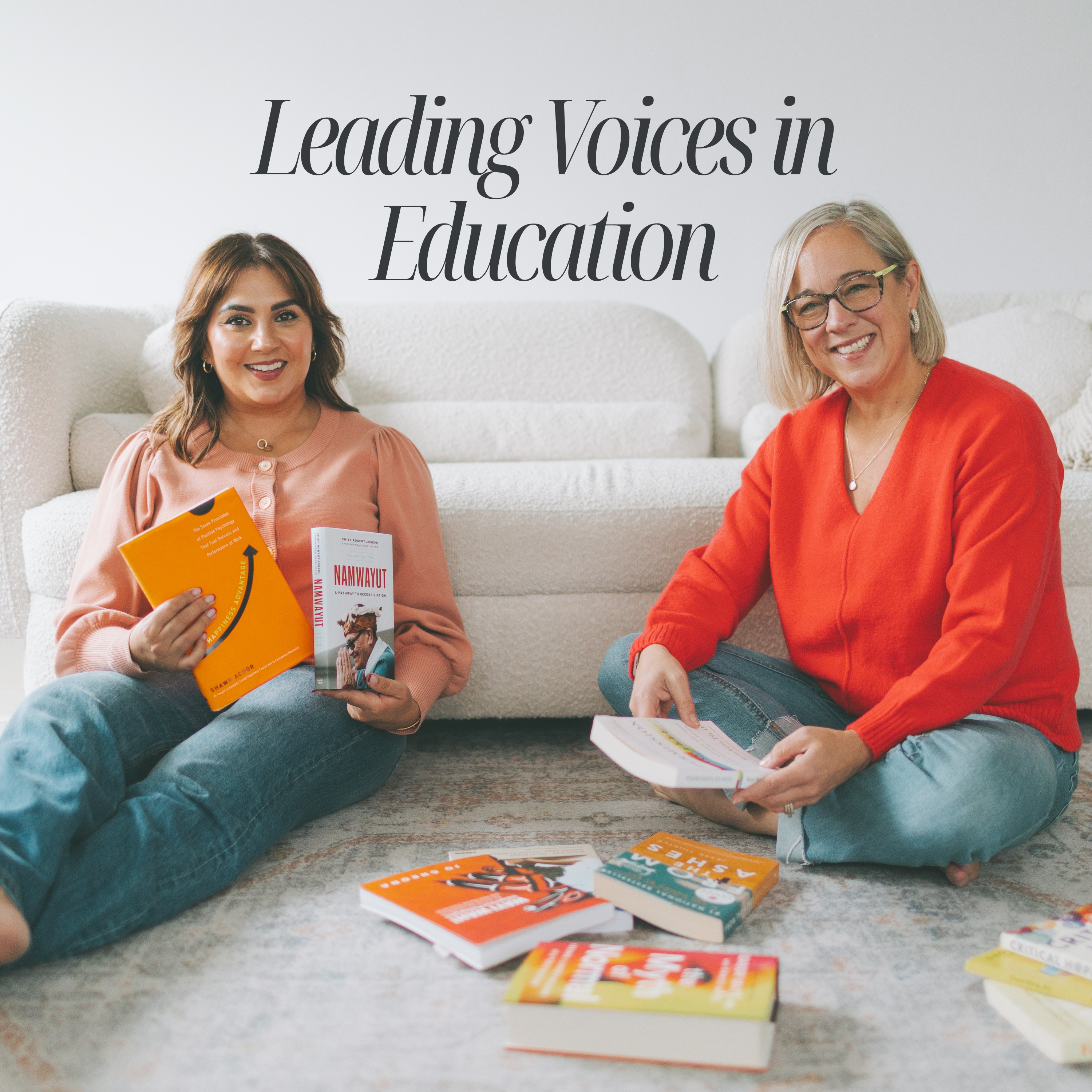
S3E10: Dr. Katie Novak – Empowering Learners Through Choice and Agency
48m 54s
Dr. Katie Novak shares her revolutionary approach to inclusive education through Universal Design for Learning (UDL), rooted in three core beliefs: embracing human variability, maintaining firm goals with flexible means, and fostering learner agency. She emphasizes that UDL reduces teacher workload by integrating routine, choice-based strategies—such as flexible text access or writing options—into daily instruction, with research showing optimal engagement at two to four choices. These practices are not just accessible but deeply connected to social-emotional learning, where self-awareness, collaboration, and responsible decision-making are foundational. Dr. Novak demonstrates how tier-one classroom supports—like group roles or voice-to-text—can replace one-on-one accommodations, empowering students to take ownership of their learning. Her personal journey illustrates how inclusive education begins with shifting mindsets: believing all students are capable, even when they fall outside traditional expectations. A transformative experience in her early teaching career—co-teaching with a special education specialist—deepened her understanding of inclusive practices, while a former teacher’s belief in her potential inspired her lifelong mission. Ultimately, she advocates for educators to look beyond external resources and recognize that their colleagues hold the greatest expertise in supporting diverse learners—making collaboration and professional dialogue essential to equity and student success.
Welcome to Leading Voices in Education, the podcast where we bring you insight from
educators, change makers, and thought leaders who inspire us to reflect, grow, and enhance
our leadership practices.
I'm Christy Blakeway, Director of Instruction with a Focus on Building Professional Capacity.
And I'm Sandeep Chohan, School Principal in Surrey School District.
Today, we are thrilled to welcome Dr. Katie Novak, an internationally renowned educator
author and leader in inclusive education.
Through her work in universal design for learning, inclusive practices, and learner-centered
education, Dr. Novak has helped educators around the world create learning environments where
every student can thrive.
Known for making complex educational concepts practical and actionable, she challenged us
to rethink traditional approaches to teaching and leadership while keeping equity, inclusion,
and student success at the center of our work.
Dr. Novak, thank you so much for joining us. We're so excited to learn from your experience
and explore how educational leaders can create schools where all learners feel valued,
supported, and empowered.
Welcome to the Leading Voices in Education, podcast.
Thank you so much for having me. I'm super excited for this conversation.
And I think this started because we had Dr. Shelley Moore on our podcast, and as soon as
we had Shelley on our podcast, we weren't even finished the last question, and she was
like, "You have to call my friend. You have to call Dr. Katie Novak and have her
on next."
Oh, yes.
She's my IBFF. We're inclusive best friends forever. We've decided.
Did she tell you our celebrity name? We call ourselves the more you know, Vak.
Oh, that's cool. I love it. I love it.
Shelley Moore would describe you as an expert in UDL, that universal design for learning,
and when we were looking on your website, you have so many resources and self-assessment
tools, or even online courses that educators can take to help build that capacity and their
knowledge around inclusion. I noticed on your website when you talk about UDL, you said
it's based on three core beliefs, and that with those beliefs, it puts proactive strategies
in place before things go wrong. Can you talk to us about those three core beliefs and
help our listeners understand the basics of UDL?
Yeah, absolutely. I would love to. So first of all, the three core beliefs are one.
We embrace variability. Two, we design with firm goals and flexible means. And three, the
goal of all of this is to build learner agency. So I'll break those apart. So the first
is variability. Now, when we talk about variability, there are two different kinds. The first
is inter-personal variability. Everyone is unique. We're different from each other.
That is not news to anyone. The other type of variability is intra-personal variability.
And that is that we are dynamic, and we are always changing. And as a result, no one ever
really knows what we need, because traditional education tends to put us in groups. And
those are the students who are extroverted and like to work with partners. And those are
the students who are introverted and like to work alone, for example. Now, I'm as extroverted
as they come. However, there are times where I don't really want to work with anybody.
Depending on my mood, depending on the task and the timeline. And so this idea of variability
is that when we embrace human variability, we recognize that people are incredibly unique,
but they're always dynamic. And so we're never going to know exactly what someone needs
because of all those differences. And so that is why we design with firm goals and flexible
means. And so we say, you know, the goal is to accomplish this task. And so we can give
our learners options to work alone or maybe work together. But because we don't know how
a single learner is going to show up that day, we need them to help figure that out. And
so we need to build learner agency, which is more self-directed learners. And that requires
that students become more self-aware and learn how to make responsible decisions. And it's
as simple as saying, this is the task. This is what we're all doing. Here are the options
that are appropriate. Which of these would you rather do today? Which of these would best
meet your needs so that you can work towards that same goal? And what's so interesting
is that on a given day, a different learner would make very different choices. So let's
take something as simple as I know in an inclusive classroom as a former English teacher that
if I put down a printed text, let's say we're learning about characterization, and I put
down a printed text, a couple of pages of an excerpt of a novel or a short story, I know
so many learners are excluded. I can predict that. I can predict I have learners with
visual impairment. I can predict I have learners who are learning English as a second language
who are not yet decoding at grade level. And so I'm going to be flexible, right? I embrace
that variability. And I say, all right, everyone, we're going to access this text. I'm going
to give you some background knowledge, some multimedia. Think about how you're doing today.
These are the questions you have to answer. This is the purpose of why we're accessing
this text. Which is the best way today for you to access this text? Would you rather have
a hard copy? Which allows you to annotate and dig in? Would you rather access it digitally?
Which allows you, of course, to magnify, to have it read aloud, to have the first redone
in a translation so that you recognize the cognates before you go into the read in English?
Or would you rather come into a small group and do a reader's theater where you take
turns reading? And if one person is a really exceptional artist, they can draw what they're
thinking. Someone else can pull up Google images. What do you really feel like is going
to serve you today as a learner so that you are able to answer those questions? And think
about is today a day that you are in a place that you can challenge yourself? Is today
a day that you had a really rough last period and you need to take care of yourself and
choose more scaffolds? What do you need today and why? Now, in that, there's incredible
accessibility for students who might have more traditional support needs. But you also
have students who say, "Oh, Mrs. Novak, thank you so much. Last night, I was up with my
baby brother all night and I had an exam this morning and oh, can I just put my head down
and listen? I promise I'm going to answer the questions, but I just need a beat." And I'm
like, "Oh my gosh, thank you so much for sharing that with me." So it comes together that
we embrace variability. We design with firm goals and flexible means. And then we honor
the learner to say, "I have high expectations for you. I believe that working together,
you can learn how to make really responsible decisions for your learning." And in a nutshell,
are the three core beliefs that we have to essentially align our design values to
if we're going to design something that works for all kids? I agree with absolutely everything
that you have said. And I'm thinking about some of our newer teachers who will be listening to
this and taking notes. Many educators can sometimes feel overwhelmed, right? Especially some of our
more inexperienced teachers. How can UDL, and I think it's really important,
reduce rather than add to workload? Just as you were talking about, I wrote down, "Students need a
variety of learning strategies when they have that firm goal." And I think at times for a teacher
that can feel like, how many of those learning strategies, how many options do I give? How will they
match the assessment tool that we are going to use? Just so many things that will be going through
their minds as they're doing that planning. Okay, I love this. Now, first of all, if you are new to
the profession, you're amazing. And this is the greatest profession in the entire world. My oldest
son is going into education. He's going to college next year. And I said, "Oh, like it'll break
your heart some days." But it puts it back together tenfold. So I am here for teachers. And let me
tell you, I taught for I think eight years before I learned about universal design for learning.
And once I learned about universal design for learning, my planning became so much more efficient
and facilitating a classroom became so much more enjoyable. And not only were students more engaged,
I felt really more engaged. So I'm going to share a couple of different things. First of all,
let's talk about the paradox of choice. There is really good research that we absolutely need
choice for accessibility, for engagement, for autonomy. But really what we're trying to do by
providing choice is we're trying to eliminate barriers. If I don't provide choice, if I only hand
out a printed text, there are some students who will not be able to access that. And they're so
capable of comprehending complex text with the right supports, with the right strategies.
And so I want to eliminate those barriers through design. And so when we're thinking about
providing choices, I think sometimes we think if choice is good, more choice is better. That's
actually not true. The paradox of choice tells us that too much choice actually creates barriers.
And so people say, well, how much choice is too much choice? The research is very clear that once
you go over six things go downhill quick. But the outcomes that people have the most intrinsic
motivation for is between two and four. So essentially kind of a rule of thumb and what my colleagues
and I share is between two and six, I like to leave one open for students to choose. So younger
students you might say, I'll give let's say up to four, but maybe you come up with three ideas
and then you leave a little bit of time and you say absolutely choose one of these three ideas,
but I'll also give you a couple minutes to propose something else if you feel like it would allow
you to meet the same goal. So the first thing to remember is that paradox of choice. The next is
every single time you're flat.
Think about it as the routine.
It's not the lesson.
So the strategy that I just shared about accessing text
when you're focused on reading comprehension.
It would be very different if you're working on foundational reading.
So if you are pre-K to grade five or if you're a reading specialist,
it is a different strand and there's going to be different flexibility.
But if you're working on comprehension across the content area,
or just comprehending literature or informational text,
accessing text, it's going to be the same options every time.
Do you want to access hard copy?
Do you want to access digital?
Do you want to read it in a small group?
Once that becomes a routine, there is no work for me.
And so I'm just going to share with you a typical lesson that is very traditional.
And then I'm going to share with you a couple of routines that I can add.
And so I always say when I'm working with educators,
what verbs can you explode?
So for me, again, I was an English-language teacher,
but I can share a couple of different examples in different content areas,
is let's say reading, accessing text, right?
Do you want it in hard copy? Do you want it digital?
Do you want to do it alone? Do you want to do it with a small group?
And then it's maybe annotating text.
And it's do you want to actually highlight?
Do you want to use note cards or post-its?
Do you want to use graphic organizer?
Is that digital or is that hard copy?
When it comes to drafting writing, if writing is actually the construct,
right, we're actually working on a teaching writing.
Do you want to write by hand?
Do you want to do a voice text and then have it transcribed?
Do you want to type it with your fingers?
Do you want to type it with your voice?
And then you can start thinking about the scaffolds.
While you're drafting, do you want to look at the rubric first?
Do you want to look at the exemplar first?
Some students don't like to look at exemplars first
because then they end up copying them, right?
And so it's all of this flexibility just becomes a part of the routine.
And I think sometimes it's valuable to teach all the options first
because sometimes students don't really know what they want.
So let's say a PE teacher to say the first five minutes of every class,
the firm goal is you have to warm up your body.
But different athletes warm up their bodies in different ways.
So we're going to talk about what it looks like to safely warm up your body
by just walking around the gym or the track.
And what does that look like in terms of keeping your heart rate stable?
And we're going to practice that for a week.
And then we're going to practice plyometrics and what that looks like.
And then we're going to practice some stretching.
And then after that, I'll give you a choice.
What do you feel like you need today to warm up your body, right?
That is now a routine for the other 170 days that you work with students.
That requires nothing from you.
Another interesting thing to think about is just when you're posing questions to students,
really ask yourself, is this question something that students really have to write?
If you're working on a writing standard, the answer is yes.
Or is it something that students really have to discuss?
If you're working on a speaking standard, yes.
If you're not, every time you pose a question,
if you're working through something like a worksheet or a complex text set,
if you pose questions, you could say, okay, how do you want to answer these questions?
Do you want to answer them by making a short video?
Do you want to answer them by writing them down?
Do you want to answer them by putting together a slide deck?
Again, bringing the same options and choices all of the time
and then asking students if there is one additional way that you want to be really creative
and what I have found and I still model lessons often.
Kids have the zaniest, most amazing ideas.
They'll say, you know, could I answer the question as if every one of the answers
is actually a song by Noah Conne,
but then I can like show how the song is representative of the answer.
I'm like, oh my gosh, yes, absolutely.
If you can somehow cite the evidence from the science text and pull that off,
I'm here for it because it's about them building their autonomy,
them building their engagement and in the equity space,
there's a quote that says, and I don't know who to attribute it to,
but it's like nothing for us without us, right?
Like don't try to do something for us without saying like,
well, what is it that you need?
And so thinking about how do we provide the same options over and over as a matter of routine?
How do we ensure that those options are minimized,
you know, two to four options when we give options,
ensuring that we're always using the same success criteria or rubric.
If my goal is students have to demonstrate understanding of how water moves
through the different levels of the environment and is impacted by gravity and sun,
there's not a rubric for a poster and then a rubric for a podcast and then a rubric for a paper.
It's like, do you understand and are you able to explain these things?
You create a rubric and then you say,
how do you want to show me that you can meet the success criteria?
So that's another thing that like minimizes the work for teachers as well.
Thank you. That was very helpful.
I love the examples that you gave where students have choice to come up with their own option
and I just can imagine some of the creative things that students of all ages would come up with.
And we were thinking about so often when we have students with diverse needs,
we start with the adults having that conversation and so much planning that the adults do
in your example is such a beautiful way to give that learner agency back to the student.
When we think about as school leaders and we're working with educators,
how do we shift that mindset from kind of accommodating the student's needs to really developing those structures
where students can thrive?
I think it really comes down to just thinking about just this idea of would you rather
is that there's so many preconceived ideas that even I had about what school should look like,
kids should sit in rows, kids should work on this by themselves, kids should be able to do this.
And it was because that was the way I was educated, that was the way that I learned to teach.
It was something that was comfortable and it did work for most students.
And so I don't want to say that it's not high quality, it's just not working for everyone anymore.
But more so, it's not building the independence that students need to go out and be successful
in this bizarre world where we're competing with robots.
And so the example that I sometimes give when I'm working with teachers is just saying,
you know, imagine that I had this amazing stay-couse.
And I have the best steak in the world and I have this winery or this vineyard in the backyard
and like no one does steak and wine better than I do.
And for a long time, that's all I served.
But you know, eventually a couple people start coming in and I start going,
okay, well, I can just throw together a salad.
Or, okay, fine, you know, I can throw together a mocktail real quick with, you know, soda water in line.
And then eventually I realized that the group that used to be a very, very small minority
is just becoming a much healthier part of just the expected diversity.
And so you start to design for that.
And now if you go to a stay-couse, you'll see cauliflower steaks and portable mushroom steaks.
And now the generation that's coming behind us, the 20-somethings,
it's not a generation that they're drinkers.
They're not drinkers like previous generations.
And so you're going to see a lot of these mocktails.
And so it's this idea of, you know, when we proactively design for the variability
that we know we can expect, you don't have to make all of those accommodations after the fact.
And so any educator, we basically, if we have an inclusive class,
we can get ahead of, we're going to have kids with learning and attention challenges.
And so therefore, I know that there's going to be some students who are far better served
by just saying, "Okay, listen, the firm goal here is that in the very short spurts
where I provide explicit instruction, you have to be, you know, attentive in a way that works for you.
And I want your body to be comfortable in a way that you can focus,
but you have to honor yourself and you have to honor other people in this class."
And so there's some different zones in my classroom over there as kind of like a movement zone.
Over here is the furthest from the movement zone.
And so I want you to think about what you need to do to honor yourself and honor this community.
And if you are a fidget or that's fabulous, I'm a fidget or as well.
You can't do fidgets that are super disruptive to other people.
So talk to me if you want some quieter fidgets.
If you are really bothered by noise, talk to me about noise cancelling headphones.
But ultimately, I am totally fine if you're standing up,
if you need to go into the movement zone, if you need, right, like even just that.
Because sometimes you see an accommodation that's like student can stand up and take breaks.
Student can have an alternative seat. And it's like when you actually think about it,
I think the reason that people hesitate is it's like, I don't want it to be disruptive.
Of course you don't want it to be a disruptive. I totally agree with you on that.
So if we can get ahead of that and say, you know, proactively,
the real firm goal here is that we create an environment where all of us learn.
And it's being self-aware, but it's also being socially aware.
And recently I was working with these two teenage boys.
And one of them was fidgeting incredibly annoyingly loud.
It was like a pounding.
And then the other one, of course, explodes. And it's like, shut up.
And so I was like, okay, dear friends, let me just give you some life advice.
You, number one, I am a fidgeter, constant, right?
I like, you know, where my ring, my legs are bouncing right now.
You know, I was like, if you like the noise, they actually have some really cool fidgets
where you can actually get the reception like in your pocket.
It goes to an earbud. There's a lot of really cool things.
I'd love to talk to you.
You don't get to go into public and make a racket.
But there is a lot of ways that you can make a racket to yourself, right?
And I'm happy to talk to you and you.
If noise has bothered you that much, dude, you're going to have to figure out a way to, like,
go noise-cancelling, right?
Because like, you just want to go out and live your life.
And you should be able to do whatever you want to do.
And if it's in a noisy place, that's awesome, right?
And they were kind of like laughing at me.
They used to know my older son.
But I think that sometimes we don't have those conversations.
We can have a restaurant of which
You can have cauliflower, I can have steak and we can be at the same table. There is no issue.
The same is true in a classroom. So it's just thinking about what options might be necessary and then having those conversations.
Another one I see on an IEP all the time is clarified directions. This is the easiest hack of all time.
Every time you give out an assignment, every time whether you are in preschool or whether you are in BC kelk, right, if you're doing AP kelk,
you say, "All right, everybody, here is the task. Let me give a very, very brief overview for the task. I am now going to give it to you.
Now you can work alone or you can work with a partner. Take about two minutes to review the task. Those who feel ready get going.
Those who view who would value me clarifying the directions even more. Come over here to teach your club. I got you.
Again, it's not only for students who might have that accommodation on the IEP. Sometimes a kid was absent the day before. Sometimes it's just, "Oh, I have a little bit of a question about this."
And so like, when I know that something is necessary for one, I'm going to make it available to everyone.
The same thing about an exemplar in an IEP, right? I'm not going to create an exemplar to give to one student.
But I am going to say, "Okay, we're going to get started. Anybody who would value an exemplar, why don't you come over here with me?
I'm going to create an exemplar. I'm going to met a cognitively talk to you about what I'm doing and why I'm doing it.
If you think that's valuable, I'd love to have you. Anyone who feels like that is not necessary, you can just get started."
Right? A lot of people don't think about that that is possible, and then they create more work for themselves.
And it's actually, I think, far more valuable to do it in real time, where students can actually get the process of what it looks like to create it.
And I think like when you're talking about that, especially the word "flexibility," I think a lot about our kindergarten teachers who are so amazing at that.
And sometimes that gets lost as kids move up in the grades. Like when you walk into a kindergarten classroom, those teachers are going to have such a diverse set of learners, learners who have never been to a preschool, learners who where English really isn't spoken at home, learners who are unable to sit at a carpet.
So the magic of a K teacher and how they are able to manage a classroom and have kids feel safe and that they are still learning and they don't feel left out.
It's so beautiful when you see that transfer even into the intermediate grades and high school.
Because I know when we were growing up, it's like once you hit the intermediate grades, the expectation is you all have to sit at your desk, you are in rows, everybody is getting the same piece of paper to show their learning.
Which is so different from those younger primary grades, while I'll walk into a classroom, and I'll see one kind of rolling on the floor and kindergarten, but he's still listening.
And I see another one that is by the counter, looking at the teacher, but just walking quietly, but still listening.
The expectation is not, you all have to sit on this X and you cannot fidget. The main rule is keep hands to yourself, right?
I mean, that's an important life rule. That's an important life rule. It keeps hands to self.
And I think more intermediate teachers and high school teachers need to remember that a little bit that we also need to be flexible in our teaching strategies and remember those types of learners.
I mean, the examples you gave were just were really great. So thank you.
My pleasure. And again, I pre-school teachers and kindergarten teachers are wizards. Like I really honestly believe that.
So I went to kindergarten. I mean, we're going way back early 1980s, and it was back in the day where you did have to sit on the carpet on a square.
And my seat in kindergarten was sitting on the teacher's lap in a lock-hold seatbelt with her arms around me in a rocking chair.
And I literally thought it was because I was her favorite student.
In hindsight, I believe it's someone couldn't keep her hands to herself. But I was like, oh my gosh, she always speaks of me to sit on her lap.
Like I'm awesome. But you know, again, I am somebody who needs to move around.
And if I was able to have a chair, a rocking chair behind the circle or stand, I would have been totally fine.
But like I am a mover and a shaker. I am a fidgeter. You know, when I'm presenting in people go,
do you want a lav mic or a hand mic? You can't give me a lav mic. I will throw it off with my hands, right?
Like I'm constantly moving. But I think that again, what I do totally understand is that sometimes we'll say,
okay, just be flexible. And then students are disruptive. And like those two things can't coexist.
And so how do we create those firm goals, right? Which is we are going to create a space, a community that we respect each other.
If we are doing something that distracts someone else, we do need to provide the language,
the sentence frames the way to communicate that in a way that allows us to kind of work through that.
Like that's a part of creating a community that's really important.
So one of the things that I used to say, and it was a little bit fresh, but I used to say it all the time,
I would say, you can always sit where you like as long as I like where you sit.
And they would say, this is Novak. That's not really like us choosing. And I said, no, no.
I mean this truly with love because I'm responsible for all of you, every single one of you.
And so I need to make sure not only that every single one of you gets what you need,
but that all of you get what you need. And so if one of you is choosing something that works for you,
but it doesn't work for other people, like we just need to work that out as a community, right?
It's not like it's going to be a Novak recipe and I'm going to make all the rules,
but we are going to have a conversation if I don't like what's happening for the learning community.
And then we're going to work it out together. And again, there was never an issue that we couldn't
talk through and make better. I'm not going to say that we could fix, right? But that we could,
you know, we could lean into and make it better for us as a community.
I love that. And I just love how every example you've offered isn't as we talked about earlier
that more work because of a particular learner in your classroom. Every example you're giving
is great practice. We could use with any students and especially I was thinking even as educators,
when you were describing how, you know, we change ourselves day to day that some days we might
like allow environment in other days. We might like acquire environment and, you know, as adults,
that's still very true, right? Love your examples. When I was looking at your Instagram page,
there was a post that caught my attention where you said one teacher with high expectations changed
my whole entire life. Can you tell us about that teacher and the difference that they made in your
life? Yeah, absolutely. It was my senior year, Mrs. Paula Kraus, C. Conk High School. And I was a
student who did fine, you know, my kids we joke about like a C's get degrees, you know, like
I was a solid C plus B minus student in the lowest track, right? So I was not AP, I was not honors,
I was not CP one, I was like CP two, right? And I did fine, you know, every once in a while I'd get a
D, you know, in PE, I was a gym class hero, so I'd get an A plus, I was always an athlete, but no one
expected me to do better than that. And so it was just like a totally kind of invisible middle of the
road. I was a nice kid, I was always redirected for talking because I was the type of kid like,
you couldn't even move me because I liked everybody. So it was the kid that like good luck moving me
because whoever you put me next to, I'm going to be friends with. And if you move me across the class,
I'm just going to like, hey, like across the class. So I basically go through my whole entire
career doing mediocre in lower level classes. And nobody really expected me to do any better than
that. And so I went into my senior year and I had Mrs. Kraus and she basically said, all right,
you know, like this is the transition your friends. And a lot of the people that I were, you know,
was in my cohort, my friends had no intention of pursuing, you know, college or going in that route,
they were going to go directly to work. And she said, I just want you to know what your options
are because maybe you're not going to go college or work or military right now, but like those
are always options. And so I want you to know what those options are. And so she basically said,
you're all going to write a college essay, you're all going to fill out a resume, a job application,
you're all going to know what it's like to go into public service, things like that. And so I wrote
a college essay and she pulled me aside and said, that is an amazing college essay. Like you're an
amazing writer, not technically actually because a lot of things are spell drong. And I still remember
the conversation, like I remember as a core memory where I was standing. She's like, you're so creative.
And I was like, I do write a lot of love poetry at home. That's probably why. And she said, and honestly,
like I looked back at your transcript and I realized no one's ever challenged you. And you're great
writer. And so I'm putting you in honors. And I was like, what? Like we're going not only CP1.
It's a double bump. Like it's far away from where I have been. And I was like, I don't know thank
you. And she's like, well, I already called your parents. It's done. And so if you've ever seen
Wizard of Oz where they go from a black and white to technicolor, going from below average regular
ed to an honors class, even with the same teacher is a totally different environment. And no one can
tell me otherwise. I'm in classrooms now. I see it. I lived it as a student, you know, the hidden
curriculum, the expectations in those classes is different, right? It's like these kids essentially
have very, very different options. And so we went in. And it was like, how are we going to do
the drama unit? And students like, Oh, we should do our one at plays. And we could write a grand
to get buses. And let's go down to the elementary school. Right? Like we're
not going to just read a plan of a textbook. Like what is have they been doing this the whole time?
Like my mind was blown. And then I was like mad. I was going home. And I was like,
Like, do you know this happens all the time
and I have a super smart sister and she's like,
"Yeah, obviously."
And it was just mind blowing to me
that like I never got it.
I never got it because somebody decided in grade five
or grade six that I didn't prove that I deserved it.
That's really what it comes down to.
And the thing that makes me so mad is I am wildly capable
of having to have done it.
And there wasn't any evidence that I could,
but there was also no evidence that I couldn't.
And so this is where a Shelley Moore and I have become BFS
where you do not know what a kid is capable of.
You do not know.
So you have to presume they're capable
of the highest level of work.
And so I went into that class and then I was like,
"You know what, I could do this work.
I am an honors kid and I am gonna go to college
and now I applied to a state school and got waitlisted,
but I made it, I made it and I became a teacher
because of Mrs. Krauss and kind of the rest is history.
But the great part of this story is that I reach back out to her,
after I wrote UDL now, the second edition,
I've written 17 books at this point.
My career in education literally is because of this woman.
So I dedicated the second UDL now to Mrs. Krauss.
And I reached out to her and I took her out to dinner
and I was like, I just, I wanna give you this book.
You changed my whole life and she's like,
well what did I do?
I was like, Mrs. Krauss, Mrs. Krauss,
what do you mean what do you do?
Like you read my college essay and said it was awesome
and she had remembered it.
Like she remembered it.
Oh, it was about sailing and you getting seasick
and I was like, gosh, I am the greatest writer of all time.
And then I said, you put me in honors
and she was like, I don't remember that at all.
And I was like, oh my gosh, like what if I made that up?
Like what if that's a core memory that did not happen?
And it turns out that I keep, I'm like,
it was this year, this was the principal.
And so she finally was like, oh my gosh,
now I remember I used to do that all the time.
I'm like, what?
And she basically said, oh, I hated the tracking system.
I hated it.
And I just was like, why don't we just give everybody
this honors class and everybody was like, no, no, no, no.
And so basically she didn't use these words.
I am now ad libbing this.
But it was like, I took the kids that everybody was like,
oh, there's no way they're gonna be able to do it
to just show anyone could do it.
And so I was like the starfish in the chicken soup
for the soul, but where the old man's throwing the starfish
and they're like, why are you bothering?
You can't save them all.
And he's like, I can save this one.
Yeah, Katie Novak is the starfish, but it does show.
And she's like, I did believe in you,
but I believed in everyone.
And like I want every kid to get the opportunity
that I got because it's really dangerous
not to give them that chance.
I can see so clearly why you and Shelley Moore
have become international inclusive best friends.
So kind of.
If I close my eyes, I hear Shelley Moore too.
You guys are awesome.
Yeah, just as as you're talking,
I'm thinking about tier one supports.
And you often talk about strengthening
those tier one supports rather than focusing on one-on-one.
And I had a conversation with a teacher about this.
She has a student that she believes requires more
one-on-one support.
Can you share some ideas that teachers could implement tomorrow
to strengthen some of those tier one classroom supports?
I'm thinking about students who need a scribe
and we don't always have somebody there to scribe.
And it's very difficult for a classroom teacher to do.
Just some ideas that teachers can take away.
I mean, a lot of this is just honestly like,
it's really hard to be inclusive of students
when we're not inclusive of the teachers
or the educators who serve them.
I'm coming at this from having a background
in general education and my collective efficacy
has been built over time by sitting in a room
with the SLP, with the OT,
with the special education teacher,
with the English as an additional language teacher,
with the counselor.
And saying, okay, like, these are the needs of the students.
Here is the barrier.
What is another way to do this?
And so, you know, with a scribe,
the first thing that comes to mind,
and again, I don't have the expertise in assistive tech,
but someone in your school does is like,
instead of a scribe, could you use voice to text?
Or could this be a task that you allow students
to work together?
And then another student could be the notetaker,
like if you're doing collaborative work,
and then you could do different roles for group work.
And so, it's not like this one-on-one has to have a scribe,
but if you're thinking about like,
is the thing that the student's doing,
does the standard actually say,
it is a writing standard, and does it actually say
that it has to be done individually?
'Cause there's very few standards that say that.
In fact, there's one.
It's anchor standard number 10.
And you're working toward that.
It doesn't mean it needs to be done all of the time.
And so, for instance, if I'm working on, let's say,
writing an introduction, then I might say,
let's get into small groups,
let's examine lots of different introductions,
let's sort them, let's try to figure out
what grade they are in the rubric,
and then work together as a group and create an introduction.
You don't need to scribe for that,
because there's one student who's gonna be the notetaker,
another student who's gonna make sure everyone participates,
another student who's going to capture disagreement,
we're gonna have sentence frames, things like that.
If you're actually not working towards an actual writing standard,
so there's content standards,
and those are the ones where we're trying to figure out
can the student explain, can they communicate, can they understand?
Do a voice recording, right?
There is no requirement for the student to write,
and if the student has a scribe, it means the student
does have some ability to communicate.
I know that sometimes voice detects his heart,
because if you have articulation challenges,
it will be hard to pick up,
but an audio recording would pick it up,
as well as a scribe would pick it up.
And so I think sometimes it's just stepping back
and saying, you know, I have 25 students in the classroom,
and a one-on-one scribe is not always something
that I'm able to do,
and I'm working with different small groups,
does anyone have any ideas?
And those are just the ideas that I can come up with,
like off the top of my head,
without a brilliant group of people around me.
And my dear friend, George Corso, he says,
the smartest person in any room is the room.
So if you get your different specialists,
but I think it often comes down to,
we are often jumping to an assumption
that a firm goal exists that does not exist.
So collaborative learning and working with diverse partners
is a huge part of educator evaluation all over the world.
And so saying you can work together as a group
is still a really meaningful learning experience.
We're not making things easier.
We're not negotiating or watering down the curriculum,
but it is like a really meaningful instructional strategy
that doesn't require the writing.
If it does require the writing, again, voice to text.
I do, people always say, how do you churn out so much writing?
Almost every single thing that I write,
I actually voice record first,
and then it transcribes itself,
and then I text it to myself, and then I revise.
So if I, as a professional writer,
can use a voice recording to produce texts,
then why can't a student use that?
That's right, yeah, thank you.
I love that too, because it just shifted the thinking
in a sense of, sometimes we see the barriers
or why we can't do something
or why our classroom is hard or a school
or we don't have enough staff to be able to meet the needs.
And I just love the way you flip that of,
why are we assuming that the student needs to have
the answer on the paper,
that there's another way to capture their thinking
without doing it in the traditional way?
So thank you for another beautiful example.
We're wondering to, in British Columbia,
curriculum focuses a lot on core competencies
and social-emotional learning,
how do UDL and FEL intersect in instructional design?
There's really no way to separate them,
because universal design for learning
is how do you design learning so that all students can learn
and all learning is social-emotional.
So when you talk about what is learning,
learning is being engaged, being able to understand
and being able to share what you learned,
and engagement, if you break it apart,
is really a social-emotional construct, right?
It's knowing the goal that you're working towards.
It's self-awareness where you stand in relationship
to the goal, it's being able to self-manage
and make responsible decisions.
It's all about collaboration and community.
And so if you're looking at the core competencies
for social-emotional learning, self-awareness
is necessary for engagement, is necessary for agency.
It is also a social-emotional competency.
The idea of self-management of what tools do I need?
What strategy should I use?
What do I need to choose today,
based on my mood and the context
and what I'm working towards,
so that I can do the best work that is possible?
I want to try to find my zone of proximal development,
and it takes time to figure that out,
and that's why teachers are there to provide feedback
and to pull small groups,
and all of that's going to be happening all the time,
because it's not only about proactive design,
it's being responsive in the moment, right?
And so we're also going to be providing instruction
and feedback, but I think that it comes down
to, we want to help students understand
who they are, self-awareness.
We want them to realize in the community,
other people are going to make different decisions
than them, social awareness.
In order to create this community
and make decisions that are both self-aware and socially aware,
that is really nurturing of relationships, right?
When I realize, I'm not in a place
that I'm going to be a really great collaborator today,
and I love you to pieces,
but like I'm going to work by myself,
Like, that is a. a great way to keep a relationship healthy.
It's also even just about responsible decision-making
in general about how you're gonna challenge yourself,
the materials you're gonna use.
And so there is no separation at all.
The giving students options and choices
and slowing down enough to say, this is the goal.
This is what success looks like.
This is where we are headed.
Now take a moment, think about how you're feeling.
Think about what you know about this already.
Think about where you're able to challenge yourself today.
And then what is the most responsible decision for you
for this community?
Why are you choosing what you're choosing?
I'm gonna come around.
I'm gonna check in with you.
You can always redirect.
And I can always redirect you, right?
That is my job.
And if we put all of that together,
there's no separation.
And so I don't need to take any time away
from academic learning through the lens of UDL
to focus on social-emotional learning
because it's totally embedded.
Yeah, it's so accurate.
And if you're doing all those supports,
as you said, the two UDL and cell
go completely hand in hand when it's done right.
Now you've already talked about your favorite teacher
and just the impact that she had on you.
So we're gonna just shift it a little bit.
Looking back at your career,
was there an influential person or moment
that shaped your beliefs about inclusive education?
I honestly think it was when I learned about UDL.
And I would have to say that probably one
of the most influential people I've ever worked with
was the first person I co-taught with.
So I was a, I'm gonna say good teacher
before I learned about universal design for learning.
And when we think about the full level of variability, right?
When we talk about the margins,
you take a bell-shaped curve and most people
are kind of your mythical average, right?
And then you have people on the margins,
like you're twice exceptional in your gifted students
and your students who have really significant support needs
linguistically, intellectually, physically, right?
And when I first started teaching,
we didn't have fully inclusive classrooms.
I started teaching in 2002.
And there was still a lot more tracking
and a lot more substantially separate programs
instead of substantially separate programming.
And so my skillset was limited to a skillset
that kind of hovered around that mythical average.
And so the further students were
from that expectation of this one size fits all curriculum,
the more I felt like,
oh, this is going to be a lot of work
because I had to then create these accommodations.
I had to create these modifications.
And I was so incredibly lucky
that when I was a seventh grade teacher in Massachusetts,
I think it was 2011, the district that I was in
got selected to be a district in this huge research study
funded by the Gates Foundation
called the Tale of Four Districts
that was looking at the implementation of UDL
moving from the exploration of the framework
with a small group of early adopters
through installation in the strategic plan,
through initial implementation to full implementation.
So really using like the fixin model
of implementation science
from the National Implementation Research Network,
what does it look like in real time?
And they chose a large urban,
a large suburban, a small suburban, a rural, right?
Chelmsford, Massachusetts,
where I happen to be teaching happens to get this.
And they asked me, do you want to be a part of it?
And I was like, what's the commitment?
And they said, you're going to be trained over the summer
for like two weeks.
And I was like, nope, nope, I'm not interested.
Like I have a baby at home.
You know, I just had twins.
Like there's no way that I can do it.
And they just kept saying, right?
Kristen Rodriguez was the assistant superintendent.
I've written two books with her,
dear friend of mine to this day.
She's like, come on Katie, like you've got to do it.
I'm like, I have literally, I have a two-year-old,
and I have like two, like, you know, five months old.
Like I cannot make it happen.
And she's like, I'm telling you, like I feel it.
Like you're going to lead this work.
And she is one of those women
that you just can't say no to.
She's like so good at convincing people to do things.
And so I was like, so I like go to this training, right?
I like get, you know, my mother-in-law watches all the kids.
I go to this training.
And not only do you have the training,
but then like somebody comes out
and they observe you once a month.
You get a release day once a month.
I got to build a graduate course.
They taught me how to build a graduate course.
I got to teach my colleagues, like I'm all in.
And because I'm a lab rat, they record lots of interviews.
And they say things like, you know,
what do you think is the best resource that you have for UDL?
And I was like, it's probably myself.
And that's not being fresh, like I'm something special.
I'm like, a lot of it is just your willingness
to try something that you don't know it's going to work.
Right? Like that's hard, right?
To like take something that you know works pretty good.
And throw it out and try something totally different.
That's really hard to just take that leap.
And I think sometimes like the best resource you have
is just like, face that like, okay, like it can't be that bad.
And David Rose, who's the founder of Cast, like heard that.
And is like, oh, she's hilarious.
Like, would you come out and present
at this Harvard symposium?
And I was like, yeah, sure, I'll go to Harvard.
Right, I have never presented in front of adults before.
I am a seventh grade teacher.
I go out to Harvard and give a presentation
about like, this is what I know about UDL.
This is like a seventh grade lesson as I was done it before.
This is what I'm doing now.
And then people started coming up going,
like, can I have your business card?
I'm like, for what?
I teach seventh grade.
Like, I already, I already have a job.
I'm not interested.
I got professional status.
Um, but because of that, after a year of training,
they said, okay, now we're going to be folding
all of those programs and the programming
is going to be inclusive.
So what used to be, you know, life skills, behavior,
autism, resource is now fully included.
And I have four sections, one section is co-topped.
So I will never forget the very first meeting that I had.
I thought I was so cute and funny because I used
to do my vocabulary just totally randomly by letter.
Like, I didn't think about the tears of vocabulary.
I didn't think about like command words.
It was like, it's the first week of school.
I'm picking 20 random words at the beginning with A.
And then I brought the blow up doll that was the A,
like kindergarten does and hit knock on the door.
And I'd be like, oh, Mr. A's here.
He's bringing her a vocab.
And it was just stick and the kids loved it.
And my first meeting with Betsy, she comes in
and she, you know, is the special education teacher
who I'm going to be co-teaching with.
And like, my view of co-teaching was so skewed
and so problematic because I was like,
so I just say what we're going to do.
And then she helps me, which is like, co-teachers,
I'm sorry, I love you.
So she sat down and I was like, okay, so week one, A,
and she goes, oh no, we're not doing that anymore.
And she goes, no, we're not doing that anymore.
And I was like, oh, we're not, right?
Like I had no idea what co-teaching was going to be.
It was the best thing that ever happened to me.
The best thing to have someone with that level of expertise
to in real time say that's a barrier.
That's a barrier, that's a barrier.
And she was so kind and so not judgmental.
And I co-taught with her the whole rest of my career
and loved the woman.
But I think like the idea of co-teaching,
when it's truly interdependent, when it's truly reciprocal,
when someone, and special educators,
imagine if you could tell your genetic colleague,
like no, you can't do that anymore.
That is able to stop doing it, you have to do it another way.
But I think again, being willing to say, okay,
so tell me why that's a barrier.
And listening to that is our colleagues know so much.
And if we open ourselves up to them,
and I never had an opportunity to be as close
to a colleague who is a specialist,
just because we had time every day.
But I think that sometimes we're struggling so much
and we're looking to outside professional development
and we're going on these podcasts
and we're reading books.
Honestly, some of the smartest people in the world
are in your building.
You just have to make time and find them.
- Yeah, yeah.
And it's just really great when you are able to work
with somebody who challenges you in a professional way
and makes you rethink.
And that's where the most growth happens
on a daily basis in a school.
- Yeah.
- Well, thank you so much.
This has been an amazing conversation with you.
There's been so many takeaways that our listeners
are going to get from this episode.
It's been wonderful chatting with you.
Thank you for being on leading voices and education.
- My pleasure.
- This has been leading voices in education
where ideas shape the future.
Listen every Tuesday on Spotify or Apple Podcasts
and watch full episodes on YouTube.
Leading voices and education is a platform
for dialogue and learning.
The perspective shared by our guests
are their own and may not necessarily reflect the views
or values of the Surrey School District.
Podcast Summary
Key Points:
Dr. Katie Novak emphasizes Universal Design for Learning (UDL) based on three core beliefs: embracing variability, designing with firm goals and flexible means, and building learner agency.
UDL reduces teacher workload by providing structured, routine choices—such as how students access text or complete writing tasks—without adding extra planning complexity.
The "paradox of choice" shows that too many options overwhelm students and teachers; research supports that two to four options, with one open-ended choice, maximizes engagement and accessibility.
Inclusive practices are embedded in social-emotional learning, as self-awareness, self-management, and community collaboration are central to both UDL and core competencies.
Tier-one classroom supports—like group roles, voice-to-text, and collaborative learning—can replace one-on-one accommodations and empower all students.
A pivotal moment in Dr. Novak’s career was co-teaching with a special education specialist, which transformed her understanding of inclusive education and co-teaching as a reciprocal, professional practice.
She credits her shift to inclusive education to learning about UDL and a research study that transitioned her district from segregated programs to fully inclusive, student-centered classrooms.
A former teacher, Mrs. Paula Kraus, inspired Dr. Novak by believing in her potential and placing her in an honors class, which fundamentally changed her educational trajectory and lifelong commitment to equity.
Summary:
Dr. Katie Novak shares her revolutionary approach to inclusive education through Universal Design for Learning (UDL), rooted in three core beliefs: embracing human variability, maintaining firm goals with flexible means, and fostering learner agency. She emphasizes that UDL reduces teacher workload by integrating routine, choice-based strategies—such as flexible text access or writing options—into daily instruction, with research showing optimal engagement at two to four choices.
These practices are not just accessible but deeply connected to social-emotional learning, where self-awareness, collaboration, and responsible decision-making are foundational. Dr. Novak demonstrates how tier-one classroom supports—like group roles or voice-to-text—can replace one-on-one accommodations, empowering students to take ownership of their learning.
Her personal journey illustrates how inclusive education begins with shifting mindsets: believing all students are capable, even when they fall outside traditional expectations. A transformative experience in her early teaching career—co-teaching with a special education specialist—deepened her understanding of inclusive practices, while a former teacher’s belief in her potential inspired her lifelong mission. Ultimately, she advocates for educators to look beyond external resources and recognize that their colleagues hold the greatest expertise in supporting diverse learners—making collaboration and professional dialogue essential to equity and student success.
FAQs
The three core beliefs are: embracing variability (both interpersonal and intra-personal), designing with firm goals and flexible means, and building learner agency to make responsible decisions about how to achieve those goals.
UDL reduces workload by creating routines and consistent choices (typically 2–4 options) that become habitual, minimizing daily planning. Teachers also use shared success criteria and student-led decision-making, which reduces the need for individualized interventions.
UDL fosters student agency by giving learners choices in how they access content, complete tasks, and demonstrate understanding, encouraging self-awareness and responsible decision-making about their learning process.
UDL can be applied universally—such as in reading (choice of text format), writing (voice-to-text or digital drafting), or PE (warm-up options)—with strategies adapted to grade-level goals and developmental needs.
UDL supports inclusion by proactively designing learning environments that accommodate different learning styles, abilities, and needs, ensuring all students have access to the same goals and opportunities to succeed.
The paradox of choice suggests that too many options can overwhelm students and create barriers. Research shows that between two and four options is most effective, with one open-ended choice allowing students to personalize their learning without feeling overwhelmed.
Chat with AI
Loading...
Pro features
Go deeper with this episode
Unlock creator-grade tools that turn any transcript into show notes and subtitle files.
 PodcastTranscript AI