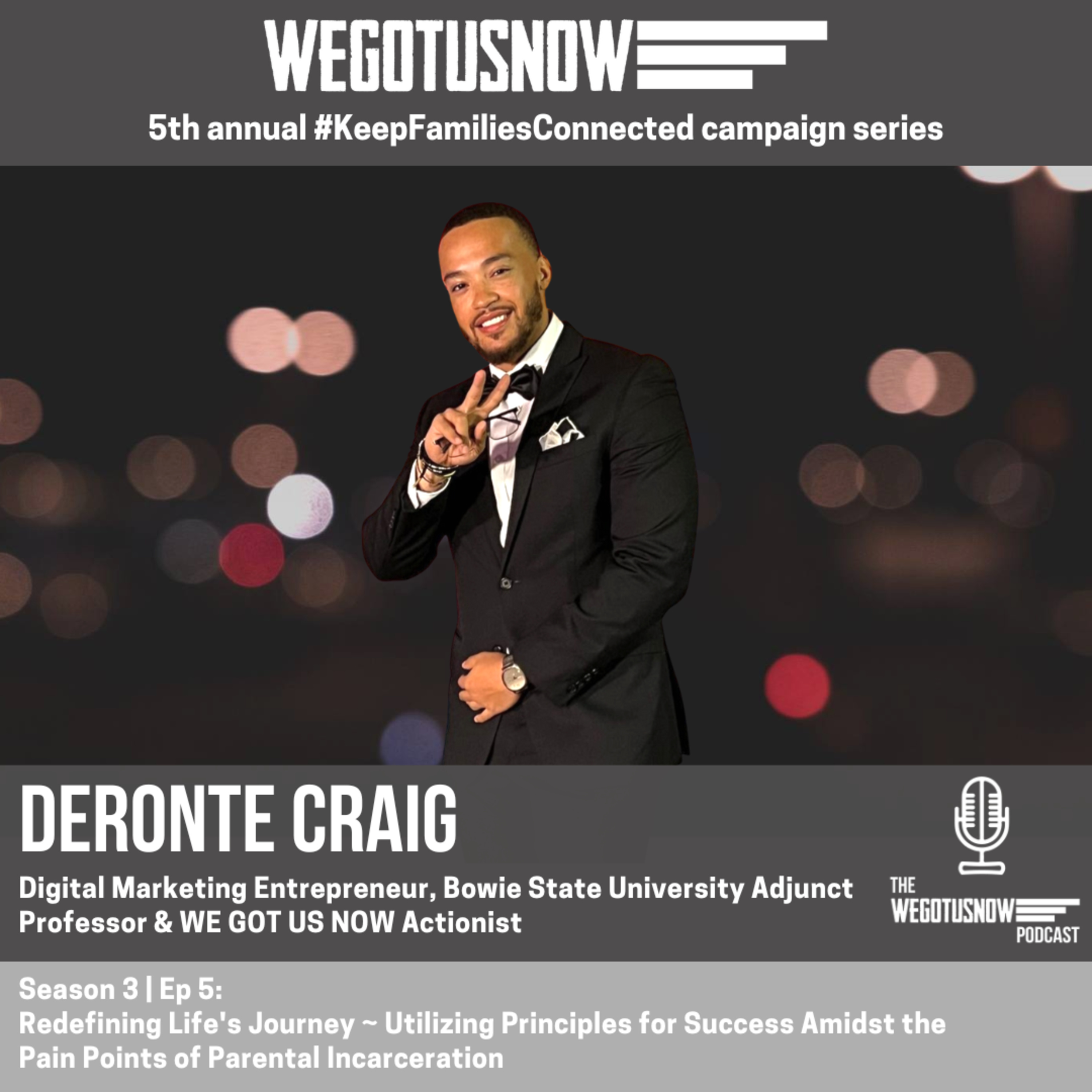
Mass incarceration in the U.S. is the great tsunami that has ripped apart families and destroyed communities. At the epicenter of this destruction are the children of those incarcerated. My name is Ebony Underwood. I am the founder CEO of We Got Us Now. We got us now as the first of its kind, national, nonprofit, nonpartisan, organization, built by, led by, and about children and young adults who have been impacted by parental incarceration. These are our stories. Welcome to The We Got Us Now podcast. I am here in sunny Long Beach, California with actionists, 2022 actionists, Durante Kray. Hello, hello. Hi Durante. Hi, welcome to the West Coast. So Durante is not from California, but he had to get away from the cold East Coast and came across the country to Long Beach, California, and we are out here chilling. And so today we're going to be in conversation. Amazing view. Yeah, we got an amazing view. He runs this beautiful park. I can't wait to just get into all this that we're about to talk about. So Durante, how are you doing? Thanks for being well. That's good. Really, really good. Let's take a look at the last like five, six months. You know, my business has been growing a little bit more, been taking a few action. It will step to try to get my father released from prison. I have a trip plan, so I'm going to be having some mental rest and reset and reflection. That's right. And then, you know, I've been in the gym. So hopefully they can tell. That's right. That's right. But I've been consistent and, you know, things are going good. I don't have any complaints. And, you know, and even if I did complain, I don't want anybody to listen to them because I want them to keep saying, hey, keep doing what you're doing. Yeah. Well, you know, we just re-release our five year impact report titled 10 million children inspired. Our answer to 50 years of mass incarceration and beyond. And I feel like you are the epitome of what inspiration looks like. And so, I want to kind of give, like, our listeners, like a real, like, arc and trajectory of, like, your life. Similar to what we did in the life apps, right? And, like, kind of, like, give people, like, an overview of, like, your story and how you got here, what you're doing, and, like, you know. So, my father was incarcerated sometime in '98. I believe I was probably like a year old, maybe a little over a year when he got incarcerated. But primarily, most of my life, I grew up, you know, with my mom. We spent a lot of time with my grandparents. I could remember that. I have a younger brother and a younger sister. You know, we all have different dads. So, my experience, my brothers and my sisters experience, are all different. Yeah. Because we all have different, like, sides of the family when we, like, leave mom's house and we go somewhere else. And so, you know, growing up, when I left mom's house and on the weekends, I would go see my grandparents. And I spent a lot of time with my father's mom and dad. And that's where I was able to start building a relationship with my father. And they made it their business that I had that relationship with them. And I want to say thank you to them. I grew up in, you know, Southeast DC. And, you know, Prince George County, Maryland. So, land in Maryland is like a place I would call home. But we spent a lot of time, you know, back and forth. You know, a lot of good influences. Also, a whole lot of bad influences and, you know, people. And you're the oldest? Yeah, I am the oldest. So, I'm the oldest of three. So, a lot of good, bad in the small community in space. But I would say oftentimes recognize or, you know, look at my father's experience as a reason not to go down that certain path. So, as I was growing up in these different neighborhoods and having examples like my uncle and my grandfather's. I learned a lot. I seen a lot. And I also did a lot. Some of the things could have passed to me and had my life ended up. My father still made us something like that. But, you know, thankfully, you know, with God and, you know, some guidance. You know, in a vision to want to do something different and be something different and actually be the person I am today, which is so ironic. That wasn't the path that I had to take or walk very much longer. So, as I grew up, a little bit more. Went to high school in high school in high school in Maryland. Went to Northwestern High School. Things would change a little bit. You know, I moved out my mom's house around my sophomore year of high school. This is where I bounced around a bit, staying with family members, friends, and whatever I, you know, honestly could. And eventually, I moved in with my grandparents. I always say that my grandparents definitely saved my life. Because that path, I was walking and kind of ultimately changed once I moved in with my grandparents. So, when I was staying with my mom, I was the man in the house that, like, 12 years old. So, many years, I was the exactly, I was that person, you know, responsible for my brother and my sister. And, like, I remember times where my mom worked two jobs. She was so busy and she was so drained that she would wake up about five o'clock in the morning to get to her job on time in DC. And then she would leave around four o'clock just to get to her second job, which was at Audi by six o'clock. And so, she would close there and sometimes get out of there at 12, sometimes get out at one o'clock in the morning. It was a period where, like, we didn't see my mother. You know, she was here because stuff in the house was different by the time we woke up, but, you know, she really worked hard. Eventually, my mom met my stepfather at the time. I mean, that's when our relationship changed, you know. I'm a young man, being the man in the house for all these years. He is an actual man. So, we bumped heads. Things didn't work out. And so, you know, I decided to leave. So, me leaving, not having to deal with that, and also not having so much pressure to be, like, that man in the house will be responsible for my brother and my sister. I guess, honestly, allowed me to focus more. And then, moving to my grandmother, like, she ain't in play. Like, grandmother, honestly, didn't care what I did. It's long as school was taken care of. It's long as I did what I was supposed to do in school, longer than had good grades. And honestly, my grandfather was the same kind of way. And my grandfather, he would always tell me that, you know, you won't have to want for anything. You won't have to need anything as long as you do what you're supposed to do. That was an agreement that we had when I was coming up in my teenage years. And so, I always deal with what I was supposed to do. So, the parents, the grandmother and the grandfather, made a complete difference in your life, right? The two-parent, grandparent caregivers. Yeah, they helped to change the trajectory it sounds like. Yeah, absolutely. Grandfather, keeping his end in the bargain, grandmother being stern as she is. You know, my freshman year of high school had, like, a 1.8 GPA in high school. So, that was, like, a reflection of the problems that I was having in school. And all the extra curricular activities that I was taking up some of my time, that I shouldn't have been taking up some of my time, right? So, I moved to my mom's house, freshman year. Then, you know, I began to solve my year, moved in with my grandparents. And then that's when things slowly started to shift in change. Do you believe that was due to the, like, the structure because, like, they're there? And then, again, like you said, the parent child positioning wasn't the same, right? You don't have the responsibility of being, you know, responsible for your younger siblings or even being responsible to make sure everything is done whenever your mother needs. But now, you have, like, parents to some degree. Not that your mom was not a parent, right? I think the major part of it is honestly, like, the respect that I have for them. Like, I respect them, my mom, I respect my dad, my mother grandparents as well. It says a lot when someone takes you in and they don't have to. If I say that, my grandmother would, like, I'm your grandma, I'm supposed to do this. Their job was to raise their children so that their children can raise their children, right? They took me in and I think living with my grandparents and, you know, all the great things that they would do for me as a kid on those weekends when I got to spend with them. I did not want to disappoint them. Their opinions mattered to me that much. I remember talking to my grandmother and my grandfather about wanting to do this or wanting to do that. And, you know, I just hear their opinion or what they say. And that will completely alter the decision I would make or do because I cared about them so much. I respected them so much and, you know, I honestly, like, trusted their word and I knew that, you know, they wanted their very best for me. So, examples of this, when I was getting out of high school, I was like, I talked to this recruit and I was like, maybe I should go to the Marines. Grandma was like, uh-uh, she's not having that. Oh, no, really? Yeah, she did not want me to go. I think if I went to the military, I would have a completely different life than I have now. So, sophomore year, you go to your grandparents. You're now living there, you're in school. What's happening in school? Oh, yeah. So, it was a 1.8, which is reflective. Okay, yeah, so freshman. Freshman year, I had a 1.8 GPA. I had problems at home. I kind of like reflected in the school. I moved there with my grandparents, my sophomore year, that 1.8 turned into a 3.65. What? Yeah, yeah, yeah, yeah. And one year? The boy was bad, yeah. Oh, that's fantastic. So, 1.8 to a 3.65 and then my junior year, that 3.65 turned into a 3.875. And then my senior year, I had a 4.0. And then I was in a program called Dual Enrollment. So, I was taking college classes and that. So, yeah. Like complete, complete. Oh, my God. Like change and turn around. Yeah. So, in those three years of high school, what's the relationship with your mom? What's the relationship with your siblings? Like what's happening? She was heartbroken. I also didn't understand why I wanted to leave. She had an idea and knew why, but as a parent and your child, I said, "I don't want to live with you any longer." It was tough. So, I just avoided having those conversations with her. You know, we avoided communicating with each other, you know, didn't ask something off anything, you know. And like, I was growing up to be a man and make man decisions and, you know, be responsible for myself and those around me. So, when I did leave, you know, I didn't really have any problems. But I still tried to keep a relationship with my brother and sister, even though I, today, don't think I did as good of a job as I could have. I honestly feel like when I left, I left them, even though we still stayed in contact. My junior year, me and my mom started reconnecting again. Oh, good. She realized from that 1.8 to that 3.6. So, I was like, "Hmm, maybe you're going over there with some father-in-law." Okay. So now, you graduate 4.0. You're taking college courses in 12th grade. Yeah. And now, like, okay, where? What do you want to go? What's your relationship with your dad? You know, now, you've, like, you're thriving. Like, how are you feeling about, like, journeying into the next phase of your life? Right. So, I told you, grandma, I was like, "Yeah, you're not going to the Marines." So, that was out of the picture. So, we started to apply for schools to go to in colleges. And if it wasn't for my grandmother, I wouldn't have went to college. I'm going to be honest with you. Even when I was living with my grandparents, I had this idea and thought that you don't have to go to college. You don't have to go to college to be successful. And I feel like that's what a lot of people think, who plan on not going to college. And that's okay. And that is true, but honestly, it makes it a little bit difficult. So, I decided to go to college and me and my grandmother went on this binge of applying to colleges, scholarships, and things like that. And again, I got to shout out to my grandmother because without her, I honestly wouldn't have gone. This is your paternal grandmother. Yes, my dad's mom. Yeah, so. But I tell a bunch of schools, University of Maryland, Howard, Hampton, Bowie State University, which is, you know, the best HBCU there is, doing some research and, you know, checking out some of the schools. So, it kind of was between Morgan State University and Bowie State. Bowie State University is the first HBCU in Maryland. It started in 1865. Okay, okay, tell us more, tell us more. Bowie State was the school that I chose. I had a best friend from high school that went there. So, that was kind of like a little age that helped me decide to go. And I ended up going to Bowie. Started there this summer of my up 2015. That's when the world of Bowie kind of erupted, you know. And what happened? I'm not just there today, but most times people would see me pretty stylish. It's in the suit. In the suit, I know. I started. You know, he's running there and we got a snap today. He's suited in Bowie. Yeah. But I started that summer because I heard, you know, there was a thing called professional dressed Wednesdays on campus. I have a few mentors, one of Denzel Prince and another is Richard Lucas III. And it was one day, I had like a nice polo one. I had some cool khakis and I had some slippers. You know, all the students were just walking around campus and slippers. And Scott Denzel, he pulled me to the side. And he said, "Man, I don't ever want to see you like dressed like that again." And I'm like, "What?" And he just like, "Man, you know, you never know who's watching or paying attention to you from afar. So whenever you step out, if you're room, your house, whatever, you always need to be your best and look your best." So him telling me that coupled with the SJ president at the time, which is Richard Lucas III. It's SJ. SJ, a student government association. Okay. So that president, you know, my first time meeting him was in a suit which is actually a fraternity brother and a big brother of mine now. It was like grandma. We got some things and he did. That's all I was about to say. How did you afford this? So grandma helped me get some suits. Okay. The first set, you know, she thought I looked really nice. I thought I looked like I was in, I was maybe going to court in 2002. You know, things are a little baggy than I like. But when I look back at the mission, I was like, "Oh, yeah, they actually look nice." But they were a little baggy. So I started dressing up every Wednesday. And, you know, things kind of erupt different. Did you feel different wearing a suit? Well, I felt like I was the man. I felt like I was the man. Yeah. And especially because no one else just like this. I knew I stood out. I knew that I was like, you know, living by those things that, you know, things that have told me, like people are paying attention to you now, even when you're not even trying. Right. So not only people look at you when you don't notice, but now based on your appearance, people are looking at you. This was a way to help me actually start getting out of my shell because I'm an introvert. A lot of people don't know this, but this was a way to help me stand out starting to communicate with people. Because now I'm the only one who dressed up on campus. Now everyone wants to know where I'm getting my stuff from. If they can borrow my stuff. And I started to let people borrow my stuff, which ended up turning into a business that we could, we're going to talk about that. Okay, so. Okay, so. Yeah, we got to talk about, obviously we're thriving, right? You're in this environment of education. You're soaking it all in. Yeah. You're soaking in the environment as well, the people, right? What I've observed already is that you're really observant. And you're a really good listener. Like if it makes sense to you, you're going to take heat. Yeah. You're going to make sure that we capture in this conversation things that you took heat to. So that any young daughters and sons that are listening to this. Yeah. And just people, right? People that may be teachers or educators or mentors. Yeah. They may know, like, okay, maybe this is how I should approach, you know, a young person that has had this experience or, you know, is out here and trying to thrive. So, you know, you as an example of that. The one thing that I do know personally about you is that you are the ultimate entrepreneur. For sure. So my sophomore year of college, I started a company called the Gentleman's Toolbox. Wait a minute. You started a company? Yeah. Wow. Like official? Yeah, official. Wait. Very small, but official. Okay, interns, you work for me. What? Talk about it. So I started a company called the Gentleman's Toolbox. The inception of this was me building a collection of clothes and wearing suits every single day in my freshman year. And people wanted to borrow stuff and I would let people borrow it. And I'm like, yo, put my stuff up. You know, and I didn't want to have to keep approaching people like this. So I was just like, hey, give me $20. You can have it, right? And then eventually I started doing some research looking online. I am the marketing for my business on campus. So I'm going to dress up and every time I'm going to ask me why I get this from, I'm going to be like, I'm going to give him a card. Like, hey, I have some resources for you. Or you can come to my room and I'll lay it out for you. So I started doing research putting together packages. And there was these little care packages. So oboxes that had ties, pockets, squares, the pill pens. These were actual packages that people were able to buy. Shout out to one of my mentors having conversations with him. I was actually probably one of the first students to get their products sold in the bookstore. And so now this is something that actually regularly happens at Bowie State University. Wait, wait, wait. So the gentleman's toolbox is actually in the Bowie State bookstore. And people, wait, wait, wait. Tell us more. So shout out again. Shout out to my mentor, Wade Henley. I came to him and it was like, well, this is a need. You know, people just up every day on campus. People always ask me where I'm getting my stuff from. A lot of people don't drive. So they can't drop down to men's warehouse. You know, it makes sense. Let's figure out how we can get in a bookstore. And we had a conversation. You know, we had to go through like an negotiation strategy. Like him as the university, me as a vendor. And then I was able to get my products wholesale to two them in the bookstore. Wow, that's incredible. Yeah. Good for you, congratulations. Thank you, thank you. I worked hard on that. I was like my first big entrepreneurial endeavor that was official. And I was able to see a little bit of success. And so then the company changed. I was, you know, going on to add up more subscription based approach. And so I was starting to sign up clients and customers where they would get a package every month. So I would notice that it would be a drop off after like maybe three months or like six months. It just depends. So it packaged these hills and opportunities around certain month periods. And I would know the type of person it is based on how many they ordered. So if they ordered something like six, I know that they don't really have like a suit collection or anything like that. So this is like their first peaches. But if a person just gets one or gets three, then I know, okay, this is someone who probably is a working professional and has a plethora of things. They just want something went off and something different. And so this kind of even went into me like styling people a little bit and things like that. That was the first big, you know, project that, you know, I pat myself on the back that I was super proud of. That's right, you should. That's excellent. You like a resource and doing big things for your university. What a way to get back. Yes. I wouldn't have been able to go to Boise State without funding. There were two big resources that helped me get through college. Yes, please talk about it. The first woman she runs the organization in our community called scholarships for children with the incarcerated parents. Ran by Yasmeen Arrington. And this was the first time that I was actually embedded in a community of other individuals who were children with incarcerated parents. First of all, let's just shout out Yasmeen Arrington because had it not been for Yasmeen. I would not know Durante Craig. So shout out to Yasmeen. We love you Yasmeen. We just saw you got announced as a CNN hero. Congratulations to you because you truly are a hero. They have been 10 years strong doing scholarships and ensuring that children of incarcerated parents can be able to go to college. This was her personal experience. She didn't have the funds to go to college. So she raised money and she said she wants to pay her forward. Exactly. Durante is doing the same thing. That's what we got us now all about. As a national organization, we always want to uplift local organizations that are doing work to support our community. So Yasmeen Kudos always to her. Yes. But the second woman is a woman by the name of Angela Angels. This woman decided to say, you know what, I'm going to bet all my chips on you. And so instead of giving me these small scholarships, she actually gave me pretty huge scholarships that really played a significant amount. For my school each year. How did you find her though? I don't even remember how. I think I was connected to her from another delegate, but I don't remember how I found out. The delegate, like what is that? And so these are like people that hold seats to help pass laws and bills and make sure that you know the cities are ran appropriately or in these general districts. Okay. And so she was a huge resource for me. She was amazing and that really was the saving grace that kind of made the big difference in cover schooling for me. So delegates can help young people as they so choose? Yeah. Wow. And so in your district, you're a delegate. Angela. Angela Angels, yeah. Angels. Yeah, Angel for real, right? That's what I'm telling you. She was definitely my angel. Now all this time, let's talk about your relationship with your dad. How is that going? Because you're with his parents, right? Yeah. And like what happens? So for me, are you visiting him? Yeah, me. We would see my dad. I think we would visit my dad at least once a month. Oh, okay. That's what I could remember. We would actually, every month, my grandmother picked out a weekend about four weeks in advance. It's like make sure your butt is at this house because it's going up that road. And so I, you know, I knew that's what we're going. I would say me and my dad always had a good relationship. I wouldn't say it was always directly father-son relationship because I had to get to know him. Like this is a man that I just always remember visiting. I knew that he was my father. I had to get to know him. I would say honestly, the getting to know my father started to happen around maybe two year of high school. I'm not doing it. Beginning of high school, but now I was like, this is my dog. This is my best friend. That happened in college and me moving and graduating, right? And so it was the process of actually seeing him in person and being to build with him. And I'm guessing yourself and him and like, right? And be able to connect? Yeah. I think that plays a huge part, but I think the conversation's like my dad calls me. He always faithfully calls me at least twice a week, right? And even from from a little boy, since I had a phone, I used to have a next-tale flip phone. And since I could have that, he'd call. He even got me out of some butt whipped with my mom. Those conversations and calls definitely play the huge part in our relationship. In the beginning, I kind of was teeter around understanding. I knew he was my father, but figuring out how much, how transparent can I be with him? How much can I share with him? And little by little, you know, I started to share more and more in the relationship got stronger. And, you know, I tell this man everything now. I tell my grandma everything too, because if I don't tell this, she won't find out. I just make it easy for myself. That's right. But, yeah, I tell them everything. And my dad's definitely one of my best friends. I say that because, you know, a large part of what we talk about in the report is the importance of, like, being able to have free communication with our family members. Right. Being able to have in-person visits because the communication systems are now trying to eliminate in-person visits. And we don't want that to happen. Yeah. So we don't want that to happen. So we're trying to work. Yeah, we're trying to work to ensure that that doesn't happen. And that children and young adults that have parents that aren't incarcerated are able to stay and remain connected. I think the phone calls of my dad kept my relationship growing and developing. But that in-person visits made that stamp an impact of me understanding, you know, who my father is. So, when I was a kid, he was incarcerated in Maryland. And so, we were able to go visit him pretty often. But once a year, they had something called Family Day. And so, this is where me and my family were able to, you know, go behind the prison walls and actually, you know, go to the gym and spend the day with my father, you know, playing like softball, basketball, lifting weights. They had food for us. And so, these are core memories that I have with my dad, you know, that I was able to really build with him. I remember the first Family Day and when I look back at that picture, I remember it like I'm 25 years old now. But I had to be like five or six if that. Like, I was so small, but, you know, those memories and being there played a huge role. And as I went to go visit my father regularly and him being transferred from Maryland to Virginia. And even though I'm a grown boy and then becoming an adult, man, it's something about, you know, when you see your dad, he walk through those doors. And, you know, he has this tough look and then he sees the family and then it's just a smile. He can't stop, you know. And so, now I haven't seen my dad because of COVID since 2019. And then me moving out here and then in Virginia, like the visits because of COVID has been limited to, I believe, to like an hour. So, it's like a four hour drive for us. My grandmother normally would take that job, but four hours one way for an hour, it isn't really great. So, you know, if I was in the visiting room and I could see my dad come out, man, it's just like ton of vision. It's a smile that can't go away. And so, what's interesting about that is when I was a kid, I would think it took us forever to get to COVID. We lived in like, Printero's County and he would be in like, Cumberland or Hagie's town and stuff. And these places like aren't super far. But boy, when I was a child, I swear that was like a 30-hour trip. But, you know, I would hate every bit of it. When my grandmother was like, "Make sure you're here on this weekend." I would know, but I was like, "Oh, guys, I can't hang out this weekend." Because the whole trip would be, but then when we get in there and my dad comes through, and it was just like, everything changed. And then the rest of the trip, on the way home, we're in a car, we're talking, you know, having a good time. And it's now like, I guess the ice is broken, but boy, I hate going out there, but when I seen the smile that it put on this face, it was like, you know what? It's worth it. And I can, you know, deal with this however long drive, you know, to make him happy. And to make you happy too, right? 100% yeah. Yeah, I mean, now you're saying, even in retrospect, like, right in reflection, that's good, and it's been so many years. You've got to make it so that you can see him sooner than later. So the next time I go home, we're planning on going to see him. I'm going to be home for about a week and that weekend, we're going to try to drive down. Even though it's going to be a short visit, we're going to go try to see him. That's good, that's good. Okay, so now I'm going to talk to you about we got us now. Okay. So now, this national organization you hear about us, what are you thinking? At first, I really didn't know what we got us now was. I took a look at the website and I was like, oh, such a doing this cool. I know that Tony Lewis Jr. was a part of it, and I met him through scholarships before. And so I was like, oh, this is some pretty cool things. I remember our first call, and we just chatted and be telling you about my experience. And you were just like, wow. So that was pretty cool, and then I became a part of the organization. And outside of scholarships, this is like, and now I'm an adult. Like the conversations that I can have with people who have the same experience with me, were just even more transparent. So when we had a retreat, I had basically everybody that was in my cohort, walking like three miles down the beach and just answering a whole bunch of questions that I have for. And we really were able to get really close and build a relationship. Where is the introvert there? I don't see it. I'm an introvert, but I know how to communicate and talk to people. Since then, I've been a part of the organization and it's been phenomenal. What's the value that you feel like we got us now brings to this community? So number one, the community itself. Like I said, I didn't know many people who went through this experience. I went to Boise State University. I am the only person at the time I went to Boise State University that had the experience that I had. I'm sure there were probably other people that had that experience, but they might not have talked about it, they might not have made it known, and I was going to tell you. If you wanted to know, I'm an open book, I'm going to share with you. We got us now is a space to allow you to communicate, to talk, and to be a part of the community. I regularly meet and talk with my cohort members and talk about their experience. One member, father recently got released, and I'm like, bro, what's that experience? That's the day that I've been waiting for and looking for. I'm able to talk to people like that. When I was a kid, I remember going to family days or going to see my father and going through this long process, sitting in the waiting room, having to go, take off your belt and your shoes, and walking through the metal tactic. But I also remember being in that room, and there was other kids, my age, and we looked at each other, but we never really spoke to each other. I guess being apart of the organization now allows me to ask those questions. I had back then when I was a kid that I was never able to ask. It's so good to hear, because so many of us have been silently dealing with this alone. Children of incarcerated parents are considered a historically invisible population. You know, 10 million children in the US have experiences, so we're vast. It's like an epidemic at this point. And so, you know, our goal is to be able to uplift and honor and do all the things that we do to empower our community. All the amazingness. Thank you. What about the personal wellness, because you are very much into your self-care? The number one thing that, you know, we talked about, and I think that hit home for me, is when you have moments and sessions like this. What were you talking about this experience? It can be mentally taxing. You need to figure out what works for you, so that you can unwind or de-stress from, you know, having these interactions and experiences. And, you know, talking about like these traumas or hardships or these pain points that one might have. So, I think, you know, that's one, and I got the opportunity to bring you guys to one of my favorite spots. It's very peaceful. I tell you, I come here every day almost, and, you know, doing my journey on my walk daily, I'm able to, you know, reflect. I'm able to, you know, think about, you know, what I've done in the past, plans on the future. And I also talk to my dad a lot when I'm working here. So, yeah. So, my process of wellness, it's many different layers, you know, for me, it's going on walks or riding bikes. Being active is most important for me. Also, going to the gym, journaling, which was something that you guys introduced to the community. It's something that I've been doing for a while, having been doing recently. But, something that I do for a while, I think having these bi-weekly or weekly check-ins with myself or with people that, you know, you trust and you care about. When they care about you, which is really important, you know, allows you to, you know, unwind and, you know, and help you. And on the professional side, you know, I recently had a speaking opportunity and we kind of went through the process that you got shared with us and kind of cultures through. How do you prepare for a speaking engagement like this? What are some of the things that should you do? How do you unwind? What is the process and steps that you do after this to kind of continue about your day or continue, you know, with whatever you're doing? So, we were able to, you know, sit down and have a conversation and outline the things that I'm going to be talking about, what angles we're going to be, you know, going after. And also, you being representing and, you know, being supportive of me and actually being there and also having a recap moment and, you know, having a chance to discuss what I thought went well. You know, what do I think I could have improved on or how good you thought it was and things like that. So, you know, you guys have been fantastic. I say all that to say because, you know, our community is really about creating a safe and inclusive space and for all of us. Right. And especially because, as you said, right, there's pain points in this work. And as you have been a very like vocal spokesperson for your dad and his release, I would love for you to tell the audience about some of the stuff that you've been able to accomplish. And trying to help gain more attention to your father's situation and circumstances so that you all can be reunited. I think the first thing is just understanding, you know, his case and the situation. I thought you say up until, like, college. I really didn't know what my dad was in prison for. Right. And so, understanding why he was there, learning a little bit about his case and his sentencing, connecting with organizations and people in the state of Virginia to try to advocate, you know, for his release. Also, you know, working with him and having conversations about putting in partens, talking to lawyers, talking to people, reaching out to organizations to try to do some pro bono work, you know, to help with his case. I've been doing a lot of the past, but five months is when I made a promise that this was something I was going to do. In the past five months, we've done a lot. We've talked a lot of people. I think we're making a little progress, but nothing substantial or nothing that is clear that, you know, okay, this is the new release date or anything like that. I oftentimes think that's just how the journey is, you know, when you're working towards something oftentimes, you have your head down and by the time you look up, you the result that you're looking for is actually arrived. That's true. So, as of late, you know, learning about his case, you know, figuring out who can help us identify organizations that can support us, having conversations with people who specifically work and parole. For commutation, for clemency. In clemency, and also oftentimes just having conversations with my dad and saying, like, man, you know, just keep hoping on. You know, I'm working and doing everything that I can and, you know, he's like, you know, if you can do it, great, and if you can't, I'm going to be here. How long has your father been incarcerated? My father has been a prison for 24 years. He's supposed to be released in 2040. Okay, that's too long. 2040. Yeah. What the heck, how old are you going to be at that point? Well, he's going to be a grand dad by that time. Yeah. And so my goal is to try to get him out in this year. So that's what I've been working on. And he's been in there for 24 years? 24 years. How old was he when he was incarcerated? They keep his 23? Okay. Pretty sure he was 23? Okay. Yeah. I asked that because that matters. That matters. My parents are science as shown. Our brains aren't fully formed until after 25. Yeah. So, yeah, it's a long time. And you're his only child? Yeah. Yeah. So, what's his name? What's his name? Oh, so my father's name is Ronald Wayne Craig Jr. He's incarcerated in Virginia. He's currently at Deerfield Correctional Facility. Okay. And he's in a Commonwealth there. That's a Commonwealth of Virginia. Yup. His case and his situation is a little unique because when he was my age and doing other things he was doing, because I'm from the DMV area. You can get in trouble in three different areas and you have to be sentenced three different ways. Yeah. And so my father was sentenced in Maryland and he was also sentenced in Virginia and for his case. Because specifically they wanted to do it consecutive to his sentence in Maryland. So, my dad did about 15 in Virginia. I don't believe he was sentenced to 24 or 26 something like that. So, with Maryland is a little bit more lenient with good time and good behavior. And then after he left Maryland they sent him directly to Virginia. So, he did good time in Maryland and then he went to Virginia. Yes. And now he's serving the rest of his sentence there. Yeah. Because he was triad and sentenced differently. Right. And so. And then in Virginia because the things that he did were in different counties and cities. So, after his sentence was in Maryland they sent it to Virginia to get triad, you know, back when he was my age. And so, they was like, all right, we're going to do this after you do your sentence in Maryland. And then next city was like, okay, you're going to serve this one after you serve that sentence. That Virginia city sentence. And then another place was like, you know, and you're going to do this sentence after you serve that one and that one. Wait, what? So, he's supposed to do something after Virginia? No. So, he's doing all this time in Virginia. So, all the time he has to serve in Virginia is about 33 years. So, y'all hear how confusing this is? Yeah, exactly. Right. Like, it's so confusing. And this is not your. like, you guys are not alone. So many people have experienced these situations where they're either incarcerated in state prison and then have to go to the feds or go to the feds for a couple of years and then have to go to state prison or just like you described. Because of the way D&B is situated, which is DC, Maryland, Virginia, you can be incarcerated in Maryland and then have to serve time in Virginia, like. Like my dad. That's the correct. The main portion of this is them deciding to do his sentence in consecutive opposed to concurrent. So, if they did it concurrently, my father would have been released a long time ago. Right. But because it is consecutive, which means one after the other. So, he did his Maryland time. Now he's doing his Virginia time, but the time adds up from this city, this city, based on the sentences that he had. So, if we were able to make some changes to those laws and go in, and Virginia is just different from a lot of other states. So, it's very different from DC, very different from Maryland. My uncle got arrested in Washington, DC, and my uncle is nine dollars away from me. We're in California, right? That's the federal prison. That's why it's different. It's different. Yeah, and they can push you. Look, right? All the way across the country. Exactly. Yeah, does he have children? My uncle doesn't have any children. Okay. But thank God they don't have to go. They visit him. Ask for your advocacy for your dad. You did something big. Talk about it. I actually started off in my junior year when I was campaigning to run from Mr. Bowie State University. Oh, really? Yeah, so we had to do like a whole pageant. I had to like run a whole campaign that actually get people to vote for me. During the pageant we had to do an auditory. You know, I was like, okay, speech. I can do that. So, I wanted to think of something in a way where I was able to allow people to learn about my story a little bit. Allow people who don't know me to know me in a matter of three minutes. So much so that they would like me as a person, but also want to vote for me. Okay. That's when I started thinking, and I was like, well, I'm going to do them on a look. And I'm going to share this story about me and my father's relationship. Dad, it's so dope. Okay, let me hear. I'm just imagining being a student and like listening. Okay, tell me. As I was putting this together, I was adding like some of the final touches on top. And you know, I put this together and I did with Will in the pageant. I didn't win that pageant, but I had like all like best talent and best even wear and stuff like that. And so eventually I did become Mr. Boise State University. You did? Of course. So I did become Mr. And as the king of the campus and king and queen of Emily State University, you know, it's simply the hard duty to, you know, participate in some of the pageants. As I prepped for that, I knew that I wanted to continue to use what I did when I ran from Mr. Boise. But I needed to figure out some ways to make it a little bit better. And so that's when I kind of rewrote it. I incorporated a few more things. And then I had my father be incorporated this as well. So I told him about what I was doing and he was like, okay, that's dope and I asked him what he'd be a part of it. And he was like sure. And so he ended up calling me back. I recorded everything. And then in the monologue, you hear, you know, you have a collect call from Ron and inmate at Buckingham for a correctional facility to accept that. So and then you hear, you know, a piece of, you know, what he would say about me and what advice he has, you know, to other people. And so, you know, putting this master piece together, you know, I end up winning, you know, missed that talent. And that has been something that I did four or five years ago. And it's still something that a piece that I could hold, a piece that I share, and a piece that I share within this community. And a piece that you and your father collectively put together. Wow, how powerful is that? Yeah. So people who know me now, they have somewhat of an idea of, you know, my father. I feel like I talked about him so much because it's just, you know, the relationship I had with him is important. He's important in my life and, you know, the work that, you know, we do in the community that I'm a part of is important. So oftentimes people know about it and they hear about it, even if they're not a part of this community. And so that monologue allows them to have a microcosm or a little snippet of, like, my life. But it was like, but also who my father is today. He seems like such an incredible guy. I had the opportunity to speak with him. Yeah. And he seems really, really, really proud of you. Yeah. I mean, how could he not be? He's definitely my number one fan for sure. Yeah, man. Like, he's so funny. I know him and Grandma could be. What does he say about all of your, like, you know, moving across the country and you as an entrepreneur? What does he say about all of this stuff? I mean, he tell everybody about it. I don't remember going and visiting him and it'd be people, you know, that I don't know clearly. Be like, hey, how you doing? You know, how you doing? Like, how are things, man? I heard about this. I'm like, okay. I know that. I have no idea what to do. No idea what to do. But to be sure. That's so funny. It'd be times that I would be on TV and people would be like, people would see episodes and clips of me. And my dad wouldn't even be able to see it. Yeah, you know what I'm saying? I want to say a little critical on TV and, you know, so then he'll be starting to come to share stuff and tell, you know, him about things that I was doing. He was like, hold on, how you find out about this before I did, you know? But my dad is super proud, man. He tells everybody about me. He's written letters on me for scholarships on my behalf. Oh, wow. You know, my dad, he's a huge supporter. And even though I situation the way it is, the way it is, you know, I appreciate the time and the relationship and the bond that we had. So we talk like two to three times a week. So he gets the full rundown and plays of, you know, all the things that I'm doing, which stressing me out, you know, what opportunities I'm working on. And so he gets to hear all of it. And, you know, as I tell him about like new contracts and I'm winning, he's like, wow, that's, that's, that's exciting. Like that's all right. You know, you're really, you're doing something. Well, that's good because you're keeping his spirits up and you're keeping them alive. Okay, so I have a question for you. Yeah. In a perfect world, he comes home. You're here in California. Yeah. What does that look like for you in the perfect world? I've been thinking about that. When your dad comes home, what does that look like? My dad is released. Well, not if when he's released. When? I mean, of course immediately. I got to go. I'm like, everything in the house is going to stay, but I got to go back home for a little bit. I would definitely look forward to spending time hanging with him and just doing the things that, you know, I like to do. And, you know, showing him what my life is like, you know, outside of, you know, talking on the phone. I don't think that California would be a place that I'll just completely walk away from. Yeah. My goal is to build this empire so that my whole family could be a part of this, right? Okay. That's a small part of it. Where we live. I don't know. I even have like dreams and thoughts. You know what I even talk about. I was like, you know what? I'm on a handcuff. We and my dad were roommates, you know? I don't know. I don't know. That is something I think about pretty often. Every time I think about it, it changes, though. It changes, though. Really? I don't know. We've had the conversations about it. Oh, you talked about it. Yeah. We've had conversations about, like, if usually, you know, he can come out here and visit and stuff like that. I don't know, man. That's the day that I've probably been waiting on all of my life. Of course. Yeah. If you gave me a call, it was like, look, don't tell your dad is being released on Friday. I'd be frozen. I don't know what I would say. I don't know what to do. I just know I got to book a ticket and go home. After that. Once you have them doors, you know, we just drive as far away as possible. You know, nothing like that. It don't matter what we have. It's true. It's true. Just so much, y'all. That's something I've thought about for a long time. Wow. Yeah. Yeah. Yeah. Long time. I remember you told me Durante, like I said, Durante is so entrepreneurial. So you have a vision for your life. And part of that vision is writing to your future ancestors. Where did you get this idea from? You know, I don't know. Sometimes I guess it's God because sometimes ideas and things just come to me. I think that's phenomenal. And to have had your experience, right? You've probably been incarcerated since you were, damn, they're one years old. But you having the wherewithal to say, you know what? For my, and you don't have any children yet. But for when I do have children, I want to write my story, my life story to them. It's not like you're trying to make a movie or anything. And literally like dictating to your family, your ancestors, your future ancestors, who you are, what you've been through, and what you want for them. And any gems and jewels that you've learned along the way, it's so beautiful, it's such a beautiful thing. I just want to say, who does to you for that? Thank you. And you even created a journal because you know he's an entrepreneur. He created a journal that he sells to other people so that they can do the same thing. Yeah, it's called the honor legacy journal and it strategically asks a bunch of different questions that people would want to know. You know outside of God, bringing the idea to me. It honestly goes back to the relationship I have with my dad, right? So my dad's been a prison on my life. I told you I grew up with my mother. There is a whole side of a family that I don't know. And I don't know them because, you know, my father's in prison. Like, I know my grandfather's family, but I know only a few of my grandmother's side of a family. And that's recent. I grandmother had a lot of brothers and sisters. She had like 16 brothers and sisters. So that's a lot of people that I don't know. But a lot of people that my father would know. But, you know, it's kind of like I told you when I left me and my brother and my sister's relationship kind of changed. Same thing for my dad. Well, when he went to prison, the relationship kind of had like a bookmark. It was Paul's, right? So there's tons of people that are also like skin, brown skin, that live in southern part of Maryland, that I don't know and that are probably cousins of mine. Right. And so, the idea of, you know, just having all these people that I don't know and also having like grandparents and great grandparents as I hear stories of them because every time I go home, I interview a new family member. Oh yeah. And I hear stories about our family and I'm just like, wow, like there's so many questions that I would want to know. So, for example, my grandfather's grandparents, right? His grandfather was a millionaire, you know, in Texas. I carried his same last name, right? And also, my great-grandmother's father, her father was a Negro League Baseball player. Wow. So, this is interesting because I tell you, I work out a lot. I'm pretty active. I'm athletic. And I'm also an entrepreneur where I can clearly tell you where that came from. I'm not going to be here forever. So, I want to be able to kind of like write down some laws and rules, you know, and things that I think and I believe that will be best for my family going forward because I won't be here forever. So, my grandchildren, great-grandchildren, this is something they could pass down and they could learn about me the same way I'm learning about, you know, the people that came before me. But this way, they don't have to hear stories from a third party. They can get it right from the source, even though I'm not here. What does your dad say about this? Oh, you think this is pretty cool. Yeah. Have you shared any of it with them? Yeah, I do. I mean, he knows the reason that book I did came about is because I interview all these family members every time I get to go home. So, there's stories that I find out about him and he didn't even remember that he did. You know, so it is. It's cool stuff like that. Yeah. Yeah. That's what's up. Okay. Well, let's talk about you being an entrepreneur. Yeah. Right? And pursuing your entrepreneurship. What does that look like for you? Because now you graduated college. Yeah. You're here. The first thing about entrepreneurship is I wear many different hats and I do a whole bunch of different things. Oh. I do as much as I can and the most efficient way that I can. Okay. And so, you know, that includes me being an adjunct professor. That includes me cutting here. What are you studying? I mean, what are you teaching? Advertising and marketing. Okay. Right. And management. And college? Yeah. Oh, okay. So, you teach as an adjunct professor in college. What college? The illustrious Louis State University. Oh, really? I'm a model. Yes. Congratulations. That's fantastic. Well, complete full of circumstances. Yes. Oh. These are the illustrious things. So, I teach advertising and marketing. At Louis State. At Louis State. Also, some management classes. I thought it was like elementary school. Meanwhile, your adjunct professor at a university. Yeah. The first university in Maryland, the first historical black college at university in Maryland. Yeah. That is a big deal. Yeah. Congratulations. Thank you. And it's your alma mater. Yeah. And I tell people that I'm an adjunct professor and I tell them how old I am. They're like, what? You're sure? Because you're like, are you even 25 yet? I'm 25. Yeah. Well, I became an adjunct professor when I was 24. Okay. This was before my birthday, but yeah. And I run a digital marketing agency which I am most proud of. My entrepreneur, Johnny, has evolved in many different ways. So, first started off with, you know, been in school selling bubblegum out of my locker. You know, to, you know, more on people's lawns and like, the art town that we lived in. And has grown in many different ways to the gentleman's toolbox. To also be working on a medical tech startup, you know, my senior year and throughout my master's program. And then things shifted and I end up being in the digital marketing space. So, I run 927. We work with a lot of small to midsize businesses, nonprofits and government agencies, which is something that we started to tack on to what we do this last year. That's absolutely fantastic. Yeah. What a wonderful, wonderful, wonderful story. Yeah. I would love to know what words of wisdom do you have to share with young people that have this experience, that may be feeling hopeless. You know, we're in a time post pandemic that a lot of people are feeling compassion fatigued and just like exhausted by everything. And we, because we've been through this, like our community, we kind of know what that is already because we've been going through this, like, separation, social distancing thing for so much of our lives that we've had to create ways to cope. And you've just basically laid out how you've been able, with the right support systems, how you've been able to thrive, right? And miss this experience. What are some thoughts that you have that you maybe you felt like somebody should have told you or that you could lend to anybody that's listening, especially young men that are listening to this. It's a great question. A few things, Bob. So you guys have got to get a whole bunch of quotes right now. Okay. So the first quote, one of the quotes I live by, Confucius said, "He who says he can and he who says he can, above usually right." And so what that means, if you think you can do something or if you think you can't, you know, you are correct. Right. And so what that means, if you say you can do something, if you believe you can do something, you can do it and it will happen. But also if you doubt yourself, if you don't think you can, you have the ability to create this outcome, then you are also correct. Another one is something that my grandfather instilled in me. And it's a quote that I know, my dad knows, and my uncle knows. And it's just some things that he says. And he says, "Do what's necessary. Keep it as in the hole and know the bottom line. These three things that carry you the rest of your life." Can you break down what that means? Can so do what's necessary. In life, there's some things that we might not want to do. Some things we might not feel like doing. But as a man, there are things that you have to do that are necessary and that are required of you. So there's your job to do it. Keep it as in the hole. It's to always be prepared. Keep money in your wallet, you know, just in case, you know, your car breaks down and you might have to catch a taxi. Or put money aside if you own a home in just in case, you know, the roof starts leaking. So have things aside and be prepared, right? And then know the bottom line. And that last one is really, really important. And I think that last one and something that my dad really understands and knows is because, you know, with every action you do, there might be a consequence to it. And so before you do anything, know what that thing is. And do it. And if you're okay with that, the bottom line is, then do it. But if not, then don't do it. But do what's necessary, keep it as in the home. And as always, know the bottom line. So powerful. And you know it up and down. That's right. So my little advice that I have for those people is to find people out there who are where you want to be in life, find people out there who want the best for you. And, you know, find mentors and listen to them. I believe those people will not stay you wrong. I believe those people would genuinely want the best for you. So listen to them, do the right thing, and do the best you can. We are so grateful to have you as a part of this community. And I just can't wait to see with this future hold for us. Because, yeah, I see your dad being home and Mr. Craig and Mr. Craig. I can't wait. I can't wait. Is there anything that you want to share in any place that we should be looking at? Like, do you want people to find you anywhere? Is there some, of course, 927? If you want to look that up, you know, please. So first off, if you are company out there that needs any marketing services, communications, resources, strategy, you can always reach us at 927. That is n-i-n-e-2-7.co, you can find us online. And if there's anyone out there who wants to have a conversation with me, get to know me a little bit better, understand my father's situation, where we are and where we're trying to get to. You can find me on all the social media platforms at I.M. Durante Craig. That is I-A-M-D-E-R-O-N-T-E-C-R-A-I-G. You can also send me an email at Durante
[email protected]. I would love your support, I would love your outreach, I would love to just connect with you. And if you can help me, help my father and help our family and help this community, I would really appreciate it. If you want to join, we got us now. First, you need to connect with this woman. They need to connect with people like me. And have conversations about, you know, the amazing dope stuff that's going on. If you're a person of this community and you don't have any resources like that, we're not going to bite, just reach out to us because we are here to help. This is a family. She came all the way to Long Beach, California to come check me out, right? So, yeah, we are a family, we're here to support you, we're here to help you, we're here to help your situation, your case, your family. So there's honestly no other place to be. I'm happy I'm here, I'm happy that I'm a part of this organization and it's been so much more than I even thought and knew that I was walking into this. So, you know, come on. It's a pleasure. It's been a pleasure. Thank you so much for allowing me into your place of peace, right? Because this is so peaceful. I appreciate it. Thank you for coming. Thank you for having a conversation with me. Thank you for letting me share. And, you know, I enjoyed myself. Mass incarceration in the US is the great tsunami that has ripped apart families and destroyed communities. I am the founder, CEO of We Got Us Now. We got us now as the first of its kind. National nonprofit, nonpartisan organization, built by, led by, and about children and young adults who have been impacted by parental incarceration. To learn more, to join, to donate, go to WeGotUsNow.org.
 PodcastTranscript AI