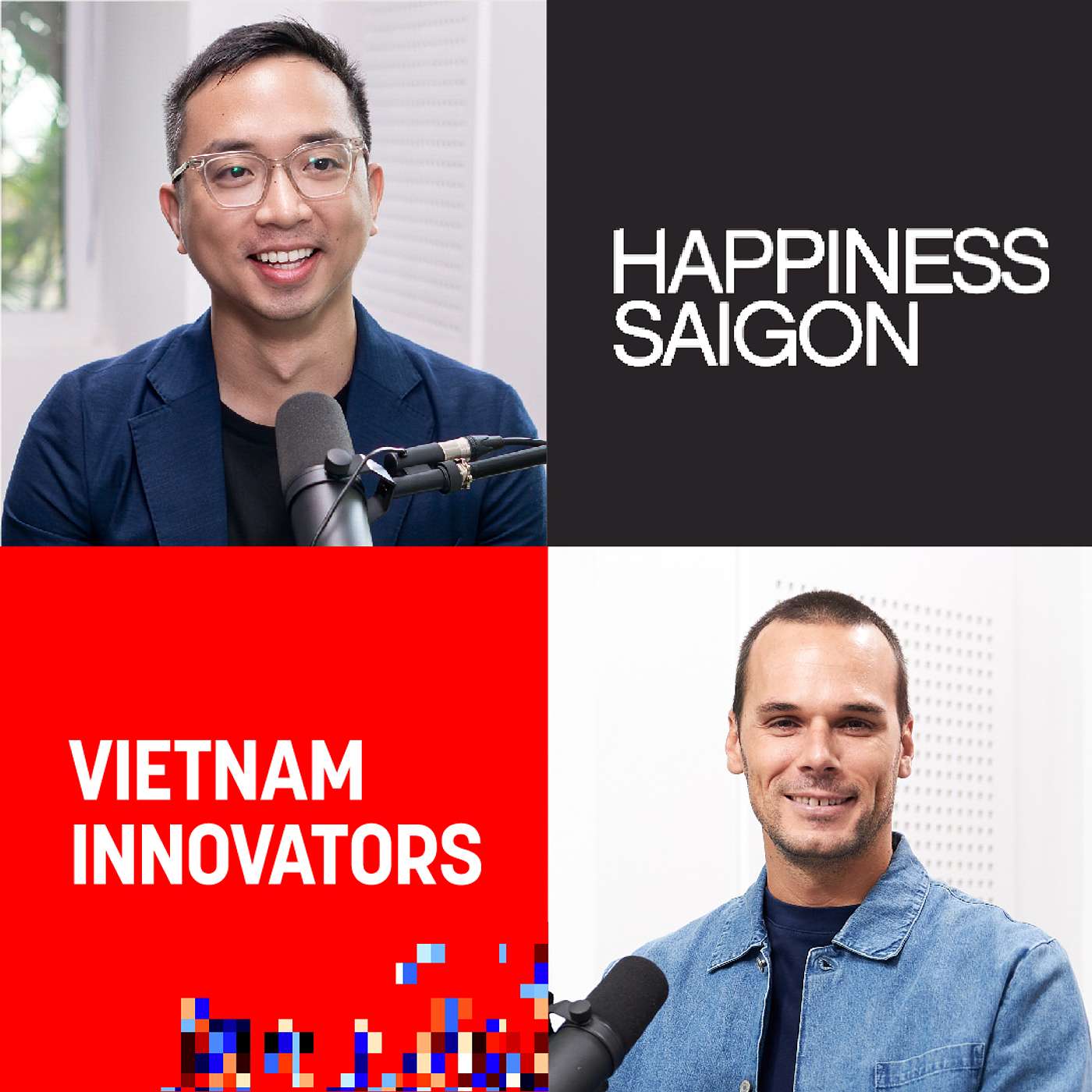
S3#30 Alan Cerutti, Co-founder/CEO, Happiness Saigon: Connecting creativity - the new generation advertising industry model
33m 9s
In a conversation with Alan Ceruti, CEO of Happiness Saigon, the key theme of happiness as a rebellion against negativity and impossibilities emerged. The agency places a strong emphasis on employee happiness, fostering a culture of experimentation and bravery in their work. Happiness Saigon's approach involves strategic creativity, differentiation, and entering the Vietnamese market through emotionally engaging campaigns. They have executed innovative campaigns challenging societal norms and creating interactive experiences for consumers. Vietnam's market, characterized by rising middle-class incomes and a growing consumer base, presents significant opportunities for brands. Alan highlights the country's appeal for creative consultancies like Happiness Saigon, driven by the market's emergence, entrepreneurial spirit, and positive attitude towards progress and innovation.
Transcription
5957 Words, 33657 Characters
Good morning, everyone. Welcome to another episode of Vietnam innovators. We're here at the studio. I'm your host, Howe. Thank you so much for tuning in, supporting the show each and every week.
Today, we have an old-time friend. I've known him for probably four or five, maybe even six years, the entire time that I've been in Vietnam, it feels like. His name's Alan Ceruti.
Alan, being the CEO and co-founder of Happiness Saigon, he's built an agency that has done pretty incredible stuff in Vietnam.
So, we're going to hear from him about what they're doing, their kind of future, and how they think about creativity, which is their business.
Let's start off with something, you know, in my notes before today's episode, you mentioned that happiness is all about rebellion.
I'd love to hear what you mean by that. I get a sense of what that means, but I'd love to hear from yourself.
So, we say happiness is the ultimate rebellion against negativities and impossibilities, and when you think about it, actually this morning I paid really attention to that coming here.
You see people in all walks of life actually going to work, and everyone has different stages of lives, of course, but also has different moments of their lives in which they feel happiness or feel unhappiness.
The weather has an impact on that, the inflation has an impact on that. So, it's fair to consider that a lot of people are not always happy.
So, we think that brands and their purpose should be to really inject happiness into their marketing and communication. That's always a starting point for us.
So, that's why we are called a rebellion. We are rebelling against sadness in a way, and we think brands can help in that sense.
Does rebellion also reflect in the way that you approach work, because an agency business, creativity, consultancy, it could be a bit commoditized sometimes, because there's a lot of them, but it comes down to the people, of course.
How does that reflect in the people and values of happiness and the rebellion?
Great question. Thank you so much, Hao. We believe that our people are the most important asset. Second comes the work. The work is baked by the people, and if the people are happy, the work gets better.
And the clients we're working with, they get that. They understand that they are third in that rank in a way. And this allows us to really put all emphasis on making our people happy.
Therefore, also experimenting. Once they are happy, they are more brave. They are trying to do new things, try to pioneer with marketing and communication strategies, tactics, with bigger creative ideas.
So, that's where the rebellion also started, that culture of people actually wanting to do something new. But that only really works if you are really, truly working with a bunch of people that are coming to work with passion, that are fulfilled by the work as well.
So, that's where also that rebellion sits.
For our audience to know, I've had the personal opportunity to work with Alan on a couple collaborative projects with big brands, one of them being MasterCard. We can't share too much now, but we've done some work in the past as of recent.
You may know this for those that follow you, etc., often. Alan, besides what you've done with MasterCard, a pretty beautiful TVC. But aside from that, you're even working on other types of branding that are not so common.
I don't know if you can share more than that. But maybe you can share specifics aside from MasterCard about how you guys try to push the boundaries of not just music videos, which is very popular in Vietnam today.
I'm sure you've done a few yourself. But what are some other aspects that you can draw upon?
So, first part of our rebellion is that we're a bit allergic to music videos at the moment, because there's been a trend and the flavor of the month that kept on coming. And we've really noticed doing some of ourselves, with something like MTP, for instance, that the bigger brands in these MVs is actually the singer, the KOL.
And the brand that actually paying for it is diluted. So, you have to really consider this.
It's almost like paying for the KOL to be famous, not Lombom.
Exactly. That's our point.
So, we try to really be strategic about every opportunity we get. So, there is always, and this is what all traditional agencies do, you start with a strategic solution.
And this then becomes the path to a creative idea. So, these two always go hand in hand. We don't do strategy for the sake of strategy or creativity for the sake of creativity, they have to go hand in hand.
What is working from our experience is entering through the heart in Vietnam.
And so, you do that again with a solid strategy, but then also tied this to an idea and something that is, again, new.
Because what's happening in the market is that there's a lot of saturation happening. In the beginning, it was a bit more easy.
You come in and you have, let's say, a bag of money and you might have a share of voice through that spending in media.
Today, the market is maturing, so there are more competitors in the market.
So, there is a need for differentiation and differentiation drives memorability. And that doesn't mean that you have to spend the same amount of money as long as you are creating a share of choice, which in a way is amplification,
buzz marketing and so on, conversations. You are basically tapping into a very powerful opportunity. And what you need for that is creativity.
So, we have rebranded actually in 2020. We positioned ourselves basically from a creative connectivity agency to a creative consultancy agency.
Because we really believe that creativity can be used on a business perspective, on a marketing perspective, on a communication perspective.
And what we love to do is really think on a business level, sometimes on a product level, how can we create something new, often a tangible thing, a product.
We've done that quite often and I think that's what makes us set apart from the competitors.
You know, going back to how we deliver these messages, I think strategy starts and of course the end deliverables depends on the strategy.
I recently watched a pretty fascinating short docu-series and I'll share this with you later, Alan.
He's a YouTuber. His name is Johnny Harris and he's famous for making these animation videos.
And he went to South Korea just a couple of weeks ago and he was noticing that all these K-dramas, they would do a lot of product placement with Subway.
Okay.
And there was an analysis about why, he was wondering why this was happening and apparently in Korean, South Korean advertising law, you're not allowed to put ads.
Literally, you can't do an ad break in shows or anything or even in TV channels.
It's literally illegal.
And so advertisers, they were historically limited to billboards or magazines or stuff like that, but digital, they're not allowed to.
And what that led to was product placement that also became very awkward.
People suddenly, you know, you're watching a Korean drama and then suddenly they're holding like an iced coffee that's promoting a brand and it's so visible that they're doing it like the shot and the angle and everything.
Anyways, the Subway example got brought up because they just literally blanketed K-dramas but it actually worked for them because they were able to blend it in effectively.
I'll have to send it to you for more context.
I'm not surprised.
I'm not surprised.
I bring up that example because, you know, you mentioned in a format like music videos, the artists take really big center stage.
That's what brings people in, right?
But sometimes the brand is so diluted that they kind of think like, why are we even doing this at the end, right?
And we're spending potentially hundreds of thousands, if not more, to sponsor this.
How should brands think about how they position themselves next to content creators, next to, you know, sources, distribution channels?
I know that's a more specific question.
Yeah, it's a big one and this is actually part of our next evolution because when you look at brands, they become publishers.
To your point, they create content and so on and they might have YouTube channels where it's not just about ads but they create tutorials for instance.
Coming back to the South Korean example, this is actually a very good analogy of what brands should do because when you look at a brand, they are the ones that are technically advertising, correct?
Brands in Vietnam have actually done the opposite of what you're talking about with what happened in South Korea.
The brand is in South Korea, paying to be part of content. This is how they create visibility.
And so when you do a music video in Vietnam as a brand, you are basically creating the content.
But it's almost like the key opinion leader or the artist should be paying the brand to be part of that content that they are creating.
Right now it's the opposite. It's brands one creating for the production, it's brand actually paying for the key opinion leader or the music video artist or the singer or whoever.
So they are sponsoring the entire setup and this is to the benefit of a lot of people but sometimes actually the brand comes at a secondary place in that space.
I really like what you talked about when you look at South Korean advertising because I'm not surprised that it would work, especially if it's not something that has been done before.
And if the context is, let's say a horror movie and somehow you have a product there that doesn't fit in, it gets talked about.
It's intentional.
It's intentional and this really could really be beneficial to brands that are brave enough to try it out because it's like wait a minute and then you have memes that pop up and so on.
Of course the traditional way of doing product placement is to have the product that fits the context put there in a very subtle manner that really fits again with the moment in which they are interacting.
But yeah, I kind of like the idea of being creative and trying something that is a bit more brave because I know it works, gets talked about.
For the audience that doesn't know the Subway brand, it's an American sandwich shop that's proliferated across the world.
It's not exactly, I would say, the best sandwiches, they're pretty decent but they're not the best.
They're quite ubiquitous, everyone knows it.
And actually, you mentioned that almost becomes like a parody, memes, it's made in South Korea.
Subway ended up making a show.
So they use the K drama love kind of plot. A South Korean actress in this case meets a Subway employee and they fall in love and it actually became a series that was talked about.
That's hilarious.
So it was almost like leveraging the fact that consumers are getting savvy about these things.
They do go to the content for the entertainment and they can spot out the brands easily and it's almost a parody in that sense.
It proves the point that brands, the next evolution will be for them to become publishers of content.
Yeah, they're media companies. Every brand is a media company in itself.
We've been talking about some formats that don't work or are working, how you guys approach creativity.
Let's talk about the campaigns that you guys have done in Vietnam successfully that have been recognized.
We know internally what we've worked on, but maybe you can highlight some examples about campaigns that have worked quite well for you guys and having been recognized for awards as well.
So as I said earlier, I think we're quite excited when we have an opportunity to create something, a physical product.
And one of the campaigns that I felt was very new for its time in 2019, Sunlight.
So Unilever came to us. They are dishwashing liquid.
They came to us and said, look, we're number one in the category.
We have been year after year inventing new variants through ingredients, through flavors and we've been advertising, marketing that basically.
We think it's time to do something else to really set again the number one position in the record.
And so they came to us and asked, do you want to do a purpose campaign with us?
And the brief was quite open. So we had this possibility of actually going in all sorts of direction.
Then we came across the statistics that 77% of men think it's a woman's job to do the dishwashing.
So we started looking at that. That's interesting.
So that's the strategy bit. And then we looked at what kind of product can we invent to have men somehow sensibilized to take the step of helping women in the household and doing the dishwashing.
So we created an altar, a bottle in the shape of an altar that was very hard to open, but also very hard to squeeze to get the liquid out.
So men being men like to show off, like to show their muscles, roll their muscles and coming into the kitchen, especially when a woman is asking, hey, I cannot open the bottle, can you please help me?
And that created a lot of conversation. One, the product, of course, was very much talked about, but then the entire interaction in the kitchen was also documented.
People were sharing pictures. There was an engagement activity where you can win a trip for two to Singapore.
It's a romantic trip. All you had to do is demonstrate that you were doing the dishwashing together in a creative way.
And it broke records because the bottle could only be purchased on Shopee. And we had a partnership with them.
And so in about one day, I think we sold around 80,000 bottles.
80,000?
Yes. And we got a lot of good buzz from that.
And I think the status that it broke 300% worth of the KPI. So it's overachieved dramatically on the expectations.
Amazing.
So that was a very, very fun campaign to work on. And we've done these products innovations quite often.
For UNICEF, for instance, when you look around town, now there are a bit more of them, but there weren't enough bins, trash bins.
However, when you look around town, you also see a lot of scooters, which have a basket in front of them.
So we consider this to be a substitute to the bins that are lacking.
So we created a very simple paperback that people could take at certain locations and put into the basket of their motorbike
to basically collect trash around town and then put them into centralized trash locations.
So you guys are almost like taking pretty obvious things and leveraging that, right?
Kind of flipping on its head a little bit, getting people to think about something that is almost every day
or it's just ingrained behavior or thinking, but kind of flipping on its head a little bit.
There are many more like crispy subtitles where we invented a tool that detects automatically when there is a chips crunch
whilst you're watching a YouTube film and automatically it puts on the subtitles.
This has been downloaded in 80 countries around the world, around $9 million worth of media exposure that's earned media.
It just shows that when you are innovative, you're doing something for the first time in Vietnam.
Also, the rest of the world can start looking at it and is excited about it.
You know, that's a theme. I think a lot of innovations related to the name of today's podcast start in Vietnam.
Not a lot of people know that. I like to wind back the clock a little bit.
Happiness started in 2015. I understand it was started in Belgium.
Well, going back even further.
Yeah, even further. Happiness in Belgium started in the 2005-2006 space.
I joined around 2009, 2010, I believe, and from there onwards the group has been growing.
In 2015, we got the opportunity to for clients start happiness here.
We already had a digital production company in Vietnam, so we kind of built on top of that.
And this led us to basically start with that one client in 2015.
Small operation, but very entrepreneurial because we knew that we could not rely on one client to be successful in Vietnam.
So we had to really be entrepreneurial and move from that.
What has kept you in Vietnam? Obviously, there's enough client work going around,
but what also makes this market so appealing to you guys as a creative consultancy?
Opportunity. It's a market that is in full emancipation.
It's clearly in emergence. A lot of brands are coming in.
A lot of brands are kind of taking, let's say, material or existing assets from outside to put them into Vietnam.
But also a lot of brands are originating ideas out of Vietnam.
And this creates huge opportunities for hungry, creative minds that want to make a difference, want to build a legacy.
And Vietnam has just been so good to us.
So automatically, myself and my family, we are very much ingrained here.
My kids are born here. My wife likes it here.
Actually is working with happiness now as well.
So there is this momentum happening.
And most of all, I think we're having a lot of fun with the team we're having now.
And when you look at what's happening in Europe or the West,
there's a lot of different topics that are basically keeping the headlines up.
There's a lot of negativity in ways.
And what I love about Vietnam is that we can do it attitude, entrepreneurship,
and that let's move forward mindset.
And it's just great to be part of that. That's my level.
Let's talk about the macro opportunity too.
In the West, in Europe, or in mature Asian markets like Japan or Korea or China.
Let's say, and this is my guess, out of any 100 global brands that currently, let's say, sell in Korea or Japan.
How many of them are in Vietnam currently, would you say?
Like they're selling actively in Vietnam.
Is it a lot or is it actually not very many?
And you expect more to come in over the next coming years?
I think you'd be surprised by the amount of brands that have already entered the market that are establishing.
I wouldn't be able to put an exact percentage on that.
But then there are a lot of local brands in these markets that are not super relevant here
because there are different habits, different behaviors, consumption patterns.
They have to adapt and localize.
So I think it's always important to look at the market and understand the consumer first before coming in.
And with the emancipation, with the rise of the middle class,
there is now more disposable income to kind of please yourself, please your family with new products.
And this is where I think it's not the end of it.
I think more brands will come and enter the markets.
And it's demonstrated now in the import stats, you know, it's really on the rise.
Have you heard of a term called Henry's, by the way?
Henry's, no.
You don't know this term?
So it stands for high earners, not rich yet.
You mentioned like middle class rising incomes.
And in this term, I've tossed around on a, you probably, if you listen to my podcast,
a couple of the episodes I mentioned here and there.
When you say middle class, can you paint that picture a little bit?
I say Henry's as an example, but, you know, age group, education level, where do they live?
Is it all in the city or is it throughout Vietnam?
Maybe you can paint that.
Yeah, middle class would really be living in the key cities.
And they have a growth in disposable incomes.
They might have two incomes, two earners in the family.
They are the ones who are interested in buying a car, for instance.
They are the ones who are today taking a loan, for instance, to buy an apartment or buying
an apartment with some help from friends and family.
That would be the middle class.
The age group might be a bit larger than 25, 45, I think, because there is now a lot of,
you know, money coming in from different sources.
So I would say, yeah, that's about it.
Okay.
Lots of opportunity here, then.
I believe so.
I believe so, yeah.
And brands have a real opportunity to look at Vietnam at the moment, especially from outside,
because, as you know, there's a lot of development and a lot of growth.
Okay.
Alan, you know, in this industry, like I mentioned, it's sometimes hard to kind of seek and identify
who the leaders in the industry are.
There's media.
There's a podcast like this.
But sometimes, you know, the agency or the consultancy takes a step back when it comes to the deliverables
and the final recognition.
In Vietnam, and this is my personal opinion as well, it's hard to see and recognize creativity
and who the top leaders are in the market.
What's your opinion and take on those?
Because I see some awards out there.
I'm not sure if some of them are the best or some are not.
What's missing currently?
Well, there is this hunt for awards, which personally, I think is a good thing.
We believe that they should be part of the journey, not the destination.
You only get rewarded if you really created significant results or you did something for the first time.
And then I'm talking really about creative awards.
There are two types of awards at the moment.
The agency of the year awards, creative agency of the year awards.
These reward agencies that are successful in business, in keeping clients, in having a vision,
in innovating, taking industry initiatives, and of course, creative work.
But it's not just about the creative work.
It's really to demonstrate how successful the company has been in the last year.
And we believe we're only as good as our last work or our last year.
So it's always a very good indication to feel how strong we are.
And so every year, happiness has participated in the last five years.
And every year, happiness has been in the top three of creative agencies of the year.
This to us is important because it demonstrates that we're on track.
And we only want to compete with ourselves almost.
Then comes the second award type, which is the creative award.
And there it's about playing in the Champions League.
The Champions League is Can Lines, Spikes Asia, DNAD, The One Show.
And so these are the most important competitions to test how good the work from Vietnam or Southeast Asia is.
And there is a lack of good work from Southeast Asia in these shows at the moment.
So it's growing.
There is more and more entries.
There's also more and more conversion and more and more results.
But you don't see Grand Prix.
You don't see gold very often.
We were lucky this year at Spikes to win gold for crispy subtitles.
And therefore were named Vietnam Agency of the Year for the first time at Spikes Asia.
Vietnamese Agency was named that.
But then comes the other layers of creativity.
There is this hunt for awards.
So also the award show organizers know that.
They know that there is a business to be taken because don't forget that every time you kind of make a submission,
it costs around $500, $600, which could be half the salary of a very talented person or starting person.
And so this is that feeling right for us at the moment.
And when you look at the award shows in Vietnam that are being celebrated as the standard of creativity,
there is the MMA, which is not a representation of creativity.
However, it is celebrated as the best creative work from the market.
So we're advocating to really hire the standards, go for the Champions League altogether
and really educate one our talents, but also the marketeers and the brands we're working with
to demonstrate that if we really want to drive results, creative ideas that mean business,
it's important that we demonstrate that they work at that level.
So at the international level, there's some that are considered the Champions League tier.
Now going down back to the domestic league in terms of creativity and awards,
what would your ideal kind of vision of how would that work?
How would that look like?
Who is the selector of these awards?
Vietnam runs its own awards, not for this particular space, but for food and beverage.
We recognize the restaurant of the year, the bar of the year.
We have a jury.
We have a public vote.
But there's always questions about, oh, how's it nomination?
Nominations work is in an auditor, all these different things.
How in your opinion would that look like?
Well, the model that you raised is interesting because you have an independent source,
in this case, et cetera, that has nothing to do with the restaurant business in a way,
celebrating the best restaurants.
So this is a possibility.
And I've been in a lot of conversations with my peers, my fellow colleagues,
that are also interested in doing that.
But you need to get the entire leadership from all the agencies involved,
and it hasn't worked so far.
Have you tried?
Yeah, we have tried.
Through happiness or through just a collection?
A collective of like-minded people.
What's been stopping that from succeeding, in your opinion?
Well, it's funny because...
Motivations, priorities.
Yeah, there is this barrier, I think, coming from some agencies,
and I don't want to name them, but...
because there is this possible realization that, you know, we're not there yet, you know?
And great work takes a lot of effort.
And you still have anecdotal stories of how brands are working with agencies,
and why this came about.
This is also a market that is in emergence in that space.
It's not always evaluated in a fair way.
You have the favor to work with each other,
whilst there might be a pitch, for instance.
I'm going to give this business there.
This is something that I think will be developing in a positive way.
But I think not everyone is ready to really go all in on making the people and the work the most important thing.
And it really only works if everyone is involved from setting up that advertising or creativity reward show.
That would be...
So that's why you're better off now looking at international award shows to really compare the quality of the work.
But yeah, I'm hopeful maybe this is something we...
Let's get spark a conversation about that.
Exactly, and you know, you have to start small, and it has to happen at some point.
Otherwise, I believe the MMA's, and by the way, I really appreciate and respect everything that they are doing.
I think they set up a fantastic organization with a lot of engagement from the leadership,
from a lot of brands and marketing teams.
But it's just important that we are also acknowledging that this is not the standard of creativity that Vietnam deserves.
And I see.
Cool, yeah, I think I myself see the need for that.
It's to help raise the standard in the industry.
Lots of talent, but how that talent is organized comes together, has those dialogues,
and it's also recognized as definitely missing.
So hopefully in the years to come, we'll be able to see something, hopefully even from us as part of that.
Yeah, it's gonna happen, I'm sure.
Very hopeful, very positive, optimistic about where we're going.
Vietnam is gonna rule the world, I think, honestly, I think you're a fantastic bunch of people,
and I'm very privileged to be able to work day in, day out with people in this country.
Fantastic.
Very happy.
Thanks a lot.
Today's podcast, we talked a lot about the opportunity, what advertising, creativity and communication looks like in Vietnam.
Alan, at the happiness level, is there anything else you'd like to share about the values of your team
and what you're trying to achieve?
Yeah, so I spoke earlier about our people and how important they are,
and it was about how do we deal with the Gen Zs and the employees that sometimes want to work from home,
sometimes want to work at the office, how do you deal somehow with that?
And there are a lot of differing opinions about that.
We have a simple rule, which is 100% freedom, 200% responsibility.
And so we believe that I should not be the boss.
It's actually the task that is the boss.
And so people are really activated to live up to their accountability.
And they take their own decision, therefore, as long as they are basically delivering on the task,
they can decide where they want to work.
Now, we are setting some other rules.
We would like people to come to the office two times a month, for instance, for a happiness day.
Two times a month?
Two times a month. That's set, that's fixed. And we have around 30% of the people that come in regularly.
So there is always people at the office, including me.
However, it just creates that dynamism and that energy.
And again, that's what makes people happy at the moment.
So this is for us very, very important.
And the work is not suffering.
We are indeed developing great ideas that are now in the making.
So this is also a sign that it is working also.
When you look at the bottom line results, we are not in any way complaining.
So we're quite happy about what we're doing now.
The next step is to really reinvigorate energy into the office space, to reinvent the role of the office space.
And to turn that into a community hub where our people will be more inclined to come, more invited to come,
and can really share experiences, make things together with their employees.
We're building our new physical office as we speak actually for Viacetera, we're preparing to.
And we are thinking about the layout, not in a traditional sense, but do we have common areas?
How can we encourage people to come to the office?
We do take a different stance at Viacetera.
We do require working at the office.
I am very much open to work from home, but for good reasons.
I've been to the Happiness Villa in District 7.
How have you changed the space, if at all, other than just--
We're in the process of doing that.
So it will be a process that will take a couple of months.
We hope to do this before that next year.
But to your point, whatever suits your organization, whatever the need of your organization is,
and whatever you find fitting to achieve that ambition.
This year also we changed a couple of things.
Traditionally, the CEO is at the top of the organization.
And this year we decided to put the CEO at the bottom of the organization.
It's more of a democracy at Happiness, but our management team and I have decided that this was a good thing to do.
And what this means is that I'm not a chief executive officer anymore.
I'm a chief excellence officer.
So if we want to continue to have what we have now, which is things that are going quite well on a financial,
creative level and so on, and the happiness level of our staff,
we need to continue and drive excellence in everything we do.
So instead of going for the traditional CEO role that sits at the top,
I'm now at the bottom of the organization trying to really uplift everyone,
empower everyone to get them to achieve the best results and also their best selves.
So we're doing a lot also on a personal level.
We're talking about manifestation, visualization.
We're talking about the importance of working out.
People have a gym membership at Happiness nearby the office, for instance.
And it's really about getting excellence in making people happy
with the belief that, again, happy people make great work.
And great work, again, makes people happy, which is actually written on our walls in the agency.
And that's been a very exciting adjustment because, again,
every organization might be in need of something else.
You have to find really through that new world in which we're living that change
what really is the model that works.
And so I'm unsure about how longer we'll continue to do that.
Maybe there will be a time where we're going to say,
"Look, guys, you've come two times a week to the office.
We're organizing a survey to keep the happiness barometer on
and understand how people are feeling.
And so this changes from time to time.
And that's the exciting bit I find.
I find, personally, if you're telling everyone you can do what you want.
Be free as long as you deliver.
I think it's my responsibility as well to help them to achieve the best that they can.
And our best is really creative ideas that mean business.
I'm sure happiness is growing and hiring.
At the moment, we are, yes, indeed.
Okay, well, fantastic.
For those of you that are interested in the creative space, consultancy, agency, communications,
look no further than dropping a note to Alan in esteem and happiness.
Yep.
Alan, thank you for joining today's podcast.
It's been a pleasure learning about how you and your team thinks about creativity,
the advertising world, how to work with brands.
I've learned a lot today and I hope to continue working with your team and happiness.
For those of you that are listening in today, drop some questions in the comments.
We'll leave Alan's LinkedIn and contact points in our channel here today so you can reach out to him.
Thank you so much, Alan.
Thank you, Howard. Appreciate it.
Cool.
It was a fun talk.
Excellent. See you guys next time.
Viglessera Corporation is the largest real estate and building materials group in Vietnam,
as well as the largest industrial park operator in Vietnam.
48 years of excellence makes Viglessera a leading full service provider of sustainable
and high quality building materials.
Having a total of 40 subsidiaries, Viglessera covers the entire real estate and building materials spectrum.
You can also check out the video version of this podcast on our other platforms such as YouTube and Facebook.
New episodes are out every week, so don't forget to subscribe to Vietcetra's Spotify,
Apple Podcasts, and YouTube channel for more interesting content.
Podcast Summary
Key Points:
Alan Ceruti, CEO of Happiness Saigon, discusses happiness as rebellion against negativity and impossibilities.
Happiness Saigon prioritizes employee happiness and emphasizes experimentation and bravery in their work.
The agency focuses on strategic creativity, differentiation, and entering the Vietnamese market through the heart.
The agency's innovative campaigns include creating products to challenge societal norms and engaging consumers interactively.
Vietnam presents a growing market with opportunities for brands due to rising middle-class incomes and increasing consumer interest.
Summary:
In a conversation with Alan Ceruti, CEO of Happiness Saigon, the key theme of happiness as a rebellion against negativity and impossibilities emerged. The agency places a strong emphasis on employee happiness, fostering a culture of experimentation and bravery in their work. Happiness Saigon's approach involves strategic creativity, differentiation, and entering the Vietnamese market through emotionally engaging campaigns.
They have executed innovative campaigns challenging societal norms and creating interactive experiences for consumers. Vietnam's market, characterized by rising middle-class incomes and a growing consumer base, presents significant opportunities for brands. Alan highlights the country's appeal for creative consultancies like Happiness Saigon, driven by the market's emergence, entrepreneurial spirit, and positive attitude towards progress and innovation.
FAQs
Happiness is seen as the ultimate rebellion against negativities and impossibilities.
Emphasizing that happy people lead to better work, they focus on making their employees happy and encourage them to be brave and innovative.
By focusing on creativity and strategic solutions hand in hand, they aim to create differentiation and memorability for brands in a competitive market.
One successful campaign was for Sunlight dishwashing liquid, where they created a bottle that encouraged men to help with dishwashing, resulting in high sales and engagement.
Vietnam's emergence, opportunity, and positive entrepreneurial spirit make it an attractive market for brands and creative consultancies like Happiness Saigon.
The middle class in Vietnam is typically located in key cities, with growing disposable incomes, possibly two earners in the family, interested in purchasing cars or homes.
Chat with AI
Loading...
Pro features
Go deeper with this episode
Unlock creator-grade tools that turn any transcript into show notes and subtitle files.
 PodcastTranscript AI