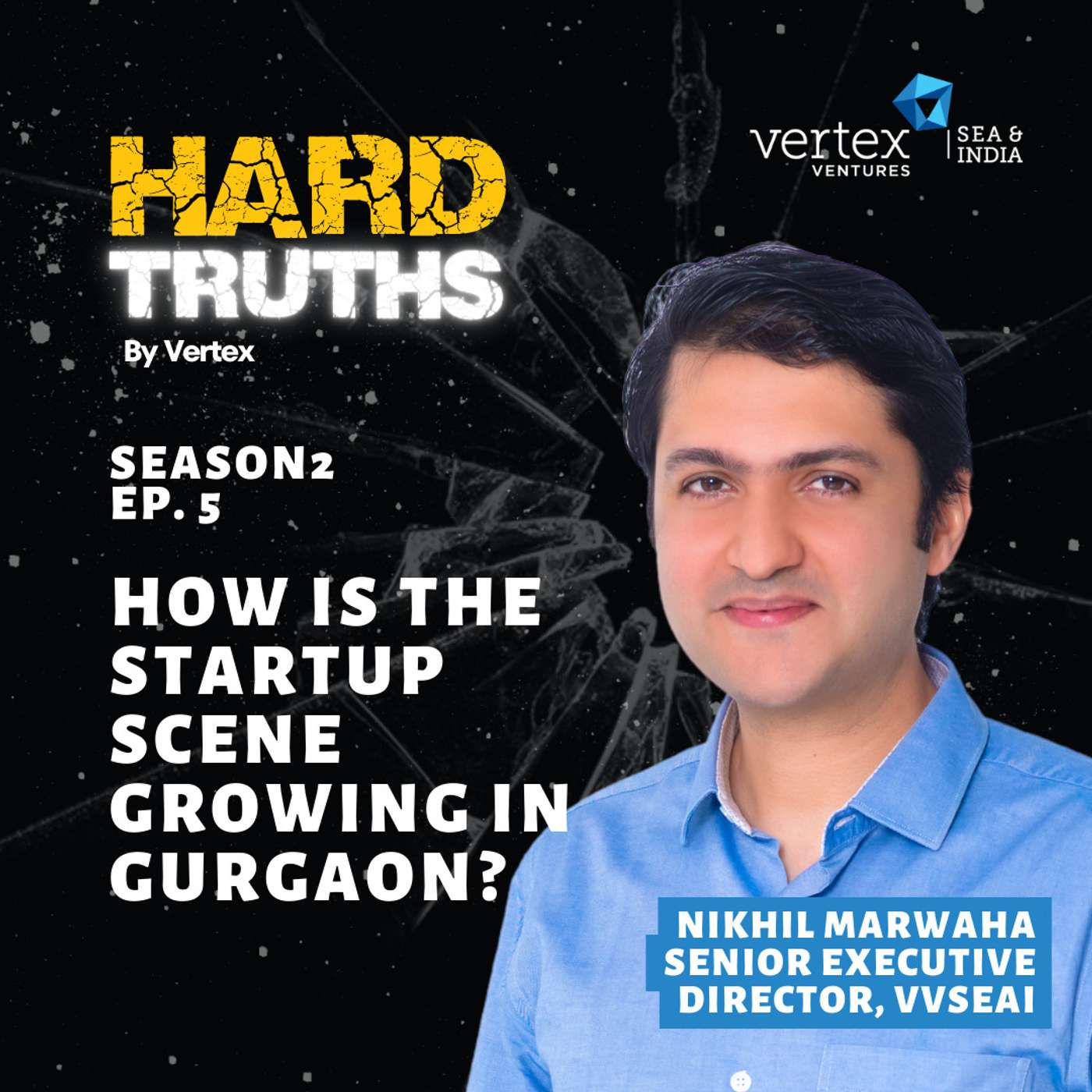
S2E5 | Unlocking the trillion dollar Indian startup ecosystem with Nikhil Marwaha
from Hard Truths By Vertex
33m 50s
Milis Tan hosts Nikhil Mahwaha, a senior executive director at Vertex Ventures, who discusses India's diverse market and investment landscape. India is described as three distinct economies—mass, mass premium, and premium—each with different paying capacities, allowing for large brand building across segments. Nikhil shares his background in growth and venture investing, noting his transition to early-stage investing for its hands-on, co-founder-like involvement. He highlights Gurgaon's growth as a startup hub, driven by its ecosystem, IT talent, and affordability, though Bangalore leads in startup concentration. Key investment trends include enterprise B2B SaaS, manufacturing due to China plus one strategies, consumer premiumization, and EV/sustainability. For evaluating startups, Nikhil emphasizes market sizing to target $100 million+ revenue potential, unit economics as a proxy for product-market fit, and capital efficiency—how effectively a company uses capital to generate revenue. He stresses the importance of founder mindset in optimizing spending, especially after recent capital abundance. Overall, India's consumption-driven economy and favorable demographics make it an exciting market for venture capital, with opportunities across sectors.
India is like three India's. When you look at the average number, a lot of people will be below poverty line. People in India, one city will be doing really well. But when you go down to tier two, right, obviously they won't afford. So India, there are multiple products across multiple price points that cater to the three different India's. There is actually a possibility of building large brand across these segments. So mass premium is a larger segment but lower paying capacity. Premium is obviously a lesser segment but a higher paying capacity. So from a time perspective, both of these kind of balance out. Hi, I'm Milis Tan and I'm your host for this episode of Heart True 5 Protects Podcast. Today, I have my colleague and senior executive director, Nikhil Mahwaha with me. So Nikhil brings with him a wealth of investing experience across later and at least stage companies. So he's very experienced in sectors such as consumer, V2B, enterprise companies as well as healthcare. So prior to the tech ventures, Nikhil was with a group equity fund, 200 million which is sponsored by one of the leading India Investment Bank co-aventers. Before eventers, he worked for companies such as Megadatta as well as new enterprise associates, NEA in India. Hi, Nikhil. Hi, Ali. Saw you. Good. Yeah, thanks for taking time for this podcast. Firstly, maybe you could give us a bit more about your background. Sure. So I'll be happy to at least. So I think overall I've spent close to about 12 years now on the investment side. I started my love for investing when I interned with Goldman Sachs in London. So I was a part of their special situations group. So this is essentially Goldman's own prop investment arm. I was one of the very few interns who actually got the opportunity to work on live deals and that started my love for investing. Obviously, I graduated in 2009, which was like the peak of the financial crisis. So financial jobs were difficult to get by. Got my first break into India P investing with a firm called Baring Private Equity Partners. So this is a growth equity fund, a billion dollar AUM growth equity fund. I was a part of the healthcare and life sciences practice. Move to NEA sometime in early 20-12, spent about close to about seven, eight years with them was involved in a lot of consumer healthcare investments. So first-cribe, for example, is one of the investments that I worked, worked on. Nova Medical is another one, right? So got a very rich experience across technology, consumer healthcare, B2B. Move from that to another fund called Metadelta, which was on the growth equity side, then to Avengers. And finally, join Vertex, Jan of this year. Yeah, we're definitely very happy to have you on board. You mentioned about first-cribe. We also were invested in first-cribe in India. Is that how you get to know Vertex as well? Yeah, so that was my first introduction to Vertex. So from NEA, we invested in first-cribe in, I think, 2015, early 15. Vertex was already an investor. So Vertex was there on the cap table. We got to know Vertex on board meetings, interactrible juhawk, who used to be, I think involved with the company at that point of time. My other experience with Vertex is also when used to be my boss at NEA. So I worked very closely with Ben for about four years while Ben was at NEA and I was at NEA. So that's another reason how I know Vertex turns out that Piyush, who is also a general partner in our Vertex, he's also a good friend. I have a deep association with Vertex in that sense. Yeah, it's really a small world. And I believe that for NEA, Ben was the one who started the India office. That's true. Ben was the first India employee for NEA. Ben actually was involved with NEA in the valley. Then he decided to move to India. And he set up the India office when I left NEA, we were a team of about six people on the ground. Wow, it's grown a lot. So I think one question is, you know, you have been in private equity, growth capital area. So what brings you to, you know, at this stage? Sure, no, I think that's an interesting question, at least because both asset classes invest on the private side. I think one or two key differences that I would want to point out is that when you talk about growth investing, this is a lot more mature investing. The company is scaled up a lot more. There are metrics that you can look at. The founders have also kind of scaled up along with the company. So the founders are also a lot more mature as an individual or as an investor. A lot of times what it comes down to is that you are getting capital on to the table. Capital becomes something which is very critical at a growth stage. But when you look at a venture stage, these are young founders, these are young companies. There are a lot of unanswered questions. So I think personally as an individual, I like being in such situations because this is like being one of the co-founders. So you are entering at a stage where the company is really young. A lot of the trajectory, the journey of the company still is to take place. And you are a very active part of that entire journey. It kind of gives you, let's say a front seat view of how this start-up scales. And also I think the other really rewarding part of it is that when you do see companies scale and you've been associated with those companies from a really early stage, I think the satisfaction that it gives you is a lot higher when you talk about venture versus maybe growth when you're entering when the company is a lot more stable. That's what excites me about doing venture investing. It's like you are one of the co-founders in our area. Yeah, definitely. And I think for our tech, we really pride ourselves as co-founders to our founders because we really work so closely with them having calls as a frequentness every other week or every week even. I think it's really, really fulfilling to be able to be part of this high-growth journey with them. I think most of our team is based in our Bangalore, but for you, you are in G-G-G-G-G-G- -That depth. -Yeah, I didn't tell us more about this vision because many of the startups are based in Bangalore, but I think where you are now is growing very quickly as the startup has to. No, so that's correct. So I think I always wanted to be in Gurgau. I spoke to Ben sometime, I think late last year and Ben also told me that look as Gurgau tech, we're also kind of planning to expand to Gurgau. By that time, Gurgau tech has already had three portfolio companies in Gurgau. So I think that is something that really worked well for me. But I think what is happening now in Gurgau is something that may be happened in Bangalore five, six years back. So for any startup we need to thrive. I think there are three key things that you need. One of them is a very vibrant ecosystem. And when I talk about an ecosystem, this is founders, this is mentors, this is angels and seed investors. So what has happened in the last five, seven years in Gurgau is that you had two or three very, very successful companies getting created. Right? Obviously, Zomato is one of the Mpatium is one of them. Right? So we have a very strong founder set, which is coming out of these established companies trying to build something on their own. Right? You have an angel set from these companies who've done it in these startups, want to help founder to it. Right? So I think overall, if you look at the ecosystem, it definitely are developing. So I think that's one large part of it. Right? The second part of it, typically a startup we look for is access to resources. Right? And these are like human resources. Gurgau is a very, very strong hub. There are a lot of IT professions in Gurgau. Right? So I think from a second standpoint, you're very sorted when it comes to talent. Right? I think the third key part obviously is cost of living. Right? So Gurgau is still not as crazy as a Mumbai is. Right? Mumbai is where it comes to cost of living. So Gurgau in that sense is not up there. Right? So there is a lot of people who actually want to move to the city because it's easier to live now. It's kind of become a lot more developed. Right? I think these three factors play very well. So Band-Law, if accounts for like 50, 60% of all startups, Gurgau today might get 25 to 30. Right? But that is definitely something that's growing. Very interesting. And if you could actually look at the kind of sectors that do relatively well in Gurgau versus Bangalore, how would you have had like the major industries? So I think Gurgau traditionally has been a lot more consumer and B2B commerce facing. Right? Like for example, Zomato was based in this is a strong aggr-y battle or aggr-y tech company that ended up starting up here. Right? Band-Law has been always a very strong traditional IT hubs for all SaaS companies that you would see would have been started in Bangalore. Right? But I think that is also now shifting to India. So for example, as Vertex, we are fingers crossed very close to closing and investment in the B2B SaaS space. The company is based in Delhi and CR. Right? So I think Gurgau as a hub is catching up on the tech wave. This goes back into availability of talent. Right? And that is IT talent is something that is very well available in Gurgau as well. So we'll see a lot more tech companies also start in Gurgau. Right? But obviously Bangalore has a head start. So it's difficult to catch up to Bangalore. But I think we are getting through it. Yeah, got it. And I think if you were to compare perhaps you can say that Bangalore is that a cent heel of India. Yeah, super interesting. And I think as we look across this region,
India is definitely a market that is rapidly developing, is growing, GDPs are like sorry, it's never a better time I think to be investing into India while there's some of the you know interesting trends that you have been observing recently. There are a lot of things that are working right for India right. I think the biggest factor that works for us is we are a very strong consumption driven economy so that helped us build a lot of crises right. So that keeps India India relatively doing well right. But I think from a VC standpoint I am really attracted really interested in the three or four key teams that are playing out in India right. One obviously like I spoke about earlier also the entire enterprise B2B sass site right. So there are some really valuable start-ups that have been created out of India but sadly globally and I think two key factors that are driving this obviously India has a lot of good tech talent right. We have a lot of people in Silicon Valley. We have a lot of offices of companies, large tech companies like Google Facebook and India. So a lot of these people also want to do something on their own or join startups that are not more open to it that right. So tech talent to build products at a world class. What also helps us is that obviously the cost base is a lot lower right. So we can create these products that can compete globally at costs which are much lower than what they are today let's say in the US or in Europe right. So from an end-to-client perspective the ROW that you get when you talk to an Indian enterprise B2B sass company that's a lot higher right. So I think there are a lot of spaces where this is going to happen in fact we already have we have one company that we've invested in on the B2B sass site from front five. So I think that continues to be a strong team right. The other thing that is also working very well for India is the entire manufacture in India piece. What is happening to supply chains is that China used to be a very large part of a lot of global supply chains. Everyone today given what happened in the last three years is looking for a China plus one strategy. And India is definitely one of them right. So startups who are doing this in a capital efficient manner who can extract high gross margins right. I think those are the kind of startups that we are definitely looking for. The other one obviously continues to be consumer. Like I guess I said India is a very consumption driven economy. GDP increase leads to people wanting higher brand right wanting more brand affinity wanting premiumization right. So a lot of those themes are also playing out. So in fact we've been a very active investor in India consumer we were like you said investors in first cry but also invested in this years as BOTX right. So I think that theme and is and and kind of looking for new sectors looking for new behavior patterns. Thank you. Yeah I think India is definitely super exciting right now. I think you gave us quite a bit of a download in terms of how consumer businesses are going to grow and some over watching trends. So tell us more about the other sectors. What do you think are going to happen and how would that influence venture capital investing. As BOTX we have six broad theme globally that we focus on right. I think I spoke about three of them right. One other emerging theme that we're also looking at very closely is the entire EV space right. EV and sustainability. All countries globally are moving towards net zero gold right. If not 2030 2040 2050 right but people need a path to get to net zero right. And obviously EV is one of them right. You have a lot of other sustainability platform. We're trying to move companies towards adopting policies or adopting procedures that help them get to net zero common emissions right. EV as a space in India has already seen a lot of interest. So we are now the leading I think EV to real a manufacturer today right. So we're doing it both for personal consumption as there is commercial consumption right. There are companies using to be the release to do deliveries at the end of the day right. So that entire space also I think is something interesting that we are also monitoring at. I think India being a highly populist country whatever you know the country wishes to do or manage to do we have a huge implication on climate and environment. So I think so far you know it's been really positive hearing about what India aims to do in terms of getting to net zero. Yeah so I think that aside whenever I listen into our investment discussions I'm always really intrigued by the question that you are in terms of looking at the metrics looking at how we can better assess a particular company for investments. There's no one size fits all in a way right. But I think three four key metrics that remain constant across sectors. Obviously off the bat market size is one large part right and when you typically do a market sizing the first card that you get will obviously be a very large addressable market right. You just multiply the number of people with a certain price you get a very large market opportunity for everything right. But that's not the typical way to kind of look at it right. You need to die you slice a lot more to figure out okay which is the target segment that will actually end up maybe going for it right. Which people can actually maybe afford this right. So I think market sizing and how you do it is a very crucial part of what we do because if it's not a large market or it's not a large need that is being sold or met you can't create a large company and maybe I'll just take a step back and say that look because we are early stage investors we only have limited amount of data. But I think the key data points that we do look at would obviously one be around the unit economics. When you talk about startup investing you can expect startup to be profitable right. What you have to definitely look at is that at a unit level so when you scale that to 10 units 100 units 1000 units right. And if you do it properly you should be able to attain your end goal of profitability right. So what unit economics today tells you is that okay there is someone who is willing to pay you a price that makes sense for you to operate that business it right. So it is kind of a proxy for product market fit right. So what you're making someone is paying you something more than what you're making it for and therefore you can build a sustainable business as you scale. So I think the other thing that we definitely look for is a lot of repeatability and responsibility given that we are coming in at a fairly early stage right. The company will not have a lot of customers right. But I think it's important for us to understand that the customer, the company has today how do they look at the company or how do they look at the product right. It is the product something that really works or really solves a very critical need for them right. So I think these things kind of help us in our entire investment decision making and obviously goes without saying the founder team their clarity of thought their quality their ability to attract talent right. So I think that's how I would maybe summarize it in like five minutes. Yeah definitely you know in the beginning you mentioned about market sizing. So you know market sizing to so then the founder team you know have a clear picture you know like how big is enough. There's no prescriptive answer here right. You know market size can be a billion you know market size could be a five billion can be a ten billion right. But I think the way that we look at it is that can you build a business which tomorrow will be attractive for someone to acquire slash maybe for the public markets to invest in it right. That threshold is something that people have said as maybe a business that is doing a hundred million dollars of top line right. So I think that's the way we like to maybe backfangle it. Can you build a business that can tomorrow be a hundred million dollars plus in this sector right. If that's the case then that is something that we will definitely evaluate a lot more. The idea is to build a business where like I said there is exeftibility at the end of the day right. Yeah I got it one of the things that we emphasize on this unique economics. So there's something that you brought as well. It's very important you know to be making money. And then I think together concept that we have been bringing up is capital efficiency. So could you explain a bit on what do you mean by what do we mean by capital efficiency. So I think the very basic way to understand it is that how much money have you spent to get very well right. So if you spend a hundred million dollars to get to a five million dollar in revenue right then clearly you haven't spent it the right way. It is also a very sector dependent phenomenon right because the capital efficiency in a B2B SaaS company will be very different from a consumer company. So I think the lens that you typically have to wear when you look at capital efficiency is that how are the founders thinking about it right. Are they going about doing tasks activities in the most capital efficient manner right. It basically means that if you need to hire a resource worth 50k to do something I use spending to 150k on that resource just because you have capital available right. So I think it comes down a lot more to the decisions that have been taken by the founding team what the mindset is. Unfortunately ended up happening in the last two, three years is that founders got access to a lot more capital than maybe what was
required. So the spend that were done, maybe if it were a more capitalized constrained manner in which people were building businesses, you would have had different outcomes. But I think important for us is to understand the mindset. Are we squeezing every dollar for what we can squeeze it for? Right? Yeah, I think this is super clear. I'm also curious about how various companies are doing it in there. You are a portfolio companies of several companies, which you'd like to share what are they and what are they working on now and what makes you excited about their growth? Sure, sure. One of the recent companies that we've closed and it also came in the press is a company called SOTA. So they are essentially building a compliance platform for enterprises large fortune 3000 companies, right? A lot of these fortune 3000 companies have a host of vendors that they work with. Right? So imagine someone with a turnover of let's say 500 billion might have actually 10,000 vendors that actually manage, right? And every year, the onboard 500 plus vendors. So there are a lot of parties involved when it comes to onboarding a vendor, right? You will have someone from procurement, you'll have someone from finance, someone from legal, someone from IT, right? A lot of these people ended up operating in their own different silos. And how did they come together or either through emails or through Google Forms, right? So not the best way to kind of communicate when you're doing such a critical activity because what's happening in the US also is that a lot of cooperates are getting fine for non compliance by vendors, right? So I essentially bought everyone onto the same platform. It's like an orchestration layer that sits on top of all solutions, gets all stakeholders onto the same platform. So that the vendor on boarding journey is a lot more smoother. So what people were doing in three months sort of helps them do it in less than like three days, right? So the company has a very good client roster, right? So I think that's one company that we are definitely excited by. Other than that, I think on the consumer side, we recently invested in a company in the BBC space, called Big Rib, Beauty Space, right? They're bringing a lot of international ingredients into beauty products and getting them into India, right? So Korean beauty, for example, is something that they are definitely doing very well on, right? So I think that's another company in the consumer space that I'm really excited by. Like I said, that people are now becoming a lot more brand conscious. There's a lot more brand affinity that will get very, it has consumers go ahead. So I think these are a few of the beds. Obviously, we have a portfolio of like 18, 19 active companies, but I think certain things are something that we should definitely want. Another popular company is that is in the consumer space, and it's a sector. Tell us more about the sector and progress that is making sure. So I'm not happy to release and glad you touched on that because that's also one of the companies that we are, we are really excited by. So we recently closed around there. So think of it like they essentially deliver India on a platter to international brands, right? So as India as an economy grow, that's disposable income grow. There are a lot of international brands who are looking to enter India, tap or get a portion of the Indian consumer wallet, right? A story essentially just gives them an end to end distribution technology platform where all they have to do is sign up with a story and we will launch that brand in India for them. And we will take over the entire responsibility of India as a country, right? This will be right from designing of products that are very specific to India, right? That's one of the pain points that a lot of brands are faced. They have international product catalogs, but not a lot of them cater to the Indian audience, right? So that is what A30 helps them do. So we have designers who work with international designers or brands that help them curate merchandise for India. Then this merchandise, we help them get it manufactured for India, right? We also then post that, help them actually distribute the product across various channels, be it e-commerce, be it physical commerce, right? Be it opening our own branded stores, right? What we also do is we take over the entire marketing, right? Because international marketing campaigns is something that won't work from an India context, right? It's obviously very different when you look at the Indian consumer and has mindset. So I think that's what A30 does. They have done it very well with two very large international brands. So we are very hopeful that they can continue on this growth journey. Yeah, it's really exciting times for them now. So Nikhil, you know, you have really seen companies from the very early stage to the March later stage. And so if you're experienced, you know, what do you think are some of the hard truths that you would tell any stage entrepreneurs, particularly building some good India? Sure, I don't know. There's anyways have a very, very tough job, right? Just keeping aside their own personal ambitions to create something big, right? They also have a responsibility for a lot of other things, right? So, the example is employees, employees, families, right? So being an entrepreneur, I think, is very hard in itself, right? So I wouldn't want to advise or prescribe anything, right? But I think some of the things that I would definitely want people to think about and spend a little more time would be that today the environment that we are in is obviously a capitalist-case environment, right? There are reports of a lot of drive-outers sitting on the sidelines, not getting invested, but the fact of the matter is that it is a capitalist-stop environment today. People are taking a lot longer to take decisions to build some big things, right? So from an entrepreneur perspective, in such an environment, what happens is that you necessarily do not get the best outcome when you're out fundraising, right? This might mean a down-run from what you already done, right? The only thing that I would urge founders to think when something like this happens is that, look, company building is a marathon, it's not a sprint, right? You don't want to capture all the value in one year, right? You want to build something valuable. Unfortunately, what also happened in the last few years was that the yardstick for success moved to valuation, right? Which I think is still playing on in some of the mind of founders, right? It's important for you today to get that money to execute on what you're building, rather than thinking about these points which in the long run, if the company ends up succeeding, really won't make much of a difference, right? Another thing that I would definitely want them to spend more time on is is surrounding or hiring the right people, right? Founders typically wear multiple hats, right? And that is something that you need to do when you're an early state founder, right? But what happened in that process is that when you also do end up hiring people, you don't want to take off that hat, right? You have someone who's working, but you don't give them the delegation or the autonomy to run, right? I think that's something that founders really need to think when they're hiring is this person someone that I can delegate to and speak peacefully, right? Not just take off my hat of sales and marketing or take off my hat of technology, right? and focus on the other things. So I think that's something that they should definitely think about, right? One more thing that I would maybe want to spend a little more time also on is the importance of building systems, processes and compliance right from a very early state. I think one of my earlier bosses had given me an analogy that look, companies like NFN, right? So there is a car, there's an engine, there's a driver, but there is also the pit stop group, right? And what a lot of times decide races is how much time you spend in the pit stop, right? Because your margin of victory is like seconds, right? So if you can change how much time you spend in the pit stop, you can actually end up doing very well, right? So I think systems, processes and compliance should be viewed as that pit stop. And it is easy for you to build it when you're at an early stage, then when you're maybe later, when you're also struggling with growth, you're struggling with hiring, it always becomes difficult to do it there, right? The good thing today is that there are a lot of external resources that can help you build those, right? You don't need to hire someone for it, right? There are outsourced firms who can actually help you build the entire process around compliance, you can have someone who can take control of sales systems of finance systems, right? Think about this at an early stage, rather than thinking of it that this is something that I'll fix later. So build that in your funding requirement, but definitely do think about spending time on it really early. I love the racing car analogy. Actually in the recent business times article in November 2023, our colleague Himanshu wrote about the importance of having financial, HR, process, setup, even the early stage. Yeah, it's a really interesting article. I would urge all founders who are listening to this to definitely go and read that article. There was a lot of thought that went behind it, right? As I look at the GDP per capital, the average number is 2000 plus USD per capital. So in that sense, there's a range they are really looking at in India, obviously. So when you talk about, let's say consumer products, what do you think work and what don't doesn't work, given the kind of willing to pay, ability to pay? I think that will be a little difficult because
India is like three India's right when you obviously look at the average number that takes a lot of people You'll be below poverty line as well, right? So about 30 or percent right if you take that out that number goes up to close to about $4,000 right Even in the $4,000 you'll have like People in tier one cities will be doing really well, right? And that is kind of the target segment for guys like Lychus But when you go down to tier two right obviously they won't afford if I look at pilgrim right so pilgrim will be One third of pricing of a Mac right until you want six the pricing of a buy set right so India there are multiple products across multiple price points that cater to the three different India that we have Right, so there is a there is actually Possibility of building large brand across these segments So mass premium is where pilgrim fits in yeah, which is a larger segment, but lower paying capacity premium is obviously a lesser segment, but a higher paying capacity so from a time perspective Both of these kind of balance out yeah, Nikhil, thank you for sharing so much about not just about yourself Why you move from private equity to venture capital as well as the various exciting segments of India and how quickly India is growing So you know now we are in the beginning of 2024 a whole new year Well, are you excited about in terms of you know venture capital and start out in the shoe? So I don't know thanks and for sure happy new year as well at least Thank you And so 2020 for definitely should be exciting right from what is it what Texas standpoint We raised our fifth fund we announced it last year. There is a large capacity. We have We definitely are very keen to deploy right there are a bunch of companies in these sectors that we are We are closely working with so we're hoping for some of the transaction in these sectors to close Right, so I think that's that's something that is definitely interesting from what vertex is doing What we're also fairly excited about is that if you look at the way the public markets have done till now There at least the Indian market there is a very good amount of buoyancy what I'll say There are people who are very actively looking at public markets there be in fact The return for the Indian stock market over the last 12 months has been highest across the globe right So there are public investors who are coming back into stories that seem interesting So I think from our own portfolio perspective that that goes down very well Because we do have a few scaled up companies who will look to Maybe tap some of these markets some of these funds right So I think that is something that excites us so we will work with them to To see how we can make use of this entire buoyancy of the Indian stock market The hope for us is that the markets turn a bit in 2024 right if that happens then obviously it's great right but From our standpoint, I think like I said here keenly looking at deploying in the sector that we look at As well as keenly looking at some extra opportunities opportunistically that might come out way I think as we look back in 2023 it seems like we enter winter So definitely for 2024 we hope for spring and even the summer towards the end of the year Yeah, yeah, yeah, yeah, yeah, yeah, yeah, yeah, yeah, definitely really be nice talking to you Look forward to doing more of these in the future Thanks a lot for taking our time for it Thank you so much Nikhil for spending time with us and so sharing with us your thoughts [MUSIC]
Podcast Summary
Key Points:
India's market is segmented into three distinct consumer groups (mass, mass premium, premium), requiring products at various price points to build large brands across segments.
Gurgaon is emerging as a startup hub due to its vibrant ecosystem, access to IT talent, and lower cost of living, though Bangalore remains dominant with 50-60% of startups.
Key investment themes in India include enterprise B2B SaaS, manufacturing (China plus one strategy), consumer premiumization, and EV/sustainability.
Venture capital assessment focuses on market sizing (targeting businesses that can reach $100 million+ in revenue), unit economics as a proxy for product-market fit, and capital efficiency.
Capital efficiency measures revenue generated per dollar spent, with a focus on founder mindset in optimizing resource allocation.
Summary:
Milis Tan hosts Nikhil Mahwaha, a senior executive director at Vertex Ventures, who discusses India's diverse market and investment landscape. India is described as three distinct economies—mass, mass premium, and premium—each with different paying capacities, allowing for large brand building across segments. Nikhil shares his background in growth and venture investing, noting his transition to early-stage investing for its hands-on, co-founder-like involvement.
He highlights Gurgaon's growth as a startup hub, driven by its ecosystem, IT talent, and affordability, though Bangalore leads in startup concentration. Key investment trends include enterprise B2B SaaS, manufacturing due to China plus one strategies, consumer premiumization, and EV/sustainability. For evaluating startups, Nikhil emphasizes market sizing to target $100 million+ revenue potential, unit economics as a proxy for product-market fit, and capital efficiency—how effectively a company uses capital to generate revenue.
He stresses the importance of founder mindset in optimizing spending, especially after recent capital abundance. Overall, India's consumption-driven economy and favorable demographics make it an exciting market for venture capital, with opportunities across sectors.
FAQs
It refers to the economic diversity in India, where one city may be wealthy, but tier-two cities have lower paying capacity, leading to multiple product price points catering to different segments.
Nikhil has 12 years of investment experience, including roles at Goldman Sachs, Baring Private Equity Partners, NEA, Megadatta, and eventers, before joining Vertex in January.
He prefers venture capital because it involves working with young companies and founders, offering a front-seat view of scaling and higher satisfaction from early-stage involvement.
Gurgaon has a vibrant ecosystem with founders and angels from successful companies like Zomato and Nykaa, access to IT talent, and a lower cost of living compared to Mumbai.
Key trends include enterprise B2B SaaS, 'manufacture in India' for supply chain diversification, and consumer premiumization driven by GDP growth.
Key metrics include market size with proper segmentation, unit economics as a proxy for product-market fit, repeatability of customer need, and founder team quality.
Chat with AI
Loading...
Pro features
Go deeper with this episode
Unlock creator-grade tools that turn any transcript into show notes and subtitle files.
 PodcastTranscript AI