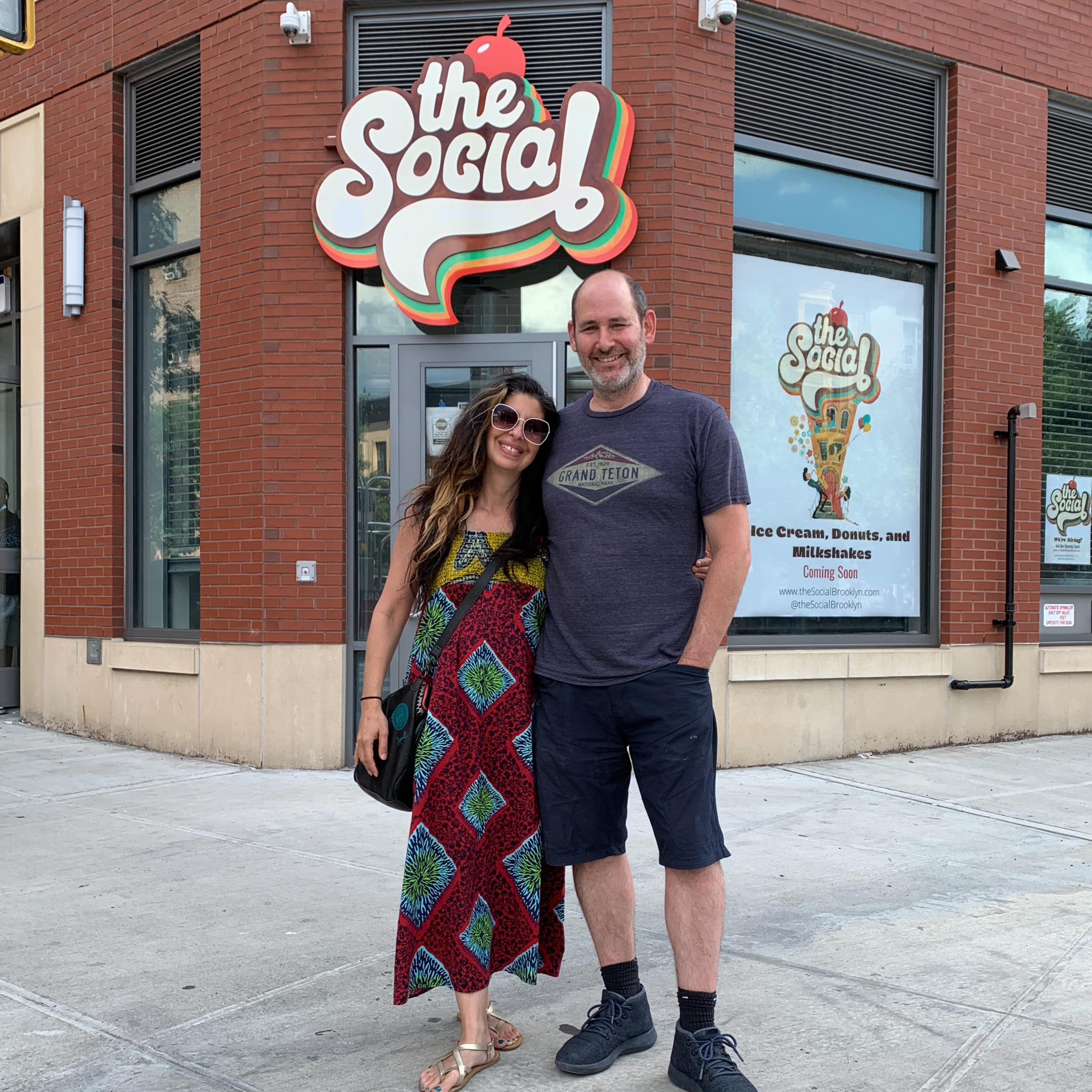
In this episode of "As the Ice Cream Churns," Jackie and Brian, former owners of Ample Hills Creamery, share their journey of rebuilding after bankruptcy. They discuss the dual challenges of finding a new apartment—facing landlord rejection due to their financial history—and launching their new ice cream shop, "The Social," in Brooklyn. The personal toll is evident, particularly on their 11-year-old son Kaleo, who struggles with leaving his familiar neighborhood, while their 14-year-old daughter Nonakai has started a successful sticker business, demonstrating resilience. On the business front, construction is about to begin, with a planned July opening. They detail the design process, which draws from 1970s influences like Sesame Street and The Brady Bunch, aiming for a warm, inclusive, and handcrafted feel. A key lesson from their past failure is their newfound emphasis on organization and documentation, creating a clear narrative for the shop's flavors and aesthetics. Despite the excitement, they acknowledge ongoing stress from budget constraints and potential construction issues, vowing to share both triumphs and pitfalls with their audience. The episode highlights their determination to learn from past mistakes while navigating the emotional and practical hurdles of starting over.
Welcome! We're Jackie and Brian, and this is As the Ice Cream Churns. Together we founded Ample Hills Creamery, one of the most beloved ice cream brands of the last decade. Then we lost it all. We filed for bankruptcy a day before New York City shut down due to COVID-19. Now someone else owns Ample Hills and we're out of work. But we're ready to start over. Come join us for an exploration of what went wrong and more importantly what comes next. Our guides are close friend Debbie Rosen. She created the cracked cookies in her hit flavor salted cracked caramel. When she's not baking she's a therapist. We thought she could help us navigate these troubled waters. Let's get started. Hey Jackie and Brian. Hey how are you Deb? Hey, how you doing? Good. Alright so last episode you've downstu-signed to New Least for the social. What's going on? What's the latest with the new shop? Well I wish I could tell you that we were focused on updates for the social. But we're actually looking for another lease now for ourselves. You know that we had to file personal bankruptcy back in September and we talked about that in a previous episode. Part of that has resulted in us needing to leave where we've lived the last number of years with the family. And so we're in the process of trying to find another apartment under a pretty quick time frame here before we open the shop but also wall we're trying to build out the shop. And you know it's surprisingly maybe not surprisingly it's quite difficult to find a landlord that will rent to somebody that just filed for bankruptcy. Yeah it's been exhausting we've seen a number of apartments we've gotten turned down by a number of different landlords and it's just it's exhausting it's time consuming. Yeah and it's tough because you know we have to find that we're trying to find a place closer to where the new shop's gonna be you know but we're also obviously downsizing a great deal which is you know that's okay it's just as you know it's fine. I grew up in a tiny apartment in New York City it's you know it is what it is it's just it's it's just trying to you know get rid of our stuff and figure out you know how we're gonna how we're gonna get this place and the pack at the same time that we're trying to think about you know creative decisions around the social so it's definitely creating some stress. Yeah I mean bankruptcy doesn't go away once you file it clearly. I'm just wondering how you're framing this experience to the children and what's their reaction to it. Oh it's it's rough you know I think especially for Kaleo who's 11 and you know his kind of world you know revolves around the neighborhood that we're in right now and he he you know is able to walk to the playgrounds and see friends and he can walk to school from here and so you know if he's had a he's had a kind of nice you know you know just just neighborhood life the way I did when I was growing up which is great you know my family never moved you know my family stayed in the same place you know rent control department for you know still actually it's still there but you know so for years and years and years and I mean no no there's a little more resilient because she's older she's 14 so she gets on the train she can go to different neighborhoods I think she's less focused on a specific spot you know anytime we tell Kaleo that we're looking at an apartment that's outside of the five block radius of where we are you know he starts to freak out so it's it's gonna be I mean I think that's probably the hardest part and emotionally for us is to is with them yeah you know they they understand that you know why but it doesn't I don't know that the understanding makes it you know any easier for them you said that known as resilient and I've seen online that she's caught the entrepreneurial bug you tell me a little bit more about that yeah oh my god yeah she started a whole company she's she's an artist and so she started an online sticker company called creations by Nonakai which made me very proud also because you know we named her Nonakai although she used to go by Nonak and now she's kind of embraced the Nonakai part which makes me also very just proud yeah so for any of you podcast listeners that want stickers for your kids no but it's just it's really been neat to see because you know we have limited resources obviously right now and she's out making you know almost as much as we are at this point in time yeah you know selling stickers herself yeah she's doing custom illustrations and you know she's communicating with the you know her customers and and she's posting you know things that the customers say once they receive these really cool stickers they put on their phones or on their computer it's just it's really sweet it's great I mean necessity is the mother of invention I wonder if she would have done this had this not happen yeah it's true no it's true I mean she's definitely yeah she's got that entrepreneurial bug which is amazing all right so let's turn to the shop what's the latest on the progress well I mean the exciting news is in the last few days we've got our work permit from the Department of Building so we have a contractor and you know we're recording this on a Sunday construction should start tomorrow or the next day so in the next 48 hours or so construction should start and we we've got a decent shot at you know opening at some point in in July National Ice Cream Month so I mean starting a new business is a mystery to most people can you share more details about the steps involved yeah actually I mean I guess if we go back to where we were ending it last episode I mean we were just announcing that we'd sign this lease and we were starting this new business but you know what's the very first step I mean the very first thing that we did was we had to hire an architect and so we did that and then the very first thing that you're doing with that architect is just what is the floor plan what's that you know meaning if you're sitting above the shop looking down what's the layout of it how do people move through the space where do they line up where are the cabinets and the dipping cabinets where the ice cream is where's the kitchen where's the booths that people sit in and so we had to just we had to create that and so it starts by you know the benefit of having done this 10 15 times at ample hills was that we had a pretty good idea of how to do that and most spaces sort of speak to what they should be there aren't that many ways to lay out an ice cream shop in a space so you have you know you have sort of a limited way in which you can do that but we start by doing it where we're just doing a little drawings ourselves and and then we pass them on to the architect and then they send them back and like you know nice drawings and so we did that that's the that was sort of the first thing and we submit that for permitting and then you can start out on the building process what about the design process yeah that's the the real fun part because it's it's how everything is going to come to life and it's the feel of it I mean there's certainly when you're creating the floor plan there's a feel to that as well which we know but that's more of an operational feel you know it's like how are you going to move through this space efficiently and how is it you know not gonna feel like either a you're on top of each other and be able to you know as a as an employee serve your guests you know as quickly and efficiently as possible but the design part is a whole other thing and we knew right away that we wanted it to be an illustrative homegrown feel you know that's important to us because we respond you know to that type of a shop when we walk into you know a space whether it feels corporate and usually if it feels corporate it's a digital it's you know it's not done by hand and for us it was really important to have it done by by hand so it was founding an illustrator which we did we interviewed many of them actually and we decided to hire somebody that was just a painter actually and and she created these moods with her paintings that were so captivating to us that you you know, and we
we asked her if she could draw characters and another kind of designs and she certainly is a very, very, very schooled and experienced painter. So yes, she could. Yeah. And so the first step within that illustrative process is really designing a logo. And well, oftentimes you would have somebody else design a logo than somebody that's sort of doing a mural on a wall. Here we wanted the two things to speak together and to be part of the same thing. And so the first step with the illustrator, it was designing this logo. And so the idea behind the logo was that we wanted it to feel like the 1970s. And we wanted it to have the color and the playfulness of the 70s. Yeah. I mean, when we first started envisioning the look and feel of the shop, it was very sesame street like for us. I think we had talked about that even prior to this, or I guess maybe the last podcast, but we were talking about how we wanted to feel like everybody's welcome, no matter who you are and everybody's different. And we're celebrating that difference. And all of this kind of great things that you learned on Sesame Street when you were growing up, or at least when we were growing up, which was in the 70s, that made you feel accepted and excited about being with other people. And it's another offshoot of the social and coming out of this time of social distancing and being together. These are the people of your neighborhood. And that was the vibe we were looking for. So it was funny because when we started out designing the logo with her, we didn't immediately go to the 70s, even though that's kind of what we were thinking about, but we weren't necessarily thinking 70s. We were thinking all of these experiences, feelings of like togetherness and like difference and celebration and you know, in the city, in New York City, you know, celebrating the city, right? Like everybody's leaving the city. We are celebrating the city. Like these are all really important parts that we want to be able to impart visually, viscerally when you walk into our shop. Now I hope we can do that because this, you know, makes me excited and you know, for this experience when we're able to, you know, actually get it all put it all together. But so anyway, the logo started all very different from where it is now. And it's still being tweaked a little bit. So we're not quite ready to share it with the public, but we, yeah, I would say like within the next two weeks, you know, we've been just, you know, making sure it's exactly what we want it to be before we show it widely. How does the logo influence how you're going to design the shop? Yeah, I mean, I think that's, that's right. I mean, actually everything starts with the logo and that illustrative style. And then out of that, we think, well, what are the actual materials and finishes? I mean, what does the countertop look like? And what are the cabinetry look like? And the booths and the lighting, right? All of those are design choices that we have to make. We want to start with a guiding principle, which is this Sesame Street's 1970s, the logo and the illustrative design. And so then, you know, when we first started talking, you know, the one of the things that Jack and I love so much is, you know, mid-century modern, madmen. And so we'd talk to the architect about that. And we'd talk to the designer about that kind of aesthetic look in terms of we were thinking of materials and booths and wall treatments. But I think, you know, you mentioned another reference. Oh, the Brady bunch. Excuse me, the Brady bunch. Yeah, I mean, you know, because it's a bit more playful, but you know, very 70s. And like, even if you just you know, Google image of the Brady bunch, there's an image that comes up where they're all standing on that staircase. And there's like this like really cool like four-color wood paneling, you know, well surrounded by wood paneling. And there's a geometric shape of like orange and green and something else and drawing a blank on. But you know, it was that vibe. I'm like, oh, that's the mood that we kind of wanted. I mean, that's the beautiful thing is sort of the creative process. As you know, we started with this thing and we're like, well, madmen and mid-century modern, how does that relate to this other vibe of Sesame Street? And it doesn't. And, you know, when Jackie sort of brought up Brady brunch, I mean, the architects, you know, like like Bob went off because he was like, yes, because of course, Brady bunch is filled with mid-century modern furniture. And yet it's in a much more whimsical, colorful way than the sort of coolness of madmen and the lack of color there. And so that's sort of what then we're thinking about in terms of, you know, formica or wood paneling or the bold color combinations that we're going to look for with the boots and the walls. Yeah, and of course, mind you, we have a budget. So that's the tricky part, right? Like, you know, we've got to make sure and we are very focused on making sure that it comes, you know, you know, into to our budget. So, you know, it's being creative too. So how do we, how do we do this? You know, a lot of it's going to be with like, you know, paint color because paint color is cheaper than, you know, other types of construction. So, excuse me. Have you always agreed on the style and what you wanted for the design of the shot? Brian and I? Yeah, it's a lot. I was going to say it's a lot easier to agree on the design of the social than it is where we're going to move to in the personal life of the apartment. It's a lot, these are so much, it's true. We can, we can agree on a lot easier, you know, or or we, yes, we can agree easier on that than moving into the right apartment. It's been, I don't think the process is one, the process is a really creative and exciting collaborative process. So we, we both absolutely love mid-century modern and madmen and we absolutely both love Sesame Street and we both love the 70s and the colors and so we loved all those things and the process of getting to what the actual thing is is a iterative process in which, you know, it's been, no, it's felt great and I think for the most part we are absolutely on the same page of it. You know, there'll be things like, oh well, maybe it should be a little darker, this color darker, that color, but those are, those are easy things. I always want red and everything to you because I'm like, I am, red is my absolute favorite color and I'm in a constant state of what, where's the red? So, I see on Instagram that you're visiting a lot of ice cream shops. What's the reasoning behind the research besides the obvious? Well, at least the research. I just like ice cream. No. Yeah, I mean, you know, so it's, it's double, right? It's both, you know, trying the ice cream and getting a sense of how that's being served, you know, obviously the quality of the ice cream, but then just, you know, not even just the quality. The quality's, you know, can be good, it can be bad, but, you know, it's really about, you know, how, how is it presented? You know, how are their menu boards? What are they, you know, what is their, you know, kind of overall focus? You know, what's the design of the shop? A lot of the places that we've been going to have been in existence for many years. So, it's really cool just to, I like to, you know, look at, you know, how, how have they, you know, what, what are people love about coming to this shop? And I've been posting on Instagram and asking for people suggestions, which have been unbelievably helpful, because like, we have like a list of places now from people who have like, you have suggested places on Instagram, and I'm like, great, let's go this place, you know, and, and we're taking the kids, which is possible because, you know, drag them around to ice cream shops. So, she'd think, you know, they'd want to do, but she's like, I guess our kids are a little tired of ice cream, but still, it's good to get their feedback and, and their, you know, impressions from the point of view of tweens and teens. Yeah, no, it's been fun. Before we end, I'm wondering if you can speak on your observations of how differently than with ample hills, you're approaching these early stages. Yeah, I think, with ample hills, you know, we, you know, initially had an idea, and it was, you know, we had a, you know, very loose vision. We didn't know how it was going to particularly come together. And, you know, we didn't necessarily write anything down. We knew what we wanted to name it, and we kind of went through iterations with the designer in the beginning of what the logo was going to be, and that took, you know, various steps and kind of looked back at that this week, actually, and it was interesting because it was a completely different color palette, and, you know, that we started
with that we ended with. But in some ways it's also very much the same I think, except for the fact that we're codifying everything now, like we're writing everything down. You know, have a very clear vision that's written down? Yeah, I think that that's the key is that we're so much more organized now. I mean, we have pages and pages of, you know, story and narrative that we've written down about what we want to accomplish and how the flavors are interacting and how the shop is communicating those stories. And things that it took us, you know, a decade to sort of codify, as Jackie said, at Ampo Hills, we're starting from the point of view of knowing what those things are. So I think since those are influencing the decisions that we're making now, it's just it's going to make the whole thing feel a little more put together, a little more whole. And it certainly makes the process go a little smoother. You know, on the other hand, it is still just as terrifying. And, you know, every every week still has, you know, ups and downs and they're still going to be plumbing problems and electrical problems and all the, you know, the crappy things that just sort of arise when you're trying to build out a shop, which we will continue to update you on as we have new updates as we go forward. Yeah. I mean, we definitely want to sort of bring people along with the process, not just all the good stuff, but also all the pitfalls that happen as you try to, you know, build out a new shop and start a new business. Yeah. Yeah. And I know that some people will eventually be doing the same thing or are doing the same thing. So we're happy to share our journey with you all and hear about yours in the coming weeks too. Well, good luck with apartment hunting. And I look forward to the next update and seeing the new logo. Thanks. Thanks, Deb. Take care. Bye. Bye.
Podcast Summary
Key Points:
Jackie and Brian, founders of Ample Hills Creamery, lost their business after filing for bankruptcy just before COVID-19 shutdowns; now they are starting a new ice cream shop called "The Social."
They are simultaneously searching for a new apartment after filing personal bankruptcy, facing rejection from landlords and emotional strain on their family, especially their 11-year-old son Kaleo.
Their 14-year-old daughter Nonakai started a successful online sticker business called "Creations by Nonakai," showcasing resilience and an entrepreneurial spirit.
Construction for the new shop is set to begin soon, with a target opening in July during National Ice Cream Month; steps include hiring an architect, designing a floor plan, and obtaining permits.
The shop's design is inspired by a 1970s Sesame Street aesthetic, emphasizing inclusivity, community, and handmade illustrations; they hired a painter to create the logo and murals.
Compared to their Ample Hills experience, they are now more organized, documenting their vision and narrative to guide decisions, though the process remains challenging with potential setbacks.
Summary:
In this episode of "As the Ice Cream Churns," Jackie and Brian, former owners of Ample Hills Creamery, share their journey of rebuilding after bankruptcy. They discuss the dual challenges of finding a new apartment—facing landlord rejection due to their financial history—and launching their new ice cream shop, "The Social," in Brooklyn. The personal toll is evident, particularly on their 11-year-old son Kaleo, who struggles with leaving his familiar neighborhood, while their 14-year-old daughter Nonakai has started a successful sticker business, demonstrating resilience.
On the business front, construction is about to begin, with a planned July opening. They detail the design process, which draws from 1970s influences like Sesame Street and The Brady Bunch, aiming for a warm, inclusive, and handcrafted feel. A key lesson from their past failure is their newfound emphasis on organization and documentation, creating a clear narrative for the shop's flavors and aesthetics.
Despite the excitement, they acknowledge ongoing stress from budget constraints and potential construction issues, vowing to share both triumphs and pitfalls with their audience. The episode highlights their determination to learn from past mistakes while navigating the emotional and practical hurdles of starting over.
FAQs
The hosts are Jackie and Brian, who co-founded Ample Hills Creamery.
They filed for bankruptcy the day before New York City shut down due to COVID-19, and someone else now owns the brand.
They are struggling to find a landlord willing to rent to them after filing for personal bankruptcy.
Their 11-year-old son Kaleo is upset about leaving his neighborhood, while their 14-year-old daughter Nonakai is more resilient and has started a sticker company.
They have obtained a work permit and construction is set to begin soon, with a target opening in July during National Ice Cream Month.
They are aiming for a 1970s Sesame Street vibe with a playful, illustrative feel, inspired by mid-century modern and the Brady Bunch.
Chat with AI
Loading...
Pro features
Go deeper with this episode
Unlock creator-grade tools that turn any transcript into show notes and subtitle files.
 PodcastTranscript AI