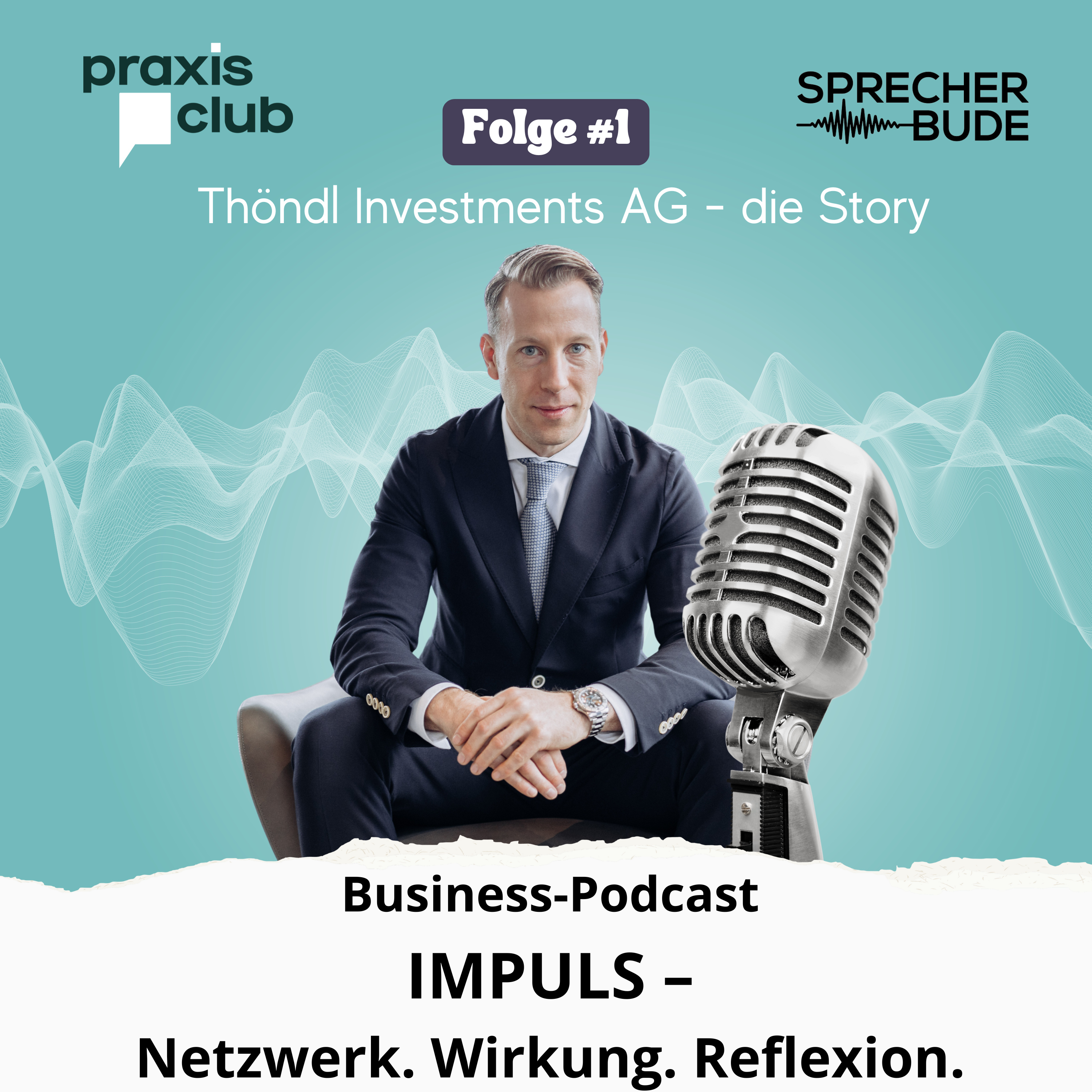
S2 - F1 - Jan Thoendl | Thoendl Investments AG | Story
37m 49s
Jan Töndl, the entrepreneur behind Töndl Investments AG, shares insights into his business trajectory, highlighting the development and implementation of trading algorithms for the capital market. The company specializes in analyzing and evaluating trading systems, particularly focusing on ETF arbitrage strategies to capitalize on price inefficiencies in ETFs. Töndl's background in the banking industry and his expertise in financial products have contributed to the success of the company. By offering unique trading systems and leveraging AI and machine learning algorithms, Töndl Investments AG provides private investors with opportunities to participate in the market with market-neutral strategies. The company's innovative approach includes collaborations with external portfolio managers, such as in the crypto sector, and plans for future expansion, including the introduction of a volume trading strategy for futures. Töndl's emphasis on automated trading systems and market-neutral strategies positions the company as a key player in the financial sector, catering to a diverse range of investors seeking alternative investment opportunities.
Transcription
5774 Words, 32395 Characters
Praxis Klub Impulse
Maintain valuable impulses, success stories and inspirations for your business.
Praxis Klub Impulse is a format for gratitude, appreciation, inspiration and a common success.
Hello and welcome to this new episode of Praxis Klub Podcast Impulse.
Today the first episode of season 2.
My cooperation with the speakers.
Today's guest is Jan Töndl.
Jan is the entrepreneur with the Töndl Investments AG.
He is a student at the University of Vienna with the master's degree in Business Economics.
We have been in the Praxis Klub since February 2024.
We have been in the lecture hall at the Fachhochschule BFI Vienna in the study of film, TV and media production
as well as in the MBA study of film, TV and media management.
He is involved with his company, especially focussing on the development of trading algorithms
for future private companies from Switzerland, Austria and Germany.
Dear Jan, you are here today.
Thank you very much for the invitation, dear Florian.
Jan, let's take a look at what is your business story, what are your learnings and what exactly do you do.
Florian, we would like to introduce ourselves. What do you do with the Töndl Investments AG this year?
Thank you very much. I like to do that.
The Töndl Investments AG has been added to the financial market by the IT-genous market.
The main purpose of the company is the development, analysis and evaluation of trading algorithms for the capital market.
How this whole thing happened is basically a six-year history.
I have been working in the bank and finance industry for 17 years now.
After my graduation from university, I worked in various positions in the bank and finance industry in Austria for several years.
Among other things, I worked in the Austrian National Bank, in the Bank Ostsee, also in the Uni Kredit in Mailand.
And in 2019, I was more or less exposed to the subject of trading algorithms.
I had a friend who was a sales advisor who worked with a trader, with a portfolio manager back then.
And he talked to me about whether I was interested in investing in the customer.
And I looked at the whole thing and thought, yes, that sounds very exciting, good performance.
And then I just talked to a few people I knew.
And a very good friend of mine, Antoni, who was an Immobilian investor from England, said,
yes, I find it exciting, I would like to invest.
And he said, yes, wonderful, then I would make the contact there.
I didn't have my own company back then, I was already self-employed.
But I wasn't thinking about the Töndl Investments or the previous business yet.
Then I just brought both of them together, we made the contact and then the thing was done for me for the first time.
And in the case as such, yes, they weren't able to get the Anthony on there, that is to open the account.
And then to take it up in the trading strategy.
And Antoni asked me at some point, what's going on there, why is there nothing going on?
So I said, I don't know, I'm not in the operating system, I'm in the company.
But I can see if I find something out there and I talk to the people.
Yes, you said to me, yes, everything is running and so on.
But two or three months later Antoni was still not on board.
And I thought to myself, okay, there is a business model, I already have all the customers.
That means the customer is already there, that is often the most difficult case in the company.
You now have an idea or a product, a service performance, where do I get the customers?
I had the opposite case, I had a customer and I had to find a product.
And then of course I researched and I said, okay, I can bring such a service system myself to the market.
So not very well developed, I'm not a trader or portfolio manager myself.
But I quickly found out that there are many very good service systems or very good trader/portfolio manager
who can't do anything, namely capital creation and also set up this whole regulatory setup
that you need to set up something in the financial sector.
And usually traders like to sit by the screen and implement their trading systems.
Or they are software developers and they develop the algorithm, but they are not necessarily able to market it.
And then I found a trader myself, with whom I signed up for a collaboration.
I founded my first company with the Internet as the first customer.
And then the whole thing took its course.
Exciting development history, what are you at this time, or what is it like when you look at the time horizon?
That was in September 2019, that was almost a six-year anniversary.
Congratulations, thank you.
That was a super club commitment and you noticed that you are the ideal bridge builder between investors and all these portfolio managers, right?
Yes, of course, everything has developed very, very well.
Anthony was very satisfied, we have built up many systems for customers.
So satisfied customers who recommended us.
And therefore it has become a very big customer base very quickly.
It has grown very, very quickly and with time, of course, more trading systems have come in.
So I have certainly analyzed and evaluated over 100 trading systems in the last six years.
So from external traders or portfolio managers.
And of course we also develop our own trading systems.
So there are in fact two spares.
The one is the implementation of financial products for external portfolio managers.
And the second business area is the development of own trading systems and the marketing of financial products.
Okay, now for the hear-and-hearers, who have never known the TFI before, what are the trading systems?
Yes, trading systems are in the usually automated or partially automated systems, which are in various systems on the capital market.
That can be shares, that can be futures, that can be currencies or also raw materials like gold or crypto currencies.
Use market chances, depending on how the trading system is designed.
In general, it is also market-neutral, that is, in different market phases.
So that's what drives me, that is, trading systems that are independent of the market direction,
independent of whether the action market, let's say, or the capital market, is rising or is falling,
can still achieve a positive profit.
And how does that work?
Yes, as I said, that depends on the individual systems.
I can now tell you a little bit about our current trading system, because I can tell you exactly how that works.
We currently have an ETF-a-bidrage strategy on the market.
ETF stands for exchange traded fund, so for all hear-and-hearers, for whom this is not yet understood,
it is a stock traded fund, so a fund that represents a portfolio, a portfolio of value papers.
It can be stocks or obligations.
And we use, or the trading algorithm uses, price inefficiencies in this ETF,
which results in the fact that the ETF itself is traded at the stock market, as the name already says.
And because it has a market price, and this market price is, like all the others,
also dependent on supply and demand.
At the same time, the value papers of the portfolio are also traded at the stock market,
and therefore their price and the value are constantly changing.
And now the following happens, that the price and the value of the portfolio do not always coincide,
or do not always coincide with each other.
And here we set our trading system and identify the value papers of the portfolio
that are evaluated or undervalued in relation to the price of the ETF.
And open corresponding positions.
Either you buy the value papers, if it is undervalued, then it is too cheap,
or you buy the value papers, if it is overvalued, then it is too expensive.
And it creates, so to speak, the difference between the ETF price and the value papers.
Everything sounds very complicated, but it is actually quite boring.
So that is not a mathematics at all, through an algorithm, through KI, machine learning.
And then we use these price inefficiencies to achieve market neutral,
independent of the overall direction of the market, independent of prognosis models here,
very solid and sustainable products.
Now it sounds very lucrative and very exciting.
Why does not everyone do this? Why can't I just do it myself as a little customer?
Why do I come to the Tündel Investment?
Well, the development of a trading system is of course connected with a corresponding
effort of the costs and also the know-how.
That is, in general, that is, say, the investment companies,
investment funds are kept up by some extent.
The ETF contract is not what we have found now.
So there is an ETF contract, since there is an ETF.
So that is in nature the design of ETFs.
Large investment banks and hedge funds use the ETF contract strategy
to achieve very lucrative profits.
Tündel Investments, we are the only, let me say it now,
without having made an intensive market research,
but I said once that we are the only or at least one of the few,
who can offer this ETF arbitrage model to private investors.
And that is certainly the advantage.
OK. Now you are always talking about the sea.
That means that this is already the Tündel behind the whole construction.
How do I have to imagine that?
Or how do I have to imagine a construct in the system?
Yes, we are small and flexible and very strong.
So we always have... I am the founder of the advisory committee, president Martin.
Martin Schiller is still the second advisory committee.
He is responsible for legal and compliance.
He is an former chairman of an Austrian private bank, he is a lawyer.
So he covers the whole issue of risk management compliance with us.
And we have a responsible person behind every trade strategy for the trade system.
That can be an external person, or an external portfolio manager,
if it is a trading system that we do not develop ourselves.
Or if we develop ourselves, then we have the know-how in our area of software development.
And most of the time it is a combination of experience in trading
or with trading systems plus software development.
Very good. You said that you also have the background
at the Austrian National Bank and other bank institutes.
It is not like you do not come from the industry.
You know that a little bit your west, don't you?
Yes, he has the advantages that I have collected the experience in the bank and finance industry.
He had some advantages, because the filmers of course have the advantages
that you have the experience in the bank and finance industry.
So that certainly helped me to get the license.
And of course you also know how financial products have to be set up
so that they are attractive for customers.
And the big advantage is of course that the banks
or their customers and customers are not necessarily the best products,
but in general, they earn the most from the banks themselves.
And that is of course the advantage that our customers search for alternatives
and also want to work on investments that they do not get from their banks,
which are a bit out of the ordinary thing.
Now you said that you started with Anthony
and then the first few customers came in.
If it was a little bit the turning point that you said,
after what you started, you started running now?
So the turning point was certainly with my departure to Switzerland.
So in Austria, the whole thing went well.
But in Austria, there were also some regulatory and mainly tax-free hires
that were to be taken.
And when I came to Switzerland in 2020,
I have re-founded the tunnel investments,
but in the end it is a successor to the company.
The company was founded in Austria back then.
And a year later, in 2023, I then signed the Finnish license
and we just got them in June 2025.
And the turning point was of course to close the old company,
to build a new company.
And of course that also meant a certain period of time.
It was also a challenge to develop the right product.
Switzerland also had a very large share in that,
because in Switzerland there is a product that I think is absolutely brilliant,
if you want to bring a trading strategy to the market,
namely the so-called AMC, or AMC.
So it stands for Actively Managed Certificate.
And that is, in my opinion, the easiest, fastest and most expensive opportunity
to bring a trading system to the market.
So compared to an investment fund, it costs a fraction.
And it is ready to use in a few weeks.
It has an e-sign, so a value number.
And the customer, the customer can simply store it in their depot,
so just buy it via the bank.
And of course that also helped us a lot.
So the film license plus the AMC structures,
that's what we work with and what has also provided us with a corresponding growth.
Very nice.
Now, did you have a little bit of a break in before?
Can you do the whole thing?
But because there is an artificial intelligence algorithm, a learning behind it,
did you develop it yourself?
Or is that something that, how do I imagine it?
That's always real, that's always in seconds, or what it decides.
Yes, exactly.
So we developed it ourselves.
I mean, artificial intelligence is just a hit word nowadays, in the end, in the algorithm.
And of course, it meets certain parameters of trading decisions.
And it is also an element of machine learning,
so that the trading system, of course, on the basis of the previously made decisions,
also optimizes the future decisions.
And yes, that is something, in my opinion, of course, that offers such great advantages.
Because if you compare it with a human trader who makes the whole thing manually,
of course, a trading algorithm can of course meet millisecond trading decisions,
of course, during market opening times, without pause,
can of course trade through, which of course a human also could not,
can of course trade several setups in parallel.
And yes, I think that the future will certainly lie in automated trading algorithms.
So the form manager, who still manually makes the trading decisions,
or still analyzes and evaluates companies, and then decides,
which companies he buys, or takes it to the portfolio, or buys it away.
Yes, I think that's going to be a hit word.
Exciting, yes.
So I don't think it has a huge influence in many neurons,
and that is certainly at the pulse of the time.
Now you have your company, 2022 Gründer, which is just yesterday,
what are the questions that you have already done with it,
and since when is the algorithm used,
and what are the values that you can take with you,
or that you can say from a retro perspective, that works?
Yes, so the new algorithm for the ETH Fabiatra strategy
was developed in 2023 and tested as a result.
And it is now in 2024 on the market,
since about a year and a half.
In the meantime, of course, we have been able to win an external portfolio manager.
So we now have two EMCs with external portfolio managers on the market,
both in the crypto sector.
So that's also very, very exciting.
And many customers want to participate in the crypto market,
but do not know exactly how they should do that,
and do not necessarily want to transfer money to exchanges,
which they then have to exchange in crypto currencies.
And there, the EMC offers a very good opportunity,
because then you can simply participate in dollar, euro, Swiss franc,
and the value paper is bought, and at the same time,
however, also at the development of this trading strategy,
which can specifically participate in the crypto market.
And we are currently developing a trading system,
which is a volume trading strategy for futures,
which is also very, very promising.
So we want to bring them in the first quarter of '26 on the market.
And we currently have three external portfolio managers in the pipeline,
which also want to invest with our EMC.
And what is still planned,
of course, we want to have the Finnish license,
also to build up a private wealth management spate
in order to offer a very promising customer or family office
simply with a comprehensive amount of money.
Because we are currently only, let's say, product suppliers
or strategy suppliers.
And with the private wealth management spate,
we can also completely distribute the amount of money to the customer,
and, of course, use our trading strategies there in a punctual way,
where they simply achieve a surplus debt for the reasons.
So that's the plan for the next, let's say, six months.
Interesting.
You bring in a lot of great words again,
which are certainly known from the banking world and the financial world.
Now you said 'future', what is a 'future'?
A future is a trading contract that will be fulfilled in the future.
So, as the name says, 'future', usually the future is an automated,
a standardized product that is traded on the stock market,
where usually there is a false data, where there is a false data,
for example, mostly at the end of the quarter,
and that is, however, a trading instrument
that is also very, very well suited to build up trading systems with it.
Because, for example, the future can be traded on the S&P 500,
on the American stocks index,
of course, on one side it is liquidary,
and on the other side it can be traded with smaller stocks.
So, for example, there is also a 'mini-future',
which brings smaller capital requirements with it.
There are 'futures' as standardized, stock traded products
on special indices, like, for example, the S&P 500,
very, very exciting instruments to build up trading systems.
I remember that once there was a Netflix series on the topic,
when was the big economic crisis, 2008?
2008, yes.
And then there was someone who put it on a 'future',
a group that made a lot of money.
Yes, it can be. I don't know exactly.
There was the Big Short, maybe.
I don't know if you've betted on 'futures',
but he definitely put it on special markets.
He kind of anticipated that or expected something to happen
with the financial crisis,
and then he put on a very big bet,
which then also happened.
But I'll say that, that's of course great,
if you can do that, and if it opens up,
the risk is, of course, that it goes in the other direction,
and then you can lose a lot of money.
And we're looking at developing trading systems
that don't happen on forecasts or expectations,
and which, in all directions,
no matter if the market is breaking in or if the market is rising,
so that we can make money in the market neutral,
that's the technical term for it,
because if you just put it in one direction,
and the classic investor or the classic investor
always puts it in one direction,
that it goes up,
this is the classic buy-and-hold strategy,
I'm buying today an asset, I'm buying today a fore,
I'm buying today Bitcoin,
and I'm expecting, I hope, that the whole thing goes up,
that the value is rising,
that a value increase is happening,
and I'm earning money with it.
It can work, of course, it doesn't have to,
or if you get the timing wrong,
then it can also be that if you buy at a bad time,
and then the value of this system falls,
that it can last for several months or even several years,
until the value is repeated,
and that's the time in which we are today,
no longer necessarily the best strategy.
So you have to have a very, very long time horizon,
mostly, let's say, 10 years plus,
so what we said in the morning,
okay, save 30, 40 years and invest,
and then at some point, if you're in a pension,
you have to build up the capacity.
I think it's going to be more difficult today,
because the cycles are getting shorter and the time is getting shorter.
Good, thank you for the picture and then I want to hear from you.
Yes, it's effectively exciting what you can do with it,
and if I would decide now and say,
"Hey, this is really still interesting,
what is the capital that you have to calculate
so that it makes sense at all when you invest in it?"
Yes, I would say that we can start working with 50,000 francs.
So that's a reasonable size,
so, on the one hand, it has to do with the administrative effort
and of course with the least capital that the depot banks want.
So it's also different from the depot bank to the depot bank.
From the process it is like this, if the customer wants to work with us,
he says, "Yes, I find this strategy exciting.
I would also like to invest in it."
Then he closes with us a compensation mandate
and then we open a depot at the Swiss Depot Bank.
In general, our Swiss customers have a bank connection in Switzerland.
We still open a second depot,
because in general the customer already has a depot
with which they then implement other systems and strategies,
with which they then buy stocks, buying stocks.
That has nothing to do with us,
that is, we always make a separate compensation depot
that we then develop and then we then buy the trading strategy
or the EMC.
For our German customers and also Austrian customers,
it is always very exciting, because many of them want to diversify regionally.
They also want money not only in Germany, not only in Austria,
but also in Switzerland.
And there we simply offer the whole setup
with the Swiss Depot Bank and the Swiss Depot Bank.
And these are very, very attractive solutions.
Absolutely.
How important is the topic of the network team for you?
That you don't have to do it alone, but with people together.
How important do you think the whole thing is?
That is very, very important.
So I think you can simply carry out it in the team
or in the network as much as you can by yourself.
And I work exclusively with cooperation partners together.
And these are just people who recommend our products,
who have a large network.
Of course, I go to the network myself to get to know people.
And that's how the whole thing develops.
So I have to say that this development has not been given
without other people who take the path and support the project.
Very nice.
In the next episode, where we will then open up,
we will also talk a little more about personality
and how you have done all this through your business.
Because it still depends on the initial strength of the person
who initiated the whole thing.
Then we will go a little bit further.
Jan, what chances and trends do you see in the next,
say, once a year, maybe two, three, four, five years.
You said that cycles are getting shorter and shorter.
Is that something to say that the product, the ITF-Abitrasche?
The ITF-Abitrasche, yes, the ITF-Abitrasche.
Is that something that will stay with you for the next few years?
Or is it something that you can always be careful about?
And the man over who watches and watches.
Is there a new opportunity here?
What do you think about the next years for you?
Yes, the ITF-Abitrasche strategy is definitely a strategy
that will not be given for the next few years.
So the ITF market is a huge market.
We focus very strongly on the US-American market.
And the daily market volume in the ITF alone is 42 billion dollars.
So there is still enough space.
Of course, you have to look at the digitalisation
and also the further development that is going on with the AI,
whether the markets are becoming more efficient.
So I don't see it currently.
Trends are certainly AI, very, very clearly.
So there will surely be a lot more to come.
The whole energy issue will continue to be very, very relevant,
depending on how the geopolitical situation develops,
the defense issue, of course.
Otherwise, we have to see how it develops.
Although the focus is not on the forecast of trends,
because, as I said, with the trading systems that are market neutral,
we are so focused on the trading systems
that we can earn money in all market directions.
Cryptocurrencies are still a big topic.
That's why we already have two,
and probably two more external EMCs in the crypto sector on the market.
So a lot is going on there.
It remains exciting.
Very nice.
On the website, you write that there are opportunities
to generate 40% of the rendited value.
Is this effective?
Do you also hear people saying that is this at all serious?
Can we generate so much value at all?
Yes, I always say that.
I always say that you should be very, very critical.
So the natural reaction when someone hears or hears from the rendition,
which are about what he or she can imagine is the natural reaction,
that it is always too good to be true.
That can't be true.
And I always say, yes, in most cases it is like that.
So it makes sense that you turn on the healthy human understanding here
and just look at things very, very carefully.
Now I can only hear and say,
"Okay, based on the past results, I predict,
that it will go in a certain direction."
Of course, that has no claim to the truth.
With the ETF arbitrage strategy, in the year 2024,
we have achieved almost over 20%.
And now in the year 2025, we are on an analyzed rendition
of over 30% for the investors.
So that is remarkable.
As I said, we have a financial product.
That means, the performance will also be calculated once a month
from the calculating agent, the emitter on the basis of the performance
of the previous month.
And then there will be a new course for the EMC.
And then it will be delivered via Bloomberg to the banks.
And the 40% are certainly a little bit more critical.
However, 30% plus, 30% to 40%, we continue to optimize.
We still have a lot of potential in the strategy,
so I don't want to exclude that.
But I say, currently, 20% to 30%, we have definitely already achieved.
And as you said, we are optimistic for the year 2026
that we can achieve more in one or the other percentage point.
So 20% or 30% is already a good rendition.
Definitely, definitely.
And as I said, the topic we have is just this delta-neutral arrangement.
Because we can't say the future in advance.
That means it's also about having a trading system,
or an investment decision, when you can sleep in peace,
when it gets more turbulent.
And when it's 20% or when it's a few percent less or so,
but you can sleep in peace, it's of course also good.
Absolutely, absolutely.
Now we always have a part to fail and learn in this success,
because it's not always just a straight line,
even in business, not.
You said you already had a company in Austria,
and then you went to Switzerland.
Would it be a fail version now?
Because you had success,
but you then decided to go to Switzerland.
Would it be an example now, or would you have something for the listeners
that you can take with you and say, "Hey, look, I did that, don't do that, learn from it."
Yes, so mistakes that have happened are certainly trading systems
in which I also invested money over the companies that didn't work.
So basically from the process, which is always like this,
when a trading system comes to me on the table,
there is of course a due diligence,
where I could demo or backtest results,
but at some point you come to the point where you then
invest your capital yourself to look at the whole live business
and then you have the system where both of them didn't work.
Yes, maybe again to summarize,
so the biggest learning was just that you,
how to say, that you, even if you look at it so precisely,
you still do your homework and you still do the due diligence,
it can still come to situations that you didn't see before.
That's just the company risk at the end of the day.
And as I said, I tested a specific trading system very intensively.
It was in 2023 and it worked very well for a very long time.
And before I did that to external customers or financial products,
it's always the rule that I then also invest a lot of money
and then build an Intrack record over my company.
And then I was so, then I was engaged with an medium six-star company.
But then I pulled out most of the capital,
because I needed seed capital for the ETVA contract strategy
and was only in a higher five-star contract with a small amount.
And then the system achieved a total loss.
And if it had been three weeks earlier, it would have been sensitive to me.
So that was already a challenge.
There were other challenges too.
Back then, in Austria, for example, the bank closed down a larger capital contract.
Because of a compliance alert, as you can see.
Of course, we all have our customers, so we have the underlying KSC.
Only the banks are regulated very, very strictly these days.
And there is often no one behind it now,
but some machine and then there is a red lamp and then alarm is hit.
And even though we had delivered all the stocks,
we had the business case and also the information about the customers,
because the capital was closed for three months.
Fortunately, we still had other bank connections.
However, when something happens as a company,
you have a bank account and it is closed,
that leads to an insolvency in the master field.
So why do you have so much money at all levels?
It's not that trivial, the problem is always that you need the banks,
or the bank systems to operate your business.
And that is of course always a bit challenging in the investment and consumption area,
because you work for the banks in a high-risk segment
and you also wander in their business fields, of course.
So that is certainly the challenge.
And yes, the other challenge is that you have a good balance
between behavior and risk, a hero.
Very good.
Does it mean for you or for everyone here who is interested in learning,
not only one bank connection, but perhaps a second one as a backup?
Definitely.
So I would immediately describe that.
We always have several bank bills.
Very nice.
For people who are interested, you actually see that the network is an important part.
Some kind of tip or something, your personal experience,
what does a good network do for you?
And how, if you have a network strategy, how do you approach people
and what kind of tip do you have for people to approach you?
Yes, a good network strategy is simply to be open and just to talk to people.
I think without a certain expectation to go there,
because if you bring an agenda with you and say, "I really have to win with the customers,"
or "I have to convince someone," the people will notice that.
So I usually go there without expectations, but I already agree that I take two or three contacts with me.
And then let's see what happens out there.
So contacts exchange anyway and then it's important that you then also meet with the person relatively quickly.
Exchange and in exchange, you quickly find out whether there is a common synergy or co-operation possibilities.
And even if there are no concrete co-operation possibilities,
it is always meaningful when you stay in contact with the people,
because you never know if something changes in the life situation or in the entrepreneurial situation or in the future.
And then maybe it fits in one way or the other.
Very nice.
Is there one sentence that you want to say, "Hey, that was a life change for me," or something that surprised me?
Is there one sentence that you say, "Yes, that's something that impressed me a lot"?
Yes, the quote from Henry Ford, "If you think it's okay or it's okay, you will keep it right every time."
And I think that's absolutely the point.
So many things were presented as impossible until someone came and did it.
So that's just the entrepreneurial spirit.
You have an idea, you have a vision and you follow this to the goal.
Nice.
Yes, I would say that was a wonderful conclusion for this first episode.
Is there anything else you want to say that you haven't talked about or is it also a round-end conclusion for you?
I think it's a very round-end conclusion, because a podcast with a quote to end is a nice way to end the whole thing.
Thank you very much, Florian.
Thank you and thank you very much to all listeners and listeners.
We look forward to seeing you in the next episode of the "Praxis Club" podcast "Impulse" together with the speaking Buddha, who is allowed to be introduced.
That was the podcast "Impulse", a collaboration between the Praxis Club and the speaking Buddha in Basel.
Podcast Summary
Key Points:
Jan Töndl from Töndl Investments AG discusses his business journey and the development of trading algorithms.
The company focuses on analyzing and evaluating trading algorithms for the capital market.
Töndl Investments AG offers an ETF arbitrage model for private investors, leveraging price inefficiencies in ETFs.
Summary:
Jan Töndl, the entrepreneur behind Töndl Investments AG, shares insights into his business trajectory, highlighting the development and implementation of trading algorithms for the capital market. The company specializes in analyzing and evaluating trading systems, particularly focusing on ETF arbitrage strategies to capitalize on price inefficiencies in ETFs. Töndl's background in the banking industry and his expertise in financial products have contributed to the success of the company.
By offering unique trading systems and leveraging AI and machine learning algorithms, Töndl Investments AG provides private investors with opportunities to participate in the market with market-neutral strategies. The company's innovative approach includes collaborations with external portfolio managers, such as in the crypto sector, and plans for future expansion, including the introduction of a volume trading strategy for futures. Töndl's emphasis on automated trading systems and market-neutral strategies positions the company as a key player in the financial sector, catering to a diverse range of investors seeking alternative investment opportunities.
FAQs
Praxis Klub Impulse is a format for gratitude, appreciation, inspiration, and common success.
Jan Töndl is an entrepreneur with Töndl Investments AG and holds a master's degree in Business Economics.
The main purpose of the company is the development, analysis, and evaluation of trading algorithms for the capital market.
Trading systems are automated or partially automated systems used in various markets like shares, futures, currencies, or commodities to capitalize on market opportunities.
The ETF arbitrage strategy exploits price inefficiencies between ETFs and the underlying securities, buying undervalued securities and selling overvalued ones to profit from the price differences.
Chat with AI
Loading...
Pro features
Go deeper with this episode
Unlock creator-grade tools that turn any transcript into show notes and subtitle files.
 PodcastTranscript AI