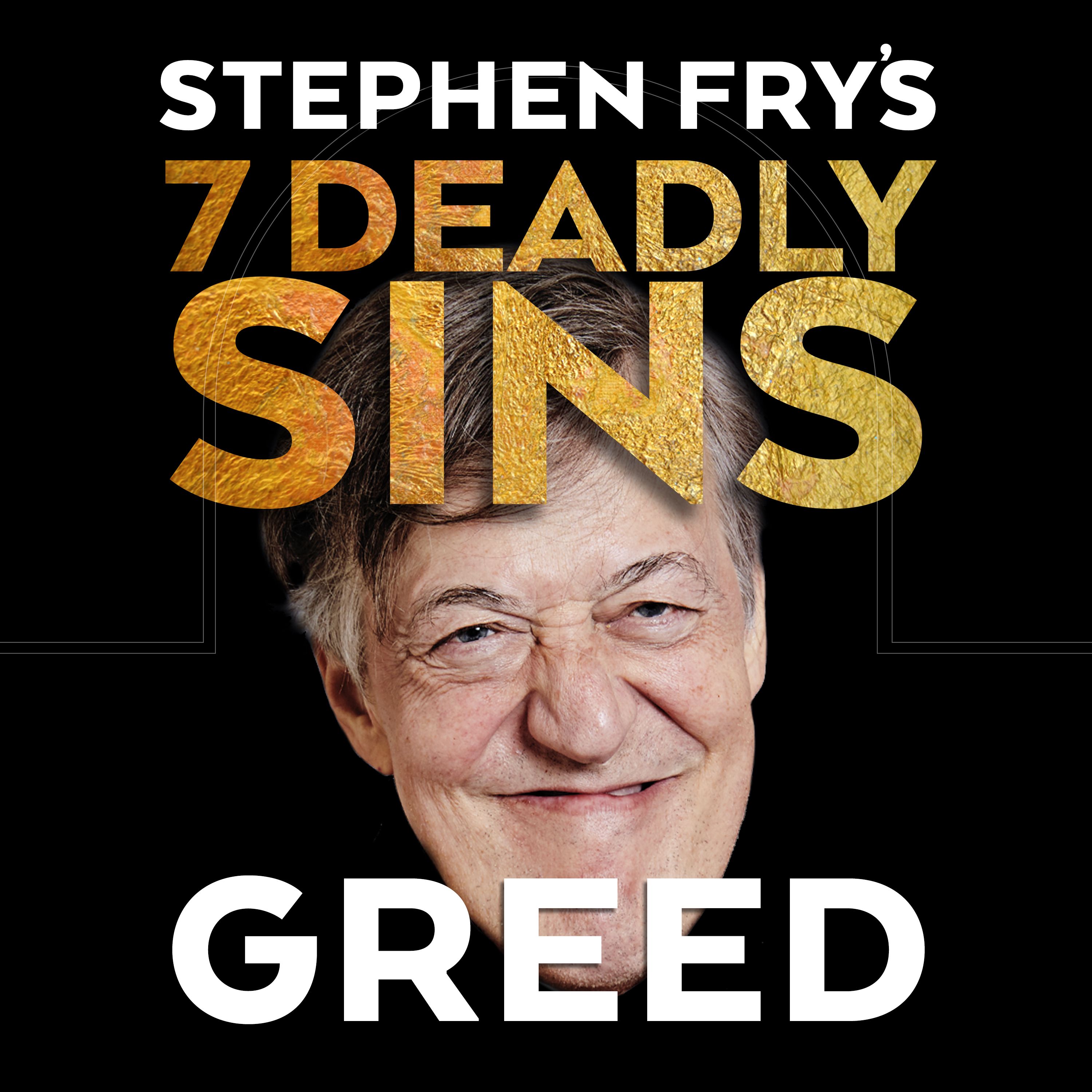
In this episode, Stephen Fry examines greed (avarice) as distinct from gluttony, defining it as a psychological drive for accumulation, power, and possessions rather than mere physical excess. The discussion acknowledges the common condemnation of greed but also explores arguments in its defense, notably through the fictional Gordon Gekko's assertion that "greed is good." This perspective is linked to Ayn Rand's philosophy of objectivism, which champions rational self-interest, individualism, and laissez-faire capitalism while rejecting altruism and collectivism. The episode notes how greed has historically fueled economic growth and innovation, yet also critiques its role in widening inequality, exploiting resources, and fostering ethical dilemmas. Rand's enduring influence is evident in political movements and figures, from Silicon Valley billionaires to conservative politicians, despite academic dismissal and opposition from those who view her ideas as socially destructive. The analysis ultimately presents greed as a complex force with both proponents who see it as a driver of progress and critics who highlight its moral and societal costs.
[Music] This is Stephen Fry's "Seven Deadly Sills." Episode 3. Averis. Averis. Agreed. As we recall it today, now there's a proper vice. One week and all, surely identify with, claim and confess to. I was all ready to dive into greed, own it and rub it all over me like suncream. When the thought flashed across my mind that another of the seven deadly sins is rather similar. Perhaps in my excitement to acknowledge and engage with greed, I'd really been thinking all along of gluttony. For when I hear the word "greedy," I think first of food and drink. I think of greedy guts and greedy pigs whose eyes are bigger than their tummies. But all those surely belong more to the fat warthog gluttony than to hard-eyed, averis and greed. Gluttony, after all, is a physical desire seen not just in gormondizing, but in all kinds of addictive behaviors, whereas greed comes not from the body, but from the mind. Averis is therefore, I think, a better word to describe, are altogether darker, meaner kind of owning, hoarding, grabbing, collecting, acquiring, winning impulse. So when we talk of greed, we'll forget food and wine and concentrate on avericious greed. This greed is the grasping of the money-grubbing miser, the skin-flint cold-heartedness of a scrooge, the unquenchable territorial ambition of an empire builder, the venal capacity of the corrupt official, and the voracious TV evangelist, the limitless need for more and more and more that drives the repine and monopolistic instincts of the acquisitive hedge funder and predatory assets stripping financier. All that seems a world away from a gormond, a glutton, a drunk apoteira, a homosymsen-styled doughnut scoffer, or Monty Python's Mr. Kriusot, and that one last wafer thin after dinner mint. Gluttony and Arya, old adversaries, old friends even, but Averis, greed, can I acquit myself of that, the craving for power and possessions? I don't feel it's something I need worry about. Do I? There can't be much question that greed is very allied to selfishness, which if you listened last time, you will know I chose to be my deadly sin number one, deposing the canonical original pride. Just as pride, at first glance, appeared to be closer to a virtue than a vice, and we thought about pride as a booster of self-esteem and a builder of self-belief, so there are those who think of greed in the same positive terms. One of the defining quotations of the materialistic 1980s came from the fictional character Gordon Gecko, the junk bond pirate, played by Michael Douglas in the Oliver Stone Film Wall Street. "Greed," he tells a dinner of fellow financiers, "for lack of a better word is good. Greed is right. Greed works. Greed clarifies, cuts through, and captures the essence of the evolutionary spirit. Greed, in all of its forms, greed for life, for money, for love, knowledge, has marked the upward surge of mankind. It's easy to dismiss this. Your instinct might be to shake your head, sadly, or scoff angrily, or snort derisively when anyone defends Greed and especially dares to present it as a moral good. We are all surely aware that the gap between rich and poor is wider than it ever has been, and that the rhythm of capitalism still rules the world, will inily, disruptive rebel newcomers, evolving with bewildering speed into tax dodging corporate titans. Jeans and sneaker mavericks morphing into color and time moguls. Rebellion innovation initially branded as, for all, producing monopolistic strangleholds. Cool startups becoming bloated corporate fortresses for stockholder benefit only. The same rhythm that turned Henry Ford from an oily rag engineer into a terrifyingly merciless and aggressive corporate tyrant. And Mark Zuckerberg from shiny faced student with high hopes to a loath symbol of everything that's wrong with the new surveillance economy and its insidious reach into every aspect of our lives. But let's, for the moment, think about whether perhaps there may really be a moral virtue to self-interested self-enrichment, a justification for rejecting altruism, selflessness, and all the other social justice warrior desiderata. So for a while, I'm going to play Devil's Avocado and argue for greed, or at least put the argument for greed as best I can. "Grid is good," says the Wall Street predator. "Wealth creation is good," says the corporate titan. "Well, they would say that," you might reply. "All repacious billionaires will claim that they are enriching the world, that when they generate wealth for themselves, they generate it for others, that to quote their favorite atherism, a rising tide lifts all boats, that they are, if anything, philanthropic. Their greed, one might say, is part of a virtuous and effective human instinct that burns to know, what's over the hill, that labors ceaselessly to find out, for example, how to feed the whole tribe over winter by devising silos and barns for grain storage, that comes up with newer smarter and more efficient ways of growing the economy and fattening us all. If they get a few private jets and tropical islands out of it, well, why not? Do you honestly believe communism would deliver greater riches for all?" Forget comparisons of equality, look at the reality. Today, more people in the world are dying of obesity than of malnutrition. "Grid has brought largees for all. If we relate riches to height, it's as if we were all once four-foot high. But now the greed of the achievers has raised the average height to nearly six-foot. So how dare you, if you're now six-foot, moan about the billionaires who were eight-foot? You are better nourished with more access to knowledge and the world's bounty than the generation that came before. That's what counts. It's not the gap between the rich and the poor that matters. It's the gap between what people were and what they are now." We've all heard this argument and variations of it. Not just from rightists and laissez-faire libertarian free-market zealots, but from those on the left, too, like the Harvard psychologist and linguist Stephen Pinker, anxious to show how the world has advanced thanks to the values of enlightenment, classical liberal economics and scientific thinking. Alexander the Great and all conquerors who came after may have been pathologically greedy in their conquests, all empire builders, and usually their grateful countrymen exhibit greed. But from Julius Caesar to Jeff Bezos, the benefits that accrue the economies of scale, the trading advantages, the spreading of technologies, skills, languages, and cultural capital, the guaranteed security that comes with increasing size, scope, and power, these have advantage the majority. That is the argument. Until communism came along to offer another way of doing things, the drive to grow, the greed to expand, these were all accepted, glorified even. Communisms, short-lived attempt to offer an alternative, has since only strengthened the grip of capitalism. Communisms failure has given capitalism new courage to be even greedier, and even less apologetic or diluted by social justice regulation and constraint. We're all aware of it, and there seem to be two responses. One is to shrug and endorse, to echo-gecko, and believe in the ability of our species eternally to invent new paths to prosperity and growth. The other is to question and challenge the greed, to repudiate the idea that it is beneficial, to point to how it creates not just inequality, but how it exhausts resources, depletes the soil, and threatens the long-term future of the planet. Fine, say the capitalist, do by all means present an alternative that doesn't shackle individual and social liberty, and impoverish the many whom you seem so anxious to serve. But if it's revolutionary socialism or communism you're offering, excuse us while we vomit with laughter. The individual writer and thinker above all others, who might be regarded as the inspiration
for this unapologetic Gordon Gecko point of view, the individual who stands as a heroic intellectual champion to all those who believe that rational self-interest greed, the drive to grow, expand, seize, conquer, and devour is desirable. Good, even essential. That individual was born to a prosperous, middle-class Jewish family in St. Petersburg, Russia, in 1895. She died in New York City in 1982, and her name, yes, she was a woman, was I.N. Rand. At the sound of that name, you might have groaned, or your breath might have quickened, and your ears pricked up like a warhorse at the sound of the bugle. To this day, she inspires levels of devotion and detestation that consume equally and temperate, but perhaps, perhaps the name is unfamiliar to you. I.N. Rand left Lenin's now Bolshevik Communist Russia, or Soviet Union, as it called itself, in 1925, and made her way to the United States of America, where she said about making her name as a screenwriter, novelist, and philosopher. To most lovers of literature, she is, to put it very kindly, very far from what you might call a literary talent. Her hectoring, long-winded, bombastic style is not suited to everyone, yet her two major novels are still very much in print, adding new fanatical followers amongst the young every year. I travel a fair deal by tube in London, and rarely a week goes by without me spotting someone reading one of the two major novels. Discounting her very first novel, "We the Living," a condemnation of the Soviet Russia she had left, her first success was "The Funt in Head," which was made into a rather good, if peculiar film, starring Gary Cooper and Patricia Neill. Rand wrote the screenplay, but disavowed the end product. The story revolves around Howard Rock, a dedicated modernist architect who refuses to compromise his vision. Her next novel, "Atlas Shrugged," remains her most popular today, a teemnit touchstone for her fans. It most clearly, through the mouth of its hero, John Golt, articulates her credo of individualism. To the majority of critics and reviewers, both contemporary to her and to us, calling the Funt in Head and "Atlas Shrug Novels," is akin to calling Hallmark greeting card ditties poems. But that isn't really the point. The books served her purpose, which was to dramatize her philosophy, a form of libertarianism or rational egotism that she called "objectivism." The enemy of this line of thinking is anything to do with collectivism, statism, dirigism, government interventionism, call it what you will, even the mildest form of social democracy, any hint of state-substitied control or interference. Altruism, sympathy, compassion, and selflessness are contemptuously dismissed, greed, in other words, is good. The U.M.I.T.S. here is as coming from a long line of what an earner's classical liberals confusing, but that's what they call a line that goes if you like names from Hobbes and Locke through Adam Smith all the way to popper and hi-ek. In some sense, she could trace her heritage back to those who first expressed the idea that the rights and freedoms of individuals are more important than those of groups, countries, religions, or any other ideologies or collectives. Such an idea seems obvious to us, because almost all of us will have grown up more or less taking the primacy of individual liberty for granted. But such ideas were initiated in the teeth of outrage to clasiasisism and monarchical absolutism. These days, classical liberalism as a phrase is mostly used when thinking of economics and the idea that without free markets there can be no free people. Ine Rand took it all much further, though, damning even Friedrich Hiek. He was the Austrian Nobel Laureate and free market hero of Margaret Thatcher and Reagan. She damned him for his weakness and shilly-shallying, endearing mildly to suggest that maybe transport could be provided as a public service. She accused him of all people of being quotes saturated with the bromides of collectivism and cursed him even further for his daring to suggest that individual morality might need to be considered to have defined limits. "Oh, God damn, the total complete vicious bastard," she wrote. "This means that man does exist for others." The idea of man existing for others was the great abomination to her and Rand counter to everything she stood for. But incidentally, woman or not, she always referred to humankind as "man" and glued with pleasure when someone referred to her as "the most courageous man in America." You can see why Ine Rand, individualist, anti-statist, a puzzle of the virtues of greed and self-interest appeals not just to financiers and corporate bigweigs, but to the general run of conservatives and libertarians for whom big government, the nanny state and any suggestion of regulatory breaks, checks and balances are inathema. Her biographer, Jennifer Burns, calls her "the ultimate gateway drug to life on the right." Listen to this from Rand. "Government help to business is just as disastrous as government persecution. The only way a government can be of service to national prosperity is by keeping its hands off." "I could have come from one Reagan or Margaret Thatcher, couldn't it? Just as the Iron Ladies famous pronouncement, there is no such thing as "society." Might easily have emerged from the mouth or pen of Rand. "To this day, Rand's adherents are out and proud in the Republican Party and in Britain's conservative party too, outer and prouder than ever, in fact. Alan Greenspan, for 20 years, head of the American Federal Reserve Bank, counted himself amongst Ine Rand's friends and disciples. Many Silicon Valley billionaires quota with fervent admiration, since 2008, sales of her books have tripled. Which you might think peculiar at just the time of the economic crash. When the world surely had most caused question the value of unfettered markets and call for some kind of regulation, the apostle of non-interference, the high pre-stess of unbridled self-interest, began to appeal to more and more people. The name of Atlas Shrugged's hero, John Gault, was seen on banners at Tea Party rallies and all over America, baffled tutors and professors, were asking each other why their students were suddenly electing to do dissertations on Ine Rand, a voice that most had believed died with its possessor in 1982. The explanation for this at first glance counterintuitive resurgence of interest in Rand can perhaps be found in the plot of Atlas Shrugged. In the book, a group of capitalists and industrialists, achievers and producers as Rand calls them, are growing increasingly alarmed by the way government is encroaching on them as they see it inhibiting, overtaxing and shackling them and even daring to redistribute the wealth that they created. Led by the charismatic John Gault, they go on strike, withholding their apparently indispensable genius of enterprise, entrepreneurial daring and wealth creation, and withdrawing to a hidden valley, Gault's Gault from where it is assumed they will build their own untrammeled capitalist paradise. You're listening to Stephen Fry's Seven Deadly Sins. I'll be back after a short interval. In 2008, the vested interests of banking and corporate America were so afraid of what Barraka Barma might do to regulate the markets after the sub-primes scandal and the crash that came in its wake that John Gault and Atlas Shrugged seemed like a clarion call. From the crash, shaming the bankers and their apologists, the rise of the Occupy movement and other anti-capitalist and anti-globalist coalitions in its aftermath caused the capitalist true believers to double down on the virtues of free markets, small government and
great individuals. Hence the resurgence of interest in Iron Rant and her works, as Amy Benfer, in a fine Mother Jones article entitled "And the Rant Played On" observed at the time. Her Rant's particular genius has always been her ability to turn upside down traditional hierarchies and recast the wealthy, the talented and the powerful as the oppressed. Donald Trump cites the fountain head as one of the few works of fiction he admires. Other noted adherents include Ryan Paul and his son Rand Paul, short for Randall, not in fact as widely believed, and after Iron Rant. Ted Cruz, Rex Tillerson, Mike Pompeo, Judge Clarence Thomas, Sadge Javid, former Prime Minister of Australia Malcolm Fraser, Facebook billionaire Peter Thiel, Uber Fonda, Travis Kalanik, Wikipedia Fonda Jimmy Wales, Apple Steve Jobs, John Mackie of the Whole Foods markets and dozens of other Silicon Valley big cheeses have all identified as Randians or Randites. In fields as disparate as comic books and tennis, her name is revered by many, including Spiderman's Frank Miller and Steve Ditko, Star Trek's Jean Roddenberry, not to mention assembled media figures like Hunter S. Thompson, Neil Peart of the band Rush, Magician Pendulate, Brad Peart, Angelina Jolie, Vince Vaughn, Amber Heard, Oliver Stone, Roblox, Jim Carrey, Roblo, Martina Navratta, Lover, Billijin King, Chris Everdett, it's really quite a list. And the many Rand societies and foundations that flourish around the world are proof of the staying power of her ideas, love them all, loathe them. For of course, there are those who do loathe everything to do with her. Such a point of view, often showing the kind of disdain that causes her adherence to cry, snobbery, and metropolitone elitism. Though how a true follower of Rand can use elitism as an insult is hard to explain. Or metropoliton come to that, Rand adored big cities and claimed to have burst into tears when she first beheld the Manhattan skyline. Urban dictionary has this definition of "randite." As someone who thinks that "Ine Rand" is not only a philosopher, but has logical consistency, see also "ass hat." In general, academia would go along with that, relegating her to the status of little more than a freakish footnote in mainstream courses in philosophy, politics, and economics, which isn't to say that there aren't accredited, tenured, and respected philosophers and others who do offer courses in objectivism. Rand didn't call herself a libertarian, allowing that in her mind with anarchy, which she despised, but she shared the essential libertarian instinct of distrusting any kind of legislation to control morality. While she claimed to be revolted by homosexuality, for example, she absolutely opposed the legislation that outlawed it. Most of her Republican fans, at the Tea Party end especially, have to square their admiration for Rand, not only with her laissez-faire attitude to the bedroom, but more problematically for them, her absolutely committed atheism and hatred of religion, and her resolute and off-stated belief in the rights of women to terminate their pregnancies. Her definition of freedom was this, freedom, noun, to ask nothing, to expect nothing, to depend on nothing. Rather, pathetically, I and Rand, the lifelong enemy of big government subsidies and state handouts, spent her last years entirely depending on welfare and Medicare. A six-foot dollar sign was placed by her coffin, evoking the final image of Atlas Shrugged, where Galt carves a giant dollar into the hillside. Well, now this podcast is supposed to be examining greed and averis, not the complex maddening and peculiar life and works of I and Rand, but she stands as a deeply influential flag bearer for classical liberalism taken to the edge, dragging the rational self-interest that figures like Adam Smith held to be the benevolent force that made markets work for the good of all into something crueler and more brutal, an uncompromising belief in individualism, a contempt for altruism and a belief in greed. "And what is the opposite of greed? Generosity, apathy, and maybe it's thrift, the great Victorian virtue or sustainability, the great virtue of our time." What would the greed is good as, say? They might say, at the simplest and most obvious level, if we all patched and mended our clothes, recycled, reduced our upgrades on technology, cars and every other damn thing, we'd imagine that we were helping save the world. But they would say, we'd also be sending millions into unemployment around the world. Our participation in the greedy game of consumption keeps our fellow humans in work and prosperous, or at least on the path to prosperity. And if the opposite of greed is generosity, here I and Rand wax charming on that subject, it's easier to donate a few thousand to charity and think oneself noble than to base self-respect on personal standards of personal achievement. It's simple to seek substitutes for competence, such easy substitutes, love, charm, kindness, charity, but there is no substitute for competence. There's a hardness there that reminds me of some of my Marxist friends at university who tried to persuade me that charity was repressive, that charity did the work of capitalism. So long as the poor and disenfranchised were lulled and patted by charity, the less likely they would be to rise up to free themselves, they argued. Charity and philanthropy are oppressive, therefore, and a hindrance to the necessary revolution. It's very well, I used to wail, but passing by on the other side when a fellow human is in pain or need. Both full on Randians and Marxists, such complete and incompatible opposites as they would believe themselves to be, share a similar, sternly rational and deeply materialistic outlook. They are like denied that there is any morality other than the needs of the self on one side or of the state on the other. For Rand self-greed is good, for Marx state-greed is good. Above all they share an absolute contempt for the woolly, soft, bleeding heart, hand-ringing liberal, the progressive, the social democrat, the compromiser, the pragmatist, the free thinker, and for that matter the pious charitable person of faith. I confess to belonging to that weedy, uncertain and hapless breed of liberals, so despised by, well, by everyone at the moment, liberal intellectuals, liberal lovies, liberals of any kind are elite, loser hypocrites driven by either guilt or some kind of virtue signaling urge to occupy a high moral ground. Of course we don't feel that and we don't think that love, kindness, charity as Rand puts it, are such feeble human attributes as she and Marxists would have us believe, but there is no denying that our viewpoint is increasingly out of favour, derided and shut out. But suppose Rand and her adherence are right. Suppose such wishy washy progressive ideas as diluting capitalism into a mixed economy, taxing the billionaires at higher rates and intervening to regulate the markets. Suppose such policies really do shrink the economy and therefore functionally impoverish the majority, all for the price of hacking down the super rich. For us to dismiss their greed and self-interest as bad, but suppose Rand was right, and it's actually good. Well, influential figures on the left like Thomas Piketty and Rutke Breggman don't believe that, but for every social democrat economist you can find an equally vocal free marketeer to disagree, which leaves us amateurs with a serious question to ask. Are the compassion, empathy, sorrow, fellow-feeling, desire to suck a heel and help others less fortunate than ourselves, either useless sticking clusters that cover the real systemic problems as a The Communists would have a story.
believe, or are they self-indulgent barriers to the success, achievement and wealth creation that will benefit all, as a randian would believe? Hmm, maybe it's just DNA. It seems that some research suggests there may indeed be a genetic basis for greed. It is possible that people who have a shorter version of the so-called ruthlessness gene AVPR1A may behave more selfishly. At the Hebrew University in Israel, Professor Richard Epstein and his colleagues, according to a 2008 article in Nature magazine, decided to look at AVPR1A because it is known to produce receptors in the brain that detect vasopressin, a hormone involved in altruism and prosocial behavior. So greed could be a congenital suppression of altruism. Altruism itself is no more than a genetically evolved attribute found not just in homo sapiens, but in many species of socializing and colonizing animals from termites to vampar bats, dolphins and buffalo. If you weren't born with that version of the ruthlessness gene, you can read I'm all day long and it won't convince you that greed is good. If you do have it, you can read as much progressive literature or indeed as much New Testament as you like and you'll never be altruistic. I, and maybe you sincerely don't believe that such reductionism tells the whole truth which is not to say it won't play a part. As social animals we tamp down the wilder fires of our lusts, drives and impulses all the time that truly would be no such thing as society if we couldn't. But here's the thing. Many thinking people would argue that all of these political and economic philosophies are utterly and fatally irrelevant. They are outdated, dangerous and catastrophic. For neither randianism nor Marxism nor bleeding heart progressive liberalism in the middle do anything to address the only greed that counts. The averse that is destroying our planet day by day and ensuring that children born round about now have a very reduced chance of being able to live at all in the future. Yet alone live with prosperity and individual autonomy. This reading tells us we're all greedy and that our greed is not good. Unless you're a cockroach, bacterium or hardy acacia capable of weathering the coming apocalypse of desertification and doom that is, in which case you're laughing. We're screwed. So it might as well screw. It's lust next time. See you then. Wear a cap or condom. But before you fit it, consider tweeting me @StevenFry with the hashtag #7 DeadlySins if you'd like to offer some thoughts for the final pot stormant. You've been listening to StevenFry's #7 DeadlySins. Gratual thanks to our composer, Guy Farlie. The show is produced by Andrew Sampson and Norman Goodman. Additional episode information can be found at stevenfry.com/bananaskins. This has been a Sam Fry limited production.
Podcast Summary
Key Points:
The episode distinguishes greed (avarice) from gluttony, framing greed as a mental craving for power and possessions rather than a physical desire.
It explores the argument that greed can be a moral good, citing Gordon Gekko's "greed is good" speech and linking this view to Ayn Rand's philosophy of objectivism and rational self-interest.
The discussion highlights how greed drives capitalism, innovation, and wealth creation but also leads to inequality, resource depletion, and ethical concerns, with modern figures like tech billionaires embracing Randian ideals.
Ayn Rand's influence persists in political and cultural spheres, despite criticism from academia and opponents who view her ideas as promoting selfishness and social harm.
Summary:
In this episode, Stephen Fry examines greed (avarice) as distinct from gluttony, defining it as a psychological drive for accumulation, power, and possessions rather than mere physical excess. " This perspective is linked to Ayn Rand's philosophy of objectivism, which champions rational self-interest, individualism, and laissez-faire capitalism while rejecting altruism and collectivism. The episode notes how greed has historically fueled economic growth and innovation, yet also critiques its role in widening inequality, exploiting resources, and fostering ethical dilemmas.
Rand's enduring influence is evident in political movements and figures, from Silicon Valley billionaires to conservative politicians, despite academic dismissal and opposition from those who view her ideas as socially destructive. The analysis ultimately presents greed as a complex force with both proponents who see it as a driver of progress and critics who highlight its moral and societal costs.
FAQs
Gluttony is a physical desire often related to overindulgence in food or addictive behaviors, while greed is a mental impulse focused on acquiring, hoarding, and possessing wealth or power.
Ayn Rand was a philosopher and novelist who championed rational self-interest and individualism, arguing that greed and the pursuit of personal wealth are morally good, which has influenced many capitalists and libertarians.
Proponents argue that greed drives innovation, economic growth, and prosperity, benefiting society through wealth creation and technological advancement, as popularized by the character Gordon Gekko in 'Wall Street'.
Critics argue that greed exacerbates inequality, depletes resources, and threatens long-term sustainability, while supporters claim it raises overall living standards and fosters progress within capitalist systems.
Objectivism is Ayn Rand's philosophy that emphasizes rational self-interest, individualism, and laissez-faire capitalism, rejecting altruism and collectivism in favor of personal achievement and greed.
Many saw her ideas as a defense against increased government regulation, with works like 'Atlas Shrugged' resonating among those advocating for free markets and minimal state intervention post-crisis.
Chat with AI
Loading...
Pro features
Go deeper with this episode
Unlock creator-grade tools that turn any transcript into show notes and subtitle files.
 PodcastTranscript AI