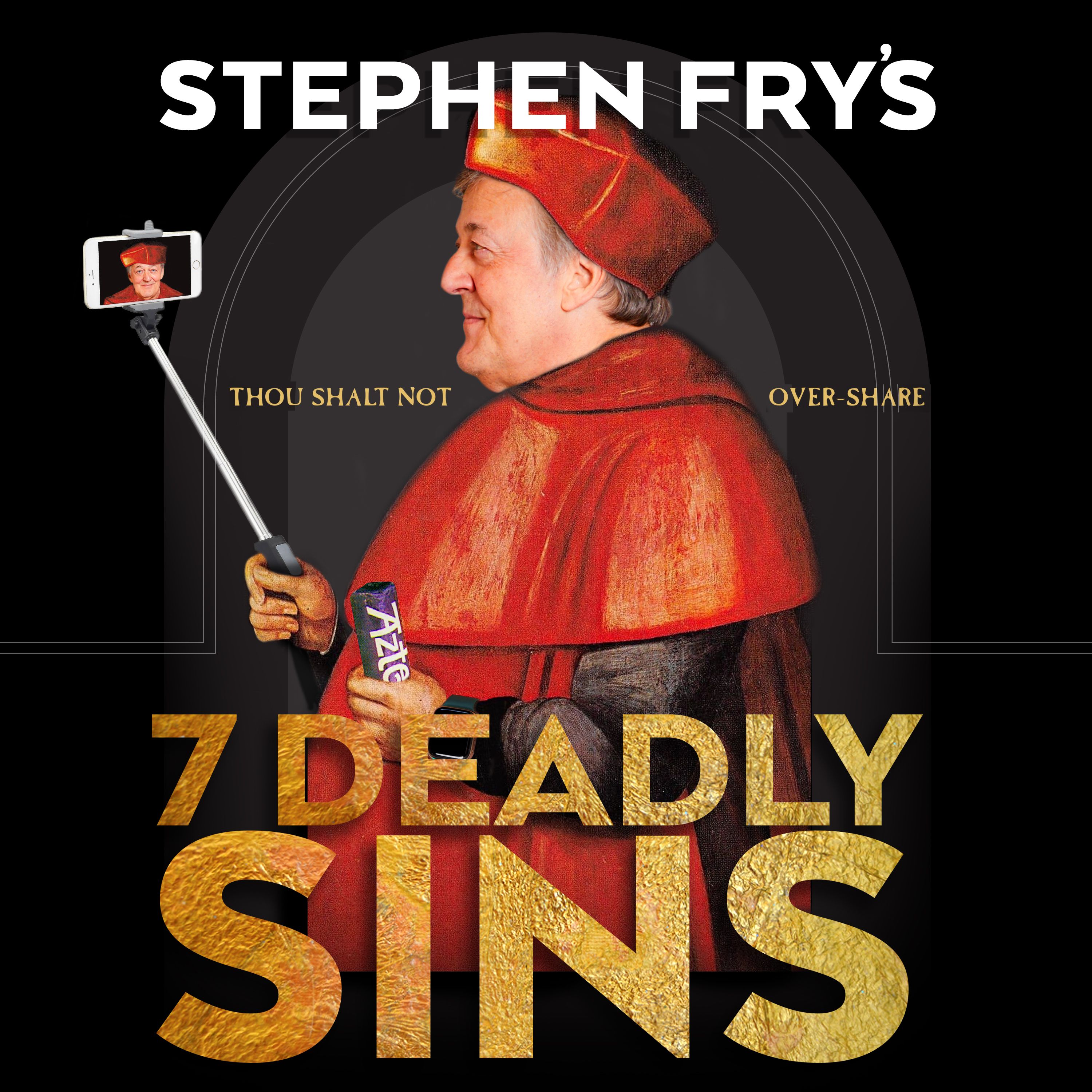
In this introductory episode, Stephen Fry critiques the polarized state of modern discourse, exemplified by the "culture wars," where opposing ideological sides engage in mutual contempt rather than meaningful debate. He suggests the real crisis is not external but internal, rooted in human failings. Instead of assigning blame to politics or social media, Fry advocates for introspection, using the historical framework of the "seven deadly sins" to examine personal morality. He explores how humans judge themselves, contrasting utilitarian ethics (focusing on consequences) with a deontological, innate conscience. Ultimately, Fry argues that despite our differences, all people share a fundamental desire to be happier and better, coupled with a unique sense of moral guilt that defines the human condition. The series aims to turn the focus inward, confessional style, to understand our personal roles in a troubled world.
[Music] This is Stephen Fry's "Seven Deadly Sills." Episode 1. An introduction. Hello, my dears. I don't know how much you listen to podcasts. Maybe this is your first ever, but I listen a lot. I try to go for a longish walk every day, you know, swinging those creaking hips and pointing those sagging, but ever hopeful nipples into the wind in my restless quest for peace, ease, fitness and balm for the soul. In the countryside, bird song and day nature in her ever-changing collection of seasonal frogs are usually enough. But in the notchous burp and bump of the big city, I find all the books and podcasts are the happiest way to eat up the miles and earn the weirdly addictive health app rewards, badges and medals that are on offer these days. And generally, you know, keep myself motivated to stride on without getting bored and mentally restless. Perhaps you're the same, although you will most certainly have perky nipples. It's dispiriting, to me at least, to note how many of the most popular podcasts these days, especially the American ones, it must be observed. Keep picking at the scabs of what are called the "culture wars," you know, and feasting on all the blood and pus that oozes from that terrible wound by the wound of the "culture wars," I mean, of course, the grand canyon, that great fissure that has opened up in public discourse in the politics. And all other aspects of life in the West especially, the seismic crack that grows wider every day. And as it widens, the armies on each side shriek more and more incontinently at their perceived enemies on the other side across the divide, their gestures and insults growing ever-hugeer, cruder and louder. Of course, as the chasm widens and the distance between the two sides increases, and the chance of either group hearing or interpreting the other, even if they wanted to, which they don't, decreases daily. The hatred, the contempt, distrust, fear and abhorrence, each feels for the other is absolutely movable, implacable, visceral, frightening. "I and millions like me do not have a place on either side. You can find us cowering down in the ravine below while the arm is clashed clatter and screech above. And what are these two mighty clashing forces? On the one side arrange the newly energized battalions of the populist right or alt-right or nativist right, for whom what they call political correctness, globalism, internationalism and the ideals of social justice are dragons to be slain by their fearless, taboo-busting, white knights of the cross. They claim to stand for ordinary people tired of the failures, the moral relativism and all the virtue-signalling piety of progressive politics and to champion values that often magically combine Christianity or even Buddhism with anti-state libertarianism. Against them, across this ever-widening fissio, amassed the arm is of a new ideological left, a generation of illiberal liberals, intolerantly fixated on identity politics, semi-schooled in impenetrable academic jargon and prone to gabbling about things like cultural appropriation and the heteronormative patriarchy, in comically sanctumanias and barely-literate babble. Champions and orators on both sides take far more time and derive far more pleasure in riding out to mock the opposition's mouthpieces and spear their sacred cows than they do in making any real effort to explain a credible alternative agenda or present anything like a thought through manifesto, credo or philosophy. It's not about what anyone stands for, so much as what they stand against, not what in livens them, so much as what inrages them, not what inspires their loyalty and trust, but what inflames their hatred and enmity. We're all like that. Aside from anything else, it's so so demotheringly, us paralyzing the easy. Which of us can't savage the dumbest lune from the other side, nail their fallacies and expose their hypocrises? It's the contemporary version of the circus maximus. You know, instead of gladiatorial combat, we have shaming and railing, denouncing and disgracing and the mob screaming for Caesar's imperial thumbs down, which today means Emperor Zuckerberg cutting off their Facebook page or pontifex dorsi, deleting their Twitter ideas. Similar contemporary modes of public execution and banishment. Give us enemies, give us hate weeks, put names to our pain. The liberal elite, it's their fault, white privilege, it's their fault. We don't need to engage with the coherent, decent people across the divide. For the modern world throws up easier targets. We look with gloating relish to the wilder shores of anti-vaxxers, flat earthers, white supremacists, denialists, fundamentalists, history rewriters, de-platformers, deranged gender and race identitarians and statue smashes obsessed by cultural appropriation and misplaced cisgender pronouning. We look to such outlying fanatics to justify our contempt for the entirety of the foe. How much easier to do that? And look at and listen to the more reasonable sane and cogent viewpoints, nuance and complexity. So bloody hard and worse than hard, time consuming and boring. We have machines and devices to wash our clothes and dirty dishes, to calculate and convert measurements, to print and transmit our words. The modern world also gives us automated ways of coming to conclusions. Without the bother and toil of thinking, reading, researching, reflecting, scrutinizing and wondering for ourselves. Heaven knows I'm guilty too. Short cuts and simplifications are as appealing to me as they are to anyone. So you know what? Fuck all this posturing and snarling. Fuck all this fake outrage and real outrage. Fuck all this redacting people from history. Fuck all this year's zero zealotry. Fuck the borish pelting of balls of shit at those in the pillory. Fuck all this second guessing of other people's motives. Fuck all this meanness, malice and mendacity. It's time we understood whose fault it really is. And I am in a happy position to be able to let you know. Absolutely. I have looked at this problem long and hard from every angle. I can now state with confidence certainty that the fault lies entirely with me. It is my fault. Entirely, my fault I am the reason the world is going to hell. The madness and tumult can be laid at my door. I'm not the first to have noticed this. Maybe you've seen a copy somewhere of that poster they used to put up in London tube stations during the Second World War. It's not you that's letting the country down. It's the person standing next to you. They were right of course. GK Cheston once wrote a letter to the Times newspaper along the same lines. Sir, I can finally put your reader's minds to rest. There seems to be a general clamor to know why the country has gone to rack and ruin. I can happily reveal the answer. It is entirely due to me. I am surprised all your readers have not written in with letters of a similar nature. My hat and a candy said, be the change that you wish to see in the world. If it is all my fault, I better explain why. The purpose of these podcasts is not to look outwards and expose all the manufacturers and monstrous ogres stalking our world. It's to look confessionally inwards to the dark, turbulent waters of the human soul. Stephen, seriously, have you any idea of how much of a dick you sound when you talk like that? Yes, yes, yes, I know. Yet you see, well, almost everyone is keen on being right and exposing what is wrong with others, almost no one out there, suggests that there can be anything wrong with themselves. Jesus and I don't agree on all matters. I can't for instance go along with Mr. Christ's idea that to think a crime is as bad as to commit it. When he talked about first taking the great plank of wood out of our own eyes before presuming to criticize the tiny speck in other people, he had a point. So perhaps it might be illuminating, instructive or the very least entertaining to look at something very inward and personal that almost no one ever looks at these days. Usually when we look inwards, we're encouraged to congratulate ourselves on our beautiful.
underappreciated and cruelly misunderstood personalities, but I want to kick away the julin-crusted stone of our shining cells, and reveal the nasty squirming slimy creatures that crawl beneath our sins. "Sins?" "Sins?" "Sins?" "Have you run mad, madder or maddist?" "This is 2019, not 12-19. We have crime, we have error, we have evil intent, and evil actions we have disorders and bad decisions. As you of all people, godless heath and atheist scum that you are, should no better than to use words like sin." "Yes, yes, yes, you'll probably be right again, but let's just remind ourselves how the world is going." "Now, there's an emergency in our political culture and social lives and no measures to put it right aren't working. So, isn't it reasonable to look for answers in places that might have been overlooked? And I think we can agree that there is an emergency. I mean, look at the world. The withdrawal into nationalism and trade wars, the complete loss of faith in national and international institutions and governance, intolerance, shaming, isolation, bullying, hate crimes, nativism, de-platforming on campuses, alienated males, angry females, gender and trans-gender wars, an epidemic of self-harm in the young, a surge in suicide rates around the world, opioid epidemics here, knife crime there, world leaders demonstrating stunning levels of corruption, dishonesty, brutality, hypocrisy, deceit and ignorance. No grace, no authority, no consensus, no common cause. Who will be next to be shamed, silenced, redacted from history? Toxic social media, addictive gaming and unlimited porn, desensitising and corroding the sensibilities of the young, fascism on the march. Free speech has never been so expensive with us or against us. Now, if snow bats, new ones, knowledge and quizzical doubt, shouted down as liberal elitist wank, no time for logic, no time for reason, find your tribe and stay with them. Everyone else, dirty enemy. Oh, and in 20 or 30 years time when you're middle-aged and still trying to repay your student loan, floods, droughts, depleted resources, antibiotic-resistant disease and infection, unbreathable air, poisoned plastic throttle, rising and acidic seas, mass species extinction, on a scale not seen since the great Permium extinction. Our fragile earth crying out in pain. We live in dark and difficult times. Things getting worse, worse, worse and worse than that people getting worse and worse. Corruption, violence, cruelty, abuse, distrust alienation. Cultural commentators, podcasters, essayists and all of us in pubs, homeschools and offices can bang our pint glasses on the bar, stab our fingers, accusing the in every direction and explain why this is. How it is the fault of politicians or corporations or Facebook or someone else somewhere, doubtless a proportion of such explanations holds a germ of truth or a whole packet of germs. But nonetheless, surely there's room for looking not outwards but inwards. The human project is failing. We the humans are failing. Every day we fail by the world's standards but much much more importantly, by our own. And to make it worse, there is no one to turn to. The grown-ups left long ago. There is no locus of authority, not even a fake wizard of ours behind the curtain. There's no referen, no unpun, no judge, no pilot, no teacher in charge, no appropriate adult, no designated driver, no board of directors, no fairy godmother, no prophet, no oracle, no supreme ruler, no Gandalf, no merlin, no dumbledore, no Churchill, no Mandela, no Einstein, no Tribune of the people, no parent, no god, no mummy and no daddy. It's game over, people. Sip the wine and take your pleasure where you made. It's Lord of the Flies. The conscious smashed, piggy is dead, and the allulating tribes in the war painter, all that's left on the island, best hide in the undergrowth, and wait until they've destroyed each other. But one thing hasn't changed. At least in any real measurable, provable way, and that is what we might as well call the human heart. We have always been, as WHO-DN put it, frightened children who have never been happy or good. Or at least we've always driven to be happier and good, usually without satisfactory success. I'm not so much of a one for politics, talking in the conceptual abstract about general masses of people and sweeping economic or social theories, even where the political aims and causes speak less to me than the drama of the individual human soul. Damn, that sounds potentous. Never mind. You're listening to Stephen Fry's seven deadly sins. I'll be back after a short interval. Of course, in our age, sin has been safely medicalised into conditions, syndromes and disorders. Roth is an anger management disorder. Pride and vanity are narcissistic personality disorders. Sloath an attention deficit disorder, gluttony and eating disorder, lust is sex addiction and so on. Now, I hope I'm the last person to doubt the truth and gravity of mental illness. But I can't believe that it's helpful to reduce all human behaviours, instincts and impulses to neurological, hormonal or chemical dysfunction, whether there is such a thing as free will or not, and most thinkers these days have agreed that there isn't. It doesn't follow that we should behave as if we're not to be held accountable for our actions, even if only to ourselves. Should it be that the most reductionist views of humanity are true? We still get fulfilment, satisfaction and dare one say happiness from a sense of agency, responsibility and charge over our own character and behaviour. Well, like most people, I yearn to be better. That's very odd about that. When I say better, I mean it in as many ways I think as it can be meant. I'd like to be happier. Yes, who doesn't? I'd like to feel that I was, what, morally sounder, a better person to know, treating others better, having a better influence and a better effect, feeling better, all of that. I do as don't we all, when trying to drift off to sleep, wonder if I might have behaved better that day? Responded better to circumstances, felt better about myself and made others, feel better about themselves. So at whom are these podcasts aimed? Well, at you, dear listener, now I'm going to have to make the leap of assuming that you are something like me in your inner sense of self. It's a hell of an assumption, I'm aware. Of course, we're likely to be different in all sorts of obvious ways. We have different tastes in music, wallpaper, pornography and pizza toppings I expect, different tastes in people too, different skin colour perhaps, different histories and different standards in all kinds of areas. We quite probably think differently about politics, society, gender, religion and history. But I'm assuming all those differences aside, we might yet share a way of thinking about ourselves that is more important than all those differences. We are all when it comes down to it frightened children who want to be happier and better. We all in one way or another hunger and thirst after righteousness. We have heard and strayed from our ways like lost sheep. We have followed too much the devices and desires of our own hearts. We have left undone those things we ought to have done and we have done those things which we ought not to have done. There is no healthy in us. Now, I'm no expert in the history of philosophy and if you are then forgive me of what I'm going to say sounds simplistic or muddleheaded or even just plain wrong, there have always been, I think, alternative ways of thinking about our goodness or badness. One way is to compare our actions to a list laid down by authority in the form of scripture or law. All that is required there is faith and obedience. Another is to be a little more independent minded and judge for ourselves our conduct perhaps on the basis of its effect on other people. You're probably familiar with the greatest good for the greatest number, that idea, the utilitarian ideal. Do my actions ever hurt others myself included? I might ask myself do they hurt those close to me or society or the wider world as a whole? Thinking this way, we judge ourselves by the effect of what we do and say and how we relate and interact and the effect those relations and interactions have. A commonly used word for this is consequentialism because it comes down not to the intrinsic nature of our actions,
beliefs and behaviour, but to their consequences. It's easy to see the sense in this interpretation and morality and agree that it offers a reasonable and practical guide to behaviour, but there is another way of judging ourselves and our actions that most of us can't deny. However, complete and satisfactory system consequentialism appears to be. Some thinkers, Emmanuel Kant in the 18th century was a leading example, identified an inner law, a sense inborn, it seems, inside ourselves. Not just of right and wrong, but of duty and honour too. Something between a chimney-cricut conscience and an inner voice of compulsion or obligation that guides us or judges us. Philosophers call this a deontic or deontological sense. It needn't be a religious voice, but trials we might, I think it's hard to deny its existence. Two things or me most Kant wrote, the starry sky above me and the moral law within me. Some snort with the Nietzschean division, but most of us hear that famous saying and respond to it with at least some recognition, me too. Whether that's healthy or the result of indoctrination is for our purposes neither he and all there. Many others, besides philosophers, have tried to explain our sense of guilt and sin. If you want to call it that, guilt and shame from the Garden of Eden and other creation myths onwards have caused us to wonder at our uniqueness. Animals don't appear to have it any more than they have anything as weird as a sense of nudity or sexual shame. Just us. It seems to be an identifying part of our human brand of consciousness. Now I'm not here to promote or dismantle religious or Freudian or any other explanations as to why we seem to have this deontological voice, this inbuilt feeling about right and wrong. Maybe it's to do with early infancy and its rewards and punishments, with half-baked Sunday school and other indoctrinations. Maybe it's divine. Maybe it's part of an evolved behavior code that bans us together and reinforces our bonding with like-directed members of our tribe, group and species. Maybe it doesn't exist, but we tell ourselves it ought to, in which case it does exist, for its essence lies precisely in that very sense of ought, of obligation. Anyway, listen, we've all looked at a dog sleeping by the fire, haven't we? And envied them. It's freedom from homework deadlines, student loan repayments, family troubles and Brexit. But above all, dogs seem to us relieved of the curse of not being able to sleep because of feeling guilty about how they behaved that afternoon, how greedy and unreasonable they were, how lustful or lazy. Oh, how we wish we could be as free as that. But we really give up. Movies, music books, travel, discussion, architecture, friendship, getting drunk or high from time to time, Christmas, learning a new technique like knitting, joinery or cryptic crosswords, just so as to have the unclouded conscience and limited horizons of a dog. Yes, I know some will claim that because we can't know for sure what it is to be a dog, everything I've said is just contentious, sir, my's, but be fair, you know it's true. Every culture has a creation myth that tries to explain why it is that we instinctively know that A, we are animals, yet B, we are so radically different from all other species of animal around us. We eat, feed, defecate and breed just like them, but we know that they didn't, as it were, taste the fruit and eat and they didn't suddenly think they were naked and become ashamed. They don't have language, they don't have a sense of sin. This is, this is deep and marshy terrain and I don't want to get bogged down in it. These podcasts won't presume either to align themselves with or take issue with any philosophy, intellectual, spiritual, religious or academic doctrine or practice. I've said all this because to repeat, I'm making an assumption about you, the listener. However different we may be, you and I in background belief or experience, I take it that like me, you do have that inner voice, whether we call it anything as grand as a moral law or not, that you sometimes lie awake, cross it to yourself, wishing you were better than you are, annoyed that you've let yourself down, vowing to improve. Of course other people are total, ass hats, utter tith wheels and unredeemed cock fingers, they don't understand you, they take advantage of you and they fail to see or appreciate you for what you are. All that is is darkness true, but in the silly watches of the night or when ironing, rolling pastry, idling in traffic, weeding the garden or pounding the exercise bike, doesn't the part of you acknowledge that the problem is, is really not them, but us, silly, imperfect us. We are poor shivering creatures striving to be nobler, kinder and better than we are. We are frightened, lost children striving to be happy and good. I'm not qualified to teach anyone how to be happy and good. I've never trusted anyone who claimed they were nor am I qualified to give you a course in self-care, rules for life, mindfulness or what I recently heard, I shit you not, described as "wellfulness". But I am rearing to have a look at the obstacles to our individual happiness and fulfilment and sin, trespass, wrong, transgression, error. All these words describe what you might call obstacles. The other stumbling blocks and impediments to our happiness and fulfilment that come from within. God knows enough shit comes from without. Society is of course screwed, politics is screwed. Many of the young hurt so much that they cut themselves with knives to distract from the pain. Many of the old hurt so much inside they numb themselves with booze and drugs to distract from the pain. There are, as we've seen, no authority figures in any case. The institutions they once ran are no longer trusted or respected, Parliament, Congress, the BBC, the New York Times, the intelligence services, the church, academics, experts, they're not held in any regard at all. But I'm not going to address that. I'm going to travel, as I said, inside into our troubled and confused hearts. And this brings us to the flaws, deficits, traits, traps, obstacles, banana skins that stop us from being happy and good. Traditionally, seven major or cardinal defects have been grouped as the seven deadly sins, the seven deadly banana skins. Anti-religionist as I may be, I actually rather favour the language of sin and demonology in its drama, glamour and apocalyptic power. Over the sometimes ennemic, self-righteous, jargonistic languages of self-help, life-coaching and armchair or indeed office chair, psychology, I think the language of sin speaks much more directly to us. Thinking of each sin as a demon might sound weird, especially coming from someone like me, associated as I may be with rationalism and secular humanism and atheism and so on. But I've always been a believer in drama, ritual, ceremony and story. The medieval picture of, for example, Roth and Lust as creatures, sleeves of the devil himself threatening our peace, such images dramatize and personalize human motives and drives that are still mysterious to us, whatever interpretation of the world we hold, whether we favour medical or scientific interpretations or the discourse of morality or religion or the language of mindfulness, as well to call them a demon, as an impulse or a complex or a neurological misfire. All we can see sin as the dull duck hissing and cracking temptation into our left ear while the angelic Mickey Mouse falsettos virtue into our right. Actually, that's anything more like Michael Jackson, never mind. To personify sins is a rather efficient way in not of managing them necessarily, but of giving shaped dimensions and character to the otherwise wild and unfathomable forces that control us, which might be the first step to managing them. I've done it this. When I was trying to give up smoking years ago, I hit upon this very helpful technique which I'm free to use. I thought of a person who I really despised at the time, let's suppose he was called Barry Bastard. Now I pictured Barry Bastard not in his house in North London, but coiled up like a dragon right inside my stomach. And every time I was weak and had a cigarette, Barry would cheer and gloat and sneaker and scoff at my weakness and susceptibility. I knew he had cave in, he'd say, which was of course unbearable and felt like a kick in the guts. So every day that passed without me smoking saw Barry Wins and Shrink and lose more of his power till in the end he was a weak withered, dried up husk of a dragon that I could pass out of my system with a yell of triumph. Giving more than a name then to one's pain, giving shape-formed, dimension-colour
smell and character, so much more helpful than abstract talk of right and wrong, healthy and morbid, mindful and distracted, good and evil. Anyway, that is my starting point. I am constantly falling down. My moral health isn't as good as it could be. Gastly creatures haunt and hinder me. The upcoming podcasts in the series then will look at these rude and wriggling, seven deadly sins, these banana skins on the path to happiness. According to tradition, the names of the beasts are pride, avarice, lust, envy, gluttony, wrath and sloth. I've changed wrath to anger because it's a more usual word and because it allows me to remember the sins in a traditional order with the happy acronym, Pail Gas, P-A-L-E-G-A-S. I will take each one of the seven in turn, lay them out on the surgical table and poke prod, pry and provoke in an attempt to try to anatomize and understand them. I hope and believe it will be if nothing else, delicious fun and something of a change from the usual run of podcustery. Anyway, that's the plan. If as you listen, you tweet a question, rebuttal or any other kind of constructive comment with the hashtag #7Figure7 DeadlySins or one word, seven DeadlySins, then I will do a special final podcast which takes on your best and most illuminating thoughts and counter arguments. I do hope you'll join me. Bring your sinful self and see you there. You've been listening to Stephen Fry's "7 Deadly Sins." Grateful thanks to our composer, Guy Folly. The show is produced by Andrew Sampson and Norman Goodman. Additional episode information can be found at stevenfry.com/bananaskins. This has been a Sam Fry limited production.
Podcast Summary
Key Points:
The podcast critiques the divisive nature of modern "culture wars," where opposing sides focus on hatred and outrage rather than constructive dialogue.
It argues that instead of blaming external forces (politicians, media, institutions), we should look inward and examine personal failings and sins.
The host introduces the concept of the "seven deadly sins" as a framework for self-reflection, suggesting human flaws are a root cause of societal problems.
It contrasts consequentialist morality (judging actions by outcomes) with deontological ethics (an innate sense of duty/conscience) as ways we judge ourselves.
The episode posits that despite cultural differences, humans universally share a desire to be better and a sense of inner moral conflict absent in other animals.
Summary:
In this introductory episode, Stephen Fry critiques the polarized state of modern discourse, exemplified by the "culture wars," where opposing ideological sides engage in mutual contempt rather than meaningful debate. He suggests the real crisis is not external but internal, rooted in human failings. Instead of assigning blame to politics or social media, Fry advocates for introspection, using the historical framework of the "seven deadly sins" to examine personal morality.
He explores how humans judge themselves, contrasting utilitarian ethics (focusing on consequences) with a deontological, innate conscience. Ultimately, Fry argues that despite our differences, all people share a fundamental desire to be happier and better, coupled with a unique sense of moral guilt that defines the human condition. The series aims to turn the focus inward, confessional style, to understand our personal roles in a troubled world.
FAQs
The podcast explores inward self-reflection and personal responsibility, using the concept of sin to examine human flaws and societal divides, rather than blaming external forces.
He describes it as a widening 'grand canyon' of culture wars, with polarized sides shrieking insults across a divide, leading to hatred and a lack of constructive dialogue.
He humorously claims it is entirely his own fault, but seriously advocates for looking inward at personal failings rather than outward at others, emphasizing self-accountability.
He proposes confessional self-examination, focusing on the 'dark, turbulent waters of the human soul' and personal sins, as a path to understanding and improvement.
One side is the populist right, opposing political correctness and globalism; the other is a new ideological left focused on identity politics. Both are depicted as more invested in mocking opponents than offering solutions.
He argues that despite modern medicalization of behaviors into disorders, the innate human sense of moral law, guilt, and conscience remains a valuable, defining part of our consciousness.
Chat with AI
Loading...
Pro features
Go deeper with this episode
Unlock creator-grade tools that turn any transcript into show notes and subtitle files.
 PodcastTranscript AI