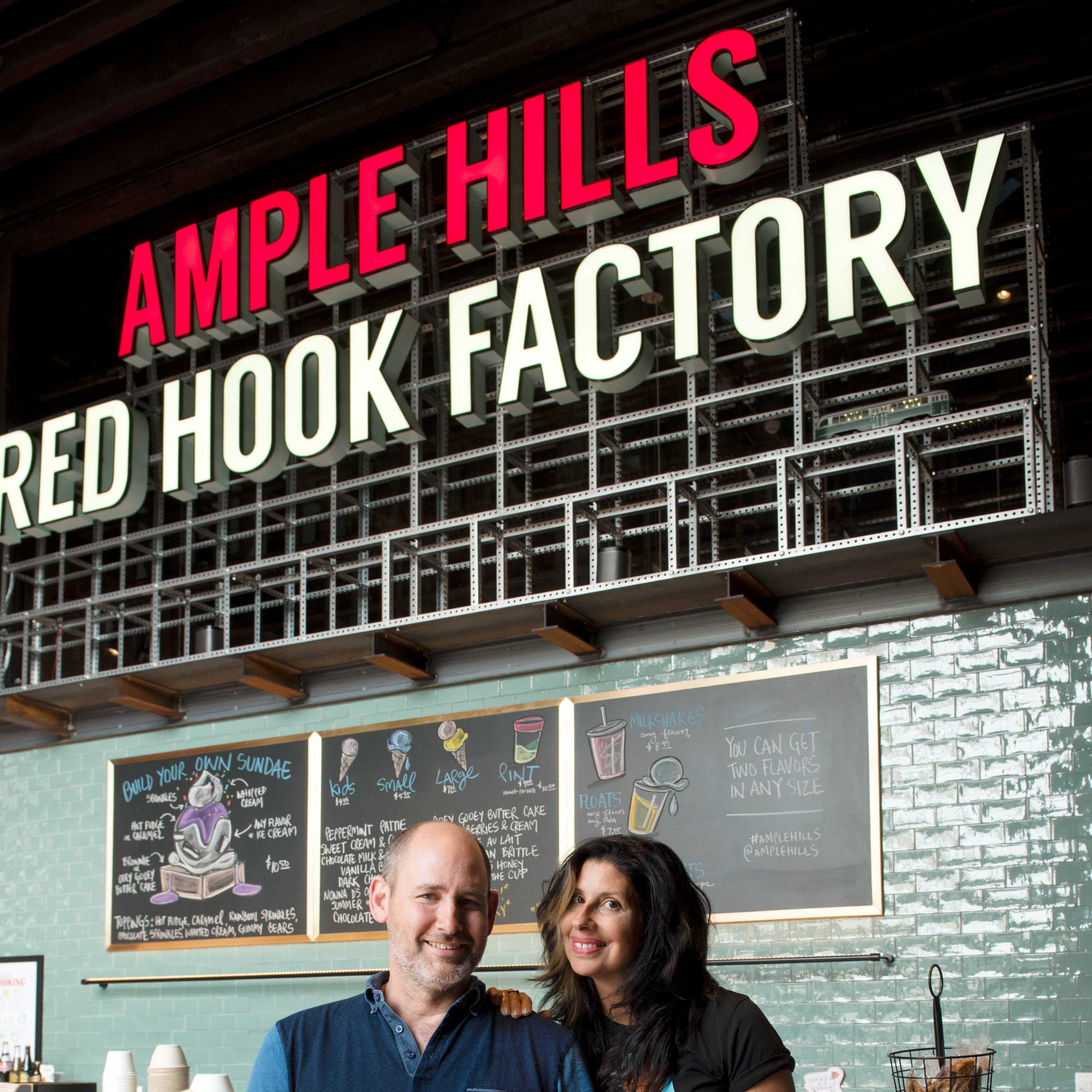
In this podcast episode, Jackie and Brian, former owners of Ample Hills Creamery, recount the beginning of their downfall after opening a factory in July 2018. The shift from manual batch freezing to industrial continuous freezing required recipe adjustments and testing, delaying ice cream production for their shops until fall 2018. Simultaneously, they launched a Mickey Mouse ice cream line for Disney’s 90th birthday and opened a costly flagship shop in Los Angeles. A critical error was investing in custom rectangular pint containers, which required a specialized filling machine that never worked properly, causing 50% of pints to be wasted. Despite multiple fixes, the machine’s failures led to massive financial losses. By June 2019, their finance director warned that the company was burning through cash too quickly to survive the winter. The founders admit they were overconfident, focused on crisis management rather than long-term planning, and lacked proper oversight during this chaotic scaling period. The episode sets up the subsequent struggle to secure funding, which ultimately failed, leading to bankruptcy.
Welcome. We're Jackie and Brian, and this is As the Ice Cream Churns. Together, we found an ample hills creamery, one of the most beloved ice cream brands of the last decade. Then, we lost it all. We filed for bankruptcy a day before New York City shut down to the COVID-19. Now, someone else owns ample hills and we're out of work. But, we're ready to start over. Come join us for an exploration of what went wrong, and more importantly, what comes next. Our guides are close friend Debbie Rosen. She created the cracked cookies in her hit flavor, salted cracked caramel. When she's not baking, she's a therapist. We thought she could help us navigate these troubled waters. Let's get started. Debbie, how are you? Hey, hey, hey, Dapsons. Hi, Bear. Let's go back to the end of July 2018. The factories open. What went wrong? More like what didn't go wrong. Basically, we said we opened in July of 2018. It's kind of a fudge. We had a big opening party. We had all the staff there. We were paying them. We opened the factory in July of 2018. But it didn't make ice cream for any of our shops effectively until really September, maybe even October of 2018. The reason for that is we were transitioning. This is really like inside baseball kind of ice cream making stuff. But the way that we used to make ice cream from the very beginning when I was the one making every scoop of ice cream was with a process called batch freezing. It's a single machine. It's got a barrel and it's got a hopper. You manually pour the ice cream mix into the top of the machine and you wait 10 minutes and the ice cream comes out of another hole in the machine and you stand there and you shake cookie dough or cookies or brown ebits into the ice cream as it comes out. It's a very manual process and it's how we made ice cream up until the moment the factory opened. Then it was a wholly and completely different technological way of making ice cream. It's called continuous freezing. It's the way any of the big boys do it. I mean, Hagen Doss, Ben and Jerry's, every ice cream company that gets to a certain size has to move to this continuous freezer operation because it's the only way to make a lot of ice cream at one time. And it's wildly efficient if you're making a lot of ice cream at one time. But it's also a wholly different way of doing it. So we had to scale our recipes. We had to reformulate flavors. It's not as simple as, well, because we're making 10 times as much ice cream, you just increase the sugar by 10 times or increase the cream by 10 times because the way the machines work and the way that they move through the machines, you had to adjust the recipes. We worried about the quality suffering? Yes. I mean, that was exactly what we were worried about. And that's why we couldn't release the ice cream out to the public until we tested it against the versions that we had still in the freezer from the batch freezer because we were making hay about this factory, right? It was out in the press, you know, and the whole idea was that we'd open this factory to make better ice cream, not worse ice cream or not different ice cream. And so we had to sit there and try it. The other real challenge is that the machines then were feeding all the pieces of the cookie dough or the ui-gui butter cake into the ice cream. So that was a machine that was doing that then. And that machine is a more challenging to get enough ui-gui bits into a pint of ice cream as it can be if you're doing it by hand, right? And so we would do them, we would test them, we would cut open the pints, there wouldn't be enough, we'd throw them away. I mean, we threw away a lot of ice cream. It's a fairly normal process if you're transitioning to have an R&D period and a test period. The problem was we also had 10, 11, 12 shops open at that time. And so we had to keep making ice cream for them. At the same time, we were trying to do this R&D and test and transition phase. So it was really complicated. We had to, you know, we just made a lot of mistakes and had to throw away a lot of ice cream at the same time. At the very same time, we were in the process of launching Mickey Mouse Ice Cream. So I think we mentioned it last episode, but Bob texted me and said, "Hey, it's Mickey's 90th birthday." Well, Mickey's 90th birthday was in November of 2018, just a couple of months after we opened it. So we had to do all this work to lead up to Mickey's 90th birthday. Yeah. And on top of that, we were also in the process of opening a shop in Los Angeles. Oh my god, I forgot about that. 3,000 miles away. Yeah. So that was, yeah, there was a lot to do at the same time. A lot of operational and logistical problems. On top of that, there's also an old adage that, yeah, there's an old adage that goes something like Y. Reinvent the Wheel. And, you know, I think the answer to Y. Reinvent the Wheel is because, you know, there's maybe some hubris involved or maybe because you think you can design a better wheel. We had always loved in the 1930s and 40s and 50s in the United States, and elsewhere, all ice cream was served out of rectangular square shaped pint containers and half-gallon containers. And we just loved the nostalgic feel of those rectangular shaped containers. And also they technically sort of could do something for us, which was they gave us more real estate for illustrations and artwork and more important storytelling because we wanted to do all of this storytelling with each and every pint. We wanted to, especially with the Mickey Mouse, we wanted to do these three panel comic strips. And if we use the three panels of a rectangle, the fourth panel being, you know, ingredients and nutritional facts. And the other three panels could be this artwork. We thought, my God, we've got to reinvent the wheel of the regular Ben and Jerry's pint container, the Hogan Dust pint container, and go to this rectangular pint container. Yeah, and the other part of that, those containers that made them really special were the fact that underneath the lid, you lift up the lid. And there's a little message actually on the lid that told you that there are two spoons under the lid, so you could share it. And because our whole ethos with our shops was about community and sharing and being together and gathering around in this space, how could you gather around the space when you're just getting a pint from a grocery store? And so the whole idea of putting those two spoons under the lid to me and to us really just drove home the idea of community and sharing. And, you know, you could take that pint from, you know, a freezer in a grocery store. And that could be your ample hills. That could be your shop in a pint that you could share with somebody and you had these two spoons in which to do it. It's a brilliant idea. How did it contribute to the problems? I'll talk more about that. Yeah, I mean, just as we're talking about it, I'm like, oh, that really is a good idea. I do like it. And maybe it is worth reinventing. Oh, no. I mean, why was it a problem? Well, so there's a reason why a lot of people said, well, you know, because it's rectangular, you can't get a scooper in there or a spoon because that's why they went to a round thing. I don't that's actually not really the case. I mean, when you've actually go and scoop out of these, the inside of the rectangle was slightly concave. And that never actually posted to be a problem. It wasn't a user issue. The problem is is that when you're in a continuous freezer factory operation, you have to automatically and machine wise fill the pipes. You're not doing them by hand. You're running them off of a pint-filling machine. Well, the entire industry in North America and the world is built around machines that fill round pints. So we knew that going in. So we worked with a company to build a custom machine. Again, a couple hundred thousand dollar investment, which again, the hundred, couple hundred thousand dollar investment in the whole scheme of things and having raised the money that we did wouldn't have been a problem if you're going to launch this new thing out to the marketplace and all your ice cream is going to be in it and it's going to work. The problem was that that machine that we had custom built to fill the pints never worked properly. It became an incredible challenge for them to get the pints to drop into place, to have the ice cream filled to the right line and then have the lids go on and snap into place and go down the assembly line. And so what happens is you get what are in an ice cream parlance are called under fills are over fills where the machine
doesn't fill the pint enough, so it's only like three quarters full, or it fills the pint, it overfills the pint, and then the ice cream's coming out of the side of the lid when the thing closes. Either way you're having to throw those pints away as they come off the line, you can't clean them out, reuse them, or the ice cream is done and destroyed. And so believe it or not, over the course of the next four to five months as we made this Mickey Mouse ice cream, for every one pint that came off of that assembly line that worked, another pint got thrown away. And so we were losing money, hand over fist, just selling those rectangular pints. But we couldn't stop. We couldn't say, "Oh, well, this isn't working, let's not do it." Because we'd already invested the infrastructure and the money in the time, and we had contracts in place to get that ice cream out into the marketplace, and Mickey's 90th birthday was a finite time period. So all of that pressure was on it to just keep going. We had to just keep dealing with those losses at the time. And we made about 10 different fixes to that machine, and none of them worked. Was the goal to have these rectangular pints for all of your ice cream? Yeah, yeah, exactly. I mean, that was the reason that we'd invested so much into it. So one, we'd launched Mickey Mouse that way. That was going to be the trial below, the exciting thing that opened it. And then we were going to launch our own six or seven skews, which we then delayed because we were seeing the problem with Mickey. But then what happened was after about 10 different fixes for the machine, we had to pull the plug. We'd already started the work on these marvel pints. So we launched, we were launching three marvel stories at the same time in the spring of 2019. And all of that work had already been gone into developing the rectangular pints for the marvel. And we had to backtrack, throw all that out the window, and redesign all that for round pints, get rid of the rectangular pint machine. All of that was happening. But you know, at the same time, the labor was ballooning. And I think I've even missed the fact that we were opening that shop in L.A. That's right. Yeah, I mean, we were opening this glorious shop in L.A. that Brian and I fell in love with. This house in Los Feliz, neighborhood that really reminded Brian and I of Brooklyn. And we had toured L.A. with a bunch of different real estate agents. And the place that stuck out for us was the one that felt like a home. And a neighborhood that felt diverse and walkable and very different, I guess, than most of L.A. the ones, the shops we had seen in shopping malls were not nearly as appealing as this craftsman house at the base of the Griffith observatory, which we also had fallen in love with. And so I think we are, our hearts were in it 100%. And our love for it was there. But it basically cost us almost a million dollars to build out this shop. And it was in a residential neighborhood at the end of the day. We love that neighborhood, but it wasn't probably that we led with our hearts and not our minds in terms of where we thought we would open it. At the time, were you questioning at all your choices? You know, I, it felt right. It felt like an incredible space. We, at the time, had the money to build it. And we really didn't know how heavy the lift was going to be to market it and get, you know, people to come to that shop. We had a parking lot. We thought, well, this is what people care about in L.A. It's parking. It had it. We also, I think, maybe, you know, I think we were over confident. I mean, we had opened the second shop, our second shop in Gauannas, which clearly is not heavily foot traffic neighborhood where we opened right on the Gauannas Canal. I mean, it's more so now than it was when we opened. But we built that shop, a huge shop with a, with a high overhead. But with the idea that if we built it, people would come and find us as a destination. And I think we'd had so much success with being in Brooklyn that we thought, hey, if we opened there in Los Angeles, in a house, you know, in a neighborhood that people will find it and they'll just, it'll be the same kind of destination. And I just think. Yeah. I mean, the idea with that space too is that we wanted to create a large enough space that was a flagship in Los Angeles where we could do classes and have birthday parties and have ice cream socials, which is what that that shop allowed us to do. But we didn't do enough research and, you know, put enough, you know, dollars to marketing and understanding, you know, where to open and in how much, you know, that market was going to need to know about who we were. Did you have any people around you that could tell you these things or you could consult with? Not really. Not in that way. I mean, we definitely, I think that everybody felt that going to Los Angeles in general was the right thing to do, even though it was 3,000 miles away, even though it provided operational and logistical problems. It was the first of what would be many outposts in Los Angeles. And there was this idea that we had established on the east coast, you know, this big presence. And now we were going to go to the west coast and do the same thing because we were launching these pints, Mickey Mouse. We had the relationship with Disney. So it seemed right at the time to think about an effort to sort of go national by going to this other giant major media market and opening multiple shops there with this one being the flagship. So I think there was a lot of support with that. I just think that we might have, you know, chose the wrong spot and we went in too big at first. And it was also the timing of it at the same time again that we were transitioning to the factory at the same time we were tackling the Mickey Mouse problem. And so what happened because of all that was that the labor numbers in the factory were just ballooning like crazy. We had had estimates, we had done models and estimates of what it would cost to operate and run the factory. And we had, we just all that sort of went out the window when we started in the factory and we faced all these challenges because at the end of the day, you know, we couldn't not make the ice cream we had to make. We couldn't decide to not have the labor that was ballooning. If you needed the ice cream for the commitments of Mickey Mouse and you needed to ship the ice cream to Los Angeles and you needed to keep feeding all the other 10 shops in the New York Tri-State area. And we also had marble coming and we had to keep doing that because we'd already committed and signed the contract. So we were sort of on it. It felt like a runway train, but it also felt like we were, you know, we were coming then from March. We pulled the plug on Mickey Mouse of 2019. We shifted to the round pints. We redesigned the marble. We had started to get our, you know, sea legs with the factory. We were making great ice cream out of the factory and designing and building that. And then we were all aiming at this June launch of the three marble flavors. We had black Panther, Spider-Man and Captain America. And they were going to go wide. We were going to get them into grocery stores. And so we had the warm weather coming. So we felt good about all that. And where really I think the real beginning of the end happened was that one day at that's in that same month of June as we were gearing up to launch Marvel. Our finance director pulled me aside and said, you know, we need to talk. And he had started doing modeling based on what we had gone through in the winter and the spring of 19. And he just said, we're not going to make it. We're not going to make it through the winter. There's not enough money in the coffers. And we're losing too much money operating the factory. And we have to, we don't have any money. But there's not enough money and we're not going to make it. You know, that was the moment that really, really hurt. And really that really terrified us.
It's-- it sounds terrible. I guess my question is, how did you not know that? [laughs] That's a-- that's a really-- that's a good question. You know, I think that we were in the process. I think for all those, what was it? From September to June. So what is that? Like eight to ten months, uh, of dealing with one crisis after another after-- and when I talk about the ballooning costs, everything was abandoned. You know, we were-- you know, it's like we were on a-- on a sinking ship, you know. And we were trying to band-aid things. And we-- we didn't have eyes on where we were going or the future or how big the waves were or how big the ocean was. I think in retrospect, if we would been 15 yards from the shore and we were band-aging everything, you know, we probably would have been okay. But, you know, when you had to cross the Atlantic, um, and for us the Atlantic was the winter. Because in the winter time, even in the best of times, we're not making money. Because people don't buy that much ice cream in the winter time. And so we had to get through the next winter of 2019 into 2020. We had to have money in the coffers, as it were. And we just-- we just didn't have eyes on it. I mean, there is no excuse. So that's a long-winded answer to your question of how good we not know. We should have known. We obviously should have known. But we, uh, we didn't. And I think next week, uh, next episode will go through, um, you know, the effort from that point on, which was to get more money to save us. Yeah. That's-- that was the beginning of starting to figure out how we could save ample hills. Yeah. Which didn't happen, big secret. But, uh, anyway-- [laughter] --it kind of happened. All right. Well, thanks, Debbie. We'll talk to you soon. Thanks, Debs. Fine. Bye. Bye.
Podcast Summary
Key Points:
Ample Hills Creamery founders Jackie and Brian lost their business after filing for bankruptcy during COVID-19, and now aim to rebuild.
Transitioning from batch freezing to continuous freezing in 2018 caused major production delays, recipe reformulations, and quality control issues.
Custom rectangular pint containers required a special filling machine that malfunctioned, leading to 50% waste and significant financial losses.
Simultaneous challenges included launching Mickey Mouse ice cream for Disney, opening a costly Los Angeles shop, and preparing Marvel flavors.
By June 2019, the finance director revealed the company lacked funds to survive the winter due to ballooning factory labor costs and operational inefficiencies.
The founders admit to being overconfident, underprepared for scaling, and lacking oversight during a period of multiple crises.
Summary:
In this podcast episode, Jackie and Brian, former owners of Ample Hills Creamery, recount the beginning of their downfall after opening a factory in July 2018. The shift from manual batch freezing to industrial continuous freezing required recipe adjustments and testing, delaying ice cream production for their shops until fall 2018. Simultaneously, they launched a Mickey Mouse ice cream line for Disney’s 90th birthday and opened a costly flagship shop in Los Angeles.
A critical error was investing in custom rectangular pint containers, which required a specialized filling machine that never worked properly, causing 50% of pints to be wasted. Despite multiple fixes, the machine’s failures led to massive financial losses. By June 2019, their finance director warned that the company was burning through cash too quickly to survive the winter.
The founders admit they were overconfident, focused on crisis management rather than long-term planning, and lacked proper oversight during this chaotic scaling period. The episode sets up the subsequent struggle to secure funding, which ultimately failed, leading to bankruptcy.
FAQs
The transition from batch freezing to continuous freezing required reformulating recipes and scaling flavors, which led to quality testing and significant ice cream waste.
The machine often underfilled or overfilled pints, resulting in about half of the pints being thrown away, which caused major financial losses.
The launch coincided with the factory transition, requiring simultaneous production for shops, R&D, and a tight deadline for Mickey's 90th birthday, increasing pressure and waste.
The shop cost nearly a million dollars to build in a residential area, lacked sufficient marketing, and was too large for its location, straining resources.
They were focused on handling one crisis after another, like factory issues and product launches, without monitoring long-term financial projections.
The finance director revealed the company wouldn't survive the winter due to high factory operating losses, marking the beginning of efforts to save the business.
Chat with AI
Loading...
Pro features
Go deeper with this episode
Unlock creator-grade tools that turn any transcript into show notes and subtitle files.
 PodcastTranscript AI