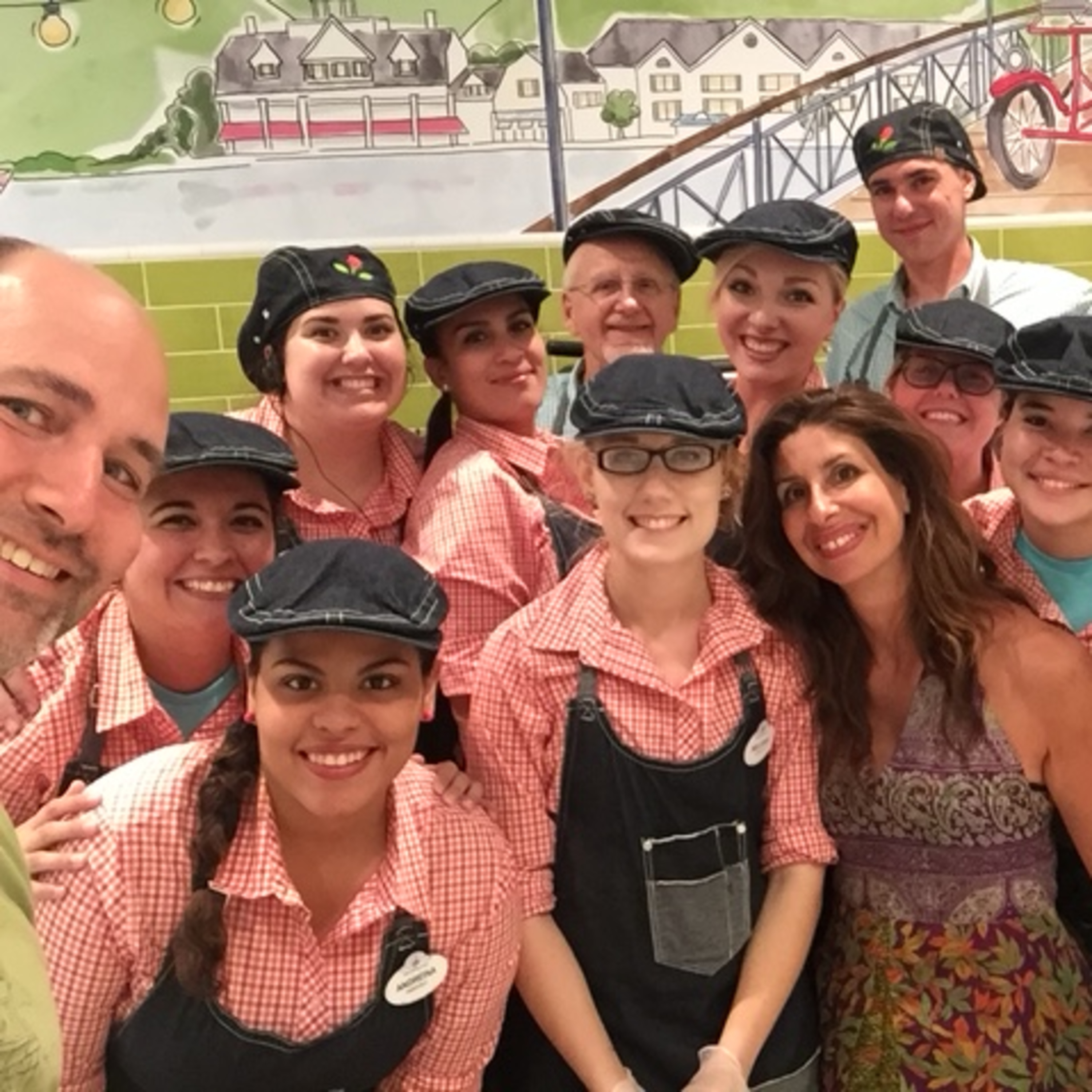
Jackie and Brian, founders of Ample Hills Creamery, recount their journey from success to bankruptcy. After building a beloved ice cream brand, they filed for bankruptcy just before New York City shut down due to COVID-19. Now, someone else owns the company, and they are out of work. In this episode, they discuss how a partnership with Disney set off a chain of events. Disney’s interest led to opening a store at Disney World, which required a larger factory to meet demand. This forced them to raise money for the first time, selling equity in the company. They chose a historic warehouse in Brooklyn’s Red Hook neighborhood, despite higher costs, to create an interactive ice cream museum. The factory took two years to build and cost significantly more than planned. They raised $8-12 million easily, fueled by Disney’s reputation and their vision. However, they lacked experienced advisors to challenge their decisions. The grand opening in June 2018 was a high point, but within 16 months, they declared bankruptcy. The episode ends with them planning to discuss the events that led to their downfall in the next session.
Welcome. We're Jackie and Brian, and this is As the Ice Cream Churns. Together, we found an ample hills creamery, one of the most beloved ice cream brands of the last decade. Then, we lost it all. We filed for bankruptcy a day before New York City shut down to the COVID-19. Now, someone else owns ample hills and we're out of work. But, we're ready to start over. Come join us for an exploration of what went wrong, and more importantly, what comes next. Our guides are close friend Debbie Rosen. She created the cracked cookies in her hit flavor, salted cracked caramel. When she's not baking, she's a therapist. We thought she could help us navigate these troubled waters. Let's get started. Hi there. Hi Deb. Hey, Lai. Hey, so in the last episode you talked about a line between the attention from Disney and the troubles you experienced with the company. Can you tell me more about that? Yeah. I mean, so really, it'd probably be unfair to blame Disney for all the troubles that happened over the coming years. I mean, it'd be nice to blame somebody other than ourselves, but really what I mean is the decisions that we made as a result of all the opportunities that Disney afforded us, the decisions that we made. Certainly, you could draw a straight line from there to all the troubles that we ended up having. But of course, I talk about that straight line. It's not really a line across. It's more of a line straight up the side of a mountain. I mean, to this incredible peak that we were facing. But of course, on the other side of that mountain was a cliff that we fell off of and tumbled down. Before we get to the cliff, why don't you tell more about the climb up? Yes, I think that would be helpful. I think so, really, from that moment that Bob sent that first email, it set a whole bunch of things in motion with the relationship with Disney that led to lots of different opportunities. The first one that was the first real tangible opportunity that came about was opening that store at Disney. That he even mentioned in that very first email, right? Maybe Ample Hills at Disney. So there's a place in Disney and Orlando on the boardwalk. It's a series of hotels around a boardwalk that looks like the Jersey Shore on a lake. They had a space there for us and they wanted to open a shop. So we flew down there. We met with the team. We designed a whole concept for this shop and we worked with them to build out this shop. Of course, to build out a shop at Disney with the projections for the numbers of people and the masses of people that come through any Disney property in Orlando. Also people buy ice cream all year round in Orlando. We knew that we couldn't possibly make that ice cream out of that shop and go on. There was no way we could make enough product and get it down to Orlando. So it precipitated the need to build a larger space, a factory. Of course, we couldn't build a factory with just the sales from the shops that we had. So that precipitated the need to go out and raise money. We really had to for the first time raise money, sell equity in the company and go out and do that in order to finance this growth plan. Up to this point, it had all been self-financed. We'd open shops based on the profits from the previous shops. The shops were profitable. We had gone on a nice, slow and steady path. And this was now the idea was raise money, rocket fuel, build a factory, build a lot more shops and take off because you've got Disney and you've got this Disney opportunity. This is sounds like another spoon in the road, as Jackie says. And I'm wondering at the time, what were you thinking about this big shift? Yeah, I mean, I didn't stop and question whether we should or shouldn't do that. So I mean, it didn't really feel like a spoon or a fork in the road at the time because how unearthed you say no to Disney? And I mean, Bob Eiger. I mean, like it's just that attention and those ideas and those opportunities. And truth be told, I mean, I don't think we should have said no to them. I mean, even now, what I think we should have done is made a few different decisions along the way, sort of after these decisions. But really came down to like getting that factory and the decisions that we made in terms of where to put the factory. I think probably had nothing to do with Disney, but it had to do with ultimately some of the problems that happened. I mean, do you want to talk Jackie a little bit about where we were looking originally? Yeah, I mean, we were looking for obviously we couldn't make ice cream in the Guana's kitchen any longer. So we had, you know, maxed out the space at the Vanderbilt kitchen, which was a very small amount of space. And then we maxed out the production space at the Guana's shop. And so we were looking for something a lot larger. And so the first place that we started to look at was up in Sullivan County, which is about two hours north of New York City. And it was a large space. It was inexpensive, we got pretty far into looking at that space to, I think, the point of design. And then it just felt wrong. We took a drive there a couple of times and it took like two and a half to three hours. And it just felt far. We weren't going to leave our family with here, kids were in school in Brooklyn and New York. And so then we started looking a little closer to the city because we just thought, you know, having a factory in the city was probably not attainable because of the cost. And then we looked at another space in peak skill, which was actually quite beautiful. And a little closer, but still far. And then, you know, then we met Jerry of Ben and Jerry's, right? Yes. And so somebody on our block, strangely enough, just happened to know Jerry had grown up with Jerry. Yeah. And came up to us one day and said, "Hey, you guys own ample hills, right?" And, "Do you guys want to meet Jerry? Jerry Greenfield?" And I'm like, "Yeah." And so he introduced us to Jerry. We went up to Burlington and met him. You know, I go put my hand out to shake Jerry's hand. And he's like, "Come on, come on for a hug." You know, we ice cream people hug it out. And I mean, he was everything you want to hear out to be. It was very generous. So sweet and so warm and just loving and supportive and, you know, just caring. But one of the things that he told us from the very beginning was that the number one marketing decision that Ben and Jerry's ever made in the history of their company, which he credited to Ben, was to open their factory in Burlington and in Vermont and open it to the public and have there be this sort of museum guided tour experience to allow people to come and see the process and touch the ground where Ben and Jerry's was made. I mean, on every pint container, it says Ben and Jerry's, you know, of Vermont, you know, and Vermont's finest. And so it was of a place. And even to this day that Ben and Jerry's is made across seven factories around the world, it's owned by a giant conglomerate, Unilever, people still think of Ben and Jerry's as this company from Vermont. Because the factory's still there and people can still go and touch the ground where ice cream is made. And so for us, it just really hurt that we were abandoning Brooklyn, that we, you know, where we lived. Yeah, I mean, we couldn't really build this story in Sullivan County or in Peakskill. We couldn't, you know, have it be a part of, you know, who we were as a company, as a family, if it wasn't in Brooklyn. Yeah. And around that time, you know, we had a real estate agent who brought us this factory space, this giant warehouse space along the waterfront and Red Hook and Brooklyn. And it was, you know, an 1850s civil war era tobacco and cocoa beans warehouses. I mean, right along the waterfront, the history that the walls could talk. I mean, it just, it just felt so magical and beautiful. And then Red Hook, there's so many makers, you know, there's key line pie makers and there's
distillers and brewers and chocolate makers. And so to be down there felt right. Yeah, we loved, I mean, we'd always loved Red Hook also and could walk there and just a great space. But in terms of how we thought of the space, we really wanted it to be an interactive a museum space. And at the time, did you have any reservations? No, I mean, we had-- I don't think we had any reservations. We felt a sense of relief, a sense of calm, a sense of this is right, like this feels right. It's in Brooklyn. It's in our neighborhood. It's where they're all the time. We're going to be able to offer jobs and livelihood and a factory in Brooklyn. That honestly was just-- it was like, oh, why didn't we try and do the floor? We had reservations about peak skill, about the urban county. Right. And that was it. I mean, we realized this is it. And so we really didn't think twice. We knew it would be more expensive than it was. It cost us-- the rent was twice as much, three times as much, maybe, and the build out costs were certainly more. I think, ultimately, we could have sort of survived that idea of building it in Brooklyn as opposed to Sullivan County. Had we just built less of a factory? I think really it was that how big of a factory we built. Yeah. I mean, we didn't want it to just be a production space. Had we just opened a production space that wasn't beautiful and glorious and viewed to the public that you could kind of interact with the space the way that you can now, it would have been a lot cheaper. It's interesting, because initially you had said that you prepared only for failure. When you first started, and it sounds now the shift was preparing for success. Correct. That's right. That's right, because up until this moment of bringing the factory online, we couldn't keep up. I mean, every step of the way it was always in a battle to keep up. And I think that the idea of building the factory and building it big and building it large like we did. I mean, without the relationship with Disney, we probably eventually would have built a factory. But we probably wouldn't have built a factory as large as we built, right? And so it was because of all of these opportunities, these stars in our eyes, if you will, that we saw, that we thought we can't fail because we have this big mouse behind us. I mean, we have this opportunity for the exposure and for the opportunities to sell. I mean, one of the biggest things was Mickey Mouse. I mean, we had-- I had been sitting on the couch. I remember distinctly sitting on the couch watching TV in late 2017, I think it was. And Bob Iger texted me, and he said, you know, next year is Mickey's 90th birthday. You want to do some Mickey Mouse ice cream? And it's just like, yeah, I want to do Mickey Mouse ice cream. I mean, you don't think maybe that shouldn't-- maybe I shouldn't do that. I mean, it's like the opportunity to work with that property. And I think it's important to stop and mention how we thought of working with a licensed property like Mickey Mouse. I mean, most people that work with licensed properties, you know, a cereal, a Star Wars cereal, or a muppet cereal, they would slap a logo and an image on a box of cereal or a box of jelly beans and call it a day. I mean, we wanted to rethink the way licensed products were. And because of that, that focus in our obsession with interest and storytelling that we've talked about, we wanted to tell these new stories with these old properties, like with Mickey Mouse. And so, you know, we decided on three flavors of ice cream and decided on writing these original Mickey Mouse comic strips that celebrated Mickey through the decades. And so we did one flavor that was set in 1928, sort of the steamboat-willy era of Mickey Mouse. It was all black and white. The artwork was black and white. And one set in the 1950s, 1958. And then one set in 1998 when Mickey's 90. And the artwork changed over the years. And we did these original comic strips that wrapped around the container. And we worked with Disney's artist and our artist. And we did this original work. And so that took time and energy and cost a lot of money. But again, it didn't occur to us that there could be any problem with that. I mean, it was Mickey Mouse and it was Disney and it was great ice cream. But, you know, so those were sort of some of the ways that we thought about it. I mean, do we want to maybe mention a little bit more about how we were thinking about the museum space itself? Well, yeah. I mean, I think part of the reason why we wanted to have the space in Brooklyn and the way that we had originally envisioned our Vanderbilt Avenue shop was this interactive museum-like experience about how ice cream is made. So when we first opened Vanderbilt and we had our tiny little 175-square-foot kitchen, the artist that we had worked with at the time had created these large cutouts of what the insides of the machines looked like and what they did to try and bring education and understanding to what these big metal machines did and make it more user-friendly and understandable, as to how the pasteurizer works and how the batch freezer that makes ice cream works. So we started that way and we continued with that same narrative, that same visual, that same inside experience with the museum and Redhook. So we had-- we're 50% of ice cream factory where we made everything with massive windows onto the factory that explained what the machinery was. And then 50% a bakery because we make 95% of our mix ends from scratch in-house, which is also very different from most other ice cream places. And then we also wanted to have interactive exhibits so that kids could come in, look through the windows, lift up a lever, smell something, turn something, and experience what is behind those glass windows as opposed to just staring in and wondering what's happening. We have this large, we had it, we have it. It's still there. A large interactive map of Brooklyn, a fantastical map. I'd homage to all things Brooklyn over time from Ebott's field to Prospect Park. And I mean, photographs of my grandfather and my relatives in Coney Island up on that exhibit as we are here today. And a trolley car that goes across the kids' control. But I mean, that factory was all leading up to opening day. I mean, the opening day of the factory was June 26th 2018. And so we had raised, God, I don't know, I mean, $8 million, $12 million by the time the factory had come online in order to build out more shops and to build out the factory. The process of building the factory had taken two years. It was supposed to take a year, but it took two years. The architect had been brought up on charges at one point for other jobs, not our jobs, but that delayed it. There were all kinds of infrastructural problems with the building itself. Was it hard to raise the money? How did that happen? I mean, it surprisingly was not hard to raise the money. I mean, we had been told that, you know, it obviously always takes a long time and to wrangle a lot of people and to raise money. But because of the relationship with Disney, and because of the vision that we had painted for all of these opportunities from Star Wars Ice Cream to Mickey Mouse Ice Cream to a shop at Disney to building a factory in Red Hook, I mean, we were able to tell a story to potential investors and they could see the next Ben and Jerry's. I mean, that's what we were sort of pitching. We certainly bought that, drank that Kool-Aid, and it was a great deal.
And it was a relatively easy thing to do at the time, was to raise money because they saw us on that trajectory. And we had people come to us. We ended up turning away investors, because we didn't want to obviously, you don't want to raise more money than you needed in a given time. And so when it came, each of those different raises, the $4 million raise, and the $8 million raise, tapped out, and we had other people trying to get in. And that couldn't invest because we just didn't have room for them. And it was exciting and overwhelming. You have all that money in the bank account, and you think you're invincible. I mean, you can do anything and everything. And I think that in retrospect, we didn't have people around the table. We didn't have investors around the table. We had a lot of wonderful investors, a lot of very friendly people, a lot of real cheerleaders. But we didn't have a lot of people with the kind of food and beverage experience, the kind of brick and mortar experience, the kind of day-to-day operational, logistical experience, to be able to say, yeah, but to the different decisions we were making. And we had a lot of yeses and yeses and yeses out there. And that was as much our fault and the people that we picked to be around us. It was just-- I think that that's the hard part to live with now is to think that we had just a few other people around the table. Yeah, I mean, we were going with our gut, with our instincts, what we felt seemed right from our perspective. Did you feel like you needed that at the time or you're looking at it in retrospect? Oh, God no. I mean, didn't need it at the time. I mean, I don't know. Like, at the time, I just wanted all-- I mean, we wanted the money and we wanted the excitement. We wanted-- we were confident in the vision in the same way that investors were confident in it. And we had all of these things on the horizon. I mean, all of these things. We had food networks saying we were the number one ice cream shop in the country. We had Oprah saying we were her favorite ice cream. And we had a shop that was going to open a Disney. And we had a factory. I mean, it's just-- it's hard to see how that could go wrong. I mean, so I wasn't thinking I needed it then. I'm just saying I certainly think that I needed it then now, which, you know, hindsight is always 2020. I don't know. I mean, that makes it hard. But opening day? Opening day was fabulous. I mean, yeah, CBS this morning came and filmed us. And we had a big, big party in Red Hook. It was-- people were just so enamored with that space. And it was an incredible space. Yeah, it was June 26, 2018. The Mickey Mouse ice cream was going to launch in September or October, just a couple months later. So we were gearing up for that. And you know, I think that was the-- the pinnacle was opening day. Was the idea that was the mountaintop, because everything was coming. And within 16 months of opening day, we declared bankruptcy. Yeah. I mean, it still gives me goosebumps and brings me close to tears. The plans were grand and wonderful. I'd like to dive into what happened to the dream. Yeah. I didn't know what you mean, the dream. What do you mean? What dream? You know, you had the vision. Yeah. You made it a reality. Yeah. And then things took a term for the worse. Yeah. I'd like to talk about the series of events that led to-- I think that's maybe next week. Yeah. Let's do it next week. Let's leave at the top before we follow the cliff. Exactly. Thanks, Deb. OK. It's not too soon. Bye. Thanks, Deb.
Podcast Summary
Key Points:
The founders of Ample Hills Creamery, Jackie and Brian, lost their business after filing for bankruptcy just before the COVID-19 shutdown.
A partnership with Disney led to opportunities like a store at Disney World, but it pushed them to build a large, expensive factory in Brooklyn.
The factory, intended as an interactive museum, cost much more than planned and took two years to complete.
They raised $8-12 million easily due to Disney’s backing and their vision of becoming the next Ben & Jerry’s.
The company lacked experienced advisors in food and beverage operations, leading to poor decisions.
Despite a grand opening in June 2018, they declared bankruptcy within 16 months.
Summary:
Jackie and Brian, founders of Ample Hills Creamery, recount their journey from success to bankruptcy. After building a beloved ice cream brand, they filed for bankruptcy just before New York City shut down due to COVID-19. Now, someone else owns the company, and they are out of work.
In this episode, they discuss how a partnership with Disney set off a chain of events. Disney’s interest led to opening a store at Disney World, which required a larger factory to meet demand. This forced them to raise money for the first time, selling equity in the company.
They chose a historic warehouse in Brooklyn’s Red Hook neighborhood, despite higher costs, to create an interactive ice cream museum. The factory took two years to build and cost significantly more than planned. They raised $8-12 million easily, fueled by Disney’s reputation and their vision.
However, they lacked experienced advisors to challenge their decisions. The grand opening in June 2018 was a high point, but within 16 months, they declared bankruptcy. The episode ends with them planning to discuss the events that led to their downfall in the next session.
FAQs
The hosts are Jackie and Brian, who co-founded Ample Hills Creamery.
The opportunity to open a shop at Disney in Orlando required more production capacity, prompting the need for a larger factory.
They wanted to stay connected to their roots and story, inspired by Jerry Greenfield's advice that a public factory in Vermont was key to Ben & Jerry's success.
Disney opportunities, like Mickey Mouse ice cream, helped them raise money easily and fueled rapid growth, but also led to overexpansion and financial troubles.
It was a major success, with CBS coverage and a big party, marking what they considered the pinnacle of their success.
They lacked experienced food and beverage investors who could challenge their decisions, instead having many cheerleaders who said 'yes.'
Chat with AI
Loading...
Pro features
Go deeper with this episode
Unlock creator-grade tools that turn any transcript into show notes and subtitle files.
 PodcastTranscript AI