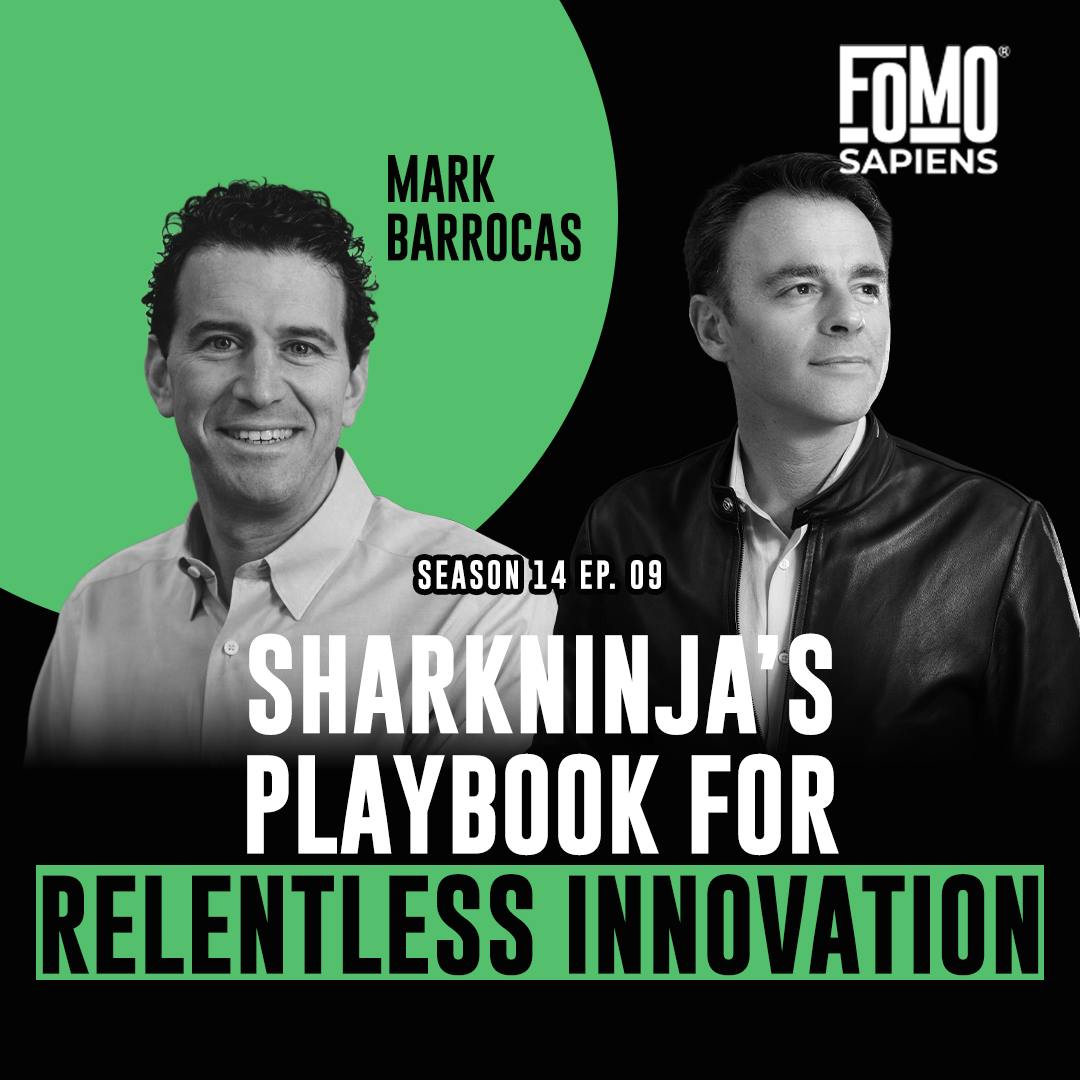
S14 E9 SharkNinja’s Playbook for Relentless Innovation (and FOMO), with Mark Barrocas
42m 13s
Shark Ninja, led by CEO Mark Barocas, emphasizes solving consumer problems through innovative product development. By observing consumer behavior and identifying unmet needs, the company creates products like the Ninja Creamy ice cream maker to cater to dietary restrictions and preferences. Shark Ninja's focus on authentic storytelling and consumer engagement has led to the viral success of products like the Ninja Creamy and LED face mask. The company encourages consumer participation in product customization and sharing on social media, leveraging user-generated content for marketing. Additionally, Shark Ninja considers factors like threshold of acceptability and designs products with elements that make them visually appealing and shareable on social platforms. This approach has enabled Shark Ninja to connect with consumers authentically and drive product success through consumer engagement and storytelling.
Transcription
6721 Words, 36641 Characters
And at the end of the cleaning session, we say,
is there anything you change with your vacuum cleaner?
And they say, no, it works great.
And our observations have to go into, well, hold on a minute.
We saw that you turned over the vacuum,
you ripped the hair off, you almost cut your finger.
And we found that consumers will actually
apologize for the lack of ability of their product.
They just tend to live with and manage
the problems of their existing products.
They're not thinking, you know, could a product
be done that didn't wrap hair?
But that becomes an inspiration for us that we're then able.
It's one thing to be able to identify the problem.
It's another thing to be able to solve the problem.
I'm Patrick Jay McGinnis, and I coined the term FOMO.
That's short for fear of missing out.
And it's why some people end up following the crowd
when they should be blazing a trail of their own.
But if you want to achieve greatness in business and life,
you've got to break free.
Come on, I'll show you how.
This is FOMO sapiens, where we explore
how entrepreneurial thinkers find the inspiration
and the courage to build exceptional lives.
Welcome back to FOMO sapiens, the show for bold thinkers
who want to turn their FOMO into focus.
I'm your host, Patrick Jay McGinnis.
Today, we are joined by Mark Barocas,
the CEO of Shark Ninja,
the company behind household names like Shark Ninja.
Since 2008, Mark has helped transform Shark Ninja
from a small appliance player
into a multi-billion dollar global innovation powerhouse.
And he's also the architect of the company's
outrageously extraordinary culture,
which fuels bold decision-making,
agility, and nonstop product launches.
And by the way, this is one of these,
go in your kitchen or go around your house,
and you're going to see these products.
Maybe you didn't even realize,
but check out your vacuum brand,
check your LED face mask, check your toaster.
I have all three of those.
And you're going to realize
that these are things that you have in your home.
So it's always amazing to talk to leaders of companies
that are literally transforming categories
that we don't think about every day.
Welcome, Mark.
- Thank you so much.
I really appreciate you having me.
- It's my pleasure.
All right, so we have a lot to talk about,
but I want to dive in with a little bit of the background.
Like, how did you end up at Shark Ninja?
And when you got there, what was it like?
- Yeah, what it was like was we were a small company
based just outside of Boston.
You know, we had about 40 people in the office.
So if you wanted to get everyone aligned,
you got everyone in a conference room.
And in 10 minutes kind of the company was aligned.
And, you know, we were,
we only had the Shark brand at the time.
The company was called EuroPro.
And for the most part,
there were two main products that we sold.
One was called the Shark Steam Mop.
You would clean your floors with steam.
And the other one was called the Shark Sweeper.
And we, you know, I joined my best friend at the time,
a gentleman named Mark Rosensweig who founded the company.
And we really kind of repositioned the business
around how do we solve consumer problems
that we can talk more about.
And that was back in 2008.
- Wow, an interesting time to join
because like obviously the world was falling apart.
Financial crisis going on.
I imagine consumers were a little bit, you know,
reluctant to part with their money.
You come in and then ever since then, you know,
obviously the company is much larger now
and offers many more products.
Like you talk about the problem solving culture,
which is like theoretically every business
should start from that first principle.
But, you know, a lot of times you see that they don't.
They're bringing out products that don't find a market
because they're not actually thinking
about like the consumer first.
What does that mean?
Like what does it mean in practice?
Like how do you actually figure out the problem
of the consumer in order to meet it?
- Well, listen, it'd be really easy
if the consumer would just come and knock on our door
and say, this is my problem.
So let's start off with that we see problems
that others don't.
And that needs to come from lots of different places.
I mean, we're scouring consumer data.
We're in consumer homes.
We're looking at things that consumers are doing
outside of their home,
that they're not doing inside of their home.
We're looking at how things are done
in commercial environments like restaurants
or office buildings or things like that.
And we're starting to create hypotheses.
And we're starting to kind of tease out
what might be a consumer problem.
And those consumer problems could be varied
as watching a consumer vacuum,
turning over a vacuum cleaner,
having them take a knife or a scissor,
cut the hair off the brush roll,
pull the hair out, throw it in the garbage.
They continue cleaning.
And at the end of the cleaning session, we say,
is there anything you change with your vacuum cleaner?
And they say, no, it works great.
And our observations have to go into,
well, hold on a minute.
We saw that you, you know, turned over the vacuum,
you ripped the hair off, you know,
you almost cut your finger.
And we found that consumers will actually apologize
for the lack of ability of their product.
I have two dogs, my daughter has long hair.
It always gets caught in the brush roll.
They just tend to live with and manage
the problems of their existing products.
They're not thinking, you know,
could a product be done that didn't wrap hair?
But that becomes an inspiration for us
that we're then able,
it's one thing to be able to identify the problem.
It's another thing to be able to solve the problem.
And today we have 1,300 engineers around the world
that we take a problem like,
why does your vacuum wrap hair around the brush roll?
And we go back to those engineers and say,
hey, can we solve that problem?
Is that something we can do
where the vacuum cleaner no longer wraps hair?
And so it's this ability to be able to tease out
and see problems that others don't,
and then solve problems that others can't.
And as we go through the process,
you ultimately find out that sometimes there's a problem
that you thought was a problem,
and that, you know, by doing a whole lot of consumer testing,
you realize that the consumer didn't really think
it was so big of a problem.
Or you ultimately give it to the engineers
and you realize, hey, that's a really hard problem to solve
or maybe it'll take too much money.
Oh, we don't have the technology to be able to do it.
So it's when these two things come together
where you've got a problem,
and then you've got the technological ability
to be able to solve that problem and to do it
at what we call kind of this three pillar quotient
of Shark Ninja.
We need market leading performance,
we need high quality products,
and we need to deliver them to the consumer
at an extraordinary value.
And when you bring all those pieces together,
you get something that really excites the consumer.
- That's really cool.
You know, I'm thinking about this.
So I got your, you have this toaster
that becomes a toaster oven, which is like,
by the way, it's fun to just show people,
like if you have somebody over the house,
you're like, look at this, boom.
And you can, you take the toaster
and you pivot it down so that it's flat,
and then you can use it to like, you know,
as a toaster oven, right?
And like, so you don't need to have a toaster
and toaster oven.
You can just have the one product.
So like, it's kind of like, it's delightful, by the way.
It's kind of the thing that like,
makes cooking more fun in a sense.
But what's interesting about that,
as I think about it in your context,
is you also have to be able to explain to the customer
why they want to have it.
Tell them the story about how it makes their life better.
And then also do that in a way that isn't overwhelming,
'cause like, how many times do you buy a product
that has all these features that you never use, right?
And so there is like a big part of this.
It's like telling the story
that has to be like baked in from the beginning.
So like, how do you make sure
that the story aligns with the product?
- Well, let's start with, you know,
if your business is about product developing
and your product developing towards a price,
there's not gonna be a really compelling story, okay?
That can tell around the price.
Or if your product developing
because a retailer buyer told you,
there's an opportunity in this category,
that's not really too compelling of a story
to be able to tell the consumer.
Or if you've developed a product based on just your,
you know, idea of something that you've come up with
that doesn't really have any consumer connection to it.
Again, you know, it's really hard to tell that story.
What I think we're doing is we're telling authentic stories
because it genuinely starts with a real problem.
And then there's a journey to solve that problem.
So let's take your example of the toaster oven
that flips down.
We started off and we said, look,
the consumer has limited counter space.
That's a fact, okay?
Now, how does the consumer get the most
out of that counter space?
And so we looked at it and we said,
well, there's a toaster functionality
that delivers great toast to the consumer and does it fast.
But then there's an oven functionality
that does a great job of heating things or cooking things,
but not a great job of toasting.
So what if you can combine something
that does a great job as a toaster,
a great job as an oven, limits the counter space
that it does it on, is either able to work
in the vertical position or the horizontal position,
depending upon when you need it.
And when you don't need it, you just flip it up
and you kind of tuck it away on your countertop
and it doesn't take much space.
There's a story behind that.
There's a journey.
There's a, how did we get to that point?
I mean, why did we develop a product
with all of these different features?
As you start telling that story,
and I'll tell you about your coming,
our history comes from infomercials, right?
Back in 2008, you know,
our advertising was done on 28 minute
and 30 second infomercials.
- Oh my God, it's amazing. - We would go on TV
for 30 minutes and my partner would be on TV
and he would be demonstrating.
And we would literally in advance come up
with the demonstration of those infomercials.
We'd be in his living room or my living room
and we'd put sand on the floor
and we'd look at our vacuum
and we look at a competitor's vacuum
and we'd say, how do we come up with a demonstration
that's able to articulate to the consumer
what the benefits are of the product
and how it's gonna come to life for you and your home?
Fast forward to today,
while that might not be done on a 30 minute infomercial,
it's gotta be done on a 12 second TikTok
or an Instagram post or something on YouTube.
But again, it starts with, do you have a story to tell?
And I think that all of our products have a story to tell
because it comes from an authentic place of
what's the consumer problem to solve?
But then I'd love to say that it starts with a problem
and it ends with that.
It's the meandering journey of what it takes.
We might go through 30 iterations of that product
before we ultimately get to something
that we think is really going to satisfy the end consumer.
- FOMO.
FOMO.
- See, what I love about, there's so much good in this
because I don't care what you're doing for a business.
If you use this mindset of figuring out in a different way,
being innovative, coming up with a product
that solves a problem that actually exists
and then figuring out how to communicate that
and also doing it in a way that is fun
'cause it is fun to take the Toaster Reven and flip it.
I like to show that off to people.
I mean, maybe I should find some other things to talk about
but I enjoy that.
And people smile and they want one for their house.
So you're creating that and it's like,
I think about those infomercials, that's what they did.
I mean, for people who don't remember or weren't around,
there was a time, on a Saturday afternoon,
you would watch this crap for like 20 minutes
and there was a studio audience that would clap.
It was weird but somehow it was like ASMR a little bit
and people would watch this stuff
and then they became like cultural touch points.
Nowadays, as you know, you have to get people straight away.
And one of the things that you have done as a company
and I want to talk about this
is you guys do find ways to make things go viral.
Like I have this LED mask that you guys make
and I posted it on Instagram
and I got tons of people writing me back
either like, does it work or I want one
or that's crazy or whatever.
And so there is something about these products
that is fun and that has some virality.
So talk about, give us an example of like,
one of those products that's been able to go viral
and like why it did and like, how did you actually,
what was your role in driving virality?
- Okay, so Patrick, let me,
you brought up a whole bunch of different topics there
and I want to touch on one of them.
- I know, I tend to do that.
Go ahead, you answer the question that you think is best.
- I want to touch on one of them
because I think it's interesting.
The thing about infomercials is,
when we would launch an infomercial
and I'm going to go back to 2009,
we would launch an infomercial at 10 a.m.
on Saturday morning on USA Network
and it was the first time it was going to come out
and we were going to present this product to a consumer.
And that would run from 10 a.m. to 10 30 a.m.
And Patrick, by 11 a.m. based on the number of calls
that we got for orders, we knew by 11 a.m.
whether that show or that product
was going to be a success or not.
We knew that quickly in terms of the feedback
from the consumer.
So in the DNA of our business is not,
let's go throw a whole bunch of 30 second commercials out
'cause you always get asked the question,
hey, you ran a lot of advertising
but did it really have any impact
or what portion of the advertising had impact?
We came from a place where we had no money.
Okay, that's why we ran infomercials.
I mean, we couldn't run 30 second commercials.
Every time we ran an infomercial,
we needed to generate sales off of that infomercial
to be able to pay for the advertising.
But it built in our DNA this idea of what's the feedback
and what's the response
that we're getting immediately from the consumer?
Are we connecting with them and are they resonating
or are we connecting with them
and they're just flicking the channel to the next channel?
Now on the point you brought up of a viral product
and I'll give you a great example,
we launched a product a number of years ago
called the Ninja Creamy.
It was an at-home ice cream maker.
Okay.
And I will tell you that we developed the product
during COVID, it was in the beginning of COVID
and I remember being in a board meeting
with our board in the middle of COVID
and I was telling them about this great product
that we're developing that's gonna change
the way consumers make ice cream at home.
And there was a board member that was challenging me
and saying we're in the middle of a pandemic,
why aren't you focused on UV or sanitization
or killing viruses or something like that.
And I said to them, because people love ice cream.
Let's start with that.
Okay, doesn't matter where you are, people love ice cream.
And the idea behind Creamy came from,
we started seeing the number of consumers
that were having dietary restrictions,
kids with allergies.
Okay, they couldn't buy store-bought ice cream
because there was a nut allergy
or some other sort of allergy.
People that were lactose intolerant
and they needed to have it made with coconut milk
or oat milk or this whole way of customizing ice cream.
Patrick, at the time, the entire at-home ice cream market
in the United States was $40 million.
Wow.
And I remember a major retailer telling us,
well, if you go into this market
and even if you take 50% of the market,
you're only gonna have a $20 million business.
I mean, why would you even be interested in this?
And the idea was is because we think at Shark Ninja,
we can enlarge the size of the market.
We can get so many more people excited by it
that they'll come in to a market
that they would say to themselves,
"Hey, I didn't think I needed an ice cream maker at home."
But based on what Ninja made,
this can really change the environment for my family.
We went out on social media.
We talked about all the recipes.
We created all of this viral content.
People started getting excited and sharing recipes
about what they could make and what they can do with it.
And about a year into the product,
product was doing well, but a year into the product,
a bunch of consumers on their own just said,
"Hey, what if I didn't take my protein shake
"after I work out and drink it?
"What if I froze it and then I turned it into ice cream?"
And consumers created protein ice cream.
Shark Ninja didn't create protein ice cream.
Consumers created it.
And it started this whole viral trend of
that instead of drinking your smoothie,
you could eat a pint of ice cream,
a pint of ice cream that had 270 calories.
All the ingredients that you know,
'cause you're making it fresh yourself,
it's got 30 or 40 grams of protein in it.
And it kind of started this whole exciting movement
around protein ice cream at home.
But what it shows Patrick is that we're putting products out
and then we're letting consumers hack the product.
Consumers love to hack the product.
And in a world of social media where they can hack the product
and they can make it their own,
they're then willing to go on social media
and show millions of their closest friends
the best recipes that they've done,
the best ideas they've come up with,
the best ways of using the product.
And so they become our ambassadors.
And if I go back to 2009, when we sat and we said,
we're gonna grow our business one five star review at a time.
And there were people that said five star review,
who's gonna write a five star review about your products?
You make steam mops or sweepers.
I mean, no one's gonna write a five star review.
Will you go on social media today?
Or you go on Amazon or walmart.com or target.com
or any of these.
You'll see how many consumers engage with our products
and then really feel compelled to kind of make it their own.
- That's so interesting because you're getting,
I mean, all marketing is FOMO, right?
You're getting the consumer to do the heavy lifting,
but more than that, when the consumer does it,
it's way more credible than any other sort of source
of marketing because it's, you know,
people trust their peers.
I'm curious, like with the LED face mask,
you have placed lights on the front,
which make it look cool on social media.
Do you guys, as you develop products,
do you sort of bake into the design like elements
that make them more fun and exciting to share
in social media channels?
- When we develop a product,
we have three things that we think about.
Okay, the first one is called threshold of acceptability.
Okay, what is a consumer gonna be acceptable with?
Let's take as an example the noise on a vacuum cleaner.
Okay, it can't be above a certain point
that's going to be annoying or irritating,
but it also can't be super quiet
because the consumer's not willing to pay $800, $900,
$1,000, you know, for a super quiet vacuum cleaner.
So there's like inherent challenges.
So you're trying to find this like threshold
of acceptability, okay?
Consumers might not love it,
but they're not gonna hate it and ding you for it.
The next level is threshold of excellence.
Threshold of excellence is something
that's gonna get the consumer really excited.
I used a short vacuum for the first time.
I can't believe what it picked up in the dust cup.
People get excited by seeing the dust cup of their vacuum.
It feels satisfying that they were able to pick up
so much stuff and say, wow, I mean,
I can't believe the old vacuum that I have
didn't pick up, you know, a third, a quarter
of what the shark vacuum is able to do.
Another example of that is I put ice into my ninja blender.
I filled it all to the top
and that thing pulverized the ice into snow, you know,
and that's incredible and I'm excited by it.
That's threshold of excellence.
Somebody's gonna write a review about that.
Over the last four years, a new level has developed
and that's threshold of viral.
And it's thinking about the products through the lens
of if you see it on social media
and in the example that you gave,
when the cryo pads are lit up on your face
and the face mask is working,
we don't want the consumer on social media
just to see a blank plastic mask on the outside.
So we added some LED lights around it
to kind of signify that the product is in use.
Little cues like that that kind of tell the consumer
the product's working.
Okay, it's, you know, there's some feedback element to it
and that all plays into this kind of threshold of viral aspect.
- That's really, by the way,
and it also makes you look less like Michael Myers,
which is good because it would be scary.
What, okay, so I will say what I like about that answer
is you can tell like, this is a CEO answer.
Like a lot of the people we have on our show
are entrepreneurs building companies.
And they have a reason, but they do things for reasons.
They have structure, but you have done a very clean,
you have three reasons you do this,
and they all make sense.
And I think like, just listen, folks,
if you, you know, as you're listening to this like,
this is what I would say is like very effective communication
about like why this business exists
and what you're trying to do.
And we don't hear it enough from CEOs.
So like, I appreciate that because like,
I'll walk away with this and I can tell you,
like the three things that you,
that you're doing when you develop a product,
it's very clear, right?
So that's good stuff and it makes sense to me.
I wanna talk about, obviously,
we've talked about a bunch of successes today,
but not everything's gonna hit.
And I'd love to hear a story from you
about something that just did not,
like just hit the wall and fell on the floor
and like what you learned,
like what went wrong on that occasion?
- Yeah.
Well, let me start by saying, like we're failing every day.
Okay, I mean, we bring 25 new products to market every year
and we're failing every day.
And, you know, that's part of the DNA of the business.
I mean, how do you get something amazing?
You know, ultimately, like you're going to fail.
You're like, you're gonna hit a roadblock.
You know, and the question is, you know,
how do you react to that?
Do you throw the baby out with the bathwater
or do you look for the nuggets that really worked
and then kind of reinvent it and build on it?
I'll give you an example and I'll go back to 2009.
My partner and I at the time
were really excited about our vacuum business.
It was starting to grow and we developed the product
and it was a hand vacuum that fit on a pole
and it was able to clean either your floors
or above the floor.
Prior to that, you either bought a vacuum cleaner
that was designed to clean your floor
or you bought a vacuum cleaner that was a hand vacuum
that had very little suction, very little performance
and that cleaned above your floor
and you kind of went around and did it.
What this did is this hand vacuum
had incredible amounts of suction, okay?
It was a marvel and he and I became absolutely enamored
with this thing and we would pile up on a desk,
you know, a pile of sand or a pile of flour
and we would take this hand vacuum
and just a tiny bit of that sand or flour
would have rendered another hand vacuum useless
because the filter would have immediately gotten clogged
and this thing picked the entire thing up
and we were so excited by it.
And so we went to market with it
and the hand vacuum kind of attached onto this pole
and then the pole allowed you to be able to clean the floor
and you had a floor attachment.
It was called the Shark Multivac.
I'm sure you could probably still find it on social media.
We put the product out and instantly we realized
consumers hated this thing.
It was like an erector set, okay?
It was terrible.
I mean, but we got, you know, clouded by the fact
that the cleaning performance was so great.
There's people that couldn't even hook the thing back on.
It was wobbling and it was falling over, all of these things.
And by the time we realized that this was bad
and we knew instantly that it was bad,
we had made a ton of units of this product
and we were a small company at the time.
We immediately went to all of our retailers
before our retailers even knew that this thing was bad.
And we said, we're gonna discount the price.
We think that the better price for the product
is not $199.
We're gonna sell it for $149.
What we knew was we had to liquidate this thing out
as quickly as possible.
We shut down the production.
We limited it as much as we could.
And we said, okay, this is a major loss
and what do we learn from it?
Not like how do we throw it away and move on,
but what do we learn from it?
A lot of what you've heard from me about TOA and TOE and TOV
comes from your failures.
It comes from where were the blind spots?
Where were you developing a product for you
and not for the consumer?
And so we learned a tremendous amount about that
and it allowed us to become
a much, much better product development company.
We no longer develop group think.
We need to have discerning personalities and conflict.
I mean, one of the big traits of Shark Ninja
is this idea of challenge and be challenged.
We want to challenge, but we also want to make sure
that we're also being challenged
to make sure that we're getting to the right end result.
The end result of that, Patrick, was, as we said,
in most companies, you would say,
never talk about the multivac again, throw it away.
It's gone from our brain,
but there was a nugget of amazingness in it.
And the nugget of amazingness was the ability
to be able to clean above the floors and on the floor.
And a year later, we came out with a product
called the Shark Navigator LiftAway.
Shark Navigator LiftAway.
By 2014, we became the number one vacuum brand
in the United States.
The Shark LiftAway family is still the number one
selling vacuums in the United States, this product.
And all of that came from the biggest failure
that we ever had in our company's history,
the Shark Multivac, but we learned from it.
We found out what was great about it, we perfected it,
and we came out with the LiftAway.
And this goes back to the example I gave you
on the infomercial at 10 o'clock
on Saturday morning on USA Network.
I remember to this day, we put that infomercial out,
and by 11 o'clock, Mark and I knew
we had a home run on our hands.
We had an absolute home run on our hands.
And so there's a great example of how do you,
failure is a temporary condition.
How do you kind of learn from those things
and make sure that as you move forward,
you don't just throw the baby out with the bath water,
but you really try to pick out the nuggets that worked well.
- FOMO.
FOMO.
- What I like about the story is that
you guys moved quickly.
So many people think they can bail the water
out of the Titanic when things aren't going right.
I was on the board of a company once, it was in Turkey.
We were doing a new retail concept.
It was kind of like Mer, it was like Aldi,
but for health and wellness, like hard discount, whatever.
So our founder was a very inflexible guy
who had a lot of success.
We opened this company, we raised 50 million bucks for it.
And what happens is that the consumer
did not understand the concept.
I remember standing outside the damn store,
people would walk up to the store, look in the window,
like look confused and keep walking.
And we knew that, so I went to the board meeting,
I'm like, people don't get this business.
He was like, no, we will just keep going,
they will figure it out, we don't need to change anything.
Of course this company went bankrupt, right?
Now that's a lot of things went wrong in that story,
but the biggest problem was an unwillingness
to trust the consumer as being correct
when things aren't working.
And the idea that you somehow,
the consumer's gonna get smart to your crappy idea,
I won't say the S word, is really arrogant
and that's where the crystal Pepsi's get kept on the shelves
for three years, when they should have been
completely thrown into the dustbin or whatever.
- Patrick, to that point, we use the term in the company,
which is we reserve the right to get smarter.
You made a decision, you had an assumption,
the data proves out that your assumption is wrong.
Pivot, change, I mean, I think kind of holding on
to something is ego-driven, okay, it's not,
on 2009, I wrote a mission statement for the company,
which is positively impacting people's lives every day
and every home around the world.
If you walk into any office of shark ninja around the world,
you will see that as the first thing
right in front of the door,
positively impacting people's lives every day
and every home around the world.
If you stay true to that's your beacon,
when you see things that are not resonating
or not connecting, the answer's very simple, change it.
Evolve it, pivot it, do something.
Because the question is, are you in business for yourself
or are you in business for some higher good?
And that higher good is,
we wanna positively impact people's lives.
If no one's gonna buy our products
and if no one's gonna resonate with those products,
how can we fulfill our mission?
- Yeah, that makes a ton of sense.
All right, so we're gonna move on now to the FOMO4,
which is four quick questions for quick answers.
You ready for this?
- Go ahead.
- All right, these aren't easy though.
Number one, what's the decision you're proud of
that you made fast?
- I would say COVID, in the beginning of COVID,
you know, when everyone shut down
and everyone stopped and everyone hunkered down,
we said, you know, the vision of the business
is product innovation, product innovation.
We'll burn the furniture first
before we're gonna cut product innovation.
And I think our ability to just keep that going
through COVID, had us come out of COVID stronger than ever
and not having to restart.
When you stop product innovation,
it's very hard to get it kickstarted again.
And I think that conviction at that moment
was really the right decision.
- That's a very good answer.
You're fast, it's good.
Like you got that right away.
All right, number two, best advice you've ever received?
- Best advice I ever received was from my grandfather.
I mean, there's no shortcuts.
There's no get rich quick schemes.
You just got to work every day
and you just to build something that is sustainable
and long-term and successful.
And I saw him work into his 70s and he just got up
and he worked every day.
And yeah, I mean, that's what has inspired me.
- That's cool.
All right, number three,
what's your favorite use case for chat GPT?
- Asking chat GPT, what are consumers dislike
about a particular product or a particular category?
- That's great.
That's really good.
And do you feel like it's accurate?
- I really do.
I mean, and I'll give you a little quick example.
We were developing a new technology in air purification.
And we had this hypothesis.
And my hypothesis was that people bought an air purifier,
but within three months, the filter clogged
and you had to go buy another filter.
And what you were really buying when you bought an air purifier
is you were committing to $300 worth of filters
over the course of the next couple of years.
And most of the time, you didn't even know
if the filter was clogged 'cause it didn't tell you.
And so it might be sitting in the corner of your room
and who knows if it's even working or not.
We developed a concept called the shark never change
air purifier.
You never change the air purifier
for the five-year life of the product.
If you go and you chat GPT, what's the number one thing
the consumers dislike about an air purifier, filter changer?
- Oh, that's so cool.
I love it.
That's really smart.
Everybody should be doing this for their businesses,
but that's a really good use case.
Final one.
What's the boldest consumer problem
you still want shark ninja to solve
now that you've solved the filter problem?
- You know, Patrick, I mean, there's so many.
I mean, I think that first off,
I would hope that our best solves are in front of us
and they're not behind us.
I think we're solving bigger and bolder problems.
We're delighting more consumers around the world.
I think we want to earn the right to keep playing the game.
And to keep playing the game, you know,
is about developing more great products,
getting consumers to trust us
when we go into a new category.
We just launched a product called the ninja fireside.
It's an outdoor heater fire pit combination.
- Cool.
- Now you might say, well, ninja,
hold on, the consumer might say,
well, I own a ninja air fryer,
or I own a ninja slushy or a ninja creamy,
but now ninjas come out with an outdoor heater fire pit
that uses propane.
But when the consumer says,
hey, I've had a great experience
with that other ninja product,
I'm willing to try ninja when I'm coming out
into this category that I might not know the brand
in that category,
but it's building that goodwill
so that when we come out with the next problem
that we solve, the consumer's willing to try it.
- Okay.
Everybody look for that fire pit.
What's it called?
- The ninja fireside.
- Okay. Nice. I like that.
Sounds cozy.
All right.
Last question.
For people that want to learn more about you,
connect with you in some way or with Stark Ninja,
where should they go?
- So as of next week,
we're launching a new platform sharkninja.com.
Today, if you would have to go to ninja kitchen,
if you were interested in ninja or shark beauty,
if you were interested in our beauty business
or shark home,
if you're interested in our home business,
for the first time,
we're bringing all of those sites together
and we're launching one platform
that will have all 37 product categories,
the shark ninja cells and all the information
and exciting things about our products.
So that's going to be the destination.
- All right. So everybody go check that out.
It's up now because we're going to run this
a little after a week.
So go check it out.
I have been on your website
and seen that it was split into two.
So as somebody who has perused it,
I'm going to go check that out too
because it is cumbersome.
So bringing it all together under one roof
makes a ton of sense.
Now, everybody, if you liked today's episode,
don't forget to subscribe,
rate and share FOMO sapiens with your friends.
Go check out sharkninja.com.
Check out the stuff,
check out the toaster oven and the, you know,
I'm telling you, people will want to have toast with you.
And I want to thank you so much, Mark,
for being here.
Mark Barokas, a CEO of shark ninja.
A lot of wisdom.
Thanks for being here.
And remember everybody, FOMO is real,
but the power to master it is yours.
- FOMO sapiens is recorded in New York city
and can be found on YouTube at FOMO sapiens
or on your favorite podcast network.
The music is by Mike McGinnis.
Editing and post-production is by Josh Elstrow.
And the show is produced by Matt Curtis and me.
If you liked today's show,
please be sure to rate it and share it with your friends.
And as always, you can find more about the show
and me at FOMO sapiens.com and patrickmcinnis.com.
Podcast Summary
Key Points:
Shark Ninja focuses on identifying and solving consumer problems.
They prioritize authentic storytelling based on real consumer needs.
Shark Ninja encourages consumer engagement and product customization.
The company's success lies in creating viral products by engaging consumers.
They consider factors like threshold of acceptability and design for social media appeal.
Summary:
Shark Ninja, led by CEO Mark Barocas, emphasizes solving consumer problems through innovative product development. By observing consumer behavior and identifying unmet needs, the company creates products like the Ninja Creamy ice cream maker to cater to dietary restrictions and preferences. Shark Ninja's focus on authentic storytelling and consumer engagement has led to the viral success of products like the Ninja Creamy and LED face mask.
The company encourages consumer participation in product customization and sharing on social media, leveraging user-generated content for marketing. Additionally, Shark Ninja considers factors like threshold of acceptability and designs products with elements that make them visually appealing and shareable on social platforms. This approach has enabled Shark Ninja to connect with consumers authentically and drive product success through consumer engagement and storytelling.
FAQs
Consumer problems inspire Shark Ninja's product development process. They identify problems by observing consumers and aim to solve them.
Shark Ninja ensures their products resonate with consumers by telling authentic stories that start with real consumer problems and involve a journey of problem-solving.
One of Shark Ninja's products that went viral is the Ninja Creamy, an at-home ice cream maker. Consumers started creating protein ice cream from it, leading to a viral trend.
Shark Ninja lets consumers hack their products, encouraging them to make products their own. Consumers become ambassadors by sharing their product hacks on social media.
Shark Ninja considers elements that make products fun and exciting to share on social media during product design, like placing lights on the LED face mask for a cool appearance in social media posts.
Chat with AI
Loading...
Pro features
Go deeper with this episode
Unlock creator-grade tools that turn any transcript into show notes and subtitle files.
 PodcastTranscript AI