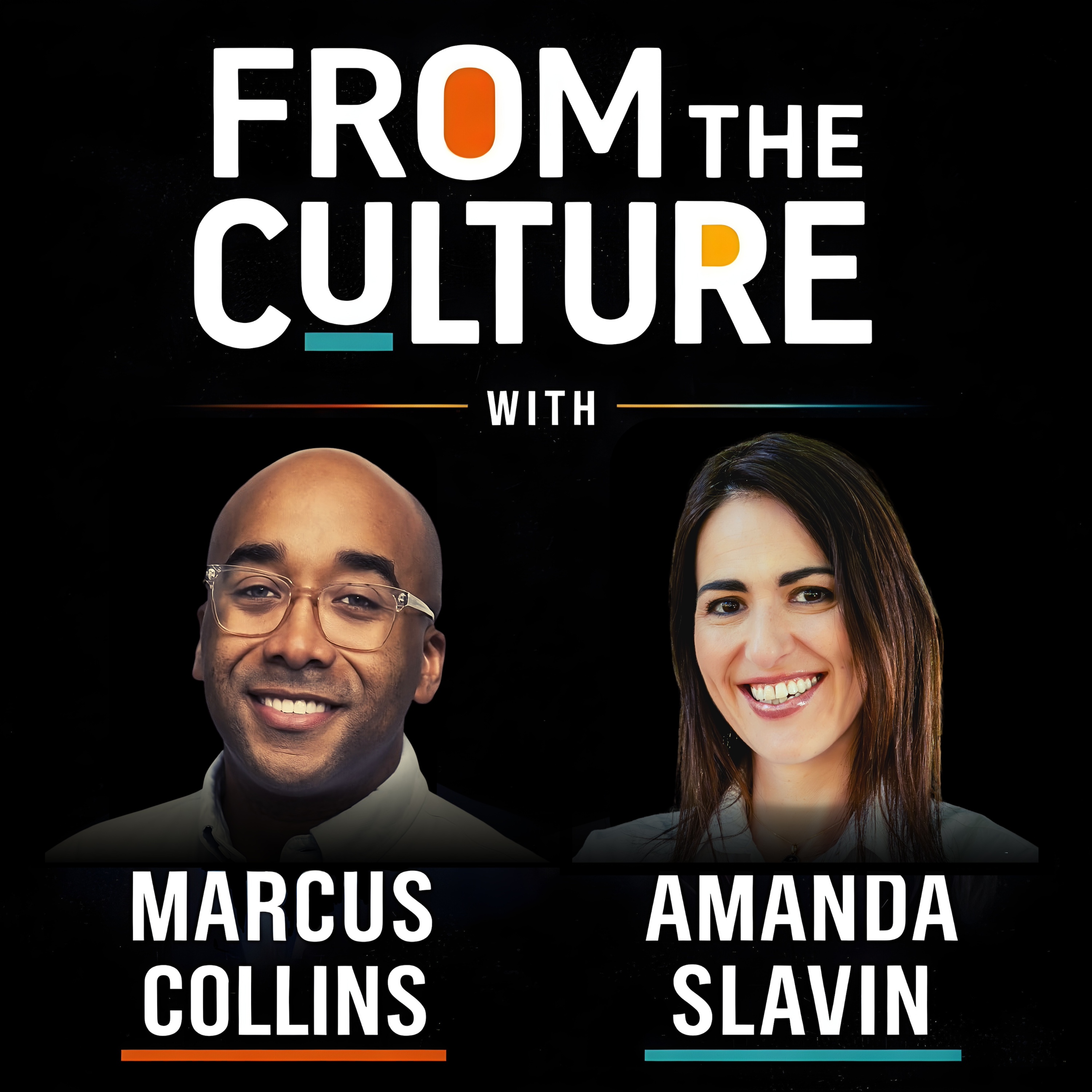
S1, E26 - Vibe Founding and the Irreducible Human Skills
from From The Culture
66m 34s
The conversation explores the volatile reality of being a founder, emphasizing that entrepreneurship is not about freedom but constant pressure to serve teams, clients, and investors. Founders must possess a "professional delusion" to pursue ideas others cannot see, often feeling misunderstood while gaslighting themselves and others into believing in their vision. The discussion critiques the glorification of founders on magazine covers, noting that success often relies on privilege and luck, not just merit. Instead of idolizing a few, the hosts advocate teaching the founder mindset to more people, enabling them to identify problems and execute solutions. The guest, Jim Hornthall, shares his journey from selling donuts and pinball machines in college to teaching evidence-based entrepreneurship. He stresses that startups should not be permanent; they are temporary organizations aiming to find a viable business model. Key to this is "getting out of the building" to interview real customers, as actual insights matter more than business plans. The goal is to reduce the "valley of death" between idea and market, making the entrepreneurial path less harsh and more accessible for all.
Hi, I'm Marcus Collins and I'm Amanda Slaven and this is from the culture a podcast where we study Organizational culture and it's influence on how we bring the backstage to the front stage that allow organizations to flourish today We're talking about the changing nature of the startup industry in the age of AI and how companies are still creating in ways that speak Genuinely to our culture and how these companies can best reflect culture in real time We're excited to get into this a bit with entrepreneur investor and Stanford professor Jim Hornthall So most people think I'm a spy. That's what they think is my job It's just a thing. I think it's because I do as you said It was like the guy in that show. What was the show that you said? Maybe it was Martin What was the show that's like he had no jobs? Oh, yeah, you're Tommy from Martin totally. Yeah I'm like the total opposite of Tommy like I couldn't be more of an opposite because I have all the jobs And I was like, wait, what do you do? How do you do that? What so but the thing that I have mostly closely related to in my career is a founder And it's not actually an operator. It is a founder I almost think of myself sometimes as a surrogate sometimes a doula sometimes the mother like there's a lot of Ways that I interact with businesses projects initiatives, but it always often is through the lens of being a founder and I've taught actually what it means to be a founder the founder Mount mindset at Howard University all about what it means to again be an entrepreneur I've been a visiting partner of antler and I've helped founders I wrote an entire curriculum with HubSpot to support founders for in Belmore. I am passionate about being a founder and I gave a TEDx talk called the three piece a million years ago when I was a Teenie Bobber founder and I talked about how Every person should find a problem that they can solve specifically be able to have their passion connected to that and then be able to Make a profit, but I also said in that talk to not every single person should be a founder that there might be a company that already exists That you could add your passion to add your sense of purpose to solve a problem because maybe that's the way that you can actually make money and a lot of people Even though we had the have great ideas and they have great passion They're not meant to be a founder and there's this great picture. It was an entrepreneur magazine. It was the day in life of a founder We should put in the show notes and it literally is like one of those It's like reminds me of my dexcom my blood sugar tester of like the high in the low like you know like one of those heart rate machines And it's it's like starts at the bottom. It's like my life is terrible and it's the top It's like oh my god today's amazing and then it's the bottom It's like I'm gonna lose all my money and then it's at the top. It's like I got an incredible client And then it's like at the end it's like I think I'll be fine and Being a founder is volatile Everyone thinks oh, I'm gonna have so much freedom. You have no freedom You work for your team you work for your clients you work for your stakeholders in terms of your investors And I think that there are probably no one's I've not done the research But there are probably a lot of similarities between sociopathic founders Because founders need to have this bigger than like vision and believe that they are just like who are they to say that they are the one That are gonna build a 20 billion dollar business for like a messaging app. We're like a 30 dollar business to like Rent a car. I again, it's this unbelievable uncanny ability to convince yourself that you are the person That's going to change the world You got to suspend reality for sure. See used out would say That you got to be a bit of a masochist to be an entrepreneur because you're essentially inviting pain You're going I'm going to go around that no one else has gone by its very nature I'm going to pursue a thing that no one else saw and he would often say That if you have an a sound idea that is logically bet and no one else gets it You're probably on to something which also means that you're spending all your time trying to convince people to see a thing that they inherently do not see And like you I started my career in entrepreneurship, right? I did a startup a music startup But that kind of function has a record label slash production companies slash Partnership marketing thing which was your most creative which was your most creative field you said you had That's my best for sure does I'm a best shout out to Mike Muse my co-founder on that one But you are inviting you're inviting in a level of tension or resistance That is not a Harrent to people who are going a traditional route by its very by its very nature and and therefore it requires a bit of delusion Like professional delusion. You got to be like man. Y'all can't see this. This is right here. How are you missing this? And I think it's so it's like it's kind of like is the idea in the room with us now It was like you know it's it's so it's wait is that a stranger thing saying I thought it was like I thought it was like the underwear. What is it called? It's like the underwear all or whatever the upside down the upside down that actually is kind of what it's like to be a founder like no joke It's the upside down like only you I get I really don't watch ranger things So you're gonna have to go with this Half metaphor, but when you just said it's not just being a massacres It's seeing the problem that and convincing everyone that it's real Which is essentially like gaslighting but really what's end but from what I've always felt like I am on the outside of every Even though I can get along with anyone I can talk to anyone I always feel so misunderstood and that was the best framing that I've ever heard about what it feels like to be a founder Where you see things that no one else sees and then it is your job to convince everyone that it's real Which is essentially just gaslighting I mean I Marketing gaslighting I feel like it's more ex files than it is Stranger things though I do like the idea of that be not for no is living the upside down that like you know When people are going to bed you're just getting going like you know, it's like all these sort of things that are Antithetical to the traditional means but I like ex files as as maybe a stronger Connection because it's some ways like you have to like balance your rational brain And also just saying the saying that I see something doesn't really exist You know, it's like you know molder and scully at constantly negotiating is this thing real like that sort of what you're doing Day in a day out. There's this uh this this tiktok video. I saw of an Olympian Saying that you know there don't be moments where she feels like I can't do this that I suck and she was really Distraught about it and she was telling her coach and her coach goes listen when it comes to being an Olympian you have to You have to exist in a world of threes that your year is broken up into three even Portraits like 33.33% free-twent so like a third of the time you have to feel like really really convinced that you can do this that you can win Another third of the time you're gonna feel like I suck. I can't do this. I'm terrible And then another third time you feel like maybe this is possible. You know, you feel like I'm okay like this is possible Like as long as you are operating within those three different realities across the totality of a year then Your your spot on and I imagine for entrepreneurs. It's probably not that even Like every day. No, it's three every Danny. That's what I say It's it's not because it's vaulted. It's truly exactly what you're saying It's you're constantly at odds with convincing people and then you know what's so this by the way this drives me a little bit bananas about About magazine covers right we put and we've talked a little bit about this before But you put these entrepreneurs and we talked about Elizabeth Holmes as an example a founder who You know lied She's fraudulent. She's she's there's there's some fraud there But when she was at her height she was at every single magazine cover. We were all worshiping her And then we're like she's crazy like how dare she but it's like we worshiped her because she was showing us a new way And then when that way did it work because she lied. She should not have lied We're like you're the worst person alive But we're the ones who are creating that worship mentality and so I also have this problem Where I think we've created the face of the founder and the face of the founder is tends to be a young White dude with a sweatshirt or like one of those they become a VC and then they become like we're a vest And it's like actually maybe we should start to teach the founder mindset to everyone because if we could all look for Problems that other people are not seeing if we can all identify things around us that we can improve Doesn't that actually allow for us to all make the world better instead of just leaning on these few people to then be Contrillionaires living in castles while the rest of us are like why did you make my life so miserable? And now I have to use this terrible Social media app that's making me so dumb while you're living in a castle with no phones. I mean it is totally a harmful Practice that we do you right we consecrate These these founders these leaders and oftentimes ignore all the privilege they've been given to do these things Right we ignore the fact that they were you know There were a nipple baby or that they had trust fund or that their parents were able to put so much money in their original And their original idea the lot of the good off the floor and we say that idea was just so good It's like well, there's a lot of ideas that were really really good that didn't get funding that's no shade on the fact that that then made it right but like to find the problem to but maybe we can think about how to teach that founder mindset to more people so that more people have a chance
to actually not just have a good idea, but execute on those ideas and also be able to solve problems. - I think you're spot on, which is why I think it's such a refreshing conversation we had with Jim, because he sort of poked at some of these longstanding ideals that we have about what it means to be a founder, what it means to be entrepreneur. And in many ways sort of subverted them. Some ways doubled down, but in other ways forces us to see it a bit differently. And you know how we feel here at from the culture? Like that's what we're all about, like seeing these things differently so that we can navigate through the world differently. - Today's guest has spent decades helping founders understand that entrepreneurship isn't just about having a great idea, it's about learning and a navigate uncertainty. Listen deeply and build cultures where innovation can actually thrive. Jim Warranthal is a longtime entrepreneur investor and Stanford educator known for helping shape evidence based entrepreneurship and lean, Lodgepad thinking for generations of founders. His work sets at the intersection of innovation, psychology, leadership and organizational culture, helping entrepreneurs move beyond type and toward building companies people genuinely need. - So let's hear from Jim, then we'll come back and talk about what we took away from the conversation. (upbeat music) - Hello Jim, welcome to From the Culture Board. We are so excited to have you. This is Marcus, this is Jim. - Let me see you. - Okay, so Jim and I met at TED at the patron lounge party thing, I don't know, whatever, a party at the patron party. And I was very tired. Marcus, we were just talking about jet lag before Jim came on, so jet lagged. I only could drink coffee. I think I had like six coffees a day or a espresso martinis. So I may have the bartenders making a special espresso martini and Jim came up and said, "You know, there's a great place to get in the espresso martini." This was like just the way that he, there was no hello. See, this is what works. There's no hello. It was like, do you wanna know where there's a great place to get and espresso martini and San Francisco is Gary Danko? Gary Danko, is that right? Yeah. And then I said, "I am so hungry." I, this was like, I literally had the conversation and I said, "I really wanna steak." And then somehow Jim found a steak restaurant across, literally it was like, there was a bridge. He's like, "I think there's a steak restaurant over there and then brought me to a steak." - That was survival in steak markets 'cause I did not want to be the source of protein. So it was a blower to the flies kind of thing, down a party and I figured I would get this woman something, some nourishment, otherwise, I could lose a leg. - Also, you just like crossing bridges, as we said, from San Francisco to Marin and from the patient party to the steak. So we did talk a lot about your passion and your commitment to changing the way that people think about entrepreneurship and the framework that you designed. So I would love without, you know, going into whole the whole like song and dance about it. Why are you from like really from your heart without because if you don't answer from your heart, I will eat your leg. (laughs) That is the attentionality of this podcast. It's all the time, at all times. I'm very hungry still. Why are you so passionate about entrepreneurship? Like what in you made you so passionate about this topic, this vision, this concept, and how do you even define it? - Okay, wow. There's a quote that hung up my room forever that I think was misattributed to Kennedy was actually George Marrajard, who said, "Most people see things as they are and ask why. I dream things that never were and ask why not." And it was this shitster in me from an early age that always was curious and looking at opportunities to make things different. Goes back to grade school, high school, college, and had a sort of a genetic flaw of entrepreneurship, which comes with the affliction of happy years. Everyone you think is saying yes, when most people are in fact saying no, but politely. So when I went to college, I noticed, for example, that I thought I might be pre-med and realized quickly I wasn't. But my classmates would go to a biochemistry class or some such thing at 7 a.m. a couple days a week. And nothing was open. It was a vast wasteland of cold freezing wet students on a rainy day. So I found a process where I could create the student donut agency and was able to have initially me and then I hired people to sit outside that dreary building with coffee and donuts to sell to these people who are waiting in line. And it made their lives a little less harsh and it made us a little more money. Realizing when donuts are ordered, there's not just students in line, there's faculty, there's administration. We would be getting enormous amounts of bad things for you and hindsight, delivering to lower the age expectancy and lifespan of the whole community. So one bad example, but there was a hole to address there was a need to fill, clearly not repeatable scalable global, but certainly served the local community. - Wait, wait, did you, was that your line a hole to address because of the donut? - Yes, that was a donut life. You picked up the pond, very good, Amanda. - So you lowered the life expectancy, increased the whole of the donut. And then when you were continuing your adventures, you just kept going in terms of fixing problems. - Yeah, I think the one also from college that strikes me is there was not a lot to do in the evenings of the study and studying can be quite dreary. So I was able to get permission to put pinball machines in many of the dorms and then hired some friends to empty the quarters and they were coming in now and then until a game appeared back in the dark days before you were born called Pong. And Pong had to be empty like four times a day 'cause the quarters filled up. And later in life, I actually had the pleasure of being in the same white pill chapter as the person who created Pong and Atari Nolan Bushnell. So when I met Nolan the first time, I said thank you for helping pay for my college education. He had no idea what I was talking about. But without Nolan and Atari and Pong, I probably wouldn't be on the spot yesterday. So thank you Nolan, wherever you are. You're a great person. - First of all, I know Brad Bushnell his son. I saw what he was, do you know Brent? - I have never met him. - He's doing the pleasure. - Well, he's creating an entire, it's amazing to see also generationally what happens when we have this framing and mindset of entrepreneurship and what our kids are watching. And then what our kids realize is possible because he created a two-bit circus, which is this whole, it's like essentially a circus to teach kids STEM skills. And yes, and it was kind of taking on what his dad was doing in a way that was meaningful for him for the next generation. So, I'm interested as you continued on this journey of solving problems and where did it take you? And why were you continuously being passionate about it? Was it like feedback where you were like, "Wow, this is changing a lot of people's lives." Or this is making me a lot of money. You're like, what was the thing that kept having got what was your personality? - I think I was inherently unemployable. So I had to create my own job. In fact, what's interesting, I was looking at some research of the class, I've been teaching at Berkeley for 16 years, the Lean Launchpad. And there was a statistic you can read two ways, which is 40% of our students immediately go on to pursue something entrepreneurial. So, a couple of key points, 60% realized they don't want to be an entrepreneur at least not now. So that was helpful. And at the 40%, I'm not sure that it could just mean they didn't have a job offer that sounds better on your resume to pretend to do something entrepreneurial than say, "I'm unemployed and sitting on the beach." So, I don't know how many of the 40% were truly pursuing an entrepreneurial task, but at least in the surveys they said they were. And I think that the experience trying to understand, working with Steve Blank when we started teaching this course at Stanford and Berkeley, is that a startup is a temporary organization. You shouldn't be a startup forever. And the goal of a startup is to see if you can find a repeatable scalable business model, simple definition. And at the time we were shifting from writing business plans, which we've now successfully given to English departments under creative writing and fiction, 'cause they never happened and they're ridiculous to write and no one reads them anyway, and getting into developing business models. And one of the things that Steve has brought to the game is a wonderful framing about get out of the building, talk to real people. In fact, the AI that mattered then and matters most now is actual interviews. If you think you have an idea for physicians, talk to them. And it might not be the physician, it might be the nurse practitioner, and how is it bought, and who are the buyers, all the different elements that you kind of learn in hindsight, we're trying to build a roadmap in foresight to make this value of death from idea to marketability a little less harsh. If you think about the Boulders, got a little smaller, the Hill got a little shorter, it's still a slog. And so the whole construct of understanding what tools you can provide when Steve and I were working with transitioning from a syllabus to the National Science Foundation ICORP program, we created a company, we founded a company called LaunchBad Central. And the mission then was to create tools for innovators, entrepreneurs to achieve uncommon things. The mission hasn't changed, but the tools sure is hell-haven. And so now with the advent of AI, we kind of killed the old model in the end of 2023, and empowering innovators, creators, scientists, entrepreneurs with tools that are not just a printout from Clawed, a great prompt from Chatsy PT, but an infrastructure of engagement so that I can pull Marcus in with a question, I can ask Amanda something, I can post interviews and have them be read with analysis that would help me avoid the happy years, understand what people are really saying, and plot experiments, which we define as getting out of the building and talking to certain people to acquire certain knowledge,
and improving your pattern recognition skills, 'cause ultimately, pattern recognition is why you're on this podcast today. You saw an opportunity, you moved to do it. But your pattern recognition is limited by your pattern acquisition. What have I done up to this point? What do I know? What do I remember? Who do I know who can help me? And so your knowledge is, limit has historically been limited by some of those factors. When you plug in an LLM that's trained to understand this innovation system, then you're bringing more knowledge to your fingertips. Things you didn't know, things you hadn't read, things you hadn't thought of. So to incorporate the power of an LLM through the lens of the workflow of an entrepreneur, we did some analysis about four years ago and said, okay, so our mantra is, you're gonna do 100 interviews over the next 10 weeks. You're gonna get out of the building, you're gonna talk to people. We're moving from faith-based to evidence-based. You know, you think it's a good idea, prove it, show it work, show it doesn't. And we said, well, everyone's doing 100 interviews. Why isn't everyone equally successful? So in academia, you got an A. In government, you got a grant. In commercial, you ship product. And when we looked deeper at the analysis, what we found is that the people that were successful had two to three times the engagement with their stakeholders. They asked more questions of their manager, of their instructor, of their team, which duh, you wanna pull in pattern recognition skills behind your own. The people who thought they knew all the answers, by the way, they might have, but statistically, they probably didn't were sort of self-limiting themselves. They were walking with a backpack, swimming with weights on their waist. What's interesting is that we've introduced an AI coach and AI co-founder and AI mentored the process. They are engaging five to 10 times more of the AI. So they are getting as much signal integrity, high fidelity awareness, if you will, of different paths, different alternatives, different options, different go-to-markets, looking for different product market fits. All the buzzwords that we've become very accustomed to, flat out didn't exist in 2011, when we were trying to steer the world from business plan writing to business model proving. Phonologist-free, you are inches away from wisdom, making really smart decisions. And the classic line about wisdom is, knowledge is knowing that tomato is a fruit, not a vegetable. And wisdom is not putting it in a fruit salad. So this construct of a real-time signal that allows the driver, the entrepreneur, the founder, to make better decisions that are not always the obvious decisions, to pull in the knowledge from places they have never imagined having access to, at a cost that they can afford, that situation flat out didn't exist. There's a company that posted on LinkedIn the day after the Y-Companator demo day recently, and there was like 100 companies in the Y-Companator demo day. In 24 hours, they replicated every product. And so the answer is, yeah, felt sense, I think, it's the company. That proves you can build a wrong product really quickly. Yes. Congratulations. - And that's what's actually, but that's really, I mean, with the AI slop, and I think now anyone can be an entrepreneur, right? And that's in a good way and a not so good way. So I'm so curious what you've learned through now being able to map the journey of so many successful founders, and maybe not so successful founders. What do founders, and obviously from interviews and asking and understanding stakeholders, they're learning a lot, but what do founders often misunderstand about building something people actually want? - Good question. So let me rewind the tape a little bit. You are familiar with the Human Genome Project, at least by name, you know the concept of deconstructing your genes. And primarily, its mission was what I would refer to as anomaly detection. What is it about my genetic profile that's different? That's causing this condition. And if we understand it, there might be treatments or even cures, and with CRISPR, maybe even redesigning my gene. So the human genome was sort of a really great example of deconstructing incredible complexity, looking for patterns, and then leveraging what you've learned. So company called Pandora applied the same thinking to the music genome project. And their idea was not anomaly detection, but similarity detection. I love that song. Why do I love it? Well, it's got a quarter tonalities and B flat minor. No, I don't have that vocabulary. I just know I love that song. So it's gonna not look for anomalies, but for similarities. The innovation genome is not about anomaly detection. It's not about similarity detection, it's about opportunity detection. And if you reimagine what opportunities look like, there are areas of size reasonable to you, doesn't have to be a unicorn, could be something that just simply feeds your family and puts clothes on your back and takes care of your family and your kids. That's a win. That's the way you do not have to go public. You do not have to go to San Hill Road. You do not have to beg for venture capital to have a repeatable scalable business model. And if you're looking to understand the construct with the analogy of the human genome project, then you're looking for the threads of consistency of product market fit of go-to-market. And there's a business model campus. The Alexander Rostov-Walter created about, I don't know, 20 years ago. And when he first created it, it was a visual representation of customer segments, eye propositions, channels, partners, and so on. And Alexander's initial insight was, let me talk to you as an oil painting would look. Let me tell you how this espresso makes money. They have machines, they have pods, they have channels. And it was a really wonderful visualization layer of the complexity of a business model. When Steve Blight saw that canvas, he said, "Well, wait a minute, it doesn't have to be an oil painting. It could be a slide show that changes every week as you get more information." And it evolves. Thank you, Eric Rees, for giving us and repurposing the word pivot. When I was a young entrepreneur, we called these near-death experiences, pivot sounds so much more survivable. Thank you, Eric. And as you look at these changes over time, you watch things transform, you watch things evolve, you watch the iterations, which is another word for a sort of minor pivot. And as we started to think about this new approach to give people the skills they might need, when I kick off a class, Amanda, we started every year by saying, we're conductors in a symphony of opportunities. And our students' ideas, those are the instruments of change. And so we're trying to make some music together. So if you ever go to an orchestra before they start, they're all like, "Mm, they're tuning up, they're all hitting the same key." We're trying to get the same virtual sheet music, if you will. But like jazz, there will be a lot of improvisation. You will have your own chance. You will transform the piece to reflect you, your market, your product, your knowledge. But the first question in the innovation genome is desirability. Does anyone really care? And so that's the harshest signal to digest. If you've got a handle on desirability, customer segments, value propositions, concept of product market fit, then you look for feasibility. Can we deliver this? The components of feasibility, historically, have been key activities, key resources and partners. The activities and resources are becoming commoditized. The solo pre-nor doesn't need 17 engineers. When Amazon Web Services started to sell pieces of hardware in the cloud, you didn't need drone data center. You didn't need as much hardware engineering. Well, today there's another massive disruption on feasibility. And my perspective is the feasibility for some of these startups, these native AI startups, is going to emphasize much more on the partner side. Where can I be a resource for a partner who has a unique position with a channel, with a customer, with a value proposition? Because if I can vibe coded in three days, millions of people can vibe coded in maybe five days because they're not as smart as I am. But it's single digit days or weeks. It's no longer single digit years of the advantage. So the partnership becomes really important. And the last part is viability. Can we make money? What are the revenue models, current and emerging? And the cost structures, which are shrinking, to allow me to understand this might in fact be ultimately viable. And then the last element is adaptability. Now, what does that mean? There are four fundamental forces that really shake up in compensate. One is just simply changes in competition, both current and emerging. Changes in regulation, both domestic and international. Changes in the environment, physical environment, warming, global warming, political environment, financial environment. But ultimately, it's changes in technology, quantum, robotics, AI. And if you're not moving towards opportunities and away from threats in the adaptability matrix, you might have a brilliant business model that works for about six weeks. Jim, what you have opened up is a can of worms that's got my gears going. You beautifully laid out sort of the landscape for entrepreneurship. And I love this idea about the innovation genome being able to sense where there is opportunity. But this is a mindset that exists in the minds of one or a few that is the startup team. How do you build a company around this? Like how do you build the mindset within an internal team to understand, to see the opportunity? And then move from being a startup to a more sustained organization.
what you said are, which I totally agree, are two different compositions. How do you, how do you, how do you foster that? So it, it, there's a hidden question in your statement and I don't have an answer to it, but it's provocative, which is what do companies look like in the next three to five years? Um, I was at an event with the two Jarrett's, the one who's currently running Y Combinator and the one who's running the Rebel Fund. And they were questioning whether venture capitalists, we know it, will even exist in this form in the next three to five years, because if the age of the solo pranor is upon us, and I wouldn't read solo as strictly one person, they're folks I know experimenting with no employee companies, which is kind of creepy and wild. But the question is, what does it mean that the article New York Times about the guy and his brother, technically not a solo pranor who got over a billion dollars, he'll be one drugs legally online. So I don't know the dynamics of what a company means going forward. You know, when we started and built the online travel agency world, we had 400 travel agents because you still need support behind the data, behind the screen. Um, but more and more of that rougher effort is going to go away. When the internet was just at its dawn and the risk was, well, people ever use a credit card online, I don't think so. Um, that was something we had to overcome. I gave a talk at a travel agent convention. This is pre online booking. It was like imminent. We were working on it. We hadn't yet launched it. And I got to tell you, I, I, there are thousands of travel agents and I felt like a fire hydrant at a convention of dogs that just not going to happen on special 10% commission forever. My customers love me. And over 70% of travel agents are gone. The ones who survived expanded their services got more involved. Um, the number of agencies is down and the number of agents is way down. And that's for especially for leisure travel. So the transformative power of disruptive technologies is known to us in our rear view mirror. And no one has a clear roadmap through the windshield and the turns ahead of what that's going to do. So Marcus, your question investor in a Middle East venture fund and one of the investments that that fund made was in Karim. And at a minimum level, they put thousands of entrepreneurs to work driving what are basically Uber's Uber actually want to find a company and the financial returns were decent. But it was really creating economic opportunity for people that didn't have it. And doing it in ways that made them more stable economically, politically, socially. And it didn't have to become as big as it might become. So you know, the real struggle in Berkeley and very proud of the lists where we have more entrepreneurs on bigger pitch books and so on. Those are great. But practically speaking, if you look in the mirror and see Steve Jobs looking back at you, get another mirror, you are probably not Steve Jobs. You are probably capable of innovation and of success. But too many stories of failures come to mind when people overstretched their opportunity. And Bill Salman, who is a great teacher, Harvard Business School and he actually wrote a case of one of my companies. Bill said that entrepreneurs really don't run out of money. They run out of trust. And when you run out of trust, you're not going to get money. And it could be overstating the reality, having expectations that can't be met. And it's a different perspective of what are my next best moves. You know, hey, I's not going to solve your Rubik's cube for you, but it should tell you the next best move. The trust thing is a good shout because if the idea is to take what's in your mind as the founder or the founding team and inspire that into a group of people who will be working for you in today's current landscape. But they no longer trust you. They no longer buy into the broader idea as well as funders, etc. So trust is sort of the bedrock of that. But question I guess is, do you buy into this idea of there being companies of one, thanks to the AI? Are you bullish on it? Are you bearish on it? Because I think about to your point about the travel industry, you took or you leveraged the intelligence, the understanding the wisdom of these 400 different travel agents to inform the product and then people are able to build on it with the advent of these new technologies. But for new things to come in, does it have to be some knowledge that A doesn't exist and also be able to see things that AI can't see because it hasn't been conceived yet? So someone has to be the navigator. Or the governor of this orchestrated set of talent, both human and AI for sure. But the, so I'll give you three pieces of science fiction that I think come together where AI can be helpful and we're now pushing that edge out a lot further. The first to sort of this Vulcan mind melt where you and the AI make you smarter. I think to me, AI is actually augmented intelligence. If you don't want 15 to 20 IQ points, get off the phone and go pick flowers because that's not a bad thing to do, but it's not going to make your initiative more successful, more sustainable. So if you are looking at this Vulcan mind melt, I'm smarter now. My team is more capable. However, larger small my team might be. The next thing is sort of this this borg like idea where the AI is part of what you do. You have ingested cloud code. You're working with co work. You're getting more done faster. You've got a virtual chief of staff. I've got one managing my inbox and helping me figure out, you know, things to follow up on and not I still miss some things, but I miss fewer things now that I think I used to. And how we breathe with this new technology. And the third is from Harry Potter, the sorting hat. And let me tell you where I think AI is at the edge of making some huge breakthroughs. Now give you sort of an analogy metaphorically within a educational institution. There are a lot of really bright people. And it's unlikely that even people on the same floor know what everyone's working on. How could they let alone the same building, let alone the same campus. But imagine if you could enhance and enrich with enough fidelity, each separate opportunity. Unlike the sorting hat, you could say, oh, this person should talk to that person because they actually fill in missing pieces in each other's puzzle. But they're unaware of that. How could they know? And then at a higher level say collections like like if I wanted to put certain things together, what would they be and what would they give them to get beat? Because a synergy is when I give you something and I get something back, right? Otherwise it's a vendor supplier relationship, nothing wrong with that. And just because you're using AWS doesn't make them a partner, it makes them a supplier. And one example is we have a principal investigator at UC Irvine doing some really great work. And it turns out that they really need to talk to someone at University of Oklahoma in Norman, Oklahoma. And it's an unlikely, it's peanut butter and chocolate. Like who thought of putting them together and when you do, it's like, wait, that's a whole different thing. So where AI lets us get really good at pattern recognition and scale is if it's just five or six people and you spend enough time together, you kind of know who knows what and you fill it in. But if you multiply that by two or three orders of magnitude, it's impossible for the human mind to compute what the possibilities could be. Yeah, I love the science fiction, fiction reference because it makes me think about like that those are the possibilities. But if I'm starting a company right now and I have people who are working for me, I'm getting to buy into the conception of reality that are the option that the opportunities they got ahead of us as a company. But I'm currently also building an AI team that's a mind meld or board members to help me improve the company. Am I inherently eroding the trust between me and the people that have employed right now, knowing that the ideal scenario is to offer up them? I don't know how to answer that. It's a great question. Because Sam Altman was asked recently by a young man, you know, what should I do with my career? What should I do with my life? And Sam basically said, well, I would have said coding, but I'm not going to say that anymore because coding is not unlocking the opportunities, but what Sam said was, be resilient, be adaptable, thrive and rapidly changing conditions, generate ideas. And so that timeframe happens to be a semester. It happens to be the academic lane I've been in for a while. My wife's fond of saying, you know, having your knees bent is one way of thinking about the resiliency. If you've ever snow-skied and you have a hill with mogul, you know, you're going to have a lot of fun. And I'm going to say, well, I'm going to have a lot of fun with my life. I'm going to have a lot of fun with my life. And so that's the resiliency. If you've ever snow-skied and you have a hill with moguls and you don't bend your knees, you will not make it down that hill. And so the construct of the flexibility, adaptability within the unknown changes. And, you know, if the engineer is a back end engineer, not a full stack, they're going to be less productive. One of the teams at Berkeley that was developing some technology to manage the tokens, the costs of AI, which are not trivial. You know, the rule of
The fun is if you're a half million dollar top-end engineer or the major company and you're not spending a quarter of million dollars on tokens, you're not living up to your opportunities. So you really should amplify and turbocharge your technical skills with what's out there. Doesn't mean you're not great, doesn't mean you're gonna lose your job. And it doesn't mean you're wasting tokens to create a metric that is nonsense. But it is a constant challenge of how do we reinvent ourselves to contribute to this dynamic ecosystem. I think Gandhi was famous for saying, there go my people and I must follow them for I and their leader. And so the market is moving. And if you want to be a leader in this market, you don't have to know everything even where it's going. But to be able to synthesize through your own lens, through your own experience, through your own knowledge, where you think the pain is. Is it coffee and donuts at 7 a.m. for students taking a course? Is it something more dramatic? Doesn't have to be. So we all know what vibe coding means, right? And this podcast, we're at the age of vibe founding. And vibe founding is bringing a bunch of different ideas. And quickly mapping of your many ideas, which are the one or two that might have the most resiliency, opportunity, lower investment relative to market size, whatever metrics kind of drive you. And then if AI can do all this synthesis to your question market, what are the irreducible human skills that we have to develop? And for academia, how do we think about our students? We, most schools are preparing their students to graduate in 2026 for the job market of 2021, which is kind of a misfit. And so how do we make ourselves, as contributors, more successful? How do we make our projects more successful? If you adopt this vibe founding construct, I don't have answers. Those are the questions that I'm wrestling with about it. What can I do with the tools we create, with the support we give? We trained in the onset of the Lean Launchpad I-Core, we trained over 400 instructors. We trained the trainers to take this curriculum in 90 countries and 100 universities and 25,000 teams went through some form of pre-AI process to think about business models and customer segments and getting out of the building and doing interviews and doing evidence-based innovation. But that is rapidly fading in our rear-view mirror that got us to this inflection point. And my own sense is when the original Lean Launchpad died at the birth of GPT 3.5, fall of 2023, we shredded our syllabus. We said, okay, we have to move how we think about this and academic commercial government and nonprofit worlds with the tools of tomorrow, not the tools of yesterday. - By the way, speaking of when you said, the rear-view mirror and the uncertain future, right now we are in uncertainty and it's happening rapidly. Like the future is here at this moment, at this moment, at this moment. So what separates, because this podcast is not just for founders, but it's really for teams, people working with people, or just themselves as a founder of one, but what separates the people who navigate uncertainty, change, transformation at a very, which is really the entrepreneur mindset, right? Being able to just be so comfortable with that. What, how can we teach people in corporate environments and big environments, people working with other people? What are some skills like really tangible skills that you have seen that other people can actually learn in order to be able to be comfortable with uncertainty and ambiguity, saying I'm fine. (laughs) So I think that's a great question. The enhancing and enriching of a signal, like the human genome did for anomaly detection, like the music genome did for similarity detection, like the innovation genome has to do for opportunity detection. There's actually two things to enhance and enrich. One is the idea, and what does it do, how do you think about its desirability, feasibility, viability, adaptability? And then the underlying thing is the team. And let me tell you if I could prescribe the least dangerous path towards the reasonable effort of success however you define it, it starts with problem curation. What is the problem? However, bigger small it might be, it's, you know, donuts and coffee at seven a.m., that was the problem. And when you know the problem, then you do resource identification. What do I need to deliver the problem? In my case, I had to find a baker who would deliver donuts before seven a.m., I had to find a way to make a lot of coffee at the time of the wasn't a lot of coffee to be made. But really, then the third step is team formation. And we always start with team formation being the first step. It's unlikely that the founding team is the right team in its entire team, because you have incurated the problem well enough. So the best example I'll give you. So this is with full credits of a note, Kosovo and the work at Kleiner Perkins, where problem curation was the issue. So if you take yourself back in time, it's 1996. And the network graph where you look at nodes and edges and opportunities, there's just huge negative space, like something missing. And no one was gonna vote against what the notes saw was missing with fiber optics. He said, "You know what, we're at the dawn "of what could be a one gigabit ethernet, "that changes everything." So with problem curation, they defined and prioritized what it would take to deliver to create one gigabit ethernet. Then they did resource identification, finding the tools, the expertise necessary. And then they did the team formation around that. Initially, the node was the CEO, as he's pulling these pieces together. And the fourth step is engagement optimization. Who should my board be, my advisors that could, again, bounce back and pull in their pattern skills? And in two and a half years, they sold Sarant to Cisco, because it gave them three years of development in a transaction, $7.2 billion. They sold CR of six months later to Redback for $4.3 billion. And the fact that their $8 million investment became $2 billion, 250 times return, was not the primary reason for the story. It's enabled the entire portfolio, the entire venture world, the rising tide of gigabit ethernet. So if you start with problem curation and own it, you know, what do nurse practitioners need in pediatric medicine that they don't have? Is that a problem that you're passionate about? Can you dig in, can you final what that is? Once you find it, what are the resources I need to address the problem? And then start building the team that either understands, does our ability understand feasibility, understands viability so you are smarter? - Well, so the one thing that we haven't talked a lot about is culture, because as you identify the problem, tighten up the problem, and therefore you get the right people to address the problem and the right board to help guide the problem, the problem addressing, probably to say it, how do you ensure that the people with the right skills have the right operating system so that they're operating at the highest fidelity possible? What role does culture plan on? - Yes, that's a great question. Well, let me re-frame it. What are the elements of culture that sustain and survive? And I would say that teaching a lot of really talented students in Stanford and Berkeley, who are used to getting A's, and are used to being right and are used to studying, the path of entrepreneurship is being wrong. And if you look at the National Science Foundation, super smart men and women, top of their fields getting grants to push science, and they start with the business model canvas before we had AI, they would have guesses, they'd have ideas of what the customers were, they would have ideas of what the value prep positions were. And so I'll ask the question Amanda Marcus, how many times were they wrong, divided by the number of times they were right? What was their invalidation, their invalidation ratio, would you guess? - Twice, four times. - It's greater than that. - Six times. - Yeah, eight times, eight times. Eight times. So in fact, part of the path to building something that might work is being wrong a lot, and not taking it personally, but having the resiliency, you know, we look at the four factors that make team successful back to your question on culture and Marcus, intense level of curiosity. Like if you could measure it on a scale, it would be off the fricking charts, right? Students always, you're always trying to learn more, confidence without attitude, that it was to work about that. And the second is a balance between tenacity and resiliency, holding on, but not to look. And that's an art form, that's, you learn, you don't get to become a great figure skater without falling in the ice, an awful lot. And the fourth is diversity. And diversity in every axis you can imagine. And the reason the worst team I ever had an experience teaching was four male Indian engineers that all went to IIT before they got to Berkeley. And it wasn't they weren't individually brilliant. They were ridiculously brilliant, but they could only see problems formatted in one way. They couldn't understand a different perspective versus having a poet working with an engineer. We, the best teams we have, Marcus Amanda, our engineers, MBAs and engineers.
engineers. And the reason we bring them together is MBAs can sell things that cannot be built. And engineers can build things that no one wants to buy. So by putting them together, we have a chance that maybe what you want to build is less important than what people want you to build back to problem curation. So many people come to the market saying, I want to do this. Okay, maybe it's exactly right. Maybe there are no pittits in your future. It has never happened before, but you could be the first person. Think about all the successful companies you're looking at today. They are not doing today what they started doing when they started. All right. Part of it was the culture, Marcus. They were embedded to look for the next quarter, the next period, the next effort. And their vision on adaptability to changes in regulation, changes in the environment, changes in competition, changes in technology. They were blind to that. They were four-mile Indian engineers from IIT that only saw things one way. It kept improving on the state of the art as it was known and as it was likely to become. So if you want to dream things that never were and ask why not, you've got to have some disruptive dreams. And you'll be wrong eight times more than you'll be right. And it's hard to view those failures as a path towards potential success. That's their business model. It doesn't necessarily have to be your business model. So that's kind of where we are. I love this. Jim, thank you so much. This is the future of entrepreneurship. And this is so well said. Thank you so much. And innovation, the future of innovation, the future of entrepreneurship. I didn't eat your leg. Thank you so much, Jim. Next time over espresso martinis. And we're so grateful for you. Thank you so much for being here. Thanks for the time, guys. Appreciate you so much. Donuts on a cold and rainy day. You know, it's always about seeing the problem before, before anyone else does. Or I guess again, I think sometimes too, again, what's amazing is that another person who maybe doesn't think like naturally, think like that. Like that's really the opportunity to, to, as Jim is teaching. And he's a teacher teaching this thinking of, of being innovative, of identifying problems, of coming up with creative solutions, you know, that it is such an opportunity for more people, maybe not to sell donuts to a bunch of people in the rain, but to look at how they can improve. That's what I think is so exciting about what Jim is working on. How can we improve the world around us by identifying the things that are keeping us from enjoying our lives? So I thought that that was an incredible story of how he kind of came to be, but I also love how he's now expanding that and thinking about it through the lens of this innovation genome and teaching others how to be actually innovative in their thinking to make the world around them more meaningful. You know, I talked to my students about innovation and the juxtaposition I give them is that, you know, what we call innovation is religious inventions. And they go, what do you mean? And they go, you know, what the literature tells us is that inventions are new and novel ideas, but not all inventions or innovations. They go, what do you mean then? What by so? Because innovations are when inventions meet value when new novel ideas are valued. And you go, okay, great. So how is value assigned? Well, companies don't create value. People assign value to things, right? Which requires understanding what people need, what their jobs we've done are. If you're a Clay criticism kind of person or the way I think about it is, what are the point of frictions that people experience? Where are the points of friction? How can we remove them? And when we bring new and novel ideas to the picture that meet those points of friction, it's more likely that people would tribute value to them. And in doing so, you get innovations. So this idea of like selling donuts in the rain, it's that I've identified that this is a point of friction for people that aren't being met. And therefore, I can bring these new ideas to the marketplace to help them. And when I help them, people go, oh, man, this is amazing. And then they go start preaching the gospel on on on our behalf. You know, similarly here that it's like not the technology that actually drives the innovation technologies help bolster inventions and bolster new and novel ideas. But it's our ability to take these things and apply them to a point of friction that gets us to innovation. Like you think about Uber, Uber invented a tire category that we now call ride sharing that actually has grown more to become the gig economy. The technology that Uber used to build Uber had already existed. This wasn't new and novel technology. They built it on top of Google Maps. Like this was not new and novel technology. What it was, however, was identifying the points of friction that people experienced and leverage those tools to help relieve them, right, to help get those jobs to be done. Those many jobs to be done that first business travelers had. And then ultimately, we in general, trying to get from a to z have that is something I have never thought about. And that is so interesting in terms of an invention and innovation and very bizarre Marcus because yesterday, I was literally talking to my kids about inventions because my son was like, I'm going to create a car that's going to be a boat and a rocket. And this and then he was telling me about the cost of it. And then we were talking about the different street Uber and Waymo. And I said, you know, he said, wait, no one owns the cars of Waymo. Who owns the cars? I'm like, great question. The business owns the cars and they've invented now something of the self driving car, which but Uber actually essentially invented the industry and the value for the perceived value to it. But I always talk about Uber where I'm like, before Uber, we were told the number one thing we were told was don't get into car with strangers. Like, no, and now like sometimes I get into a car with the wrong stranger. It's like, I'm not an Uber. I'm like, I'm sorry. Or like the wrong. Yeah. And so it, what you're what you're talking about reminds me of this HBR. I don't know if you've ever heard this article about marketing my opia, my opia market. Yeah. Yeah. The market in my opia. Yeah. It's a staple reading theater. Love it. It is like a must read for incoming NBA students who are taking the marketing core. I read that like 10 years ago. And I remember that one example about the train industry. And they said if the train industry as a whole realize they weren't just so focused on selling trains, but they actually thought about it through the lens of transforming transportation that maybe they would have been the one to invent the plane. Which I thought was just such an interesting simple way of thinking about value exchange. And I think with Jim, what was really meaningful is this innovation genome framework that he's developed of really being able to actually help people not only think about the problem and quote unquote the invention, but then having these pillars to be able to learn from to actually think it's if it's going to add value. And I also want to say about Jim that I found really interesting. Is when we asked him about his founder's journey, he didn't talk about making money. A lot of a lot of people, you know, they're like, I have to make some extra money. So I started selling candy bars or right now. I had to like, it's just like one of those things. But he really Jim just wanted to solve a problem. Like he was really looking for problems to solve. So I love this idea of identifying a problem to make something better. Then actually inventing a solution. But then having a framework to ensure that it's actually going to be able to add value before bringing it to life because now everyone can be a founder and everyone can create a iSnap. And let me push on this just a little bit that it's not adding value. People see the value and they affix value to it. Right. It's people who have fixed value to it. And in your example, I do in my class often, as I talk about the memorabilia industry. Right. Here's an industry that's based all on people assigning value to things. You know, like how much would you spend on the original snake eyes from GI Joe? You probably say nothing because I don't value it. For me, I'll go, how much will I not spend on it? I love GI Joe. And I love snake eyes in particular. You know, it's like, it's because I value it. And therefore, I'm willing to spend more money for it is snake eyes inherently valuable? No, because value is perceived. It is intangible. It is nebulous. It is assigned. Right. The company doesn't, doesn't establish that we do which gets to AI. Because we talk about the value of AI. And it's like, this is sort of inevitable thing that we are just going to have to accept. You go really well, I don't know. I don't know if we feel that way. Like how valuable is it? It depends on the cost. So if it's like, hey, it allows me to optimize my email. It allows me to, you know, to do better negotiations when I'm trying to lease a new card, which we had to do this weekend. If it's like, helps me get better cooking recipes for the leftover scouts that I have in my refrigerator, that's pretty good. But if that requires building a data center in my backyard, that's going to take up all the water resources and it's going to, you know, make the sound in the city sound terrible and like, cause me hard. No, it's not worth it. Right. It's we who decide that, the people. And when we think about the role that AI plays and the product offerings that companies bring to the marketplace, particularly these entrepreneurs, these founders bring to the marketplace, they are not inherently valuable.
We decide if it's a value. So this idea of the innovation genome requires us understanding what people value. It requires a level of intimacy, a level of proximity that helps us see the world through their eyes and translating accordingly so that we have product market fit. That is, I'm really thinking about it through the perspective of founders who were, that's always like, oh, they were crazy again until they succeeded, right? I thought, I'm thinking of Airbnb and I'm thinking of Uber. I'm even thinking of Slack. I'm just thinking of things that didn't exist at all in which they then changed a category. I'm thinking of Zoom. I'm thinking about, is it also now because of in terms of the way that we can reach people on a constant basis and we can shift their lives on a constant market anymore? It's like constantly communicating with individual. It's like, you're literally creating a reality for them. Can you now as a founder create perceived value in which the individual then starts to value things differently in the way that again, thinking about Uber, I was with one of my partner, Dave Garcia in one of my partners in one of the businesses and he talked about how Uber shifted New York City. And Nick was like, what are you talking about? He's like, I'm a Latino man. That is like six foot and like a bigger guy. He's like, I could never get a taxi. So Uber, like that is not something that again, in terms of value that like I'm just trying to think about like perceived value, created value. I think that now the modern day founder actually convinces us of value that we didn't even think about and that they have the opportunity to. Yeah, 100%. And Peter Drucker once said that the customer is rarely buying what you think you're selling. So to your point with Uber is like, I don't have to hail a cab because they're going to pass me over because I'm black. Great. This is a great subversion to that very thing. And to be able to see that requires a level of proximity that most companies don't have and most founders miss companies actually end up failing because they either don't meet the right product market fit or they didn't get more people to buy into the idea to allow it to last as long as it should have it could have. You know, I think I think about now a day is that everyone wants to be a founder. Love the passion. I love the mindset of being a founder, but I think that we have a really, we're at a really unique crossroads right now, particularly with technology like lovable, like, Claude. Even when we talked to Nigel, right, she talked about telling kids not to have an internship but to like create a business, right? Like anyone can create anything now within a day. Like literally you can create an app on lovable in a day. And so does that make everyone a founder and doesn't that dilute the value of everything because we're constantly just like this valuable, this is valuable, this is valuable. So I feel like we need to really think about it through the lens of what it actually means to be a founder in terms of a methodology, like a structure of the founder mindset, what it means to add, that's why I said add value because it's understanding what people value, what's going to make their life better. And that is that is what I said when I would do all these talks and all these places I said, I don't care if you're selling a toothbrush or a printer or a straw. If you are not doing it to make someone's life better, you should not be a founder. So maybe maybe the better word instead of add values to meet value, you meet value, right? Because you meet people where they are, you meet them where there's anemia, you meet them where their jobs be done, you meet them where they have points of friction. And when you frame it that way, it really identifies who's actually leading this exchange that is not the founder who's leading it, it's the people. Just like in an organization, you're leading, but it's the people who are leading you. Jim mentioned this, this is probably a good way for us to close this out. I've Jim mentioned that Gandhi quote says, they're going by people and I must follow them for I am their leader. So it's this idea that I go where the market is and I go where my people are. But when I'm leading an organization, I lead them by following, which requires understanding who they are and the things that bring us all together. So Jim, thank you so very much, man. You dropped so so many jewels. And I think you post some really good questions for us to think about, was it need to be entrepreneur? Would be to be a solo entrepreneur? Like, is that really a reality that that that's in front of us, concerned the technology are available to us? Is this technology really meeting value based on how people describe value to things? Is this getting our jobs to be done? Is this removing points of friction or perhaps creating new ones that we have not invited? I welcome you all who join us with this podcast to think about these provocations as you as you think about your own work, whether it's within an organization or an organization you have established yourself. So I thank you again, Jim, for joining us. I thank you all for joining us as well. And Amanda, I thank you for just being a great co-host. This is always so fun. Thank you. See you all next week. All right, that's it for today from the culture is produced by Taylor Hosting of 93rd Street Media. I want to thank you for tuning in and being part of this important conversation. Remember, understanding and shaping culture isn't just about having a foosball table in the office or catchy slogan. It's about truly understanding the invisible forces that guide our behavior and using that knowledge to create positive change. If you enjoyed this episode, please take a moment to rate, review and share it with your network. Your support helps us reach more people and continue these crucial conversations about culture and its impact on our organizations and society writ large. Don't forget to subscribe so you never miss an episode. We've got some amazing guests lined up and I can't wait to share their insights with you. Until next time, keep questioning, keep learning and keep sharing and shaping the culture around you. This is Amanda Slaven and Marcus Collins signing off. Peace.
Podcast Summary
Key Points:
Entrepreneurship is driven by a mindset of seeing problems others ignore and believing in solutions others doubt, often requiring a suspension of reality.
Founders experience extreme emotional volatility, with constant highs and lows, and must convince others of a vision that isn't yet visible.
The romanticized image of founders (often young, white, male) overlooks privilege and ignores that many good ideas fail without funding or support.
Teaching the founder mindset to everyone could empower more people to solve problems and create value, rather than concentrating success among a few.
Startups are temporary organizations seeking a repeatable, scalable business model; success depends on customer discovery and evidence-based methods like the Lean Launchpad.
Summary:
The conversation explores the volatile reality of being a founder, emphasizing that entrepreneurship is not about freedom but constant pressure to serve teams, clients, and investors. Founders must possess a "professional delusion" to pursue ideas others cannot see, often feeling misunderstood while gaslighting themselves and others into believing in their vision. The discussion critiques the glorification of founders on magazine covers, noting that success often relies on privilege and luck, not just merit.
Instead of idolizing a few, the hosts advocate teaching the founder mindset to more people, enabling them to identify problems and execute solutions. The guest, Jim Hornthall, shares his journey from selling donuts and pinball machines in college to teaching evidence-based entrepreneurship. He stresses that startups should not be permanent; they are temporary organizations aiming to find a viable business model.
Key to this is "getting out of the building" to interview real customers, as actual insights matter more than business plans. The goal is to reduce the "valley of death" between idea and market, making the entrepreneurial path less harsh and more accessible for all.
FAQs
The podcast discusses the changing nature of the startup industry in the age of AI and how companies can genuinely reflect culture in real time.
Jim Hornthall is an entrepreneur, investor, and Stanford professor known for teaching the founder mindset and evidence-based entrepreneurship.
He describes it as a volatile journey with highs and lows, requiring a bit of delusion to convince others of unseen opportunities, similar to gaslighting or balancing rational and irrational thinking.
He defines a startup as a temporary organization whose goal is to find a repeatable, scalable business model.
He emphasizes getting out of the building to talk to real people, as actual interviews are more valuable than writing business plans.
It criticizes the worship of founders like Elizabeth Holmes, noting that media often ignores the privilege behind success and creates a harmful narrative around the typical founder image.
Chat with AI
Loading...
Pro features
Go deeper with this episode
Unlock creator-grade tools that turn any transcript into show notes and subtitle files.
 PodcastTranscript AI