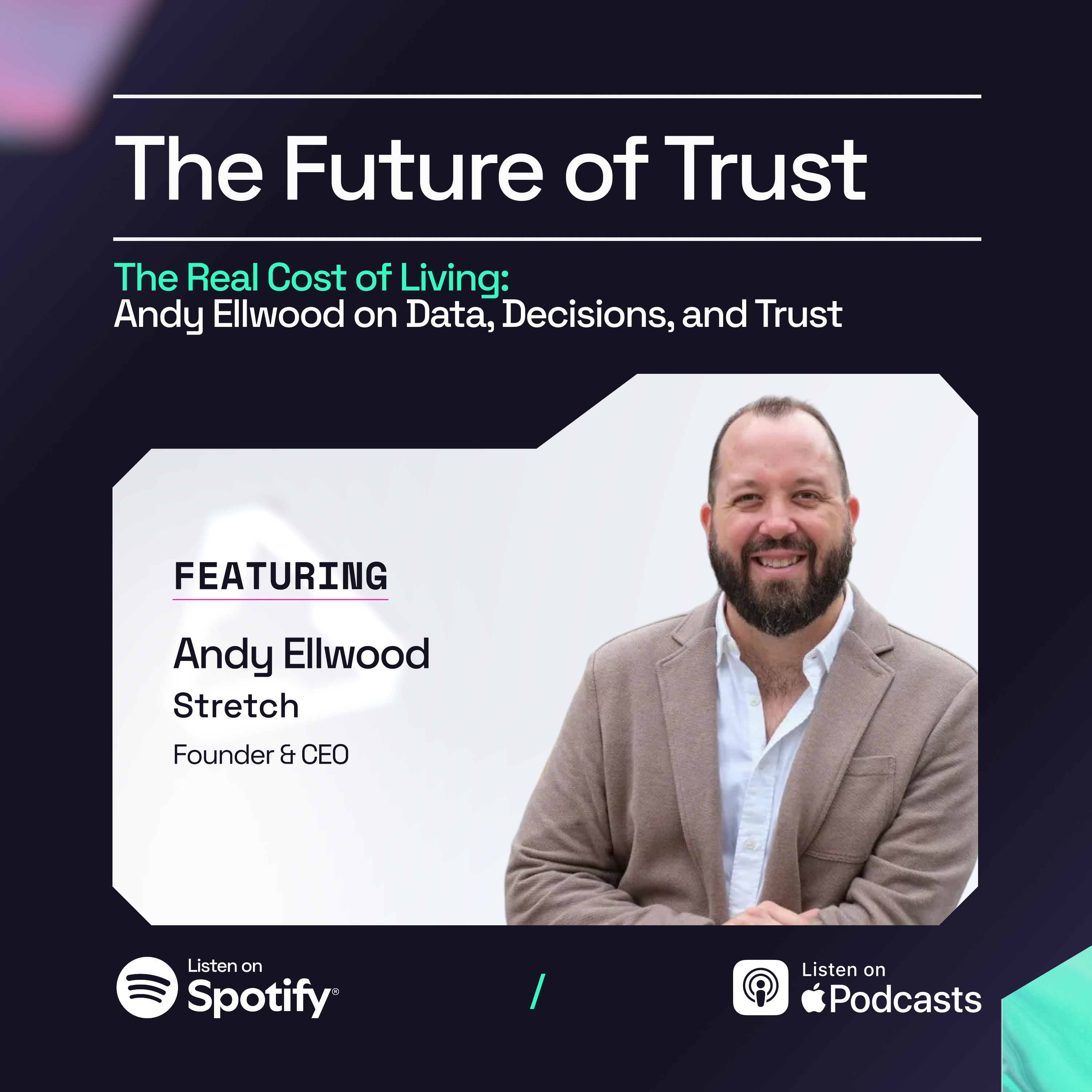
S1 E18: The Real Cost of Living: Andy Ellwood on Data, Decisions, and Trust
62m 28s
The podcast "The Future of Trust," hosted by Matt Yager, examines the role of trust in shaping systems and decisions. In this episode, guest Andy Elwood, an entrepreneur and technologist, discusses his mission to bring transparency to everyday systems, starting with grocery costs. Inspired by his childhood, where monthly grocery trips required careful budgeting, Andy now uses AI and data to help families understand true shopping expenses. He shares his personal philosophy of curiosity and humility, shaped by his father's lesson to seek help from those who know, and describes his "big brother" approach to building relationships. Based in New York City, Andy reflects on how the city's ambitious environment fuels his work. His career includes both successes and failures, yet he maintains strong investor trust, with some backing him again despite past losses. The conversation highlights how personal experiences, transparency, and resilience are key to building trust in technology and business.
Trust is the foundation of progress, yet in a world of rapid technological change and growing complexity, it often feels like the missing piece. I'm Matt Yager and I've spent years working at the intersection of sustainability, technology, and innovation. Through this podcast, I sit down with leaders, visionaries, and change makers to explore one key question. What builds trust? From global systems to personal decisions, we'll dive into how trust or the lack of it shapes our world. Join me as we uncover insights, challenge assumptions, and explore how we can create a future built on trust. Let's get started. Welcome to the future of trust, where we explore how trust is built, broken, and rebuilt in the systems shaping our world. I'm your host Matt Yager. Today, I am joined by Andy Elwood, an entrepreneur, father, and technologist who has been at the ground level of multiple successful startups, and is now building his next big thing. Andy works at the intersection of money, data, and everyday decisions. His mission is to help families understand the systems they rely on each week, starting with one of the most fundamental and least transparent parts of modern life, the cost of groceries. Gershary stores shape choices that feel small but add up to real consequences. What to buy, what it truly costs, whether the incentives around you are aligned with your well-being or working against it. Most people never get a clear view of that system, and Andy has spent years trying to change that. He grew up in a home where a single grocery run had to stretch for an entire month, and the checkout line became an early lesson in math, trade-offs, and responsibility. Those experiences stayed with him even as his career took him into very different worlds. From selling private jets to joining early stage teams at Goala in ways, he later built basket, a crowdsourced Gershary pricing app, that revealed how much prices could shift across the same city, and now he's building stretch using AI and structured data to give families a simple, reliable picture of what their weekly shopping should actually cost. Today, we explore trust, transparency, and everyday systems that quietly shape how families live. Let's dig in. Andy, super excited to have you here today. We had a really great inter-call. A lot of commonality in our upbringing and just like who we are as men and people, and how we think about some excited to hand off to you, and just like understand how do you pitch yourself? Like, who are you? What do you believe in? Where did you come from? Yeah, first off, thanks for having me. I've heard some past episodes, and there's the way that you think about the questions and the prep that you put into this, so really appreciate that. What I think about myself, I think about myself as I have big brother energy. I am the oldest of four kids, and I have gone through life being taller than most folks, and I'm the one who people ask to reach things on top shelves, and I take that responsibility very seriously, and kind of think about anybody that I interact with as kind of, hey, if this person was my sibling, how could we have some fun together? How could we build a project together? How could we explore something new together? And that is open up a lot of doors for me, and I've found myself being able to partner with people on small things and big things. Everything from, you know, I'm the chairman of a culinary institute in Mexico, where we use culinary arts to help students understand the opportunities that exist in the Eucatan Peninsula to leading a dinner club here in New York City, where I bring people together around food, and just following the footsteps of my mom, who was one of the greatest hosts of all time, and love, love, always having an extra seat at the table was one of the things that she taught us, and I think that that sense of generosity that came from her has served me well in my day to day, and now as a new father, you know, a four and a half month old little girl, I've learned a lot more about selflessness than I ever have. So it's been an amazing journey and excited to chat more with you about it. Yeah, absolutely. Where are you based out of? Eastern New York City. I originally grew up in Texas, but it was like, you know, a dalsal be here when I, when I get back, I'm going to go to the New York City for a little bit and see what happens, and that was 16 years ago, and then you know, married in New Yorker and now my daughter, you know, is in New Yorker, and I think we're going to be here for a while. Yeah, that's absolutely great. I feel like you kind of get sucked into the New York ecosystem, and sure, it's a very different way of raising your own daughter now than what you experience growing up in Texas. Yeah, it takes a certain type of crazy to live in New York, which is why a lot of people love, you know, you either love it or hate it, you know, it's kind of like blue cheese, you know, it's either like the thing you choose or the thingy that you don't. But if it's your type of crazy, there's no place like it, but it's actually special, different, even crazier type of person who's like, yeah, I'm gonna raise a kid, you know, on the streets of New York, and my wife and I, turns out we're that type of crazy. Absolutely. We're at which borough are you based out of New York? We're in Manhattan. Okay, Washington Square Park is kind of the West Village, Gratitude Village area. Yeah, that's a good area. I like that space. My wife has a lot of family up and I guess they're my family too, so I should say I have a lot of family. But like she's got family and Brooklyn and Manhattan, now they've moved out to Orange, New Jersey, which is just a suburb of Manhattan at this point. Exactly. Right. Yeah, like all her cousins grew up there, and it's just incredible to see the difference in their mentality, like growing up there versus like their parents who grew up here in Delaware, Pennsylvania or elsewhere. It can really have a huge impact, but I think a really positive impact on just how kids see the world. Yeah, you know, I don't think that we rise to a level of our potential. We rise to a level of our expectations. And you kind of learn to expect more when you're kind of thrust into all the different situations that I've found myself in in New York. Everyone here is trying to take their shot at building a big life and they expect a lot from themselves and from the people around them. It's not for everybody, but if it's for you, you find other folks that are wired like that. You know, when I moved here 16 years ago, my parents came to visit and do two months into me being here. My parents were walking across the Brooklyn Bridge and I remember them just being like, how the hell do we raise in New York or in the suburb of Dallas? My dad was like, you're not coming home, are you? And I just found my people here. And I'm really grateful for the community that I have. Yeah, I mean, I think it you're an ambitious person, obviously. We've been involved in multiple companies and you like to push yourself and you've got this like drive and grit to like build the next thing and always be like working on something. You're not the kind of guy that's going to like sit back on a farm and just like take care of some chickens. And there's nothing wrong with either one of those. I grew up in the country. I grew up in North Carolina in Tennessee and I never visited a major city unless you guessed it or meant for some major city, but like I didn't really see it that way. Yeah. And then I met my wife and like she pulled me into New York and DC and all these other things. I'm just like, we ended up moving to Baltimore for a year, like right in the heart of like the most busy area. I was hooked. I was like, holy crap. Like everything I need is a block away. I can walk out my door and I've got 15 restaurants. I can walk 100 feet away and get fresh ducked oysters. And I remember taking my son when he was a year and a half two years old and walks like on the waterfront. And I was just like, I never thought I'd be a city person, but it's so convenient that like at a certain point in a lot of different ways, like, yeah, you know, you're in the heart of everything, but you still feel like you have a lot of privacy somehow. And I don't really understand how that works. Yeah. Yeah. No, it's I've got a 60 pound rescue dog. And so, you know, I take about three times a day. And, you know, and I remember, you know, I was visiting my brother who lives in Austin. And, you know, when I take my dog out for a walk, I say hello to four or five people that I know, just about every morning, walking out in the block, walking through the park. Like, you kind of see the same people. I don't know them. I see them walking their dog, building the next door, whatever might be, different characters in my Truman show of an existence. And I remember visiting my brother in Austin. And, you know, I got up, I was headed to a, you know, business meeting. So I walked on his front door with my Uber. And I stood outside for five minutes waiting for my Uber. And I didn't see another living thing, like not even a squirrel, right? And Austin though. Yeah. Well, he lives in East Austin. So I was just in the neighborhood. Yeah. But in the neighborhood, like, it was so eerily quiet. And I realized, oh, my gosh, the transformation to me being in New Yorker now has officially happened where, you know, if you're uncomfortable with it. Yeah. I did. I was just so aware of being by myself standing outside and like, not being able to say hello or good morning to somebody. Okay. All right. I think it's officially happened. Yeah. Absolutely. I mean, the city calls to some people. We go to DC a lot because we're open to nowhere. And right now we live in a very rural area. We're itching to get back into a city because we go to DC or we go to Philly or we go to New York. And you see that everyone has something that they're working towards and that there's an ambition that's inherent in the people that decide to be in that environment. And it's kind of addictive in a way. It is, it is a special kind of drug. That's for sure. Special kind of drug. Okay. So kind of keeping this through line of like where he came from and who you are as a person. When you think about the path that brought here, where does that story actually start for you? I think it starts when I told my dad, I wanted to rebuild the carburetor on my Chevy truck. I would read that. So I had a long word business when I was growing up and I started saving to buy a truck when I was 14. And so on my 16th birthday, I paid cash for a 1985 Chevy Silverado 305. Great truck. You know, classic, classic paint job. And it was, you know, like I was the only kid who was buying himself a car on a 16th birthday, but it was actually important. So I could make more money in the next summer, more and more. And so I had that idea and I told my dad, I think I need to rebuild the carburetor. You know, can we do this together? I said, Hey, there's a lot of things that I am, but I'm not somebody who works on cars. But my buddy Jim does. And I'd be very happy to ask if Jim wants to come over. So Jim came over on a Saturday and Jim and I rebuilt the carburetor for seven hours and got it all back in. And I remember that being the first time, but not the last time that my dad was humble enough and generous enough to say, I don't know how to do something, but let me help you find somebody who does. Yeah. And he instilled that in me across just about everything that I do where I kind of look at every single person I know as somebody who might know something that I don't and can I learn from them? And if I don't know, how can I go find the person who does another thing? And I think that curiosity has been a through line in just about everything I've done that I now feel like I have the confidence that, you know, give me three weeks and I can learn just about anything. Thinking about what doors might open next for me if I learned how to do a new thing has kept me on the front edge of a lot of things, whether it's technology or relationships or things going on in culture and society. Looking to every person that I speak with as somebody who might teach me the next thing that I need to know is a pretty fun way to go through life. Yeah. Yeah. Yeah. And that's a great lesson too. I don't think I learned that lesson until it was in the military where, you know, I was going through things and my auntie, I was like, if you don't know, that's fine, but don't be afraid to say you don't know. And when you tell me you don't know, just say, I'll go find somebody that does. I was like, wow, I can be flexible. Like everything's not black and white, holy crap. Yeah. And you know, grown up when we did, there was still the belief that you could have a right and a wrong on everything. But I think that as we've expanded and grown as a society and the access to information has become even more than it ever was. It's not about having answers. It's about having good questions with access to all the information in the world, like what question do you want to ask next? You know, not what answer do you think that you're going to hold on to and be able to be staunchly correct about forever and never change your mind? You know, a friend who said, the only thing you have to do, whether it's talking about the NFL or talking about wine tasting, is just sound like you know more than the other person. You know, on that day, you really had that smoky flavor and I love the leather on the finish. Is that true? I don't know. But the bears are definitely going to win the Super Bowl this year. A lot of these things with some confidence. You know, people have been able to get away with backing others down by saying it, even if it sounds ridiculous in hindsight. Yeah. And I think that you see that, you know, in the past and even still currently in some cases in politics and in business, if you were rough enough and big enough and loud enough and sounded confident enough, you could go very far, but I think that the accountability that is now available at everyone's fingertips with AI and with technology and even just with the idea of the humility of, hey, there's maybe some things I don't know, but I can, as you said, go find somebody who does. I like that future better. Yeah, absolutely. Yeah, you know, I think that mentality about business even used to work in in a lot of cases it still does. Yeah. But we have so much information readily available with like AI and smartphones and just like everything going on. Like I know I can find out what happened in Japan an hour ago in 30 seconds, which is incredible. Like the just the access we have to figure out what's true and like confirm it and then hold other people accountable. Like that's a, you're going to take me down a whole rabbit hole with that. That's something I focus on pretty conservatively. You shared a story with me during our intercall about like money and responsibility and like the grocery store. So can you recall what that was and like from those early years that you had, how that still influences your decisions today? Yeah. So I was homeschooled and very unique privilege to have my mom as my teacher and my dad as my principal. And every time the family gets together, it is a cost reunion. So 100% attendance for everybody who went to my high school. Yeah. And yeah, that is a unique privilege being homeschooled. Everything was a lesson. And for my family, I didn't know that my parents were pretty much paycheck to paycheck. They did a really great job of letting us have exactly what we needed. But as I got older, I started to realize, oh, wow, they were really fighting every month to make sure that there was food on the table and that we had the home and the resources that we needed because my mom stayed at home. So we were single for single income family before kids. Looking back on that, always just incredibly grateful to both of my parents for the way that they ushered us through that time. My dad had a successful career in architecture and rose as an executive within the firm. But the early days when he was an associate and just making his way, it was a challenge. And using the grocery store as a place where lessons happened was something that my mom did pretty frequently. Not only planned out meals one month at a time, so she would go to the grocery store once a month for the whole month and that food had to last us all 31 days. But you know, nothing went to waste and we figured out how to make sure that everything that went into the basket and went into the pantry was used in some way and that we weren't throwing anything out. And you know, that became a math opportunity for us. That became a science opportunity, a measurement opportunity, a geometry opportunity for thinking about, hey, how are we going to get all the stuff in the cart, get all the stuff in the minivan, get all the stuff in the pantry, and then make sure that we use it across every meal that we have over the rest of the month. So it's something that I think about a lot, you know, had some success and probably not pinched pennies quite as much in recent years as I know my parents did. But I still kind of show up with that mindset of like, this isn't permanent, but this is all being taken away any moment. So I got to be good steward of what I've been given. And you know, it doesn't keep me from taking risks, but it does keep me from taking too many risks. Yeah, absolutely. But it also gives you a confidence in yourself because like, you know where you came from and you know what you've achieved. And you know, you could do it again. If it came down to it, you lost everything. I'm sure you have complete faith and confidence that within a year, you'd be right back where you need to be. Yeah. I think that the experiences I have, the network that I have has raised the floor, right? The net's not that far below me. Yeah. I've worked pretty hard to make sure that that was true. Yeah. That I'm super grateful for everybody that I have in my life that if something crazy happened with some humility, be like, hey, this is what happened and this is what happened. And we would build back. Absolutely. I mean, your network is your network as they say. You've built so many connections through all the professional things that you've done that like if you risk it all, you know the investors, you know the angels, you know the VCs, you know the partners, you know how to sell. You've got so much of a stronger foundation just in your brain, in your bank account that you need to do. And that came into, you know, that was an experience I had very recently, you know, in the new company that I'm building. We went out and raised money from investors. I called investors who had backed my previous company that ended up not being successful. And I said, here's what I'm doing. And several actually jumped in and said, I'll back you again. These are people who I lost them a million dollars of their personal money. This was not a fund. This was like an angel investor. And there's one investor and he's like, hey, you were right. The time it was off, you know, came on. The time is right now. He kept just posted the all the way through. You were true and honest about what was happening. And I know that I personally lost this guy seven figures. Yeah. And you know when I was sharing that with somebody on my team, I felt like you're going to ask him for money again. I was like, yeah, like I'm going to make it back, you know, and so, you know, but to your point, I'm grateful that I have the opportunity to build again. And I'm incredibly grateful that some of these investors have decided to back me again. Yeah, absolutely. And I mean from an investor perspective, we just had an episode released on this, like investors don't invest what they're not willing to lose. So him coming in and supporting him in that first round, he knows the chance of a success as single digit percentage. Like the risk is very high. But if you win, the payout is worth it. And so like he's worked or she, I don't want to be biased in my perspective there. But they put money on you that, you know, they were like, I'm okay with losing this if it doesn't work out. But I want to see what you can do and give you a shot and see how you prove yourself. And you gain their confidence and they're going to be a lifelong backer of anything that you want to do. As long as you have the consistency to continue communicating with them and meet the standard we set. Yeah. And you know, the way you finish is just as important as the way you start, whether it's success or failure. And I think that, you know, while I was sad with the outcome, you know, that it didn't work the way it hoped it would, you know, it was still important to make sure that I was honest and, you know, let them know this is how it happened, this is why it happened. And you know, here's what I would do differently if I ever got the chance to do it again and five years later and get the chance to do it again. Yeah, that's awesome. I'm excited to dig into that here in a moment. So a consistent question we ask because this is the future of trust. I think trust is personal first before it's professional like to build trust in a business. It starts with the people that run that business and feel like we've started to build us into trust and who you are and what you stand for and what you're striving for here. But can you give me an example, either personal or professional on something that's either built your trust in a system or a person or just a process or broken it. Yeah, I married my college sweetheart. That's awesome. And you know, we got together over 20 and it was we were together until we were 32 and then we got divorced. I spoke too soon. It was great until it wasn't and I think that because we had got started so we don't like we didn't question a lot and it was just kind of like, yeah, this is what happens. And then as you know, life continued to move on, we didn't keep checking in. On, is this still great and what, you know, what do we do there? And so for a while, you know, you know, I'm a hopeless romantic like the idea that I could ever like fail at marriage was one of the really hardest things that I think I've ever had to wrestle with. Even to the point that I was trying to convince people, you know, post-divorce like, no, no, it's totally fine. Looking back on some of the conversations that I had, I was just having what we're trying to prove. And I was trying to prove that I hadn't messed up that we weren't failures, but sometimes say like the nicest thing that she ever said to me was, I don't love you, but you should go find somebody who does. But broken heart is sometimes the only way to be set free. When she's happily married and has kids now, and I'm happily married and I have kids now and wish her the best and she's an incredibly successful author and glad that she has changed her path. And also, I think that it's a lesson that I learned that not everybody is in your life or forever. And I wish that we would have figured that out before we got married and said, hey, you know what? Like, it's okay to part ways with people. That lesson was one that I needed to learn the very hard way. And so I think that the institution of marriage I'm so grateful for my wife and my daughter now and love everything about being a dad, being husband and building a family together. But you have to really be intentional about going into it, eyes wide open and be intentional every single day about like investing into that relationship and into the institution of family. Because you can't just take it for granted that it's like, no, we're stuck together. Let's just figure it out. I want every single day to feel as excited as I possibly can for my wife that she's like super pumped that she's still married to me. That's my job, you know, and keep dating. I mean, I try to, you know, having a kid has been a whole new adventure and figuring out how we do that. You got to be gracious with each other. So the loss of sleep kind of wears on you and you're not exactly getting at each other a little bit. Okay. That's something that you, it's okay to question institutions. And if you're committed to them, you know, figure out how you're going to stay involved with them. But I think that it took me, having, it has been break for me to realize that I still wanted to get back in. Yeah. Do it better. Yeah, but you know, you kind of lost trust in yourself a little bit in that journey because you're like, hey, I was kind of like faking it to myself that everything was okay. And so you had to question yourself and rebuild your trust in yourself. And then the institution of marriage as its own thing. Like, you know, I have a lot of friends, including myself where it's like, oh, I have to check these boxes to get to this stage, you know, and then you kind of realize, maybe I didn't need to check that box, you know, I learned a lot through it and everything happens for reason. But it really does make you question like, oh, you have to do this and you have to go to college and you have to get a master's to see degree. And you can't start a company unless you've done this that and the other. And it's like, none of that's true. It might be the most frequent stereotype. But like, it's okay to question it. Yeah. And I think that, you know, boomers in that era were given the greatest 40 years of prosperity in the history of the world. And everything worked if you just did exactly what they did because literally just worked. The whole generation got 40 years of easy. What do you look at the history of the world? And then, you know, they're like, hey, why aren't you doing exactly what we did and we're like, because the whole world's different game has changed. We're not playing Atari anymore. Map doesn't work in this part of the simulation. And I think that that's, you know, with a lot of friends that I have, you know, who kind of quit learning at the tender age of 24. They're like, nope, I did all the things my parents told me to do. And here I am. Yeah, I think there's a lot of people being left behind in, you know, the future that's coming and people have not had to fight recently. And they're out of shape and they're not ready for combat. And things are weird right now. And there's no, like, anybody who thinks that all this is normal, like, man, you could like, come join the living, you know, like, this is absolutely weird as part in, you know, our lifetimes of, you know, of the simulation and this cycle of things. And it's, you know, if you think all this is normal and you're just concerned about what type of car you're buying next and whether your favorite person's on sale this holiday season, like, come on, join the fight. Like, let's be real. There's a lot of stuff happening here. Yeah. I mean, that's an interesting point too because like, you look at the cultural differences between us and the US and like, the, the community or the people in general versus like France. As they try to change the tax code in France, you've got five million people on the streets rioting. They change the tax code here. And most people don't even know what happened. Let alone, are they out protesting it? Yeah. I mean, let the meat cake. Yeah. You know, like, as long as the bourgeoisie are distracting us with social media and status and making sure that everything's fine, go buy a new car. I mean, to quote my favorite philosopher, marketing has us buying shit we don't need. And, you know, Tyler Jordan, he was right, you know, fight club age really well. Oh, yeah. It's still one of the best movies all time. 100%. So you've moved through a lot of really interesting worlds. I don't know if I know another successful founder for one that was homeschooled. So that was really like, oh, man, you know, because we're considering homeschooling our kids. I have to travel a lot and everything. But how did you go from like selling jets to joining early tech companies like Walla and Ways? And then when you look back at those chapters, what experience or lesson really ended up being the most defining for you? Learning that I was good at selling people things was one of the best things that ever happened to me. And viewing rejection as a feature, not a bug is a really important thing. You got a lot of good lines. See that. Okay. That thinking about rejection as feedback that lets you know you're in the right place. Oh, yeah. Okay. So if you're in a world and you're in a part of the map where no one's shooting at you, it means it's not important. Yeah. It means like it's uncontested and the simulation, the video game doesn't care about that place and you're wasting your time. If you're almost shooting at you, you're supposed to get out of there and go to where the action is. And so when people start to shoot at you, you know you're walking in the correct direction. You know you're walking towards where something valuable is. And so if you are in a moment in the map that you're on and no one's shooting at you, no one's rejecting you, nobody's turning you down. It might not be that valuable of a part of the map. Yeah. And you might need to reposition yourself in a place where you're getting a feedback of, oh, this is getting harder. I must be on my path towards what I'm actually supposed to be doing. Embracing the difficulty. Yeah. And I think that in sales, learning to own what you control is the most valuable lesson I probably learned in my early days of selling things. Because when I sold life insurance as my first job out of college, they told me that if you have 10 leads, three of them are going to let you pitch them. So seven of them are not going to let you pitch. There's going to reject you before you get to the pitch. Of the three that let you pitch, only one of them is going to say yes. And so if you think about what do I control in that process, if there's three people that I pitch, one says yes, I don't control who says yes. I just know that one of those three is going to say yes. So I have to make sure I pitch the three. But then after that it's out of my control. And I have to make sure that I reach out to 10 in order to get the chance to pitch three. So the only thing I actually control in the entire situation is that I find 10 more leads. And I put 10 leads in the top. And I ran the math on that and said, okay, if I want to be rookie of the year, here's what I have to do. And I broke it down by whoever had been rookie of the year, the previous year. And that sold 120 deals. So I was like, okay, 120 deals. That's the one. So 360 pitches, 1,200 leads. Keys. And I said great. How many leaves do you need a day? Well, so it turns out that's 100 leads a month. That's and that's 25 leads a week, which means you need five new leads every single day. And I would not leave the office on Friday until I got my 25th lead. And I did that for a whole year. And I became rookie of the year for Northwestern Mutual Financial Network, which is the largest and best life insurance company in the country. And so I sold more life insurance than any other 23 year old in America. And as it turns out, Ziggs Zagler said, if you can sell life insurance, everything else is easier. Yeah. Because life insurance, the pitch, your opening line is, have you thought about your death recently? Everything else is easier to sell after that. I don't want to have this conversation. Especially with a 23 year old carrying a heart cited briefcase wearing a suit in a pen or a bread. And so somehow I did it. And it's not that everything else is easier after that. But if you've been rejected that many times, most of a year, right? And if you do the math, you know, I get rejected 1,080 times that year. I knew that hey, that's just a person identifying that they're not going to be one of the three or that they're not going to be the one. And so that I think that mindset has allowed me to go from one thing to the next. He was Henry Ford that said success is moving from one failure to the next without losing motivation. Yep. I think that that's ultimately, you know, where some of the Hutzpah and tough skin that I have came from. So in every situation, I just try to look for what I can control. And that has served me well going from one thing to the next. Yeah, I mean props to you at 23 looking at like, okay, if I want to be this, this is my goal. This is my objective. I want to be the rookie of the year. So what are the key results that I can, I can stand behind that are going to make sure I have the highest chance of reaching that objective possible. Yeah. One of my mentors, he said, if you'll be smart enough to be dumb enough to do exactly what we tell you to do, it'll work. Yep. And you know, again, going back to like the, okay, well, you know, I've never done this before. They're saying, you know, if you do 10 to three to one, it'll work. And I just kind of blindly trusted them. And then literally, when I ran my numbers at the end of the year, it was almost exactly 10 through one. I thought I was better. You know, you're like, no, 60 years of data, you know, like, like, this is how it works. Yeah, but I'm sure you look at the first sale or the first outreach you did versus the last outreach you did. Very different. It's just reps, right? You get better every single time that you do it. And I think that that's the other thing that I see so much in my peers and in folks who are following their parents playbook. Yeah. They're so afraid to do anything, quote, unquote, wrong. It's not wrong. It's just different than the way that somebody else did it. Do it your way. Figure out how to put your personality on anything that you do. And you'll be more successful. Yeah, don't be afraid of the rejection. I mean, the lessons that you learned in sales and like iteration and just refining your system or your process apply to software just as directly. Like every software company, if you want to build the best software, you need feedback. And you need as much feedback as possible, as quickly as possible. And you need to refine those loops so that if you can get, you know, 1200 points of feedback a year, then that's a lot of information to help you refine your product and refine your pitch and refine to your customer and your strategy is absolutely. Yeah. Man, that's in props to you too for like at 23 looking at that number and saying, I can do this. Most people look at that number and they're like, that is impossible. I'm not going to make it there. Never made a quote. Wow. Yeah. 1200 referrals. Yeah. That's incredible. So like coming from that point, you joined ways before it was acquired. And so that was like a transition for you from sales to software as well. And it gave you a close look at how communities can kind of help feed that same cycle and how they can create value. So how did that experience shape the way you think about coordination and trusted scale? When you think about what ways was it even go all the other company before that was was taking lots of individual pieces of information and saying, if you'll trust me with your piece of information, I will use it with all the other pieces of information and give you a more valuable piece of feedback than the one piece of information that you gave me. And so building the collective knowledge platform on that on the back end that if everybody contributes what they have, it's better, everyone actually sees the benefit of it. But if you just hold on to that piece of information, I'm in traffic on 635, where? I wish I wasn't. But if you signal, hey, you know, traffic is here than the thousands of cars that are behind you on their way to that spot of the map are going to have that data point. And hopefully they're able to transfer the information as well to the feedback loop of, I'm willing to give up this piece of information about myself, about where I am, about what I'm doing in order to get more relevant information about where I'm going. It has to be a pretty fast flywheel of trust. And the payoff has to happen pretty quickly the first time. Yeah. And eventually you get to where it happens every time. But to start bootstrapping phases tough. Yeah. And I think that the speed of iteration that we're talking about is so important to understand is that are you seeing that the work that you're putting in is going to actually pay off quickly enough for you to be to continue to do the work? That's what I think is what you really want to fight for. And I think that especially in the world that we live in today where technology is being built faster than it's ever been built, getting those feedback loops and understanding the lessons in real time in some cases has never been easier. But also getting people to stick around long enough to buy in and to stay a part of the community has never been harder because there's so many choices probably can choose to spend their time or really can invest their efforts. I think that's where there's just a tremendous amount of learning that's happening right now as a lot of those decision making moments are happening almost instantaneously. And the iterations are seemingly more available to us than ever but harder to get right. Yeah, absolutely. I mean the iterations are really important but they have to feed something that's sticky. And if it doesn't feed something that's sticky that makes people want to keep coming back then they're like, you know this was great but let me just go use this one because you know I want to try something different. Yeah and that's where I think that's you know one of the tests that I kind of run when I'm thinking about whether I'm making an investment or working on something myself is is it a vitamin or is it a painkiller? Right like if I'm walking to work and I forgot to take my multi-vitamins in the morning which I don't know but like I'm not going to turn around and go home. Yeah but if I'm walking to work and I've got a headache and I've got a big meeting that I'm walking to you better believe I'm pulling over to see CBS grab an ad bill. Yeah I'm not pulling over CBS to grab a multi-vitamin right but I am pulling over to CBS to get an ad bill so that I can walk in and so I think that when you think about what products you want to build is it a nice to have multi-vitamin? That'd be nice if we had that or is it a painkiller or something like I will do whatever it takes to keep that in my life yeah and I think that's with AI you can buy code a million multi-vitamins but it's really hard to find the right things to integrate on the painkillers that truly make a difference for somebody and they say I need that in my life yeah absolutely I mean we've had a lot of those conversations from our perspective where it's like you know we're building this thing and we take it to one of the companies we're selling to and they're like that is the most painful part of my day like the thing that you're addressing is the thing that I dread every day I wake up and we're like that's good we like that so let us take that off your plate and save you as much time and money and energy is possible and they're like yeah that that sounds like a win I want that thank you and so you went from being an employee and being early in these teams and like having the exits to building basket which was like your first big swing right and so with basket you know I can explain what it is but it's probably better coming from you how did you go from like ways and go Walla and like insurance and private jets to like I want to focus on groceries yeah the catalyst for that conversation was my former co-founder had just become a dad and he was buying things differently than he had previously I relate a decade later being the new dad and it's like is that how much that costs and is that the only store that sells it and turns out it's not and turns out there's a lot of places that sell those things but they sell for different prices and the question that we asked was well how am I supposed to know before I actually go to the store like who sells it for what price and we've gotten used to as consumers having the information to make the purchase decision for homes we have Zillow for cars we've auto trader.com for flights we've got price line and Expedia and Kayak you know for fuel we've got gas buddy for prescriptions we've got good Rx but for groceries the thing we buy most frequently yeah we just walk into a big box that has a nice parking lot and give them our money without checking to see how much things cost at the store and we just thought that was silly and so we said all right we talked a bunch of shoppers we showed them the comparisons of you know this is the store this is it at the store and they're like oh I know idea and so we said great we're gonna go build it and so baskets set out to be a smart shopping list and you know with the idea of you give me your list for the week and we'll tell you every store that is close by that carries all the products and then what the total price is for your entire basket of goods at each store only thing that we didn't really think back it was we needed access to that data and it wasn't readily available now and we went to the grocery stores and we said here's what we're building shoppers really want this we want to put your prices right next to the other store prices and let the shopper choose and that was the first time I ever got kicked out of a corporate office Walmart kicked us out they said that's not what we thought this meeting was about and I changed the pitch deck for our next round of funding and said Walmart hates this and we raised 20 million dollars across three rounds of funding and using my background at ways the idea of collective knowledge we sent secret shoppers and everyday shoppers out into the stores and they could earn points and we kind of gamified it if they scanned the market and typed in the price it fed our human mechanical and pre-AI is very early machine learning and we ended up crowdsourcing 118,000 grocery stores wow two million different products in our database and at our peak we had 650,000 families that we were helping save money on groceries man that's incredible yeah and I'm sure like wild that people uploading their lists can I help you prioritize what the shoppers need to look for yeah yeah yeah we got to understand pricing schemes and retailer clusters and product clusters we were able to give missions and assignments to folks with a slack channel with 6,000 moms across the country and every Monday based on your seniority and your geography you could sign up for a different mission yeah and you got paid for every data point that you collected the grocery mom talk it would be credible shout out mom talk absolutely and so like that was the one where you had an investor that you kind of referenced earlier and it just didn't quite work out so like what was the catalyst for it to not work out and how did you know to make that decision too that like okay we got to call it quits on this one yeah well so we had all those momentum things were going well you know it's end of 2018 and we're getting ready to like go raise our next round of funding like summer of 2019 it's gonna be great and our investors said don't talk to anybody else like we've got you like we're going to fund this like like this is exciting it's working you know and so that was in our Q4 board meeting of 2018 that was what they told us so we're like great and we said if you want us to keep playing offence the way that we are we're going to need a bridge round in Q1 so that we can continue to put up these numbers and then raise a monster series B in the summer and they said absolutely we'll wire five million first week of January like like keep going so we hired board people we you know had a great Christmas party like we did all the things with the assurance from our investors that they're wiring five million dollars in January would confirm that you know the first Friday of January of 2019 Jeff who was our chairman of board but kind of like our third co-founder who's like our crazy uncle it was his 68th birthday he was winding down his fund he's like everything that's left in the fund I'm going to invest in you guys like one more big shot that's awesome so we confirm that he's wiring on Thursday we talked to him it was his birthday on that Monday and Jeff was a great garyous guy loved to have a good time with friends so through himself a birthday party in San Francisco and then hopped in his assessment to fly himself and his business partner to their vineyard in northern California crashed the plane and died oh that's terrible and we get the news and we're distraught over losing Jeff yeah but the immediate second thought is like oh shit but he's supposed to be wiring us five billion dollars on Thursday yeah I mean the emotional conflict alone of like oh crap he was our crazy uncle and now he's gone and then also happened to like saddle that emotional burden with like wait what do we do with the company now because we haven't gone out to anybody else because they said we didn't need to that's exactly right and so we were caught very flat-footed and unfortunately Miss Payroll you know a little while later and and I've taken really really hard terms from some investors who like I don't know if you guys going to pull this out but I'll you know if you give us you know really big liquidation preferences and you know on these terms and these board seats and all that sort of stuff and so we you know we didn't know we had to do I put in way too much of my own money my you know the whole fender he did too and it was like truly one of the hardest things because it was a shit show behind the scenes we didn't know like we're on the steep we were on the Steve Harvey show like Steve Harvey was like tell everybody how awesome basketball is he flew us out to LA like we were on the Steve Harvey show and like we got all these downloads and you know then the good good word in America Robin Roberts was talking about how amazing our app was and got a bunch more downloads so we survived 2019 like we did whatever it took and we finished the year with a much smaller team and but still like serving hundreds of thousands of families yeah we're like you know what 2019 was hard but that's what founders do like they make it through and 2020 is going to be our year we all know what happened in 2020 and then this whole pandemic thing happened and we might have been able to write it out if we'd had a good 2019 but we were already pretty hobbled and there's just no recovery at that point so it was kind of a series of black swan events that all hit the exact same time and then she ended up selling the company for parts to one of the investors who wanted basket.com I think that's the most valuable thing that they got out of it I said hey like I got to recover those 15 years of tilty that windows I just tried to do whatever it took to find my way through to what kind of next that was how we were on basket down because we never would choose to have a hat too. Yeah it's never a decision you want to make yourself you're like I'm just going to keep pushing and keep pushing keep pushing but when everyone else tells you hey it's time to stop this isn't going to happen yeah yeah it's they made their decision for you and it's really unfortunate but you know now with stretch you came after the pandemic we're in a different kind of crisis mode in different ways but luckily I don't think it's going to impact you your vision that you had with basket now kind of transitioning to stretch and you've learned a lot of lessons there's so much more technology already like we're five years later but it feels like a lifetime of change from the technology that's available to you so like you're approaching the same problem but with a completely different method so what's that look like now? Yeah so the reason that we had to crowdsource it with basket was that grocery is antiquated business and the grants you it you know it is gnarly data and when we were building basket if you looked at a price online you go to walmart.com it was a very different price than the price that you would see in the store because the infrastructure wasn't there for e-commerce for grocery you know 2013 2014 2015 the way that it is now so that if you were willing to pay the much higher price online they would chip it to you but they weren't trying to make that the primary move you know it was about 6% of groceries were transacted online at that point because the infrastructure to be able to support daily grocery purchases online pretty big lift that's the reason it was the last category to show up on e-commerce fast forward because of the pandemic because people were not going to grocery stores that ended up being a really good thing for Instacart for Uber Eats for DoorDash etc and they the grocery stores had to structure their data in a way that allowed those companies to get that information about what was in stock it was the price and have that transparency. Walmart still hates it though Walmart likes their Walmart garden let's just put it that way and so I think that that's what changed right it's actually because of the pandemic and what happened with the pandemic that grocery stores had to structure their data in a way that allows for what we're doing with stretch to have a chance and I saw that opportunity under 2024 I said all right well let's explore this a little bit more and it's fortunate to be able to work with some incredible veterans from the grocery industry who understand everything about pricing everything about inventory everything about the way that data is structured and we said all right there's an opportunity right now to make a run and to serve the shopper in a way that they've never been served before and so that inspired us to jump back in and take the initial idea of what we'd go with basket which is the smart shopping list but really understand that the collective knowledge is not just around pricing an inventory but it's around the power that shoppers now have to expect more to expect more for this week's shop to expect more from their stores to expect more from the brands that they choose to and and I think that you know in 2025 the fact that there are any families that suffer from food insecurity in the richest country in the world is not a problem that we should take lightly it's a systematic problem and a lot of it I think comes from entrenched inefficiencies that those that enjoy the status quo those that are in control right now they don't have to fix those problems and there's not anybody really holding an accountable and so information is power and that's what we want to give shoppers with stretch yeah absolutely and so you've kind of like replaced the the human part of the crowdsourcing with the AI component because the data is now much more available or at least like there's ways to kind of pull it efficiently that you don't have to have a hundred thousand secret shoppers out there taking pictures of price tags at Walmart's across the country yeah I think that's where you know we think about the way that different moments happen do there's a technological advancement that allowed a company to move it you know with ways like ways was it initially built on a palm pilot yeah and you actually that's a throwback holy like literally had to go and install it on his friend's palm pilot you know and then they would go home and sink their palm pilots to their laptop yeah and that would be how the the map got uploaded every every night the app store then gets birthed and all of a sudden the ability to get access to the people all around the world became available right the app store is what allowed ways to sell for a billion dollars it would never have gotten that big previously the way that the pandemic forcing grocery stores to structure their data in a way that is empowering for shoppers was not what the intention was but it is what the outcome has been yeah and it's or we're hoping to put that power of the shoppers hands yeah so I want to consider that like we're playing on releasing this episode early in January people are going to be setting up New Year's resolutions stretch is new and it's coming out and you know what's the status on that but then also how can families really like intimately understand the benefit of what it's going to be doing for them like how's it going to change their grocery experience yeah so as of Thanksgiving week the early version of stretch is in the app store there will be more iterations through December and into January to so that when people are walking into their January budgeting season where maybe you're kind of regretting a few of the things that you bought during the holidays and you figured out how to go home stretches a pretty simple promise give us this week's grocery list and however you currently have it like this was the last week's grocery list on the back of a novel right give us this week's grocery list scan it take a picture of your seat you know upload a screenshot of your you know your last transaction from insta cart and just let stretch your grab it and it turns it into a smart shopping list that shopping list is in actual list form not in cart form right so if you write cheese we get to know what that means for your family for my family that means provolone for your family might be some of the different right but the personalization that happens around the free form text of I need to add this to a list is what work you know my competition is pen and paper yeah but if you give us the list hit get recommendation we'll show you all the stores in your area that carry those products and then what the total price is for your entire shopping list at each store so you know that turning left or turning right out of your driveway could save you 20 to 30 percent this week and out about you but like for the amount of my family smells like groceries that turns into you know hundreds of dollars a month and thousands of dollars a year actually absolutely all of that's available for using our free app like what we're we try to be very fiscally responsible because I'm still building a startup looking forward to my first one in the future yeah absolutely but we still have to be very conscious about these kinds of things and my wife does an incredible job like she'll go to all these and then she'll go to Walmart and then she'll go to bj's and then she'll go like we'll shop at five different grocery stores just to try to like balance it appropriately and so I'm looking forward to running up stairs right after this saying babe it's ready like download stretch we want to try this out it might make it week easier and then we're also planning our summer vacation because we got two boys you know as soon as school's done we want to go somewhere but we don't know how much we're going to be able to budget for that so if I could save 20 to 30 percent a month from now to June that all goes in the family vacation fund and then we get to do something really memorable that sounds like an incredible opportunity and just offering that you put together yeah and I think that the really interesting part is you know people have their default which is like you do for a lot of things like I have status on American so I'm probably gonna fly American on my next flight but I still start my trip on kayak.com just to make sure that American is not twice as much as Delta or United if it's jet blue Delta United or American if American is within some range of the others I'm probably going to pick up American because I'll get an upgrade maybe yeah but if it's twice as expensive my loyalty is not for sale you know it's you know I am my loyalty is for sale you know I will switch if you know if I can get there faster if I can get a better time if I can you know do it for half the price you know like I'm back and start a plan as well you know like we we're watching you know we're watching things so we have the chance to take this all the way yeah absolutely if you imagine this world that you're really creating from the foundation where families actually start to trust the systems around like their weekly decisions around the pricing the availability like the incentives that different grocery chains and other stores as I'm sure you expand past groceries at some point start to offer what does that future feel like from the perspective of a new parent standing in their kitchen yeah when we think about the way that we design the app you know it's not one so weak use right there's two three different use cases there's the adding things to the list there's getting the recommendation and then there's the install right move where you check the things off your list as you go adding things to the list you know we'll do integrations with Siri and Alexa in the past had conversations with Samsung around like a smart refrigerator that understands what you're out of stock up right previously for a decade previously it was a little bit extractive and a little bit creepy because there wasn't there was no reason to know those things right yeah it was just you know oh wow we're out of milk okay great what do you do with it but when you start to think about what agentic commerce might look like where we could actually have not just a smart grocery shopping list but a smart grocery shopping assistant who understands your family understands the frequency with which you buy things understand things that have expiration dates and damn did you think about the fact that this is gonna expire before you have the chance to make that meal that you were thinking about right what are all the different ways that that smart assistant could not only save the time and money but also help prevent waste right throw things out and so those are some of the things that we're thinking about down the line and what do you think about you know there are lots of shopping agents being announced right now by the big players they're all retailer agents right the Walmart agent the target agent the Amazon agent there that agents only jobs to get you to spend more at that retailer yeah and we're saying what would it look like if you had an agent that was helping you understand the landscape and when it made sense to save money but also save time you know that sometimes it's not about saving money on that trip it's I've got two kids in the back of the car and I just need to know who has this in stock like that's that's what I'm optimizing for you know yeah other times kids are in school and the household CEO can drive a little further to save a little bit more money so they can save up for summer vacation but right now you don't even have the choice of which one you want and that's really what we're optimizing for it to give the agency back to shoppers here's what my priorities are for the week and here's how stretches gonna help me achieve them yeah and I mean with the new year resolution concept in mind too it could probably be really helpful in making sure you stick to your diet like that's that's my biggest issue is I love cake I love pie I love ice cream I'll be really good on my diet but then eventually I see that thing in Walmart or wherever I'm shopping like oh I gotta have it and it just ruins everything so if you're kind of like removing yourself from that temptation and saying I'm gonna you stretch to kind of make sure I'm not getting that stuff shoved in my face and insulating me to make the right decisions for my nutrition and my diet my goals yeah I mean that sounds like a huge wood for me and one day down the line you know it's not in our immediate roadmap but we can imagine you know grab your weekly shopping list things that you typically buy take a picture of your refrigerator take a picture of your pantry we kind of know hey here's what Matt's household has and then hit a button at the top it says make it healthier and all of a sudden what's normally on your list if there's opportunity based on the dietary restrictions of your family based on what your goals are just say hey you know like pericles are awesome but should we do some carrots instead like you know to just say hey help me with this and something that you're gonna get hit with once you decide to put your new little one in child care is the nut free and all the other things so like that's a whole experience like oh how do I stop from buying cliff bars and buy the nut free version how do I start from buying this and buy the gluten free the the sensitivities that you have to be conscious of that might not necessarily be yours but for just like packing your kids lunches thanks so much energy to figure out what that is at first yeah well you can imagine in the future where you've got stretch set up on your relaxer with Siri and you say hey my mother-in-law is coming in town and she's dairy free make this week's grocery list and the recipes that we usually make for the week dairy free yeah right and you know just for the week we'll be able to make sure that you're stocked with the things that you need for your family and boy have that assistance do all the work for you so you're not thinking about all the swaps that you have to make it's like you've got your personal nutritionist like on demand right there and they're not subjected to marketing and you know by accident you don't need it's like this is what I want and this is what I know I need and I know that I'm weak sometimes when it comes to saying no to ice cream the flexibility it provides like I dream I've always dreamed of the day where I have my own nutritionist and my own in-home chef that can come and make sure it's making the meals for me so that I'm standing on my diet and everything this is a big step towards that yeah and that's our vision you know we believe that if we just can continue to find things that serve the shopper give the shopper more autonomy and agency over the decisions that they're making and at least to understand them yeah they'll just become a paradigm shift in the way that we think about the food infrastructure of our country absolutely I mean I think there's so much potential in what you're building and hopefully investors see it too and they think it's silly not to put money towards someone who's proven their abilities as much as you have but now I want to be cost you your time this has been a great episode I'm really excited to refer this one to a bunch of friends and family that I know could learn a lot from you and your experience but to close out I ask this question every time I think there's a big difference in being well-known and being known well and so if you can leave our listeners knowing one thing about you so that you are known well and that they like trust you and what you're building what do you think that would be I didn't want to build stretch I had a pretty good thing going you know with what is an executive coaching that was dabbling with a few projects I was advising was a part of a couple of different things that kept me interested and curious put me in interesting places with cool people and but I made a commitment to myself that if four things were true all at the same time my four non-negotiables if all of them happened at the exact same time that I would exit left from the cheat code life that I kind of felt like I had built for myself and one of those things was it had to be a 10-year problem it had to be something that I didn't know how you could solve it any faster than 10 years it wasn't a flip it and create a feature it wasn't a fast exit to you know whoever's M&A was most interesting but it had to be something that you know like I would want to dedicate my life to serving the people that this problem was affecting for 10 years yeah and there were a handful of things that presented themselves in between basket and stretch that were interesting that were really good projects but none of them passed all four of my non-negotiables and a lot of them never even made it passed the first one which was the 10-year test yeah and so I think that's you know for me I don't think I've ever had this much energy right like my dog's thing a lot as a new parent yeah I wake up wanting you know hold in my daughter and then when I get to the office I'm ready to run through brick walls I don't remember what I slept last night or not because I'm so excited about what we're building because the path is emerging with every next step that we take and I think that if I could be known for anything it's that this is in service of something so much more than getting to be a founder again with the service of every family just like the one that I grew up in that is fighting to provide for their family and make sure there's food on the table and if technology can be used for everyone and not just to enrich the oligarchs that seem to think they run the country that's a legacy that I want to be a part of absolutely I think so I don't even know what to say to that I mean there's it's a great way to end this and so Andy I'm just gonna leave it at that it's been a real pleasure talking to you I'm looking forward to talking to you more in the future and hopefully getting to hang out and have a coffee or go grocery shopping together how can people get in tongue-tacked with you how can they follow your work and if you listen and you haven't downloaded stretch already by the end of this episode I'd be surprised yeah and you all the dot com is where I do a lot of writing I've done a newsletter called Makeroom for many and then stretch if you want to track it down it's now live in both app stores so just search save on groceries and you'll find it there or the website is stretch4more.com FOR more.com I would look you know feedback is a gift and we're at the early stages of what we're building so if you download stretch and you have an idea for how you can make it better for for you or for shoppers like you would love to hear it I'm @AndyLwood on every social platform thanks Andy I really appreciate the time absolutely if trust is at the heart of your work whether in sustainability business governance or personal leadership I'd love to hear your story reach out share your thoughts or tag someone who should join the conversation on our socials let's shape the future of trust together until next time thanks for listening
Podcast Summary
Key Points:
Trust is foundational in a complex, rapidly changing world, and the podcast explores how it is built, broken, and rebuilt across systems.
Guest Andy Elwood, an entrepreneur and technologist, focuses on increasing transparency in everyday systems, particularly grocery pricing, driven by his childhood experiences with financial constraints.
Andy's personal philosophy centers on curiosity, humility, and a "big brother" mentality—learning from others and fostering community, which shapes his approach to business and life in New York City.
His career journey, from early startups to his current AI-driven project "Stretch," emphasizes resilience, learning from failure, and maintaining investor trust even after setbacks.
Summary:
The podcast "The Future of Trust," hosted by Matt Yager, examines the role of trust in shaping systems and decisions. In this episode, guest Andy Elwood, an entrepreneur and technologist, discusses his mission to bring transparency to everyday systems, starting with grocery costs. Inspired by his childhood, where monthly grocery trips required careful budgeting, Andy now uses AI and data to help families understand true shopping expenses.
He shares his personal philosophy of curiosity and humility, shaped by his father's lesson to seek help from those who know, and describes his "big brother" approach to building relationships. Based in New York City, Andy reflects on how the city's ambitious environment fuels his work. His career includes both successes and failures, yet he maintains strong investor trust, with some backing him again despite past losses.
The conversation highlights how personal experiences, transparency, and resilience are key to building trust in technology and business.
FAQs
The podcast explores how trust is built, broken, and rebuilt in systems shaping our world, featuring conversations with leaders and change-makers.
Andy Elwood is an entrepreneur and technologist focused on helping families understand systems like grocery costs, using AI and data to provide transparency.
Growing up in a single-income family where groceries had to last a month taught him lessons in math, trade-offs, and responsibility, which drive his mission today.
Andy sees himself as having 'big brother energy,' meaning he takes responsibility seriously and approaches interactions with a mindset of collaboration and generosity, inspired by his role as the oldest of four.
Andy values curiosity because it allows him to learn from others and adapt, believing that asking good questions is more valuable than having all the answers in a rapidly changing world.
Andy takes calculated risks, confident in his ability to rebuild if needed, thanks to his experiences, network, and the humility to learn from failures.
Chat with AI
Loading...
Pro features
Go deeper with this episode
Unlock creator-grade tools that turn any transcript into show notes and subtitle files.
 PodcastTranscript AI