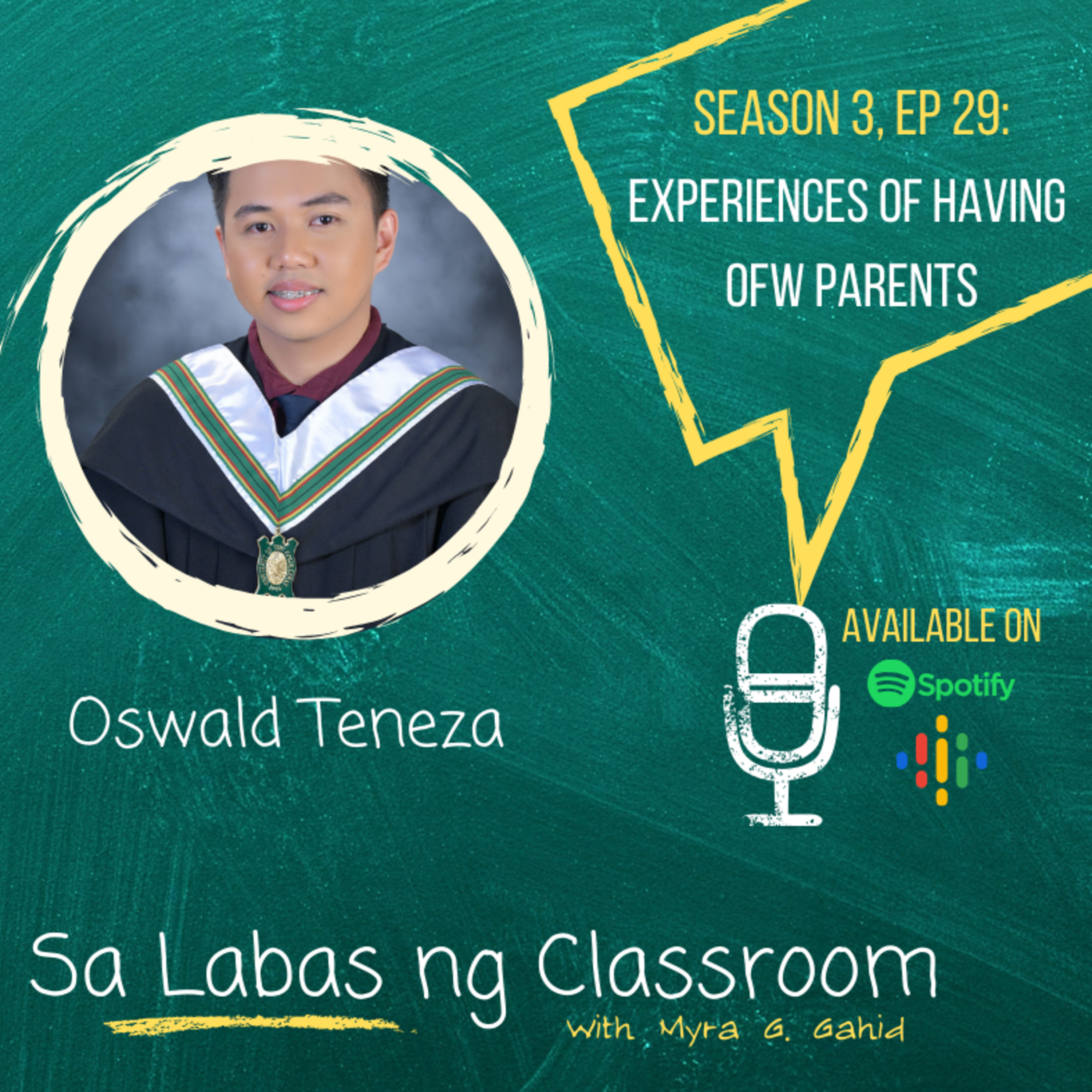
Oswald, who recently passed the psychology licensure exam, shares his personal journey of growing up with parents who were overseas workers (OFWs). Though he faced emotional challenges—like feeling isolated during school events and struggling with communication due to distance—he also developed resilience, independence, and self-reliance through experiences such as attending seminary. He emphasizes that the absence of parents, while difficult, led to valuable life lessons in responsibility and emotional strength. Key coping strategies include maintaining open communication, relying on a strong support system, and using music to process emotions. Oswald highlights that OFW families face both hardships and opportunities, and that understanding the sacrifices behind the decisions helps build empathy. He encourages children to recognize their parents’ love and efforts, not to feel abandoned. For parents, he stresses the importance of self-care and emotional balance. As a future psychologist, Oswald aims to study abroad and bring culturally relevant therapeutic practices back to the Philippines. His story offers a balanced, hopeful perspective on OFW families, showing that absence does not equate to neglect, and that personal growth can thrive even in challenging circumstances.
So, good morning, good afternoon, good evening, everyone. And welcome to another episode of Salabas ng Plashroom.
I am here with one of the people I really am interested in terms of his career path. So, I encountered him initially as a student in the previous school that I worked with and at the same time I recently passed the board exam for psychologist.
And I am very, very proud of his achievements and looking forward to what he will achieve more in the future. But I let him introduce himself further. So, welcome to the podcast Oswald.
Thank you, Maria. So, hello, everyone. I am Oswald. As not mentioned a while ago, I recently passed the psychologist more in exam. And the ones that get my license, I get to practice as psychologist.
Yeah. And so, before we start our psychologist, would you have a preferred field as of this moment?
As of this moment, I prefer to be in the counseling field since I was also exposed before as a guidance, as a student in what the school's here in Belgium.
So, thank you so much for sharing a bit about that. Although, it's not your main topic now. So, when it comes to this session, it was actually surprising for me to receive this suggestion from Oswald.
It's a very interesting thing in terms of the experience of actually being in that situation. So, we are going to talk about his narrative or experiences in relation to having OFW periods.
So, from what we are seeing now, is that the script or how do you narrate your story in relation to having OFW periods?
So, growing up, having parents who were OFWs was a challenging experience. It was challenging because I didn't really see it as a negative experience.
So, firstly, I cannot deny the fact that throughout my growing years, I have always felt the loving for the presence of OFW and OFW.
Especially so that my mom went abroad when I was in elementary and my father went abroad when I was in high school.
So, when my parents were away, it was hard to feel their absence in everything moments that matter most, especially during my birthdays and events school events.
Mom, if I may share, I can still vividly remember a time during our school program when we were required one by one to introduce our parents to the count.
When it was my turn, I almost did not get up to the stage. I was struggling to hold back my tears because my parents were not with me and only my cousin and my grandmother was there.
At that time, I felt so embarrassed that I was the only one who did not have parents. And also having OFW parents, our communication was also a struggle.
Of course, communication was difficult due to the time zone differences, even for internet connections and our schedules.
Which sometimes led me to a sense of disconnect or misunderstanding. When I was younger, there were times that a question "Why did not call or respond to my messages? Why are they too busy to even respond or call?"
But I could also say that we lived a better life when my parents went abroad.
When I say a better life, it means a more comfortable home, access to better education and opportunities that might not have been possible otherwise.
But while the money helps, it is understood that it comes at the price of being apart.
All in all, the absence of my parents and stuff, but the way for me to be more independent is a good thing because I have learned to align more on myself, my skills, capabilities, and also learn to be more responsible for the things that I do.
I appreciate the contrast that you've given in terms of your experience, particularly highlighting the initial responses of people when they hear about these types of stories.
Like, "Where are your parents? What are they currently doing? Why are you not with them? Why are they not with you?"
Especially asking these questions to children or teenagers, it's difficult to get a response.
And the level of understanding has to, of course, the reasons and the intentions of our parents to do the things that are very difficult to do.
For us to have a more comfortable life, as you mentioned, is beyond what we understand, or how we understand.
And I also like that you mentioned that these experiences also taught you to rely more on your skills and to be more independent.
So I think I'm curious, do you remember the moment or the situation that made you realize that it is also advantageous for you to have this kind of experience, or what was the moment that taught you now?
My situation is different from most children or most teenagers, but I can do well with it or get the most out of this situation.
I think what helped during those times was that I entered the seminary during that time when both parents were already abroad.
So during high school I entered the seminary, so it's like a boarding school. So you stay there, you only have visitation hours once or twice a week.
The seminary life was really helpful for me because it was really a good training. There were very times for everything.
So you wake up, you do your morning routine, and then you go to the chapel, pray, attend the holy mass, and then have your breakfast, attend your classes, and then have your lunch, sleep for a bit, pray again, then have your afternoon classes.
And then in the afternoon you can play, then have your shower, and then prepare for dinner, and then pray again, and then you can study, and then sleep.
So that's the usual routine that we have when we were in the seminary.
And I guess the training that we had was really helpful in my growing years, especially that I didn't have my parents with me.
I was actually surprised that you were part of the seminary boarding school, set up when you were in high school.
I think that's also a situation that can add to your level of independence at the same time.
The faster that you discovered your coping strategies and what worked for you, my follow-up question will be in terms of your experiences.
What were the advantages or what were your favorite moments in terms of spending time with your parents after this experience of being a part of the boarding school or the seminary?
I guess since I am in seminary, we're not allowed to go out. I guess our bandit moments with my parents was during the patient hours, where we have calls, we'll have our staff, what happened during the week.
I guess that's, I think it's very important for us to have that communication despite the distance that we have with our parents.
It also helped maintain the closeness, the bonding that we have as a family.
I agree and I also think that communication, as always, and as cliche as it may seem, is really the bedrock of any relationship.
Not saying that it's the relationship per se, but it fuels as well getting to know the person at the same time, expressing your feelings and your thoughts,
coming to a point of understanding whether it be similarities or differences.
Looking back in terms of your experiences, would you have changed something in the set up or the situation or right now that we are talking about this in the past tense?
How do you think would it have been for you if your parents were here or if one of your parents were here until this point in time?
I guess I would not change anything because I think I grew up, I'd like to believe that I could have to be a good person despite the absence of my parents.
But there were only opportunities here in our country, then I guess my parents would not have thought of going abroad just to provide a better life for us.
That's actually a good point. And I'm really interested in terms of your perspective because the usual stories that we hear from situations or from families that have a no-fw parent would be focusing on the negative side of things.
That children feel neglected or children feel that they are left behind or children feel that they are forgotten to a certain extent or not supported.
And so, hearing your story, focusing on the other end of the spectrum is actually hopefully good reflection as well for the audience to check that not all situations are mainly bad or mainly good.
So, they present both advantages and disadvantages depending on how interpreted. Maybe in terms of your experiences, how do you feel your upbringing, albeit not the lack of physical presence of your parents for most of your milestones affected your mental health and at the same time, how you understood mental health?
One notable struggle that affected my mental health was the pressure that I placed on myself. The notion that my parents were sacrificing so much pressure would need to make the most every opportunity.
and not to waste the hard-earned resources that they sent
the pressure, the millions of stress as I strive to meet
these expectations, fearing that anything less would disappoint my parents.
I always had the thought that I should do my best and excel in my academics
so that I can make my parents proud or in Ilokano.
We can refer it as Agas Bano and I always wanted to see my parents happy
during that vision that they had met out to have on my neck.
Another struggle is that I had to keep some of my problems to myself
just because I did not want to bother them or add stress knowing that life
abroad can be difficult to 3 times that I chose to deal with problems on my own
which I guess I have adopted up until now
where I do not really bother other people with my problems
because I think that we just stressed them out.
But looking back at my experiences, I would like to share, I guess, 3 weeks
that helped me try despite the physical absence of my parents.
First, I learned the importance of communication again.
It is really very, it is vital in any relationship to have a good line of communication.
In my case, we find time to talk and help our staff and also, most importantly,
my parents were able to explain and help me understand the reasons
why they had to leave and go abroad.
I was able to maintain our close relationship
because it put effort and communicating with each other.
And now that we live in the digital world, we have lots of needs
to communicate with our loved ones.
Second, I used a good support system that I had,
despite the distance, they never failed to make me fall in love
and supported, always cheer me on, even if I don't share my biggest problems.
Every time they say "kaya man", it almost always gives me a sigh of relief.
And also, I guess, help to remember that a good support system
can serve as a good buffer during times of stressful situations.
Our support system can either be our parents, siblings,
friends, or other people close to us.
And indeed, I learned that no man is an island, no matter how strong we think we are.
We still need other people in our lives.
Lastly, is music.
Although I'm not a musician, music played a role in my life.
And I have very little to have words to express how I feel around music.
Somehow listening to music helps me process my emotions.
Sometimes I cry, laugh, and sing my heart out while listening to music.
And afterwards, I feel good and get on with the thing.
Very practical suggestions and recommendations for the audience to actually try.
And thank you for highlighting the importance of a positive support system,
always communication, and, of course, adding music in the mix.
And maybe in terms of your message to the audience,
we start first with your message to our listeners,
children, or maybe teenagers who have an OFW parent,
or if both parents are working abroad.
What would be your advice or words of wisdom,
gaining from your experience, and at the same time to the general audience,
especially for teachers maybe, or for town cellores who have clients
who are going through an off time because of missing their parents,
or wanting that their parents would be here physically with them.
To our deer of double leaves, our heroes,
your selflessness, and your bravery is very admirable.
You chose everything to leave and work overseas,
experiencing hardships of being far from your loved ones,
in order to give them a better future.
Please take care for help because your well-being is just as important
as the well-being of those you support.
And to our children of OFWs, when you're strength, also admirable,
please also understand that your parents laugh not because they don't love you,
but because they made a tough decision to leave out of their great love for you,
for them to provide you a better future.
And to everyone, these don't forget to communicate,
share experiences, their joys, and their challenges,
and know that it's okay to ask for help and support from others around you.
You can have your family, friends, teachers,
because you don't have to carry the weight alone.
Very concise, but deep words of wisdom from Oswald.
I'm just curious, since we actually talked about this,
prior to the recording, would you like to share your plans to the audience,
and what are you excited about in the future?
Right now, I'm looking forward to further my knowledge and skills,
because I plan to go abroad and learn the ways abroad,
so that if the time comes when I have to come back home,
I have something to share to my future clients,
especially the therapeutic techniques or interventions that they have
that might be applicable to our Filipino culture.
Thank you so much for your brief answers.
Actually, I was surprised that we finished this episode
within the time frame, like half point of our considered time frame,
so I'm very stunned that this actually happened, and despite the time constraint,
you gave your wisdom freely to the audience,
and I'm very happy that you are here to share about your experience,
giving away detail, but at the same time,
maintaining your privacy in terms of the experience
or the situation that you went through.
So thank you so much, Oswald, for your presence,
and for greeting this episode with your wisdom,
and it's also a positive episode for us to reflect on
that not all situations, in relation to having OFW periods,
would have majorly or dominantly negative outcomes,
and hopefully you get to share your story to more people
at the same time be an inspiration to other OFW children
to also gain their independence and level of character
in spite of the things that they go.
So thank you so much, and hopefully, if ever you do return to the Philippines,
and you have more things to talk about in relation to what to explore,
outside the room, we do get to have another podcast episode by then.
Yes, yes, sure, so thank you very much for the opportunity,
also, to share my experiences.
So there, hopefully you gain one thing or two from our conversation,
and we'll see you in the next one. Bye, guys.
(Subscribe)
Podcast Summary
Key Points:
Oswald shared his personal experience growing up with parents who were overseas workers (OFWs), highlighting both the emotional challenges and positive outcomes of this upbringing.
He described moments of emotional struggle, such as feeling embarrassed during school events when he had to introduce his parents, and facing communication difficulties due to time zone differences.
Despite the absence, he learned independence, responsibility, and self-reliance through experiences like attending seminary, where a structured daily routine helped him develop discipline.
He emphasized the importance of communication, emotional support systems, and music in helping him process emotions and maintain strong family bonds.
Oswald believes that having OFW parents is not inherently negative—it offers opportunities for growth, resilience, and a deeper understanding of mental health and family dynamics.
He advises OFW children to understand their parents’ sacrifices, not to feel neglected, and to seek support from others to avoid carrying burdens alone.
His future plans include studying abroad to gain therapeutic skills that can be culturally adapted for Filipino clients.
He underscores that both children and parents must prioritize their own well-being, as sacrifice should not come at the cost of emotional health.
Summary:
Oswald, who recently passed the psychology licensure exam, shares his personal journey of growing up with parents who were overseas workers (OFWs). Though he faced emotional challenges—like feeling isolated during school events and struggling with communication due to distance—he also developed resilience, independence, and self-reliance through experiences such as attending seminary. He emphasizes that the absence of parents, while difficult, led to valuable life lessons in responsibility and emotional strength.
Key coping strategies include maintaining open communication, relying on a strong support system, and using music to process emotions. Oswald highlights that OFW families face both hardships and opportunities, and that understanding the sacrifices behind the decisions helps build empathy. He encourages children to recognize their parents’ love and efforts, not to feel abandoned.
For parents, he stresses the importance of self-care and emotional balance. As a future psychologist, Oswald aims to study abroad and bring culturally relevant therapeutic practices back to the Philippines. His story offers a balanced, hopeful perspective on OFW families, showing that absence does not equate to neglect, and that personal growth can thrive even in challenging circumstances.
FAQs
Ang pagkakaroon ng OFW magulang ay may mga positibong halaga tulad ng mas mataas na antas ng pagkakaunlad ng pamilya, ngunit hindi naman ito walang pagkakaroon ng mga problema tulad ng pagkakasira ng relasyon at pagkakasalungat.
Ang pagkakaroon ng OFW magulang nagpapakita ng pagkakaroon ng kahalagahan sa pagkakaroon ng kaniyang sariling pag-uunlad, pagpapahalaga sa sarili, at pagpapahalaga sa responsibilidad sa mga bagay na ginagawa.
Ang pagkakaiba ng oras ay nagdudulot ng mga pagkakakitaan at pag-asa sa komunikasyon, ngunit kailangan lamang ng pagpapahalaga sa pagkakasunduan at pagpapahalaga sa kagandahan ng pag-uusapan.
Ang komunikasyon ay nagpapakita ng pagkakasunduan, pag-unawa, at pagpapahalaga sa bawat isa, na nagpapadala ng peace at pagkakabukod sa relasyon, kahit sa iba't ibang oras at lugar.
Ang mga paraan ay kabilang sa pagtatanong sa sariling emosyon, paggamit ng musika para sa pagproseso ng emosyon, at pagpapahalaga sa pagkakaroon ng tao na nagpapahalaga sa kanya.
Ang mga kabataan ay dapat magtanim ng pagkakaintindi na ang pagkakaroon ng pagkakamaliw ng mga magulang ay dahil sa pagpapahalaga, hindi sa pagkakasira, at ang pagkakaroon ng pagkakaroon ng pagkakasunduan ay importante.
Chat with AI
Loading...
Pro features
Go deeper with this episode
Unlock creator-grade tools that turn any transcript into show notes and subtitle files.
 PodcastTranscript AI