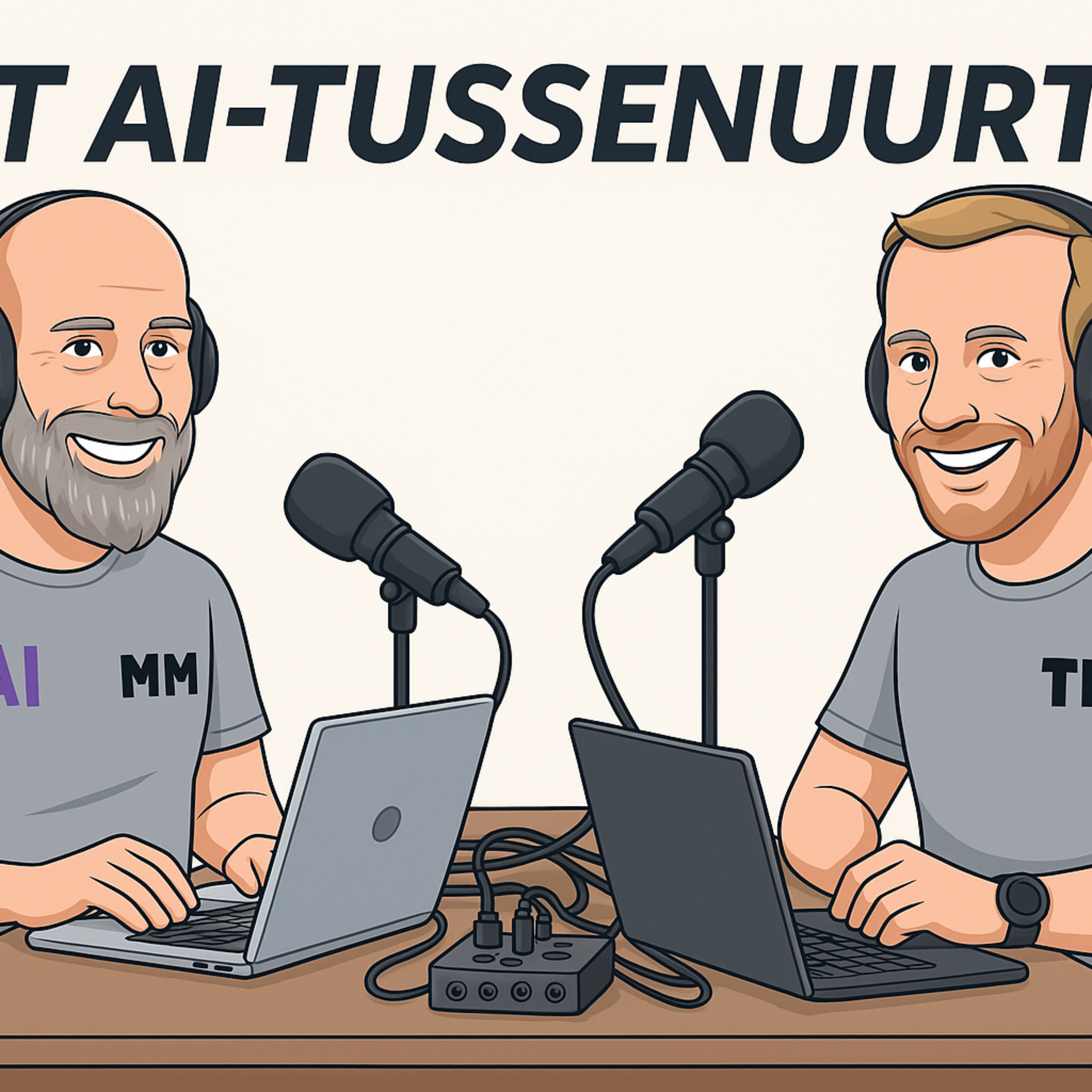
S02E04: Wanneer gaat AI al het nakijkwerk overnemen?
38m 23s
The transcription covers various topics related to AI, starting with debates on AI's role in taking over maintenance work. It discusses investments in AI language models, seniority bias in job markets due to AI, and the launch of a platform for AI skills certification by OpenAI. Additionally, it explores language model hallucinations and adjustments to improve reliability. Technical advancements in ChatGPT, including branching conversations, and Cloint AI for Office applications are highlighted. The conversation also touches on Apple's announcement of real-time translation in AirPods. Lastly, practical applications of AI in education, such as creating language learning websites using tools like ChatGPT and Cloint AI, are discussed.
Transcription
7314 Words, 39029 Characters
[Music]
Yes, there we are again. Welcome ladies and gentlemen, to the AI Tussen Uurtje, your weekly update on AI in the lower class.
We are Tom, Marcel, two teachers who don't only talk about AI, but also really fit into the class.
Today we are going to talk about when will AI take over all the maintenance work.
When or what?
Yes, we are going to talk about it.
I'm looking forward to it anyway. Let's go to the news first, of course.
Yes, Tom, before we go to the news, let's have a quiz.
Okay, come on, cool.
Name the car brand.
Yes.
[mimics car sounds]
A Max Verstappen Ferrari, something a bit faster.
This was a BMW.
Okay, yes.
There's one more.
[mimics car sounds]
Is this a car?
What's a DAF?
A DAF.
For the older listeners, is that a bike or what is that?
Yes, this is the only context that people are going to get rid of.
Okay.
Today we saw in the newspaper that ASML, or actually yesterday I think,
ASML and Dutch Trots, the chip machine manufacturer where the whole world needs that,
they pump 1.2 billion euros in mistral in French, European, they say then.
We call them as European language models.
Yes.
And there was an analysis in the newspaper, and there was a comparison.
I thought it was a bit too right.
They didn't have to do it as if mistral is just as good as the American top models,
but it's nice that the money goes in, and an American top model is a BMW.
And mistral is a DAF, and we walked on the street and you didn't know what a DAF was.
And our concierge said, what is a DAF?
And he said, pop, pop, pop, pop.
We just thought it was funny.
Yes, that was funny.
Yes, but I think it's important news.
You are immediately 1.2 billion, and I say, well, it's really money.
It's not like at GPT.nl that 13 million is pumped somewhere.
We have trust, if you think about it, I would like to have it.
But it's really about substantial money, but much less money than what is going to happen in America.
Yes, because Entropic has just had a new round where they pick up money.
And then you have it, what was it, 10 billion, 13 billion, in which they still have 1.5 billion to pay for the books they had stolen.
Yes.
Well, that's a different kind of behaviour, isn't it?
Yes, but positive.
Yes, very positive.
I am very happy with mistral, and we have at least something.
And I think we need a lot more money for that, but 1 billion is already a lot.
So I am happy with that.
1.2, yes, that comma always sounds smaller when you put something behind the comma.
Yes, it's just a lot of money.
That's true, isn't it?
Let's go to other news.
Yes, I actually have three news that touch each other, or where I see a report, but I would like to start with a news that last week,
actually just after we had recorded our podcast, and that is about an investigation.
And this is probably the beginning of a long-term investigation that is going to come, something that is already being played for a long time and that is now really going to happen.
An investigation in America, after the track and the impact of AI on those tracks.
Yes, and of course we often talked about it, and the shocking part about it, it was called by someone on Twitter as a "seniority biased technological shock".
Or sometimes.
Can you explain that?
Or sometimes.
At the moment that AI impact is making, it seems, are not the juniors with all AI skills, but the juniors that are asked.
And the juniors, those tracks that were 14% back in, so if you just finished your studies and you don't have any experience,
then suddenly there is less work for you, because that AI takes over your work, because a senior in that company does that with AI.
He does his old work plus your work.
That's kind of the interpretation, so to speak.
And that is quite intense, especially for education, not only descriptive for, say, the work, but we are the ones who teach the juniors.
And where do we put that? That falls between the wall and the ship.
Yes.
Yes, and then you immediately mentioned that you say that those seniors use AI very well.
I think it's right that if we give our students the good, that AI leadership, that they can add a lot now.
So yes, I'm quite surprised about these results.
But I think that we really have to go deeper this time, because I think it's a very interesting theme and very relevant for the research.
Yes, because I think it's a main theme.
Yes.
Really true, because I think that going around with the AI and young people, say, is not necessarily a golden combination.
I think there's a lot more behind it.
Okay, great.
We're going to do it.
Teezer.
The new thing that comes with it, in my experience, or I even think it's a regular reaction, not necessarily on the research, but on what is behind it.
The trend.
The trend is that OpenAI, the JPT company, is going to set up a jobs platform.
And that seems, actually, as described in the link.
But LinkedIn already exists and notabene microsoft is the biggest sponsor of OpenAI.
So it's actually a very strange, strange move.
And when I went deeper into that, what they want is actually a platform where you can give what your AI skills are.
And certified.
And you have to rate three times who separates that certificate.
OpenAI itself.
OpenAI itself.
Because you already have such a certification system.
You can do all kinds of online courses via OpenAI.
Then you can give on that platform.
I'm a black belt, i.e. JPT.
And then you have more opportunities on a job.
And I think that's really going to happen.
A lot of people are going to do that.
But it doesn't matter.
And JPT is used by 700 million people.
Maybe, let's say, 80 million Americans or so for 100 million.
If 10% is going to do that, you have a very big network.
And companies are going to think, well, if Pietje has a black belt and Jantje has a brown belt.
I do need someone who has those good AI skills.
Well, that sounds very logical.
Because something is going to happen on that labor market.
And they want to play on that.
It seems fresh to me.
Yes, and we would.
Because I think it's nice on my own.
That you make it visible what the qualities are on your CV.
Around AI skills.
But I think it's annoying to be certified by JPT.
Because it sounds quite limited.
I would actually want you as a teacher.
At the moment that a student is finished studying.
That's what the certificate says.
Just because you took care of yourself.
In your digital skills.
That's just one of the basic skills you need.
Well, I think that we are completely on one line here.
I think we say that AI skills just have to be a very important skill within the education.
That doesn't have to be somewhere outside what OpenEI is going to offer.
No, then we have to offer it in education.
But you do need AI skills teachers first.
And how you get that is that everyone has to listen to it in the middle of the hour.
And then it's a circle round.
Well, great.
I think that you see AI skills on more and more places.
We also saw in internal hand policy documents that that really becomes important.
And it's not only for the docent but also for the students.
Everyone, yes.
And you're not going to talk about AI if you don't know what it is.
I think I said the message behind it.
Well, great.
But the question is who does that?
And that's a bridge to the third news.
The wife of Donald Trump, Melanie.
She has called the Technoreus at each other.
In such a dinner.
And there they spoke about the AI skills and the schooling in AI areas.
What she is worried about is then the idea.
And the companies that give gas.
And it was already a while ago, I think a few months ago,
Gemini from Google said, or Google from Gemini.
All students in America look at free access to the pro account or plus account or so of Gemini.
So they can use the real model.
And just count on that OpenEI that it will also do.
And the American government is very much stimulating.
And then I thought, yes, of course, I thought, listen, of course you do that.
And the cynics say, then yes, they want to say, it is also partly so.
If you use Gemini in your study and you like that,
then you will probably use Gemini in your work as well.
Then you hook up to that system.
The less cynical look or the attachment, you can say,
is that it is actually, say, very much stimulated by the government
to put it in a mental center and to facilitate it.
And we have been very often going to facilitate it.
Everywhere we come, we ask the question, do they only have a free account?
Can they play for half an hour or do they have a free account?
Free and facilitated.
Well, that's all very complicated.
In America, that all just goes a bit faster, Tom.
Well, I get from this kind of report, in the end, they take it seriously.
Exactly.
That's what I get.
And that really goes a bit differently than what we do in the Netherlands or Europe.
They really go there very fast.
Yes, I ask myself, we're going to talk about politics again,
but why is this not a subject in the second room?
Why does the minister of education say, don't continue, wait a minute,
something very strange happens, among others in education,
and we are on the front of that revolution.
We have to make sure that.
I'm going to go from the script, because you're twerking it, right?
I had a post on LinkedIn ...
You're going to hallucinate.
I'm going to hallucinate.
I had a post on LinkedIn that the A.I. docenton that we have made,
that he, now, and then I'll talk about the paid version,
that he is just right in about 75%.
All the theory that the teacher must learn at the middle school.
And do you know what 75% is?
I think I have a pretty good picture.
And I think that all the docentons, if they try to do this themselves,
that you will come back very quickly, where they are good in a sense, not good in a sense.
But how powerful is that?
That we are already in 2025.
And I hear so few people here.
Look, in a few years, those things are really no longer to be thought of.
Everyone is going to use those things.
And we have to think very well, I think, how we are going to implement this.
We also received a message about ...
You can't say that A.I. is always bad in education,
you can't say that it is always good in education,
but it's about how we implement this, it's about timing, it's about ...
And that's exactly what we have to experiment with.
But you're triggered by thinking, why doesn't anyone have anything to do with it?
Well, this is also something, I really don't understand why people don't have anything to do with it,
why people are not experimenting with it,
why this is not being facilitated.
I think that's unbelievable.
Yes.
Well, there should be a podcast about it, actually.
I think that a lot of people are working on it,
but the people who have to facilitate it,
or who have to make the policy, at least nationally,
and I think that education institutions are also really busy with policy,
I don't hear that.
I think that's the most surprising thing.
But that just doesn't go through.
And I would, well, you don't really have to walk behind the trend,
something like that.
So S.Lands is a very nice example,
they already said it before,
we just go to the sea with that company,
I can find it from everything,
but our students are going to be led by A.I.
In America, they say this.
In the Netherlands, I think we say,
look, don't do anything that is dangerous or something like that.
Oh, take care.
Take care.
Yes, I feel that a bit.
But I just made a little bridge back to the script.
Very good.
I didn't deserve you to get rid of it,
I can't do that.
We just described it,
the next point is a new one,
about hallucinations.
Yes, I actually thought this was the news of the week.
Inherently.
Yes, sure.
Yes, I really thought this was very big.
It's about hallucinations,
and language models will know hallucinations, as we know.
And Opener has brought out a paper,
and they say, hey, we have come a little behind,
where that comes from.
And we can adapt this.
We can play it here.
Because what happens is,
if you get a kind of thought or a reward,
if it has something good,
and they have come behind,
if that thing is trained and it smells something,
then it has it sometimes good.
And if it doesn't smell, it never gets the reward.
And that's why it always smells.
And that's why it hallucinates.
Very quickly.
It's hallucinating.
Yes, exactly.
I don't know, but I don't say I don't know.
I'm just going to try,
because then I can get the reward.
Yes.
So we actually have a wrong reward signal,
in the pre-training.
Exactly.
Say, if the model is trained for the first time,
the moment they apply it,
because they did it in experiments,
that's the nice one,
then the chatbot will say, I don't know.
Because he is mainly worried about the truth,
especially to say how it really is.
Or what he really knows and what he doesn't know.
And that is very powerful.
I think this is very big news.
And what is important is that it also goes like this.
It also went as a running fire.
Because very often it was said,
hallucinators have an inherent ownership of language models.
It was never given an argument,
but then you believe it.
That's what people say.
That's obvious.
If you don't take that away,
then it's definitely not true.
And that's just not true.
And if you can't get it completely away,
but you know where it is,
and so you can do something about it.
Exactly.
Well, for the education, I would say for your 75%,
at the moment that 80% or 85%,
and at that 50% the chatbot doesn't say,
that's how it is, but I don't know.
That makes so much of it.
And then it can go to the internet,
make a tool call,
and then that's good again.
But I think it makes the reliability of the system a lot better.
Absolutely.
Yes, cool news.
We're going to bring it.
Yes, just a few more small ones,
because we've been doing it for a long time.
Yes, two technical things.
Yes, we're going to have new functions.
For example, in ChatGPT you now have branching.
So you have a certain conversation,
and then at some point you can branch the conversation.
So making some kind of duplication of the conversation.
And then you can go up different paths from a certain point.
Well, quite handy, a small one, but quite handy.
Yes, you say quite handy,
but it is very often that you are in a conversation
and think, I would like to know,
now I have a question, and what would happen if I
and then you lose the first conversation when you go back.
And now you can actually talk more from the same.
If you have a very nice talk line,
you can just make three or four variants of it.
I think that's going to have a lot of impact,
but it sounds like something small.
I don't think it's going to have a lot of impact,
but that's just my guess.
If it wasn't in the script,
I would have given it to me right away today.
Hey, second, I think it has more impact.
I don't believe in anything else.
That's now with the clothes,
and you still have to have the 100 euro subscription
that we have.
And clothes can now go very well with the office applications.
So with Word, with Excel, PowerPoint, that kind of thing.
And especially with Word and Excel,
it seems to be very, very good.
This really came out last night,
so we haven't really been able to test it yet.
You did a little bit.
Even Mollick was in any case very enthusiastic.
And this is, look, if that thing really makes
a very good Word document,
and Excel can work with templates,
with all sorts of formulas and all kinds of stuff,
I would be very excited about that.
So I'll play with that next week.
I had made a PowerPoint based on a very bad prompt.
And that made it, it was just quite serious
to think about and think about for a long time.
And I also got a PowerPoint and not a white page
with three points, which happened at Chatipati.
It looked really better, but it wasn't perfect yet.
And that was also a bad prompt.
But what I think, that even analysis,
look, Microsoft with that Office package
and Google also put a Chatbots in there.
So they actually try to get AI to their environment.
The Chatbots or the AI companies
try to get the Office to their environment.
Sort of a trick game, right?
Are you going to say, in Word,
are you going to ask Chatipati there?
Or are you going to ask Chatipati
to have a kind of Word canvas function,
where you can just work as a kind of Word program
in Chatipati.
If you understand what I mean.
And I think that this trick game is going to be won by AI.
I think so too.
And I think it's a very nice meta-analysis of you.
And I think that clothing here does a very good job.
Because if I say, for my work really serious things want to do,
you still have to go to the Office package,
but it doesn't have to anymore.
Because if you go to the Office package,
then you have to make a screenshot every time,
because it's very complicated.
Now you can just say to clothing,
here you have your Word assistant,
and you can work together and make it better and make it better.
It's again a clear step in the direction
that more and more things can be done.
We're going to make some time.
What else are we going to say?
Well, very briefly,
Apple has announced that the real-time translation
in the AirPods is coming.
Apple has told us that there will be real-time.
Is that how it works?
Yes, exactly.
And I think we've already seen that coming.
Of course, I think we mentioned that in the podcast last year.
But I think we also said before,
we have to have it again about language education.
Because there will be a lot of changes.
Yes, there will be a lot of changes with language in any case.
And that would have to have consequences
or could have for education.
Could have.
Come on, guys.
Do you have best practice, Tom?
Yes, I do.
A while ago I shared a Vibecode course online,
just free with all the films and some apps.
One of the easiest things was that I was in chat GPT.
You can also just Vibecode it.
Many people don't know that.
But you just put your hand on it and say,
"Make a simple app for..."
In this case, I did a flashcard app
for certain terms.
Then I had a teacher who told me,
"Tom, I've improved your thing.
Otherwise, you can take my thing.
You can go on with it again."
And he said, "I'm a language teacher."
And they had to learn certain words.
So I took your flashcard thing.
And then I put the words in it.
But I also have...
Because he was a Dungeons & Dragons fan
and he was very fond of gamification.
That the users had to fight against a beast.
Or something strong.
So you always had a profile and there was a beast
and you had to beat them if you chose the right words.
You share your application that you made in chat GPT.
You can share it.
And if you give it to me, then I have the option to use it.
But I can also iterate on it.
Exactly.
That is a kind of pass.
Yes, and that's what he did.
And I found it so creative.
I thought, "This is really fun."
He had gamified it completely.
And it worked immediately.
And he was able to share it with his students.
Of course, I thought, "This is exactly what we want."
But then I thought, "This is within chat GPT."
But of course, I have Clodocode within Cursor.
And I'm very good at Vibecode.
So I thought, "I can make this even cooler."
Are you going to overdo it?
Exactly.
I did that.
And now after four days that I was going to chat with you,
I made an environment.
It's a website called Taalkampioen.
I'm also going to share it on LinkedIn.
You can use it for free.
You can put your own words in it.
You can learn all the languages.
And you have all kinds of cool practice modes with all kinds of spells.
Just a kind of website that everyone can use for free to learn words.
And we have a few people who have already played this already.
Super enthusiastic.
That's Diolingo 2.0.
Yes, maybe.
But what I think is cool is that we inspire each other.
And we can build very cool things now.
That's nice, right?
Really.
We're going towards the main theme.
But before we do that,
find our podcast valuable, subscribe and give us a like.
We are now at 107 times five star Marcel.
That's nice, right?
We still want to see who does that.
Exactly.
And for more background information,
visit our website, ai-vordercenter.nl.
Then we have a sponsor.
And he has a new sponsor message.
So listen to it.
Colleagues.
On Wednesday, November 26th, it is just a real congress.
The place to discover what generative AI means to us education.
You can choose.
There are paths for starters, advanced, experts and creatives.
There is even an apart path for ethics.
There is something for everyone.
Think about inspiring keynotes and sessions of speakers
such as Technophilus of Rens van der Forst,
Professor Eric Likpostma, Pascal Mariani, Christophe Benoit,
Noelle Sicilia, Bart Meufels and Erdinc Satchan.
Of course, Tom Nabring of the AI "Tussenuur" is present
with a deep session about vibe coding.
Soon, a day full of ideas, inspiration
and specific approaches in your own class.
Call today at netechtcongress.nl
Yes, Marcia, was that AI or real or real?
I think it was a joke and they did it right.
I wasn't very enthusiastic about the name,
but then I heard your name.
Then I thought, here you get the money out of it.
No, I think it's a very nice list.
What are you going to do?
I'm going to tell you something about vibe coding
and we're going to talk about it.
You're not going to be afraid, are you?
Just do it.
Sure.
Nice.
We're going to talk about the main theme
and that is today when...
Or?
When AI will take over all the work.
Yes, if that's going to happen.
Because you don't see that yet.
Well, no, I'm complaining a bit.
I have the impression that you'd rather want it to happen
than tomorrow.
Sure.
I want to talk about it a bit on the other side.
Otherwise, it's going to be a story of a year and a half.
Maybe just for a moment.
I don't think it's possible now.
I don't think the AI is powerful enough at the moment
to take over all of that and that we don't need a human in the loop.
Oh, okay, so far so.
I think we're already quite far with the current AI
and that we can get a lot out of it.
I'm going to give a very concrete example of what's going on in the Netherlands.
It's an initiative called Eval.
You can also test that on eval.learnloop.nl.
I've looked into contact with the makers.
I have some extra information.
They have a demo you can do there.
And what they do there is a report you can use there.
Then there will be an AI that is actually going to take over for you.
It's going to help you a bit, but you're in the lead yourself.
So you're going to give yourself all sorts of things.
And it's also going to help with feedback.
If you're really in the lead to really make something out of it.
But how do you know?
Is there also a rubric in it?
Yes, exactly.
Okay, so you give yourself a report, rubric or formulate.
Yes, yes.
But you can also just do that with ChatGPT, right?
Of course.
But this is completely made for the help of watching.
And therefore it actually works much better than the standard ChatGPT.
And of course also from VibeCode.
We can all make applications that we make specifically for a specific application.
And well, this works very well.
I tried it myself.
And I really liked it.
They also indicate that they have already tested this at different high schools and universities.
And the teachers were very satisfied.
At this point they said, hey, this painting is about 10 to 20 minutes per stroke.
I thought, no, okay.
And the reliability was pretty high because that is really the human in the loop.
And they said that we now have a standard average of 0.67 points.
This is the worst start, so it only gets better.
But this is really a nice example of what it is now.
And this is now for sale.
But they also want to do this for tentamas, of course.
They also want to handwritten tentamas and they also want an LMS integration.
Well, I think that's very logical in the next steps.
I'm already interested in this.
Okay, nice.
Sounds good.
I'll go back a little bit.
Because you said a standard average of 0.67 points.
Put it out.
They tested what teachers would give themselves.
And so what it looks like in this tool.
And that's because the average average of 0.67 points means that it's pretty close.
Of course, you want it to be even closer.
Or maybe this tool is a little better.
Exactly, that was my question.
That would also be possible, indeed.
That's not allowed to say that.
But you want it to be pretty close.
It would be very weird if it was here or there.
But maybe it doesn't have to be one.
But maybe it depends on how well you know what the real answer is, I would say.
In my experience, I immediately go into that.
I think it's still right that I say, you can do this in Chattiparty.
I don't think it's that special.
I think it's a pretty rapper, personally.
So I think, yes.
But pretty rappers are fantastic.
That's true.
If you get to know their friendliness.
On the one hand, on the other hand, I think, guys, do it yourself in Chattiparty.
Make it through center, you read it, then you don't need it at all.
You can do it yourself.
You can control a lot with the prompt that is behind it.
That would be my point.
But that on the side.
I would think...
I'm completely lost in thought by this one.
What do I have to say now?
I don't know anymore.
Let's continue.
I'm going to take a step further.
I see, for example, that we are at CITO.
So at the exams where a lot of criticism is being made.
There are a lot of students on the front page.
We always talk about it.
The first student has to make a second student.
And they don't agree with each other.
They all have to do it within two weeks or so.
So that's a lot of criticism.
I think CITO has to put a lot of effort into that criticism with AI.
About a year and a half ago, I talked to them.
They were doing a lot more with that criticism with AI.
But not through LLMs.
I then had, I think it's very convenient to test that.
They don't believe that things are going to get even better.
They said with current technology that's not going to work at all.
But those things are much better now.
I think they did that a few weeks ago.
Or they have already told me what they did in Belgium with that criticism.
That that was very good, very fast.
So that we are really far away from looking at LLMs.
I think that within a few years that thing can just look better than people.
And then it is almost unanswered to let that criticism go through people.
Yes, that sounds very logical.
I am back to my thought path.
Okay, let's go.
Your thought is breaking, I don't think so.
But back to that 0.67.
My experience, and that's why I say I'd rather do it myself,
is that if I know what I want, I have a rubrics, I have a stroke,
I do that, then I go and test that 0.67 myself.
What is the feedback that the chatbot gives, what do I think of it?
I'm going to adjust that prompt, and at some point I'll get higher than 0.67.
That's my experience.
That just works, if you take that on.
Lower than 0, it's less, that's what you mean, right?
Higher is bad.
Okay, lower, lower.
That's how you read it.
So that the chatbot does more the same as what you would do.
Yes, exactly.
Exactly, that's good.
My question is then, and based on my experience,
my experience is that the chatbot actually looks terribly good in terms of content,
so he never says anything else than I do,
but the decision is different, because it's too mild.
That's my experience.
I've actually never said that before,
but that's very bad, that I think,
"Oh, that was very good."
It's always on one line, that's not so difficult,
but he gets that thing so far, that it's great,
and it's almost good, a nine.
I thought, "No, it's almost good, it's just a four."
So I think there's a lot more, the crux,
than that it's so complicated to let the current chatbot decide something right.
That can't be long.
Sure.
There can't be a four, I think.
The feedback is very good.
It's all about one.
I think that a lot of people have experienced that.
But what's the problem then?
Because then the only thing you need is to make sure
that that thing also says the same numbers,
so that it doesn't fill in the same number.
Exactly.
That's the question of prompting.
Yes, one.
What's the problem?
I think we'll have to go through this a lot more,
to test and implement it.
And I think that's what we've done with Eval,
which makes it much easier to use this.
That already helps a lot.
And that we're going to implement that,
that we're going to evaluate and test it,
and that we get more and more data from it.
"Hey, this just works very well."
So we're getting more and more trust in it,
that it works as we want it to.
I'm really on a different track.
Nice, isn't it?
Why then?
I think that you have to have your own regime.
I don't want to rap with people
who have made a prompt on the other side,
thinking that it's good.
I want to do that.
It's my strategy.
It's my rubrics.
I know what I want to see.
And why don't you just do it yourself?
Super easy.
But you're AI-led, and you want the same thing.
But for the normal standard teacher,
he just wants to upload his rubrics.
He wants to upload the document of the student.
And with the human in the loop,
he just wants to be able to do it easily.
He has to do that in chat.
And then you can do that very easily.
I'm serious, Tom.
At the moment we're going to call the whole time,
you have to do it by yourself.
So teachers have to do this.
That happens relatively massively.
That happens quite widely now.
That's very nice.
All kinds of training.
Then it would be my message.
Pacturgy, do it yourself.
Because a rapper means that
there is something in the back that you don't have a grip on anymore.
Doing it yourself means that you have a grip on yourself.
And it's not like you have to be very AI-led.
You have to know what you're hitting,
what your rubrics are and what you want.
You know that as a teacher.
Stop it, it's coming out.
It's possible now.
We're done with this discussion.
Go away with those rappers.
Just do it yourself.
But are you against all the rappers?
Because now you can say,
you can build this all yourself.
Yes, definitely.
I'm against rappers who attach the content for you.
They say you can't attach the content on the back.
And then you're against our AI-do center.
I would rather do it all myself.
Yes, I would also want them to do it all themselves.
But that's a lot of work.
No, I'm making use of it.
Because a lot of people don't know how it all works yet.
I want it to be used mainly.
So we can help them build rappers, AI-do centers,
where we think about prompting well.
So that other people don't have to do that.
In a sort of breaking phase.
He's also a bit against it, that's nice.
No, seriously, I think that you...
That I would like to make impact in the sense that I help the teacher
to do it himself.
To take care of how that chatbot reacts.
That we made AI for learning, I think it's very nice.
Because when we made that, there was really no one who could do that.
But I'm going to do all the workshops I'm going to give.
I'm going to say, you have to do this yourself.
Here you have AI for learning.
Test it.
And actually all the teachers say,
it doesn't do what I want.
But I know how I can build it myself.
That's what I want.
I don't want to go to our rappers.
They just have to do it themselves.
We have to break the exhibition.
We're going to fight here.
We're coming back like this.
We're going to take the headphones off.
That's nice, that's nice.
Yes, I think that you, with your expertise in prompting
and for example our AI-do centers,
we've made a lot of connections there.
There's a lot of didactics behind it.
There's content behind it.
There's pedagogical behind it.
A docent won't be able to do that.
And certainly a teacher,
because they're real users,
they're not going to use it in one go.
So it's very nice as other people,
you're already helping there.
And it's much easier in the use.
Yes, I don't know if that's the case.
I think we'll get to that.
Okay, then we'll get to that in the middle.
I've built a teaching environment
in which the docent can take a degree.
Exactly what I want.
But it's also a kind of rapper
that might make it easier.
They come together a little bit.
You stop there, you get to know each other.
But you can also give your didactics
and your pedagogics.
If you don't do that,
there's a standard story behind the rapper,
namely me.
Yes.
But I always give the one
who uses my teaching environment
the chance to adapt that.
If your rapper, Ivel, can do that too,
we're with each other.
When you can't give that input,
then I'm not alone.
Then I want to have my own degree in the docent.
Why don't you want to teach him?
If you say it's all that easy.
That's another discussion, I think.
I think and say all the time
that the docent is the one
who has the didactics, the pedagogics and the input.
Not the teacher.
He doesn't know that yet.
So you have to leave that to the teacher.
And not a company with a rapper.
That's my attitude.
Okay.
Agree to disagree at the moment.
Yes.
What I agree with is that it's nice
to learn from the docent.
It works very well.
But the danger is that the docent
thinks it works well.
And I can't do anything with it.
I don't have to do anything with it.
Or it doesn't work well enough.
You can do it yourself much better.
That's my message.
Yes.
I have the feeling that you expect a lot
from the docent at the moment.
Yes, but listen.
My listeners.
Those who listen to you.
No, they don't listen to anything from the docent.
They also do the didactics and the rubrics.
They also judge themselves.
They know everything they have to do.
Yes.
I don't see a problem in that.
Okay.
Let's go back to the discussion.
I wanted to make one step at Tutsing.
Yes.
And that's the process I want to look at
in the coming years.
I think that the AI will do
the first look at the first look at work.
Then I want to check if the student
is going to check if he is the only one
with the decision of the AI.
So that's going to look very critically.
And also after his own work.
He also learns a lot from us.
The student is standing on the right back.
And then we, as docentes, come to check
if the student has checked everything well
and whether we are the only ones there.
Okay.
For me, the student is standing on the right back.
The student learns from it.
And I also think that you will get a better judgment
than now.
And so much less work for the docent.
That's how I see it in 2028.
Let's put it that way.
Yes.
And then you start thinking about it.
Because this is still about a proposal, for example.
Or an exam.
Yes.
It's about an open question.
Yes.
Because we've always had that in mind.
I think and hope that, let's say,
looking at what now costs a lot of time,
that it will go away anyway,
because it's no longer valid.
So a proposal.
A proposal.
Yes.
No, a proposal we just don't have to give.
A proposal, that kind of thing.
You have to say that in the process, I would say.
Yes, yes, yes.
And then you've been working on it for a long time.
Yes.
Because then you ask the student,
write it with AI, write it yourself,
search for differences,
give me a brilliant prompt to improve that story.
We have a test-work-example,
exam, exam, exam.
Yes, yes, yes.
And then that can also be done.
Because then you give the letter with the answer key,
then you say, "I want to do it myself."
And then you check that.
And now you actually have AI in between,
which makes it go better very quickly.
You say, "Interesting.
I think that's actually strong.
I'm not even allowed to go into your interest."
Hey, this subject is a bit concluding.
Yes.
Where do you think we're going in the next few years,
what does AI mean that helps with the decision-making?
Well, I see two streams.
Yes.
Yes.
I see around me,
no, that's also true.
It fits our story, I think.
I see that there are all kinds of rappers,
say, that use the opportunities that are there now,
actually, but that make it easier,
they make it easier.
So your example, for example.
And that education institutions are there with it,
but if such a company can answer that correctly,
if it's anonymous, if it's AVG Proof,
if it's in Europe, all sorts of things,
that have been experimented with there,
and then it still takes a long time, I think,
and then it's going to happen.
On the other hand,
I see a lot of initiatives everywhere,
with teachers who do that on their own.
And who then maybe look at it with a blind eye,
to their policy piece.
Is it possible?
I think they already have their own approach,
I hope so,
to have the human in the loop.
So they say,
"Anonymous piece, I throw it in there.
"I have the rubric string, I have a little bit of a prompt.
"He does what I want, I have calibrated it twice,
"and now I'm going to shake the rest of it.
"But I'm not going to write that number on it,
"I'm going to give it a check.
"So those two come together somewhere.
"I don't know who's going to win.
Yes, I think we really have to experiment with it.
And also a little bit of rap,
because actually, we already say,
"A.I. is already at the level
"that it can look at it very well.
"And most of the teachers think this is one of the tasks
"that they would prefer to pay out to A.I.
"And there's something like,
"Oh no, we don't have to do that, dangerous and blah, blah, blah.
"We have to experiment with it now,
"what it means to me.
"And quite quickly,
"we have to bring this into practice.
Yes.
And if you follow the European Law,
there's a high risk,
because that's a summative measure
where you get a number,
in terms of understanding the life of a teacher or student.
And that means that you have to be in the loop
and that you carry out the final responsibility.
Is it more exciting than it is not?
No.
In the loop?
And that's what we're talking about.
No, and it may be that your organization says,
"We're not doing that,
"then you have to make a different conversation,
"but as long as it's not like that,
"100% agree, don't be afraid."
Just do it?
Just do it,
but make sure that you're the one
who gives the final judgment.
Yes, right?
Welcome to A.I.
This is Luque.
(upbeat music)
Podcast Summary
Key Points:
Discussion on AI taking over maintenance work.
ASML and Dutch Trots investing 1.2 billion euros in AI language models.
Impact of AI on job market and education, especially concerning seniority bias.
OpenAI launching a platform for AI skills certification.
Analysis of language models hallucinations and adjustments.
New features in ChatGPT and Cloint AI for Office applications.
Apple introducing real-time translation in AirPods.
Summary:
The transcription covers various topics related to AI, starting with debates on AI's role in taking over maintenance work. It discusses investments in AI language models, seniority bias in job markets due to AI, and the launch of a platform for AI skills certification by OpenAI. Additionally, it explores language model hallucinations and adjustments to improve reliability.
Technical advancements in ChatGPT, including branching conversations, and Cloint AI for Office applications are highlighted. The conversation also touches on Apple's announcement of real-time translation in AirPods. Lastly, practical applications of AI in education, such as creating language learning websites using tools like ChatGPT and Cloint AI, are discussed.
FAQs
The podcast discusses various aspects of AI, including news updates, AI skills, and the impact of AI on education.
The investment in mistral aims to enhance European language models and compete with American top models in the chip manufacturing industry.
AI skills are becoming increasingly important in education, with a focus on implementation, experimentation, and integration into various subjects.
ChatGPT now offers branching in conversations, while Clooding enables integration with Microsoft Office applications like Word and Excel for enhanced functionality.
Language models like Opener are working on resolving hallucinations by adjusting reward signals during training to improve accuracy and reliability.
Apple is set to launch real-time translation capabilities in AirPods, which could have implications for language education and communication.
Chat with AI
Loading...
Pro features
Go deeper with this episode
Unlock creator-grade tools that turn any transcript into show notes and subtitle files.
 PodcastTranscript AI