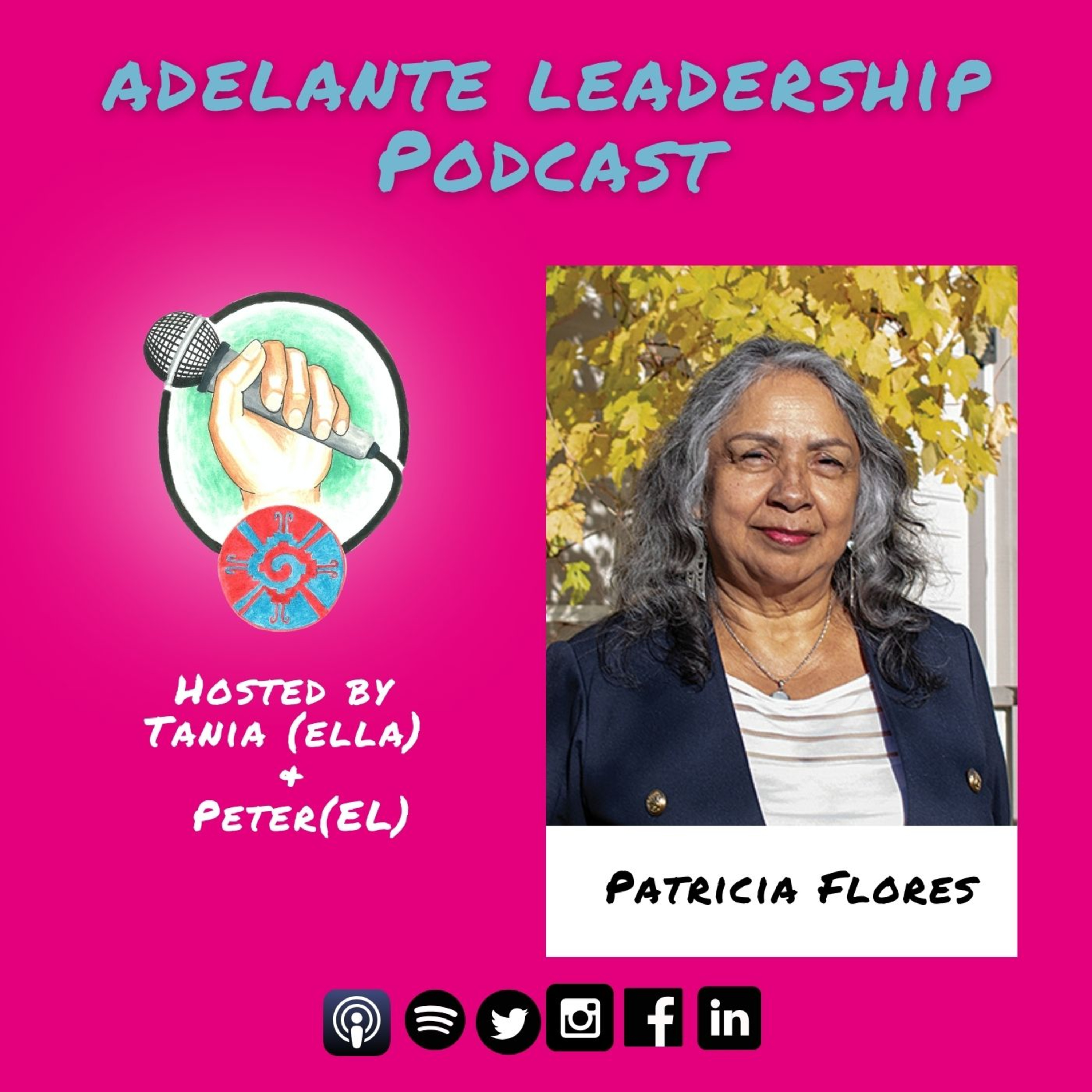
Patricia Flores, líder indígena chicana y coordinadora de programas de salud mental en Nami Seattle, comparte su historia profundamente arraigada en la comunidad de trabajadores agrícolas de Washington. Desde su infancia en un campamento de trabajo agrícola, donde vivió en condiciones difíciles pero con fuertes vínculos comunitarios, ha desarrollado una visión de liderazgo basada en la vulnerabilidad, la resiliencia y el cuidado mutuo. Para ella, la vulnerabilidad no es debilidad, sino una fuerza que fortalece la autenticidad y la conexión emocional. Su experiencia personal con traumas familiares —como el rechazo violento hacia su familia en una tienda y la pérdida de hijos por parte de su madre— ha moldeado su enfoque en la sanación del trauma como un proceso continuo y espiritual. En su trabajo de salud mental, Patricia desafía el estigma cultural y promueve un enfoque basado en la cultura, el respeto y el reconocimiento de la diversidad. Destaca la importancia de la conexión comunitaria, la humildad ancestral y la resistencia al aislamiento como pilares del liderazgo latino. Además, cuenta con una profunda vulnerabilidad actual al cuidar a su madre de 93 años con demencia, lo que la lleva a reconocer la fortaleza de la humanidad, la persistencia y el amor incondicional. Su mensaje es claro: la vulnerabilidad, cuando se vive con conciencia y en comunidad, transforma el liderazgo, permite un crecimiento profundo y fortalece el vínculo con el entorno y con la Tierra.
- Bienvenidos, bienvenidos to Adelante Leadership.
I'm happy to be your co-host with Peter Black Garcia.
I'm looking forward to learning together
from our incredible guests.
- Welcome to Adelante Leadership
and I'm happy to be your co-host with Tony Hino.
- In season four of Adelante Leadership,
we'll be diving into leadership, vulnerability,
self-reflection, and healing trauma.
- We practice our own vulnerability with our guests
in each episode when they share knowledge and wisdom
from their lived experiences and studies.
- And we will go more deeply into how vulnerability
is a strength in our Adelante Leadership
and why it's key to our leadership
and how we can access its power for more joyful life.
- Patricia Claude, Spanish language program coordinator.
Aja Sheefer, Patricia's a Washingtonian,
born and raised in central Washington
on the Jackima Reservation Toponiche.
She's an indigenous tutorial island
through her maternogram mother,
who's Sarah Wumaura, Mexico.
Patricia's and indigenous Chicana works at Nami, Seattle
as their Spanish program coordinator.
Ica Fritan, she enjoys communicating with nature,
dancing, and spending time with her family.
- Patricia, welcome to Adelante Leadership.
- Bienvenida Patricia.
- Gracias, gracias.
- So tell us Patricia, who are you and what's your story?
- Yes, my name is Patricia Flores.
I identify as an indigenous Chicana,
indigenous to Turtle Island.
My pronouns are Aja Sheefer.
And so I was the fourth of five kids
at my migrant farm working mother had,
Manuel Arroche Flores.
And the fifth of six kids of my immigrant farm working father,
who immigrated to the United States from Mexico
with his four-year-old son.
He was raised in Mexico by his maternal grandmother,
Gideon Asifuentes.
And was selling her food out in the community on the streets
and Biedras Negras at nine years old
to help the family survive.
And his mother and father, Aloy Flores and Consuelo,
Asifuentes Flores immigrated with the rest of the kids
to the United States to Texas during the Bracero Program Times.
And once my Abuelita Kirina passed away,
my father and his little boy came to the United States
to Texas to join the rest of the family.
So my mom was a migrant farm worker
and born in Casper, Wyoming.
So she was a first generation, right?
And those are my roots.
I'm indigenous through my maternal grandmother,
Ibolita Rocha Rivera.
And she belongs to the Taro Mara Nation, Raramuri
and spoke that language and learned Spanish for survival.
And they immigrated with their older kids,
which were still little,
but my mom was the youngest of seven
in the late 1920s.
And I just think of this foundation that I have
and it's just so powerful, so strong.
When I was born, as I said,
I was the second to the youngest child.
We were living in a hop labor camp
that's still there outside of Topanish,
the golding farms where my parents worked.
And so I was there for the first six years of my life,
which was really instrumental in,
it was my foundation.
And it was all Spanish-speaking community.
Many families, we had little,
the rooms we stayed in were concrete floors,
no indoor plumbing, wood stove.
My grandmother was out there, Ibolita, my mom's mom,
my maternal grandmother was out there also.
I was very close to my maternal grandmother.
And so for the first six years of my life, I was there.
And that's how I knew the world.
That was my whole world.
People arriving from work at the end of the day,
doing farm labor, planting harvesting,
tending to the crops in nature,
coming home exhausted, coming to their families,
eating their dinner,
and then going out in the spring and summer
and fall months to the lawn area, and just laying out there
and all the kids playing.
And I think of it as communal living.
And it was so beautiful.
We don't know as we're growing up,
where we are in the hierarchy and resources are many.
It's not just finances.
We were so rich in that.
And then my father ended up buying
a little tiny house in Topinish, a surupper.
And I began first grade in Topinish.
And that opened up a whole new world to me also.
So when that happened,
then my father became organized by Tomas Viennueva,
who many people know,
and is an amazing hero in our community
and activist and organizer,
and was invited in to the farm worker movement
that Tomas was leading.
So then, again, still very community oriented
because they would have regular meetings.
There was a lot of work to do like there is now.
And the whole family would go.
So again, the kids would be playing
at the first building that they bought in the basement.
That's where they'd have the meetings.
That building is still there in Topinish.
The kids would be playing
and the parents would be having their meeting
and organizing and figuring things out.
It was an amazing and successful time for them.
And so that is the beginning of my life,
which really set a strong foundation
for who I am during that time.
Every Saturday we would go to the local
Safeway grocery store.
My father had this old, old, old vehicle.
It was very embarrassing.
And my teens, I thought it was very embarrassing.
Now, I'm like, oh, that was amazing.
And we would go to the grocery store to get our grocery.
So my father's covered in dust from head to toe from working.
My mom and the three girls.
And my brother was already teenager.
He wasn't going to the grocery store with us.
And we got out of our car and there was this large white man
full of anger yelling at us, go back to Mexico.
I froze.
I froze fear.
I don't know if I had felt fear before that.
And I froze staring at him.
And he was so full of such anger.
And it scared me.
And I looked at my parents and head up, shoulders back.
They completely ignored him in you to walk.
And I looked at my sisters and my sisters were following them.
And I ran to catch up with them.
And they just kept going.
Didn't the beat.
They were there to get their groceries.
Their girls were with them.
They completely blocked him out.
It scared me so bad.
And we never talked about it.
But that action, like watching a silent movie of my parents
handling hate, was tremendous, tremendous.
And then, with the farm worker movement in top edition,
the '60s and those years and early '70s,
they had gotten funds for a summer program.
And I joined that program.
And it was amazing.
It had so many things for us to do that we hadn't done before.
And then they said, we have this action.
We're going to go protest and boycott letters and grapes
at the local safeway, would any of you--
and it was 12-year-olds and up--
that they were asking, would any of you
like to join us, my hand shot up.
Shot up, my spirit, my spirit.
Yes.
I said, I want to go.
And at 12, there I was.
And I didn't think about that a lot
until I'm asked these types of questions of who am I?
And why?
And so those were my early years.
And I knew, because I love my community,
and I identify, my community is the Spanish-speaking
immigrant community.
Love them so much.
I knew I wanted to work in the area of where
I would be using my Spanish and connecting with people.
And so that is who I am.
And also, another thing I remember
somebody telling me later, another activist organizer
that lived in the Golden Farms.
And some other people too, I'm the family, I think.
So my mom had a fifth grade education, my farm workers.
My grandmother did not want her to go to school after that.
And she learned English, she learned math.
And so in the Golden Farm with the Spanish speakers,
she would help people with correspondence they received,
sometimes with appointments, things like that.
So when you're raised in that kind of family,
that you help one another, that we are connected.
It was very powerful.
- It is beautiful how you describe who you are.
It's so rooted in your community self-care.
- Yes.
- And it's just beautiful because I think
community of self-care is so important
and it's so rooted in our culture.
- It is, it is.
The curanderas, even the people like my grandmother,
would do home remedies to take care of us.
And then when we moved into top niche,
we moved one block away from the community's curandera.
Donia Paula, who I was at her home
all the time playing with her children, right?
And so the living room, her living room,
was full of community who needed help.
And some would be holding eggs, fresh eggs.
Some would bring in a chicken.
Some would, the trading, it was trading, right?
Again, resources.
What are our resources?
And so just that childhood was priceless, priceless.
And I didn't realize, you know,
anything about essential workers,
low wage workers, all that.
I didn't, you know, I didn't know what category we are in.
I have a child, right?
I just know, you know, the work that my parents did,
but it was a beautiful way to grow up.
- So Patricia, you now are currently still serving
the community and you lead the mental health programs
in Spanish for Nami Seattle.
Share with folks about your work
and why it's important to you.
- Yes, it's mental health is part of our whole health,
our wholeness, and I hadn't ever thought
that I would be working at an organization
such as Nami Seattle.
Then I have, you know, a lot of experience
as a facilitator, as a trainer, as a presenter.
And not in this area, I've been learning.
It's been a huge learning curve and I love learning.
So it's been great.
And I knew I can connect with my community.
I know how to do that.
It's been very emotional because mental health,
there's such stigma around mental health.
And fear, and when we're dealing with fear,
we need to handle it so gently
with the people we're talking to.
And so a lot of my time has been processing
and thinking of what my delivery is to people,
how they receive me and what I know about my community.
And so what I know is that they don't know me
from Juanita over here.
They don't know who I am.
And so they need to get to know me.
So it's about connecting first
and building relationships and that takes time.
And that is not how our systems go.
Our systems do not honor that.
So it's been interesting.
I've loved it.
I bring my experiences to it.
The people see that, and it's been amazing.
I've taken many trainings to co-facilitate groups.
Mental health first day, all the sessions,
NAMI offers, and learning from my colleagues.
It's been amazing because it's such a sensitive topic.
It's very nuanced in our community.
Maybe in every community that,
but I don't know every community that I know ours.
And I know mainstream culture
because this is where I was born and raised.
What's NAMI do and what does it do for the community?
Yes, so NAMI stands for National Alliance
for Mental Illness.
NAMI was created by a mother in Seattle
whose young adult son was suffering from schizophrenia.
And she was looking for help
and not finding it in the 1970s.
And as mothers, as nurturers,
as parents, I should say, when our kids need something,
we will move mountains for them, for our family.
And so she did, she connected with others.
And so what we do is inform and share,
and support and connect.
So that's our mission in my words, right?
And that's what we do.
That is the work of NAMI
for the Spanish language programs.
Yeah, I'm so glad, Patricia, that you're there
to not only interpret translate,
but also use the cultural component
of what it is mental health to our community.
It's so important.
And like you said, if we have stereotypes
or some kind of taboo in mental health issues.
That word, yes.
I'm glad that you're changing it in an narrative
for our community.
Now, with our Latino community,
higher societies, under the scoring,
oppressive administration,
what do you advise to stay on course with our leadership?
Stay connected with each other.
We are many of us.
I'm not saying all because we're individuals.
We are like-minded, like-hearted.
Mr. Corazón, stay connected to each other
and to who we are.
Know who we are.
Know our roots.
Our history are on ancestral power.
Stay in that.
This is horrible.
What we're facing.
Our families haven't faced horrible things before.
Our ancestors have faced horrible things before.
My ancestors are indigenous.
We have faced genocide.
What we're facing now,
and we must stay in our power.
And we know what our power is.
And if we don't, come talk to me and let's talk about it.
Let's talk about it.
And I have questions for you.
And I will help you unearth, you know,
because we're all equals.
We're all equals.
I don't like hierarchal thinking and authoritative thinking.
And that's not part of indigenous beliefs.
It's a circle oriented.
So I'm talking to, you know, of course,
my friends, my community, my family.
And I'm like, nope, not gonna do that.
Not going to do that.
I'm not going down that rabbit hole.
And at some moments, I'm stronger than others, right?
Sometimes what we're witnessing is so painful to witness.
Like when I thought that man was going
to attack my father physically, it's so painful.
And it is traumatizing.
We cannot minimize the trauma.
It is traumatizing.
And it's retraumatizing.
And for the people doing this work,
it's secondary trauma.
It's their own trauma.
And then it's the trauma of others.
It is heavy.
It's heavy lifting.
And together, we have this.
We have this.
- It's beautiful.
I went to this conference last week.
And that reminds me of something a keynote speaker said there.
"Resist to love in isolation."
- Mmm.
- And I think that's not really. - Thank God, that is so.
- Yeah, exactly what you were just saying
is a perfect connection to the follow-up question,
which is what role do you think healing trauma plays
in advancing Latina leadership?
- I am a staunch advocate of healing trauma.
It's not easy.
I'm doing it all the time.
And it's exhausting.
And it's so critical and so necessary.
And the first thing is awareness.
Because we're such fighters.
Go, go, go.
We're going to fight.
I'm not going to talk about that.
My mother never talked about any of her trauma.
And she lost two babies before she had me.
In the late 1950s, talk about trauma
and not recovering from that trauma.
Because you don't talk about it.
So I believe the first step is to have time alone
and to think about things that are happening within us,
within our spirit and within our daily life.
And think about what has pained us,
what now triggers us or activates us in situations and why.
So it takes a certain amount of awareness
to handle our trauma and process it.
And it's like circle spirals.
Because just because you've processed a trauma
doesn't mean you're going to get to another place.
And you're going to have to process it again
at a different level.
Again, those nuances.
And I'm speaking from my own experience.
And so it's a continuum and it's continuous.
And that is powerful because we can't serve
from an empty cup.
So if I am wants insurances,
survival mode, or autopilot, I'm doing a disservice to myself and to humanity and to being here
on Mother Earth at this time.
And it's not a judgmental statement that I'm making, I'm talking about personal.
And we have people that aren't at the place that they can do it.
And we have to honor and respect that and meet them where they are, including the people
who don't have shelter, including the people, the humans who are out of their minds because
of drug addiction or schizophrenia, fill in the blank, they are doing the best they can.
And they have, they're still here and they're trying and honoring that in each human.
Yes.
Holding everybody's humanity for what they're trying, just a simple act of talking about
the experience will get you closer in healing trauma than to hold it in, to just continue
talking about it.
That in itself, it helps to release, to let go of trauma.
So thank you for sharing that.
Very true.
Thank you.
It's like it reduces the fear that we were holding on to a little bit, but able to speak
about it objectively, I think distances us from that fear or minimizes, naming it will
help to minimize it and talking about helps to minimize that fear, right?
Right.
You're already changing the narrative.
Yeah.
You're not minimizing your parents' experience.
Yeah.
Mm-hmm.
That's what they did, and not talking about it, it's not minimizing, but it's just that's
the way they dealt with it.
Now you're talking about it, it's already changing the narrative of what we need to do to let
go of the trauma in our bodies.
So thank you so much for talking about that.
Yes.
Yes.
And it's not doing that in handling it, to me, it's in a spiritual way with myself is
minimizing the power that that hate had, that he wanted to create fear.
Yes.
Exactly.
And my parents are like, not today, not today.
Nope, not today.
And that's exactly what we need to do with this immediate session right now.
Exactly.
Patricia, what does vulnerability mean to you and how has that been important in your
own leadership, practice, and journey?
Everything vulnerable to me is, every time it presents itself, the opportunity, evolving
to the next level of who I'm supposed to be.
And going through the vulnerability, which is uncomfortable, you get to the other side
and you're stronger and you're more of your authentic self.
It's very difficult for me to explain, but I'm coming from my spirit, right?
It just, it grows.
And we are in these little bodies, we're these huge spirits in these little containers.
And so when I go through something, the vulnerability, it's amazing.
But it took me a long time to get to that place, right?
A lot of evolving and a lot of iterations of Patricia.
What advice do you have for others to embrace their moments of vulnerability?
Again, I'll go back to self-awareness and getting to know, who am I?
And why am I the way I am and acknowledging all of it, the joy, the laughter, the pain,
the harm that has been done and has been done to us.
And that we've done, we've all done harm, we've all done harm.
And by that, I mean even with our thoughts and our words.
And so the awareness and one of the things I've heard is things in life do not get easier.
I forget where I heard this.
We get stronger with everything we handle and our authentic selves handling it.
No matter how tough and how scary it looks, we get stronger.
And then our cup fills up and we're able to pour that in someone else's cup who does
not have that.
And I think of my grandchildren who range in age from five years old to, well, soon to,
oh my gosh, to 32 years old, they're amazing, they're so amazing.
And right in the beginning, a little bit after my three grandsons were born, my three grand
daughters were born and they are 24 and two are 25.
And to be able to be where I'm at, again, I'm going to say spiritually because that's
my foundation and that goes to professionally, personally, everything and share and listen.
I don't know why it's different if it's because I'm a girl, I'm a grandma, but with the
girls and also the oppression of women.
We have the greatest conversations, the greatest conversations.
And so when I was asked to rise up and do better, I was co-facilitating a training for new
bees, we call them new bees, people who want to be sexual assault advocates in the community.
And so we were doing that training and in one of the evaluations I read, I want to hear
what it was like for you when you first began.
And I gasped, I was like, I know no whether to see less assault.
It's so embarrassing.
You know, being a beginner, we don't know.
We don't know what we don't know when we're learning.
And so I contracted, my first reaction was like, oh heck no, no, no, no, I can't share
that.
I'm going to be the consummate professional and talk to you about what's, this research
says.
And I'm like, oh my goodness.
And I just meditated on that and I thought about it and I thought, Mujer, if that is what
they're asking for and this is the work they're going to be doing, you better show up and
you better deliver it.
And so I did.
And I have not gone back since to feeling, you know, that contraction.
I'm like, now I get, I'm like, yes.
Wow.
That was powerful and itself that you said, this is what they need and this is what I'm
going to do.
Period.
Yes.
That's a must.
It's a must.
It's a must.
And then, you know, continuing to do, I'll say my inner work because humans, we are so
precarious and we're so varied and in work, we all show up together and we're so precarious
and very different people are at different places of their healing journey or of their
life journey, right, life and I've almost, I've almost, Patricia, what advice do you have
for the Latin leaders when they are in a majority white spaces and anxious to be vulnerable?
I would say everything I've set up to now to ponder that and take some time alone in
nature and ponder it some more and build up like people go to the gym and lift weights.
This is what we need to build up.
It's invisible.
This is what we need to build up and remember, and if you don't know, come talk to me, we
can talk about it, who you are and where we came from, powerful nations.
We came from powerful nations and that is why the people who are oppressing us, they're
afraid of us, they will never say it and so when we connect, join arms and come together,
we are forced to be reckoned with and that's happening now and I'm so excited about our
up and coming generations.
We have so much knowledge, you know, I'm in the older generation now which I can't believe
I'm like, how did I get here? Oh my gosh, the decades flew by and so I love working
with people in their 20s which at this position that I have now, I have the opportunity
to do because they are so powerful and they were born at this place in time and then here
we are and the fire is growing because of all of the generations coming together, honoring
each other and vulnerability is a superpower, I've heard that many times in other places
and it really is, it really is and at the beginning it's not easy because we are showing
up with our vasscon and posing and you know, flexing our muscles and this is me and don't
mess with me, okay and what's the next level?
Patricia, is there anything that we have not asked you that you would like to share?
Right now I'm getting emotional, what my vulnerability is right now, it's not about work, our
mom is 93 and she has dementia and you never think, you know, that this is going to happen
again, fill in the blank and that has been the most challenging
for me and to be vulnerable in that. And as one of her caregivers, you know, she lives with my
older sister. She is tough as nails and has always been and has been an amazing role model.
And the six-year-old in me is in pain because this can't be happening to my mom.
And she's still even with this. We just had a celebration for her 93rd birthday
in February. And my kids and her like, mom, she's good. She is good because she remembers them all.
They don't see what we see on a daily basis and as her caregivers. And I'm like, yes,
I know me whole. I know she's good. I know me. She's good. She is. And she is handling
something I think is very scary dementia, which I will not say to her, of course.
Like, she's handled every decade of her life. And I'm just like, I am blown away by that.
And so that is a new experience for me that I didn't want. And I've almost looked at this. Okay.
And it's beautiful. It's sacred. It's a sacred time. She just had a doctor appointment. Every doctor
she's had is like, I want to be like you. She doesn't have high blood pressure. She doesn't have
diabetes. They check her heart. They're like, she's amazing. She is amazing. And that's our
Indigenous blood. And she is handling dementia. Dementia is not handling her. She's handling
it. And I'm just like, I am in awe. She continues to be a role model. And humility.
Humility is a big part of our culture. And by that, I come from the Spanish-speaking
farm worker culture and humility. And with that, I think of confidence. The confidence I saw
on my parents. And many times we think of confidence as the Cresmas, the Canedis. No, that is not.
That is narcissism. Confidence is confiando en que somos nuestro super poder.
Patricia, thank you so much. This was lovely to get to know you better. I look forward
to continuing our work together.
Si, gracias, Tania. Y somos luchadores. We are fighters. We are fighters remember who we are
and we continue on. Thank you. Palante. Thank you for listening to this episode with Patricia
Flores about healing and mental health. Peter, tell us who's our guest in episode 19.
Bastion, partidas, asuna, a young leader pursuing his purpose to make the world a better place
through leadership for sustainability. Thank you for listening to Adelante leadership.
We hope this episode helped you reflect on your own vulnerability and the power of vulnerability
in your life. We welcome your comments on LinkedIn, Facebook, Instagram, and Apple. For more resources
and information, visit our website, www.adelanteleadership.com. We want to hear your thoughts, ideas,
and your Latina leadership story. Which is gracias para escuchar Adelante leadership.
Thank you for listening and stepping into your Latina leadership.
Podcast Summary
Key Points:
Patricia Flores, una líder indígena chicana, comparte su historia de raíces en la comunidad de trabajadores agrícolas de Turtle Island y su formación en valores de comunidad, resiliencia y autoayuda.
La vulnerabilidad se presenta como una fuerza transformadora en su liderazgo, permitiendo el crecimiento personal, la autenticidad y la conexión emocional con otros.
En su trabajo como coordinadora de programas de salud mental en español en Nami Seattle, Patricia combate el estigma y promueve un enfoque culturalmente sensible y empático.
La herencia de trauma familiar, especialmente el sufrimiento de su madre y la violencia experimentada en el pasado, es un pilar clave en su proceso de sanación y liderazgo.
La sanación del trauma requiere conciencia, procesamiento continuo y un enfoque espirituales, ya que no se trata de una solución final, sino de un camino en constante evolución.
Patricia enfatiza la importancia de la conexión comunitaria, la resistencia al aislamiento y la necesidad de estar enraizados en las raíces ancestrales para enfrentar injusticias.
El papel de la vulnerabilidad en espacios blancos dominantes requiere preparación personal, tiempo en la naturaleza y un proceso de fortalecimiento emocional y espiritual.
En su actualidad, enfrenta la vulnerabilidad con su madre de 93 años que padece demencia, destacando la fortaleza, la humildad y el ejemplo que ella sigue como rol modelo.
Summary:
Patricia Flores, líder indígena chicana y coordinadora de programas de salud mental en Nami Seattle, comparte su historia profundamente arraigada en la comunidad de trabajadores agrícolas de Washington. Desde su infancia en un campamento de trabajo agrícola, donde vivió en condiciones difíciles pero con fuertes vínculos comunitarios, ha desarrollado una visión de liderazgo basada en la vulnerabilidad, la resiliencia y el cuidado mutuo. Para ella, la vulnerabilidad no es debilidad, sino una fuerza que fortalece la autenticidad y la conexión emocional.
Su experiencia personal con traumas familiares —como el rechazo violento hacia su familia en una tienda y la pérdida de hijos por parte de su madre— ha moldeado su enfoque en la sanación del trauma como un proceso continuo y espiritual. En su trabajo de salud mental, Patricia desafía el estigma cultural y promueve un enfoque basado en la cultura, el respeto y el reconocimiento de la diversidad. Destaca la importancia de la conexión comunitaria, la humildad ancestral y la resistencia al aislamiento como pilares del liderazgo latino.
Además, cuenta con una profunda vulnerabilidad actual al cuidar a su madre de 93 años con demencia, lo que la lleva a reconocer la fortaleza de la humanidad, la persistencia y el amor incondicional. Su mensaje es claro: la vulnerabilidad, cuando se vive con conciencia y en comunidad, transforma el liderazgo, permite un crecimiento profundo y fortalece el vínculo con el entorno y con la Tierra.
FAQs
Para Patricia, la vulnerabilidad es una oportunidad para crecer y convertirse en una versión más auténtica de sí misma. Al enfrentarla, se fortalece y se vuelve más consciente de sí misma, lo que la ha transformado en una líder más empática y conectada con su esencia.
La sanación del trauma es esencial porque permite a las líderes reconectar con sus raíces y reconocer sus experiencias pasadas. Esto les permite actuar desde un lugar de equilibrio, no desde el modo de supervivencia, y ofrecer un liderazgo más auténtico y empático.
La salud mental es parte integral de la salud global, y Patricia trabaja en programas en español para conectar con su comunidad. Su enfoque es empático y respetuoso, ya que rompe con el estigma y promueve un diálogo abierto sobre emociones y experiencias personales.
Recomienda reflexionar en soledad, conectar con la naturaleza y fortalecer su propio camino interior. Destaca que la vulnerabilidad no es debilidad, sino una fuerza que permite conectar con otros y transformar el miedo en poder.
El trauma familiar, como el que vivió Patricia con su padre, impacta profundamente la forma en que las mujeres latinas se relacionan con el miedo, la autoridad y la vulnerabilidad, lo que las impulsa a construir liderazgos más resilientes y conscientes.
La conexión con la comunidad es fundamental, ya que permite compartir experiencias, fortalecer relaciones y mantener una identidad cultural fuerte. Patricia enfatiza que esta red de apoyo es clave para el crecimiento personal y profesional.
Chat with AI
Loading...
Pro features
Go deeper with this episode
Unlock creator-grade tools that turn any transcript into show notes and subtitle files.
 PodcastTranscript AI