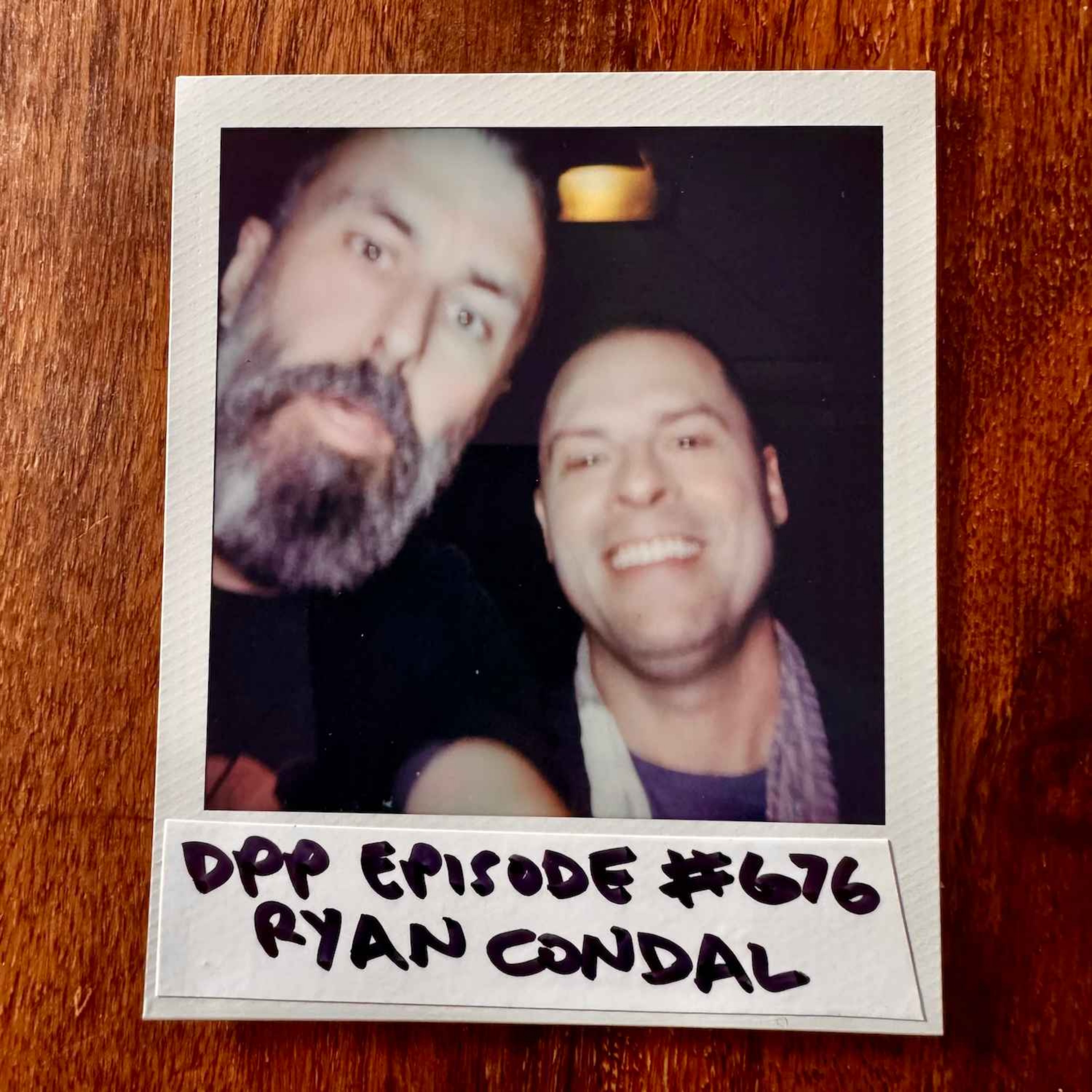
RYAN CONDAL • how to train your house of dragons, or, flight of the Condal (House Of The Dragon / Colony / Rampage) #676
from Distraction Pieces Podcast with Scroobius Pip
57m 53s
In this podcast episode, the host interviews Ryan Condole, showrunner of *House of the Dragon*, discussing the pressures of following the iconic *Game of Thrones*. Ryan explains that taking on the project was both exciting and daunting, especially during COVID, but he approached it as a "new puzzle" rather than a factory-line production. The host notes his own nervousness about being an actor on the show, but Ryan quickly acknowledges him, easing the tension. Ryan highlights the importance of casting Paddy Constantine as King Viserys to create a relatable leader, contrasting with the Mad King from the original series. A major creative risk was the time jump in season 1, replacing beloved young actors with older ones after five episodes. Ryan compares this to a character death, aiming to make audiences feel loss while trusting them to embrace the new cast. He emphasizes that making uncomfortable choices is essential to HBO's artistic legacy. The host also marvels at the production's scale, from dragon effects to sets built across multiple countries. Ryan notes that while working on such a huge show is intense, the process unfolds gradually, season by season. Ultimately, the conversation centers on the balance between fan expectations and creative integrity, with Ryan focusing on delivering the experience he would want as a fan himself.
Welcome, welcome, welcome, this is the distraction pieces podcast episode 676. And I'm joined today by Ryan Condole. This was such a good conversation. I've dead nervous about this, you know, because it was part of a big old press junket. And again, it's always mad when I get given a full hour, you know, in a press junket. So it's always a great, a great honor. But there was a lot of media types about I'll say that much, a lot of press, a lot of certain things going on. And I was sitting down to talk to Ryan Condole, the showrunner of House of the Dragon. But one of the reasons I was nervous is some of you will know I'm in an episode of House of the Dragon. But me and Ryan's paths never crossed. Therefore, it's slightly nerve-wracking because I'm like, right, when and where do I bring up that I was in the show? And some of you began, are you always bring up, you're in an act of. Yeah, sure, okay. You're allowed to think that. But if we're literally talking for an hour about a show I was in, it would be insane for me not to mention it. But do I mention it right at the start? Do I get halfway through and go, of course, because I was in the House of the Dragon? And my experience was this. But like that's the beauty of this conversation, is it's a unique insight? No one else has done a podcast with Ryan who's been on both sides of it. I'm a fan as well. I watched the first series before I was cast in the second series. I was already a fan. Thankfully, as I walked in, gold bless him. Ryan was like, "Ee, I know this guy." From series 2, and I was like, "Oh, great. I don't know if you're ever that awkward." I don't know if you're that awkward conversation or bring it up. Well, the awkward thing of. Because again, it's weird if we talk for like 20 minutes and I don't mention, I mean, if that's what we're talking about. Anyway, thankfully, you don't have to sit through any of that awkwardness. But something you should sit through is a little visit to speechdevelopmentreckles.com. We've all due as ever by speechdevelopmentreckles.com. We've got some very special stuff coming soon. I've got some new merch on its way from Mr Hegey. The sunglasses that always sell out have been restocked again. Feel your boots. And there'll be more good stuff coming in a month or so. We're also brought to you by patreon.com for a slash screwyest pip who already knew about these episodes. And twitch.tv/screwyestpipio where you can come and hang out and just have a good time really. Ask questions, chat, interact. Right, let's get into this show. It was so good to get such an insight into this huge, huge production. When Ryan took this on, it was easily the biggest project he'd been involved in. And that's a really interesting starting point. If you're a house of the dragon fan or not, that's a really interesting starting point to kind of chase something and then get it and then the thing you've got to worry about is delivering it. It's a weird one. So yeah, I love this conversation and I think you're going to love it too. Of course, House of the Dragon season 3 starts on June 22nd with seasons 1 and the season 2 available to stream now on sky, now and HBO Max. This is episode 676 of the distraction pieces podcast with Ryan Condo. Right, I'm here today with Ryan Condo. How are you, sir? I'm good. You're catching me early on, so I still have some energy. We've got a decent amount of time, so we can go all over the place here. But they've handed you over to me early. Hopefully, I'll hand you back in good condition, barely used. I'll tell you how you're feeling because it must be a weird mix of what's the balance of excitement and stress when there's a new series about to come out that your show running that you're on top of. Yeah, well, yeah, I mean, it's an interesting, these are always interesting moments because we've been working on this for over two years at this point. And really until a couple of weeks, only a very small group of people have even seen it or know what it is. So you're working in this very insular space for a long time and then suddenly it just you release it to the world. Yeah. And then it kind of takes on its own life at that point. So I mean, I'm not really nervous. I sort of, you know, those days are behind me, but it's an interesting period. And it feels, I don't know, it feels like you've been nurturing this thing. And then, you know, when you push down the nest, you want to make sure that it's ready to take wing. Yeah, completely dragon metaphor there for you. I love it. It's perfect because we've got a decent amount of time. Obviously, I want to talk a load about series three, but one of rewind back as well, because because as you say, you kind of, you're used to it now, you know, you're proud of what you're doing. How was that at the start? Because when you took on the job of following up, obviously, it's a prequel, but following up the biggest TV show of all time at that time. Yeah. It was the biggest gig you could have, but that's just because anyone who took it, it would have been the biggest gig at that point. Yeah. Exactly. How did that feel when you took that on and had that kind of that pressure? Yeah, I did say to, because I've been working on it for, I don't know, probably a year, a little over a year before they decided to pick us up to series. And I thought a call was coming in to say we're going to make a pilot, and which is very exciting in its own right. But the call came in and said we're picking up for 10. You're going straight to series and we're moving to Europe. So it was like a big, that was just a big moment in my life. And after explaining to my wife who had two small children at home with us at the time that we would be moving country and changing our lives, all at once I said, I said, also, this is going to be the thing in the parentheses next to my name in my eventual obituary because this was going to be certainly the biggest thing that I'd ever worked on just in terms of visibility, title, the franchise, the history of it, the future of it, all that. So it was a lot to take on, but these things come out you very fast but also very slow. So it takes two years to make one of these things. So you do have time to kind of brace yourself for it and get yourself acclimated to it. And so it was just, you know, scripted a time, a shoot day at a time, cutting an episode at a time, and then you release it into the world. So I think I did all right. You released it into the world so casually. There is so much that as it has an all built to that point. Talked to me a little bit about getting that call that it's going ahead because I think it's something that's not talked about much. I mean, but I'm an actor as well as you know. Yes. But the first time I got got cast in this big NBC show and we'd worked really hard to get in it. It was a new show. And when the contract came that was an option for seven series, the panic I had and I've not got a wife until young children. It was just like, oh, this could be the next 15 years of my life. Yeah. Is this and it was filming in Canada all this kind of, I mean, it got cancelled after one season. So that that that worry didn't come to fruition. But how was that in that moment to kind of go, we've worked really hard for this and it's happening. How do we feel about it as a family, as an individual? It's kind of too big to take in all at once. You just have to deal with the thing in front of you. This all happened during COVID by the way. So we were also locked in our houses. Same with the one I got. I think that's why it was so stressful. It's filming for seven months in isolation in Canada. Yeah. Yeah. And how is that going to work and how we changing countries during COVID? But look, it was it was the most exciting thing that happened to me. I mean, I've been working professionally at that point for 10 years. I was like a very gainfully employed script writer, television producer. I think it's another thing that's not known about much in this industry. I've got some good friends in in Craig Maizen and Kelly Marcel who are these writers who had been working and punching up scripts and having stuff in development close to getting made for years. So when a like with Craig, for example, when he does Chernobyl or the last of us, people are suddenly as the go did the hangover too. Yeah. Why is the go did the hangover too? God. Yeah. This huge TV show, but it's that unspoken about thing of you'd worked on a lot of scripts, a lot of shows, had a lot of things in in development and at different points. So the work had been done. You were kind of as ready as you can be. Yeah. I guess as ready as you can be for the new challenge. And really with television, each show is so different that I think I this is certainly the obviously the biggest thing I have ever done. It's the biggest thing. Most of the people that worked on the show have done a lot of people have much longer careers thus far than I do. Even doing the last show, even if I even if now having done this the next show I go on to, that's still going to be a whole new deal. So and I'm just it almost certainly will be a smaller thing. But because each show is unique in its its vision and the combination of talent and the cast that you're putting together, each one is a new puzzle to solve and that's what makes this business so interesting times and and and fraught but also creatively exciting because it's not it's not we're not in a widget factory. We're not just you know stamping out things on an assembly line. Each thing is this like handcrafted and you have to figure out what it is. And a lot of times you figure out what it is by actually making it so you're you're kind of doing it all at the same time. Yeah. And that certainly worked that way with what you know with this show. Yeah. And it really I think a new puzzle to solve is the perfect description of it because I loved Game of Thrones and I know when the first series was coming out I was like all right let's see how this goes because it's a big it's a big thing to follow. Oh so you're a book fan. No, no I was a
- I was a fan of the show when I was a show. - Yeah, yeah, yeah. - When you were a show came out, I was like, okay, let's see kind of how this comes together. And I think the key for me straight off the bat was you followed up this huge show, by putting together a cast of just insanely good actors. 'Cause the reality is the world and the dragons and the right in are gonna bring the grandness. So a friend of mine is Paddy Constantine. And I know he was nervous like when it first came. He wasn't sure if he wanted to be involved at first. And he said speaking to you and speaking to have a guy kind of convinced him. So how was that side of things like that? Are they sure choosing who you're gonna put in what roles and get selling them on the project, I guess? - Yeah, I mean, it's incredibly nerve-wracking because I've always said, you know, we were following the Beatles. And how do you follow them? You can't, you simply can't, you know? There were acts on the Ed Sullivan show. - Yeah, yeah, yeah, yeah. - That came, that literally came after the Beatles. And where that metaphor came from. And really, we just had to be our own thing. And, you know, I owe a lot to the legacy of that original series, which I deeply love. I mean, I was there on, I was a giant fan of the books. I was there the first night on the pilot aired. And then, you know, you can end up suddenly carrying the torch of legacy with this thing. And there's this whole fan base that's waiting. And everybody has their own POV on, you know, what the original show was and what your show should be and what should be next and what they want. And really, the way I just navigated my way through it was by just being, well, I'm a huge fan of this too. That's what got me this job essentially drew me to this. And I just wanna make the series that I would want to see an experience as a fan. And as long as I kind of keep that as my true North, I feel like I'll be okay. 'Cause certainly not every fan thinks the way that I do, but certainly there have to be lots of them that do. And I think that's a nice thing about the show is because it's another ensemble show with multi POVs, different types of stories even within the main story. There kind of is something for everybody. So whatever you came to Game of Thrones for, if it was for the political intrigue or for the relationships or for the dragons, for the action, we offer all those things just sort of, it's presented to you in different forms. So I had confidence that we, you know, we could provide, it's like going to a restaurant and like, you know, you wanna deliver sort of this, not the same meal every night, but you wanna deliver the same dining experience. So I felt like we could deliver the same dining experience. Is that great restaurant that we took over for? And the way to do that was just to stab it with the most talented people possible, which gets us to the cast, which is just, you know, and Patty was the first person that we cast in the show. And it was so important to figure out, well, who's gonna be our king? Somebody that is credible as a leader and a sovereign, somebody that could be feared and loved sort of in equal parts and somebody that we were really going to, you know, latch into emotionally and sympathetically, 'cause the king in the original series was this reviled person that you really just get, you know, snips and snaps of the Mad King, you know, Eris. So over time, but if his Eris had to be, the thing that Eris wasn't, - Yeah. - That's to say that he wasn't flawed, but he had to be very human and very relatable and at least understandable as to who he was. So so much of the casting came from that core piece of having Patty and then it's sort of like, well, who, you know, who do you think Patty Constanine's brother is? What about Matt Smith and then he ended up going and his daughter and going on from, you know, from there and so forth. - I love that. And I love, like you say, the key was dying true to what you would want as a fan. As there been anything that's been tempting to drift away from to take in a different direction. I mean, the reason I'm asking this is, there's the time jump in series one. - Yeah. - And people like Millie were so good. - Yeah. - I could completely see go, no, we need to do a bit more with these guys. And then thankfully, obviously, Emma and everyone are amazing as well. But watching that, I was like, oh man, I know this is going to jump forward, but I kind of want more time with these young versions of everyone. So how was that period to kind of go, oh, we almost cast this too well. - Yeah. - It's now I'm getting to be saying goodbye to people. - Yeah. - But we had to because those were the first people, you know, Millie and Emily Carey, we're going to be the two first people that you met and you hooked in with. And I love that everybody had that experience with them. And that's what we wanted. We wanted it to feel like a character death in a way. Because really, on episode six, in the first season, when we make the change over to Emma and Olivia, 10 years have passed and they're two entirely different people. Yes, they still all have the shared history, but so much has happened in that time. And the political machinations that have happened and their own maturity and them being sent off into their camps, so to speak, caused by political strife, their fathers, Damon, Otto Hightower and all that. And Viserys is sort of unbelievable abilities, sort of turn a blind eye to things that are uncomfortable to them. But we wanted to feel like a death, the death of a character and for you to have a longing for not only the two of them as people and those characters, but also that relationship that was never going to be seen again. You see, you know, snips of it through time. And of course, there's the vestiges of this very strong bond that the two of them share in their childhood. That, and that was the, that was the boldest ask that we made, not just of the audience, but of HBO at the beginning. Because we said, you know, the crown does this every two years and they seem to be doing very well at it. Well, we're going to do it five episodes into your first season. For its HBO and like a succession took four and a half series to kill the king. And then half a series of what happens afterwards if you killed the king like, and then it's all the aftermath. Every piece of the aftermath. So I mean, because just say how that has some doubts or concerns. That, that to me, the viscerous thing that happened at the end of episode eight of the first season. So that to me was more, that was an easier lock for them because it's like, okay, it's Game of Thrones. We accept the fact that there's going to be some turn over at King and some main character is likely going to die or main characters and it's going to change the game and it's going to create a power vacuum or a new sort of new world order. That was easier for them. And I don't think that was ever in question. So much of the first season is rooted around you loving the seris and then watching him die and seeing what happens and the mess that he left behind. Right. I mean, that's the concept of the series. The harder thing to do is convince them. We're going to cast these two stars. You're going to follow them for five episodes. And hopefully people will love them. And then they'll be really angry that you changed over these new two people who they're also going to love. They're just going to have to give them the same amount of time. And sure enough, here we are many years later. And nobody could see the series without Emma and Olivia either. So much of making television is being willing to make people uncomfortable and do things that they don't think they want because that is what makes art a challenging thing. There is comfort art all over the place. Beat reads and certain types of television shows. I mean, that's never what Game of Thrones has been. And that's not what House of the Dragon is either. We're not going to do the comfortable thing that you expect or want. We're going to keep you on your toes and on pins and needles. And that's also very HBO in reality. Exactly. Game of Thrones alone, but I always remember with the wire that be characters I loved that would then die. And you'd be like, yeah, I never want to watch this anymore. Then three seasons on your life. Who's that? Who's that guy? Sometimes die by nail gun, which is a death we have not. We have not done yet. And in House of the Dragon. I always remember it. So I moved into acting from music. And before I had an agent, I met with Nina Gold. And she was like Game of Thrones. Got to be in Game of Thrones. And then she emailed me about a month later saying, I've just got the new scripts. They're not adding anyone. Everyone's dying. But the rest of these last two seasons, just everyone dies. There's no, I can't help you. So it's a bloodbath. Yeah. Yeah. It's a mess. Well, talk to me about the stress of such a huge production. Because it is a huge production. I was blown away. I did. I've been part of the Star Wars universe and the Marvel universe. But genuinely, the sheer scale of dragons was just astounding. The filming in Spain on my days off. I'd walk around and just try and care people more sets and more bits that my character isn't in to take it all in. And then going back to Leesden and going, well, you've built Spain. You've got that here. And just seeing the scale of it all in the but how is that from your side of things? Because you're over a lot of it. Yeah. And it's big. It's meant, again, like Game of Thrones, Game of Thrones feels like it was one of the first series that was multiple countries. Like there's people who I now know who we were both in house of the dragon, but we never met. Because we were with these people. We were with these people. And just all divided over there. So how is that kind of that minefield of weaving it all together? Yeah. I mean, even characters like Olivia and Matt, Alison, Damon, they've been in two scenes together. Yes. They never see each other either. But it was the same on Game of Thrones. It was just this very disparate storytelling where you have this thread and this thread. And they all weave together. Or they don't. Sometimes the threads take seasons to weave together with two different characters. But the show has tons of POVs. You're chasing things all over the world. In many ways, this and the original Game of Thrones are so much like making a giant feature film, or multiple giant feature films all once. And I would dare to say that we're even more ambitious than at times than at least in terms of process and how things are made. Then a lot of the Marvel films are. A lot of the-- a lot of the-- because so much of those are now studio rooted and the location work is done. I can focus on one at a time. You're making four or five Marvel films at once. Yeah. So it's like an event.
Yeah, we're making like two of Ender's films. Yeah, yeah, yeah, yeah. 'Cause you have to chase all those characters around. But in terms of, we're still very location based. We go, we go to all these beautiful places in the world. You were lucky enough to go to Casseris in Spain. - Amazing. - And it's just the added these amazing places. Just on my day off, when I got there on a road, just walking around the bits that weren't set. And I was like, this is the drug. - Yeah, this is the place. - Yeah, it's a thousand year old medieval city. - It's incredible. It's incredible. And as you pointed out, we've recreated a lot of that on our back lot because you go to these ancient cities and they're UNESCO sites. So you can't burn it. You can't cover it in mud and then or shit. - You want an answer, bring a single dragon there. I didn't say a single dragon won't. - No, they may not. - The import fees between England and Spain were very tricky. But it's a lot to sit over. And really going into production, it's a bit preparing for a marathon because it is, we shoot for seven months, we shoot in multiple countries, we shoot two or three units at the same time. So, and obviously I can't be in multiple places at once, but there is a lot to chase around and there's a lot of prep that goes into, okay, this is our month where we're going to North Wales. That I'm going to be in the studio for two weeks of that four weeks or whatever it is. So I need to know what's going on those two weeks. So I can prep the covering writer, writer producer who's going to set to be working with the directors as they switch in and out and do their stuff. It's a lot to just keep your arms around. But thankfully, nobody does all of this stuff alone. Surrounded by a wonderful team of directors and producers and writers, writer producers who do the same sort of job that I do where you go and interact with the director on set and make sure the thing that's on the page is making the screen answer the actors questions. If they're struggling with something, hopefully, find something new that works that keeps the whole Lego set together and doesn't upset anything. And you're just trying to make it so that, by the time you get into post, you have everything you need to knit together into the television show that we're going to see in nine months. Yeah. How important is it to you to keep that kind of the tone and vibe on set, even when you can't be there? Because again, I've spoken a few times about how huge productions aren't always these warm, lovely, welcoming places, particularly if you're only in a few scenes. But dragons were so warm and welcoming and we'll get into the cast. But Sarah Hess, who was running things while we were out there, I'm midway, as we were discussing before we started rolling. My role was basically two days of screaming in the streets and about halfway through one of the days. So I just popped down and introduced myself and I had to respectfully, oh, I very much know who you were. It's okay. And she used to listen to my music in a writer's room in another show. She's like, I looked on the cool sheet. I was like, you're that screw-be-a-speak because I used to do music as well. And things like that, it was just like, this is the best job ever. I'm getting to have wonderful adventures. I'm shocked. There's only one screw-be-a-speak in the world. Can't believe it. How many we get in, but how important is that? Is that vibe in that tone? Because as you've said, it is a really complex, huge thing. And that can be stressful. It can be long hours. It can be hard on the actors, hard on the crew, hard on the writers, producers, everyone. But all my time there, it felt like everyone was genuinely enjoying it and genuinely happy to be there. And that's not been the case on every set. So how important is that? And how do you kind of keep that? I'm very glad to hear that. I think that's one of the things I'm proudest of. That is not a given. I think that does come down from the top. And it comes from-- it's me and also the people that I hire and choose to partner with over the mobile season. I mean, I've worked with Sarah longer than any creative relationship I've had in my life. Sarah and I have been together since 2019. And I couldn't do the show without her. She is my writing partner and the person that keeps the story moving when I can't be there. And the writers room, because we're in posts. And we're making the current season and trying to prep the next season all the same time. And then eventually it's the two of us passing script pages back and forth together. And she does a lot of set coverage and all that. But so much of what the show runs job is beyond just delivering great show that everybody likes. It's also creating the culture of the show and the set. And that's something that's always been really important to me. I have a family who I actually like and like to see. I want-- that's no a way to keep an eye. It's very true. But I happen to like them. And I want everybody to be able to-- I've never felt like this business you needed to choose between success and family. I think one thing feeds the other. And I think people that choose to have families that sort of underpinning and grounding and whatever can make you more successful as a-- I'm a better showrunner and a better writer for having kids and having a family and having this underpinning that also reminds me that we're not out here saving the world, guys. We're making-- we're a big circus. And we're making entertainment for the people. And that's an important thing. But I want people to come to this show and be happy to be here and work here. And yes, it's long hours and stressful. And sometimes you get driven half insane by it. But that's the nature of anything that's kind of worth doing. But if you go and look, we have so many people on this show that have been here since season one. And then anybody who joined in season two has been here since season two. And really the difference between the crew and season two and season three is very, very minimal. And I'm very proud of that. And I love that people-- people actually wait around and won't take jobs simply so that they're available for the year that it takes to make the show so that they can come back and work on it. Because now that it is what it is and the third season is coming, I think people feel a kind of shared ownership of it. And there is this kind of family element to it, where it's-- you know, you spend a lot of time together, and you travel to different countries. And you just-- you get to know each other really well. And you know, they're kids. And they're significant others. And I think that's-- it's a thing that doesn't-- not in a bun screen, but to me, it's such an important part of this being a fulfilling experience for me. Well, let's talk a little bit about season three. Because I think there's a beauty in network TV. I love streamers. I think they're wonderful. But I think network TV allows you slow builds and long-term storytelling in a way that you don't necessarily have a lot of the time with shows on streamers. And season one for me was well-building, brutal, beautiful world building. As you say, making a falling love with characters and then move on from them. And season two felt like this masterful long-term storytelling of a world on the verge of war, trying really hard not to go to war, which-- that's every episode of the news at the moment. So that's very familiar as well. So-- For sure. Talk to me about season three. Because I've watched the first two episodes. And you're not cold enough anymore. Oh, yeah. It's all that tension and building. And it's going, oh, you know, let's go. Yeah. I mean, this show has always been-- there are some shows like you invoke the wire, one of my favorite TV shows of all time. That was a multi-season show. And certainly the characters-- a lot of the characters-- you met in season one were there in season five. But that was very much like each season was its own individual thing in the case of the year. Whereas this show is really, at the end, the 30, whatever episodes we'll have at the end, it will be all just one story. And the season demarcation points, I think will be a lot less important when it's all available. And you can just watch it all at once. And certainly, I think a lot of people will do that over time at the end. So I get less sort of antsy about the end of season two and the beginning of season three. To me, it's like, where are we in the story? And yes, I'm aware that two years past between these very sorry about that. As you saw, it's a big production. It takes a year to film the show. And it takes seven to eight months to do post-production. That's what it takes. And that's why the show looks the way it does. And as the way it is, this is not a show you can release every summer. It's just not possible. But we pour into that this idea that we are making this kind of one story that's broken into these little subchapters or subsections or books. If you look at it that way. And the end of season two is very much to me the midpoint of the story. If you-- a lot of films are written in kind of a four-act structure where you have act one, the first half of act two, the midpoint, which is sort of the point of no return in Star Wars. It's when the in-line felt can get sucked into the Death Star. It's like, well, how are our heroes ever going to get out of this? I think that's the point where we find ourselves at the end of season two. And then from that point, somebody flicks the snowball and it starts rolling down the hill the other way. And there's a sense of inexorability and inevitability about that that I think has been kicked off at the end of season two. And we will see play out through season three and into this end game that's coming. But we had to earn our way there. And there are so many people to chase around and understanding the politics of the world and also owing to the fact that warfare and medieval times happened very slowly because large armies had to march over large swaths to the earth. We were trying to honor all that to make it feel as real as possible. But now it's all coming to a head. All roads are leading to kings landing. There are multiple people that want that throne either for themselves or for the person next to them or for somebody else. And it's going to be a pretty brutal end game here. And you very much see that from the first frame in season three. Yeah. You mentioned being true to the slow pace of war in this kind of era. How fun is that to play with from a right-and-pun view? Because it does mean as you say, there's a lot of characters who've spent hardly any time together. Who we all think of as all part of this show Master.
have had loads of scenes together, but Matt, as you said, the entirety of the last season was pretty much on his own. Almost. So, yeah, how is that to kind of go right? Well, what we want to do, or how is it to stay true to that? Because what we want to do is that's happened, so now this is the reaction. But that reaction might have to come in episode and half later, or a series like that kind of thing. So, yeah, how fun is that to come? I mean, sometimes it's a great boon for, you know, sometimes cellphones just ruin storytelling. There are so many great movies that would have been ruined by a cell phone. And this is one of them. But we do have we have Ravens and horses and dragons, so you can you can sometimes, dragons specifically. So, you know, our dragon riding characters can move from place to place fairly quickly in a credible way that doesn't seem like they just suddenly teleported. Sometimes you long for it would just be great if we could just have somebody pick up their cell phone and get this message. But then you need to send a rider or send a raven, or they don't learn it at all. And then you also have this kind of sense of a fog of war where just because a raven arrives and tells you something doesn't mean it actually is the truth. Sometimes these things are sent, you know, as as trickery or deceit, the sort of fog of war of it. And not all characters know the same thing at the same points because the travel information. Sometimes you have these armies that are on the road and how are they going to get information to them. And you can really lean into that because a lot of people are operating based on what they know at this moment. And it just because you've seen it as the audience over here doesn't mean that the characters all the way over there know that that thing happened. You know that it happened. But they didn't and that creates a lot of dramatic irony, which is, which is, you know, great fun. That's that's the storytelling where either you're ahead of the audience, you as the character in the story or the audience is ahead of you. Right? Or sometimes you know the same thing at the same at the same point. That's where we, that's how we create sort of tension and also mystery and storytelling to keep people, you want to keep people leaning forward and engage. You don't want to be a passive experience, you want to be an active experience. So a lot of the sort of, you know, drudgeries of medieval war, the like time that it takes, the fact that people can't quickly communicate with each other, you can really lean into in the creative storytelling. And other times it's like, oh, how do we, how do we get this, how do we get this piece of knowledge over there? Yeah. To that person so that we can do this other bit in the story. So it also has its, it has its benefits and its hazards. Well, with all your knowledge of it, then would you try to your cell phone for dragons, ravens and riders? I think, I think so. I wouldn't want to live in, I wouldn't want to live in this society from a sort of political place of, you know, what that means because basically unless you're the upper one percent of the upper one percent, like, don't have a great life. Medical care is also terrible, even for that top one percent. A lot of leaching, a lot of bleeding. But I think the simplicity of this world and the lack of the constant onslaught of things fighting for your attention, screens and all that, there is a nice bit of that. So I wish, I would like this to be like a little place in the holodeck. I would like a holodeck. Yeah. And I would like to be able to go here. But also if I need medical care, I would like to be able to step off the holodeck and go see a real doctor. How much does it take over your brain when you're in the midst of all this? Like, do you dream in, in West Ross? No, no. No. I have anxiety dreams, but it's more of like showrunner anxiety. Like showing up to the wrong set. Yeah, exactly. On a different show. Yeah. Yeah. Yeah. You're going to dream to ride in a dragon dream. Even if the complexities of changing this dragon. I wish my subconscious dream state brand was more forgiving and creative in that way. But now I just have, I just have like job anxiety dreams. Yeah. Instead. Well, I want to talk to you a little bit about the casting because again, I think on all of these shows, it is so key. And I want to know your kind of your level of involvement there. I was talking to Abbo recently and he was saying how when you rang him to tell him he'd got the role of Alan and who it was. He thought it was a crank call at first and didn't didn't believe that you were calling him to let know. I mean, I ruined it a bit by pretending that you also called me to tell me I was the funeral held. So I thought I really, I really was on his parade there. But, yeah, how involved do you in that in that side of it in the cast? Because it is key. It's it's crucial in these stories. Yeah. I mean, it is, you know, the buck stops me. I mean, I certainly consult with the other writer producers on the show, Sarah, specifically. The directors are always involved. And what I try to do is like, if it's a, if it's a, like, you know, your character who played in that one episode, that was Claire Killner's episode. So with those types of castings, I really prefer the director to step forward and kind of take the reins and then show me who, you know, who they would like to cast and then we have a conversation about it. Because I want them to kind of own the, you know, this is the person, you know, you're picking it's your episode. You have to get the performance out of them. But then you have these, these multi sort of the arc characters that sort of sit over either the whole series of this or the whole season of the show. And those are, you know, where I tend to get involved. But even that, I'm usually bringing a director into the room to read them with Kate Rhodes James, our awesome casting director, who's been with me since before the, you know, we even started prep on the show. I think she was the first, first crew member that we, you know, that I collaborated with. And, you know, she, I've come to trust her, her taste implicitly. She has exquisite tastes in actors. And she is a ability first casting director. She's not looking for, you know, a type or a look or something or somebody that has high profile at the moment. She's looking for the best actors. And that's really, that's the way that we have cast the show. And I think it's the reason we have such an interesting, deep, diverse cast of really fantastic actors. And a lot of them have, you know, proper sort of theatrical training. And that's not an accident. It comes from that's Kate's sort of, you know, philosophy methodology and casting. But then it's a beautiful combination. Like one of the castings that came to mind immediately, that one at silkwear was, was finding the twins. Yeah. Luke and Elliot, because they're both just amazing. And they're so good and they're so identical. I've hung out with both of them and been there for a while. Yeah. Which one of you did I spend time with this funny and which one have I met for the first pumps? So how was it? It finding those guys. Because again, they're not Elliot have the tattoos. That's the way that's the way it's held. But then, but then they put on the armor. And then you can't see that, you know, then you can't see anymore. And we always remembered Elliot was Eric E goes with the that's the way. I remember that was it that either. Locke, I think had had an issue where he's all had some kind of affection. Yeah. It was swelling up. I said nothing. Where's Elliot? Yeah. But you've got this is a rare situation where you can just swap. Yeah. We did. We did. We did. There's actually there's actually a scene in the end of season one where I think one of them had coven. Yeah. We were still in COVID protocol. So we actually go go look everybody can go up, see if you can figure it out where we actually Luke played Elliot in the scene and we got away with it because of just how identical they are. It's it's kind of a miracle. And I remember going to Kate with that role. And it's like, well, here's the story of these two twins are so identical in their own mother can tell them apart. They play this massive role in the show. And then they have dueling each other. And I said, good luck. I said, see if you can find us a set of twins. But otherwise I expect this is all going to be done with camera trickery and visual effects. Is someone who's a Billy E over anything else? That's really tough bit of casting. Yeah. Because like, yeah, Billy is a poor but they also have to be literally identical. Yeah. Yeah. And and man, she delivered it was incredible. I love those guys so much. It was it was a deeply painful to have to kill them off because of course it was a major that's a major moment. In the book and the assassination attempt on Reneer. So we had to do it. There was no way to not do it. But that was a tough that was a tough set of actors to say goodbye to on the same day. Yeah. I mean, I'm not going to go through everyone because I said the cast is in in saying, but you and Mitch was another one that I hadn't really seen him in anything prior to this. I think in this role as this character, it's just astounding. And and into season three as well, just the presence and the the growth of this terrifying character. How exciting was that to find that for that bit of casting because it's interesting because you cast him family as well. So as you've said, you're having to go, well, they have to be related and you know, it's not there are these weird extra caveats as such. Yeah. And many of them had to look like the younger counterpart who had already cast and been working with. So you know, again, good luck. Kate. But no, we casting the adult amand was a was a long process because we knew that was going to in many ways, he is going, I'm not going to reduce him to being the central villain of the series, but in many ways, he's carrying that torch often in the series. I think all of our characters have, you know, complexity and dimensionality about them where they can be villainous at one moment. And then you can see them as sympathetic and heroic. And I think Amand's character is no different. You'll see, I think see more of that here in season three. But yeah, it was a real it was a real challenge because we had to find somebody who was kind of terrifying just standing in the room. And I remember we went and read a couple people for Amand live as we were getting closer to casting and Kate had put you in forward. And he had been in things. He just wasn't, you know, a known sort of, oh, he played that character in that big franchise thing. So in a way, he was fresh to us, which I think we really didn't need because I think the thing that makes Amand unique and terrifying is the fact that like he's so unique and terrifying. Yeah. And I think if you knew him as the guy from Harry Potter or something like that, it wouldn't it wouldn't work as well as it does. I remember watching soap burn and the casting director.
of that was friend and I was like the cost was amazing that one guy. Yeah. Didn't realize it was him. I'd loved him. Yeah. As I'm getting all this. I was like, oh hang on. Yeah. And now he's in it. It's that guy. Yeah. And now he's in it. Emoral Phinell's sort of troop. Yeah. And he was the he was the the stable boy in with her with her in heights. Yeah. Yeah. But yeah, you can see he's got kind of tremendous amount of range. He's not he's not the terminator anime character that you know that he often is in our show. He plays him and plays him incredibly well. Yeah. But there's an incredible humanity and pathos to you. And I remember when he came in the room and read he came in in character and was terrifying. And he he blew us all the way. I walked out of the room and we all looked to Kate and we're like, is he always like that? Because like we want to know we're getting in. She's like, oh, no, no, no, no, he's like he's doing the thing. And he and we were very relieved by that. So I actually had a conversation with him on the phone afterwards. Just and he was he was you in whose this lovely warm person. So I was because I didn't know that I was ready to sign up for eight years of working with the T 1000. That's gonna say I'm off. He was so good. You weren't sure if you wanted to. Yeah. Even talking to him before he got into the into the reading. But no, he's a tremendously gifted young act and such an incredible athlete too. I mean, the things that we ask you and his character to do. Writing horses, dragons, sword fighting, you know, falling out of things really just and he does so much of it himself. I mean, just this incredible athlete who's so committed to that process of of learning the skill and craft of being a horseman and a knight and a swordsman. And it really it comes it shines through in the character and makes you believe what's on screen even more. Yeah, absolutely. You spoke earlier of the beauty of these ensemble worlds rather than shows almost is that there is something for everyone. But again, I think the true craft is the way these stories are woven together. So I want you to talk to me a little bit about the writing, the writer's room, all of that process because like in series two, the slow build, the slow builds of map stories and aboo stories while all hell was breaking loose for for live and Emma and and and and and Fabian and all these different things. What is the process of making sure all that runs together and that kind of each story gives the other room story to do what it needs to do if you know what I mean. Like from my music days, the good producers would always know that you need to leave space for the vocal or for the MC or whatever it might be whereas a lot of early producers are make a beat here you go. Whereas it's like no, we need to leave space for this this vocal to weave through. And that's what this show does. It has that kind of you and can be going absolutely insane and it might feel over the top of the whole show was like that because you've got like that slow build of aboo for it, realize new years and just being on the docs constantly. You know it's going somewhere. How does that all all come together in a writer's room or with the writers? Yeah, I mean it doesn't come together all at once. It's a simple answer. I mean this is this is the advantage of being able to iterate on something and it's why we always start writing the next season before we even stop filming the current season. So this you know the season wrapped in October. We were writing in September meeting sitting at the table and starting a break story just to give ourselves as much runway as we could because it is such an iterative process. This is not a story where we're telling from two points of view. It's a two-hand or whatever and not that those things are easy because you have to make those wonderful characterful pieces in order to carry that and be interesting for half an hour or an hour or whatever. We have 19 POV characters in the show and look some of them are you know that includes Damon and it includes like you know aboo Alan's character who in you know in season two doesn't it certainly doesn't have the prominence of like you know Alessent or Renera or Damon or or or even Damon or Egon but they still need three-dimensional arcs. So it really it's about the separate threads so we just lay out everybody's art the story that we want to tell from them that season you know Renera Damon, Alessent, Egon, Damon, Tulana you know Jace on down on down on the road the C snake through every character that we tell in POV and when I say POV it means that character can have a scene on their own they don't need somebody else they're plenty of characters that have scenes with Renera but you know like Alinda Massey has a scene has plenty of scenes with Renera or with Missaria but she doesn't have scenes of her you know on her own where she's in in POV and sometimes break that a little bit and a lot of those POV characters will interact be in each other's scenes of course but they also have their own thread and they have to have their own three-dimensional arc. So we kind of lay all those out we do a Damon and Renera relationship arc so what's there the beats of their relationship as a duo because we know they've had some interesting moments together through their time and we've done that every season since season two and on and then we start laying out okay well what are the moments and the things that sort of realize these beats we know we know they we want them to have a have a coming together or falling out but what is that coming together and falling out what is that scene and you sort of build these kind of you know sign posts or the tent poles that hold up the whole tent and you do that individually across all the arcs and then you have to weave it together and that's where I think the iterations come in because sometimes you really have to have it all laid out and almost have written drafts of the script to realize that like well this other character set of characters they're running around the woods over here doing x y and z but wouldn't it be great if that thing that they do bounces back and actually has an impact on this thing over here even though they don't interact the thing that they do creates a ripple effect through space and time to land on them and either they know that it was you know coal and gwayne that did that thing on their road adventure or they don't and it just makes it more interesting and that's where I think and that's where Game of Thrones did set you know such great work and weaving together these I mean they had I think they had even more POV characters than we did at their height and and also more disparate like ours ours can interact more because the show is so clustered around the riverlands the crown lands the you know that's that sort of that sort of world so you can get people together easier where they they have the north and across the sea and whatever yeah but this that comes from the going back to the script again and again and again just to make sure all those threads are neatly woven together in the jigsaw puzzle all fits together but that takes that really takes a year to do from sort of concept to okay we're sitting with all the cast the table read we're about to go shoot this thing and it's just it's time it's time and time and dedication that go into that. Wow. We've been that pro as I said you've spoken of all the different characters all the different stories that you get to play with how fun is it having dragons to throw in and mess about I told my goddaughter that we got to play with the dragons in between takes because although I wasn't in a scene with any dragons they were about and all they're so so they're all well trained they're all well trained I mean that's a nice thing they do exactly as we tell them to do because they are not real. Yeah I mean you know as a as a story point it is a it's a two-sided coin very much because it's great fun and I think that's what makes this series very unique versus the original is yeah sure there were dragons in that but they they took a long time to grow up and mature yeah and to become dangerous to like an army not just dangerous to a guy ours right out of the box we had them and we had more and we had them on kind of both sides of this conflict which creates this tonal theme or motif across the show of well what do you do in a medieval combat situation where you also have nuclear weapons yeah and both sides have nuclear weapons yeah and while they don't have the terminology for a concept like mutually assured destruction we as a modern audience looking in understand that this is the thing that they're struggling with and they know that if they push a thing too far all of the thing that you're fighting for Kingslani could just turn be turned to ash and then like what do we have at the end so it's a it's a bringsmanship story and a lot of the things the fits and starts that are in house of the dragon are because the other side has dragons and we have dragons and if we push if we put our dragons into play yes we could win or we could trigger a chain reaction that will result in the end of the world yeah and there are very few people in this story that I think would take that on as a as a an acceptable cost of doing business and there are some people that would but most of the people in this don't want the end of all things they want to win and they want to use the threat of dragons just as the threat of nuclear war has been used since 1945 here thankfully no to date although it is 2026 and you never know what there's around the corner to date you know nuclear war has not has not kicked off knowing that the other guy has that the finger on the button so to speak does keep things uncertain in check and it does keep a civility in about war to a point yeah and that's really a big part of the story is how far can we get how close can we get to the brink before that boulder starts you know falling down the other side of the hill and before all bets are off it's mad that a show about dragons and knights and warriors should be escapism and everything you've said this and so familiar it's just a world it's just our life yeah when is this metaphor good no it's still still fits still fits some ice in me but they're also I would also say the dragons can be very confounding at points because they are so powerful yeah that you have a drag we often have a vague our problem in the show like vague are so goddamn huge and powerful that he could really end things that well I mean I don't think a lot of people would be happy with what that end would look like yeah but sometimes the storytelling is challenged by the fact that you do have these all powerful kaiju gods in the mix and it makes an army sort of less threatening and formidable in cases so you have to wait fine ways well how do we how do we make that army threatening and formidable and that is leaning into the organic nature of dragons and the fact that they cannot be
all places at once and it's a big sky in a big world and just because the dragon was flying around up there doesn't mean that you're going to see it or it's going to be where your army is at that moment. It does create challenges in the storytelling where we constantly have to do dragon checks. So like where is this one? How quick can they get there? Can somebody get to them? Do we know where they are? Also, the organic creatures, they have a mind of their own, they need to eat, they need to rest and these are all big things that kind of come into play in the crafting of this crazy story. I love the idea in the right Israel and the people who are having to keep an eye on where the dragons are. Where's that? Where's your dragon? You meant to be keeping an eye on my dragon. That's easy now. We do lots of air speed discussion. We have a map of Westeros with strings from it that like how long does it take an army to march? How long a horse at full clip could ride between these two points? How long does it take a dragon to fly? We're constantly thinking about all these things. I love it. I've touched upon slow builds and long-term stories telling, but one thing that this world has traditionally been really known for is battles. How fun has it been to really get into some battles now? Because again, it was slow build and then it was the brink of war at the end of series two, series three. Yes. There's some battles. How fun has that been to be able to ride? Now we can get into this. It's the most fun and the biggest headache of making this show. I mean, talk about bringsmanship. Now we're in bringsmanship with ourselves because every time we do a thing, we then have to try to, you know, the next one has to outdo it. So we're in this kind of arms race with our own creativity and writing. But look, I think the Game of Thrones battle is its own genre. And I think the original show gave us a hell of a challenge to, you know, not to better anything because that's not the game that I'm in. But the bar that you're looking at, of like you have to deliver on this level of not only awe, spectacle, and creativity, but also on a character level. You know, the reason that, you know, some of the, you know, the reason the battle of the Black Water works so well is not because of the spectacle. And actually that was made at a time when they did not have the resources that the show has now. But it works because you care about all the characters in play. You care about Stanis and Davos and what is Tyrion going to be okay. And the stakes that are in play for Kings Landing and the people living in the city. Those are the things that we always have to start with like who, you know, who's story retined with the battle of the gull, it's like, well, who's story retined? Yes, we want to pull off the biggest naval battle in television history, maybe movie history. Let's see if we can do that. But also we have to care about what's going into that. And that's why you need those two seasons of buildup to get there because we have to understand who the C-snake is and who his son Allen is and who's on the other side with with Thailand and his his stakes in the matter and how he cares about Westros and putting his king on the throne, Shraco Lohar and her history not only with the C-snake and the triarchy, but also with Westros and her ambitions. And then you bring the dragon riders into the mix with with, you know, Jason and Bala and then, you know, Rana at some point. Yeah, it's a it's a big milieu and we start there. We sort of, okay, here's the ambition, big naval battle, who are the characters and then we sort of figure out who all those those are your POV points. So we're not seeing anything in the battle that's not told through one of those POVs. What are the little individual arcs that each of these characters are going to have in this battle. So we lay all those things out and they have we weave all these things together. So it's, I mean, it's the most challenging thing that we do and on a logistics level of like, okay, now we need a water tank and a dry tank and three different ship sets to pull this off. So it's another thing that takes, you know, that takes the better part of a year and a half to really bring together and figure out before you're sitting in the edit bay with all the, you know, the raw footage to put together. And there's, we have many of these giant battles set pieces to come in the show. So everyone is a new challenge to get bigger and better and more dramatic and emotional and and to tell the, you know, uses a dramatic storytelling device for the characters. Oh, that's the view of it. The emotion is there. Without giving any spoilers, there was a point in that first big battle that got me completely unexpectedly emotional and worried for an outcome. And yeah, I love that stuff. Well, you you've said that, you know, before you'd finished film in series 3s, right in head begun on series 4s, that is where you're ending the story, right? Is that is that fun? What in your mind have you got planned or what do you hope for for the big, the big, the big finale season? Really, just I mean, landing the plane. I think I think is the thing and it's so hard to make an ending. I mean, it's hard to make an ending in a movie. It's the thing that drives, I think writers and directors crazy is what's your third act? And this is the third act. And the end of a great story is set up right at the very beginning and the end is almost inevitable if you pay attention in the beginning. And I think, you know, we have the unique opportunity here to, because my previous television show, I did not get to end, it got canceled. In chapter 3 of a plan 5 chapters. So I have this, you know, great sort of opportunity here to go into a thing and know that we are ending it when we are ending it and to be able to plan to that for, you know, for years and two years in advance. And now we just have to, you know, now we just have to pull it together. But we have, you know, we have the book, this, even though that the history of fire and blood is not yet complete, this individual chapter of the history is fully written. So I know, I know what that thing is and we can plan to that and write to that. But it's a tremendous amount of responsibility because, you know, these giant franchises, you know, everybody, you know, comes to the end and they don't want it to go away. And I think that's why you get these really kind of often divided emotional opinions about the way a series ends because a lot of times it's just simply like not wanting it to not be there anymore. So we have to leave people wanting more, but also a sense of completeness and finality and maybe some, you know, bittersweetness and hope and tragedy. It's all weaving all those things together in a satisfied way that makes it feel like it was inevitable and set up from the very beginning. So that's no pressure to me. That's no pressure at all. And if there's any funerals that need held in, you, you give me a shout. You are my chosen funeral hero. I appreciate you taking this time. It's been an absolute joy to get into it. And I said, I've been lucky enough to watch the first couple of episodes and I can't write to get into the rest. So yeah, excited for all this ahead. Thank you. Thank you, man. You've been listening to Scroobe's Pips Distraction Pieces. There we go. That was Ryan Condol. I hope you enjoyed that as much as I did. I loved all of it. There's so many insights. I loved the realisation that the dragons are a nuclear threat, essentially. And the parallels and it's meant to be a scape is on, but it's kind of everyday life now. So yeah, as I said earlier, House of the Dragon Season 3 is on its way to HBO Max, June 22nd. Season 1 and 2 already there. And on Sky and on now, so binge them ahead of times if you want, if you've not already. There was an absolute joy to record. And I'll be back next week with more wonderful episodes. So don't you worry about that. Obviously, I'll be here Friday for the rewinds as well. So until then, stay safe and stay sane. Titta.
Podcast Summary
Key Points:
The podcast host is nervous about interviewing Ryan Condole, the showrunner of *House of the Dragon*, because the host also appears in the show and must awkwardly mention it.
Ryan Condole describes the experience of taking on the massive project as a "new puzzle," noting that each TV show is unique and requires handcrafted effort.
The decision to cast Paddy Constantine as King Viserys was crucial for creating a relatable and human leader, setting the tone for the ensemble cast.
A bold creative choice was the time jump in season 1, replacing young actors (Milly Alcock, Emily Carey) with older ones (Emma D'Arcy, Olivia Cooke) after five episodes, aiming to evoke a sense of loss akin to a character death.
The production scale is immense, with multiple countries and massive sets (e.g., Spain recreated in Leavesden), but Ryan emphasizes that making uncomfortable artistic choices is key to the show's HBO legacy.
Summary:
In this podcast episode, the host interviews Ryan Condole, showrunner of *House of the Dragon*, discussing the pressures of following the iconic *Game of Thrones*. Ryan explains that taking on the project was both exciting and daunting, especially during COVID, but he approached it as a "new puzzle" rather than a factory-line production. The host notes his own nervousness about being an actor on the show, but Ryan quickly acknowledges him, easing the tension.
Ryan highlights the importance of casting Paddy Constantine as King Viserys to create a relatable leader, contrasting with the Mad King from the original series. A major creative risk was the time jump in season 1, replacing beloved young actors with older ones after five episodes. Ryan compares this to a character death, aiming to make audiences feel loss while trusting them to embrace the new cast.
He emphasizes that making uncomfortable choices is essential to HBO's artistic legacy. The host also marvels at the production's scale, from dragon effects to sets built across multiple countries. Ryan notes that while working on such a huge show is intense, the process unfolds gradually, season by season.
Ultimately, the conversation centers on the balance between fan expectations and creative integrity, with Ryan focusing on delivering the experience he would want as a fan himself.
FAQs
Ryan Condole is the showrunner of House of the Dragon. The host was nervous because he is also an actor in the show and wasn't sure when to bring it up during the conversation.
He was excited but overwhelmed, as the call came during COVID and meant moving his family to Europe. He knew it would be the biggest project of his career.
He focused on making the show he would want to see as a fan, using that as his 'true north.' He aimed to deliver the same 'dining experience' as Game of Thrones with political intrigue, relationships, dragons, and action.
Paddy was the first cast member and needed to be a credible leader who could be feared and loved. Unlike the Mad King Aerys, Viserys had to be human and relatable, anchoring the entire series.
The jump was intended to feel like a character death, making audiences long for the younger versions. It was a bold move that required convincing HBO, but it paid off as fans grew to love Emma and Olivia in the roles.
The hardest part was convincing them to cast two stars for five episodes, let audiences fall in love with them, then switch to new actors. This uncomfortable creative choice was key to making the art challenging.
Chat with AI
Loading...
Pro features
Go deeper with this episode
Unlock creator-grade tools that turn any transcript into show notes and subtitle files.
 PodcastTranscript AI