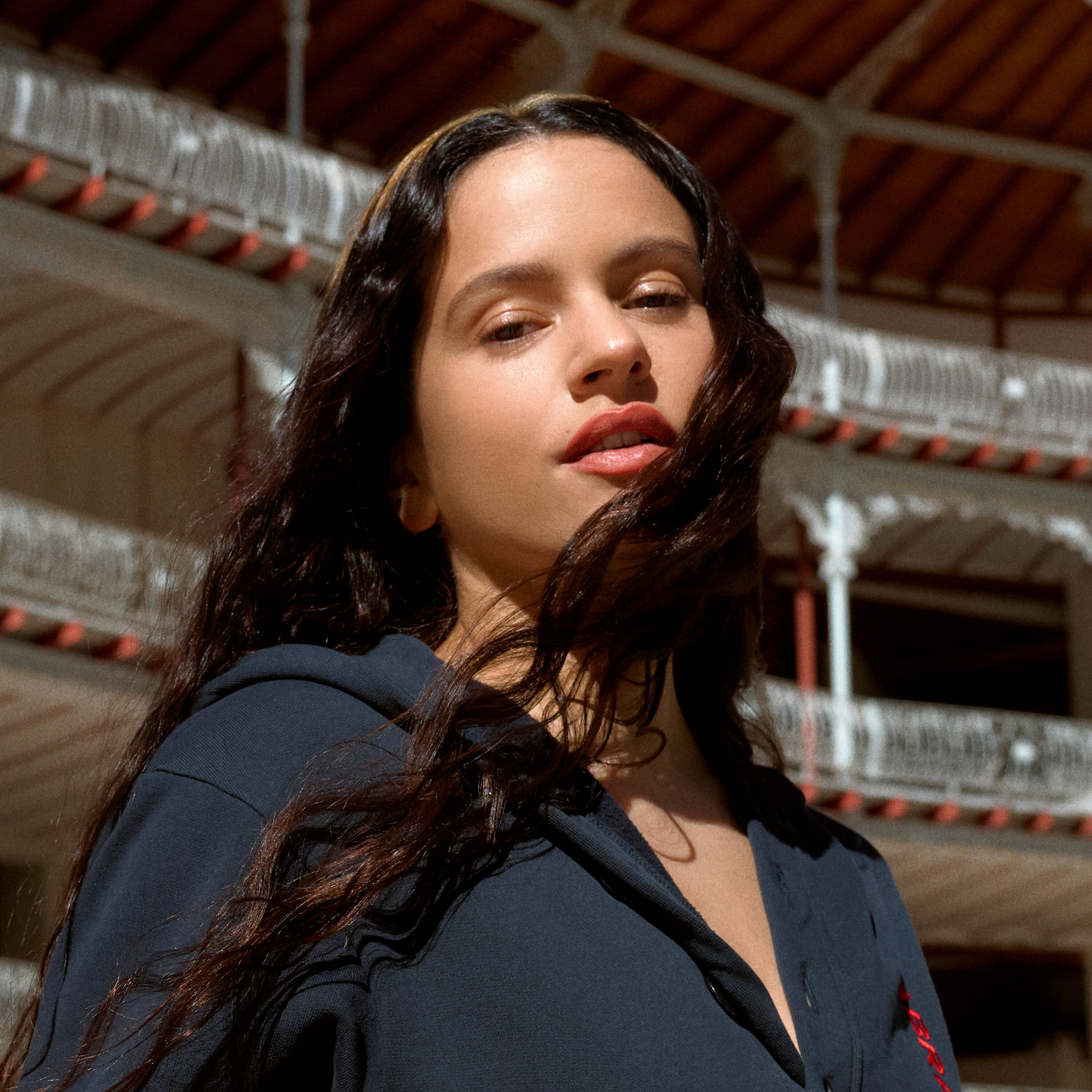
In this interview, the artist discusses her new album, which took three years to complete and represents a profound creative shift. She draws inspiration from Leonard Cohen’s quote about cracks letting in light, framing the album as an exploration of imperfection and spiritual possibility. To create it, she isolated herself for a year, studying theology and sainthood across global religions—from Christian saints to Hindu Rishis and Taoist immortals—and reading hagiographies, especially of women like Santa Rosa de Lima and Santa Clara de Asís. She aimed to channel their stories while embedding her own experiences, creating a blurry line between personal and universal. A major creative decision was to avoid loops and use only acoustic instruments, ensuring every sound felt human and every song was a journey rather than a shortcut. Her sister’s critique that she always "destroyed" songs pushed her to "finish the thought," leading to fuller, more developed compositions. The track "Aria" took a year to craft, involving study of operatic forms and extensive writing in Spanish before translation. The Japanese section in "Queen of Chaos" honors a saint who mutilated her face for acceptance, symbolizing extreme sacrifice. Ultimately, the artist embraces doubt and change as proof of life, accepting that growth demands leaving behind comfort and undergoing continuous transformation.
The Zane Low Interview Series. So much to talk to you about about this album. Thank you for making this. I love it. It's an album. That's the best. That's the best compliment. There's nobody can say it being. That's almost like a framework for this music. Thank you, mate. It's so much. You put it in there. But we're in Madrid and you're in chaos and you've locked your album here and you're running around, getting fine. You're sitting at politicians and doing what you should be doing. Oh my goodness. But it looked like you had a lot of fun. I just wanted to go see the Los Cartelis, go see the lights, you can go outside. And yeah, but it's a fun moment. It's a beautiful moment. You know when the album is finished finally and now it's about sharing it. It can be discouraging sometimes how long it takes, but I think it's teaching me patience. Each project is teaching me more patience. Well, you must have had so much patience to just get through this process of making this album because there's so much in it. Yes. I loved what you said about Linn and Cohen and the idea of finishing a record in the three stages. An area where it can just be very lost in it. It's no longer yours. It takes life of its own. There must have been many moments during the making of this, so that it felt that way. Oh, yes, because it's been three years. So all the things that can happen in three years, so many. But also I love that Leonan is a big inspiration. And I love that he used to say, which I would repeat a lot when I was making the album. He used to say, forget your perfect offering. There is a crack in everything. That's how the light gets in. And I think that I wanted the light to get in. And I wanted it to be called "Looks", how to make more space for the light to get in. I love that you refer to light as seen through the cracks. And not necessarily the light that's all around us at all times. Sometimes we shear ourselves from the light, but the light can be too bright. But you're right, the light that cracks in is different, isn't it? It's a glimmer of what's available to you, isn't yet revealed itself. Yes, yes, the possibility, the outside, and beyond. But when you're working on music, can you exist as a functional society or social way or do you need to consciously remove yourself from the normal, that side of being a human and a friend? Yeah, I think I kind of isolate. But at the same time, I listen to myself. I'm like, "Okay, it's been maybe a week that I don't see nobody except these friends that I'm working with in the studio, which I consider friends. Dylan, David, which I've been working with for six years at this point, an amazing engineer, Elio, he's became a friend here through this project. So, yeah, I feel like I hang a lot in the studio. It's a lot of hanging in the studio, but at the same time, there's a lot of being alone at home, writing, reading, writing, reading, just one year of that. It was an entire year. I remember guys were like, "We need you. We need to come back to the studio." And I was like, "I can't. No, I want. I have to make lyrics." And these lyrics are not good enough. I'm going to keep working on lyrics. I'm going to stay here working on lyrics until this is great. And then more music. When you were touring with your mom, you know, you were being in this brilliant modern loop that we're all in, which is like an album, tour, Lucy, like a song, maybe a collaboration. Yes. Doesn't feel like that. It's like you stopped that hard. Yes. This is what I need. I feel like I always do projects, find the excuse to study what I want to study and go through what I want to go through and feel like my heart is needing and it's craving. And in this case, it was reading more. And it was studying more. If I was not having a musical career, I would probably just be listening in college, teologia. I just wanted to be studying teologia. And that's what I kind of tried to, like, just study, learn more about spirituality. You know, ampliar, make, ampliar miseriesontes of what spirituality is. Understanding how sanehood it's understood and conceived differently depending on the cultures and religions, different religions. And how interesting is that, for example, in an internal Christianism, there's a very specific way of understanding sanehood. But then there's equivalence in other religions. So in an Hinduism, there's the Rishis, which are these Maestros sabios-bedicos. And those Vedas, then there's, I don't know, the Shian. They are immortals in the Tao. Zadikim, in Judaism. Those amigos de Dios, got friends, they call it in Islam. Like, they're all around the world. You can find different ways of understanding sanehood. And that was so interesting to me. I was like, okay, wait. There's all these stories about saints. I was trying to pull from, like, all these crazy, amazing stories from all around the world. I put a map of Munde in the room. And I started reading Hagiaographias, just reading, reading, reading, reading. And I just tried to, like, understand where did they come from, which was the language that would be spoken there. What was the story behind. So there was a lot of women, like, that were extremely interesting to me, that they were nuns, they were poets. And I was like, okay, I'm gonna read about them. I'm gonna read what they actually wrote. I'm gonna try to explain these stories. I think it's important to, while collecting stories about the other, I feel like, then making songs inspired in that. Like, I'm celebrating and giving love to the other, to the otherness, trying to understand the otherness better. It feels like no, this is like everything is so divided. And no, I want the opposite. I need the opposite. At least that's how it feels. The steep curiosity that informs this music, it is a huge part of what is so immersive for us about it. I'm always interested in how artists can move so deeply into, quote unquote, conceptual environments. But it has to be about you. It can't just be an essay about the past. I don't feel like it's about me. The songs you don't feel are about you. I think that it's an album that, fortunately, or unfortunately, it will have pieces of me, little pieces of me. But I think the best fiction is the fiction that has this blurry line. There's a blurry line, like the sweet spot, between what's personal and what's universal, what's detailed and what's abstract. Maybe what's implicit and what it's explicit. It's both. And so I think that, yeah, obviously, because I wrote it, there has to be some sort of truth for me in it. But at the same time, I think it's much more about the other than about myself, although there was going to be moments and specific things, journey, for example, relic. There has journey. There has been, I've been here and I've been there. But it's inspired in Santa Rosa del Lima and how her surrelicias are spread around the world. So there was so many like crazy coincidences when I was studying and learning about these stories. Santa Rosa de Palermo, Chile, Garbón, Bingen, Bimala. There was crazy stories. Santa Olga de Kiev, so many women, that, yeah, they were amazing. And I wanted to kind of, in a way, channel their stories. But I love the character studies that you created on this record. And but at the same time, the way that you perform these songs. The emotion that you still in these songs when you sing them. It's hard for me as a listener and a fan to not feel that you are feeling something deep within yourself. Personal growth. I agree. I think it's more internal. If we get to Magnolia, I can't believe at the end that you're not projecting forward into the end of what's been a wonderful adventure. To put the perfect ribbon on it. Yeah. Right? Kind of. Yes, but it's inspiring and under my ear. It's an amazing barrier. There was so many flowers, like it's crazy. And apparently everybody felt so in peace. Apparently everybody was outside. It felt so much peace and joy. And so for me, I was like, well, this is amazing to know that that happened. And I'm like, how would my, my, my, the world, how my barrier be? Maybe it's just about, please don't be sad when I die. Just please have a party. That was what, for me, what was I, what was I skiing? And in the back of my, in my back, I have tattooed that it's something that Manuel Molina wrote, which is my favorite writer in Spain. My favorite writer in Spain, he said, "Can anyone help me?" The day I die, is my most beautiful song, although it's a song with a pen. He's saying, "Betta nobody cry, the day that I die." It's more beautiful to cry even if you cry with someone.
sadness. So even if, okay, you're gonna have maybe other soul sadness, but still, like, just have fun, just enjoy. There must have been a lot of times during the making of this record though, when you thought it was a very powerful emotion. I kind of imagine working with the London Symphony Orchestra. Yeah, I mean, that's how I control it. That was crazy, that was crazy. I definitely had chills so many times. I can only make, definitely, making vocals, recording vocals. I don't think I have a great song much, making an album. I don't think I've ever, ever, ever create so much recording vocals. And I think that I didn't, I didn't maybe want to go through this before. I was like, I'm not ready. I know I had to do an album like this, but I wasn't ready. How did you know, how did you know that after Motomami, which was a resounding success, one of the most amazing tours, beautiful, high-concept art, dynamics, just a lot of movement, everything. I mean, you've got to be happy at the end of that. And how did you know that I have not gone deep enough? I need to, like, not even close. It's so different. There was something that my sister said that stuck with me when I played Motomami for her. What did she say? Okay, so we were in the car. I played for her. She pointed out this kind of musical to red or something. This sort of like, kind of like, why do you have to destroy the song always? Oh, yeah, that's pretty, right? That's my non-chalant. Yes, yes, yes. You want to get away with that. Yes, that's my non-chalant sister and my best friend, which I love so much. And she said that. And when she said nothing, I heard so bad because I was like, what are you talking about? I started fighting her. And I started being like, what are you talking about? No, no, no, because you don't get it. I'm trying to, yes, this makes sense. This is rough chunk here. But at the end of the day, it stuck with me because I'm like, wait, why do I make music? I make music for people to feel, right? And maybe they're going to feel the most if I really go all the way. Because maybe I'm not allowing myself to go all the way. Maybe I'm writing songs, but I'm not finishing the thought. So I was like, I'm going to make the next album. I promised myself I was going to make an album where I was going to at least try, at least try to finish the thought, finish the song, go all the way until the end. And I think that in this album, it allowed me to grow as a writer and as an arranger and as a producer because of that, because of going all the way and not trying to just break the song. No, like this is the thought. How far I can go with this thought? In a way, you still retain some loyalty to that idea of being free with arrangements and break things. And there are movements of the song. But because you're moving in a space that has long been considered archaic or ancient or old fashioned, you know, it's a dear working symphony, or rogue art and inspiration, things that you study. Like remember how it used to be hundreds of years ago. But why can't it be as powerful today as it was back then? And it definitely can. And I think that at least I'm always, my feeling is always I'm in service of the emotion. So yes, these albums don't have loops. And it's very intentional that it doesn't have loops that was kind of a rule. We were like, we were not going to do no loops. We have these in the back of our heads. Even at the end of the day, when it gets super fancy, can anxious. Yeah. Yes. Yes. Yes. Yes. It is no loop in it. It's played. Or the vocals. Even if there's like a repetition in a melody, still it's sung. There's there's like the conscious decision of not using loops. Humans. Yeah. So it's like how do I go from point A to point B? How do I, eh, come on, oh, how do I trans, come on, transito, so instead of from A to B, boom. Next. Yes. No, no, no, no, no, no, no, no. Go through the experience. As if the experience is the, the the most important is the journey. It's not about getting to from point A to B. It's go through it. Led yourself, go through it. And I wanted that it was acoustic instruments. Everything it feels, I think it feels like that human wood. It feels like the space. It feels entirely understood like the space. Yeah, material is a physicality. And so at the end of the day, you have the sense, the feeling that there's a human in there. There's humans in there. It's made by a human. It's about love and from love, hopefully. Well, love is an uninterrupted, unfissed, pure obsession. Then, judgments, conditional forgiveness, hate anger, violence, a lot of violence on this room. Also, also, an off of what I needed, I felt like I needed to be in it. I think we're going for example, but it's not the glorifying evil. As a protagonist, it feels like to me as a writer of this experience, either others experience brought to life through your filter or your own experience, the mixture of abstract and the literal. Yes. In the middle of all of that, there is confusion about what it all means. You asking if there is some? I'm asking you if it was written out of pure instinct or experience. That's a tough one. I think it starts with instinct. And I think that later, there's this moment where you just analyze with cold head, you are Kiruriko, Kiruriko, Kiruriko about it. But it's pretty much, I think everything usually, from it's pretty much intuitive. I don't rationalize it too much. I try to nurture myself with whatever I feel like I need to explain. And later, so I let it happen, intuitiveamente. If you nurture yourself the right way, you're going to be able to explain it, be the best of it and explain it. And so later, I think that I start rationalizing it when I see what I'm doing. I don't think I'm thinking what I'm doing, what I'm doing it. Okay, let me be specific about it. Me, Chris. Yeah, yeah. Okay, that one, it took me a whole year. I'm not surprised. I whole year through. Yeah, thank you for seeing it through. I remember a remarkable piece of music. But as a sentiment, a story, is it a generalized appreciation or is it a specific appreciation about one person, something specific? Because it's so delicately written. I think that the whole project has that balance. And definitely I found very, very beautiful, very inspiring. When I found out about Santa Clara de Asis, some Francisco de Asis, apparently they had this really, really, really strong friendship and this very strong bond. And that was beautiful. And I was like, okay, let me experience how to write about this about this friendship, how that would be. And you have friendship that is similar, you could create, you could refer back to your own experience in that way. I mean, the whole album has that, has a truth on what I've experienced for sure, because otherwise I couldn't write it, especially in Italy. I try to write first in Spanish, a lot, a lot, a lot of it. And then I would send it to a translator and also would use Google translate. So I would kind of like go back and forth with that for an entire year of writing. It took me a lot of attempts in front of the piano, I've tried to make the Aryan, I would remember, I would talk with Noah and I would say, I really want to make an Arya, I want to write an Arya, but I need time to study. I need time to understand how an Arya is. How an Arya is written, how usually the structures are or and let's see. And so it took me a year in Miami writing in Miami in this house in Miami. I finally found it. I found just improvising, I found the hook in the piano, very little notes with the left hand, just to understand a little bit how the chords could be. And then I brought it to a lay, I kept working on it and then one day finally I got to the studio and I was like, finally I have the Arya. What the Arya, what I say, what I call an Arya, I don't even know if it's an Arya, okay, but it didn't inspire you. Yes, it's, it honors that. The communication that comes through the record in multiple languages, 14 I think languages, but anytime that it switches from Catalan or Spanish and Japanese, it's very natural to the point where I had to look at the lyrics and be reminded that you was even singing in Japanese. Oh, that's me happy man, that makes me so happy. Because you made them your own, so why did you choose to have that moment of self-reflection, the Queen of Chaos, why did you choose to express that in Japanese? Because there's this saint, she was called. Rion and Genzo, she was a Japanese saint. And it was very interesting the story. Apparently she destroyed her face in order to be accepted. And to be accepted, to be. So, I wanted to get in that monastery and be accepted in it. And she destroyed her face in order to be admitted in it. And that woman, I felt like the story was insane. That was incredible. The level of sacrifice in order for her to achieve what she wanted. And also, maybe how a lot of times she's considered craziness. You know what's. an extreme can be considered craziness. It can be like catalogues in that way. Do you think that that was extreme to do that? Well, I told you that it's extreme or not. I think that this person has a different path and I'm nobody to judge a person's extreme around. Maybe for me as a Rosalia, it would be very hard to do something like that. Consider it maybe extreme for who I am. But I don't consider it extreme that for her she did that. But in a way, the fact that you've gone ahead and made something so different to what you did before and you've done so much staying and learning in order to get there. In a way that is. isn't it continued mutilation every time you reject something you've created before in order to grow and potentially lose people in the process and leave the things that could give you comfort behind? Isn't that just a form of. Yes, a hundred percent in a. Violent change in a weird way? Yes, and please, yes, every day. I hope that happens every day. I then it is. There will always be something that it dies and burns every day. And that every day you can choose who you are and every day you can understand who you are and can change every day. That's a discipline, isn't it? Because again, in your sub-stack and your birthday post you talked about the idea of wanting to stay in all the time, but then missing people's birthday parties and events and being like, "Man, I'm just going to not get invited anymore." People are just going to stop inviting me. There's foam over here. I'm missing out on it. So I guess the question is, the idea of having the courage to move forward and leave all that behind, is there a part of you that's asking you, "Sure, you've just achieved this and people want to see you and hear you like this?" But having doubt, it's a proof that you are alive. What you're doing is it's truly a life. Having doubt, it's faith. They say that faith, you know, there's a life because there's doubt in it. And I think here's the same. You know that you are here, the will here. If you are doubt about if you are here, no problem, you're feeling that doubt. That doubt is reminding you that you're alive that you are here. So yeah, I think that maybe the sacrifice, the sacrifice, I think that it's part of it. I accept it. I think I'm kind of in peace. The more I grow, the more I'm in peace with the fact that I'm going to miss so many things. I would like to spend the whole day just talking and biking and doing here, studying about this building and all of that, I would love to do. But I know that I won't be able to, maybe we'll just have this brief moment. So I won't into it. And I'm like, "Yeah, okay, this is how much I'm going to sit with you and I'm okay with it. I'm not trying to." Just a little, just enough. But it brings to light the idea of what is the present moment. Can you sit in the present moment? I'm always moving around. I would always be like this. So, you know, like I'm always, I want to always be moving, doing things. I have to remind myself, it's okay, chill, calm down. So yeah, I have a hard time being the present. How do you do that? Do you meditate? Like what? How do you find an inner peace? Where do you. Desiring less. Desiring less. I'm not meditating as much these days. I'm praying more. I'd give it all away. You talk about this on the album. And you even mention some of the trinkets and things that we. I'm learning. I'm learning, aren't you? I'm learning, I'm trying. I'm trying. It's okay because these word teaches you how to desire a lot. But don't teach you enough how to not desire. I want to learn more how to desire less. And that's what you pray about amongst other things. I pray to different things depending on what I'm lacking, what I'm missing more. If I'm lacking peace, inner peace, then I will do one type of prayer. But if I'm feeling in peace and I feel like there's so much that I have to celebrate it, then I pray and give thank you. I do more something that has to do with gratitude. And in the idea of searching for balance from something greater than yourself and asking for that from somewhere, what's at the top of your asking list? I think that sometimes it's not about asking. It's about listening. It's about stopping maybe in listening. Maybe about projecting yourself towards something that is bigger than you and that reminds you who you are, that reminds you your path. So sometimes it's about asking for guidance when you're unclear enough. Sometimes it's about asking for blessings for the people that you love. Sometimes it's asking about peace, more inner peace maybe. So it's time it's different. But I love this woman. She's called Alana Portero. She says that we should all pray even if you don't believe, even if you don't have faith. She says that even if your prayer is more like a pagan prayer, she says that's still okay. Because you are projecting yourself towards what's beyond you. And there's a way of getting rid of poison. And I like that. I think that we all do carry some sort of poison. We all have questions. We all carry questions. We all carry a stain. So I think that if you can, in a way, you can get closer to the source. You can get closer to what you're center. You can get closer to where you're supposed to be. Who are you supposed to be around it? Or what are you supposed to be around it with? Like if you understand that, I think you find more peace and you're happier than you. Life is just better. No, you're wrong. Yes. I gotta say something. I wish that I could play with you here to the game that they used to play at the Palotavaska. Because I feel like I'm enjoying these conversations so much. And you're so good at. To the right and to the right can be very wrong. Okay, did I think? Okay. I'm sure. I want to play more more games. I don't know enough. I don't play tennis. I don't play squash. Did you ever play sports when you were a kid? At all? I used to dance. Okay, that's a flutter. You used to dance when I was 16. I used to play soccer. Oh, you did? Did you like it? Did you? Did she be? She was amazing. She basically was a defender. She was a defense. And I was a conservative one who scored the goal. But you call it? Strika? Yes. I was thinking she was a defense. I think it's very much. It speaks to your relations? No, no. She strikes a lot too. But she defends me so much. I think I defend her a lot. Yeah, yeah. I mean, obviously that support that you have with family is incredibly important. I don't think you can make the decisions that you make. Take the risks you take with the confidence that you obviously have. Without knowing that there are people who are going to keep it very honest with you and have your back. Yeah, they come, I love it. My mother got my back. She always supported me so much. My dad also, like my sister, like I'm so like. Yeah, I have a really supportive father. You have a fun childhood? I could childhood. I think I know how I just get in my warmth. Like when I lose my mind. Basically, I would just always be in my head. And we having fun. We'll just do it clear a lot. And music played a huge role in disappearing into that space? I think that you know, yes, because I think I would dissociate a lot. And I think I would be singing a lot to my head. Like I think there was a lot of. just go, "Okay, melodies will get stuck." And I would stay in like a partition with that. And I wouldn't even listen to what is happening or nothing. I would just be here. And yeah, I think that music was really always there in a way. Yeah, God is a stalker. That's an impossible ledger size, okay? Yeah.
The first person trying, the first person of God in a song, it's an impossible. That's why it's already from a sense of humor point of view. - But in title, what the title suggests isn't necessarily what the song says. - It's just the most you think. - It's not literal. It's not like I don't feel like, you know, doing a character assassination on God's obsession with humanity or with yourself. It feels far more like, I'm not even sure who God is, sometimes on this record. Sometimes I feel like it's human form. It's in a relationship. Sometimes I think you're referring to yourself. - I think it's only perfect. It's in a perfect way because it's made from a human and it's the humans. So whatever it's made, human made, it will be imperfect. Just got it and the divine needs perfect. So yes, there will always be different ways of approaching it because I'm trying, it's a ledger size, an impossible ledger size, which is trying to put words and sounds into something that it's much beyond that. - And you said in your post as well that, you know, like I took into quote, "Land of Cohen," I hope I never find the one song you all have in us, right? The idea to have the space and the runway to create for as long as God will allow you to create. - To us. - And yet when I listen to this album, it's almost like it could be your life's work up to this point. It feels so powerful and impactful, like almost a desperation to get it all out onto one record. Is that, is that makes sense? - Damn. - Going so much into it. - That's interesting. I don't know what I felt though when I was doing it. It's that I don't know if something like this could be repeated. - Right. - I really have the feeling that this just sometimes come maybe once. I don't know if something like this could, at this level of intensity, I don't know if I could do it again. - Were you emotional when you finished it or just relieved? - I was about to have a mental breakdown. I really was about to because meeting the deadlines, there was a point where it was like, okay, if you really don't turn it in for the vinyl right now, this next, the next week, you have to release it next year. And I was like, something in me told me, like I really cannot miss this window. Even if it's so important, the, the, the time was creative and I always respect them so much, I knew this album had to come out in this year. I know it was now, something in me told me, this you cannot extend forever, Rosalia, like this has to come out, Aura. And then I pushed myself so much and, you know, say, I remember shaking all the time, like because that's how much the level of stress was. - What was the last song you were working on when you knew this time to start? - All of them at the same time. - Oh, wow. - It's always all of it at the same time. It's always such a like process of, there's still simultaneum, everything at the same time, everything happening at the same time. And I'm trying to learn how to exist with these uncertainty and all these things happening at the same time. And it felt like I had to abandon it and I had to like just send it to, to be pressed in the vinyl and then it changed more things. (laughs) For the digital and some songs are a little bit different on the vinyl. Yeah, 'cause it's been processed, it's been processed through making this, this project, in different stages of it. - How long did you work with London Symphony Orchestra 4? - Very little. I like maybe three days or something, three or four days. - You did all of this in three or four days? - Everything was written, everything was arranged, everything was done with so much like precision for us to go there, get there with the last partituras, with the scores and be like, this is exactly what it needs to happen. This is what we wanted it to be. We're just gonna try a couple like in different intentions. Maybe you know, more pianissimo or less, or we're gonna try this and that, but we had to be very precise. We had to be very much like, okay, no, actually, this should be metallic, so no, actually, this should be just a timpani doing this or that. But it always written, like I remember, porcelana, the hook of porcelana, it was inspired in a mappiano type of bass, but with a timpani, and we had that very much written, and it was just getting to the studio and being like, this is the line, this is the melody line we need, boom, we recorded. So super chirurhico. There are songs on this record which, if you wanted to take them away and individualize them and present them before the album came out or do videos too, that would go, okay, that is a pure extension of the rose that we know, right? But you decided to introduce the album with Birkheim, which is like, yes, yes, yes. Which I love, and it's, I mean, it's so beautiful, but so front-foot aggressive, it starts aggressive, it leads to my insid aggressive, the statement is just so powerful. So can you speak to the thinking process behind saying, hey, I'm back, eat this. - Well, I know it though, I know it. I think the music piece, it's represent the representative of the orchestra's intention throughout the album. And also I think that I really want an artist, does that to me. I really like when an artist slaps me. (laughing) Just like it's doing something that I didn't, maybe it doesn't move musically, that I didn't see coming. Maybe just, just-- - Provocation to some degree. - It's a little, I can't just provocation. - Yeah, you're in there. - Just a little, not too much, but I feel like the album starts gentle. I have the intention of starting in a soft way. So I think that when people experience the project in the album, they will have the gentle feeling that I think it's so present throughout the album. But then, a way of saying, we are not gonna do a motomami again. That's releasing Berkain. The release in Berkain first, it's releasing that and saying, this is what we, And also, it's one of the most that are intervened So I think that it's interesting that how much the song is pushed in that one. The orchestra song is pushed in that one. And it has all the elements. I feel like it has it all. It has the full orchestra, it has the full choir, it has it all. And I think maybe it's the way of saying, motomami was minimalist, few elements. This is maximalism. - Yes. - Like, not a lista. - Yes, yes. - A lot, you know, big. And so I think that Berkain shows that and there's all the elements in it. - Named after the club? - In a way, it's, I think that I've always had this idea to go to that club where I'm never there too. - Say it. - But it's always been there Berkain, Berkain. And then Berkain means Arbolega de la Montanya, means a group of trees in the forest. And I feel like we all kind of have these labyrinths in our heads, these forest of thoughts that you can get lost in. You know, so it's like Berkain can't be the heads, can be your mind, Berkain, it's your mind, it's everybody's mind. - The meaning of, the meaning of minds now that you've been able to establish with Björk, I feel like you are a child of Björk and some respects. - Mother. - Yes. - My mother, yeah. - Mother, mother, mother for sure. - So now that you two have collaborated again and found this space to be able to work together again and figure it and build on this. - Yeah. - Let's talk about Björk. - I love her, it's just the best. It's so inspiring. The most inspiring human maybe. Heros is me, they're my two favorites. - My mother's and both are so free. I think both are so irreverent, both are so. Like I think it's what's most inspiring to me. It's how a woman can be human being, can be so free and so amazing and so exciting. And so, so many layers, so contradictory. It's amazing the way they create, the way they've been creating, they keep creating and they still have that passion. I saw Paddy, they hear him and it's so her performing. She was performing horses. - It wasn't sane. That was a masterclass. Seeing her spit, her own stage with so much grace and so much like not giving a fuck. - Not giving a shit. - At the end of energy. I was like wo-wo-wo-wo. - Yeah, wo-wo-wo. - That's how we wanna, that's how we wanna, That's how you should always be. Just then, you don't care. Reminding yourself to not care. I think that's important. I think there's a few mantras that I've had through this project. Not giving a fuck, it's obviously, you know, it's not important in a mierda, but that's important. And then also, I had this tea, like a cup of tea, sorry, this mug, this mug that I draw with my friend, Alexa. I wrote in it, which is like right, stretch the bowl, - Yeah. - And say the truth. And that's why I was all the time trained to do this album and I would wake up in the morning, do my tea and I would always leave it.
La plena por fi. És el que fem a la lluny. Per què no estem ensotxant? Per què no ens ensotxant? Sí. És un lloc de moltes coses per la lluny. A la lluny. A l'aigua, a la lluny, a la lluny. A la lluny, a la lluny, a la lluny. I la lluny, a la lluny, a la lluny. Sí. Sí. Sí. Ja, sí. Jo vaig entendre determines cocaine per electione de tres dies. Ja vaig dirzna. Era el gat de la字 a un shippediu on t'ajuntava aingera. Tinc ganes d'agafar aquest saddle? Sí, la pressió ha shift els seus a viatsuper được. Ara no li xu Toronto les manquals. around and say continued with shadow, then we will have them at the start, then we will fill the window, then we will go inside and change, and later in the evening we will go out and then we will go out and change. Then we will have them at the end of the day. This is not. I backed for it. 10, 15 years ago, I backed for it. I wanted it so bad. What did you want? I wanted this. I wanted to be able to be a musician. And do it hopefully at the biggest scale possible. And make the biggest projects and tours. All of it. I wanted it all. And I knew that maybe that would be being always in this kind of like. Alvórde de él de quebrar mi, alvórde de breaking. And so that's where I am always. I'm always in this. In this about to break, about to break. And I cannot complain. I cannot complain. That's not what I can complain. I can complain. But I can complain. But at the same time, I. I don't complain too much because that was my desire. I just got to push me. And so that's how I feel. Because that always maybe brings the best. The Home Portant was the arrival. At the end of Motomami, it worked. Like. I'm on the world stage. People are interested and excited by what I create. They seem to like me as a person and who I am. Home Portant was getting to that place for you to be able. to make this record. I guess what I'm asking is, to your point, you couldn't have done this two albums ago. I don't think so. No. And also, I don't think that I could have sung. -How I'm singing in this album. -What changed? The way I'm writing, for example, it's allowing me to sing in another way also. You cannot rush things. And in order for me. In Motomami, I remember. I wanted it already to be singing. I'm pushing the boundaries of my voice, how I did in this album. But I couldn't do that yet. Why? Because I've been thinking about it for these last years. I don't know why I couldn't. And it's because the writing. I was a neighbor to write. In a way that I could. allow myself to sing like this. You need. there has to be an openness. And a surrender that just comes. You know, that just comes. Like this. If you are living like this, if you are allowing it to happen, if you are writing from this place, then you can sing from this place. Then you can explain things from this place. Because it's your truth. And maybe my truth in that moment, even if I had the desire, that my truth was another one. And I was in another point of my life. And I was going. It was another journey. Another type of journey. And I feel like spiritually it's always been around for me. In one way or another, it's always been around. And my connection with God, it's always been there. It feels like the net, the rash of speed of two, three albums. And what's in my mind was so stylistic and more materialistic. -See? -Materials. More grand, that's what you're clear. It's less searching the verticality. It was more about. -Oh, the world is a part. -I'll take this. -See? -I'll take this. Yes, like the world is my. I like what Adi Sons says. The world is my oyster. Yes, let me just open these. Let me play with these. Let me make a jewelry out of these. -It's behind this door. You'll get me this. I like this. -Claro. -Yes. Like, I know like this. I'm not going to try to talk too much about the contradictions that I might feel about being placed in this. in this world and I die. I'm just going to have fun with it. And explore it. It is artificial. I don't mean that as a criticism. There's a lot of artificiality that goes into this world. Even the idea of going on stage and creating a connection for two hours is meaningful for those two hours. But the love is different. It's not love. It's like a different love. I give what you're saying, but also, I think that anything that is extreme might be performative. Being two hours exposed in a stage in front of a thousand people, there's an extreme in it. Or. Yeah, I feel like anything. This has been thinking about extreme femininity. It's performative as much as extreme masculinity. Maybe it's just anything that is pushed to the extreme. We'll always have some sort of like. performative. I think everything is performative. Is that the sun degree? I mean, I'm not construcció, no? Always in what you. how you present yourself to the world, in how you communicate to the others. There's always some sort of construction. And maybe an artist does that, maybe even to the extreme, which is construire, una batar, construir, una obra, construir, un momento, you know? And then artists like David Bowie just accepted that. They were just like. I know, once hundred percent. Exactly. I don't need to pretend that this is anything but. That's right. Shake shifting. Yes. Or the same with Nick Cave, which I've been obsessed with during making this album. I've been listening a lot. And I've been like. Listening a lot of Bach, a lot of Mozart, but also a lot of like. Strokes. Nick, the Smeets. But I really like Nick Cave because of that acceptance of. I can be something that I'm not all the time. I can sing a murder ballad right in front of you. Yeah. Scal. I can hear the story in all of its layers. Yes, it's the Atricon. There's so much Theatric, like with Theatral, and accepting that, accepting that you are. you're creating a fiction and I love that. I heard you playing a bit of the strokes actually in your livestream. Yes. And somebody about the way Julian sings and you can't quite make out what he's saying so you have to leave it. I think he's so good. I already told him. I love his writing. He thought that I was like. Like I said, messing with him. And I was not. And I meant it that I really like his writing. And I think he's so unique. And I would love one day to write with him. Because I feel like when you write with other people, they can push you to do things in different ways. And to understand and understand writing from an other point of view. And I'm really interested in always learning. But that must be open to you now that you spend so much time writing just from your perspective. I mean, this is. This hot lux has been an exercise in pushing yourself as a writer to get to. 100%. Yes. And I didn't try to write 50 songs. No. You know that sometimes I've heard that people. I've never did this in an album. Of writing 60 songs, 50 songs. And then you decide which ones you want to finish. It's like, that's not how I do. That's not what I did. I chose to do the pieces that I really wanted to do. Let's say an area. And then more a song more inspired in. "Travial Adahuilla", which is the Sophie woman. So we've been here in Islam. What song is that? And. La Ular. And there's Arabic in it. So, you know, like I was like, "Okay, I'm going to do a song like this." And a song like this. And I focused on this idea that I want to do. And I execute it. And I don't try to make 50 songs. I try to do. 18. And you just finished it. The episode finished then. Yeah, I'm finished. You honor them. You don't sit down and go, "Okay, I'm an uninspired by that." It's like, "No, I must push through and see this through." Yes, yes, exactly. Not opening a lot of parts. Opening this, as I was saying before, and trying to finish. Can you talk about the Jogular for a second? Because that song is so powerful, so beautiful. And the ending is just incredible. And it sits so perfectly in the album sequence as well. Can you tell us a little bit about a story behind that song? Yes. Això és una altra aviat. Us ho dic.
She used to speak and people would write what she was saying. And apparently she would talk a lot about the idea of loving God, "Pordeos mismo." "Kerega Dios, Pordeos mismo." Not because trying to get a reward, not because trying to do something out of fear. It should be just "Porello amor, Pordeos mismo." And there's also something so beautiful when I've been reading more about Islam, La Cultura, Islamica. And it's so interesting how this conception of everything connected, everything is connected with everything, right? And I was trying to write and express that the best I could in the outro of it. When I say "L'O grande e lo pequeño." And then the next question is to play. Exactly, a micro and macro. And the juxtaposition of it. And the stretch of it. And that force, that tension between both, it felt exciting to me how they, between lines, I could be pushing that, stretching that. And I think it may be my favorite part. So is that feeling of the little grande siéndolo mismo? I, I, I, I, I, I, I, it's something I experienced. And I wanted it to put in a, in a song. It's clear you have very high observation, abilities. Even just what you said about Los Angeles and how the trees grow against the pavement. I love that because it's so cool. It's like, you think you won, but you didn't. We will win. Yeah. Yeah. At the end. We will win. Yes. So the roots you collect? Yeah. On the roots, come OK, Lord. Yeah, yeah, yeah. It's a, it's a very powerful lesson, such a simple thing. Most people step over them or walk their dogs over them. Yeah, yeah, yeah. But it actually says everything you need to know, which is we are temporary. Beautiful. Yes. And I like to not fight them. When I walk in a lay, which I, I would try to do here and there during the week, just at least one hour, I would just be like a night or in the morning, just walking and listening to albums. I would listen a lot about. Right, right. Right. So I would listen a lot of the classics, some Chopin, some bachner, some maler, a lot of maler, Elveniz, Grenados, Paya, lots of pa, lots of the sweets played by Paul Casales. Paul Casales really liked. And so, a lot of cello, a lot of strings, lots of strings. And a lot of Maria Caras. Yeah, which is my favorite of all time. And so I would remember, I would just be walking in the street and maybe you could have a little bit of like the, the roots, no, like it's annoying. But now later I would be friends with the fact that they make me go up and they make me go down and that I would see them and I would appreciate how strong they are big and how amazing is that they just break the parliamento. I really like when things break, they break something that it's not supposed to be broken. And that's what they do. I want to talk to you about memorials. Memorial, yes, yes. Camino wrote that those lyrics, Camino is a great writer and I love that she used this father, traditional, and she shared it with me. She sent that and I was like, wait, this is so crazy because this is so perfect. This is the thing that I'm talking about in this album, you know, and how much you can forget who you were and who you are. And also remember me in my sections. How often people say when they're about to pass, you know, remember me fondly or think fondly of me or remember the good sides of me. It's like, just remember it all. Right. And I like how you sing and there's a moment in that where your voice changes and it becomes a deeper resonant experience. Yeah. It's really like in that moment it's just a very powerful change in the way that you're performing. What inspired you to do that? These lyrics now after singing so with the chest so open and everything, now there's a confessional moment. A lot of times memories, there are memories that are real and there are others that are a little bit fabricated. And there's a vulnerability in it. Right. Yeah, I mean, right? Like there's both. And maybe I was just like, okay, this is kind of a confession to say that there might be memories of my life that I might be more through than others and maybe sometimes I explain it in a way and sometimes I explain it in another. But every time I explain it, in that moment if I'm explaining it, that's going to be my truth. This is my truth. And there's truth in it. And I like how imperfect memory is. And yeah, I think that it was just trying to have some dynamics in the song. Where it would be a little bit more soft, lower. I wanted to end with this list. Raleck. Yeah, yeah. True stories. Some. Some. Some. Okay. A lot. Okay. Maybe a lot of notes. A lot of time and hours. Or notes. That's fact. Did you lose your ears and Milan? I've missed because I lose so many things every time I'm traveling in with subcases. I've learned how to travel with just one or two. I'm trying to be better at it. Yeah, keep it simple. Keep it simple. Yeah. And then I'm factor if I lose the heel. What's my smile on the UK? I've laughed a lot in the UK also. Okay. I did. It's just that here and there it would be rainy. And. I lost my faith in the DC. Yeah. Yeah. The sky was born and born in series. Yes. It's the most beautiful sky I've ever seen in my life. The sky is so close. The sky is like you can reach it and you could like almost like. Sealants like that. You could eat it. You could take the clouds and save it with you. You could, you know, like the sky is crazy there. The colors and the proximity. I cried in Japan. Fufu, I love Japan. Yeah. And Japan, well, Japan wouldn't be my feelings. Japan is like this juxtaposition between playfulness and like, whoa, parking attractions, like an amusement park. Whoa, this that colors so much. It's a bit of a stimulation for my sense. Yes. But also that. Coming also to a point where it's you're going to, you're going to be in touch with that sun is that you didn't want to face or that whatever, that nostalgia, that whatever, it's going to come out. You're not going to be able to fight it. That's how powerful Japan is. We are finishing this conversation in Madrid. Yeah. There's a lousy love out there somewhere in Madrid. Ah, there's me. Ah, there's me. I'm leaving. I had a story in the morning here. A tough one, a tough love. You want no saint? But? I'm just talking when I'm just Rosalia. But you're blessed. But I have so much blessings in my life. That I always, I miss you and I'm so grateful for. Yeah.
Podcast Summary
Key Points:
The album took three years to create and was inspired by Leonard Cohen’s idea that "there is a crack in everything; that’s how the light gets in," leading to the theme of light entering through cracks.
The artist deliberately isolated herself to focus on writing and studying spirituality, exploring how sainthood is understood across cultures (e.g., Christian saints, Hindu Rishis, Taoist immortals, Jewish Zadikim, Islamic friends of God).
She immersed herself in hagiographies, particularly of female saints and poets like Santa Rosa de Lima and Santa Clara de Asís, using their stories as inspiration while blending personal truth with universal themes.
A key creative rule was avoiding loops and using only acoustic instruments, emphasizing human performance and the journey of a song from point A to B, rather than shortcuts.
The artist’s sister criticized her tendency to "destroy" songs on previous work, prompting a commitment to "finish the thought" and go all the way with each composition, allowing growth as a writer and arranger.
The track "Aria" took a year to develop, involving deep study of operatic structures and writing in Spanish before translating, with input from translators and Google Translate.
The Japanese-language section in "Queen of Chaos" was inspired by a Japanese saint who disfigured her face to be accepted into a monastery, symbolizing sacrifice and extreme devotion.
The artist embraces doubt and sacrifice as signs of being alive, accepting that growth requires leaving comfort behind and undergoing a continuous, sometimes violent, personal transformation.
Summary:
In this interview, the artist discusses her new album, which took three years to complete and represents a profound creative shift. She draws inspiration from Leonard Cohen’s quote about cracks letting in light, framing the album as an exploration of imperfection and spiritual possibility. To create it, she isolated herself for a year, studying theology and sainthood across global religions—from Christian saints to Hindu Rishis and Taoist immortals—and reading hagiographies, especially of women like Santa Rosa de Lima and Santa Clara de Asís.
She aimed to channel their stories while embedding her own experiences, creating a blurry line between personal and universal. A major creative decision was to avoid loops and use only acoustic instruments, ensuring every sound felt human and every song was a journey rather than a shortcut. Her sister’s critique that she always "destroyed" songs pushed her to "finish the thought," leading to fuller, more developed compositions.
The track "Aria" took a year to craft, involving study of operatic forms and extensive writing in Spanish before translation. The Japanese section in "Queen of Chaos" honors a saint who mutilated her face for acceptance, symbolizing extreme sacrifice. Ultimately, the artist embraces doubt and change as proof of life, accepting that growth demands leaving behind comfort and undergoing continuous transformation.
FAQs
The album is inspired by the idea of light getting in through cracks, as Leonard Cohen said: 'Forget your perfect offering. There is a crack in everything. That's how the light gets in.' The artist wanted to make space for that light.
It took three years. The artist isolated themselves, spending a year writing lyrics at home, studying spirituality and saints from various cultures, and working closely with friends in the studio to perfect the music.
The artist wanted to explore the concept of sainthood across different religions, like Rishis in Hinduism, Zadikim in Judaism, and friends of God in Islam. They read hagiographies and studied stories of women saints, including nuns and poets, to channel their experiences into the songs.
The artist made a conscious decision to avoid loops, using only acoustic instruments and live performances to create a human, organic feel. This was to emphasize the journey of the music rather than just moving from point A to point B.
The artist's sister criticized their previous work, saying they always destroyed songs. This stuck with the artist, leading them to promise to finish thoughts and go all the way with each song, allowing growth as a writer, arranger, and producer.
The artist used multiple languages, like Japanese, to honor specific saints, such as Rion and Genzo, a Japanese saint who destroyed her face to be accepted. This choice reflects the global and universal nature of the stories being told.
Chat with AI
Loading...
Pro features
Go deeper with this episode
Unlock creator-grade tools that turn any transcript into show notes and subtitle files.
 PodcastTranscript AI