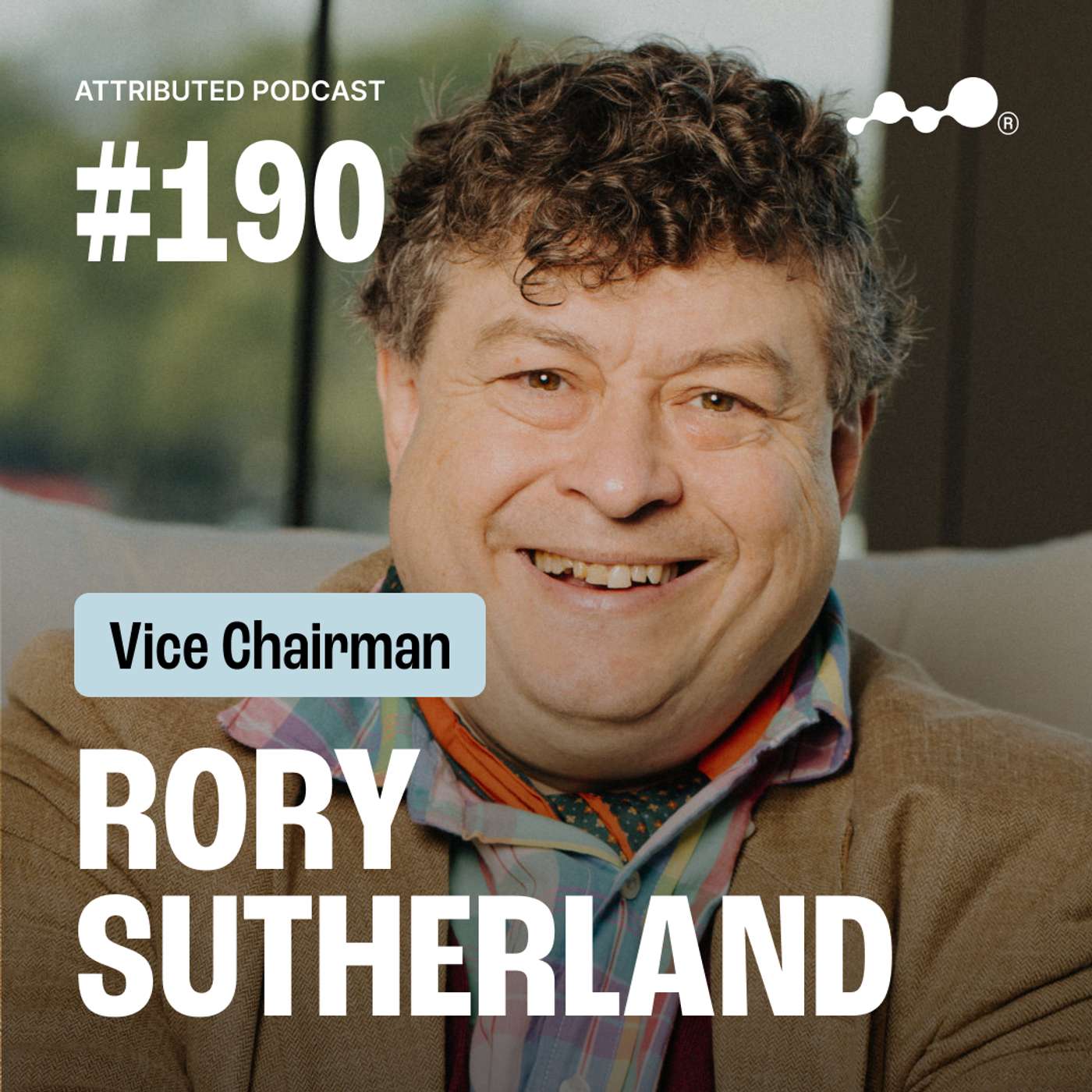
Rory Sutherland: The Irrational B2B Buyer & What it Means in 2026
50m 48s
In this podcast interview, Rory Sutherland discusses the irrational and emotional underpinnings of B2B decision-making, contrasting it with common assumptions of rationality. He explains that B2B choices are often driven by subconscious fears, such as avoiding blame or career risk, rather than optimizing outcomes. This is exemplified by the "nobody ever got fired for buying IBM" mentality, where buyers default to safe, reputable options to minimize personal downside. Sutherland emphasizes that behavioral science reveals these motivations, highlighting how loss aversion and reputational concerns shape decisions, even in procurement or committee settings. He advises B2B marketers to focus on reassurance and addressing unspoken anxieties, such as by asking buyers what nearly stopped them from purchasing. Additionally, he notes the value of local or trusted suppliers due to inherent reputational dependencies. Finally, Sutherland argues that marketing should be positioned as a strategic mindset—"how we think"—rather than just a set of activities, to increase its influence and address broader business challenges effectively.
Hi, I'm Laura. Hey, I'm Stefan and you're listening to Attributed, a podcast library by GreenDidda. The purpose of it is to store and share all the knowledge that we have gathered across DreamDid employees through our LinkedIn Lives, podcasts and webinars. The typical topics you'll find here can be stuff like marketing, sales, V2B ads, operations, social selling maybe. Hello and welcome everybody to today's Attributed Session. Today's not just any attributed session because today we truly have somebody where you can attribute a lot of knowledge to, which is Rory Sutherland. I have been doing a lot of research coming up to this interview. Rory and I found out that you probably have one of the longest marketing CVs that you can dig out, at least in Europe. So I'm really, really both humble and proud that you said yes to take some time with me today and talk about this concept of the rational or irrational buyer that you're quite famous for. But I want to squeeze you into this world of V2B where most of our audience normally live within. And I'm really just super excited to get the conversations started and learn how to do better V2B marketing as well. But Rory, for those who have not yet been pulled into your TikTok loop and everything that is going on nowadays, how do you kind of describe what it is that you do for a living nowadays? Well, it's worth noting that Oglevy has always been a B2B powerhouse. And the reason for that was that, actually David Oglevy was a passionate advocate of direct mail marketing, direct response advertising. And because of his passionate advocacy, we then won American Express, which is a very big direct mail account, largely B2C. But because we had this direct marketing expertise, it made us disproportionately attractive to B2B companies. And then we won IBM. And that in a sense made us disproportionately advantaged in terms of adopting digital direct marketing earlier. So we've always had an absolutely disproportionate strength in B2B marketing, which I particularly love. I mean, I have a particular passion for it. And in fact, some of the best worker can is often B2B work. And it's particularly important that that's celebrated because, of course, unlike consumer advertising, most people never get to see it. So the very best of B2B is often far less well known than the very best of B2C. And so, unless you're an industrial pump buyer, you may not actually see the very best work. Now what I did also is I got frustrated by the fact that I thought agencies were overly fixated on BORT media communication. And so about 12 years ago, I found it a behavioral science practice, which was intended to work as a kind of parallel stream, looking at business problems, which aren't necessarily perceptual their behavioral, which I think is particularly important in B2B. And actually, the conclusion I came to having studied behavioral science was that B2B decision making is sometimes far less rational than B2C decision making precisely because of the multiple forces involved. And so, you know, we've become, you know, quite heavily involved in B2B decision making as a behavioral science practice because it isn't really your classic consumer, you know, attributable awareness question. Although those things remain very important, there's usually something else going on as well, which often, you know, you start talking now. And by the way, I thought that saying I had a very long CV was a very, very nice, polite way of saying I'm really old. So thank you for that as well. It was actually men that's very, very, very productive in your career as far. And I'm already in sleep by all the things you're seeing about B2B and how it's different and how it's not different. But we, I'll just try to warm you up a little bit because before the hardest stuff. So if you look back at your career in advertising, what is the kind of underlying problem or underlying question that has kind of kept you intrigued or obsessed throughout your career? Like how would you describe that kind of underlying motivation for you? I think an underlying motivation which really captured my interest in behavioral economics and behavioral science is what are people really trying to do when they make a decision as distinct from what they claim to be trying to do? And there's an awful lot of behavior in both B2C and B2B marketing, which is, you know, effectively I bought the Lamborghini Urus because of its absolutely excellent boot size. You know, it's fantastic luggage carrying capacity where an awful lot of decision making is post-rationalized. And so trying to get to the underlying instinctive what Daniel Karnerman would call system one motivation that underlies a lot of behavior. So I'll give you one very simple example. We nearly always describe a decision in market research, you know, after we've made a decision when we're planning a decision, as if it's an optimization problem. I want to get the very best thing I can get. Deep down evolution has given us a psychology which is heavily calibrated towards avoiding disaster rather than achieving perfection. Because in evolutionary terms, it's much more important to stay alive than it is to, you know, it's much more important not to starve to death than it is to eat a perfect diet, which probably explains why we find fatty food particularly attractive if you think about it. Very good for us in the long term, but my god, it'll get us through next Thursday. And that's very true, I think, in B2B, which is we all pretend we're trying to make the best decision for our employer. What we're actually doing, unconsciously, emotionally, is trying to minimize downside risk or even more important still blame. So an awful lot of B2B decision making is actually highly emotional because if you buy the wrong shampoo, you may go, oh god, I wasted three pounds. 20, but you don't lose your job. Okay, no one's been farble, I hope not. No one's been fired for buying the wrong kind of shampoo. But quite often in business and in business decision making, the upside gain is actually quite small. You make a very good decision. Everyone goes, yeah, I think you know the right thing there, or maybe you can have a bonus of 500 pounds. And if you make the decision and the blame lands on you, you lose your job. But the reasons there are so many committees in business decision making is it's effectively blame your personal. What you're doing is saying because 10 people made this decision rather than one. In the event that this decision turns out badly, the blame isn't going to attach to any one person. And so once you understand that it's loss of version in a way or you know, when a reputitional paranoia or blame avoidance, we call it whatever we like. Once you understand that mechanism and the fact that of course a high upside in business doesn't get you that much, whereas a downside is career destroying. Once you understand that asymmetry, an awful lot of business behavior starts to make a lot of sense. That's very interesting. Is it a the loss of version and whatever you want to call it, is that something that's happening on an individual level or it's more like an in level? So we had a very interesting thing which, okay, one of the oldest speed to be expressions in the world, it was never actually an advertising line. It was just a mantra, no one ever got fired for buying IBM. And that mentality permeates quite a lot of business decision making, which is not when we're pretending to answer the question, what's the best I can do when our subconscious is answering the question, what's the worst that could happen? And we used to call this, we used to call this in the behavioural science practice, what we call the London city airport effect. Now if you, I don't know if you know London city airport, it's a tiny little airport very close to the centre of London, which operates flights on small planes typically Embraer 190s to kind of Amsterdam, Dublin, etc. And it's a brilliant airport. I mean, you know, it only takes you about 10 minutes to get from one end to the other. You know, the luggage arrives almost immediately. You can park within 200 yards of the entrance. It's a joy. And we were working with British Airways and they ran these transatlantic flights on, I think it was a 757, which refilled in Shannon all the way out and took you all the way to New York. And despite the fact that this airport's right next to the city of London, where a lot of transatlantic flyers originate. And despite the fact that the service was absolutely brilliant and you got more tear points and rewards for it, they can never make it work. And our explanation was this, you don't typically, if you're the CEO of JP Morgan, you don't book your own flights. You don't, you know, you don't stipulate, you go, can you get me to New York? Where do I have to go? Okay. The person who's booking, whether it's the corporate travel agent or it's your personal assistant, has a very, very strong incentive to book you on a flight from Heathrow to JFK on British Airways typically. And the reason they got a very strong instinct to do that is that's the default decision. It's like a non-decision. You can imagine you're in Copenhagen, you know, the CPH, SAS, JFK, right? And so, and actually, if anything goes wrong, your boss will then blame British Airways. Because bloody flights delayed. I'm, you know, I don't know, bloody flights delayed. British Airways, you know, so.
useless. If you do the creative thing and you book your boss on a flight from London City, if anything goes wrong, he or she will blame you. Because they'll ring up. You can't ring up your PA and go, "What the hell were you thinking, booking on a flight from the world's third busiest international airport?" Okay? It's a non-decision. It doesn't stand out. It doesn't attract any attention. It's completely uninteresting. But that's its virtue. It's a status quo decision. If you book your boss on a flight from London City Airport and the flights delayed, you'll get a phone call going, "If you hadn't booked me from this fucking toy town airport, I'd be in New York by now." Now, you've made a decision. You put your head above the parapet, as we say in English. You've made yourself visible. Now, you're exposed to potential blame. We suddenly realised that that's probably why the world's four, five big consulting firms are really big. If you go with a really large company to do your audit, if you go with PWC or whatever to do your audit and anything goes wrong, everybody goes, "Gosh, weren't PWC terrible." If you appoint a small boutique firm, even if it's better, in almost every respect and cheaper, at that point, effectively, you've made an eccentric decision. If anything goes wrong, they'll blame you for not appointing PWC. I hope you have some. It's probably a beneficiary of exactly the same bias. I think we ought to be honest about that. The weird thing is that business decision-making, B2B decision-making, is actually very, very emotional in a way. It's not emotional in the sense of desire. It's emotional in the sense of fear. I think it's such a, and as funny as you say, it's not even been an advertising quote from IBM that nobody got to find IBM. Can we try to give that some kind of like, like, legs or some kind of pillars to what's beneath that statement? So, if we kind of, the people listening, how to translate, what does that mean for our company? How can we utilize that? Nobody gets fired from buying IBM statement? That a lot of marketing isn't desire creation, it's reassurance. So understanding that subconsciously, someone's going, what's the worst it can have? Now, in my own business, I realized that when we were presenting work to a marketing director, we all assumed naively that the marketing director was thinking, what's the best possible advertising I can do to really sell a lot of this product? And then we kind of realized that 50% of the person's brain is going, how the hell am I going to sell this to my boss? We've got an animated dancing goat in our advertising. My boss is going to think I'm an idiot when I present this. And so understanding that fear is usually sort of silent and unconscious, whereas desire is perhaps noisy and vociferous. And understanding that a large part of what people are feeling in any B2B decision making setting is actually, in a sense, tacit, it's unconsciously felt, it's intuitive, but it's not something anybody ever talks about. They would, they would try and end defense procurement. They don't doubt it. It depends on which business you're in. They did doubt it. You say, well, you know, what's the worst that could happen? Yeah, you know, well, our supplier completely fails to solve the problem and we're left looking, you know, absolutely hopeless. You also get this. I think you get some dubious biases in these decisions in particular. I think procurement is a slightly dubious business discipline. I'm going to be very careful about this. My wife used to work in procurement. And, but my point would be you have created a few of these disciplines like procurement or compliance or whatever, where effectively you can claim all the credit for any reduction in cost, you're usually not held responsible for any loss of quality or any destruction of value. That's very true. And I think you know, yeah, what we experience in our market now, there's never been more procurement scrutiny in spending money on software that there is right now. So being able to figure out how to do exactly so procurement people is super important. I mean, they're interesting. I'm always interested in local in in sort of unconscious things that affect our behavior because I think, you know, obviously decision making was very important to us in the evolutionary environment. And so we've evolved a large part of our decision making is unconscious and instinctive precisely because it was important to make a reasonably good decision very fast. Yeah. You know, if you hear a strange roar behind you don't do further research, just start running. And so we have all these instincts which are imbued in us for perfectly good evolutionary reasons. And we carry them into the office often unaware as I would say, you know, an awful lot of, you know, an awful lot of this stuff. We're not even aware of the way we're thinking. I noticed it recently. I was buying a car and I noticed the car on a website and I thought, well, I might get a look at that car. You know, I might buy that car. And then I discovered that the car was on sale from a garage 10 miles down the road. And I thought, oh, I'll definitely buy it then. Now that wasn't the convenience of the journey to go and collect it. It's the unconscious understanding that if you buy from a local supplier, they're reputationally dependent on you. That in other words, they have a reputational vulnerability. Yeah. Because you'll tell your friends. Because you'll tell now. Now, by contrast, if you deal with a very, very big company that's effectively global, you don't have any power to hurt them really reputationally. You may have a legal power to hurt them. But there's a great asymmetry in the relationship. I suddenly realize if they know that they're selling to someone who lives down the road, they're going to be particularly eager to create a happy customer because the reputational effects will then feed back to their business. And if they sell me a car that's terrible, I can do them quite a bit of harm. By just going around seven oaks where I live and saying, these people sold me a dud car. Like contrast, if you buy a car from a garage 300 miles away, they say, now, what was interesting about that was that we all feel a bit more comfortable using local tradesmen for land reason. But we don't necessarily do the game theory maths behind it. We're not consciously aware of what we're doing. We just go, I like dealing with this guy because he's local. And so an awful lot of the kind of who to trust mechanisms in the brain, I think it kind of hardwired. I think they're in hardware. They're not in software, does it work? Yeah. So if I were to, like, let's say I wanted to do, I wanted to get better at this at our company, we would have to, because maybe even if we start with the sales calls, have the sales people ask, is there anything you feel unsafe about in making this decision at the moment? There was a brilliant, brilliant research idea, which was actually, I think a consumer company, not a business business company, but it was an online company. And obviously they didn't know or they didn't have the data on people who hadn't bought, who'd been to the site and hadn't. But they did have the data on people who had bought. And they asked them what I thought was one of the most brilliant follow-up questions ever, which was what nearly stopped you from buying this product? In other words, you did buy the product, but there was one thing that, well, you know, it was a niggling fear at the point of purchase. What was it? Yeah. And I was thought that was one of the clevers. I'm, it's the first time I only heard about it three weeks ago. Other was one of the cleverest questions in all of market research. I'd never heard anybody ask it before. And actually, when we onboard a new client at Ogleby, we should ask them a question what nearly stopped you from appointing us? Yeah. Because that's the thing we need to work on. Yeah. So I guess the first thing is just you have to kind of somehow surface what is the things that your buyers are scared of, is that burning budget or getting fired or whatever it is? I mean, we've literally had things where, you know, I mean, you know, the reason we weren't put on the pitch list is because our building is on the 10s and it looks quite expensive. And people go, I can't, you know, I can't possibly bring my colleagues here because it looks like all the money goes on the building. You know, you know, and of course, we're thinking, hey, what a great building. And by the way, this is a really, really important point if you're a B2B marketer, which is B2B marketing isn't as expensive as a proportion of overall business activity as B2C marketing. When something's expensive, people take it really seriously. When something's less expensive, you get fewer people attached to it, fewer people doing it. And so B2B marketing tends not always to operate at a lower status within the organization than it might do in a unilever, opin G or diagio or SIS or something like that. Now the way to make up for that and the way to compensate for that, I think. And I've been ranting about this quite a bit is don't sell marketing as something we do sell it as how we think. The real value of marketing with an organization isn't what we do. It's how we think. And the reason I recommend that is that when I started doing public speaking and I talk about ads we've done and you know, things we do like, you know, that kind of that way, I got invited to talk to marketers. When I started talking about how marketers think about problems and the remarkable way in which marketers can suddenly solve problems quite easily which are impossible for say coders to solve. I got invited to sort of 10 downing street and I got invited to, you know, 10 speeches and things like that. And actually the target audience and, you know, the potential addressable audience for how we think within a business is much, much broader than the audience for what we do. If we talk about what we do, we'll just end up talking to the finance director or the CFO. Yeah, we'll end up endlessly having to justify everything by well we did this and it had Narrow I have 1.3. You know, if you start talking to the CEO and say from a marketing standpoint, we'd look at the problem like this. You'll find much more work to do and you'll find much greater appreciation and you'll have much broader conversations and the stature of marketing will correspondingly rise.
Can you say a little bit more on how we yes under what how we think Path so the example I give is very simple one, which is one of the reasons I say there should be a marketer on the board Is if you don't have someone on the board with a marketing mindset You could literally make a really stupid decision and the example I give is that What's interesting to an engineer or to an accountant or to a coder is usually Inversion of efficiency or speed. They're trying to optimize some numerical measure Yeah, what's interesting to a marketer is what effect does this have on the consumer? It's not what can the product do. It's how can it how does it make them feel? Yeah, and I just I'm making a program for radio for the moment about the concord and I made the point that the concord was developed by engineers Who love making planes go really really fast and the concord was a beautiful plane and it was incredible It was it was a fantastic aircraft, but they completely missed one thing Which is that it's a brilliant aircraft if you're flying from east to west You leave London at nine o'clock in the morning and you get into New York at eight o'clock in the morning You've got a whole working day in New York. Absolutely brilliant. What can be better? On the way back Because concord was too fast to fly overnight you couldn't get a proper night's sleep You had to stay for an extra night in a hotel room in New York Rather than just going to JFK at nine o'clock in the evening getting on a plane and waking up at London at nine o'clock the next morning having slept on the flight You have to stay an extra night in a hotel in New York Then you have to get to JFK at sort of eight o'clock in the morning or seven o'clock in the morning and then you spend the whole day a whole working day On a plane arriving in London at about five o'clock So everybody would have preferred to leave the night before on a slow plane than leave the following day on a fast plane Nobody all the engineers were going it's a much faster plane and faster means better But faster does mean better if you're going from east to west but if you're going from west to east Maybe you want a slower plane so you can get a proper night's sleep. Yeah, like New York to come in that's around like nine hours So yeah, yeah, yeah, it's perfect. Yeah, yeah, yeah, and so quite often let's take software for example And awful lot of people will try and improve something for the sake of improving it and the market it will sometimes say the problem with that is Nobody cares. It was a wonderful story from Spotify and it's b2b case study bc case study The engineers were told but it's kind of local to you the engineers were told can you get the lag time the buffer time down when someone clicks on a song So that it starts playing faster and the engineers were actually good marketers in this case Because they came back and said we've got it down to 125 milliseconds and everybody said well Can you make it faster still and they said we can yeah, but there's no point why not because to the human brain There's no real difference between 120 milliseconds and instantaneous So they said we could have made it faster, but no one would have noticed you know and so you know It's a bit like the apple retina display you could have a better display But there's no point because the human eye can't tell the difference and there are all a lot of things businesses sometimes do which is they Absolutely Pissue certain metrics usually by the way the same metrics as their competitors with absolute zeal Beyond the point where their customers care at all And the other effect of this have always having these comparative metrics against your competitors is you become more similar to your competitors I've heard a I don't know who said it but I've heard the like different is better than better I think that's one year. It doesn't intrigue me a lot It's funny you say that so I'll give you an example which is sort of a B2B case study There's a wonderful book which I recommend you read called unreasonable hospitality by Wil Gadara Who ran a fantastic restaurant in New York which eventually became San Pellegrino's number one restaurant of the in the world and what he did is he was number 50 in the San Pellegrino rankings And he went to the best restaurant in the world and all his colleagues started copying the things they really liked And we'll say I'm not going to do any of that what I want to know is what were they bad at And they came up with two things the coffee and the people who drank beer didn't get anything like the treatment of the people who drank wine So they went back and they pointed a coffee sommelier and a beer sommelier And they said okay your job is to make the beer experience just fantastic You know tasting notes food bearing suggestions a choice of craft ails from micro breweries around the United States And the coffee guy basically you'd say I'd like a coffee and they go I've got two roasted you can choose between which would you prefer? And the point is different is better than better is exactly his point because those were two things nobody was expecting I call this reverse benchmarking by the way and my example from the hotel industry which will I think be interesting to everybody I said let's try reverse benchmarking with hotels What is it that a hotel that could do really well that no one's doing We came up with one idea around checking out which is what happens if you've got if you've got to check out it over your room at 11 But your flight doesn't need till five I won't you that was just one example But we said no no matter what hotel we'd stayed in no one had said we've got a special lounge for you I know you've got to check out your room But if your flight doesn't even till evening there's a special lounge with showers Wi-Fi and a coffee shop just for departing guests And the other one we said is Every time I'm in a hotel room I spend more time working than I do watching TV I've never stayed in any hotel with said would you like a monitor? In other words they only cost about four hundred dollars No you can get a 32 inch monitor USBC connection bingo like straight in But I've never stayed in a hotel they could even say it's $20 a night I go fine Okay, I've never been offered a monitor in my hotel room and I'm 60 in my eyesight's a bit shit You know, I'm yeah, I'm a bit long-sighted, you know all those kind of things and we said that phrase that different is better than better Certainly if you can be a lot better in a field where nobody else even bothers It makes much more notice than being a bit better in a field where everybody else is competing And I call this by the way optimise for surprise That's my little rhyming phrase optimise for surprise pretty good Sorry if kind of I'll try to force you into like changing chapter a little bit because now we We've at least this close now that we're not as rational as we think If we jump inside the box of the creative I'd love to hear kind of because as you say in at least in Can the B2B market to get some recognition, but I would love to hear kind of what does good and or bad B2B creatives or advertising campaigns look like In some ways you can have a wonderful opportunity. I mean one thing is media selection I'll give you one very simple tip Don't discount physical direct mail Okay, and the part of the reason for that is everybody else is so fetishising digitisation Yeah, that they may be forgetting A second thing I would argue as important is I think that video conferencing is very important because it's Much of the value of a face-to-face meeting without the commitment Yeah, I'd also mention a very interesting company which is called meatmagic.org Which has a very interesting approach which it's completely new and innovative and the way it works is that Now obviously in most countries certainly Denmark you can't bribe someone to have a meeting with you That would that that but what they do is they say We will make a donation to the charity of your choice If you give us half an hour of your time on zoom So $1,000 to the charity of your choice if it's called meatmagic.org If you give us a little bit of you know time on zoom just to present what we do Yeah, and that struck me as a very and what's good is because they're paying money to meet you They're not just tire kickers. They're not just trying it on They pay me believe that you have something to gain from talking to them because otherwise they wouldn't be making the Divination to charity. So it's proof of commitment without bribery. It also means by the way because they spend a thousand dollars on the meeting They'll probably put a pretty good presentation together They won't just you know come along with a random deck and so there's there are new ideas all the time I think in B2B Obviously one of the things that's really important in B2B is that video is no longer a mass market medium You know historically in B2B you know if you wanted I'd go back to the 1980s where mine You know television was for mass audiences direct male was for discrete audiences and you know B2B tends to be the male and the telephone With a bit of facts marketing and so that's on but actually now we have the full media panoply at our disposal We can make films we can host webinars We as I said we can actually make a donation to charity through meatmagic For in return for having a you know having a business meeting There are lots of lots of of how would I say levers that we can pull And we need to you know just better don't use all of them all the time But we've got a much much more exciting deck than we had once and obviously physical events of all those things are really important That's one thing that's you know changed a lot but actually don't as I said don't discount the other thing is that in a way You can You don't need to be one of the things that says you don't need to be hyper personalized But simply use creative techniques which say this is not irrelevant Yeah, so for example if you work in an advertising agency and the letter let's say refers to your customers rather than your clients They've lost you Okay, you know just one you know and that's specific in English you would never refer to a you I would never refer to a client of ours as a customer Don't ask me why not what the difference is between a customer and a client I don't really know but lawyers and advertising agency
have clients and shops have customers. There was an American company who put like soccer, I like football, but the American company put soccer into that, you know, there was something like, "Oh, you're out." One of the other things I would say is that removing negatives is marketers tend to go, "In order to sell this product, I need to make a list of the positives." And what they often overlook in that process is going, what, you know, that question of what nearly stopped you from buying this product. And actually, if you could remove those negatives or those anxieties, you can have breakthrough effects. And those negatives be like, "What comes to mind, Bory?" Well, one of them is very simply, we never heard of you before. I mean, by the way, the LinkedIn B2B Institute, I know I'm appearing on LinkedIn now, I'm not just plugging them. The LinkedIn B2B Institute does some very valuable work. And one of the things they found was that, in fact, fame, mere brand name recognition was much more important in B2B than it would be really being thought, because every decision would involve you, you might have three non-executive directors, and you have someone from, you know, in other words, you know, the majority of people in that boardroom discussion may have never heard of you before. Yeah. And they are going to ask three times as many questions if they've never heard of you, than if they have. You know, I've noticed some very clever, quite big budget B2B campaigns, in particular for, you know, the company that owns MailChimp, you know, for CRM software, for example. And it struck me as actually a clever thing to do, because one thing we tend to discount to heavily on B2B is just the value of fame. And my argument is that even if you're a B2B company, fame means, for example, if you're famous, people bring opportunities to you. You don't have to find your customers anymore at the right time, your customers will come and find you. And, you know, secondly, when your chief executive rings someone up, that person will return the call, because your company's famous. You know, you will hire people at a lower cost, you will hire better people, the people will stay for longer. They may not want to be paid quite as much, because it helps their curriculum VTI to be working for a well-known company. And the great phrase from a guy called Matt John's wrote a very good book called Blind Sight. He's a victim of neuroscientist and behavioral scientist. He said, having a great brand means you get to play the game of capitalism on easy mode. And I think it's a great quote, because things like fame are difficult to quantify if the finance people are going for every penny you spend, we must get a penny in return. Okay, you know, fame is a compounding asset. You know, there was the way to get very famous is to start off by being quite famous. And the more famous you are already, the more the easier it is to get very famous. And so it's a compounding asset. It's not a linear asset. From myself, when I get a call call from somebody, and they go, "Hey, brand name I've never heard about." Like, "I ain't bang, Ron." But if it is a brand I've heard about, I swallow my tongue for 10 seconds. You're absolutely right. There's a wonderful quote once where someone said, "A brand manifests its value in what we call an English the benefit of the doubt." In other words, I'm not quite sure about this, but since I've heard of you, I'm going to assume that it's okay. Yeah, you know, I assume you're financially healthy. I assume that you're basically an honest entity. And by the way, there are things which advertising people used to think was stupid, like established 1873. You know, they go, "What's the relevance of that?" You know, but actually, the fact that you've been in business for a long time is a reassurance. Yeah. And then kind of you need to lay your own, like, let's say, more downstream tactics. So like, one, you need to build the fame, but then you also need to find some kind of module to extract the value. Yes. All right. The thing I call to the right account that you know have received your advertisement or something like that. And there's a wonderful phrase, Nassim Talab, who writes wonderfully about statistics. He said that, "Effectually, what you're often trying to do in marketing." I mean, he referred to it in the field of everyday life, "Is you increase your surface area exposure to positive upside optionality?" Which is effectively saying, "What happens when you're famous is your chances of getting lucky in some unspecified way are much, much higher. Fame doesn't necessarily help you achieve a predefined objective. What it will do is it will bring a whole layer of opportunities to you, which you were never even aware existed before you became famous." Yeah. How do we become famous, Don Rory? At time. And the other one is, I think, your point about being different is better than being better. That one of the things that tends to happen in corporate world is there is a massive anxiety. Well, one of the problems I think that happens is that most chief executives are optimized for talking to the stock market, not to talking for their customers. They're actually chosen for their ability to talk to financial analysts, not for their skill at talking to customers. The other thing I think is interesting is that I think that the need to justify and explain and quantify everything you do is actually a restraint on growth. And it's a restraint on marketing. One of the interesting things that's happened to us recently, which we noticed, is that in 2024 there were five gold award winners of the IPA advertising effectiveness awards in the UK. And four of the five companies that won were family owned companies. And someone wrote an article saying, maybe it's because a family owned company can think of the short term, the medium term, and the long term, all at the same time. A publicly owned company is so obsessed with making its figures for the next quarter that other thing, including marketing and innovation, the two things that Peter Drucker said were the main source of value creation in a business. Marketing and innovation are the first things to get cut if you're desperate to meet some financial stock market expectation. And so family owned companies, I would argue, have an innate advantage in their freedom to make decisions, which is denied to publicly owned companies. And if I were working for a family owned company, I literally asked the question, what is it that we can do that our competitors can't or work? And so it's so true with the marketing being the first on the chopping board. It doesn't hurt moral, but it hurts in six months or 12 months because of absolutely. And all the seats you needed to be planning. Will you have all these people who can claim the credit for a reduction in cost, but they're never held accountable for a lost opportunity, an opportunity cost, as it's technically called an economics. Yeah. Probably, how do you, I'd love to somewhat as I experience this, you kind of, how do you deal with the budgeting questions for marketing? Like if you are to educate our audience a little bit about how you have this idea or next year you want this budget, kind of what is the right way to kind of approach the speech you need to the organization of why do we need this budget? Roughly speaking, there's a mantra, the figures aren't necessarily this, but it's sometimes called 70/20/10. 70% is do what we know works. You know, we know it pays, we should continue to do that because it pays. 20% is trying to get better at what you're really doing. And 10% is blue sky experimentation. And one of the things in B to be marketing because it tends to use discrete media is you can experiment in a way that often beef sea marketers can't. They have to place a huge great bet on something and hope it works. And so one of the things is I would literally say of this 10 to 20% of the budget which is experimental, we expect a third of what we do to fail because if we're not failing a third of the time, we're not really experimenting bravely enough, the reason we can afford that level of failure is because another 10% of what we do can be spectacularly successful. And then having discovered that 10%, you feed it back into the 70%. And what sometimes happens I think is people particularly data has a status quo bias because there's always a lot of data to justify what you've done previously. And there's never any data to justify doing something new. There was no data to say that Red Bull would be a popular drink. There's no data to justify the iPhone. In other words, nobody could really prove, I mean, in fact, you know what was so funny about the iPhone is Steve Balmer ridiculed it and said that it's going to be 3% of the market because our research tells us that those are the only people who'll pay $700 for a phone. So there's always the status quo bias. If everything you do has to be data driven. And by the way, we need to be cautious about that with AI as well because AI has an awful lot of information about what worked in the past and not much information by definition about what's going to work in the future. Very interesting thing is quite a lot, not all I think, but quite a lot of very, very rich people. Jeff Bezos obviously Elon Musk certainly, Rowan Buffett, are characterized by a very interesting decision making and thinking style. And Jeff Bezos has this thing which he calls the One Way Door and the Two Way Door. And there are two kinds of decisions. The Two Way Door is something where you try it if you don't like it, you just walk back.
was a two-way door. Everybody hated the idea. Jeff just said, "Let's try it and see what happens." Okay. If obviously, if Amazon is building a seven million square foot warehouse, six miles north of Nashville, that's not a easily reversible decision, and they're going to have to have all the evidence they need before they try it. I accept that. Okay. That's where you probably bring McKinsey in. But if you've got a two-way door, Jeff would go, "Look, while we're arguing about this, we could be trying it for real." And actually, Amazon Web Services came out of that as well. There were a load of people arguing it to death, and Jeff just said, "Look, we've got to buy a load of bandwidth, and we've got to buy a lot of processing parkers where Amazon, if we can sell that on to other people at a profit, great. And if we can't, well, who cares? We haven't lost very much. We were doing it anyway, to an extent." And so, I think understanding what we tend to do, because of this reputational aversion, we're just as frightened of small-scale manageable failure, as we are of large-scale failure. And actually, in a properly calibrated risk-reward environment, you'd actually go, "Hey, part of your bonus would be, did you have three or four small-scale failures, where you tried something new and it didn't work? You should actually be bonest on those." But people are so frightened of any kind of bad decision, they don't make a distinction between a bad decision that has lasting, deleterious consequences, and a bad decision. I mean, there was a great guy, I think he was the chief executive of Diadgeo, and they tried launching this premium cider, and they, you know, it cost them about £5 million, and the whole thing failed. And everybody was getting involved in recriminations, and the chief executive said, "I think what we've learnt from this failure is worth £5 million." It's not that much in the scheme of things. Now, obviously, if you were the person put in charge of the launch, you look terrible. The chief executive, meanwhile, from a different perspective, is saying, "So this is a Daniel Kahneman thought experiment, which shows how business decision-making is very risk of us." So, Daniel Kahneman, we don't know what the camper who the company was, but we suspect it might have been GE General Electric. And Daniel Kahneman, as a thought experiment, went round the room, asking the heads of all the divisions. Might have been Richard Thaler, not Daniel Kahneman, actually, asking the heads of the divisions, "I can offer you a bet that you can take, where 60% of the time, your profits and your sales will go up by 50%, and 20% of the time, your profits and your sales will go down by 30%. How many of you would take that risk? And all but two of them said, "I wouldn't take that risk," and Richard Thaler said, "but statistically, you're going to end up better off, because on balance, the odds are you'll end up a lot richer." And they all said, "All six of the eight said, "Yeah, but 20% or 30% of the time, I'd lose my job." If I take that decision five years in a row, I'm definitely not going to have a job in seven years. And then the chief executive who's at the end of the room, who of course is responsible for the aggregate of all their revenues said, "but I'd want all of you to take that risk." Because for GE overall, the risk is absolutely, you know, we'll end up effectively winning five times in losing once, or whatever it may be. -Leaders, you've needs to create that environment where people feel safe to do that. -Because you see, if you push risk, all the, and the finance function have done this, they've pushed risk and responsibility and accountability down and further and further down the organization to a point where you literally get people who are bonus on doing something stupid. I mean, this literally happened the other day. Someone turned off an advertising campaign that was very successful, which was getting people to buy premium dog food from a supermarket. And towards the end of the year, they said, "can you turn on this advertising please?" And the guy said, "yeah, I'll turn it off for you." But it's making a fortune. You're making much more profit per dog you were before. And the guy replied, "yeah, I know, but my bonus isn't on profit. It's on margin." And although our own brand dog food doesn't cost very much, the margins higher. So I need to get my percentage margin up. So can you stop selling the expensive dog food and get people to buy the cheap dog food? And you can see that happening because the great guy, there's a fantastic guy, some of you may have heard of called W. Edwin's Deming or Deming. I never know how to pronounce but he was sort of the almost the author of Japan's post-war economic miracle because he was a brilliant system, thinker. And his phrase was, "to optimize the whole, you have to sub-optimize some of the parts." And instead, we have a business which is trying to optimize the whole by optimizing all of the parts. And so here's a classic B2B story which happened recently. Someone was consulting for a B2B company and they said, "I've got to do a presentation on your business to the board. I've done the research and it's very simple. Basically, people love you for your customer service. Your product isn't that much better. Your pricing isn't any better, but your customer service, they absolutely love." And the person he was speaking to said, "Please don't say that. Can you not say that?" He said, "It's true. I know, but part of our strategy is to reduce our customer service costs to increase our margin." Now, most businesses work because you spend money in one place and then make more money somewhere else. But if you basically make cost reduction, the focus of every part of the business, including the parts of the business that are actually generating customer value, you end up destroying the whole thing. Yeah, that's so good to run. Okay, I have two questions left, Roy. First thing, you mentioned AI before and just be. By the way, AI makes experimentation much. AI creates two-way doors because if you can produce an interesting, funny film and see what happens, at a cost of $3,000 and a day rather than $30,000 and a month, what I'd like to see is not a cost reduction in the reduction and cost of the same amount of material, but actually the opposite. I'd actually like to see agencies producing speculative work again. Speck kids, what did you mean by that? It used to happen back in the good old days when we were paid on commission. Agents would produce advertising campaigns they hadn't even been asked for. There was no client brief. They just thought, "Let's do a great campaign for American Express." And one time in three, you got lucky and of course commission being commissioned, you made enough money for it to be worth doing those things. Now, because we're all measured on the utilization rate, then it's not worth us doing that anymore. We can't afford to. We're not allowed to. So, yeah, on the AI point, I was just like to hear overall thoughts about how you think it's going to shape marketing for the next couple of years because there's no doubt that the output of creatives are just like exploding and everybody can do, yes, a few effects. If you want to make something seem amazing, we'll have to find other ways. So, one of the rather unhappy predictions I'm making is that celebrities, rich celebrities are going to become even richer. Because to communicate that you spend a lot of money on your ad, maybe you need to get Tom Cruise in the ad rather than what you would have done before, producing a really elaborate ad with a helicopter shot and all that sort of stuff. So, that's one prediction. The other slightly gloomier prediction is this. I hate to say it, but I think it's true, which is that when the bill for AI comes due, a lot of IT companies are going to be desperate to sell AI to their clientele. What's the easiest way to sell something? Cost savings, particularly labor cost savings, job cuts. Now, as a result, AI won't be sold on, you can produce amazing customer service for the same money you're spending now, your customer service can go from being indifferent to amazing. No one's going to sell on that basis because it's not a quantifiable offer. Every single tech company is going to go in and basically go, you know, buy this, you can get rid of your call center. And that's what's going to happen. And it's too attractive for people to turn down, unfortunately, except family owned businesses. Family owned founder led businesses, privately held businesses, I think will go, this is a way to make us better. Okay? Everybody else will go, this is a way to make things cheaper. That's great. Thank you so much. So, last question, just as probably a good way to sum up the conversation. But if you have to, that's for all the B2B marketers listening now, what's one advice for 2026 that you would kind of, if you only remember one thing from what Rory said today, what are you going to go with Rory? The one bit of advice which is sort of generic is as a marketer, sell how you think not what you do. So make the point that marketing isn't a function, it's not a department, it's a way of looking at a business. And in terms of value creation rather than cost reduction, along with innovation and R&D, marketing and innovation are fundamentally the only way to grow a company. You cannot cost cut your way to growth. Super good, Rory. Thank you so much, Rory. If you want to direct people to some place either to follow you or to buy your book or to hire a Gil-Wee, where do you want a very boring email address, rory.southern.org or v.com. So you can always reach me there, boringly predictable. But the other suggestion is obviously go to, if you're in Denmark, go to
and Copenhagen who are a wonderful agency. And as I said, have a lot of B2B experience. But I'm also on LinkedIn and I'm on Twitter or X, it's now called as @RorySavaland. Yeah, so there's quite a bit there. Wonderful. Go follow Rory. People, there's so much good content coming from him. Rory, I just want to say thank you so much for taking the time to talk with me and to educate both me and the audience. We really, really appreciate it. It's a joy. We hope you like listening to us. Subscribe to our podcast and the ones that we have been guests on. And if you have any feedback for us, just do let us know and should there be a guest that you think we should be talking to, then like, pitch us. We're looking forward to seeing you.
Podcast Summary
Key Points:
B2B decision-making is often driven by fear of blame and risk aversion rather than rational optimization, encapsulated in the adage "nobody ever got fired for buying IBM."
Behavioral science reveals that subconscious motivations, such as avoiding downside risks, heavily influence B2B choices, making them more emotional (fear-based) than B2C decisions.
Marketing in B2B should focus on providing reassurance and addressing unspoken fears, rather than just creating desire, to align with buyers' psychological biases.
Understanding local or reputational factors (e.g., dealing with nearby suppliers) can build trust, as these tap into instinctive, hardwired decision-making mechanisms.
Elevating marketing's role in organizations involves framing it as "how we think" rather than "what we do," broadening its strategic impact beyond tactical activities.
Summary:
In this podcast interview, Rory Sutherland discusses the irrational and emotional underpinnings of B2B decision-making, contrasting it with common assumptions of rationality. He explains that B2B choices are often driven by subconscious fears, such as avoiding blame or career risk, rather than optimizing outcomes. This is exemplified by the "nobody ever got fired for buying IBM" mentality, where buyers default to safe, reputable options to minimize personal downside.
Sutherland emphasizes that behavioral science reveals these motivations, highlighting how loss aversion and reputational concerns shape decisions, even in procurement or committee settings. He advises B2B marketers to focus on reassurance and addressing unspoken anxieties, such as by asking buyers what nearly stopped them from purchasing. Additionally, he notes the value of local or trusted suppliers due to inherent reputational dependencies.
Finally, Sutherland argues that marketing should be positioned as a strategic mindset—"how we think"—rather than just a set of activities, to increase its influence and address broader business challenges effectively.
FAQs
Attributed is a podcast library by GreenDidda that stores and shares knowledge gathered from DreamDid employees through LinkedIn Lives, podcasts, and webinars, covering topics like marketing, sales, B2B ads, operations, and social selling.
B2B marketing is often less visible because it targets specific business audiences, such as industrial buyers, rather than the general public, so the best work isn't widely seen outside those industries.
Behavioral science reveals that B2B decisions are often driven by emotional factors like fear and blame avoidance, rather than pure rationality, due to the high stakes and multiple stakeholders involved.
The 'London City Airport effect' describes how decision-makers prefer default or low-risk options to avoid blame, even if alternatives are better, because choosing something unconventional increases personal exposure if things go wrong.
Asking 'What nearly stopped you from buying this product?' helps surface unspoken fears or concerns that buyers have, which can be addressed to improve sales and marketing strategies.
B2B marketers should sell marketing as 'how we think' rather than just 'what we do,' to engage broader audiences like CEOs and demonstrate strategic value beyond tactical activities.
Chat with AI
Loading...
Pro features
Go deeper with this episode
Unlock creator-grade tools that turn any transcript into show notes and subtitle files.
 PodcastTranscript AI