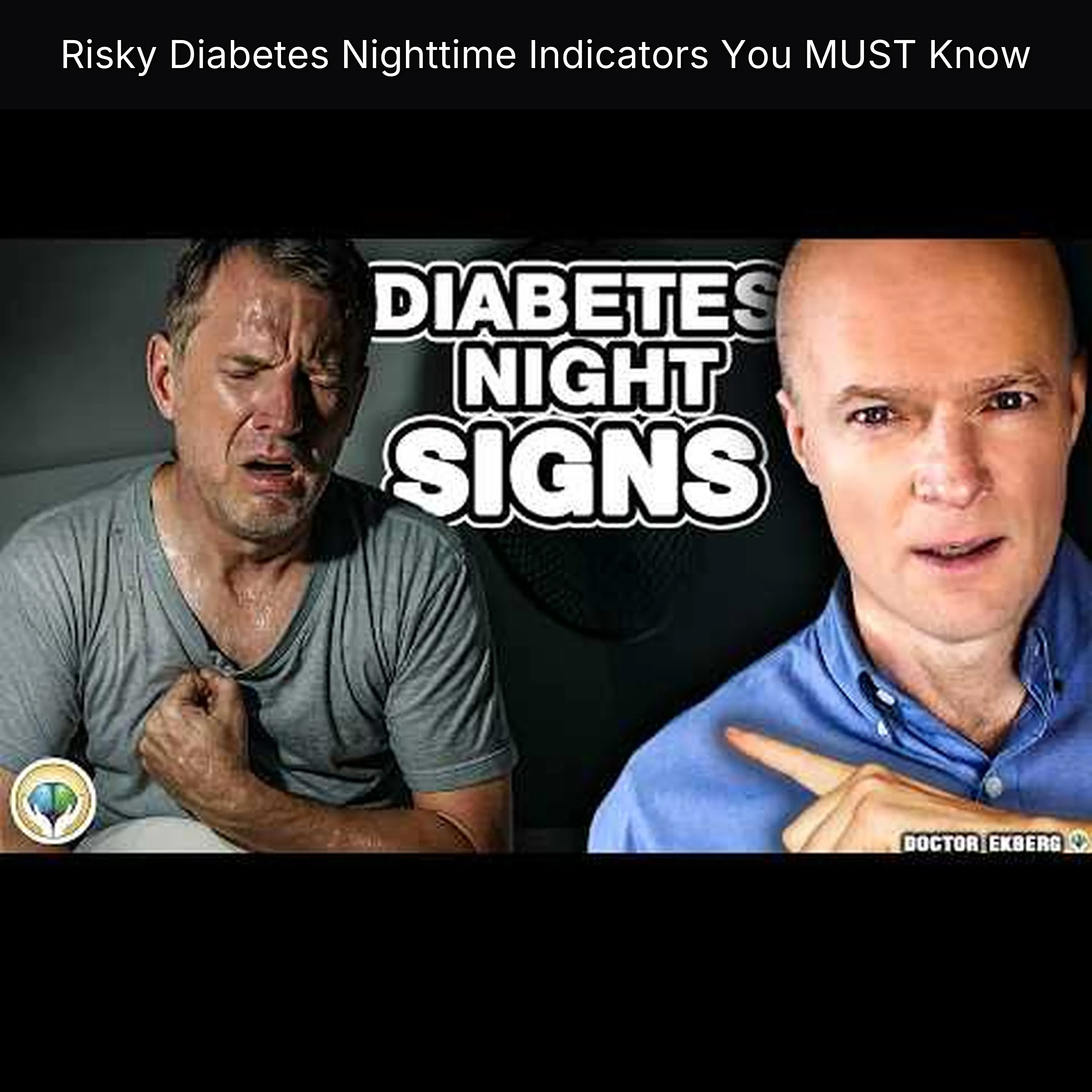
The transcription outlines ten nighttime signs of diabetes or prediabetes that should not be ignored, emphasizing that these symptoms indicate poor blood sugar control and underlying insulin resistance. Night sweats signal hypoglycemia, while frequent urination and intense thirst result from high blood sugar spilling into urine and dehydrating the body. Restless legs and cramps are caused by electrolyte loss and nerve damage, and nightmares stem from hypoglycemia-induced adrenaline surges during REM sleep. Sleep trouble arises from circadian rhythm disruption, and morning headaches or brain fog follow unstable blood sugar fluctuations. Numbness or tingling in feet reflects nerve damage from advanced glycation end products. Snoring and sleep apnea are linked to insulin resistance weakening vagus nerve tone and airway muscles. Finally, waking exhausted despite full sleep indicates poor recovery due to chronic sympathetic nervous system activation. The core message is that all these signs point to insulin resistance as the root cause, creating a vicious cycle where poor sleep worsens diabetes control. The speaker encourages viewers to understand these mechanisms and seek comprehensive diabetes management strategies.
Night time should be a time of deep rest and recovery. When your body heals and your energy is restored. But if you have diabetes or if you are unknowingly on your way there, that recovery may not be happening completely. And your body may actually be sending warning signals while you sleep. Signals that your diabetes or prediabetes is not only starting to cause damage, but maybe the very reason you're not getting the full recovery your body needs. Hello, health champions. Today, we're going to talk about the top 10 night time diabetes signs you should not ignore. And sign number one is night sweats. And this could happen if your blood sugar drops below 70, called hypoglycemia. And now that's not necessarily hypoglycemia if you're fasting, but if you normally have high blood sugar and you depend on glucose for energy, then that could be hypoglycemia. And now you would probably get a surge of stress hormones. And these hormones are the ones that restore blood sugar, namely epinephrine, cortisol, and glucagon. And you're basically having a stress response while you sleep. And part of that stress response is a sweat. And this hypoglycemia could be because you're just controlling blood sugar poorly. Your body is just not great at it. So you have unstable blood sugar. But most likely, it's going to be a combination of things, including high insulin or administered insulin. Like if you have a pump and it's not set just right, if you're on some medication, or if you have too much alcohol that can cause hypoglycemia. And if you have these night sweats and nightmares at the same time, that's really a red flag. And we'll come back and talk about that a little more. Sign number two is frequent urine nation, called nocturia. You go to the bathroom a lot during the night. And this could be because you have glucoseuria, meaning that glucose is spilling over in the urine. And if your blood sugar is uncontrolled, like if your diabetes is not managed very well, then you could get over 180 milligrams of blood sugar. And that's the renal threshold. So glucose normally should not be in the urine. You should filter it out and you should filter it back in. You should reabsorb it. So that's what should happen. But if there's too much glucose, the kidneys can't keep up. And everything above 180 is going to spill out. And because of osmosis, water is going to go wherever particles go. It doesn't matter if it's sodium or if it's glucose, wherever particles go, water is going to follow. So if your body now is eliminating glucose in the urine, you're going to also eliminate water and you're going to get dehydrated. And if this happens ongoing and you're losing all this water, now that water is also going to take some electrolytes with it. So you're also going to be losing sodium, potassium, and magnesium at the same time. And if your sleep gets interrupted by bathroom breaks and you also have this stress interrupting your sleep, now you could get sleep deprivation. You're not getting the sleep you need. And now what happens? Anytime that you don't get enough or you don't have the quality of sleep that you want, now you're getting an increase in cortisol. You wake up with higher cortisol levels, which in turn is actually going to make that insulin resistance worse. So it becomes a vicious cycle. Cy number three is intense thirst. And this would be because when your blood sugar is really high, now your blood basically gets thicker. And it's going to pull water to it by osmosis and it's going to pull it from the cells into the bloodstream. And now your hypothalamus is going to detect dehydration and it's going to signal your thirst center that you really have to drink. And this could be so intense, it could wake you up. So it's probably okay. A lot of people will have a glass of water by their bedside and take in a sip when they, if they wake up. But it's not okay if you have chronic excessive thirst where you're just drinking tons and tons of water. And it's pretty much every night. Then that could be a sign that the problem is really high blood sugar. And the fourth sign is restless legs and leg cramps. So what happens now is that if you have high insulin and frequent urination, now those two factors are going to lead to potassium and magnesium depletion. Like we talked about on the previous lighting, you're going to lose some electrolytes. And these electrolytes in particular are required for your muscles to relax after they have contracted. So that's, it's always a balance. You contract and you relax. But if you're missing these minerals, now they don't relax and they'll have a tendency to seize up. So that's on the electrolyte side. But there's also a nervous system side of this because you could get hypersensitive nerve endings from having really high blood sugar and high insulin. Because what happens with diabetes is that you increase your oxidative stress, which can irritate the tissues. And you're also going to have microvascular damage to the blood vessels that serve the tissues and that serve the nerves. So the combination of these two effects now is going to cause your muscles and your nerves to feel restless, like they're irritated, like they want to twinge all the time. And sign number five is nightmares or vivid dreams. We talked about that on the first slide. That's a red flag if you have combinations of these things. And what's happening is during REM sleep when you have a rapid eye movement and you have your more intense dreaming, now your brain actually increases its glucose need a little bit. And if you combine that increased glucose need with the fact that a lot of diabetics are going to have hypoglycemia at night, that means that you're going to get an epinephrine surge. An epinephrine is the same as adrenaline. That's your alert stress hormone, your instantaneous activation hormone. And now what that can do is can over stimulate your amygdala and your limbic system. And these are two areas in the brain that have to do with emotions. And if you over stimulate those areas, then that could result in sort of excess uncontrolled emotions as well, such as in nightmares. And this could also cause these abrupt awakenings as well as the sweating and your racing heart. If you wake up, you're sitting up in a sweat with a racing heart, then this is probably what's going on. Sign number six is sleep trouble. So a lot of these signs have to do with sleep obviously 'cause it's at night, but they have different mechanisms and express themselves differently. So if you have trouble falling asleep or staying asleep, that could be because unstable blood sugar will disrupt your circadian rhythm, that regulates your nighttime and daytime behavior. And that circadian rhythm depends on two hormones, two opposing hormones. One is melatonin that puts you to sleep and one is cortisol that wakes you up. And the way that these two hormones act together, interact is that anytime you trigger some cortisol, that's your alertness hormone, it will completely overtake the melatonin. Because if there's something that you have to respond to, then cortisol has to act instantly. So there are two ways that we can get an imbalance in this system. And one is that high blood sugar will suppress melatonin to start with. So it will be harder for you to fall asleep. But then if you fall asleep and then during the night, you get a drop in blood sugar. Now the body's gonna compensate with cortisol. It's gonna have a cortisol burst that obviously, like we said, it's gonna shut off that melatonin and it's gonna wake you up very often abruptly. Number seven is morning headaches or brain fog. So if you have low blood sugar, lower than normal during the night, and it's followed by the dawn effect, which is a normal way for your body to wake you up. Right before it's time to get up, your body releases four hormones, cortisol, blue cagone, adrenaline, and human growth hormone. And these are perfectly normal. They're supposed to get you blood sugar up, get you some energy and get you alert and ready for the day. However, if your blood sugar was a little bit lower than it should by the time that dawn effect kicked in, now we could get an exaggerated rebound spike. And that's what often happens.
happens with insulin resistance and why people with diabetes are going to have more of a dawn effect and it takes longer for that blood sugar to normalize after you wake up. Now that could create some metabolic turbulence and with that you could have fluctuations in blood sugar and in oxygen levels in the brain. And that could result in vascular constriction, in dehydration and in mitochondrial fatigue. And mitochondria of course are the little things inside yourselves that make all your energy. So between all these unstable factors we could get things like morning headaches and brain fog. Sin number eight is numbness or tingling and this would be especially in your feet. So with chronically high blood glucose, what happens is that glucose sort of slips into the surrounding tissues and it causes micro vascular damage because it disturbs the circulation and the oxygenation of those tissues. And because of that there can be an accumulation of ages or advanced glycation and products. So with increased blood glucose we get excess glycation which means that sugar sticks to different things and these ages can create a lot of damage especially in nerve tissue which is very sensitive. And now these ages can cause nerve irritation and misfiring and that could give you the sensation of tingling or burning in your feet during the night. Number nine is snoring or sleep apnea and this is a really interesting one because sleep apnea is an epidemic. There's so many people that they feel bad for whatever reason they go do a sleep study and almost invariably they end up with a diagnosis of sleep apnea and a CPAP machine. So we really need to understand some of the underlying causes here. One could be the diabetics are very often overweight and insulin will accumulate cause the accumulation of excess fat and some of this excess fat could be around the neck and around the faring on the front of the neck. So this could physically narrow the airways and make it harder to breathe especially at night. But there's a second component of this that's neurological and metabolic that we really have to understand. So up at the roof of the mouth where the uvula is hanging down from that on the sides there it's what's called the soft palate and that's a muscle. It has a certain muscle tone and it's the muscle tone that keeps that airway open. If we get a sloppy muscle tone then that soft palate tends to fall down and close especially when we lay down and especially when we breathe then that movement of air can tend to close off that opening if we don't have good muscle tone there. And that muscle that opens up the controls that soft palate is controlled by an area called cranial nerve number 10 which is a part of the vagus nerve. So up in your brainstem toward the lower end but still inside your skull is certain brainstem nuclei. And if we don't have good brain health and if we don't have good metabolic health some of those brain centers, some of those cranial nuclei can tend to degenerate. They start burning a little dimmer if you will. So the vagus nerve has gotten a lot of attention recently. They're talking a lot about vagus and vagal tone in association with stress. So in your brain, in your nervous system, in your autonomic nervous system, the portion that you don't think about the stuff that's automatic, there are two branches. One that speeds you up called the sympathetic, one that slows you down called the parasympathetic. And the reason we talk so much about the vagus is that the vagus is most of the parasympathetic outflow. So if we're really stressed then your sympathetic is always taking the upper hand over your parasympathetic over your relaxation. And now nobody knows how to relax and people have poor digestion because the vagus handles your digestion. It handles the nerve supply to most of your vital organs. But it also handles the muscle tone to that muscle that keeps you from snoring and helps you breathe at night. And something that most people don't realize is that the strongest contributing factor to snoring and sleep apnea is insulin resistance because diabetics are prone to a decreased vagus function to a decreased tone and a decreased firing of the vagus nerve. And if the vagus is firing lower, then we're going to have a lower muscle tone and we're going to have a greater tendency for that airway to close, especially when we lie down. And this would of course increase the risk of snoring and sleep apnea. And sign number 10 is that you wake up exhausted even though it seems like you got a full night of sleep. Well, it wasn't the quality sleep that you wanted, that your body wanted. And if you have unstable blood sugar, now you're not having a night of recovery, you're having a night of mild stress. And mild stress means that you have a moderate increase, a slight to moderate increase of your sympathetic nervous system all night long, which will shut off your parasympathetic, which is what helps you recover. So now it means your quality of rest and recovery, and the amount of rest and recovery is not what it should be. So now when you wake up, you have somewhat depleted ATP stores, your energy stores are not fully replenished. You have an increased lactic acid, which basically means an energy debt. And you're waking up with a slight increase of chronic systemic inflammation. Another way to say this is you're waking wired but tired. So understand that all these things have to do with insulin resistance at the root. And I have hundreds of videos on this channel to discuss in detail what insulin resistance is, what diabetes is, and what to do about it. So if you like this video, you're going to love that one. And if you truly want to master health by understanding how the body really works, make sure you subscribe, hit that bell, and turn on all the notifications so you never miss a life-saving video.
Podcast Summary
Key Points:
Night sweats may indicate hypoglycemia (blood sugar below 70), triggering stress hormones like adrenaline and cortisol.
Frequent urination (nocturia) occurs when high blood sugar exceeds the renal threshold (180 mg/dL), causing glucose and water loss via urine.
Intense thirst results from high blood sugar pulling water from cells into the bloodstream, signaling dehydration.
Restless legs and leg cramps stem from electrolyte depletion (potassium, magnesium) and nerve irritation due to high blood sugar.
Nightmares or vivid dreams arise from hypoglycemia during REM sleep, causing an adrenaline surge that overstimulates the brain's emotional centers.
Sleep trouble involves disrupted circadian rhythm, where high blood sugar suppresses melatonin and drops trigger cortisol bursts, waking you abruptly.
Morning headaches or brain fog follow low night blood sugar and an exaggerated dawn effect, leading to metabolic turbulence and reduced brain oxygen.
Numbness or tingling in feet results from chronic high glucose damaging nerves via advanced glycation end products (AGEs).
Snoring or sleep apnea is linked to insulin resistance, which weakens vagus nerve tone and soft palate muscle control, narrowing airways.
Waking exhausted despite full sleep occurs because unstable blood sugar keeps the sympathetic nervous system active, reducing restorative parasympathetic recovery.
Summary:
The transcription outlines ten nighttime signs of diabetes or prediabetes that should not be ignored, emphasizing that these symptoms indicate poor blood sugar control and underlying insulin resistance. Night sweats signal hypoglycemia, while frequent urination and intense thirst result from high blood sugar spilling into urine and dehydrating the body. Restless legs and cramps are caused by electrolyte loss and nerve damage, and nightmares stem from hypoglycemia-induced adrenaline surges during REM sleep.
Sleep trouble arises from circadian rhythm disruption, and morning headaches or brain fog follow unstable blood sugar fluctuations. Numbness or tingling in feet reflects nerve damage from advanced glycation end products. Snoring and sleep apnea are linked to insulin resistance weakening vagus nerve tone and airway muscles.
Finally, waking exhausted despite full sleep indicates poor recovery due to chronic sympathetic nervous system activation. The core message is that all these signs point to insulin resistance as the root cause, creating a vicious cycle where poor sleep worsens diabetes control. The speaker encourages viewers to understand these mechanisms and seek comprehensive diabetes management strategies.
FAQs
Night sweats, which can occur if blood sugar drops below 70 (hypoglycemia), triggering stress hormones like epinephrine and cortisol.
High blood sugar exceeds the renal threshold (180 mg/dL), causing glucose to spill into urine along with water, leading to dehydration and electrolyte loss.
High blood sugar thickens the blood, pulling water from cells via osmosis, which triggers the hypothalamus to signal thirst, potentially waking you up.
Frequent urination depletes potassium and magnesium, needed for muscle relaxation, while high blood sugar irritates nerves, causing restlessness or cramping.
During REM sleep, the brain needs more glucose; if hypoglycemia occurs, an epinephrine surge overstimulates the amygdala, leading to nightmares and abrupt awakenings.
High blood sugar suppresses melatonin, making it hard to fall asleep, while nighttime blood sugar drops trigger cortisol bursts that wake you up abruptly.
Chat with AI
Loading...
Pro features
Go deeper with this episode
Unlock creator-grade tools that turn any transcript into show notes and subtitle files.
 PodcastTranscript AI