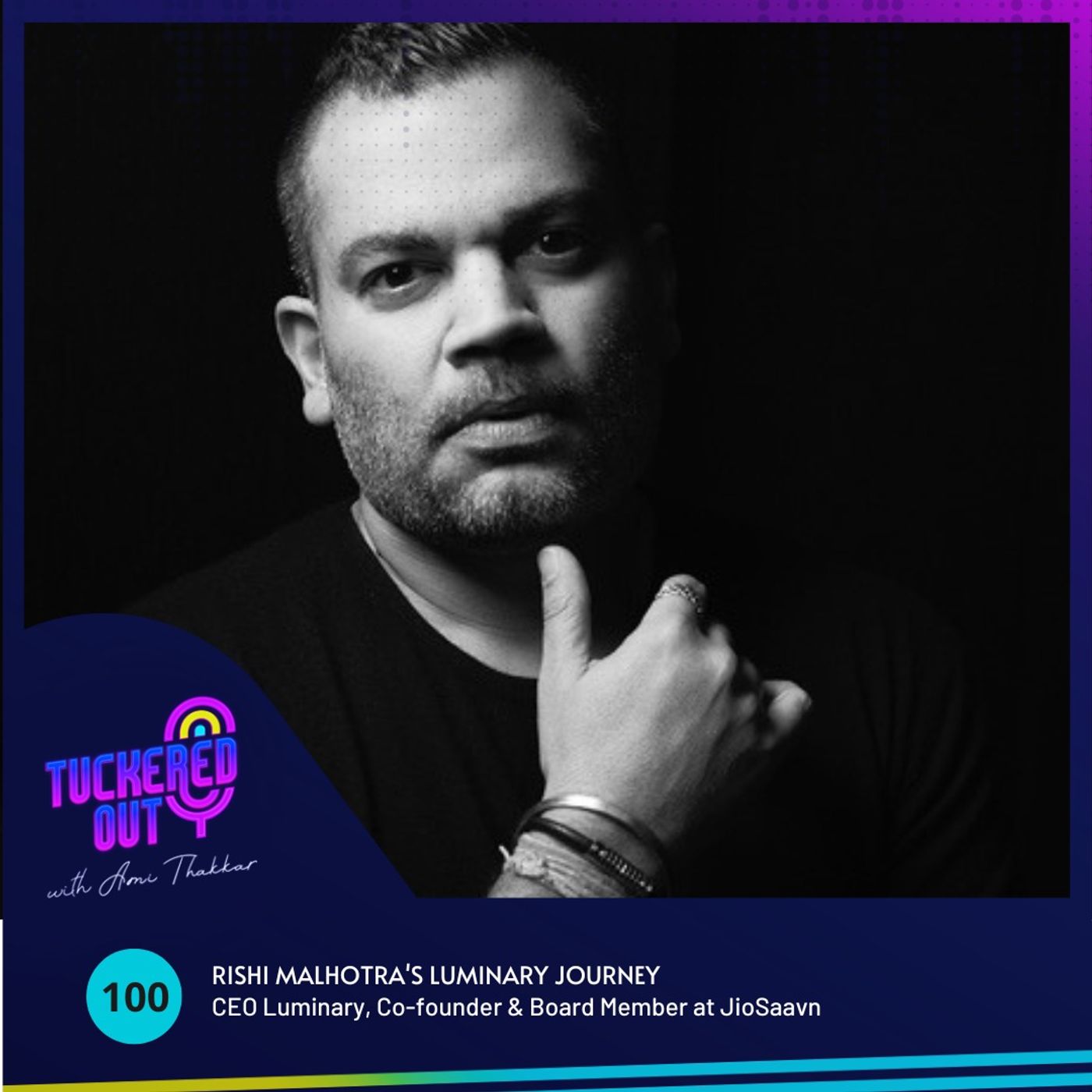
Rishima Lothra, a visionary in global entertainment, closes the 100th episode of "Tuckered Out" with a deeply personal and insightful conversation. He shares his journey from launching HBO On Demand to leading Gio Sovin, where he helped integrate Indian music into global markets. Now CEO of Luminary, a platform for original audio content, he emphasizes authenticity, cultural depth, and inclusivity—highlighting the need to elevate women's voices and diverse perspectives in Indian audio storytelling. Drawing on lessons from his 14-year tenure at Gio Sovin, he underscores the importance of energy, trust, and purpose in building sustainable, culturally relevant media. The launch of Luminary in India, with a focus on music, sports, and comedy, is a strategic evolution rooted in storytelling that educates, entertains, and elevates. Rishima reflects on how his South Asian identity and entrepreneurial mindset—shaped by early exposure to music and family support—fuel his belief in the power of art to bridge divides. He shares memorable behind-the-scenes stories, like the creation of U2’s "Hymnsa" track to boost ticket sales for their India tour, and reflects on the importance of human connection in live performances. Ultimately, he wants to be known for improving the world he entered, and he expresses excitement about future collaborations, including a potential live concert with Dave Chappelle and Chris Rock. The episode celebrates passion, resilience, and the power of storytelling to unite communities across cultures and borders.
Hello, hello, welcome to Tuckered out with me, Ami Tuckered.
Guys, it's the 100th episode.
We made it!
Woohoo!
I am so excited and so pumped.
To have this next guest close out this insane year and celebrate this milestone with me.
I have honestly been trying to get him for the past few months.
He's a busy man, but we finally made it happen.
Mr. Rishima Lothra developed HBO's first subscription video on demand platform,
otherwise known as HBO on demand.
Co-founded and led Gio Sovin, one of the largest distributors of Bollywood and other Indian entertainment in the world,
and also played an integral role in Gio Sovin's transaction with Reliance Industries,
leading to a, you know, small billion dollar integration with Gio Music in 2018.
Through Gio Sovin, he has brought legends such as U2 and Beyoncé to India, no big deal.
This man's journey, I mean, has started from launching an NYC startup
to becoming Rolling Stones Future 25 for Music.
Currently, he is the CEO of Luminary, audio home to Dave Chappelle,
and a collection of original shows from iconic talents such as Lena Dunham,
Russell Brand, Basaba Gupta, Roxanne Gay, Radio Rahim, and I mean, just a ton more.
I am honestly blown away by this interview.
This man has had such an epic and legendary career,
and could not be more humble and just open and giving.
And yeah, love the guy. This was the best.
I hope you guys enjoy my interview, my hundredth interview with Rishima Lothra.
First, you know, I know it's been 11, 12 months,
but congrats on the new role at Luminary.
Thank you. Thank you.
Give me a few adjectives.
How has the journey been so far?
Give me a few adjectives that would describe this past year.
It's been an incredible year of learning, and frankly, you know,
being able to do all of the things that you learn as an entrepreneur,
do it in a company that I haven't founded, but I'm coming in to help sort of course correct.
If you would.
Right. Right.
So I think it's been a lot of growth.
You asked for adjectives. Sorry.
So it's been, it's been, you know, learning, it's been a growing situation.
And I think it's really been, it's really been special to work with once in a lifetime talent,
you know, like Dave, which I've had the good fortune of in my career working with you too,
and working with Beyonce and working with Nas.
And this is just entirely different and have such a great respect in regard,
and professional and personal relationship with him.
So I'm very thankful for that, you know.
I would assume with someone like Dave Chappelle, who is obviously a partner or an investor,
right, with Luminary.
Yeah.
He also has a show.
The midnight club, I believe.
The midnight miracle.
Yeah.
I assume working with someone like him, you just kind of have to sit back and let him do his thing.
Yeah, I mean, you know, look, Dave is, he's absolutely a genius.
And I think he's, when I say once in a lifetime talent, you know, I,
I have worked with a lot of people and around a lot of people.
And it's kind of like, you know, I'm a huge jazz fan, you know,
and there will never be another Miles Davis, you know, in our lifetime, maybe no lifetime, you know.
I think he, he represents that not only in his artistry, but he's a diplomat, you know,
across industries, across artists.
He's incredibly thoughtful.
Some ways, like, you know, I feel like he's kind of the soul of the country sometimes, you know.
Totally.
And I think, yeah, I think you, yeah, you, of course, let him do his thing.
And he does it so well.
And he's just, he's really generous with his time and really generous with the conversation,
wants to hear from everyone and get perspectives that are not just,
just one-sided, you know.
Right.
And anyone who knows him or has seen his work will tell you that there is a,
a comprehension and a consistency that he has that transcends anyone, right?
In any platform, right?
Right.
And so I think that's, it's all his work, all testament to him and his team.
And anybody who's been doing this since he was 14, so.
Yeah.
Obviously, I've never met him, but just, you know, whatever he does,
it just, it just, it just feels like another level.
Yeah.
I would assume being around someone like that.
It's like the, the energy that must exude out of him must be pretty amazing.
And so that's awesome.
Yeah, it is.
And you said the right word because everything comes down to energy transfer,
whether you're as capable or you're building a company or you're leading.
And, and people can read that energy.
And when you're working together with on multiple things on the creative side,
on the product side, on marketing, on the corporate side, on the capital side,
energy has to transfer and be authentic and real.
And people gravitate towards that and they react to it.
For 25 years of working, whether I was when I was in house at HBO or building
sobbing with my co-founders and an amazing team, you know,
we've always had the energy on and alive and vibrant.
And even in tough times, you know.
Right, right.
And I think older, I think it does matter like who we want to work with, right?
What projects we want to do that.
And like we, I think we understand energy more as time passes.
And so I know you said, you know, you came in to kind of course correct.
Can you give me a little bit of history on luminary and kind of where it started and how it's evolved?
Yeah, I'll give you, I'll give you sort of kind of how I got here.
Because I think it's, I think it's an important kind of story.
Okay. And if that's okay, you know, we can talk about sob in afterwards,
but you know, I worked on sobbing for 14 years, you know, 31% of my life, you know.
And we obviously took it from dust to a very, very culturally important legacy company, you know,
sold a big piece of that to reliance in 2018, stayed on to lead, you know.
But there were, you know, it was time to sort of move on because, you know,
we were a team that between Mountain View, New York and India, you know,
we were there every month, some subset of us.
As the pandemic set in, it was really hard to travel like that, you know.
And there's only so much you can really lead not kind of on the ground.
And so it really, honestly, it's not fair to teams there either to not have local leadership.
That was, you know, an emphasis too. And so in 2021,
I was going to just, you know, join the board, take a step back, take some time.
And I had built kind of my own Nord star at what I wanted to work on next, you know.
And it involved being at the center of capital of great content and, you know, premiere talent, right?
These are the things I've always done in my life, right?
And almost things that are, you know, taking it from a one to 100, if you will, right?
And so I was going to take some time off.
And then a dear friend of mine, who I worked with when we brought Beyoncé to India in 2018,
she called me and said, look, there's this company called Luminary.
And I think they're looking for your type of leadership, you know,
and your type of, you know, left brain, right brain and soul type thing.
And I said, look, I'm happy to meet them. I just took a step back from it, you know.
And so I met the founders and right away, I really liked them.
And I think the company had gone through some growing pains.
You know, like every company has, I mean, you, you were, had working companies that have done the same thing.
And so you take capital, you're trying to figure it out, you're building product, you're building teams,
you're getting hit with a pandemic, you know, they had a lot of ups and downs and things like that.
But I liked the ingredients that were there.
And I liked that there was room to kind of revise the thesis, right?
So some of my first things that I suggested were, instead of trying to be everything under the sun,
let's be, let's focus on music sports and comedy, kind of tighten the aperture.
And let's also go beyond the word podcast. So it's not podcast, it's luminary.
So that means that you can do live shows. That means you can create,
intellectual property stores, you know, on the app and things like that.
Like a most immediate platform.
Yeah, a immediate platform and like really a community, like I've always said, I'm in the business of culture.
So I want to be in the business of culture here too, you know.
And the other was to, to really be focused, you know, like, to be the home for the most thoughtful voices in the world.
Which may not be the biggest, but you know, you're going to learn a lot from a Quincy Jones.
You learn a lot from a Bono. We're not working with them yet.
But these are, you know, people that are throwing it out in the university.
And in conversation, that's right.
Right.
But just like we do, you know, with Dave and Yasin and Kuali and Lena Dunham,
like, you know, they're, they're really thoughtful voices, you know.
And so, and that's the sort of thesis.
And I think in the world of kind of disposable media sometimes, you know,
I think doing something that, I use these three words that,
educates, entertains, and elevates us.
These are the type of things, right?
These are the first principles
of everything that we put out,
which means that we should say no to some things, you know?
So that was the idea.
And it kind of, it took a little bit of time
to kind of, you know, manicure and get it together.
But then we did, and so it's been, you know,
I think end of February, I really joined.
- Yeah.
- And we've been putting, I brought some teams on,
had a product, had a design, India team
to really turn that on.
We just launched in India two weeks ago,
Mustafa and Kunkana, and more to come there.
You know, it's a tight team, it's 20 people.
You know, it's 20 people.
But I think it is, it's really a beautiful company
and a lot of work and, you know,
you have to cover a lot of ground.
You know, that, I mean,
that is a 250 person company, right?
- Right.
- So it's a big difference, you know?
So that's kind of, sorry, long answer,
but that's how it arrived and that's how I sort of kind of
came to, you know, and I don't want to say reshape
in a poor way, just kind of, you know,
I've been, I'm stuff and built a big company,
so I kind of know what to focus on,
and let's tighten a little bit, you know?
- They called you in for a reason, right?
- I think so.
- Yeah.
- Yeah.
- And then you mentioned India, so yeah, congrats.
I know you guys launched it this past week,
partners with Times Bridge.
- Yeah.
- Shout out to Rishi, he was on the podcast as well.
Like you said, you obviously have experienced
working with the India market and understanding the nuances
as we both know, working, I have, you know,
I live in India, you've been there and worked there.
- Yeah.
- Working in India is a special experience, I think.
How was this launch for you compared to what you've done
with GeoSov and were you able to take a lot of what you did
with GeoSov and kind of like cut paste?
- So not really cut paste, and it's a really nice question
because one of the things is,
the only way to learn entrepreneurship
is to be an entrepreneur, you know that.
- Right.
- And so when we built Saab and from, you know,
literally from a thesis, from a B2B company
to a B2C company and built the products and built HR
and built, you know, marketing and brand
and communications and internal culture
and all of these things, you learn, you know,
all the layers that are needed, right?
And so what we did for India, which was interesting,
was along with the Times Bridge team, you know,
is we said a couple things.
One is the same first principles I mentioned
about content need to hold here,
anything that luminary does, right?
Should be of that quality quotient.
But the other thing was, and this is one of the parts
that we did really take from the Saab and playbook is that,
you know, I feel like female voices
are incredibly underrepresented in India.
- Right.
- And they were underrepresented
from a team standpoint and a lot of companies in India,
which is something that we changed at Saab
and we made sure that we really created an environment
that really looked like the world we lived in.
And so here, one of the things that the team
and I spoke about was, we'll take some pitches
on some stories and what things can be.
But if we can, let's index, let's over index
in some female voices, you know?
So that was just one of the things that we did, you know,
and I think we got really lucky with,
with Kunkano and Barefoot Boys and telling the story
that has happened to be a well-timed with the World Cup,
and with Misaba, who is, you know, just a force of nature
in every regard, and both incredibly hard working
and both feel right, you know, they feel right.
So that, you know, it wasn't really copy-paste,
but it definitely was, we definitely have learnings from that.
You know, as you know, at Saab and we did a lot of work
in Neha, Bupia as a friend of mine,
and we built no filter Neha with the similar thesis.
Like, you know, let's get some strong voices like that.
So, you know, this is part of being responsible media,
you know, you have an ability to be able to shape culture
and shape art and opinion.
So let's bring different perspectives to the table.
- You know, besides amplifying women's voices,
what content right now is in demand in India for audio?
Besides the Bollywood.
- So there is a lot of things.
So one is I think that some of the things
that really, really work are your sort of true stories,
you know, I think there's things that people
that really, really, really care about.
You know, I think that there is, you know, true crime
always does well and things like this.
You know, but, you know, we did stuff
that's a little bit narrative-driven,
obviously, Barefoot Boys, the true story.
- Right.
- And how I missabba is really about, you know,
it's everything from a new Shikshanker who's coming up
to, you know, to Garimazir, who's a chef, right?
So there's like, you know, there's,
it's different, different disciplines, if you go, right?
- Sure.
- There's a few things about, you know,
what I would call like this kind of audio storytelling
that is different, you know, and not really as formulaic
as let's say, you know, certain other things can be
because, you know, it depends on really the production quality
and what you bring to the table, you know,
if you take Midnight Miracle as an example, you know,
show that we do, it's, it is, you know,
it's music, and it's tone, and it's culture,
and it's opinion, and it's debate, you know?
- Right.
- Almost hard to pinpoint, it almost feels like an audio
Saturday Night Live at times, you know?
- Right.
- And so that's a very different, you know,
as, as, I think Bonnie was expressed to people,
it's almost like a genre of its own, you know?
- I thought, right.
- And things like how I missabba might be, you know,
there might be comparable, you know, out there,
but we're trying to do it differently
with, you know, someone who has a different voice, you know?
- Right.
- I think, you know, there's not a ton of rules sets out there,
like this always works in audio storytelling,
where this always works in music.
Just things have to be great, the talent has to be great,
the branding and the communicating has to be great.
- Right.
- And let's chase goosebumps, you know?
- Yeah.
- Let's try to do stuff, you know, if you're not chasing
goosebumps, you're just filling up a feed.
- Yeah.
- That's not what we want to do.
- Yeah, and then, and then you lose the curiosity
and the, and the real growth, you know?
- Yeah, and it was the same thing with Sabin,
like Sabin was like, we don't know how to, you know,
how to be bigger than music,
it how to be different, this has to be culturally important,
and let's, you know, let's redefine what's possible
with a music streaming company.
- Right, right.
So, India, what, what is it, 1.3 billion?
Where do we at with the population there?
(laughing)
- India, India, it's so big that you can be off
by 100 million, you know?
- Okay, so I'm just gonna say 1.3ish.
- Sure.
- Third biggest podcasting market, right?
In the world, so many just, I'm sure incredible stories
to share, which is why I do this podcast
because I feel like, God, there's so many amazing stories
and storytellers out there.
I just want to help them shine, you know?
- Yeah.
- Just kind of quickly on the audience there,
I would assume most podcast devotees there
are just younger listeners.
I feel like, is that correct?
Is it, is it mostly like 18 to 35?
And kind of, what are the habits of the Indian listeners?
- Yeah, so, and again, I'll do the best that I can there
'cause I think it's really hard to classify it
and feel like just one kind of like cohort now.
I think things do kind of skew younger there.
I mean, the consumption in India, as you know,
is like 95% mobile, you know?
- Right.
- So it's gonna, you know, map to that.
It just depends on the medium with which you reach people,
you know, like Nilesh Mishra has an example, reaches,
you know, very, very big audience in India
because he's on the radio too.
And then he's got the stuff that is also on digital, right?
And he's obviously, you know, a dear friend
and we did a lot of work with him at Soven.
But I think for digital consumption,
I think it does skew a little probably younger
in the demographic, but that doesn't mean
that it just gets contained there.
You know, I think it just takes the right type of content
to be able to reach people, you know?
And our print ads and things with times
are gonna go live in the next week, 10 days.
So that might bring a whole new audience
and awareness into it, you know?
- Right.
- Especially with the story, like Barefoot Boys,
which is culturally important.
It's important to the city, you know?
There's a lot of things going on with that.
- Right.
- India is such a modern country.
- Right.
- They don't live any differently than we do.
There's certain things that are obviously different,
you know, the time spent at home is different, you know,
and things like that.
But, you know, people are out and they're commuting
and they're back in the office and they're, you know,
it's a generation of equals, you know?
And what I love about it, and I think we saw that
over the last 10, 15 years, you know, really evolve.
You know, certain things are always gonna be different
in India, the ARP who's a lower for everything,
no matter what it is, right?
But, you know, you have to look at, you know,
why it is Apple and Google and Facebook
and why do all of these companies, you know, focus on the country
because it's really important.
- Right.
- You know, it's really important.
- You can't ignore it.
You just can't ignore it.
- Well, you can't.
And I think, I remember, there was some overwhelming stat
of how much of the percentage of the country
is under the age of 25 online.
- Yeah, something ridiculous.
- I forget the number, but it's an enormous percentage,
an enormous number.
And there's an appetite, you know,
the appetite for equal access and, you know,
and, you know, why say it's the same is because
the same generation that we are is watching Netflix there
and they're watching Netflix here.
- Everyone knows Indian mass making.
I mean, yeah, exactly, exactly.
- Yeah.
- What does she say?
I'm Sema from Amvaya,
is that what she says when she meets people.
- I mean, I think it's a T-shirt now, I feel.
- Yeah.
- I might order it 'cause it's just so, it's so awesome.
- Yeah, it's wild.
- Yeah.
- Yeah, so I think there's no difference in that.
I think part of the thing that you're hitting on to is like when we, I think people use
to kind of build things maybe only for certain markets, which also still works, but I think
you can be influenced by the South Asian market.
But you know, Masaba has a global footprint, you know, one of my friends here, which
you saw that we launched that, wrote me and said, you know, oh my God, I'm going to a wedding
this weekend and I have, you know, two of my outfits are from her, right?
So I think that's kind of the things we look for too, because great art, you know, collapses
borders, always has, right?
And does it with music?
It does it in our world here with the storytelling and podcasting, you know, it does it with film.
And that's really the goal, I think.
And this bridge between, you know, the US and India has just gotten stronger and stronger
and it just, it feels like everyone's starting to mix now, you know, there is, it feels like
a less less of a divide in general and all kinds of industries.
Yeah.
It's pretty exciting.
So, quickly about Bollywood and I feel like I'm going to answer this, but Bollywood is
part of the DNA, something you can't get rid of in India, you can't compete with it.
So how do you work with Bollywood?
Just, just, just getting the right hosts that are part of Bollywood, is that kind of the
simple answer?
Well, I mean, I, I don't have the like, the like, the singular answer to that, you know,
because we've worked with stars, we're in the center of Bollywood like a Ranbir, you know,
and we've worked with people who, who are not in the center of that, right?
And I think like you said, it's core to the DNA and the culture, you know, but I would
just say that opportunities are, are far broader, right?
Because you have, you have sports personalities, you know, that are, that are really, really
have incredible voices, you know, and following there as well, right?
And I think what's, what's interesting is like you mentioned Indian matchmaking, right?
So that is not a Bollywood show, you know, but that is a show that hits at a, a cultural
component of being South Asian, which is why everyone understands it, right?
You know, you understand it because I wasn't arranged and maybe you weren't, but a lot of
people we know were, you know, from parents to family.
And so it unlocks something, right? And that wouldn't work here, right?
It wouldn't work in the States.
So I'm obviously works for South Asian audiences here, but my point is like it's, you know,
it's obviously-
It's a unique experience, right?
Right.
It's not matchmaking worldwide.
Right.
I have always viewed, and you know, I might be a little contrarian in this, but I'll
tell you, even when we were building sovereign is, we actually almost never used the word
Bollywood, right? Because one is we were a global company, but I used to always say I said,
look, we're, you know, India's music streaming company, you know, as opposed to an Indian music
streaming company.
Because we say it's India, because it's a lot broader because it's 20 languages and, you
know, we had all the international stuff, we had, you know, every, you know, variant.
And that's what's really important, you know, and the same thing, by the way, we'll, as
we launch an India here with Luminary, we'll look at, you know, these are both English language,
you know, but like, we'll look at, do we need to version things in a different language
to get a broader audience or, you know, whatever that might be?
So this is all, you know, it's all data and learnings that you can take.
Right.
Looks like you're going to have a busy 2023, my friend.
Listen, I don't know the world is going through a very, very tough moment, you know, with
a lot of things, but, you know, I always say the rain falls on everyone alike, right?
It's not like it's, it's just dedicated to one particular, you know, sector.
Right.
And the truth is, and we've lived through this many times, is you swing shot out of times
like this, right?
And you have to get really inventive about it.
So you mentioned 2023, and here we are reflecting on a year and going into next year.
I think it's a really exciting time for a lot of industries, and, you know, everything
has growth potential.
For sure.
No, I love that.
Yeah.
You're obviously Indian-American, and what you've done with Geo Soven and Illuminary, now
with the launch in India, you are living your Indian-American identity every day, which
is pretty special, I think.
And so, for South Asians here, for Indian-Americans here, or just generally South Asians, it feels
like representation here is blowing up as well.
It feels like it, you know, in homes and this and that.
And so, what is your opinion, you know, for someone like me, that is there a space for
our voices in the audio world as well as an Indian-American, or are we too, are we too
niche?
Absolutely not, and I would say this is where you are asking the right person.
I think that we are, you know, as South Asians, as North American South Asians, capable
of anything and everything, you know, and we're proving that, right?
We're proving that in film, we're proving that in TV, you're going to see a lot more
of it in music right now.
Bodhisattva, which is on the top 50 charts, right?
We built a lot of records across over, right?
Absolutely you see it in audio, you see it at the executive level, you know, you see it,
you know, everywhere, right?
And as a world, just as this stuff is blending a lot more, you know, we're also just, people
are a lot more divided than they ever were, right?
So, it's really, really important that the arts are something that bring, you know, attention
and alignment to things.
Right.
And maybe the only thing, along with sports, but still.
Yeah.
Because the great thing about art is that, you know, your interpretation and my interpretation
are both accurate.
Right.
They're interpretation, right?
Can't fight about it, right?
Yeah, but all you're doing is really, we're laying a message, you know, through that.
So I think absolutely there's space for it.
I can tell you this, you know, and it's something that I've always said, I've been in the business
for 20 plus years now, you know, starting at HBO, about five years there and then, you
know, building sobbing and then, you know, right now, luminary and then there's been, you
know, a lot of, a lot of things I've been able to touch, right?
Right.
Right.
And in my entire career and even before that, even college and high school and everything,
but who I am and what I do have been the same.
Yeah.
And that is why I think it's really, really worked and, you know, able to be successful and
I'm able to galvanize teams, you know, who really deserve all the credit for anything
that I've ever done.
Right.
So you read these bios and you read these, these amazing press things, like that's all a
team behind it, you know, I get to communicate it and talk about it.
But all of that's been, been incredible learning.
So I think, I mean, that's what I would say to anyone, you know, you genuinely care about
this space and it comes through in the guests and in the content and how you even are, you
know, persistent to get, you know, to like, you know, we've been talking for seven or eight
months.
And finally, you're like, you got to do this, right?
I was like, fine, you don't do that.
You know, absolutely not.
You would only do that if you, you know, if it was just part of who you are.
And so I think that's just one of the things that, but regardless of the culture, it's almost
my advice to anyone who is an entrepreneur or wants to figure out what should I be doing,
you know?
Right.
And I think if you're really calculated and you're really offensive and, and you think
about it, people build road maps for companies, but they don't build road maps for their
own lives for some reason, right?
So why not sit down and build a life that you want on paper, manifest it?
Are you surprised at how much of that comes true?
Absolutely.
I'm going to steal it from you like who I am is what I do.
It took me 40 years to figure, to find out what it was and this is it.
And I think if that aligns, which is not a common thing, then you can be successful.
That's, that's actually the secret sauce right there.
You know?
It really is, because I think we're, we get so many inputs on, you know, Instagram or
on all these things of what, you know, it's almost confusing, right?
It sort of takes, you can take a very, very clear laser beam that you have and begin to
bend all the light in different ways.
Should I be doing that or should I be thinking about this?
But I, I always felt like, you know, everybody has an internal compass that little flicker
that says, Hey, you know, I should be nudging in this direction or I should be doing this.
A lot of people just suppress it, you know, I'll do it next year or, or that'll mess with,
you know, there's too much going on.
There's always a lot going on, you know, and I think if you listen to that flicker, it's
never wrong.
It's pulling you there because it's, it's kind of your gut and your instinct telling you
where to look, you know?
Yeah, I've definitely, I've had this flicker since 2021.
I just, I took an interesting path to get here and none of our regrets.
It's been, it's been a great path I've gotten to do many things.
So I read the article, I think I'm Rolling Stone and I loved about Geosavin and the first
line was Spotify had a plan to rule the world before Rishima Lothra messed it up.
And I'm like, that just sums it up right there.
I just absolutely loved that first line.
So before you're $1 billion merger, is that correct with GeoMobile?
Looking back at those 14 years, what was your proudest moment?
Yeah.
Well, one is it, it was and remains the experience of a lifetime, you know?
We got to travel the world and we got to keynote stages from investment banking stages,
to data, to mid-dem, to con, you know, all of them, right?
You know, sort of left brain, right brain?
Proudest thing is the culture that we built at Sobbing.
And people always hear me talk about it and there's a great phrase.
that cultured strategy for breakfast, we knew that early on, and as we were growing, we
just knew we had to have these principles, you know. And we have, even now, if you Google
Sob and Ten, you'll see the Sob and sort of Ten Principles is a bigger than music and
invests 124th, which is invests an hour out of 24 in a day in yourself, you know.
Love it. Surround yourself with the truth, you know. And we live that, and we really were
able to scale and build that. And it went to everything we did, how we hired the type of artist
that we work with, you know. And all of that. And it really helped us have a Nord star
at the toughest times, you know. So that's the thing I'm proud of stuff, because I think
when you can build something that becomes a manifesto, that everyone sort of aligns around.
Kind of a household name, too, correct? An idea? Yeah. I mean, it really is. I mean, it's culturally,
it's very powerful. So that's the, I think, the proudest thing. And, you know, you have all
these proud moments, you know, raising the capital. Yeah. Launching your product and, and, you know,
being able to change an industry, you know. And the thing is, you know, about the Rolling Stone line
that you that you mentioned is that this is a great example of, you know, although it's written
as, you know, before with using my name, but this was like an early vision that Vin Parham,
myself, Matt, Gaurav Sharma, you know, an extended team that we all had, you know, which was,
you know, this has to be different. This has to be differentiated. Like, I think the heart is
the best calculator for brands, you know, and something that really speaks to the heart of people,
you know, and we'll get the scale and we'll get that. But let's just be different, you know.
And also, that's just a thing. I don't know exactly why, but I've always been attracted to things
that have never been done before. Yeah. And that's been a common thread of anything I've done.
Okay. But, you know, the proudest moment is very, very simply the culture we built,
which helped us build a company. Right. Right. So I'm going to now go into growing up, Rishi.
And you mentioned this now that you've always kind of gravitated towards things that haven't
been done before. Is this from childhood? Is this like how you've been growing up? And how is
this parents that were kind of shaped you this way or? Yeah. I mean, I think it's all of that. So,
you know, it's interesting. When I became an entrepreneur, I was a VP at HBO and I was,
you know, doing very, very well and a very young VP there working on great stuff and
went to my parents and I said, look, I want to start this thing, you know, with a great team.
And when it gives a shot, we're going to start, you know, Indian music streaming company.
And they were like very scared, you know, because parents just want you to do well and be safe and
you're earning that doctor, lawyer, engineer options. Yeah. I mean, I was a bio major, you know,
but according to my parents, my parents, when I said, look, I don't want to do pre-med,
they were like, you know, do anything you want. You know, they supported me, right. Okay.
But the reason I bring up the stories because when I brought up being an entrepreneur,
there was a little bit of resistance and I reminded, you know, my dad, I said, you know,
I remember you told me that when you moved here in 1970 that you, you know, you landed with less
than $10. Oh, my dad had five. So yeah. So I think my dad, you know, or my father-in-law,
one of them expressed it. I didn't even know if the grass is going to be the same color when they
landed. So I always say to people, I said, if you're an immigrant, you're an entrepreneur, you know,
and then it kind of like made them go, okay, like it's kind of hard to argue with that, right? Right.
But I think, you know, growing up, I grew up in Nashville, Tennessee. I grew up as a musician,
anything I ever wanted to do in the arts, my parents supported. And I play a lot of instruments,
but guitar is my main instrument. And it's something that it just always, sometimes when I look back
and connect the dots backward, some of the most joyous memories that I can remember, even if
the earliest ages are all music related, you know, it's sort of been me playing something as a kid,
and people in a room reacting or being the first guitarist in the jazz band at my high school,
and us playing a Santana song, and me doing the solo and getting a standing ovation,
and then my parents going, oh, wow, like everyone's standing up for our son playing. You remember
these things, you know, and the other thing is that everything in the arts that I've ever done
has been stuff that I care about, you know, and as soon as you care about it, you can do things that
are like supernatural and things that are supposed to be impossible. Right. Well, aligns with who you are.
Yeah, it really does. And so, you know, if you ask that, it's absolutely the upbringing. It's
absolutely my family. Okay. And credit goes to all of that. You know, and it helps you build a mindset.
Right. Right. I was never limited. I was never told that something was going to be impossible.
That's amazing. You know, which really really helped for starting. When we started Sov and
Trust Me, we knew very little. There's a great legendary story of me, Vin and Parm going out to
to San Francisco in 2009 or 10 going to raise capital. And we have this presentation. And we,
you know, we were explaining the market size for India. Everyone listens to music. And
right. And we literally were like, you know, slum dog millionaire is very popular in the theaters.
And we're trying to raise 30 million dollars. And you know, people with literally like
laughs out of rooms, like one investor was like, look, you guys are adorable. They're like all.
You know, yeah, no one's going to back this, you know, but you know, look, you learn from that.
Right. And whenever we just said, okay, we got to get better and sharper. And we did, you know,
it always comes back to, is it a good story later on, you know? Yeah, yeah, exactly. Yeah.
But at the time, it's like, oh my god, what do we just do? You know, it's, I've been rejected
a many, many times in my life for many things. And that's why I'm like, wow, I have no fear of
rejection anymore. It's kind of nice. Yeah. You just kind of used to it. It's, it's, it's really,
and that ribbon of no fear, you know, there's a, there's a great episode in the Midnight Miracle
preliminary. Oh, there are no snakes. And today's story that you should hear, but it's really about,
you know, being fearless about things, you know, it's the number one thing that holds everyone back.
Right. Yeah. Yeah. No, it's been pretty freeing to turn 40 and be like, oh, well,
I'm, I give less of a shit now about stuff in a great way, in like a shot. Yeah. Of course.
Like, right. Yeah. Okay. I have to ask you this because obviously you've worked and been around
all these amazing people. I know your lead Zeppelin and Van Halen devotee. One, you can answer both
or one best concert you've ever been to and a story behind it. And maybe, you know, you brought
you to Beyoncé to India. Any epic stories from that that you can share. Yeah. Sure. Best concert
I ever went to is Prince. Oh. And Prince was just like, just the energy and his ability to light up.
Right. You know, the stage as a performer, as a musician, self-taught, you know, and as a creative,
it was incredible, you know, and it was one of the, it's interesting. Prince plays a big role in my
life as a music lover because when I was a kid, we were on an air India flight to visit family.
And at that time, they would just pay like 25 songs on loop, right? Right. And when Doves Cry was
one of the songs, and I heard it, I didn't sleep the whole flag. I just waited for that song to come
on. Come on. Come on. Well, you know, when Doves, and so later on, it was probably programmed for me when
I was, when I saw Prince at the garden years ago. Right. But that was it. And on the other question
you asked, every one of these is filled with, with great moments, a great story. I can imagine.
And they're all almost accidental. But I think the U2 one in particular is, is really, really unique
because we were really solving a problem, you know, which was that guy, Osirri, you know,
wanted to close out the Joshua Tree tour in India in 2019. Yep. And around April of that year,
we're talking about it. And I started to look at the data of U2's, uh,
listenership on sob. And obviously we were the biggest, you know, streaming platform in the
country. And the artist rank was, was, you know, in the 500s, you know, wow. And so I called,
I called guy and I said, look, I think this is going to be a really tough stadium to sell out,
you know, 40,000 tickets or 50,000 tickets because when Beaver was number one, you know,
I think maybe we only sold 13 or 14,000 tickets at that time. It's crazy. And so what I,
what I've suggested was something kind of wild. And I said, look, I think we should build
a record. We should build a track for India for the world. But it should be, you know, U2. And
I think originally I had suggested like licensing some Nostra, but our team had suggested
AR in mind, all right. So I said, okay, we'll do a record with AR. So guy was like, look,
let's, let's try it. You know, obviously he spoke to Bono and the edge and the team about it.
We went to AR's team. They built a demo. We sent it over to Bono. He loved it. That record is
called a hymnsa. Yep. And we released it maybe 60 days before the concert. I think the concert
ended up selling about 40,000 tickets, you know, but it was one of those great examples of like,
of a left brain, right brain and soul solution. Right. It was like, we had to bring them there.
We had a problem. We had a creative solution. That wasn't just marketing and billboards and
newspapers. It was actually using the content to sort of put it up in the air. Right. So I met
in their, their artists rank before we did this was like 500 and something. I think we got them
in like the top 20. Wow. And then, you know, obviously it pulls everything up. People start
listening to just a tree and wanting to do everything. So that is just one of those stories that
was really great for, and we're the whole team. We exercise the entire company worked on this,
you know, and so December 20. That must be a pinchy moment for you. That's crazy.
It was in, you know, December 2019. We did this.
And then we come back, and then the pandemic sets in, you know, three months later.
So it was almost like, had that anything been off by a few months, it would have never
happened.
Right.
Right.
All meant to be.
That's amazing.
Yeah.
Two last questions.
Sure.
At the end of all this life, career, whatever, what do you want to be known for?
I want to be known for leaving the industry that I work in, and frankly, the world around
me like better than when I arrive, you know, that's what I want to be known for.
Amazing.
And then I'm trying to figure out my next concert.
I'm going to, I was supposed to go to a racer last year that got canceled at Reagan in
New York City.
I think that's coming out.
That's my next concert.
What's yours?
Oh, my next concert.
I don't really know.
Okay.
It might be Dave and Chris Rock out West because they're on, on for the next 10 days.
Okay.
But I'll tell you the last big concert I went to was John Mayer or Sabrock with my son
and was incredible because the band he's assembled is incredible.
He's obviously just, you know, an incredible talent.
And I think live is just back.
It's just.
Yeah.
Thank God.
It's back.
And not only back, it's just like, even people who never used to go to shows.
Go to shows.
Just want to know.
Right.
You just realized that like things being stuck in this screen here is not doing it for
us.
Yeah.
This, this, you, this human connection is real.
This turns out.
It's a real thing.
Yeah.
When you hear real amplifiers and real people on stage and you get to watch it there and
not through a screen, it's wild.
And you get the, you get the, the artist sweating on you and anyways, well, at some point
when we, when we do meet, I will exchange a few cons restores with you, including, including
getting arrested because I got really emotional about something.
But anyways, four to five.
We should dedicate an episode to that.
We should.
100%.
100%.
I got MIA in there.
Yeah.
Bermanal acts.
Yeah.
Well, I play a guitar very badly.
So I will also, we'll also do a GM session next time we're in the same city.
Sure.
I also just want to congratulate you on, on your mission and getting incredible voices
together and all the work you put in and, and, and your patients and your, just, uh,
your energy.
So your session to life.
Thank you so much.
Appreciate it.
All right.
Lovely.
Thank you.
Awesome.
Take care.
Bye.
Bye.
Bye.
Bye.
Wow.
Wow.
Wow.
Wow.
Wow.
Wow.
Wow, guys.
I am on a high right now.
What a fantastic chat.
You guys, please check out Luminary Podcasts by going to, you guessed it, luminarypodcast.com.
Rishi, my brother, thank you for closing this year out with me with such a phenomenal
interview.
I entered last year with a guest I had been dying to meet for years, Robbie at Jo3.
And, uh, lo and behold, the same thing happened to me again this year.
So, man, all I can say is what a freaking blessing.
And to all of you, my listeners, my supporters, my friends, my family, thank you is just
not enough.
And, you know, I know I mentioned this all the time during my interviews, but I really
can't believe I'm doing something that actually defines who I am at the core.
This podcast, it's about the people, it's about community, it's about connection, it's
about storytelling.
And mainly it's about heart and humor and I just, I just feel really lucky.
I wish all of you the best holiday ever in a very fabulous New Year's, whether that's
going out parting or snuggling on the couch, tuckered out, way back in a few weeks in the
year 2023, hopped up on all kinds of good feelings and some amazing new shows.
Hugs to you all, thank you for listening.
This is Tuckered Out.
Podcast Summary
Key Points:
Rishima Lothra co-founded HBO On Demand and led Gio Sovin, a major Bollywood and Indian entertainment distributor, before becoming CEO of Luminary, a platform for original audio content.
He emphasizes the importance of energy, authenticity, and cultural alignment in leadership, citing his deep respect for artists like Dave Chappelle, Beyoncé, and U2.
Luminary’s launch in India, partnered with Times Bridge, focuses on music, sports, and comedy, prioritizing thoughtful, culturally resonant storytelling over mass consumption.
A key lesson from his career is the need to amplify underrepresented voices—especially women—in content, drawing from his experience at Gio Sovin to build inclusive, diverse teams.
He believes South Asian voices, including Indian-Americans, have significant space in global audio storytelling, driven by cross-cultural resonance and shared values.
The success of Luminary stems from a "first principles" approach
He credits his entrepreneurial drive to early exposure to music, a family that supported artistic risk-taking, and a mindset of innovation rooted in creativity and resilience.
His proudest legacy is the culture he built at Gio Sovin—rooted in values like self-investment, truth-seeking, and team alignment—that continues to influence his work today.
Summary:
Rishima Lothra, a visionary in global entertainment, closes the 100th episode of "Tuckered Out" with a deeply personal and insightful conversation. He shares his journey from launching HBO On Demand to leading Gio Sovin, where he helped integrate Indian music into global markets. Now CEO of Luminary, a platform for original audio content, he emphasizes authenticity, cultural depth, and inclusivity—highlighting the need to elevate women's voices and diverse perspectives in Indian audio storytelling.
Drawing on lessons from his 14-year tenure at Gio Sovin, he underscores the importance of energy, trust, and purpose in building sustainable, culturally relevant media. The launch of Luminary in India, with a focus on music, sports, and comedy, is a strategic evolution rooted in storytelling that educates, entertains, and elevates. Rishima reflects on how his South Asian identity and entrepreneurial mindset—shaped by early exposure to music and family support—fuel his belief in the power of art to bridge divides.
He shares memorable behind-the-scenes stories, like the creation of U2’s "Hymnsa" track to boost ticket sales for their India tour, and reflects on the importance of human connection in live performances. Ultimately, he wants to be known for improving the world he entered, and he expresses excitement about future collaborations, including a potential live concert with Dave Chappelle and Chris Rock. The episode celebrates passion, resilience, and the power of storytelling to unite communities across cultures and borders.
FAQs
Rishima was inspired by the company's mission to focus on high-quality, thoughtful content across music, sports, and comedy. He saw an opportunity to refine the product vision and strengthen its cultural impact, especially by emphasizing diverse voices and authentic storytelling.
Luminary is more than a podcast platform—it offers live shows, community engagement, and original content creation. Its focus is on content that educates, entertains, and elevates, aiming to provide deep cultural experiences rather than just entertainment.
His time at GeoSovin taught him the importance of culture, team diversity, and long-term vision. He applied these lessons by prioritizing female voices and creating a more inclusive environment in India, while maintaining a strong focus on quality content.
True stories, true crime, and narrative-driven audio content are popular. Shows like 'Barefoot Boys' and 'How I Missabba' highlight real-life, culturally relevant stories that resonate with audiences across age groups.
Luminary actively amplifies female voices in its content, recognizing their underrepresentation in Indian media. The platform intentionally seeks out and features stories from strong, diverse female creators to build a more inclusive content landscape.
While both markets are young and mobile-first, Indian audiences show a strong appetite for culturally rooted stories. The content often reflects local traditions, such as matchmaking narratives, which resonate deeply with South Asian communities.
Chat with AI
Loading...
Pro features
Go deeper with this episode
Unlock creator-grade tools that turn any transcript into show notes and subtitle files.
 PodcastTranscript AI