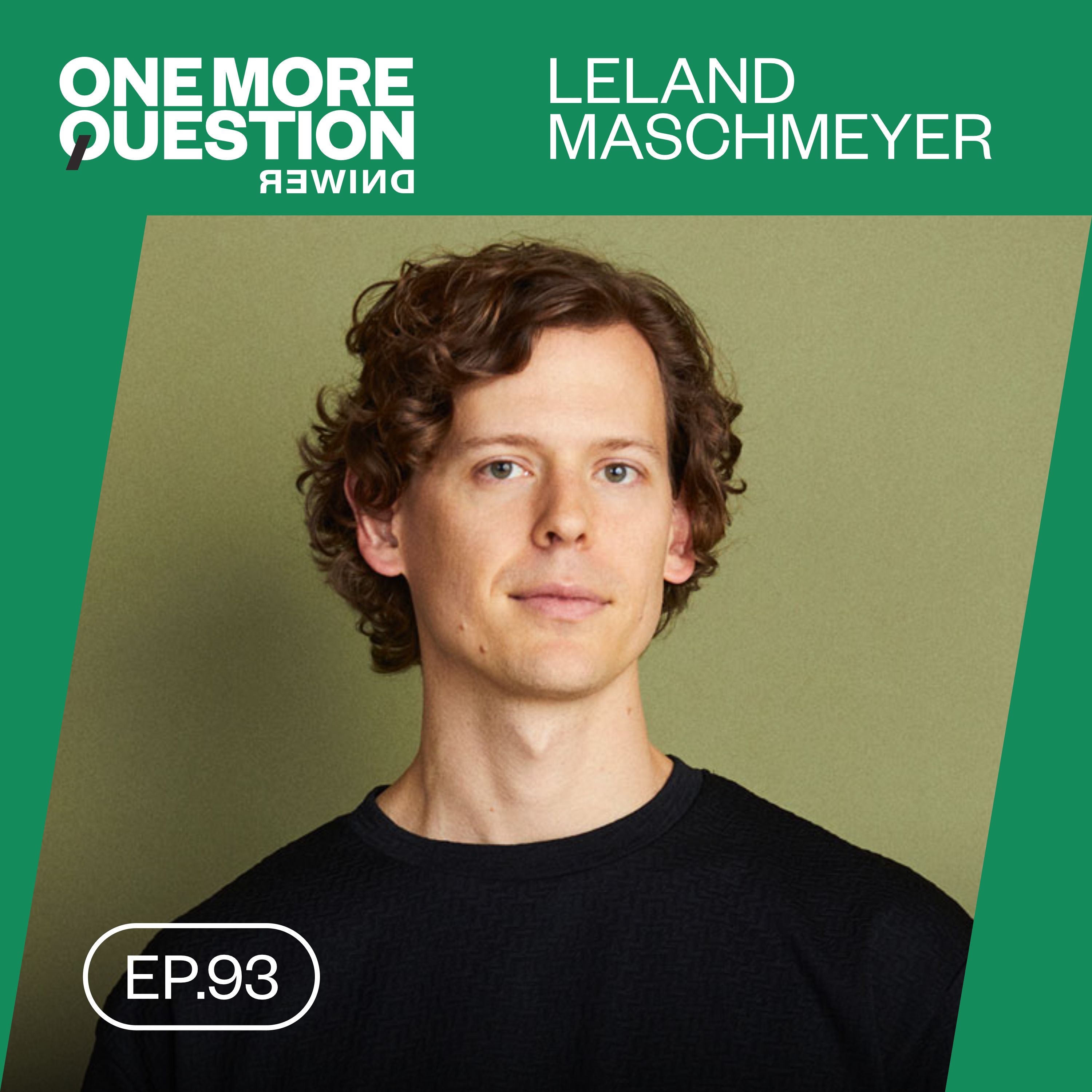
Rewind with Leland Maschmeyer: How Chobani rebuilt its brand
from One More Question
50m 12s
A brand is fundamentally a consensual hallucination—a shared story and myth that shapes human behavior and decision-making, not a tangible product or entity. Leland Meshmeyer, a brand leader with experience in both agencies and in-house roles, emphasizes that brands emerge from collective actions across departments, not from a single department. His approach at Chabani involved a four-year, phased strategy: fixing foundational systems, building a marketing engine, driving innovation beyond core products, and creating cultural resonance. This structure highlights the importance of internal alignment, long-term vision, and managing micro-decisions across functions. The conversation also reveals that brands are deeply tied to human psychology—people act on emotional patterns, not rational logic—making storytelling and consistency essential. Meshmeyer critiques the traditional agency model, which values time and deliverables over strategic outcomes and real impact. He argues that creative industries must shift to outcome-based business models that reward change and results, not just outputs. Drawing from Greek mythology, he shows how corporate narratives mirror ancient stories of heroism and progress. Ultimately, brands are not just about identity but about enabling easier, more intuitive decisions in a complex world. The future of brand work lies in redefining value through purpose, outcomes, and ecological thinking—where agencies and companies coexist in diverse, dynamic ecosystems rather than compete as singular entities.
brand is a consensual hallucination. A brand is an imagined reality. It is a useful
fiction. For the last six years I've sat down with people who build brands and
have always asked them one more question. 15 conversations but we think are worth
going back to. Revisit those moments that are worth listening to again. This is
one more question rewind. Enjoy. Today on the podcast I'm talking to Leland
Meshmeyer. Leland is a designer and business executive and the co-founder and
CEO of Collins, one of the best brand design firms in the world. In 2016 he joined
Giovanni where he led the rebrand and built the entire team behind. The world
economic forum has elected him as a young global leader and he is a list of
accolades too long to mention. Listening back to our conversation in 2021 he
is some of the clearest ideas about what a brand is and isn't of anyone I've
spoken to. We talk about it as philosophical take on branding and how it became
practical at Giovanni. He shares how he thinks about brands as an asset and how
creative people need to pair their clients' challenges with their creative
work. Enjoy. So you've got a quite an interesting sort of CV you've been through
all sort of you know you've been in the agency side you've now you switched
to you know Giovanni to be the head of an internal team and now you're looking
for the next sort of exciting opportunities. Can you can you talk a little bit
about how you moved from sort of building brands for people to building kind
of an in-house you know instead of building it for people almost building it for
yourself like what was that transition like and do you find there to be a sort
of a different way of approaching it depending on if you're sitting sort of in
the agency or whether you're actually sitting you know at the seat in the
company. Yeah totally. So you know one of the reasons why I was very early on in
my career attracted to the world of brand and brand building is because it was
a very inclusive discipline it was a big tent discipline right because
everything affects your brand. And so for me that was always really interesting
as a as a portal into lots of different kinds of conversations it could be
about ad campaigns or packaging or identity. It could also be about internal
culture and company structure, company purpose and things like that. So I love
the expansiveness of it. So for me moving from the agency side to the client
side really wasn't that big of a difference you know when I made the decision to
me it was just I was moving to the other side of the coin and I expected a lot
of the things that I learned on the agency side to translate well into the
client side and of course I expected to learn some stuff and have unique
experiences on the client side. What was really interesting to me is the
learning that I had about when you're actually in the company and building a
brand. It is very very different than being on the agency side advising
companies to build a brand. And I think you can probably catch the sense of
that just in the language that I used on one side you're building a brand on
the other side you're advising others how to build a brand. So the relationship
dynamic to the brand is very different one from ownership to to consultant.
It's not to say that they are apples and oranges but they are still very
different in some significant ways that is sometimes hard to wrap your mind
around at first because you're trying to apply a agency mindset and an agency
approach to building things in a completely new context which none of that
stuff matters because when you're on the agency or when you're on the client
side it's there's so much to do and there's so many other priorities to handle
other than brand building because when you're on the agency side like that's the
most important thing the brand is the most important thing. When you get on
client side it's one of the important things sometimes it's even lower down the
list than you might think depending on the conversation and the time but yeah
it's they are two very different things but I'm very thankful to have had the
experience of both and what was you know in that in that experience I love that
language of of building the brand versus advising hard to build like what do
you think the where do you think the agencies fall not short but sort of where
they work stops that that they could hear a little bit about what the clients
need to actually continue to build that brand to actually sort of take it to
market and connect it yeah well I think the the important thing is to know
that a lot of people client side aren't brand builders it's just not their
expertise brand building is a collective outcome from lots of people doing
their own specific work so you may have someone who is in procurement and
sourcing right who's making decisions related to specifically procurement and
sourcing but obviously in any number of industries the ingredients and the
sourcing strategies affect your brand you may have someone who works in shopper
marketing and is focused on the dynamics of a retailer relationship and is
making decisions according to what is going to be most successful in a
retailer relationship dynamic or some of that adds up to a brand so there's
very there's very rarely one person or one department that is responsible for the
brand everyone client side is doing a piece is making a piece of the brand
puzzle and you just hope that senior leadership has enough vision
communication ability and consistency in the narrative that they're
telling that everyone in the company starts thinking with a holistic mind and
is making all these micro and nano decisions that in the short run don't seem
like they're making a significant impact on the brand but when everyone across
the company is making all those micro and nano decisions and it with under the
same vision and and long-term ambition that adds up to the brand and you know
that's that's really hard to manage it you know everyone has different
competing agendas and ambitions and personal perspectives and different takes
on on what is right for the brand or not and so you're really managing a lot of
tiny tiny decisions on the on the client side and so again no one is expert at
building a brand you're just expert at the one function that you do when your
agency side you are expert on advising people how to build a brand so what
that means is you are trying to pass along frameworks language tools analysis
or diagnostic tools to help people understand you know where their brand is
right now and where they need to push it and then what actionable steps even
assets that they can use to help shape it and and move it in another direction so
so the language is very different right on the agency side it's about teaching
and sometimes delivering the assets and tools and then on the client side it's
about trying to figure out how in between the decisions you have to make or your
specific function that you're leading how can you make a decision a little bit
more of a brand supporting decision or not and so you know that's probably the
crux of the difference between the two experiences and I love I love that idea
because I'm not sure if every creative gets that idea that we are actually
teaching people and having to hand over these tools I hear a lot of people
complaining about are look what they've done to the brand you know they've
taken my work from this high level and they've executed it so poorly but I find
that disconnect there is that you don't realize that the people who are executing
the brand don't they don't have illustrator they don't have Photoshop they
don't have 10 years of design experience they they just don't possess those
skills and the tools that you gave them weren't necessarily the right thing for
them to do their job properly and we recently took took the jump and we've
started a few projects where we can own our own brands at Nicework and it's
been such an interesting journey so normally when you printing stuff you try
to print the most bad-ass thing ever and use as many finishes as possible and
make it look as beautiful and now suddenly that we're paying for the
printing the conversation dynamic changes you look okay where's the right
amount of spend so that the packaging looks good but also doesn't destroy all of
our profits and therefore make this product not a real product and more of a
passion project so that's been a fun journey for us to sort of go on and I think
it's given us a lot more empathy for how clients need to think about the work
that we do for them and how we can help them to sort of think of that journey
through a little bit better yeah I have a friend here in the United States who
runs his own mid-sized agency in the in the southeastern United States and he
started a so he has his agency and then he started a product company a beer
company and he's been you know he's one of the most awarded and successful
people in the history of advertising and just loved by everybody and a huge
champion of the world of creativity and design and things like that and as a
business owner he's like I can't do any of that like it's too expensive to do
it he had that like it'll crash
my margin, it'll destroy it. I can't be the best marketer for my brand because I don't have
the money to do that and I have all these other problems like at the warehouse and distribution
and just getting awareness of the product. I have these very basic needs and I think it's a really
great contrast in what an agency context aspires you to do versus what leading a business aspires
you to do or inspires you to do. So the agency context, you want to put a dent in the universe.
You want to do something so cool and breakthrough that people take notice and you may measure that
in terms of awards. You may measure that in terms of cultural resonance. You may measure that in
terms of, you know, what kind of impact it has on the on the company. But when you're inside the
company, you just want to survive to the next day and be a little better tomorrow than you were
today. And you have all of these things that you have to manage, the energy, morale, money in the
case of my friend, uh, retailer, relationships and stuff like that. It is so complex and exhausting
to manage all that stuff that you're just like, I want to be a little better tomorrow than I am
today and I'll be happy. And then just it's the belief that over time, you'll eventually make a
dent in the universe because your company will be so remarkable. But for right now, I just want to be
a little better tomorrow than I am today. So those are, that's a big gulf between two people who
are at the table talking about brand building with each other. Electric. So can you tell me a
little bit, you know, when you took over that brand at Chabani, you had quite an interesting
approach. Can you talk about how you approached building the brand and what the the steps were that
you took when you got there? Yeah, sure. So I was at Chabani for four and a half years. I've
since left. So I'm not there anymore. But the, when I went there, Chabani was a strong company,
but they definitely needed some coherence and clarity to and representation of the brand to help
them in the next stages of growth. So I set out a four year agenda where the first year I called
Fix the Fundamentals. The second year was, I can't remember the exact language, but it was
something like get the marketing engine humming. The third year was it push innovation outside of
Greek yogurt. And then the fourth year was cultural resonance, create cultural resonance and impact.
So the first year was really the perspective of how we fix all the plumbing and the stuff behind
the scenes so that we can execute effectively and coherently and with beauty and brilliance
over the next four years. So that was everything from the brand strategy to product positioning,
to read the product portfolio, to redesigning the identity and the identity system around it,
and getting some kind of core capabilities built in the marketing design, creative and media
departments within the company. I mean, this was, this was like the unsexy behind the scene stuff
that nobody really saw except for the for the brand relaunch. So we had a few kind of like
KPIs that we kind of tracked ourselves against to make sure we were doing that really well.
Then the second year, which is getting the marketing machine humming, that was all about saying,
okay, we have, we have the capabilities and the people and the frameworks we need to think in one
mind and to be able to execute as one mind. Now we need to figure out what is the approach to
marketing that is going to drive the growth of the core business because I knew if we weren't
contributing to the financial success of the company, it didn't matter anything else after that.
Like you have to take care of the core of the business before you can start expanding beyond the
core. So that's where the marketing and advertising really took the lead in what we were doing.
Whereas the first year, it was really like or design and strategy and brand. This time it was more
a marketing strategy and processes and approach. So we, we took that very seriously. We experimented
a lot to figure out what was working for our brand. We kind of redid our ways of working within
the organization so that we work with different functions like shopper marketing, sales within the
organization better. And again, similarly, we had our own KPIs to let us know if we were doing
well on that or not. So we eventually got to a point where we feel we were like doing good enough
on that. And then that's when we continue to push on that and improve on that. But then that's when
we started turning our eye towards innovation. And so I started working much more closely with the
internal innovation team worked on building out a innovation pipeline and strategy and roadmap for
the different types of products that we were going to get into. I founded the new Ventures
arm of Chubani where what we would do is we would look at opportunities in the marketplace. We
would make decisions as to whether or not that was something we wanted to do internally by a company
or what we were essentially outsourced. Meaning in food language, it would be co-packing. You
would essentially hire a factory rather than do it in Alice. You'd hire a factory to kind of
make the food for you for a certain amount of time. And there's there's benefits and drawbacks to
all three of those things. So it really depended on like what the category it was that we saw the
opportunity in. It was great. You know, we we took the traditional private equity mergers and
acquisitions model. We literally flipped it on its head. So rather than calling it M&A we called it
ANM acquire and mentor because the big flaw that we saw in the industry was that a lot of these
companies were being bought and then just gutted. The people were being kicked out. The business
models were being changed. The only thing that didn't change was the brand. But everything else
below the brand, people, processes and finance would get changed and gutted. And then the company is
like a shell of itself. And so the whole acquire and mentor thing was about saying like how do we
really bring people in and and and respect them as as new partners in this process and really
protect the integrity of of the company and stuff. So we did that for a few years. We got to a
point where we were pushing into new categories, not just beyond yogurt, but even beyond dairy.
So a lot of that stuff was in the pipeline. And so when that stuff was in the pipeline we started
turning our attention to cultural impact as the fourth pillar. And this and luckily this all
kind of like had this right cadence in terms of a calendar year. So by the fourth year we were on
having cultural impact. And so we started doing things that were more around how do we build the
brand through having playing a role in culture and somehow having cultural commentary. And so
there were various different ways that we experimented and tried to figure that out. And we were
actually just starting to ramp up some more significant work in that and then COVID hit and then
the multiple global crises hit. So it kind of put a poured water on a fire that we had been building.
But you know the totally understandable. And so I was really proud of the work that the team
was doing. And we had a lot of great momentum behind it and stuff. And so that was the that was
the step process that we went through during that for or you're going to have your period.
So I mean it's kind of you sort of stepped into many different places that someone of the kind of like
you know a brand title might not kind of traditionally go like how did you know was this your
did you drive this was this something that you saw was kind of critical you know how did you how
did you design this position for yourself you know and I think there's probably a huge amount of
convincing other people inside the organization to also you know include you and let you do the
work with them because this isn't just one man running around a business sort of making waves.
There's probably many people you know in different departments that involved how did how did that
all come about. Well luckily I recruited a number of people on my team who are excellent at
things that I'm terrible at. So I've made sure to recruit for that specifically so a lot of the
successes is due to them. And also you know within the culture of Chibani Chibani is a growth
organization is it's focused on doing things better and different. It doesn't mean it's always
easy and it doesn't mean that you get yes for everything that you want to do there's obviously a
lot of uphill battles and convincing and persuasion that you have to do but as a general stance the
organization has a has a tolerance for risk. So you know there was a context in which this was
possible there was an open spirit of conversation around it and there's also the attitude of like
if you have a better idea bring it forward and if it's better doesn't matter what function you
sit in it doesn't matter how old you are like you'll you'll get a fair listen to your idea and
if it's great we'll do it. So one of the things that I charged my team with very early on was
saying you know genius steals opportunities. There's no one who's going to bring you a great
brief. There's no one who's going to present you because I hired a lot of people who were from
agency side. No one's going to put a great opportunity on a silver platter for you have to go and
make that stuff happen. Now whether that's you invent your own brief because you an opportunity that
you see or you see something done within the organization that isn't being executed with excellence
and you believe that you can do better go do it better put an idea on the table challenge other
people and other functions to level up their game by bringing ideas that beat their ideas and
it's you know it's not to say that it's about competition but it's about encouraging a culture of
not just being on repetition but a culture that is about make things better and make
things happen. And so sometimes you have to put pressure on people and create a sense of
competition for people to kind of wake up and be like, oh, I got to do more than just what I did
yesterday. You know, there's the old saying that if, you know, if you're still doing what you did
five years ago, please stop. And if you're, you know, five years from now, if you're still doing
what you were doing five years ago, you're destroying the company. Like, we all have to advance and
evolve and do things differently. And so that was very much the spirit that I was always trying to
cultivate with it within the company. And so that allowed a lot of these this migration of
myself and my team into lots of different non-traditional areas of the company. There's also, there's
also, I mean, I want to ask you, oh, I was just, I was just going to say the other thing that I was
going to say was just that I have a, I have a very broad perspective of design. I, I cracked this
capital D design, which to me is the creation of desirable change. So I don't see design as just a
craft. I think craft is a subcomponent of design and a very important subcomponent of design,
but the discipline should not be defined by its crafts. It should be defined by the impact it
seeks to make in the world. And that is creating desirable change. I think this, I mean, I'd love to
ask you at this point, sort of like, what do you define a brand to be? Because, you know, just in
that last while you talked about, you've touched the visual component of it, you know, the kind of
the design, the feel of it, the tone, the, the people delivering it, the products that are being
delivered, the markets that we're thinking about, the way we entering those markets, you sort of
exponentially expanding the, the kind of brand. Like, how would you define, you know, someone
sits you like, you know, what is a, what is a brand? Like how do you answer that question?
A brand is a consensual hallucination. So a company is nothing more than a story and a bag of money. If the story wasn't there and
the money wasn't there to support the translation of that story into real world behavior, structures,
impacts and so on, the company wouldn't exist. I mean, if you take like, take like Nike, for example,
let's say every Nike office and factory around the world burns down. Did the company go away?
No, it would just take out a loan from a bank and build again. Let's say, you know, every piece of
clothing that Nike made and every television commercial disappeared. Would Nike go away? No,
they would just make more. Let's say a, the legal document that incorporated Nike was burned
and disappeared. Would Nike go away? No, because people would still think of Nike. They would still
have images of Nike. Nike would be as Nike would be like Santa. In the sense that Santa is not a
physically real thing, but it's so real in our imagination that it shapes our behaviors.
So there's a difference between the reality of like a computer or a door, like something
you could physically touch and the reality of imagination or that something stays in our mind and changes
our behavior. Just think of kids around Santa or the Easter Bunny or the idea of money. Money is a
consensual hallucination. There is no inherent value in a paper bill or a metal coin. It is, we choose
to believe in it because it makes it easier for us to do things together in the case of money to
exchange things. In the case of a brand to work together, to have a common goal, to have a common
set of values with which we prioritize to have a shared story and sense of identity. Brands are
useful fictions. They are nothing but stories. And even when you think of it from the consumer side,
think of why you buy a heavy, durable, good dishwasher or a fridge. You don't know anything about
dishwashers and fridge, but you know something you feel something about the brand.
That company, they've been around a long time. My mom used it a lot. I have friends who said
good things about it. I would like to have that brand in my kitchen. Okay, I'll buy that.
What about that was a real decision? Nothing. It was all a story that you held in your mind about
that brand and therefore that product. And so you bought it. It made it easier for you to buy it.
Or when you wear Nike on your chest versus like some unknown athletic brand. Like what that says,
what Nike says about you is a useful fiction to you to help you feel better. So these things create
persuasion. They persuade buying behavior. Now that is fundamentally what a brand is. It is a
corporate mythology. I'm a big believer in the idea of pattern and that stories are a form of
pattern that mythologies are a form of pattern. They tell us how world is structured, what's important
in that world and then how we move through that world. So if you think of any big company,
those characteristics are the exact same. It's an imagined story about how the world works,
about what's important to us and what it will take to succeed. Anyone who runs a company will tell
you those are the those are the most important things in a brand for their company. That's why they
hammer home the brand over and over again to their employees and to their consumers. So it's a useful
fiction or if you prefer to call it, it's a corporate mythology. And oftentimes those corporate
mythologies are are repetitions of ancient Greek mythologies. So here in the United States,
there's a company called Target who became very famous for making design available to the masses.
So you took something that was of the elites. It was highly desirable and made life better and
you gave it to the people who it would to the majority of people who desperately needed it because
it would make their life better. That's took that's the Greek mythology of Prometheus of bringing
light from Olympus down to the humans so that they could survive. You have Nike or use Nike again.
Nike is the story about overcoming about the champion inside of us overcoming all obstacles to
achieve that self enlightenment that that apex of who we are. That's just the Greek mythology of
Hercules. A mere mortal going through all these trials thrown at him by the gods to emerge so
victorious that he becomes a god himself. And isn't that what we do with athletes? We put them on
a pedestal and they become almost gods in of themselves. So you know, I can go down the list of
tons of different companies whose consensual hallucinations are simply Greek mythologies dressed up
in in the clothing of their time and their corporation and their category. That's what a brand is.
Now, there's also the conversation about practically mechanistically what does a brand need to do
to in terms of his performance on the business to know that you actually have built a brand, right?
So I think there's a few things. One is it needs to increase your purchasing your pricing power.
The more that you can convince people and persuade people with a brand, the more you're able to
increase the perceived value of your product. And therefore, you can raise your price without
people complaining. The second thing is is it can influence purchase decisions. If you're looking
between two products on a shelf, you reach for that product because of the way it makes you feel.
And so you get preference drivers out of it. And then the third one is it makes your media
dollars work harder. If you're continually investing in a common story over and over again,
you don't have to do much to trigger those emotional equities in people other than just sometimes
show people the logo. I think Nike again, just because everyone's familiar with it is a really
good example of that. You can just put you could take a cheap shirt and put the Nike logo on it.
And all of a sudden, it's a cool shirt. You could make a very weird piece of graphic design
and put the Nike logo on it. And all of a sudden, it becomes a cool piece of graphic design.
It's because both of those things become imbued with those emotional equities that have been built
over millions of dollars in decades of consistent emphasis. So that all of a sudden,
the things that you do communicate with become that much more powerful because they're communicating so
much more than just what is on the surface scene. And so what you get out of that is you get more
effective media dollars. For every dollar you spend on making this up, you get $10 of impact
because it's more memorable that resonates more emotionally and so on. So you get all sorts
of financial benefits from building a product or building a brand effectively and consistently
over years. And recognizing that at the end of the day, a brand is nothing but a consensual
hallucination that has very significant business benefits to it. I like, I love that you've got this
philosophical take. And then it also becomes exceedingly practical at the end. So do you think
that the Greeks were the best brand builders that we've ever seen? What do you think time has
just lifted them up a lot? They've got sort of, they can never be measured against anyone else
because there were the only ones who wrote anything down. Yeah. Well, I think Western culture has
certainly drawn from Greek culture the most and therefore it's the most resonant with us because
it's the soil in which many of our stories have emerged or been replicated to say that they're
the best of, you know, in time. Who knows? I don't think there's such thing as a best.
say that the Greeks are the most influential to us, yes, they are. Because it's also the earliest
recorded mythologies and traditions and rituals that we have in as complete a fashion as we do.
Certainly we have it earlier cultures, but we don't have it as replete with stories as
and robust of narratives as we do from Greek culture. So those because of that tend to be the ones
that we pull upon and draw inspiration from the most. But yes, Greek culture as one of the cultures
we can learn from is a really remarkable mythological structure from which to draw upon and get lots
of inspiration. And it's an endless well of inspiration that we can draw from every day.
And I love this idea because it also taps into how we as humans behave. So I mean a story,
my cousin drove a Mitsubishi cult back when I was like 15. And in that moment I looked at it
and Barry, I was like, Barry's the coolest dude I know and he's driving this thing.
Therefore, this thing is the coolest car that you can have. Fast forward five years time, I justified
to myself, I had all of these practical reasons as to why I should purchase a Mitsubishi cult.
I was like, oh, I can move this around and I can do that and feel economy and love. But the reality
is if I really, really looked deep in my heart, it was because Barry had one. Therefore, I wanted one
and I bought it and that car made me very happy for I think the nine years that I drove it around.
But the decision I caked it in logic, but it actually was completely illogical. There was no real
reason that I should have wanted that car, except I did. Yeah, I mean, look, making rational
decisions is cognitively taxing. It takes a lot of energy and burning of calories to make
rational well thought through decisions. I mean, one of the worst decisions that economists
in their history ever made was that was establishing this somewhat useful fiction of the homoeconomicus,
the person who makes the most rational decision and their best interests. It was only partially
useful because it was only useful to economists to make flawed models. It was not useful to anyone
else because it was an outweigh or reflection to reality. And you're a perfect example of that.
We're all driven by emotion because emotion is less taxing. We want, we like patterns in our
lives because we want to know what's right. And when we're not following a pattern in our life,
we have to build the pattern on our own. And that is what rational work does. It says,
"There's no obvious path for me towards the best outcome. I need to build my pathway,
my pattern of knowledge to reveal what that right answer is." And that takes a lot of effort
on an individual level. And if you're doing that, whether you're buying a car or a house or a
can of beans, like it's just, you can't do that with every decision or even like, you know,
which way do you turn at an intersection? You want to just go on autopilot and just go.
And that's what brands really well built brands help enable. They override that need for that
rational structure building and just says, "Look, it's really good. We're consistent. We're authentic.
We're credible. And we're delivering something of clearly communicated value to you in this
specific instance with products that have a reputation for being excellent." Then people just go
on autopilot. Then it's just like, you make it easy for people. And if we know one thing from
technology, it's easy always wins. Much like an easy, easy lie spreads more fastly than a
complicated truth. No one wants to tax their brain, figuring out the rationality and logic of
something. They just want the easy answer, even if it is not in their best interest.
This is why we have flat earthes running around and spreading a lot. Yeah. Yeah. Exactly.
But what role do you think people who are building brands should take? Because I love the thought
that the easy lie perpetuates faster than the complicated truth. Brands are so culturally
important and they shape narratives. What role do you think brands should be playing in our
societies? Because we sort of lifting them up onto these pedestals. And like you say,
they corporate mythologies. They actually are just corporations underneath the mythology.
There are companies. What did you say? They're just a bag of money and the story.
What do you think those bags of money should be thinking about and doing with the brands?
Well, so are you, and this is part of the area where it gets trouble talking about brands? Are you
talking about brand as in a marker of identity and narrative? Or are you talking about brand as
a company and what companies should do and what role they should play? Well, I'm asking the
question was companies are the ones that are building and creating these narratives?
Like, what role do you think they should be thinking about? And I know it's quite easy
to think that companies should be standing up for societal issues, but I don't always see
that aligning with the story that the company's telling. So how do you think companies should
navigate this space because they're seemingly more pressure on companies to make some kind
of a stand or draw some sort of a line in the sand and be more clear, whereas I think they've
historically been able to skirt those issues if they felt the need to.
Yeah, it's a, I think that's a complicated question because on one hand, I mean, look,
you know, you have all the way up to the Supreme Court talking about how companies are humans, right?
And then you have this, what I would consider antiquated, but still nonetheless present ideology
that from Milton Friedman, that says the only purpose of a company is to make profit for its shareholders.
And so in that wide range, it's tough to make a declarative statement that sweeps across all
companies because I think companies are just organisms like any ecosystem. There are,
there are people at the top of the food chain, there are companies at the bottom of the food chain,
there are net good, there are net bad, there are all sorts of checks and balances that have to be
in place for this diversity of creatures in an ecosystem to coexist in the most beneficial way
possible. So this idea of making a sweeping claim that all companies should be this way or that
way, I don't think is realistic or even rooted in any biological reality because if you think of,
if you take like farming, for example, the richest, most productive areas of land are often the ones
that are the most diverse in terms of the different types of crops and plants and whatever that are
that are all packed in together in a very tight space. And all of them have a different role to play
complimenting other ones, other plants within that ecosystem. Some, you know, put nitrogen into the
ground, other plants suck up that nitrogen to grow. Some are meant to be low level plants, some
are meant to be high level plants providing shade to the other plants that need less sunlight in order
to produce the nitrogen to put it into the soil and stuff. So it's a very complex arrangement of
different types of organisms that all need to play and do different things in order for the
collective to grow. And I think it's the same way with companies. Absolutely, there are some companies
that should and have every right to take a position on purpose. I think there are companies that
don't need to do that either because it's not appropriate for them, that it does, it's not authentic
to their business model. Or it's just, it's an unnecessary pursuit or maybe they do it in a
different way. You know, so I'm always wary of saying all companies should be this or that.
And like once again, you're very philosophical and very practical, all at the same time. I think,
you know, it's just to sort of close out, you know, I'd love to, you had some interesting
thoughts on the sort of business model of design or the business model of creativity and
why it's flawed. I'd love to sort of close out of that because I'd love to hear your thoughts.
So we can cut this question out. But can you remind me what it was that I said to you? I want to make
sure that I'm being consistent with what I said to you before. I mean, so this is what you're saying,
you were saying that this was what was inspiring you and you were titling with kind of the data
sciences, the only valuable model, but you don't necessarily agree that it's the only one that exists
and you were sort of trying to figure out what the different one is. Got you. Okay, all right,
I just want to make sure there wasn't anything I anchored that comment in. So all right,
ask me the question more and more time and then I'll come up with an answer. Yeah,
so when we, on our call, we were talking about, you know, one of the things I asked you was,
what sort of interesting you at the moment and you answered, sort of trying to figure out the
business model for design and sort of creativity isn't the best one. And you were sort of trying to
think of better ways to to leverage those two things as a business model.
Yeah, so I think in general, the creative industry is having its come to Jesus moment with
its business model.
The industry has for too long sold time as its measure of value.
Now, obviously, that is in opposition to what clients really want.
Clients don't want you to take a longer time working on something, right?
But if you're incentivized to take a long time, because that's how you make more money,
obviously, there are opposing incentives in the relationship, which is not a good basis
for a relationship.
And time obviously is in no way a reflection of the value that agencies create.
I think the other thing that is tough is that a lot of agencies, whether you're design
advertising or other, are too often selling the production costs of deliverables with a
markup on it.
So whatever it costs to make something, great, we'll throw 20% on top and then here's
the bill.
So then what you're doing is you're tying yourself to a output.
And output is quite frankly one of the least important things to a client.
The client cares about two things, the strategy and the outcome.
Those are two things they're willing to pay a lot of money for.
And when we sell time or when we sell product or output, we're not in any way benefiting
from any of the outcomes that we create.
And remember my comment earlier is that design is about creating desirable change.
So we should be incentivized by the change we create, not the tactics or the objects we
make to incentivize them.
The other big problem with that is is we give away the strategy.
We actually, if we even charge for it, we undercharge for it because we put too much value on
the output.
So already we're either not paying attention to the thing that the client wants to care
the most about and we're under selling and selling for cheap, if not for free.
One of the things that the client wants to pay the most money for and then we're charging
on the thing that the client wants to pay less for.
And so already in that we're struggling with with an economic business model.
Now the other big challenge with all of this is award shows, award shows play an incredibly
important role in the development and the sense of mastery of individuals in their career.
I absolutely pursued winning a lot of awards as part of the Shabbani experiment because
I wanted validation from a third party, from a third party to say that we were doing
excellent work that was competing with any other agency in the world.
The problem becomes when we replay, when we think awards are evidence of our worth to clients.
So there's so many websites for agencies that I've been on where it's like they list
all the awards on the front of the page.
And we think that that is going to increase the perceived value of the agency.
It does it because again, clients care about outcomes and strategy.
Go where and there is awards, awards are kind of like signals that maybe you're talking
to someone who's an expert, but if you can't move beyond the awards conversation and flashing
the metal in front of clients, you're on a downward slope in terms of your perceived value.
Awards are nice, but they are not everything and too often we treat them as everything.
So the challenge becomes for agencies to figure out what it is that agencies need to do
to more attach what they do to outcomes.
And there's an entire world of discussion around this that a lot, frankly, a lot of people
in the creative community aren't a part of because it's an interesting sounding.
I mean, to be kind of honest, who wants to talk about price point, who wants to talk
about how to write proposals, who wants to talk about different incentive models and ways
of measurement like it's like that's just not interesting, but it is necessary and sometimes
we have to do what is necessary to get to where we want to be.
And so I think there needs to be more people who look at the agency business models as
a design problem than a business problem because that's what it is at the end of the day.
It's a design problem.
We are using to put it bluntly old world business models in a new world.
And that's why so many of these agencies have been driven to lower price points per project,
being driven to project based work, being driven to commoditization by procurement.
It's because we're not working hard at finding those new business models.
And there's a lot of great conversation out there and a lot of really interesting ideas
out there that can be applied on a project by project basis, can be applied on a client
by client basis.
So it's not that agencies need to totally shift, you know, kitchen sink and all to a new
model overnight, it's that they need to start experimenting with what's going to work
in their business and also learning and engaging in those different dialogues so that we
know how to get the real credit for our type of work and also ensure that clients understand
the real value that we're bringing is not a color scheme, it's not a typeface, it's
not a logo, it was not an ad.
Those are just things we do in the process of creating desirable change for our clients.
And really, it's the knowledge and the strategy of knowing what to do and then the evidence
that we can create that change.
Those are the things that we need to emphasize and they could go on for this for a whole
another podcast, but I'll kind of just stop right there.
I mean, I love it feels like we've beautifully come full circle.
I think it's that, you know, you've been in the agency world and you've now also been
in the client world and I think it's the design problem is how do we merge those sort of
worlds together slightly more because that's in that is where the business model lies.
You know, if you look at the industry, the music industry is a great example, like streaming
has changed the way we buy music.
It's fundamentally altered how people record where they distribute, how they sell, how they
monetize.
It's fundamentally shifted the entire industry and I think we also sitting at a similar kind
of point, you know, I'm not sure if the technology was the best thing for the musicians.
It just is what, you know, it's is what has happened.
So if that conversation had been slightly different potentially, there would have been
a slightly better outcome for the musicians in the industry.
Yeah, I mean, like with all sorts of technologies, it depends on where you sit looking at the
technology, whether you deem it morally good or bad, right?
So I think in the design context, we have to shift where we're sitting to look at these
changes or these pressures that are being put on the agency model as not, oh, that's
the way it is now.
But to say, what is it saying about how we're working?
What is it saying about what we're not doing well?
What are the opportunities we're missing out on because we got to jump out of the fishbowl
and jump into a new fishbowl, if we're going to save the agency business model?
And look, at the end of the day, this is also, if you take an ecological ecosystem approach
to it, for a long time, brand-oriented agencies, whether you're an ad agency or a design
firm, were were the alpha predators in a very limited agency ecosystem.
There weren't a lot of different types of agencies to compete with and they were and
these two were alpha predators because they were the ones who control brand, which were
the biggest leverage of purchase persuasion in the marketplace, given the economic dynamics.
Now we're a very different place, we're a very different place where experimentation,
analytics, performance, marketing, growth design, things like that, e-commerce, those are
things that are the biggest drivers and creators, the biggest drivers of persuasion, biggest
creators of revenue, so a whole new class of agencies have emerged, multiple new ones
have emerged further enriching the agency ecosystem and so the alpha predators are no longer
the alpha predators.
So it's not that we're trying to get agencies to go back to the way it was.
We have to recognize that we're now in a much more complicated and rich and dynamic ecosystem
of agencies and we have to figure out what is, if you're a brand agency, what is the brand
agencies potential in that ecosystem and how can you compliment and show distinctive differentiated
value to those other agencies in the ecosystem who are experiencing meteoric growth because
they're brand new.
They have, they're working from a small base, small size, so their growth can be fast and
steep but eventually they're going to level off too, eventually all growth flattens out,
there's just things as infinite growth.
And so what happens now in an ecosystem where everything's stable and you have a much
greater diversity of very strong agencies in it.
I think that's a really interesting question to start talking about positioning, agency
narrative, agency business models and so on because it's what's needed to move forward.
I think that's such a great note to end the podcast on Leelon, thank you so much for
your eloquence and your philosophy and your practicality, I got a lot out of this, thank
you very much.
Thank you for having me.
Awesome, and we'll catch you in the next one.
One more question is lovingly made by NiceWork.
I'm Ross Drakes, the founder.
At NiceWork we build brands people care about for rebels, dreamers and pioneers across
the world.
If you'd like to talk about building a brand or connecting people to yours, find us at
NiceWorks.
and currently recording season 7 and you'll hear more about that in 2027.
Thank you so much for listening and until next time, bye bye.
Podcast Summary
Key Points:
A brand is a "consensual hallucination" — a shared story and myth that shapes behavior, not a physical entity, as seen in examples like Nike or money.
Brands create persuasive emotional connections that drive consumer decisions, influence pricing power, and make media investments more effective.
Moving from agency to internal brand leadership changes the role from advising others to managing internal alignment, where every department contributes to the brand.
Brand building follows a strategic, phased roadmap (e.g., Fix Fundamentals → Marketing Engine → Innovation → Cultural Resonance) to ensure sustainable growth.
Designers and creatives should focus on creating "desirable change" rather than just aesthetics, aligning business outcomes with emotional and strategic value.
Agencies are limited by outdated business models that sell time or outputs, ignoring client needs for strategy and real-world outcomes.
The creative industry must shift from output-based pricing to outcome-based models that reward innovation and measurable impact.
Brands and companies are ecosystems, not monolithic entities — diverse organizations play different roles, and no one-size-fits-all approach to ethics or purpose exists.
Summary:
A brand is fundamentally a consensual hallucination—a shared story and myth that shapes human behavior and decision-making, not a tangible product or entity. Leland Meshmeyer, a brand leader with experience in both agencies and in-house roles, emphasizes that brands emerge from collective actions across departments, not from a single department. His approach at Chabani involved a four-year, phased strategy: fixing foundational systems, building a marketing engine, driving innovation beyond core products, and creating cultural resonance.
This structure highlights the importance of internal alignment, long-term vision, and managing micro-decisions across functions. The conversation also reveals that brands are deeply tied to human psychology—people act on emotional patterns, not rational logic—making storytelling and consistency essential. Meshmeyer critiques the traditional agency model, which values time and deliverables over strategic outcomes and real impact.
He argues that creative industries must shift to outcome-based business models that reward change and results, not just outputs. Drawing from Greek mythology, he shows how corporate narratives mirror ancient stories of heroism and progress. Ultimately, brands are not just about identity but about enabling easier, more intuitive decisions in a complex world.
The future of brand work lies in redefining value through purpose, outcomes, and ecological thinking—where agencies and companies coexist in diverse, dynamic ecosystems rather than compete as singular entities.
FAQs
A brand is a consensual hallucination—a shared story and imagination that shapes behavior and identity. It's a useful fiction, like money or Santa, that enables people to work together, form beliefs, and make decisions based on a shared sense of value and identity.
In agencies, you advise and teach others how to build a brand. In internal roles, you help shape brand decisions as part of daily operations, where brand-building is a collective outcome of many departments making consistent, aligned choices.
A strong brand increases pricing power, influences purchase decisions, and makes media investments more effective by creating emotional resonance—so each dollar spent delivers greater impact and recall.
The approach followed four-year phases: Fix the Fundamentals (strategy and identity), Get the Marketing Engine Humming (execution and processes), Push Innovation (expanding beyond core products), and Build Cultural Resonance (impact through storytelling and societal engagement).
Design is not just about aesthetics—it's about creating desirable change. It shapes how people feel, act, and perceive a brand, making decisions easier by providing emotional cues and consistency.
People prefer emotional, pattern-based decisions because they are easier and less taxing on the brain. A strong brand provides a reliable, consistent story that overrides the need for complex, rational analysis.
Chat with AI
Loading...
Pro features
Go deeper with this episode
Unlock creator-grade tools that turn any transcript into show notes and subtitle files.
 PodcastTranscript AI