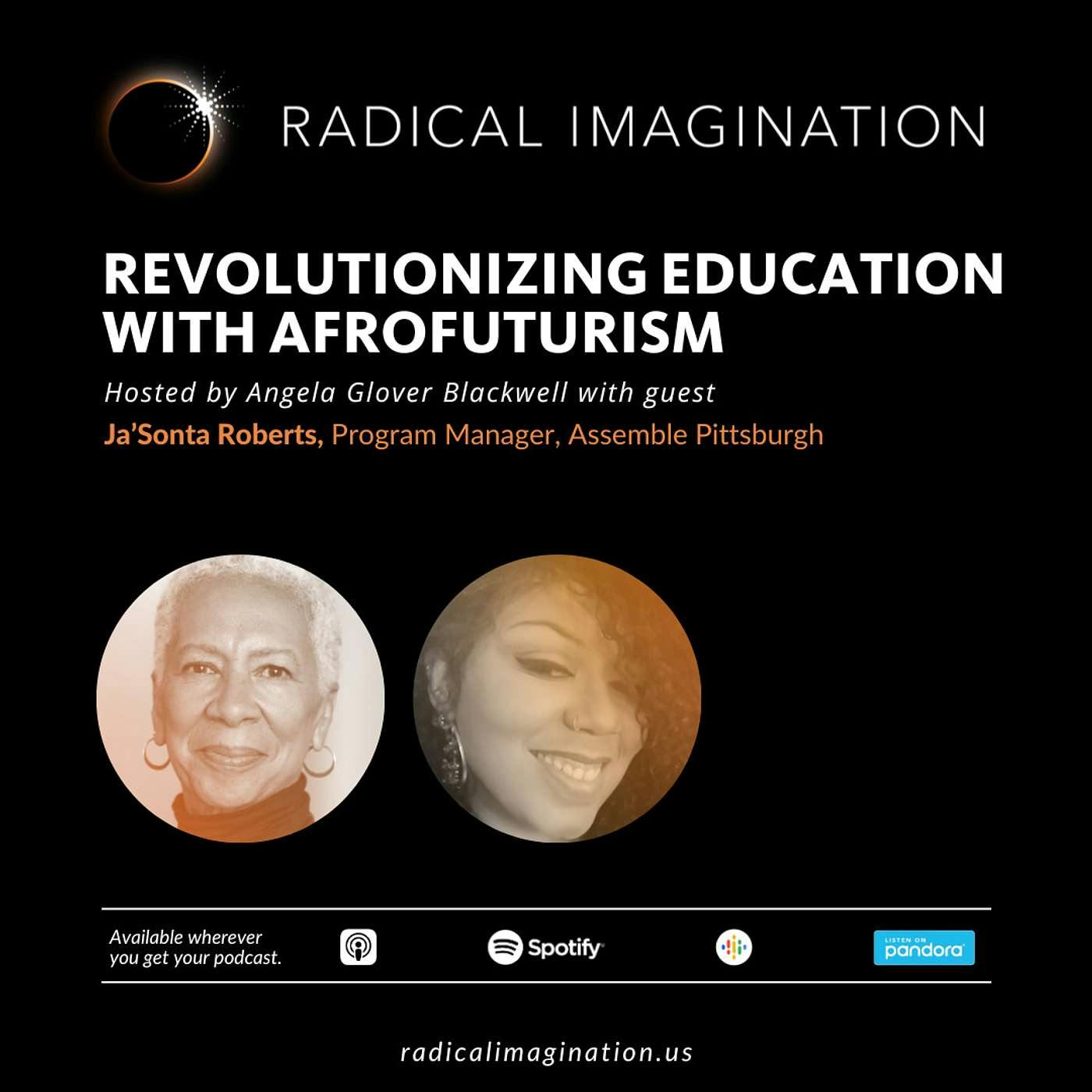
The Radical Imagination podcast delves into Afrofuturism as both a literary genre and a philosophy driving social change. In Pittsburgh, a curriculum intertwining science, technology, engineering, arts, mathematics, black history, and Afrofuturism has been developed by Assemble, aiming to empower students to envision and create a better future. Lessons include activities like exploring the science of hair and designing Afrofuturistic utopian cities. The curriculum has had a profound impact on students of various backgrounds, fostering understanding and appreciation for black history and contributions. Amid current challenges in education, such as bans on teaching black history, the program's role in promoting inclusivity and empowerment remains crucial.
Transcription
4253 Words, 24193 Characters
Welcome to the Radical Imagination podcast where we dive into the stories and solutions
that are fueling change.
I'm your host, Angela Glover Blackwell.
More than ever, we need the hope that comes from envisioning our way out of the crises
facing the world and from imagining a better future.
In this spirit of hope, I am returning to a topic that always fires up my imagination,
Afrofuturism.
In 2020 on Radical Imagination, we discuss Afrofuturism as a literary genre.
Every time we imagine a world without poverty, a world without wars, without borders, without
prisons, that is science fiction because we have not seen a world like that.
This year we explore Afrofuturism as a philosophy animating the movement for house injustice,
providing a roadmap for liberating society from patterns of the past, and creating a
world in which everyone has access to the resources we all need to flourish.
Today we will talk about Afrofuturism as a tool and as an inspiration for student learning
and empowerment.
A new education curriculum developed in Pittsburgh, Pennsylvania combines science, technology,
engineering, arts, and mathematics with black history and Afrofuturism.
The curriculum, developed by Assemble, a community learning hub centers black creators in their
role in shaping history as a way of encouraging students to imagine the future they want to
build and then activating their brilliance and power to build it.
My guest, Jacinta Roberts, the offsite programs manager for Assemble, developed this innovative
program.
Jacinta, welcome to Radical Imagination.
Thank you so much.
Now, let's start by going back to the founding of this curriculum.
What started in one of Pittsburgh's high schools in 2019 has since spread to after school programs
and summer camp programs across the state and has been modified at other grade levels, too.
Tell us about the specifics of the curriculum, the way it builds on what you call steam learning.
So what really sparked off this desire to create this curriculum was that there was
definitely a void and discrepancies and representation of black and brown innovators, scientists,
engineers, et cetera in these fields.
And as a steam-focused organization and a woman of color, I felt like this was definitely
something that we needed to address.
There are a lot of students of color who didn't see these science fields as a space for them
because they did not see those faces that looked like them.
So we started creating that at Westinghouse High School as a pilot program.
We started with about five students, and the curriculum was more so based on talking about
the history for civil rights movements, for the equality of women.
They kind of started that way and evolved into a more focused discussion on situations
like the Black Lives Matters movement.
What is the face and the drive of the NAACP today?
How do youth still feel like they can be a part of the community and look back at the
past to build a more lucrative future for themselves?
It was those students that were in that original five that told their friends, that told their
family, that told other faculty members, the other after-school program partners that were
at the location that they wanted to spend that time in the classroom with us.
And so seeing that, I was like, yes, this is exactly what I was hoping for, was that the
students themselves would see the value in this and want to drive it forward.
That in turn led us to kind of sit back and look at the curriculum and say, how can we
address this for kids of all ages?
So we kind of went back to the drawing table under the principle, the African principle
of Sankofa, where you look at your past and bring those things into the present so we
can build a great and lucrative future.
We decided to say, let's do a little bit of research, or those people who actually have
never been spoken about, who've been omitted from history books, whose products and innovations
and designs and patents we use every day, but don't know that they were people of color.
So we did that deep dive and started to come up with who was the first automobile manufacturer,
which was in the 1800s, and that this black man's patent, we still use today on every
single sliding door you see on a minivan.
But a lot of folks do not realize that that was invented by an African-American.
And so not only were we focusing on the histories through the African aspirin lens, but then
we're also saying, okay, what about everyone else who hasn't been taught this either?
So that's when we saw not only is this a need for students of color, this is a need for
all students.
Can you talk about your own thought process as you were developing this curriculum?
How has your background and experience in education brought you to this moment?
I felt like I needed to be that person that I didn't have.
And so as a young woman of color coming up through the educational system, I saw a lack
of representation throughout my educational career.
I did not have my first black instructor until I was a junior in college.
And that was specific because I took an Afro Haitian dance class, and that was our only
instructor of color that I ever had.
I felt like I had such a love and a joy for not only the arts, but the sciences.
But I was not made to feel like that was a space for me, that I was outside of my lane.
And as a young person who has always been very vocal, my mother was also very vocal.
My grandmother marched with Dr. King.
It was in me in my DNA to not stand and be idle, but to make change, even if I had to
be the one knocking on the door solo, I was going to create pathways.
And so having that drive and that passion to want to make space and make room, I kind
of would fight against the norms.
I would go to my principal.
I would go to my teachers and ask why we weren't learning about this person or that person.
Why we were not celebrating Martin Luther King Day?
Why did we have school that day when everyone else is off?
Why are we not recognizing the contributions of African-Americans in this country during
Black History Month besides the typical five that you hear everywhere?
So I've always had that passion and drive to kind of rock the boat.
You know, you said a couple of things I want to ask you about.
Sure.
You had this African-American or Black teacher in dance.
That was the first time in your educational career that you ever had an African-American
instructor?
Yes, that is true.
That was the first time.
Where did you grow up and where did you go to college?
I grew up here in Pittsburgh.
I went to Point Park College at the time and yet transferred into a university.
There I studied both performing arts and education and did not once have a Black teacher until,
and again, that's a very specific class.
You know, that is a cultural dance class and that was the first time I had ever had from
the time I was in elementary school all the way to junior and college, the first time.
Wow, that is really sobering.
I grew up in St. Louis, Missouri and went to school beginning during legal segregation
and continued from the time I was in like second grade after Brown versus Board of Education,
but my education continued to be segregated and then I went to Howard University.
So my experience was completely different.
I'm really struck by how your experience made you want to do for the students so that you
were going to come into contact with something very different.
That was really what propelled you to start doing this work.
Absolutely.
Now, how did you come to the Afrofuturism influence on the curriculum?
Because it's first when you started talking about it, it was the history.
But you have taken the history beyond looking back and understanding the present but looking
to the future with a lens.
How did that come about?
Really, some research.
It was working on a couple other curriculums that we had.
I was noticing that like we have a chemistry curriculum and we have an engineering curriculum
where a lot of the students who were of color had some interest but didn't see anybody there
so we were fraying from participating in that class.
So I was kind of like, I'm noticing this in different learning tracks, in different communities
and neighborhoods, different schools, different partners.
And I'm like, okay, why don't we do something about it?
High school kids are a little more verbal with how they feel about what they're learning.
So let's try it with them first.
Let's see if they understood how this kind of has a ripple effect so that they can project
into the future what they want to see themselves doing.
Because that was the other side of it.
Whenever we would ask them, what do you see in your future?
A lot of it was just, it was despair.
It was not seeing that they were going to have liquid futures.
Not feeling like they had the ability to access college education because they didn't feel
like either they had enough exposure to those specific fields in high school or middle school
or because, again, it was not a space that they felt welcome in.
You were talking more about how you got into this program but I'd love for you to describe
Afrofuturism for our listeners and why that's important to incorporate into the framework
for these lessons.
So Afrofuturism, when it first kind of started to circulate, it was in the early 90s.
And it was more so associated with there being some type of representation in science fiction
fields.
That was originally how it was coined and became kind of popular through a couple of
lectures and conversations that were being had nationally about science fields of representation
and science fiction and graphic novels.
And so it's kind of evolved.
So we've taken it another step further.
So more it's about the intersections of the African diaspora and the experiences and culture
as it intersects with science fields.
So it's like, what else besides a sci-fi can we really take a look at what our futures
are going to look like?
And so we folded not only science fiction, but we folded engineering, we folded chemistry,
we folded design, we folded arts, mathematics, all those things into how do we look at this
through that lens?
And that's through making sure that we are including innovators, scientists as it engineers
artists into the curriculum.
So for instance, we have one, one of our arts activity that's really popular is hair pride.
And the hair pride lesson talks about the Crown Act.
And within that, we talk about the science of hair.
Say what the Crown Act is, please.
Yes.
The Crown Act is legislation that makes it illegal to discriminate over someone's natural
growing hair.
And it was, it was actually a term you can actually look up on Google and look at professional
hair and you would see the opposite when it came to natural 4a, 4b, 4c hair, which is
more of the texture of folks who have that connection to African culture.
So that's what the Crown Act was.
We're still trying to make it a national law, but it's definitely in certain states already
been passed in New York or California and a few others where it is illegal to discriminate
against someone's natural growing hair.
And with that lesson, we also talk about the history of cornrows, of cynically twists,
of other African styles that we have adapted today, whereas those styles were, were maps.
Those were roads.
Those were signals.
Those were languages that were shared through our hair and how there were laws that, you
know, during the restoration period when Jim Crow, we had to cover our hair.
It was illegal to have our hair.
And so we talk about those histories and then we say, okay, so here we are now today.
Where can we be in the future?
How important is it that our hair is so rooted as part of our culture that we can crown it
proudly?
And so that lesson kids actually get to make.
I've had several of our local hair stores donate hair to our program, whereas kids are creating
self portraits and paintings where they're incorporating hair into those lessons.
And it has been a huge, huge winner for our curriculum program for youth of all ages.
And how does that relate to science, technology, math, the other things that are part of scene?
Well we talk about the science of hair as well.
So hair texture, follicles, taking care of it, natural ingredients.
So we also have a little zine, a little mini magazine that goes with the lesson, where
it breaks down the different types of hair and how they are sometimes culturally connected.
How do we care for our hair?
Why is it that our hair reacts differently to heat, to water, to dryness?
So we do talk about that in some human biology in the lesson.
So that's where we make those connections to steam and the science behind it.
Are you using technology much?
Is that a part of the curriculum?
Absolutely.
So we also have coding programs.
We have 3D printers, laser cutters.
We actually have a new robotics program that we're working on where they can actually build
robots that use both motion, light, voice, or sound sensors.
We have representation of every single letter in steam.
That's fabulous.
Do you have any other examples?
Because I think that for people listening to this, it's one thing for them to begin to
understand the idea of Afrofuturism, but how it gets incorporated into lessons, I think,
is a little harder to grasp without particular examples.
We also have what we call the Afrofuturistic utopian city lesson.
And that's where we talk about us as African-Americans are also not a monolith.
We have varied interests and backgrounds and desires and things that we want to accomplish
in the world.
So how do we create a space through that lens where it is equitable for all?
And again, we say equitable because equity and it being equitable are different in a
lot of people's eyes and definitions.
So what do we need to do to establish so that we can raise us all up?
So with that, kids will talk about infrastructure of a community.
What does that look like and define it?
What do we need to have a successful society?
How do we look at what we're doing now as opposed to what has happened before so that
we can say this is going to allow us all to thrive and all to be creators?
I want to see if in your experience as a teacher or observing others using this curriculum
to teach an aspiring experience that you had with students having an aha moment or a breakthrough
or you could see their eyes light up because they were connected in a different way.
Do you have an experience like that that you recall?
Oh, I have so many.
I'll give you a recent one.
We had an Afro-Future partnership with the center that cares at their Grayson location
on the Hill District.
And that is a middle and high school program that they offer there.
And one of the lessons that we did was there are black people in the future whose focus
is on Alicia Wormsley's work.
There's a lot of gentrification that was happening in East Liberty.
And she created a billboard that said there are black people in the future.
And it was posted on social media and went viral.
And then those same billboards are popping up in other major cities in the U.S.
And it was basically saying that though there may be a racer of our culture in specific
communities that were historically black communities, we will not go quietly into that good night.
So basically, we will be here.
And so it was her being a local Pittsburgher and how it became a national anthem for us.
And what did they see for themselves in the future?
And it went from them not really having a voice when we started this, at the beginning
of that partnership, to a few weeks in when we got to that lesson where they were all
running to the board to write down their futures when they were in their retirement ages and
could look back and say, I did this.
This is my legacy.
This was my mark.
And it was it was so beautiful because this was a group of black and brown students between
the ages of 13 and 18.
Even kids as young as second grade.
I had a class where we did a focus on Boskiat's work and the three-point crown and the number
42 for Jackie Robinson that you would see often in his work.
And to see these little kids, some of them of all ethnic backgrounds really were represented,
to see them all clamoring, to get that crown, to talk about that 42, to create their own
art.
It's it's just it's overwhelming.
It sounds like it would have been extraordinary to witness it.
And how would you describe the demographics of the students in general?
Our demographic background, we have about 50% of those that are students who identifies
African-American.
And then we have 50% that may identify as others.
So that would be both white students, Asian, Latinx, mixed race.
That's also something that we take a lot of pride in representation in our staff.
You will always have an African-American teacher alongside a non-African teacher.
We have staff of varying identities and ethnic backgrounds that will join as a co-teaching
team when they go out to engage those students.
I'd really like to hear what it's like for students who are not black, for teachers who
are not black to interact with this curriculum.
What are you seeing about how that's impacting them?
Specifically we have a partnership with environmental charter school.
We do a lot of work with their lower level schools, so middle school, primary and their
intermediate.
And I've had a couple students share with me when we have done some after future lessons
during their half day camp.
Everybody knows about George Washington Carver.
They didn't understand how many patents that he held.
They didn't know that he's known for more than just the peanut and peanut butter.
And so being able to dive deeper, we have a lesson called Mission to Mars, which talks
about Katharine Johnson and the fact that we would not have space exploration the way
that we do if it had not been for her contributions at NASA.
And them not knowing that and being able to make helmets or to make tributes to her efforts
blew their minds.
I had a teacher, a wise teaching assistant that was assigned to our group, who had no
affiliation with assemble at all.
And when I went to do an observation and I sat and I talked to them for a minute, they
shared that they said I had no idea what I did not know until I was able to sit in this
class with your staff.
And they said I am ashamed that I didn't know more as an educator and said that they were
now going to take steps to be more informed and to listen and to absorb more.
And it just completely, it opened my heart to say that, see, this isn't only just for
the kids, even the adjunct teachers, those who may be experiencing this more peripherally,
it's having an impact.
Listening to you underscores how important it is for children of all races and ethnicities
and educators of all races and ethnicities to know the history coming out of the black
community, to understand the barriers that have been put in place, and to begin to envision
a future that builds on the assets and creates new opportunities.
And yet, we can't hide from the climate that we're in right now, bands on books, banning
teaching black history at all.
In Florida, the state board of education just approved new rules for how to teach black
history in public schools.
The court has just issued a landmark ruling on affirmative action, officially ending the
practice in college admissions processes.
Has this current climate change or impacted how this program is operating within the context
that you are experiencing?
I would say it's made it more important.
I think there have been quite a few conversations amongst educators that I've been in circles
with over the past few months who have really taken charge in making sure that we hold on
to these things, that are writing their legislature saying, "No, we want these things to be available.
We want more funding put into the fact that we need the cultural arts.
We need these histories.
We need to be able to look through these lenses because of the populations that we're serving."
You can't ask a child to show up to classes their full selves, and yet you want to mask
their cultural identity through the process.
That's not you meeting the child's full needs.
Then we're not as educators doing our jobs.
Having all of these innovators and educators included in history, because they are part
of our history.
I understand that you're working on getting the curriculum licensed.
What is that involved in?
Why is that important?
Well, we're still at the early phases, but we feel like it's important because we, as
physical beings, can only reach what's so far.
We can only travel so many distances in order to share this curriculum, and a way in which
to reach more school districts, more students, be more impactful is to license this curriculum
so that it can be picked up by other districts, other states, other cities.
The goal with our grant team and our finance team is to be able to, within a year or two,
have this curriculum licensed, at least on the elementary end for kindergarten through
fifth grade, and then start on middle and then high school curriculum.
Jacinta, you are dripping with hope.
It is so clear that you are expecting that the future is going to be different from the
past, but it's going to build on the past.
What keeps you so hopeful?
Knowing that there is space and room for my son and for his children and their children,
that they're going to be successful, that they're going to have a space to thrive, that
they can see themselves in any field.
Being a great innovator, being an amazing scientist, a biologist, a mathematician, an artist,
where is it going to be respected for what they're bringing to the world?
It's the hope.
That is truly what drives me.
You definitely give me hope.
Jacinta, thank you so much for talking with us.
Oh, thank you so much.
Just was such a pleasure.
Jacinta Roberts is the program manager for Assemble Pittsburgh.
We need to develop a common, authentic sense of history to understand the present and create
the future we need.
A society where everyone has abundant opportunities to participate, prosper, and reach their full
potential.
It's not surprising that politicians who are hostile to inclusion and increasingly to
democracy itself want to erase black history from school books, along with ethnic studies,
LGBTQIA stories, and more.
But these cynical moves only demonstrate desperate attempts to hold on to an exclusive vanishing
past.
By bringing the expansive vision of Afrofuturism to a new generation, passionate educators
like Jacinta Roberts accomplished two things.
First, all young people have a chance to dream in the language of inclusion and to own the
future.
And second, the leaders of tomorrow discover an essential fact about the nation.
Diversity has always been our greatest source of wisdom, talent, ingenuity, economic prowess,
and possibility.
Radical Imagination is a policy link podcast produced by Futuro Media.
The Futuro Media team includes Marlon Bishop, Andreas Caballero, Nora Souty, Stephanie LeBow,
Julia Caruso, and Andy Bosnick, with help from Roxana Aguirre, Fernanda Santos, Juan
Diego Ramirez, and Roxanne Scott.
The policy link team includes Glenda Johnson, Lauren Madden, Virtual Ramos, Benice Dunn,
Perfecta Oxholm, Eugene Chan, and Fran Smith.
Our theme music was composed by Taka Yususawa and Alex Uguira.
I'm your host, Angela Glover Blackwell.
Join us again next time, and in the meantime, you can find us online at radicalimagination.us.
Remember to subscribe and share.
Next time on Radical Imagination, reclaiming language with artificial intelligence.
We fight, and we continue to fight, and we still are fighting to this day to preserve
our languages and our culture.
That's next time on Radical Imagination.
Podcast Summary
Key Points:
Afrofuturism explored as a literary genre and a philosophy for social liberation.
Curriculum in Pittsburgh integrating STEAM subjects with black history and Afrofuturism.
Afrofuturism incorporated into lessons through activities like hair pride and utopian city planning.
Impact of the curriculum on students of diverse backgrounds, including non-black students and educators.
Program's relevance highlighted amid current challenges in education, such as banning teaching black history.
Summary:
The Radical Imagination podcast delves into Afrofuturism as both a literary genre and a philosophy driving social change. In Pittsburgh, a curriculum intertwining science, technology, engineering, arts, mathematics, black history, and Afrofuturism has been developed by Assemble, aiming to empower students to envision and create a better future. Lessons include activities like exploring the science of hair and designing Afrofuturistic utopian cities.
The curriculum has had a profound impact on students of various backgrounds, fostering understanding and appreciation for black history and contributions. Amid current challenges in education, such as bans on teaching black history, the program's role in promoting inclusivity and empowerment remains crucial.
FAQs
Afrofuturism explores the intersection of the African diaspora with science fields, envisioning diverse futures. The curriculum includes innovators, scientists, engineers, and artists to explore science fiction, engineering, chemistry, design, and mathematics through this lens.
The curriculum aims to fill the void by highlighting overlooked black and brown innovators, scientists, and engineers. It encourages students to see themselves in these fields by showcasing diverse role models.
Lessons like 'Hair Pride' and 'Afrofuturistic Utopian City' explore the cultural significance of hair, equity in communities, and envisioning a future where all thrive. These lessons integrate science, technology, math, and art to engage students.
Students from diverse backgrounds have had eye-opening moments learning about overlooked historical figures and their contributions. Educators, regardless of race, have also expressed the importance of learning and sharing this knowledge.
The current educational climate has underscored the importance of programs like these that promote diversity, equity, and inclusion. Despite challenges like book bans and changes in teaching guidelines, the program continues to prioritize inclusivity and empowerment.
Chat with AI
Loading...
Pro features
Go deeper with this episode
Unlock creator-grade tools that turn any transcript into show notes and subtitle files.
 PodcastTranscript AI