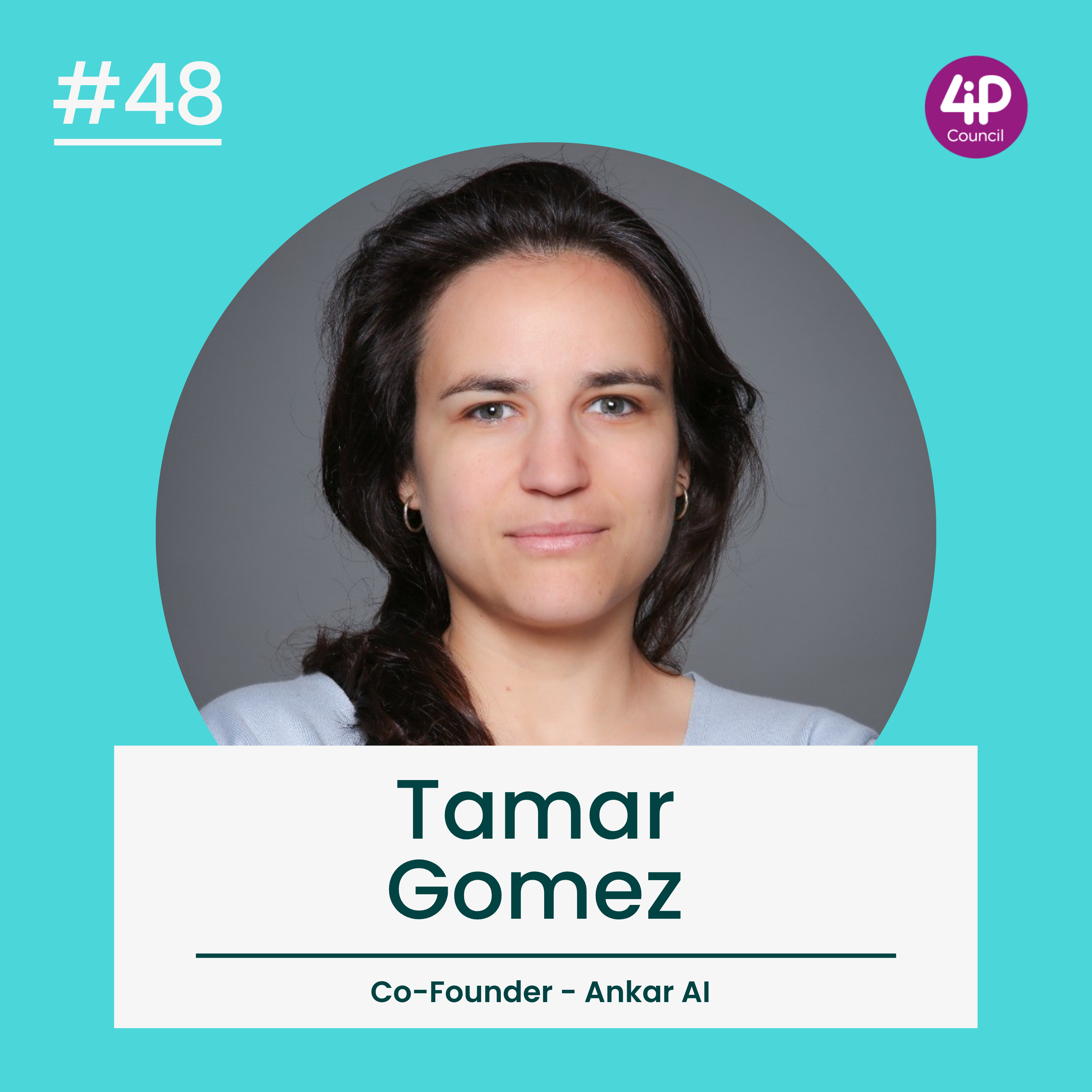
Rethinking IP in the Age of AI #48 – with Tamar Gomez
19m 1s
In this podcast episode, Tamara Gomez, co-founder of Ankarai, discusses her journey and the creation of an AI-native platform for intellectual property management. Her path was shaped by a lifelong passion for building, a PhD that taught intellectual rigor and perseverance, and professional experience at Palantir. She identified a critical gap in the IP space: existing tools were legacy systems, inefficient for transforming ideas into protected assets like patents. Ankarai differentiates itself by being an active AI assistant that helps users flag risks, spot patenting opportunities, and connect insights within their portfolio, moving beyond traditional "filing cabinet" software.
The platform serves corporates, startups, and law firms, all seeking to accelerate and improve their IP workflows while retaining control. Gomez observes a market shift where companies are increasingly treating IP as a strategic business asset rather than just a defensive legal tool. She explains that AI is redefining IP strategy from mere protection to prediction and value creation, helping guide overall business strategy. As founders, her team faced similar IP prioritization challenges as their clients, focusing on protecting core technology early while staying agile. A significant entrepreneurial lesson has been learning to prioritize development in a field with vast opportunities. With recent seed funding, Ankarai plans to scale its platform further, aiming to make strategic IP management accessible to every company.
Hello. This is IP Stories by 4IP Council. The podcast about innovation and integral property. Join us and you will hear about the journeys through invention, creation and IP understanding of our guests. I'm Marta and I'm Panaj and we have with us today Tamara Gomez, co-founder of Ankarai. Hello Tamara and thanks so much for joining us today. I'm Marza, Hi Pilar, great to be here. Before we jump into Ankarai, we'd love to get to know you better. What's parts of your background? Academic or professional, do you feel most shape your path as a tech entrepreneur? I think I always loved building things even when I was younger. I always loved going from nothing and putting a lot of work and efforts and getting to something that people could use. Whether it was building little wooden chev or trying to build little crafts or stuff like that. But then as I kind of entered my career and my work life, I think the first thing was my PhD. It was the first time that I actually touched the power of software and data and really saw that software combined with good information and good data could lead you to discover amazing things and invent really great things. Then I think finally Palantir, which is a company where I used to work, was very formative as well because I learned how to build and kind of deploy impactful software and see how users were. I was changing the lives of people and that prompted me to go in my own entrepreneurship tech entrepreneurship journey. Wow. It's really interesting to hear that this is all coming from you as a kid because for some people, it takes a really long time to discover their passion and you already knew somehow what you wanted to do from early ages. I think it's very interesting that you hold a PhD in microeconomic and game theory. As you just mentioned, it's like a very interesting foundation for a tech entrepreneur. How has this influenced your approach to innovation and problem solving and building a company like Angarae. Yeah, I think the first thing I'd say is that doing a PhD in economics or other disciplines, it kind of first teaches you intellectual rigor and that to be able to invent things, you need to kind of be able to prove things right and to be able to demonstrate things and I think that's something you need to do when you're building a company. You need to have in mind a very bold vision but you need to be able to back this vision by detail demonstration and logic basically. So I think that's the first thing and then for sure the second thing is doing a PhD is very lonely. It's a lonely word, right? You don't get a lot of attention. You're very often very low and you can spend months researching something and not knowing if it's going to work out. Connecting information and data and you actually don't know if what you're going to prove is that if you want to prove is going to actually happen in the data. So that requires a certain level of grids and determination and I don't care what people think, I'm going to do my thing, I believe I'm right and I'm going to continue and persevere and I think that is definitely useful when you start a company and when you build a company because you always have moments where you're kind of like alone with your idea and you have to prove it to everyone else and at first when you start no one's waiting for you, no one cares and so you know it's just about like flowering through and like every morning waking up and solving problems basically. Yeah, yeah, that was a very good training, definitely. Already being an entrepreneur is like, you know, it can be a lot like that so it's good that at least like you had gone through the PhD beforehand. It helps. So jumping into Ankara AI, together with your co-founder, VM Garvey, you launched Ankara AI with the ambition to transform the way we manage and protect IP. And I wonder what was the initial spark that led you to the creation of this platform? Was there maybe a particular gap that's in the IP space that you felt compelled to solve? Yeah, so I was working in enterprise, like I was working in very innovative companies from the beginning of my career, both in like industry and then in tech and so I was working always very closely with the innovation teams like R&D, software developers and also I was but I generally held like a more kind of like business strategy role and I was put in charge a volunteer, for example, of making sure we were building, you know, a patent portfolio, we were protecting our inventions and then I realized that it was really difficult to go from an idea to a protected, you know, assets to a patent, for instance. It took time, it was slow, it was very manual and inefficient and it seemed like the software that was available both for the innovation, like the people who are the inventors and for the patent attorneys were not at the level of the criticality of the problem, like being able to create and protect ideas and it's what really makes the competitive advantage of a company, it's critical for its success. But the software to help do that was kind of very legacy and was not at the level of what I'd been deploying in the age of AI to our customers and so I thought, okay, this could really serve in increasing and like fostering innovation and that's a mission that I'm passionate about because I really think innovation is what makes us, makes humanity move forward basically and so I want to participate in enhancing that. It's great that you had the good combination of skills to realize that there was an inefficiency there and a problem that you could also help solve, so that was great and I would like to dig a little bit more like deeper into that so I checked that on the website, you describe Ankara AI as an AI native end-to-end platform for intellectual property, could you walk us through what that means in practice and a little bit deeper into how it differs from traditional IP management tools that you were talking about now? Yeah, for sure. So traditional IP tools or IP management tools, I think the best way to like to, you know, visualize it is to see them as kind of filing cabinets, you can store information and then you can retrieve that information. With Ankara it's different, we're AI native and that means that we're actively working with our users with the attorneys with the inventors and the platform is their assistant. So for example, it can flag risks, it can help spot new opportunities for patenting, it can connect dots between different assets in your portfolio and so it kind of like, instead of reacting after the fact, it's making the users actually smaller, enabling them to make decisions faster up front and really has this kind of like assistant character to its versus just kind of like, you know, maybe just a kind of store that you are storing information and then kind of searching information now of basically. I don't know if you see what I mean. Yeah, yeah, yeah, yeah. It's very graphic. Here you're hearing your description about the platform. I wonder who your users are, startups, law firms, corporates and how do they need the far when it comes to leveraging AI for IP strategy and portfolio management? Yeah, so we actually have all of these as our customers. We have companies, corporate and house teams. We also have like very large enterprise and startups and we have law firms, we have large law firms, we have solo GPs. So we kind of have the whole array of kind of users in terms of size and types of users. And interestingly, what I found is that they have more in common than they have more common needs than differentiated needs. And for me, this need is that they want to everyone wants to a tool that's going to accelerate their work and make them more efficient whilst keeping them on the driver's seat, right? Like they want to have control on what's being generated or the information that they're seeing and at the same time, but they want to have that faster, probably better than they would be for and also in a reliable way and in a secure way. So I think this is really the common objective for all of these users that we're seeing basically. And following up on that, so working so closely with your users, have you noted just any shifts in how they approach IP and the AWS? Yes, definitely. I think we're seeing a lot that companies are shifting from treating IP as kind of a defensive shield to using it really as a strategic asset. And I think they all have, they all know that AI can accelerate the innovation cycle. And so we're seeing a lot more focus on speed, on quality of a quantity and like basically connecting IP insights directly to the business strategy or to the research strategy and the current R&D strategy. So it's less about like stoppiling patterns and more about like making them work harder for for you as a company, basically. And let's turn into your own IP journey for a moment. So as founders, you know, building an innovation driven platform, how did you approach protecting anchor AI's technology and brand from the outside? Yeah, that's a really good question. I know that sometimes you don't apply the things that you do for your client. Yeah, I think actually, as founders, we had to make the same tough calls that our clients face, like what to protect first, how to balance between speed and security. And so I think what we did is we focused very early on on safeguarding the ideas and the brand that make actually and car unique. But we also tried to stay quite flexible. So IP that kind of never stood down on building momentum. And actually that lived experience really shaped how we build the platform because we realized that as a company and as a tech company, you're building up IP every day, right? Every line of code or every kind of like design that an engineer makes, like is building up your IP. So you need a system that is flexible enough to also update every day, adapt every day to what to what people are building and to the new mediums that they're using. So that's really something that we've kind of built in the platform as well. I wonder what has been the most unexpected challenge or perhaps learning for you so far on your entrepreneurial journey, especially in working in a complex field. Yes, there have been many learners. I think the one that kind of like the thing that kind of keeps me up at night is that there is so much to be done. And this is also something that surprised me as I delve into IP further and further is there are so many workflows that we can build great tools for and provide customers with value with. And so it's been hard to kind of learn to say no to some opportunities to be really able to double down on those where we can bring outside return to our customers. So it's really about what do you prioritize and there's a saying in French, which is to choose this to renounce. So it's like you have to choose that you're going to invest in one particular area and then it means that it means that you're saying no to other potential opportunities. And when you're when you love building and when you're optimistic, like that's kind of hard to. Yeah, you can imagine. And I mean, a little bit related with what you were just saying, what role do you see AI playing in IP strategy? You know, not just in auto organization or analytics, but in enabling more strategic decision-making for businesses of all sizes. Yeah, I think AI is redefining IP strategy from just protection to kind of prediction and value. And I think in the future companies are not just going to do like just react to filings or just do just file patterns to kind of like because it's part of a process, but they'll use AI to anticipate like where markets, where technology is where competitors are headed. And and basically that turns IP into a forward-looking compass or innovation. And it's not just guiding legal teams, but it's guiding the entire business strategy. And that's really something that we're seeing with our customers, right? Like we work with, for example, a customer for whom would, you know, who was using our infringement detection tool. And that is helping them define their product strategy. They're like, ah, this competitor here has released a patent on this aspect of a technology, or there is this product that they've released that's not quite our product or our pack. You know, that doesn't quite cover our patent, but it means that we probably need to protect these like adjacent technologies that we've developed. And that really like, it kind of percolates in the whole business, which is pretty, pretty exciting to see basically. Also, it's not just about, you know, making the process faster, but as far as I hear, Amca is really changing how businesses perceive IP as well. Exactly. Yeah, that's a really good point. It's like, because I think people see AI tools, you know, a lot like the first layer is like it's a productivity tool. Help me do my work, my job faster. But I think what we're seeing is like actually, once you kind of like integrate deeply into the organization, you're just changing the way people are doing things that very fundamentally you're transforming these workflows for the better. And last but not least, congratulations on your recent three million seed funding ground. I wonder what does this milestone mean for your team and how do you plan to scale the platform moving forward? Yeah, um, thank you. And so yeah, the funding definitely supercharges our mission, um, to build like smaller tool that make IP strategic for every company. And I think what we're going to do is grow our team, accelerate our innovation and scale the platform so that, you know, our businesses, our customers can make even faster and smaller decisions on the platform, basically. I'd like to take a moment to remind our listeners that we have this year launched an AI and IP rights corner. And if you have made it this far, you're probably you'd be interested in looking into our corner as well. And let us know if you have any feedback. Okay, great. Well, thank you so much, Tomar, for spending this time with us. We know that you're very busy and I need to be great to have you. Well, thank you so much for having me. It was, it was, it was great to answer to, to talk a bit about AI and IP and I hope it was, it was interesting for people. Yeah, we really enjoyed that. Thank you so much, Tomar, for joining. Thank you for listening to IP Stories by Fripe Council. Visit our website on FripeCouncil.eu to find out more and check out the links mentioned during this episode. If you liked it, remember to share and subscribe.
Podcast Summary
Key Points:
Tamara Gomez's background in building things from a young age, her PhD in microeconomics/game theory, and experience at Palantir shaped her approach to entrepreneurship, emphasizing intellectual rigor, perseverance, and deploying impactful software.
Ankarai was founded to address inefficiencies in IP management, transforming it from a slow, manual process into an AI-native platform that acts as an active assistant for inventors and attorneys, enabling proactive risk flagging and strategic decision-making.
The platform serves a diverse range of users (corporates, startups, law firms) who share a common need for tools that accelerate work while maintaining control, reflecting a broader industry shift from viewing IP as a defensive shield to a strategic, forward-looking business asset.
Ankarai's own IP strategy focused on early protection of core ideas and brand while maintaining flexibility, mirroring the dynamic needs of its clients. The company sees AI as redefining IP strategy from protection to prediction and value creation.
A key entrepreneurial challenge is prioritizing development opportunities amidst many possibilities. Recent seed funding will support team growth and platform scaling to help customers make faster, smarter IP decisions.
Summary:
In this podcast episode, Tamara Gomez, co-founder of Ankarai, discusses her journey and the creation of an AI-native platform for intellectual property management. Her path was shaped by a lifelong passion for building, a PhD that taught intellectual rigor and perseverance, and professional experience at Palantir. She identified a critical gap in the IP space: existing tools were legacy systems, inefficient for transforming ideas into protected assets like patents. Ankarai differentiates itself by being an active AI assistant that helps users flag risks, spot patenting opportunities, and connect insights within their portfolio, moving beyond traditional "filing cabinet" software.
The platform serves corporates, startups, and law firms, all seeking to accelerate and improve their IP workflows while retaining control. Gomez observes a market shift where companies are increasingly treating IP as a strategic business asset rather than just a defensive legal tool. She explains that AI is redefining IP strategy from mere protection to prediction and value creation, helping guide overall business strategy. As founders, her team faced similar IP prioritization challenges as their clients, focusing on protecting core technology early while staying agile. A significant entrepreneurial lesson has been learning to prioritize development in a field with vast opportunities. With recent seed funding, Ankarai plans to scale its platform further, aiming to make strategic IP management accessible to every company.
FAQs
Tamara Gomez identified inefficiencies in the IP protection process while working with innovation teams, noting that existing software was outdated and manual. She aimed to leverage AI to foster innovation by transforming how ideas are protected and managed.
Ankarai is an AI-native platform that acts as an active assistant, flagging risks and spotting opportunities, rather than just storing information like traditional tools. It enables proactive decision-making and connects insights across a portfolio.
Users include startups, law firms, and corporates of all sizes. They share a common need for tools that accelerate work, enhance efficiency, and provide reliable, secure control over IP management.
Her PhD taught intellectual rigor and perseverance, essential for proving ideas and building a company. Her experience at Palantir showed how impactful software can change lives, motivating her tech entrepreneurship journey.
AI redefines IP strategy from protection to prediction and value, helping businesses anticipate market and technology trends. It turns IP into a forward-looking compass for innovation and overall business strategy.
The founders focused early on safeguarding unique ideas and the brand while staying flexible to maintain momentum. They built a platform that adapts daily to new IP created, reflecting their lived experience as a tech company.
Chat with AI
Loading...
Pro features
Go deeper with this episode
Unlock creator-grade tools that turn any transcript into show notes and subtitle files.
 PodcastTranscript AI