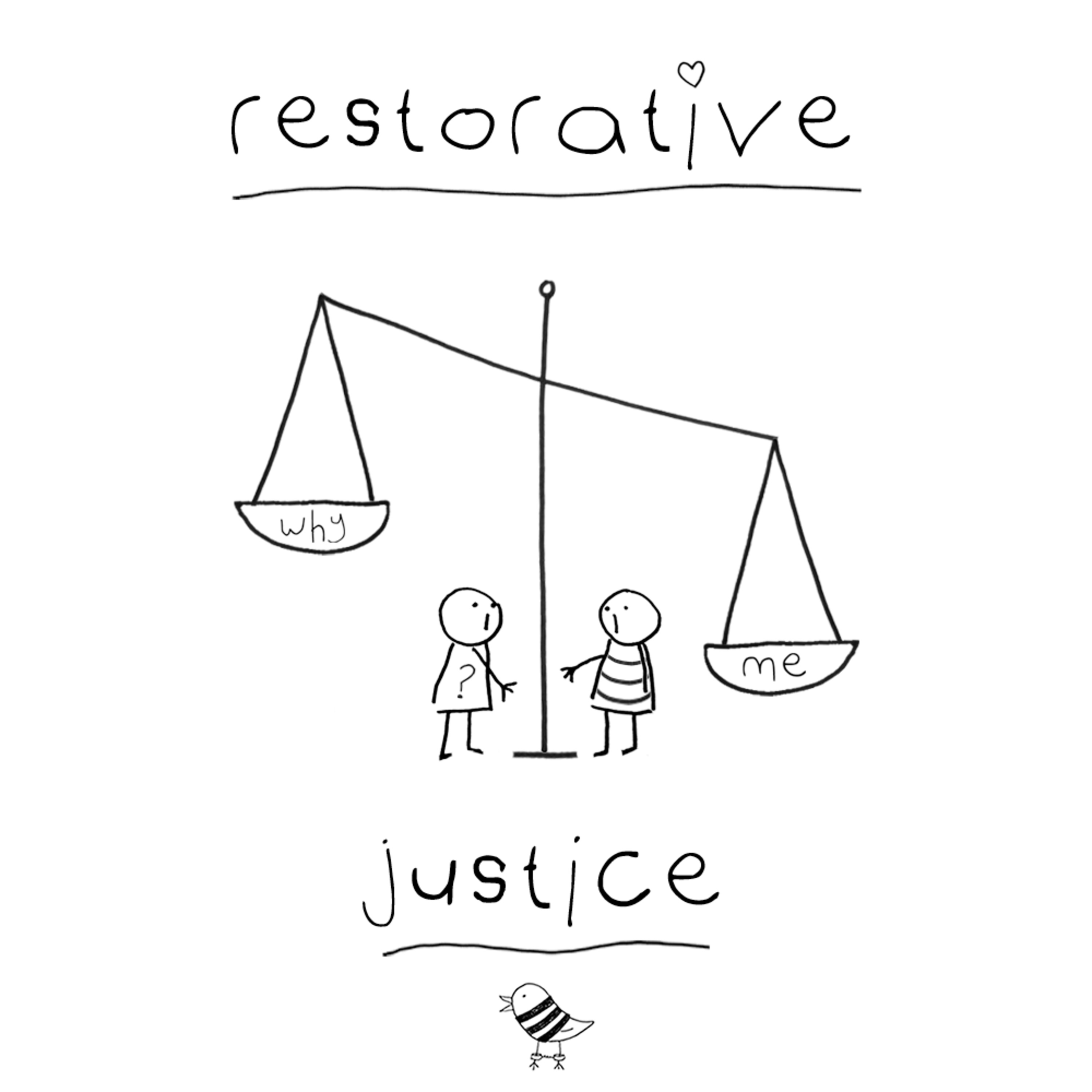
This podcast episode explores restorative justice (RJ), a process enabling crime victims to communicate with their offenders through meetings or letters. It gives victims a voice to ask questions and explain the crime's impact, while allowing offenders to take responsibility. The episode shares compelling stories: Wendy, sexually abused by her father at 14, used RJ decades later to receive an apology and closure. Viv, burgled by a 17-year-old, met him to understand his actions and encourage his rehabilitation. An RJ expert explains the facilitator's role, noting the visible power shift during conferences where victims often gain strength. Another case details a burglar who, after RJ, became a surrogate to help other victims. The discussion underscores RJ's power in healing and reducing fear, though it remains a niche practice. The episode frames RJ as a tool for empowerment and repairing harm, moving beyond traditional punitive justice.
This episode contains themes of sexual abuse, which some listeners may find distressing. One topic, two chicks, three points of view. Welcome to season two, in conversation with Bird. This season we have something different for you. Life in prison. Keeping people safe is the first duty of God's glory. It is criminality, pure and simple. I'm facing time. It's not on the island, it's common scars. I don't know how long it could be four years, ten years. There's no one solution. It could be life. Who cares for the men behind these doors? Bird. This season will be facility in conversations between prisons, organizations and charities to find out what it really means to do time. Each episode in this season will center around a specific topic, so there'll be one group asking questions and the other one answering. So what are we talking about this time, Meena? Tonight we'll be talking about restorative justice. You'll hear us refer to it as RJ throughout the episode. This time we actually went into HMP Pensonville, and we asked some of the guys inside what they'd like to know about restorative justice from some of the victims that had been through it. Later on in the episode you'll hear the questions that the guys asked, and in response you'll hear the powerful stories of the victims who've been through restorative justice. We are actually ambassadors for the restorative justice charity, Why Me, which started itself with a natural crime. So Will Riley, he was an Islington business man. He was burgled by Peter Wolf, and Peter ended up assaulting Will in his house, and he was arrested whilst he was trying to escape. After going through RJ together, they teamed up to help others do the same. We actually had to try to appease Will himself, and he kind of told us that story, which was really interesting, just to see his journey now, and all the inspirational things that he's getting up to after starting up, I mean. So for people who've never heard of it, what actually is restorative justice? restorative justice gives the victims the chance to meet or communicate with the offender that was involved in their crime. So that can either be a face-to-face meeting, like which is called a restorative justice conference, or it can be through other means of communication, often letters. It gives the victim a chance to ask any questions that they need to have, and maybe actually explain the impact that the crime had on them, and really gives them a voice where they might not have had one before. From the person who's committed the crime's point of view, it allows them to take account of what they've done. It also allows them to take responsibility and in some cases make amends. It's also about them communicating within a controlled environment, so there is a facilitator, there is someone who's assisting the restorative justice, who is acting the form of mediator and can go kind of back and forth between the two. Some people think it would be strange that a victim might want to speak to the person that's harmed them, but they can be really amazing benefits in terms of getting closure, putting a face to the person and just understanding the situation from both sides, and we'll be talking about what that was like for one of our victims later on. We'll also be hearing from our resident expert, Enica, he'll be shedding a light on the work that she's done in this area. What do you think people will make of this episode? I think with this episode, people probably will be quite moved by some of the surgeries. There's a lot of focus on repairing harm and the benefits. They're kind of very clear to see certainly when we're listening to some of those interviews back. It felt very moving to us, so hopefully that comes across. I think we knew lots of people had been doing great work in restorative justice, it's actually a really positive and powerful topic that we thought would be really meaningful for our listeners. To start off, here's Enica, our restorative justice expert. Tell us what restorative justice is and what it means to her. For me, restorative justice is about a victim no longer being on the periphery of the criminal justice system, so they're always the person that's been the most impacted on the most affected and they sit watching the criminal justice, go into this machine, take over and they have no say or no input about how what happens with the process, what happens to the perpetrator and what happens to the outcome. A lot of the times victims don't even aren't even asked to make statements, which is why I think restorative justice is so important because it gives that victim the voice, it gives them the power that they might have initially lost during the offense or the incident. So for me, restorative justice is giving people back their voice and sense of empowerment. So I think a lot of what Enica said really is the case for the story we're going to hear next, which is Wendy's story. She got the chance to have a massive weightlifter for shoulders. Next up, you're going to hear the questions directly from the guys in Pensonville and then you'll hear Wendy's story in her own words. How did you feel before you spoke to the person who committed the crime? Can you talk us through that experience? Can you tell us about the story behind how you got involved? Was it what you expected? How did that change your perspective? How long had it been since you'd spoken to your father? My mother had left the home and my father went on to sexually abuse me for two months very soon after she left. Even though I was 14 and those days I had no idea what was going on. I had no imagination that what he was doing was was wrong or the magnitude of it anyway. So therefore I'm now in the position where I needed to tell somebody, well as luck would have it, my mum returned very soon afterwards and I accidentally in a conversation told my mother that police were involved and the rest is sort of pretty much history. So from what I can gather, he was arrested and he pleaded guilty. He got a fine of £20 and then he got a two-year conditional discharge. But I never knew any of that until restorative justice searched that for me and intervened. It was just hearsay. So no one asked me, no one spoke about it, no one talked about it. I was removed from from my home thinking at the time that I'd done something wrong. As a 14-year-old I didn't want to get my father into trouble. I didn't have a clue that it was, I just thought that to me it was the equivalent of being charged for, you know, taking his car out and driving far too fast. I didn't realise exactly what crime had been committed, really. So I was searching around for years and years and years and then one day I was talking to a colleague who pointed me in the direction of restorative justice. Once the ball got rolling, I was introduced to the two facilitators who came round on numerous occasions and made it very, very clear all the way through that there was no guarantee that I'd get what I wanted but they would do all they could to help me. I realised then that there were going to be an extremely important stepping stone that's going to help me get the apology and the answers that I'd needed for about 40 years or more. And the fact that it was, I think, victim-led made me feel that for once I was actually being listened to. They seemed the ideal opportunity for me to actually meet my father and to get the closure that I'd been looking for for so long. I was concerned that the meeting may not go ahead as I'd been warned because at any time my father could pull out the last minute and I was also worried that if it were to take place I was concerned that I might regress back to the 14-year-old child that I was when the issue occurred. So all of these thoughts made me more determined actually to go through with it, focus on why I was there and that was to get longer weighted apology again from him. It was very carefully done so that I didn't go in asking him stuff I didn't really need. I also told him on many occasions how he'd made me feel because he, I don't honestly think that he realized or cared. I explained to him that he'd ruined my education because as soon as this happened I was removed from the home and my mind wasn't in my schoolwork or anything at all. I can remember feeling, "Well, so what?" I remember asking all the questions I needed to and also telling him a few things of my own, not in a spiteful way, but just to let him know that he was supposed to have been the one strong person that I thought would protect me, but instead ironically I needed protecting from him. I let him know those things and I think that that helped me. The fact that he admitted and apologized, there are the two things that I needed to have closure because I'd never heard an apology. He told everybody that I'd been lying for years, so admitting it and then apologising was an immense help to me and the facilitators, they were quite professional and very, very, I think understanding of both of us but I think I knew they were there really for me and for me to get the result that I needed. They kept in contact. They still do at times. I still speak to them and I didn't get why they would need to do that, but I do now. You really do. You think, "Well, that's all I wanted. That's what I wanted. I've got everything I want," but actually it's not. You need to just sit back and reflect on what was said and maybe I didn't say this or maybe he didn't say that, but they were there to say, "No, you did. You said everything that you wanted to say and you got this," because they would remind me of, "I definitely am a totally different person than I was before the RJ experience. All I just didn't know, I was just going around in circles and doors were just shutting everywhere." So I do honestly feel as though I'm out on a journey to where I want to go and I can see the light now and I honestly felt that at the time on the meeting, it wasn't a revenge thing, but I was able to get rid of the weight that I had on my shoulders and give it back to who deserved it and that was him. What he does with it after that, that's entirely up to him, but it wasn't my cross to bear. It was his. I think for anyone listening, Wendy's story is so powerful when we were recording with her like it was actually really emotional as well. So next up we have Anika telling us what our narrative justice session is like from the facilitator's point of view and we think you will actually be able to recognise some of what she's saying in Wendy's story. Sat together with victims and perpetrators, you actually see the shift of power in the room. When initially you go to meet a perpetrator, actually they hold a lot of the cards because they have all the answers to why it happened and they hold all the answers to the questions that the victim has and when you go into that room in the face-to-face conference, you actually see, physically see that shift of power in the room, the dynamic that happens. The perpetrator will physically slouch, I've seen them fiddle under the table, feet tapping and the victim become stronger, physically bigger in the room. A lot of the times work gives them the sense of identity back as well. A lot of people that I've met have felt lost. A sense of reality has been taken away from them from less serious crimes like burglary where people feel like they have a sense of control and power over their home and someone's broken in and taking that away from them. So that sense of identity where they've created a safe space for their children, for their partner, that's just completely been taken. So to step into that room and it's almost like an unburdening, they're giving that perpetrator that burden to carry and they will cut the room completely different. The next person whose story we have to share with you is a Ladyhold Viv. Viv was really interesting to talk to. She herself had worked as a mediator and it was a no-brainer really that she'd want to engage in with stories of justice. She kind of decided that right there in the moment as well. Think what stood out for me was just her willingness to really try and help the young person who was involved in the crime. She was really there for the whole journey and she really wanted his life to go in a different direction. Let's hear her story. How did you feel before you spoke to the person who committed a crime? What support have you got? What does it take for restorative justice to be useful to someone? Did it make you think differently? It happened two in the morning, we got woken up by somebody comming to break into the house. So he jumped out on us dressed in black with a black balaclava. I mean we were terrified because we didn't know if he was gonna hit us or beat us up. We didn't know if he was on drugs. He was covered, he was totally covered and then suddenly I just got a feeling that he was afraid so I asked him if he'd like to sit down. He obviously wasn't a hard and criminal otherwise he wouldn't just sat down. I felt sorry for him. I felt like he was he was trapped, not us. But I was talking to him my sense that because I remember feeling really sad and thinking gosh this person's making a real mess of his life. He's hard enough as it is without having a burglary conviction. It's what I was thinking. My husband let the police in and then he got arrested and we then discovered he was a young lad. He was very tall. I thought he was going to be about 28 but he had his balaclava and the police took it off and it was obviously was a boy of 17 you know. And anyway the day after my husband was contacted by the youth offending team offering for me to meet him. I said oh yeah that's great. I love to do that. A very nice woman called Diane came to our house and a social worker and told us about this possibility and so that's how it happened really. I was apprehensive. The social worker been really good and she said I want you to think about what you want to ask him. This is your opportunity. When we came into that room his mum looked daggers at me but I felt like she was going to protect her son. She thought I was going to launch at him. I was just determined to do what I came to do really and I said if you say like your mum and you work stays in your house and this you know basically reenacted it in words what had happened to us and I said how would you feel? And he said I'd feel terrible and then and then I said you know what that morning the morning he chose was the morning of my mother's funeral and he just sort of sat back as if he hadn't it just hadn't done on him that people have lives you know his mum sat back and started crying and I sort of thought I've got to get to the end of it and he just looked gobs mad. It's like I'm really sorry. I'm really really sorry. He said what can I do? I said what do you think you could do? And he said well I don't really know. I said well I'd like you to find some way of never doing this again to anybody else and I could see that that was going to be hard for him on his own. I think it was really good for me and it felt like it's really good for him and when I went out his mother laughed to me thank you you know because she was obviously sort of cared about him and probably could see he needed help so in a way I sort of thought you know this is such a good opportunity for him because he's going to get some help before he gets so hardened and tough now. And they sent me little reports in sort of saying he'd done these different things and at the very end they said would you like to come to the final meeting and sort of weirdly that was actually this is sort of so strange the day before my dad's funeral you know he was like linked to me somehow. I think that it really helped me to see who he was and to understand of it so it's worthwhile from that point of view even if it doesn't change anything for him it's worth it to just or feel like this person isn't faceless. So we've had some really powerful stuff from the victims. Kate when you spoke to Anika did she have any stand-up stories from her experience? I think the story that stood out for me was about a woman living on a road who became the victim of crime. It just really resonated with me as it probably were with listeners around the fear of potentially being on your own in the house and something happening and the repercussions of that and how engaging in restorative justice really helped alleviate some of those fears. Let's hear Anika telling that story through us now. It really sticks to my mind probably because the victim and the perpetrator was so open-minded the woman was living alone in the flat and she said she chose a flat because she felt safe as a woman living alone. This prolific burger in Islington managed to climb up the building, break into a flat and take everything and at the time she worked for a criminal justice body. So he's wiped out a whole flat and he falls into a criminal justice system he gets imprisoned but actually the fallout for her hadn't been just her flat got robbed actually what had happened then was that she felt really insecure in her home there was a miscarriage there was troubles with her relationship because her partner who was living far away at the time felt like he he should have been there to protect her actually he had chosen to live somewhere else. There was so much fallout for her but she was so open-minded she said you know if I work in the criminal justice system I've got to be open-minded to apply what I what I preach then we went to meet the perpetrator and I obviously had an image of what this guy would look like is a PPO North London he's got like historic drug offences I had a like a stereotype we look like and I went in there and he was like a comedy axe from the from the like late 60s he was so articulate it was a pretty out of proper eastern accent where he was brought up in eastern but then moved to North London he was a bit of a wide boy he was in his late 50s and he was like you know what this ain't for me no more I'm too old to climb through windows and these two people struck up a relationship because actually what she decided because of her because of her health needs she decided it wasn't right for her to go into the prison but she said you know I want to start letter writing so we did the shuttle mediation between the two and their personalities really came out in the letters and he was so concerned with sounding genuine and honest and he was like does this sound like I'm mocking her does this sound like I'm taking the mic you know does this sound sincere and I just it was such a beautiful part of his character to see and also his progression because he was part of the process so he kept her letter and he shared it on the wing he was like look at this letter this is me moving on you know she's forgiven me I'm putting this behind because if I do it again now I'm going to let her down so I actually have to draw a line under it and then he went on to be a surrogate perpetrator harmer for other victims of crime so we had another victim who was burgled and she was looking after the home and it was a van of people turned up to rob this enormous house and she was only looking after it so she was completely traumatized by by the offense and he was like oh what happily meet her I'll tell her like why people do this I'll try and answer as best as I can and sometimes I mean for her this surrogate victim meeting this surrogate perpetrator she said I know he's not the person who burgled the house but actually to meet somebody who does that I know they're not actually a monster they've got a face they live their human beings might actually remove that on a monster image I've got so we've had a lot about restorative justice why do you think that restorative justice is still a bit of a mystery and maybe not as widespread as it might be it is a bit of a postlude lottery at the moment so Wendy's now actually trained as a restorative justice facilitator but it's just not prevalent in her area to become a full-time thing so I guess just it not being available in all areas of the UK means that it just don't remain that mystery I think one of the things that I've learned just in terms of hearing what Anika had to say is that it can actually just be really hard to approach victims in fact she never actually really know where someone might be on their journey there could be a big risk if that person being triggered she think if there was kind of a way for a victim to self serve or signal that they were ready to go through that kind of process even just to be able to find information easily do you think that might help yeah I do think that if it was more widely known more victims would engage and come forward Wendy mentioned that if this had been something she'd been looking for for many years you know she'd really wanted to engage in this process and just kind of hadn't really known where to look or who to turn to in the victim's code of practice it actually says that victims are entitled to information about restorative justice so I think that the problem is that even if people are given the information at the point of reporting the stats show that only around 4% actually even remember being given this information so without an appropriate way to follow up the opportunity we can really just be lost there's clearly so many good reasons why restorative justice should be further invested in a lot of the work that YMEDA has aimed to solve this by raising awareness and sharing success stories in order for people to come forward they specialize in restorative justice and have been sharing some of the numbers with us they told us that there's actually an 85% victim satisfaction rate for those who've gone through our day and a 14% reduction on reoffending so at the beginning of the episode we mentioned that the questions that we asked actually came from people's saving time in H&P Pensonville we asked Wendy and Viv to share any advice they might have for people's saving time who might be thinking about engaging with restorative justice I think it's an opportunity to understand about yourself and there's nothing lost you can walk out but you've got if you don't walk in you can't you can't start so it's an opportunity to see understand what you've done and there's nothing to be afraid of because you know there's only to gain I would say I would hope that anyone who was given the opportunity to go and meet meet their armed or victim they'd recognise how much good it can be for both of you it's not an opportunity to for a retrial it's possibly the only chance the the offender will get to answer a question why me or or any other question that's necessary which from a victim's point of view I think from from me certainly without answers it's always appeared to be premeditated regardless of the circumstances I would have thought it would be better for both parties to recognise that each each of them have their own unique reason for being in that room and the main thing that should be remembered is that we're all human we all hurt when pains delivered and in some way just to acknowledge that the pain is recognised and it's a precious token which can only be given by the hammer no one else can do that thanks to Wendy Viv and Anika for speaking towards today and thanks to everyone for listening to this episode you want to find out more about restorative justice you can visit the restorative justice council website at restorativejustice.org.uk to find out more about the work of why me and to hear more stories like the ones we'll share today you can visit why me's website why-me.org.uk if you've been affected by any of the issues raised in today's episode you can get in touch with victim support online at victimsupport.org.uk or you can call 0808168921 to find out about services local to you thanks to the leaf library for the music today and shout out to Lewis Young for production support expect social justice info stats and prison insights from bird on twitter instagram and facebook at bird podcast if you'd like to talk to us about bird or find out more about any of the stories we've shared today get in touch at what it means to do time at gmail.com or visit our website birdpodcast.co.duk see you next time on bird you
Podcast Summary
Key Points:
Restorative justice (RJ) allows crime victims to communicate with offenders to seek answers, explain the crime's impact, and find closure, while enabling offenders to take responsibility.
The episode features powerful personal stories, including Wendy, who confronted her father after decades of sexual abuse, and Viv, who met a teenage burglar, highlighting RJ's emotional and transformative potential.
RJ facilitators guide controlled processes, observing shifts in power dynamics and helping both parties, with benefits extending to surrogate meetings and offender rehabilitation.
Despite its benefits, RJ remains underutilized and not widely understood within the criminal justice system.
Summary:
This podcast episode explores restorative justice (RJ), a process enabling crime victims to communicate with their offenders through meetings or letters. It gives victims a voice to ask questions and explain the crime's impact, while allowing offenders to take responsibility. The episode shares compelling stories: Wendy, sexually abused by her father at 14, used RJ decades later to receive an apology and closure.
Viv, burgled by a 17-year-old, met him to understand his actions and encourage his rehabilitation. An RJ expert explains the facilitator's role, noting the visible power shift during conferences where victims often gain strength. Another case details a burglar who, after RJ, became a surrogate to help other victims.
The discussion underscores RJ's power in healing and reducing fear, though it remains a niche practice. The episode frames RJ as a tool for empowerment and repairing harm, moving beyond traditional punitive justice.
FAQs
Restorative justice gives victims a chance to meet or communicate with the offender involved in their crime, allowing them to ask questions and explain the impact. It also enables offenders to take responsibility and make amends in a controlled, facilitated setting.
It provides victims with a voice and empowerment, often leading to closure by allowing them to directly address the offender. Victims can ask unanswered questions and shift the burden of harm back to the perpetrator.
Offenders can take accountability for their actions, understand the impact of their crime, and in some cases make amends. This process can help them move forward and even assist other victims as surrogate perpetrators.
It can involve face-to-face meetings, known as restorative justice conferences, or communication through letters. These interactions are always facilitated by a mediator to ensure safety and structure.
Victims may seek closure, answers to lingering questions, or to humanize the offender, removing a 'monster' image. This can help alleviate fear and provide a sense of empowerment after the crime.
Facilitators act as mediators, preparing both parties, ensuring a controlled environment, and guiding the process. They support victims and offenders throughout, helping to manage emotions and objectives.
Chat with AI
Loading...
Pro features
Go deeper with this episode
Unlock creator-grade tools that turn any transcript into show notes and subtitle files.
 PodcastTranscript AI