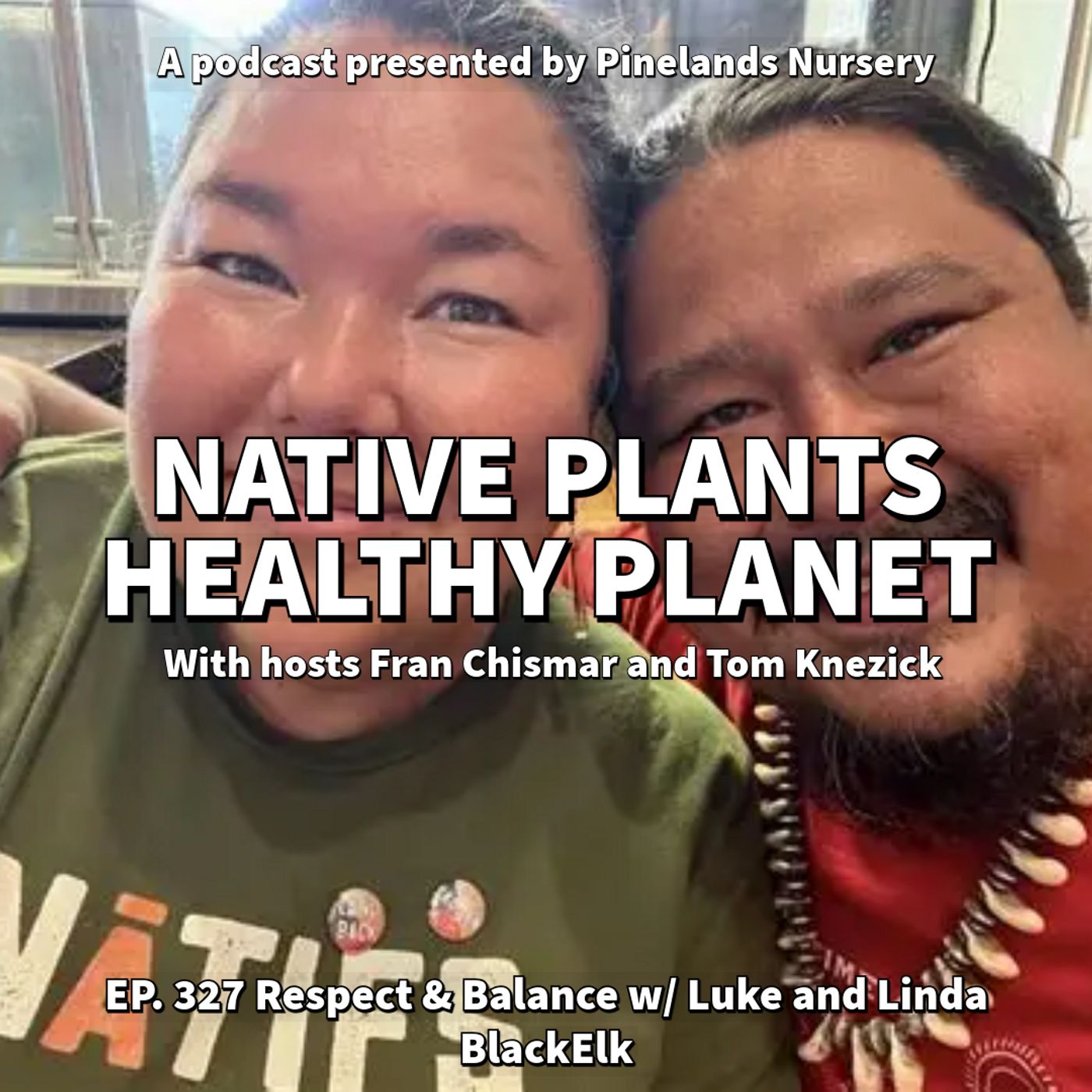
In this episode of the Native Plants Healthy Planet Podcast, hosts Fran Chismar and Tom Knezick welcome Luke and Linda Black Elk, Indigenous food sovereignty advocates from Minnesota. The conversation centers on reconnecting with native plants as food and medicine, challenging the industrialized view of food as mere calories. Linda explains that food sovereignty, unlike food security, emphasizes nourishment of body, mind, and spirit, and stresses the importance of who grows food and how it is treated. Luke shares his Lakota heritage and lifelong foraging practice, noting that colonization violently disrupted Indigenous food systems, making traditional harvesting illegal until 1978, yet knowledge persists through elders and community sharing. They debunk myths about plants like milkweed, yaupon holly, and sassafras, attributing stigma to misinformation and racism. The couple advocates for sustainable harvesting, explaining that practices like topping milkweed can actually encourage growth and benefit monarchs. They recommend beginners start with dandelions and wild onions, and suggest soups as a versatile way to use wild foods. Preservation, they note, often relies on drying, which requires no power. Their heroes include their grandmothers and fellow foragers like Sam Thayer and Sean Sherman. Luke’s favorite plant remains wild onions, while Linda prizes stinging nettles for its versatility. They close by promoting NATIFS and Makoce Ikikcupi, encouraging listeners to learn about Indigenous land history and support food sovereignty efforts.
You're listening to the Native Plants Healthy Planet Podcast, presented by Pine Lans Nursery. Here are your hosts, Fran Chismar and Com Canisic. Welcome back to the Native Plants Healthy Planet Podcast, presented by Pine Lans Nursery, I am Fran Chismar. And I'm Tom Canisic, welcome to episode 327. This is another long awaited one where it's kind of been waiting in the weeds. We've been fans of these couples work for a long time, especially me. And we're really honored to have them on. And that is Luke and Linda Blackhalk from Minnesota, am I right? Originally from South Dakota, but we applied in Minnesota right now. Awesome. And what part of Minnesota are you from? Or do you live now? We actually write in the Twin Cities of Minneapolis. Awesome. So that's not to get us too far off track already, but I had a meeting in Minneapolis almost 10 years ago now. And I loved it. I just loved that city. I went over the summer, which probably made it a little bit more attractive. I can imagine the winners get pretty cold. But. If you're coming to Philly, what do you think it's more attractive? Oh gosh. Is it the heat of the summer or the cold of the winter? Yeah. You should use the word humidity. That's a big, big part of it. But also, it's kind of funny that you mentioned that because Luke and I often say, and we're not kidding. We moved to Minnesota because of the warmer winters and the winter. Oh, wow. And so, wow. It is significantly warmer than it was in South Dakota. Yeah. One of my favorite things about that trip, just having the walks along the river, but it was a business workshop. And we went to the World Central Kitchen. And then there, or that market and did a cooking class where we actually walked around the whole thing. So doing a little research on this and seeing how some of the organizations you work with are actually working too. It was just such a fascinating place. And I'm so fascinating that I brought my now wife, then girlfriend on a, that was like our first vacation together. It was the Minneapolis of all places, but it was just we loved it. No, you know what? There have been, I mean, for, for a very good reason. Minneapolis is sort of like a hotbed of activity, whether it is surrounding plants or politics or, you know, what? Like current events. It's we're right in the center. And I think that that makes things happen. But we're also incredibly diverse. We have so many beautiful kinds of people here. And, you know, along with that incredible food. Yeah. So it's becoming quite a destination. You know, we, Luke and I have a lot of incredible date nights here. You know, I can imagine. Yeah. Awesome. Awesome. But again, we're really happy to have you on. And I have to ask our first question, which is Linda comes from your, your Instagram page. And that is why would we want you guys on our zombie apocalypse team? What, what makes you so important to that role? You know, the reason I think that we, we both actually say that sometimes is because we back when people were talking about these sorts of things. I mean, they still do. But even going back before the pandemic, people always said to us like, Hey, I have you on my list in quotes. You know, what hits the fan? We're, we're bringing you guys along. And we, we get it. We would like not to brag. But, you know, I think that when you have a relationship with plants with the plants that are around you, but plants from all over the world, it's, it's a skill set. And it's an important skill set. Because plants really are an important part of almost every aspect of survival. So, you know, you, if you have the right plants around you, you can filter water. If you have the right plants around you, you can make fire. You can obviously eat plants. You can use them for medicine. And so I think, I mean, you can even use plants for shampoo and things like that. You know, zombie apocalypse, you can still look nice. You don't have toilet paper. And I think that those skills are important when you're going through a tough time like a zombie apocalypse. I feel just to qualify this that I would get kicked out of your team. Yes, I'm not, I do not, I once told Tom's dad, like, I can't remember what was going on, but he asked me if, if Winterberry Holly berries were edible. And I told him yes. And then I had to scream like a minute later at the window. I was like, no, maybe in small amounts. Like, don't, don't put the drop those. You know, but that and it would end up going on a million side quests. Nothing would ever like, I would cause more harm. I would get kicked out. I'm really. I think that's really fun though. They are. They lead to some of the most fun in fact. That's true. No, you know, I think I think that one of the important aspects to putting together your zombie apocalypse team is finding people who may not have the the skill set, like the knowledge, but who are willing to learn and who are also willing to just go out and pick a bunch of berries that you tell them to pick. You know, that's very true. People who bring their own skills to the table, right? You guys have communication down. Well, there you, thank you. I can also give you some really irrelevant music trivia, you know, that's. I can keep you entertained for a little bit. Hey, when there's no media out there. That's a good point. That is true. I thought, friend, you were going to say that the reason that you would get kicked off is because one of the core tenets of that you live by is if you preface everything like I'm not one to complain before you're complaint, then then you don't think you're a complainer. So I thought that might be why eventually that gets figured out. It's like for someone that doesn't complain, he complains an awful lot. I'll be sent off on a side quest and then when I come back, everyone will be gone. Yeah. You said this was. Where is everybody? Exactly. It's like, wow, maybe I found the wrong place. I, without getting too far off topic already, I don't think it is. Just for the average human, what do you think is wrong with how the average person views food? Just as, I don't know that everyone has a concept of where food comes from or what food is or what food means. And I find myself as I go on this journey through ecosystems and connectivity. I even question, you know, like, if, and I'm not a hunter, but if I hunted, how would I hunt? Like, would I only use a, would I only use a bow? Would I only take what I need? Like, is there, is there something wrong with civilization today with how we just view food in general? Yeah. So I think that probably the biggest issue and really the source of a lot of problems that the world is facing is the fact that people look at food as calories. Right. They don't look at food as nourishment for not just body, but for our minds, for our spirits, for our soul. You know, so food should feed us, but it should feed us with more than just calories. It should feed us mentally, emotionally and spiritually. And I think that when we just break it down to calories or just to, you know, how much protein am I getting in a day? And how much vitamin B am I getting in a day? We're really losing connection because the fact is as much as people want to think of only animals being alive and sentient plants are alive and sentient as well. And they feed us, right. They nourish us in a way that goes beyond calories. And so, you know, when someone looks at, say, some beautiful, you know, brazed fennel that people have grown and harvested themselves and put a lot of love into that dish. And they're like, well, you know, I can eat that, but I could also just quickly unwrap this twinky and eat it. You know, there are people who look at those two things as the same thing. And they're not right. There's no spirit left in a twinky. I mean, at some point in the process, that was a plant too. Somewhere along there, you know, pretty sure the plant got somehow squeezed out of there. So, you know, I think that that's just one of the biggest issues. This also goes back to this
about food sovereignty and what food sovereignty actually is and what it really means because I was like to start those discussions off by talking about food security because when I was growing up, the keyword that everyone was using, the phrase that everyone was using when I was in elementary and middle school was food security. It didn't matter what we were eating as long as we had enough calories. That's security, right? It doesn't matter. They would send us home with backpacks full of food over the weekend for kids who were living under a certain income level and they were filled with things like ramen noodles and putting cups and baloney and maybe a loaf of bread, things like that. That's fine because we had enough calories to get through the weekend. It wasn't about being connected to what we were eating or anything like that. That has now changed thank goodness into discussions of food sovereignty which is really what I was saying a couple of minutes ago. It's the idea that food should do more than just provide calories. It needs to nourish us as complete beings. Food sovereignty also looks at those questions of who's growing and harvesting our food. Where did the seed come from? How was the seed treated? Who has relationships with those seeds and eventually with those foods? We really believe that the people who harvest our food put something into it. And if they are living in misery, if they're living in poverty, if they're out there in 105 degrees sun for 12 to 16 hours a day without breaks or nourishment for pennies a day, that type of misery can get put into our food and then passes on to us. That's a very long answer to your question. It's important and it's a great answer. I never really thought about those things until I met my wife who has a different view of food than I do. My wife grew up in Poland during communist times on a farm in southern Poland. Her views on food of what is needed and what isn't and what is good and what isn't was completely different than mine and her taste. One of the first things I remember at one point, I was at her house when we started dating. There was a deer in the backyard. It was chewing out of watermelon rind. There's a deer in the backyard with a huge watermelon rind. Nothing goes in the trash here. If it serves another purpose, it's not just us. The deer loved that. I had never thought about any scrap goes in the garden. It goes in the back. It's just things that I hadn't had a concept of at that point. That's what made me start looking at some of these things differently. I just realized I'm like, I'm just where I grew up. No one had a vegetable garden. We would go to the supermarket and I didn't know where that food come in. I don't know what was done to it before it happened. The other big takeaway for me was at Bartram Gardens in Philadelphia. Their food garden. Saying a prayer before you enter the garden. Every seed gets put in their mouth before it goes in the ground. You're giving it intention. Those types of things that I didn't have that connection. Now that I do, it's a whole different world. It was like going from black and white into color in the Wizard of Oz when some of those things started to hit. By the way, your wife sounds like a pretty good addition to our zombie apocalypse. She would be really good. She also gave a friend the advice that you can tell if a mushroom's poison is not by sticking it on your tongue. She did. Sam Thayer was like, that's not all. She was saying she, one of her jobs was foraging for mushrooms. She said her grandfather taught her that if you put your tongue on the gills underneath, it would be a quick guide as to whether the mushroom was poisonous or not. If it was poison, you would get a feeling on your tongue to know. I'm sure that's not 100% all the time. She's obviously still around. It works so far. But her uncle. What's the phrase? There's old mushroom hunters and there's bold mushrooms. But there's no old bull. I guess they use a bunch. That's every plant in mushroom is edible once. She would be great for that, but you wouldn't be able to give her any weapons because she would misplace them all. I'd be like, hey, where's that machete yet? That would be the downfall right there. I mean, I, well, one thing that you said reminded me one time, Luke and I, we went into a kindergarten classroom on the standing rock reservation. And we were planting squash seeds with the kids. So we just had cups in soil, you know, that's all you need. Cups, soil and seeds, a little bit of water. And we, but first we talked to, you know, classroom full of little Lakota kids. And we told them, this is Lakota squash. This is the squash that your ancestors have been growing and eating for millennia. We talked about the sacredness of squash. We talked about the fact that, you know, one tiny seed can make a vine that could produce, you know, 10 of these squash for your family. And, you know, when I had first given them each one seed, they just kind of looked at it like, oh, yeah, it's just a seed. But after we talked about the importance of that seed, the sacredness of that seed, their relationship to the seed, some of them were like holding them in their tiny little hands and their hands were shaping like, oh my gosh, I have power, you know. So, you know, I mean, that's what it's about, right? If you, if you don't know, you don't know, if you don't have that relationship, you don't. And so you can build it. Yeah. Yeah. No, it's awesome. I do want to take a quick step back and make sure we give you like a proper introduction. Now that we're like 10, 15 minutes in. Because I don't think we really said what you guys do and a little bit where we talked about where you're from, but I guess Luke, if you want to start, what do you do? And then what got you into the role you're in today? So the role that I'm in today. So what I do. Who are you? Oh, who am I? My name is Luke Black. I am a Lakota. So that is a lot of people say Sue. That's the colonizer word for my people, but we call ourselves Lakota. We are related to the Dakota people. So the way that South Dakota and North Dakota are named for a people that those are relatives, the Dakota people that was. Those areas are a part of our traditional homelands. I come from the Cheyenne River Reservation in South Dakota. I come from the Tazupcho band of Lakota and my mom is Candestus. No, and my father is Nathan Black Elk. That's how I get my last name. Traditionally, we didn't do last names. My Lakota name is aha. And traditionally, that would be my only name. But we have to have we have government names now. And so I have my government name that's on my ID and birth certificate and things like that. How I got into my role. So my role is I work with natives, which is Sean Sherman's nonprofit here in Minneapolis. It's food sovereignty nonprofit and it stands native stands for North American traditional indigenous food systems. He loves acronyms. There's so many more we have a program within our organization called the MNI program, which is the Lakota word for water, money, and it stands for the meals for native institutions program. He he is a master of acronyms. But I work on the nonprofit side as a wild food procurement and cultural advisor. So we do you probably seen some of our videos on social media where we're doing language and plant identification and how to use them. And so I go out and help find these places where these wild foods are help procure them and how to how to how to help people how to figure out how to cook them in the correct amount. How did I get into that well, first Linda Linda got a job with the organization and I was just kind of I'd come around once now and I'd help out and. Sean and I have been friends for a long time and I was helping out a lot. He was like, you know, you help out too much. I'm going to have to put you on the big roll. Now I have almost a full-time job here.
And it just sort of happened into that. And most of that comes from the fact that I've been foraging for most of my life. I started foraging when I was a very young child that's, you know, I grew up poor. And so when you grew up poor, you have to do subsistence foraging and things like that. And so, you know, there was wild onions that grew behind my mom's house. And so when I was four years old, she was telling me that those were edible and that I could eat those. And I can remember summer times of just spring times of just filling up on wild onions in the spring time. And so that became a lifelong journey of wanting to forge and wanting to have the food around me, especially when I found out that a lot of the food that I was getting, which was things from like commodities or from the grocery store were highly processed and weren't actually made for my body as an indigenous person. And then I started getting into why, how did our people cook these before colonization? How did they prepare these things? And so I spent a lot of my time, my life talking to my elders and talking to people in my tribe and other indigenous tribes around me about how they processed their food, how they cook it, what they eat, right? What they eat. And trying to bring that into a modern palette because our palettes have been colonized as well, right? So as indigenous people, we've almost overnight our whole food system was changed. And so we've had to spend the last 150 years adjusting what we eat. And it's very bad for our bodies, for our minds, for our souls, right? And so like Linda was saying earlier, when we're getting back into these foods, especially these foods that are picked in a way, like you all were talking about in a prayerful way, right? When we go out and we pick plants, when we go out in forage, we're praying the whole time, we're talking with these plants as relatives and not as just something that we're consuming. We recognize the life that's given so that we might continue to live in a good way. And so that is the long way of saying, that's how I ended up here. (laughing) (upbeat music) - Stay tuned for more of the native plants, healthy planet podcast, presented by Pinelands Nursery. (upbeat music) - Welcome back to the native plants, healthy planet podcast, presented by Pinelands Nursery. - Quick question before we move on, just 'cause I kind of feel it's relevant. And speaking with ecosystems, so many people talk about, like they're talking about pollinators and how this is a food, like these plants are what they evolved with, so this is what they eat. We don't talk about that as humans. We talk about it with birds and insects, but not with ourselves. You know, and when you're learning about this and the culture, like during colonization, like how much of that food systems were lost, not just changed, but lost. Like is it hard to define some of this information of how traditionally your people would have done it? 'Cause it's the food that you've evolved with over time. So I just have to just inserting my, you know, at theemia, not lost, - Okay. - Spillin or destroyer. - Okay, yeah, thank you. - Because that passive language of like, almost like you put something down and you just walk away and forget to pick it back up. - Perfect. - Didn't really happen, right? So Luke talked about commodities. There was a time in my lifetime and how old are you, friend? - I'll be 56 this year. - Okay, so in our lifetime, it was illegal for Luke's people to eat the foods that we're talking about today, literally illegal. And if they were caught harvesting, hunting or growing those plants for food or medicine, they were arrested or worse, sent to places like the Hayawatha Asylum for Insane Indians, which I believe the building still stands in Canton, South Dakota. So and that didn't end, those policies didn't end until 1978 with the American Indian Religious Freedom Act. So it was literally illegal for them to do the things that we're talking about today. So I just, I think it's just important to set that. - I appreciate that. Thank you. - Thank you. - You're welcome. - So what was the question? - Oh, just how in trying to reestablish those connections, how much, how hard was it to find that information and gather that information to get that connection back after that information was stolen or taken from you like over generations? Is it gone? - No, it's okay. - It's still out there. There are still plenty of people who hold on to little nuggets of information within their family or within their tribe or whatever. And we're picking those up, it's out there. There are historic texts that talk about things. There are some things that can't be trusted, especially like a lot of old foraging books and things like that are kind of a little bit. - Or even some new AI creative foraging books. - You have to be careful with that. There's a lot of misinformation out there, right? There are so many people who are scared of things like milkweed or choke cherries. There are so many people who are just afraid of actually going out in foraging because they're afraid they're gonna hurt themselves. Which is possible, not to say that that's not possible, but it is possible, but it's not as scary as you think. And if you learn from a few people and if we continue to teach each other to share knowledge, 'cause when we're talking about a zombie apocalypse team and we're talking about who do we want on our zombie apocalypse team, it's not about necessarily having people who know how to do something the best. It's about having people who can teach us things, right? And that's what we all need to do is we all need to learn from each other 'cause we, honestly, we are in the zombie apocalypse. We're in a point in time and unprecedented time. It's hotter than it ever has been. There are places that are experiencing drought that have never experienced drought before. We have landslides, mudslides happening in places. You know, the world is in a point of turmoil and change. And so we are at that point where we need to be really thinking about these things and realizing that our fear of wild things, our fear of nature, our fear of hurting ourselves with something that we don't get from the grocery store is something that was intentionally done to us. We are increasingly ignorant so that we continue within the capitalist system that is around us and that is shaping our lives. And so if we step out of that and we start growing a little bit of our own food, if we work in cooperation with our community and we all buy, say, a cow together and process that together, we can survive. You know, and we can survive a lot better because you know, you look like this, what's a screw worm? Yes. Being our meat right now, right? Cryptospora. Cryptospora and vegetables. There's so many dangerous things out there. But if you're growing that vegetable, if you're growing that meat yourself, then you know what's in there. And you know the process that's gone through that. So I don't think these things, and this goes back to your question, are these things lost? No, these things aren't lost. There are people out there that have these things. We just have to be able to go and ask the questions. We have to be willing to go and ask the questions. And it's, I'm sorry, I apologize. We started to talk. No, no, I was just gonna say, Luke and I often tell people that everyone knows something. You know, so like in a lot of the communities that we have lived in, people always rely on the same people. You know, there are like a group of knowledge holders or a group of elders, you know, and they'll say, oh, go to them, they know a lot. But the fact is that we've found is that everyone knows something and it might be something completely different. Or like, you know, you'll show them a picture of a plant and they'll be like, oh yeah, you know, they think, they don't know anything. Like they'll even tell us before we go talk to them. Like, you know, I didn't grow up that way. I really don't know. But then you go visit them and you show them a picture of purple cone flour and they're like, oh yeah, my grandma used to harvest that because she used it for this, this, and this. And that might be the only thing that she's willing to discuss or that person is willing to talk about, but everyone knows something. And I think that's important. - I think what makes it hard in today's day and age, and right before we talked, I was literally reading the New York Times article that just came out about native plants and Doug Talami and. and things like that. And I was saying to Tom after reading it, it was someone who was just starting their journey and learning about native plants. And like they did a garden, learned about native plants, talked a lot to tell me to learn more. And I felt that even though it was a good article 'cause at the end, the person started incorporating natives and understanding some of these ecosystem connections, I felt that some of the language was damaging to the movement as well. 'Cause it is someone who's a beginner spreading that information on a large stage, not someone who's extremely knowledgeable in today's, anyone can start a live video and say, I'm now an influencer on just a man and native plant influencers, it's happened over the last six months. Like there's a new one popping up on my feet. And I don't agree with everything that everyone is saying. And how does that play in when there's a lot of voices and I really think that messaging is so important to give people the right information and bring more people in. - It's wild that you bring that up because yesterday, I got into this weirdly long argument with a young woman who is absolutely convinced that gatherers, people who gather plants are the problem. Like that's the problem. People who foragers, you know, gatherers, they're the problem, they are destroying ecosystems. And, you know, Luke made a video, we were standing out on the prairie and it's a place that we had been going to for well over a decade. And we noticed that they had put a fence up and started grazing half of the area where we normally go to harvest one of his family and one of his people's most important foods. It's a tuber. And they had literally cut off half of that land and fenced it in and put cattle on it. And you could just see the invasive species moving in there now. And it was heartbreaking. So he made a video and he had this gorgeous intact, you know, mixed grass prairie behind him. And he said, we're not the problem. And he turned around and showed this like sort of now monoculture behind a fence and said industrial agriculture is the problem. And I think that's so important for people to know that, you know, as people who gather, as people who forage really almost every day, we take responsibility for the landscape. We take responsibility for our role in shaping the landscape. And we do not believe in the, you know, that I feel like it's a very non-indigenous, non-person of color idea of leave no trace. That's a big thing, right? You see it in all the parks, leave no trace, take only pictures and leave only footprints and things like that. We do not believe in that at all. We believe in having an impact on the landscape, a positive impact. And so when we're out there, we are making sure that we are harvesting sustainably, but we also make sure that we are pulling out, you know, problematic plant species that don't necessarily belong in those areas. We are making sure that we are spreading seed and aerating soil in places that might need it. You know, that's something that's very important to us. As foragers. And so, you know, we believe we can have a positive impact on the landscape and that that's our responsibility. - Yeah, which is, and like not, I was just thinking with the cattle, like not everyone understands, there's a difference between bison grazing and cattle grazing. There's a big difference. And one help improves the land. One changes the land, you know, and it's really important and there's so much information out there and there's so many people that think they're right, that it's hard when, you know, like reaching those people to get them to understand or believe over time. - About this to me. - I'm sorry, good. - No. - So it's really interesting that you're talking about the difference between cattle and bison and their impact on the environment and it's wild because it even goes down to their saliva. Their saliva's impact on native plants. And so if you take native grasses and you cut the native grass and you paint the native grass with cattle saliva and you paint it with bison saliva, the grass that's painted with the bison saliva will actually regenerate faster and better than the grass painted with cattle saliva. - Wow. - We noticed this was actually a research project that happened in North Dakota. - In North Dakota. - Yeah, yeah. The apical meristem of the native plants reacted much more quickly to bison saliva and yes, they had interns going out harvesting bison saliva and cattle saliva. - Yeah. - To paint on these mode areas so that they could conduct this research and then they measured growth and it was incredible. So not only you said something earlier that made me think of this, but not only have plants and animals evolved together but humans and plants and humans and animals have evolved together. And I think it's important to have that discussion because we don't look at ourselves as being observers of the landscape. We are like the bison, we're part of it, you know? And so we know that we have an impact and that that impact is important and so make it a positive one, make it a beneficial one. The way that bison aerate the soil with their hooves or the way that bison saliva reacts with the apical meristematic cells of a plant. You know, do you wanna give a-- - No, sometimes it comes down to you learning what the plants around you need, right? If you're, say if you're picking artimus, you know, Ludoviciana, which is we call a sage around here. It's not related to the culinary sage, but if you wanna pick that, you have to cut it so that you leave the roots in the ground because it spreads through its roots. If you wanna pick something like sweet grass, which is another plant that we use traditionally, you wanna actually pull that up by the roots and give it room to spread. And so it's about learning what the plants around you want, what they need to help them grow, you know? And how you can help impact, like we just, you know, we say there's so much, so much is you have to have positive impact on them. We're animals, we're just animals. And we're trying to keep ourselves separate by building these square walls all around ourselves in these roads and trying to separate ourselves from nature so hard, but really we are part of nature and we need to go really go back to that and be active in our environment. - And one of the things I learned when they, I guess when they were reintroducing bison back into Illinois, like 'cause there was so much they felt that was unknown was that the bison preferred the warm season grasses, kept the grasses down, which promote it growth of all this other diversity that they didn't know or didn't expect that improved the overall health of the prairie, you know, and things, that's not something that cattle is going to do. (laughing) - You know, but inherently, you know, these are things that involve together and work together in harmony. And it's just, you know, and it's amazing that it did it for hundreds of years and when they did that, they had no idea what the interaction would be. That's what blew my mind, that how are bison going to interact with the tall grass prairie. But how many millennia did it do that? You know, and that no longer, that knowledge no longer existed. - So, now Linda, how did you get involved with natives and about the-- - That was 40, I know, I know, or-- - 45 medicine. (laughing) - 'Cause I think you have a really cool story how you got involved with all this too. - Well, I, you know, that's so funny that you say that because a lot of my life is sort of accidental, you know, it's like, it's a lot of right place at the right time. But I taught for a very long time at tribal colleges and universities. So tribal colleges are a system of fully accredited universities. I believe that there's like upwards of maybe 60 of them now across what's now the United States. And these are institutions mostly on the basis
reservations that serve native communities. Anyone can attend them, but they tend to serve native communities and tend to have a mandate that says that culture has to be a part of every class. And so, you know, there I was, teaching at sitting Bull College on the St. A. and Rack Reservation, and then, you know, I had been there for a very long time and needed a change. And so, we moved to Bismarck, North Dakota, and I taught at United Tribes Technical College for a while. But, you know, I grew up harvesting plants. I grew up foraging, and I grew up around plants. My one of the reasons, one of the reasons Luke and I ended up together and falling in love is because, you know, a question that you will ask your guests often is what's your favorite plant. That was one of the first questions I asked Luke when he and I started talking over Facebook of all things. And he, you know, when I was little, one of the very first plants that I ever learned to harvest was wild onions as well. And my grandmother, you know, we were eating them as we were foraging them. And she said, "Oh, your breath is going to stink." And she said, "But don't worry, she said, someday you're going to meet someone who doesn't mind your wild onion breath." And that's how you know they're the one. And so, when I asked Luke what his favorite plant was, he told me it was wild onions. And I was like, "Uh-huh." And, you know, that is one of the things that brought us very close together. And then, you know, it was interesting, especially as a woman of color. I, no one ever suggested college to me. I ended up going to college sort of by accident. I never had teachers or, you know, school counselors or anybody who suggests college to me. It was actually one of my fellow students who happened to be sitting next to me one day, my senior year of high school. And I was like, "Oh, I guess I better do that too." She was going off to college and I thought, "Oh, man, maybe that's what I have to do too." So, you know, and when I was there, I learned a lot about plants, but I also realized, "Oh, my grandma knew a lot of this already." And she never went to college. She never had the opportunity to go to university. My mom, who was Korean and Mongolian, she had to forage. She had to harvest to survive. It was literally, you know, one of the most important parts of her diet and her food system. And so, she taught me a lot as well. And, you know, I was teaching at United Tribes and Sean, Chef Sean Sherman needed an education director. And so, I applied and got it and ended up out here in the Twin Cities with Luke. So, and our kids. That's awesome. It's interesting that you both brought up wild onion and how your parents, a grandparents, had said, "Oh, yeah, you can eat this." Because I remember playing with wild onion when I was a kid. And my mom saying, "Oh, don't eat that." Now, it could have just been that she didn't want me to deal with it later. But at the same time, as you mentioned, a lot of this knowledge of what plants did for us was stolen or stripped away in a lot of cases. And we're still, I think, overall, the general population is dealing with the only safe place to get food is from the supermarket. You're seeing more people in race going to farmers markets and shopping local. And there's a big rise at least where we are in local beef or local produce and those things. But then there's even less, but it's starting to grow where people are going out and saying, "Oh, I can go and get some of this myself." And I guess from your guys' perspective, do you see that happening? Where more people are saying, "Hey, I'm interested in figuring out what plants around me. I can eat." And a can eat. And then from a scale perspective, how many plants around us can be eaten? You deal with the first one. I'll do it the second time. Yeah. I think people are definitely out there, especially in this economy. People are like, "What can I put in my food that will make it a little bit, go a little bit further, but also make it healthier?" Which is something that Linda and I deal with a lot. And there are people who are very much unlocking that for themselves and people who are like you, like you were talking about earlier, they're like, "Oh, I didn't know that I could get this from here. I always thought you had, you know, you could only get this from the market." Or, you know, we even deal with young children sometimes. And we're like, "Where does the meat in your hamburger come from?" And they're like, "Oh, the grocery store." I'm like, "Oh, no, but do you see that cow out there?" And so even those talks about where does meat come from really need to happen with people. And people are very interested in that and very interested in like, "Okay, so I love hamburger, but where does it come from?" And we're like, "Oh, well, most of your hamburger is actually coming from China." You know, or it's coming from Argentina going to China and then coming back over here rather than you're not actually getting that cow. That's just next door. But people are very interested in it. And I think that it's something that everyone should be interested in if they're not. Yeah. We get a lot of people who are like, "Are you scared that teaching people about wild foods is going to cause a lot of exploitation?" And they're going to misuse that knowledge. And I mean, it's a fear for sure. But really, I think that plant blindness and industrialized food systems has had way more of a negative impact on native plants than teaching people how to forage. Because once you build a relationship with plants, once you look at them and you're like, "That plant is my relative. I know their name. I know their gifts to the world." And they know me. Once you look at plants that way, you walk on the earth differently. You start taking care of the landscape around you. You start walking a little more lightly. And I think that's really important. To your question about what plants are edible and what plants are not edible, I'm going to say something kind of controversial. So in my opinion, pretty much, if you die from eating a plant, you almost, almost. Now this isn't true of every single plant. But you almost have to be trying. Because poisonous plants give you signals. And so like, you know, they smell terrible. It tastes terrible. Most of them, if you eat a couple of them, like winter berry, or like Virginia creeper berry, you know, Parthenosis berries, which look like they should be delicious. But then you eat one and they're terrible. And you're like, "This is definitely not a wild grape." Quit eating it. Stop there. And so what I always say is poisonous plants tend to taste terrible. If you're going to eat enough of it to kill you, you almost have to be trying to do it. So don't be stubborn. If a plant is giving you a signal, quit eating it and do more research and more investigation, we are constantly surrounded by food and medicine. Just right outside the door of this office building that Luke and I are sitting in right now within 10 yards of the walls of this building, we found upwards of 60 edible and medicinal plants. And we are in downtown Minneapolis, Minnesota. So, you know, am I going to go base my diet off the plants that are within 10 yards of this building? No. But when I'm out there, I'm aware that those plant relatives are there, that they're around me. I can teach other people about them and say, "Hey, if you see this in a, you know, perhaps cleaner area, it's something you can eat." Yeah. I was going to end it's funny. You kind of mentioned that because one of my questions, I was just trying to formulate it. Like, it obviously goes beyond, "Can I eat this or not? Does it taste good or not?" Is there a lack of understanding to the average person who's just learning of the respect and balance? Because I was thinking of some things that like you mentioned, you can have in small amounts, but in large quantities. Like, I was thinking about the origins of root beer with Sassafras. And I know I think it was in 1964, they banned being able to use Sassafras because of what it can do to your organs. But I don't think it was meant to be put in a beverage to drink all the time. Like to have
you know, like I'm gonna have a couple of these a day. That's not the purpose or Ilex vomittoria, which can induce vomiting, but also makes a really good tea. - Wonderful. - Yeah. - And the only fascinated plant in North America, right? So let me just say about Sassafras super quick. It was not banned because of what it does for again. - Oh, okay, I apologize. - It was banned because it can be mildly hallucinogenic and they didn't want that. And so they made up the excuse that it can cause cancer and harm your organs in high amounts, which is true, but you would have to eat an entire tree, not shrub, like you normally find them as sort of smaller shrubs, but you would have to eat an entire tree's worth of Sassafras in order for it to harm your organs in that way. So, you know, there's also along with those issues, it's like black night shade, right? I don't know. I think you all have had Sam Faire on before. - We have, yeah. - So Sam talks about black night shade a lot. I grew up eating black night shade greens and berries as a regular part of my diet. There's just a lot of misinformation out there about a lot of plants. And I think that's one of Luke and I's goals is to. - And not only misinformation, but racism, right? So like you, Pond, you were talking about vomitarium. Naming it vomitarium is a part of that keeping us ignorant or intentionally trying to scare us away from something, right? Yes, if you drink two or three gallons of it, it's gonna make you vomit, but if you drink two or three gallons of water, you're gonna vomit. (laughing) If you drink five gallons of water, and there are people who do this as a part of like a hallucinogenic routine, you're going to vomit and have a bad time because that in high quantities water is poisonous, right? If you get peroxygen, your mind is gonna change. - Yeah, yeah. - You know, because you're not supposed to be breathing in peroxygen, right? So yeah, you Pond is probably one of the my favorite plants right now because it is our caffeinated North American beverage, and we should be, all of us should be drinking that rather than tea from China and coffee from Colombia, or where coffee comes from. But because that's what's here, that's what's here and easily accessible, right? And native. And if we're all growing, all of us, all y'all in the Eastern region are growing up on your yards, you're not having to buy coffee. You're not having to buy tea because you have your caffeine plant growing right out in your fri yard. - Full disclosure, we have not given up coffee. - Either of I, I do drink you Pond. And you know, part of the reason I used the botanical name was because I was unsure of the correct pronunciation of you Pond. So I wasn't sure. - He says you Pond. So it just depends on who you're talking to. (laughing) - I knew vomitory, I went with that one. But I'm glad I did because I loved that we got that response from you, I appreciate that. - Okay, well, I mean, you gotta look up the story about how it got that name too, right? Because the Brits were very nervous about the tea industry failing here in what they called, quote unquote, the New World. And everyone was drinking Yau Pond and they were like, "Uh oh, you know, how do we get them to quit drinking it?" So they wanted everyone to think it was toxic. - Yeah, yeah, no, it makes sense. - Sorry, interrupt. - No, I love it, thank you very much. (upbeat music) - Stay tuned for more of the Native Plants Healthy Planet Podcast, presented by Pine Lands Nursery. Welcome back to the Native Plants Healthy Planet Podcast, presented by Pine Lands Nursery. - Pivoting to another plant that I always learned was toxic. And I keep finding that there's new ways to eat it. I haven't tried most. - Pokedweed? - Pokedweed, I do really enjoy. But it's a common milkweed where I've always heard, "Oh, nothing can eat it except for monocatopolis." So it's designed that way and then through, really through the podcast and looking more into foraging and more in the Native Plants, I'm finding out, "Oh, well, you can eat the shoots." And then it's, "Oh, you can eat the blossoms before they open." It's kind of like a broccoli-esque type thing. And then I see, I forget which one of you social media pages it was, but something about milkweed soup. And I'm like, I didn't know you could do all this. I always learned that you couldn't do any of this. So can you talk about some of the other uses of milkweed, some of the favorite ways that you like to use common milkweed? - Oh, so wild onion, of course, will always be the heart of my favorite plants. But as I've gotten older and more mature, I've realized that you can't just have one favorite. You have to have a few favorites. And so milkweed is right up there, top of the list, probably one of my favorite plants to eat, because it's so versatile. You can eat the young shoots. So we take those. So this, one of the things I have to say before we go on with this is that this is a plant. Milkweed is a plant that you have to cook. - Yes. - For you eat. Right? It's not something that you can eat raw, but there are plenty of plants like that. There's plenty of things that you get from the grocery store that you have to cook before you. Right? And so milkweed shoots blanched and then sauteed or just put into soup are probably one of my favorite spring vegetables. And then you follow along. You can get the tops, the very tops of the plant as they get older. Those florets that are so broccoli-like, but they have like a little bit of flavor of green bell pepper to me. Taste wonderful in soup. And then the pods. The little pods after the flowers die back are wonderful. When they're very small, we love to take them and wrap them and bake in and make little poppers out of them because the inside's actually sort of a melt and become cheese-like, all by themselves. And then later on when they get a little bit bigger, we actually take them and we will use them as a receptacle, like almost make like a doma out of them and stuff them with wild rice and bison meat, dark turkey meat, and then eat them like that. And so it's just, it's probably one of my favorite wild edibles out there. And like you said, so maligned in that, if we've been told so long that it's sick. And then there are also people out there like, well, don't eat it because the monarchs need it, which is true. Very, very true. Monarchs love that. It's very important to the monarch's life cycle. But monarchs love to lay their eggs. And this is one of the things they do is they lay their eggs on the leaves of the common milkweed. But they like to lay their eggs on the new leaves. And so you're out there and you're topping off some of these plants. You're actually creating a new growth. And so you're giving that life cycle of those monarchs a little bit more time to happen, right? Yeah, please. I was going to say, I'm even thinking if people knew this information and enjoyed it as well, that would be incentive for people to grow this plant also. And there would be more for everything. Yeah. Yeah, Luke doesn't like to brag about the bits of research that he does. But he actually found that milkweed is an incredibly sustainable food source because you can eat so much of it, because it's perennial, because it's important for pollinators. And this is a viable food source. And we've always wondered why there's not more of it around. I mean, on the other hand, we're also kind of like, just keep letting everyone think it's poison. Oh, sorry, I brought that. No, no. It's just amazing to be-- oh, another little research project we did was we went through when we topped off an entire stand of milkweed plants. Of course, we ended up eating all everything that we took. But when we did that, we were curious about the effect that it would have on the plant. And we went back in every single plant that we had topped off, now had two flowering stems. So the plant will react to you by producing more-- again, it's another example of how we're part of the landscape and how we can have this sustainable relationship with plants. I just think that's super cool and important. And Luke also makes milkweed flowers syrup. He didn't talk about it. Oh, that's important. Can you talk about that? That sounds amazing. Well, it is. So I don't know if you've ever smelled milkweed. Oh, it's just one of my favorite smells of the flowers. And so if you just take those and you put them-- you just put them in equal parts, sugar, to the weight of flowers that you're using. Put them in a jar and make sure that the flowers are completely covered by the sugar and let that sit. you make something that. my wife's people, the Korean people call it chung, which is just a fermented syrup. And so what will happen is the sugar, the sugar used organic, tarbinado, not bleeds sugar, but it'll just sort of melt and get all of that smell and all of that taste flavor. Yeah, so good of the flowers in that syrup. You can also do it with alcohol, but I like the syrup a little better because it's a little more versatile. And you can you can make a simple syrup and cook the milkweed flowers in there too, but we really like to make it chung style because that little bit of fermentation that it goes through is so good for your gut microbiome. Yeah, so that sounds so good. And I can't upload something new again. I'm even knowing all this. I'm still so hesitant around milkweed. And some of it's just it comes at a busy time a year for me. So I'm always behind. I'm like, oh, I miss the shoots. I miss the blossoms. So Sam and I actually have, we have ideas about where these rumors were this fear came from. And we think it started with you'll Gibbons. You'll Gibbons, a lot of people, younger people remember him from the Great Knut serial commercials. Yeah, he's to eat Great Knut serial in the commercials and talk about it. But before that, he actually was one of the very first non-indigenous foraging authors in North America. He wrote a book called Stalking the Wild Asparagus. And in that book, he talks about milkweed and he says it gets toxic as it gets older and that it is inevitably bitter unless you cook it in like three or four changes of water. And you know, the thing to remember, Tom, is that you'll Gibbons was not a botanist. He was, you know, it was a hobby for him. And we really believe he was getting a Pasinum canabinum dog dog. Yeah, dog with milkweed. Because I have literally in my entire life of eating milkweed. I've never once had bitter milkweed. Yeah. Yeah. And yeah, very delicious. That leads me into the second part of my story where I, there was one year where I remembered and I went out and got it and I, I, whatever recipe I'd found online, I looked it up and said, if you got dog bean by accident, you'll know right away. Like as soon as you take a bite, you'll know. And oh, yeah, I knew for, oh, and it lingered for a long time. And it kind of scared me off for a little bit. I'm like, well, I know this is supposed to be really good, but I'm scared I'm going to have that taste in my mouth again for a long time. But yeah, that dog bean was so incredibly bitter. And even at the time when I was collecting the shoots, I'm like, this isn't a place where common milkweed would grow, but this looks just like common milkweed. It was a little bit wetter than I'd expect to see it. And in the fall, I would see dog bean in that area. It just, I don't know, I, I was just so going ho to try it that time that I had to. And I learned my lesson. But yeah, the way that I was just awesome hearing about that, that plan and how, again, how I think so many people still think that it's, it's toxic and it's really can be enjoyed in so many ways. I love that Tom has an interest in this and I get to benefit from it because he's brought in for the podcast like we've done elderflower fritters. And you did black cherry. I did a black cherry or cordial or where I just got the black cherry fruits and fermented them with a little bit of sugar. And then it was like a little bit bubbly drink. And I haven't done much in a while. Once I had kids, it kind of got a little harder to or more, more, well, between the two of them. One's harder because he's busier and the other one's harder because he's just but we, unless people are really good with plant ID, we normally don't recommend that they start off with milkweed. We usually recommend, you know, like for instance, dandelion. There's really nothing poisonous that looks like a dandelion. So even if you accidentally get south whistle or, you know, one of the false dandelions, you can still eat it. You know? So we usually, that's one that we often recommend. There's nothing poisonous that looks and smells like an onion. So wild onions are a good thing to also use for beginners. And so, you know, all aggregate fruits that are on horny briars are edible. You know, we love those little pro tips. There's no such thing as a poisonous rose. So if you know what a member of the, you know, Rosa genus looks like, all the rose hips and petals are edible. So yeah, those are really good tips. Yeah, I didn't know that. That's a fantastic tip. What are some of the plants that you like really seek out or even like plan like a trip around say, well, we're going to go and get this today. The day is the day for our annual migration. We're actually in what we call our seasonal round right now. So we'll be taking another trip soon. Yeah. So we kind of start our, we have plants that we plan our whole year around. And so it probably starts early in the spring with sugar bush. We like to go out and get maple syrup. So that's, you know, February in that March area. And then as soon as the green thing start growing, we get Solomon seal. We get young Nettle. And then, and I mean, sometimes this isn't like, we're not planning like a month long trip or a week long trip around this, you know, but, but our life really does revolve around these things. Ramps. Then we get, we still getting ramps, our first wild onion in the spring. And then one that we do really plan a trip around is around June. We go out and get a pedeomelium esculentum, which is, my people call it team Sheila in English. It's called Indian breadroot or prairie turnip sometimes. And so we'll plan actually a week long trip around that because it all, well, it doesn't only grow, but one of the best places that it grows is back in my homeland. And so I have spaces where I go back there and get that choke cherries. I mean, June, like so, so June, Mary season just ended. I might call them service berries or Saskatoon berries, the emelene care species. We have a whole list, like a seasonal round, but also, you know, there are some years when maybe there aren't as many June berries. So instead at that time, we'll start looking for ribies species, like the currency or gooseberries. And if those aren't around, and it's just not a very good berry or fruit year, we'll get, you know, members like, we'll get different evergreens. We're just constantly harvesting something. I mean, we harvested, you know, bushels of wild carrot this year, for example, because it's a really good wild carrot year. Yeah, we harvested a lot of monarda this year because we utilize it not just in tea, but it's one of our primary seasonings for pretty much everything that we eat. And a lot of people call that one wild oregano. I mean, I could go on. We have a list of probably, you know, 250 different plants that we end up harvesting often. So do you have recommendation? Like I was thinking medicinal purposes to it. I always think of the story of my wife tells me about her grandfather that whenever the arthritis and his knees would act up, he would walk through the stinging nettle because that would relieve the arthritis in his knees. Yeah, that's that's us. Luke and I both actually have not great knees. And so we'll go on paratroids and run through the nettle patch and see who can be out there the longest. We eat a lot of nettles. Luke puts them in pesto and we freeze the pesto. We freeze probably 20 to 25 gallons of blanch nettles every year. I'm sorry. Pounds, pounds. Sorry. I also got the number 303,000 mixed up the other day. So I am. But you know, we freeze nettles. We drive them. So you know, we utilize them for food and medicine a lot. They're a big primary part of our diet when it comes to green vegetables. Now, Tom, I'm just looking at time. Yeah. And we've barely asked half of our questions. We told you that would happen. But I want you to pick which questions get asked before we you we probably have time for a couple more before. Yeah. Well, I think they're not on the list. I sent you at all. But one of the things I wanted to ask is what are some some good pairings you found between native plants or native plants and a protein that that people I think that's one of the things I've found the hardest is well, I didn't found out I can eat milk
I found out I can eat XYZ plants, but I don't know how to put them together with to make a meal. It's like a single thing. Do you have any recommendations for that? It's a great question. You know soup is one of the great equalizers of wild plants. So you know you make if you can make a really good beef soup or really good chicken soup. You can add a lot of plants to that. So you know, milkweed goes good in soup, nettles goes good in soup, wild lands goes, lambs quarters. You can even make soup with a lot of nuts. So you get like your hazelnuts or your even some of your egg morns. After you treat them, you can use those in soup. So I think soup is one of the great equalizers of all things. If you can make a good, based soup or even just go out and buy a good bone broth and add some vegetables to that. Do you ever make squash soup where you like puree the squash? Oh, yeah. So foraged hazelnuts like toasted hazelnuts are incredible in pumpkin soup. Nettles and, okay, it's not indigenous, but nettles and cream go together like so amazingly well. So like cream of nettle soup is absolutely delicious. I find that because of their very green flavor, nettles and like red meat go together very well. So we'll even put nettles dried nettles into meatballs like we'll make by send wild meatballs with nettles. You know, things like your berries and stuff go really good as like glaze over red meat. You can do things like oxalus wood sorrel. Yeah, wood sorrel, the oxalus species goes really great with like smoked fish or fried fish. Because it has that lemony flavor to it. Grape leaves, you know, everyone waits for wild grapes. They know grapes are edible. But then they forget that grape leaves are a really important food all over the world. So making dolmas with wild grapes is a little follow up to that because you mentioned freezing and drying. What are some of the good plants to that, I guess, preserve that you'd like to preserve? Luke actually has a saying we dry everything. So my people dry, of course I come from a semi-air desert so you can dry everything and keep everything very dry for a long time. But I find that that's one of the best preservation methods and it takes up the leaf space. You don't have to keep power on. So again, if we come down to that zombie apocalypse time, we're not having to try to like run a generator 24 or 7 if we have things dried right. So really drying things is one of the best way and then rehydrating them. You know, you can do that with mushrooms, you can do that with berries, you can do that with green plants. Awesome. Because in the sake of time, I do want to finish with one more question. And that's who are some of your heroes when it comes to like ecology and plants and all that? I think for both of us probably are main heroes is our mothers and our grandmothers who kind of kept these things going out there right now. This is probably one of my favorite plant people. But there's also, you know, there's like Sam there, Alexis Nelson is a really awesome. Just person in general, both of those are like someone to the kindest nicest best people in the whole world. Like, I don't know if you guys know this. We're all friends. Yeah, I like to think that. Yeah, yeah. I'm happy that it is. We're all very close. We hang out with each other as much as possible multiple times throughout the year. And when like when Luke and I do our seasonal round, we always invite a couple of them along and they often come with us. So, yeah, so it's like Luke and I Alexis Sam, chef Allen Bergo who has amazing books as well. Tim Clemens, who is an incredible myologist and forager. Chef Sean Sherman is he's incredible and you know, you can like will bring stuff in and give it to them. And he'll just go back in the kitchen and like a madman and bring out like a beautiful fully composed dish. So, you know, I mean, we have a lot of people that we hang out with and it's it's always fun. That makes me happy because like I said in my head, I that's what I imagine happened. Yeah, oh yeah, yeah, safe. Welcome coming out with us too. Yes, I'm that was the other thought my head. I was like, how do I get invited to this? Thank you. But it's I just picked up. I was unfamiliar with Sean Sherman until I started getting all these Facebook ads for the botany of nations at Academy Sciences. And then his his talk and book signing that you guys were at and let a was a forging walk. Was it that you did? Yeah, we love that one. But I picked up his book right after I saw that and one of my favorite parts was that the table contents. Actually, it's closer to me and I would have grabbed it. It's well, it's it's cutting off because of that green screen. But there. Yeah, the table that the table contents is a map and it's like, okay, you want to we're on the Eastern seaboard. So it's like, well, I want to look at those page 100, but it's a map that says 100 page 100 there. Yes, that's an incredible book. And one of the most important things about that is that, you know, and one of the reasons he wanted to call it Turtle Island is because of something Luke talks about a lot, which are indigenous trade routes. So like Luke's people, the most landlocked people in North America, the Lakota have words for things like seaweed and kelp or various seashells or chili peppers even. Yeah. Yeah. But yeah, then digging into him, I'm like, oh, I need to go back to the Twin Cities and go to his restaurants and visit other friends and just it's been a while since I've been out there. So come on out. Yeah. Maybe your kids, your wife and kids can come with you too because you can relive that date night. She would, she would go to that. So I've been trying to get her some other places and she keeps telling me no. My wife would absolutely love that. Yeah. Yeah. Awesome. Go ahead, you can. Yeah. Well, I was going to say because we are getting sure it on time. We always finish up or towards the end. It's not very our last question, but towards the end, we want to ask you guys, what's your favorite native plant? I think I already know you. Did you already say it? Did you both already say it? We've said, you know, and like I said, I think it's sort of evolved. We get hard to pick just one. So, but I think wild onions is still probably my favorite. I also right now, and it's a lot of times it's what's in the now, right? Right now, we just got to experience ceremony with some of my people back home. And we were talking to them about the cottonwood tree and the cottonwood tree seed is just so small. It's just it's tiny like this. But the trees can become massive, you know, and I that that idea of growth and that idea of being able to start small but become something that is immense and powerful and creating its own ecosystem is really amazing. Yeah. It's the hardest question for any plant person is what's your favorite. I usually say I put it a little differently for myself. I don't know if it's my favorite, but if I could only take one plant to the moon with me, it would be stinging nettles or tikka diowa. Yeah. They're amazing food. They are incredibly medicinal and you can make rope and cordage out of them. So. Correct. I think my I hope it's sting I think it's stinging nettles. She does drink stinging nettle tea. Like that and like not often, but maybe like once a week she'll have a powerful anti inflammatory. Awesome. Fantastic. I love it. I don't think either of those have ever been mentioned on the podcast. So I love both of those choices. Thank you so much. So this is the time and we always truly end with this, which is our final thoughts and Tom and I also take a turn with this, but we we hand the floor over to each of you to take a turn to use the time. However, you'd like if there's anything you'd like to say summarize, promote or mention, but the floor is yours for however long you'd like. Well, I think I just want to say so Luke and I both work for natives and at I F S North American traditional indigenous food systems and if you want to watch videos, if you want educational materials, if you want plant ID cards and even that incorporate indigenous languages into the materials, you can go to our website at netifs.org. Awesome. So, yep. I think I'll tell you how it says.
sides native, something another organization that's really close to our heart is Makroce Ikeekchupi, which is a Minnesota Dakota-led nonprofit, which is about indigenous land reclamation, especially for the exile Dakota people and the host, really something that I think everyone should learn about is the exile of the Dakotas from the Minnesota, the state of Minnesota, which is their traditional homeland, our traditional homeland, and their moves to reclaim that. And so if you go to Makroceikikchupi.org or dot com, sorry, you can find more information about them and I can send you all the information. If you do, I'll put the link in the show notes for further those would be awesome. Tom, would you, thank you very much. Yes, we're both wonderful. Oh, yeah, I would like to go. I'm going to try and keep it as short as I can. But one of the things you both touched on here and there was how a lot of this information was stolen. I don't want to say from us, but from history and a sense and it's folks like you that are refining it. And I was really unaware of a lot of that until it was a combination of when we had Sam Thayer on and he'd brought it up. And around the same time I have some friends from college. I played calls across in upstate New York with some aquasazany people from the aquasazany tribe. And on Facebook, they were posting about the, I'm blanking on the name, but the, the, there were the schools that they would, um, boarding schools. Yeah, the boarding schools and then just looking into what they were posting, uh, being in Canada. Um, I was like, Oh, I didn't know clue any of this happened. And then to find out, Oh, this happened in the United States too. Um, it just really solidified the point that there was a whole education system, a food base, all this stuff was happening and it's been stripped away. And as you're getting involved with native plants, it's, it's more than gardening in pollinators and birds and butterflies and having something that's giving back to the ecosystem in your art. It's something that people humans interacted with for so long. And, um, so I really appreciate you guys, uh, bringing that up one and then, um, and then sharing some of the information that you guys have, have mastered so well, because we're, like we're so novice at this is we're interested in it and we're trying it, but there's so much for us to learn and it's great. This people who are, are figuring this out or sharing their heritage and, and, uh, sharing it along the way. Awesome. So I, for my thought, I want to thank both of you so much. I've enjoyed this so much and, and I think, you know, this is still early on in my ecological journey, but I keep trying to remind myself I'm not the center of the universe and the more that I can remind myself of that, the better everything else will be. So, um, you, you know, and, and, and I just try to never stop learning. Like there's, there's always something that I don't know or something that I don't understand or, or something that I have the wrong version of and it's, um, I'm just so appreciative that I'm at, at the point in my life where I, I can have that, that realization and I just want to thank you so much and, and I just want to keep learning and just being a part of, of all of us. So thank you so much. Awesome. Thank you. Thanks so much for having us. Anytime. Well, that's going to wrap us up for today. Thank you for joining us. I'm listening to Linda and Luke Black Elk. For more information, Linda, you brought up the website, but it's natives.org, which is N-A-T-I-F-S.org. How I found out about Linda was through her Instagram page, which is linda.black.elk. And Luke, do you have a social media handle too that you want to share? I do, but I, my name is not, same as Linda. Gotcha. Gotcha. But, um, yeah. Yeah. But no, I've, I've always enjoyed following along with social media on, especially Instagram, Linda. It's, um, I learned so much. Okay. And, um, yeah. So we appreciate you joining us for another episode of Native Plains, Healthy Planner, presented by Ponynes Nursery. Thank you to the egocentric Plastic Men for contributing our theme music. Make sure you stream or buy their music wherever you consume music. You can follow us on all the major social media. I'm not going to mention them. You can just go to our show notes and click on those there as well as our question and comment line, which is 215-3466189. You can call and ask a question and leave a comment. And we'll do our best to play in on a future episode of the buzz. And I do want to thank our ever expanding Facebook group, the native plant, healthy plant at Facebook group. And, uh, it just every, every day I look at just gets so much bigger and I'm just so, so thankful for the, I'm trying to think of the best. It's a friendly conversation. Friendly conversations is the best way to say it. So, uh, if you haven't already leave us five-star view wherever you're listening right now, um, hit subscribe, uh, five-star view Apple podcasts, Spotify. I'm rushing through that. It's fine. I say it every time. Yeah. Um, you know what to do and I'll give you a shout out on our buzz episodes. Uh, with that, thank you everyone. I'm Tom. And I am, Fran. Thanks again, everyone. Coming up next week, we have another buzz episode. Make sure you tune in for that. And until then, keep it native. [Music] These medals, woods, wet limbs and tails, good to fowty and beauty, that lower fails are being with friends so that there's some rare treasures of our land. The log is there. What the friends below, so are you so far? These friends have the place these paintings love. What are caterpillars most built with some salt? These girls about 50 letters fall. Only you class. And you grace this land in your diversity. We will obtain the stand. To prove so she deserve her jealousy to come and be the imponency. So can the nun to protect the pursuit of her tumour, she must do a bit of plan. Maybe just get a grower. Calling that ass to the flowers, the roar. Minority folks running cash. Hop up the floor. [Music]
Podcast Summary
Key Points:
Luke and Linda Black Elk, from the Sisseton Wahpeton Oyate and Lakota communities, discuss their work with NATIFS, a food sovereignty nonprofit founded by Chef Sean Sherman.
The couple emphasizes that food is more than calories, advocating for food sovereignty that nourishes body, mind, and spirit, contrasting it with mere food security.
They highlight how colonization deliberately disrupted Indigenous food systems, making traditional foraging illegal until 1978, but stress that knowledge persists through elders and community.
Foraging and gathering, they argue, are sustainable and beneficial practices when done responsibly, such as harvesting milkweed shoots, which can actually promote new growth and support monarchs.
They debunk myths about plants like milkweed, yaupon holly, and sassafras, explaining that misinformation and racism have unfairly stigmatized many edible native species.
The couple recommends beginners start with easy-to-identify plants like dandelions and wild onions, and suggests soups as a versatile way to incorporate wild foods into meals.
They preserve foods mainly through drying, a method that requires no power and aligns with their survival-ready mindset, even jokingly referencing a "zombie apocalypse team."
Their heroes include their mothers and grandmothers, as well as fellow foragers like Sam Thayer, Alexis Nelson, and Chef Sean Sherman, with whom they collaborate closely.
Luke's favorite plant is wild onions, while Linda highlights stinging nettles for its food, medicine, and cordage uses, and cottonwood for its symbolic growth.
They promote NATIFS (natifs.org) and Makoce Ikikcupi, a Dakota-led land reclamation nonprofit, urging listeners to learn about Indigenous land history and support these efforts.
Summary:
In this episode of the Native Plants Healthy Planet Podcast, hosts Fran Chismar and Tom Knezick welcome Luke and Linda Black Elk, Indigenous food sovereignty advocates from Minnesota. The conversation centers on reconnecting with native plants as food and medicine, challenging the industrialized view of food as mere calories. Linda explains that food sovereignty, unlike food security, emphasizes nourishment of body, mind, and spirit, and stresses the importance of who grows food and how it is treated.
Luke shares his Lakota heritage and lifelong foraging practice, noting that colonization violently disrupted Indigenous food systems, making traditional harvesting illegal until 1978, yet knowledge persists through elders and community sharing. They debunk myths about plants like milkweed, yaupon holly, and sassafras, attributing stigma to misinformation and racism. The couple advocates for sustainable harvesting, explaining that practices like topping milkweed can actually encourage growth and benefit monarchs.
They recommend beginners start with dandelions and wild onions, and suggest soups as a versatile way to use wild foods. Preservation, they note, often relies on drying, which requires no power. Their heroes include their grandmothers and fellow foragers like Sam Thayer and Sean Sherman.
Luke’s favorite plant remains wild onions, while Linda prizes stinging nettles for its versatility. They close by promoting NATIFS and Makoce Ikikcupi, encouraging listeners to learn about Indigenous land history and support food sovereignty efforts.
FAQs
Food security focuses on having enough calories to survive, regardless of the food's quality or origin. Food sovereignty emphasizes nourishment of the whole being, including relationships with seeds, growers, and the intention behind food.
They believe in having a positive, reciprocal impact on the landscape rather than leaving no trace. Foragers can improve ecosystems by harvesting sustainably, pulling invasive species, spreading seeds, and aerating soil.
No, common milkweed is edible when cooked. You can eat the young shoots, florets, and small pods. Harvesting it can even promote new growth that benefits monarch butterflies.
Dandelions and wild onions are great for beginners because there are no poisonous look-alikes. All aggregate fruits on thorny briars and all parts of roses (hips and petals) are also safe.
Poisonous plants usually give clear signals, such as a terrible smell or taste. If a plant tastes bad, stop eating it and do more research. Fatal mistakes are rare if you respect these warnings.
They plan trips around key harvests like maple syrup in early spring, followed by Solomon's seal, nettles, ramps, prairie turnips, and chokeberries. They constantly harvest something throughout the year.
Chat with AI
Loading...
Pro features
Go deeper with this episode
Unlock creator-grade tools that turn any transcript into show notes and subtitle files.
 PodcastTranscript AI