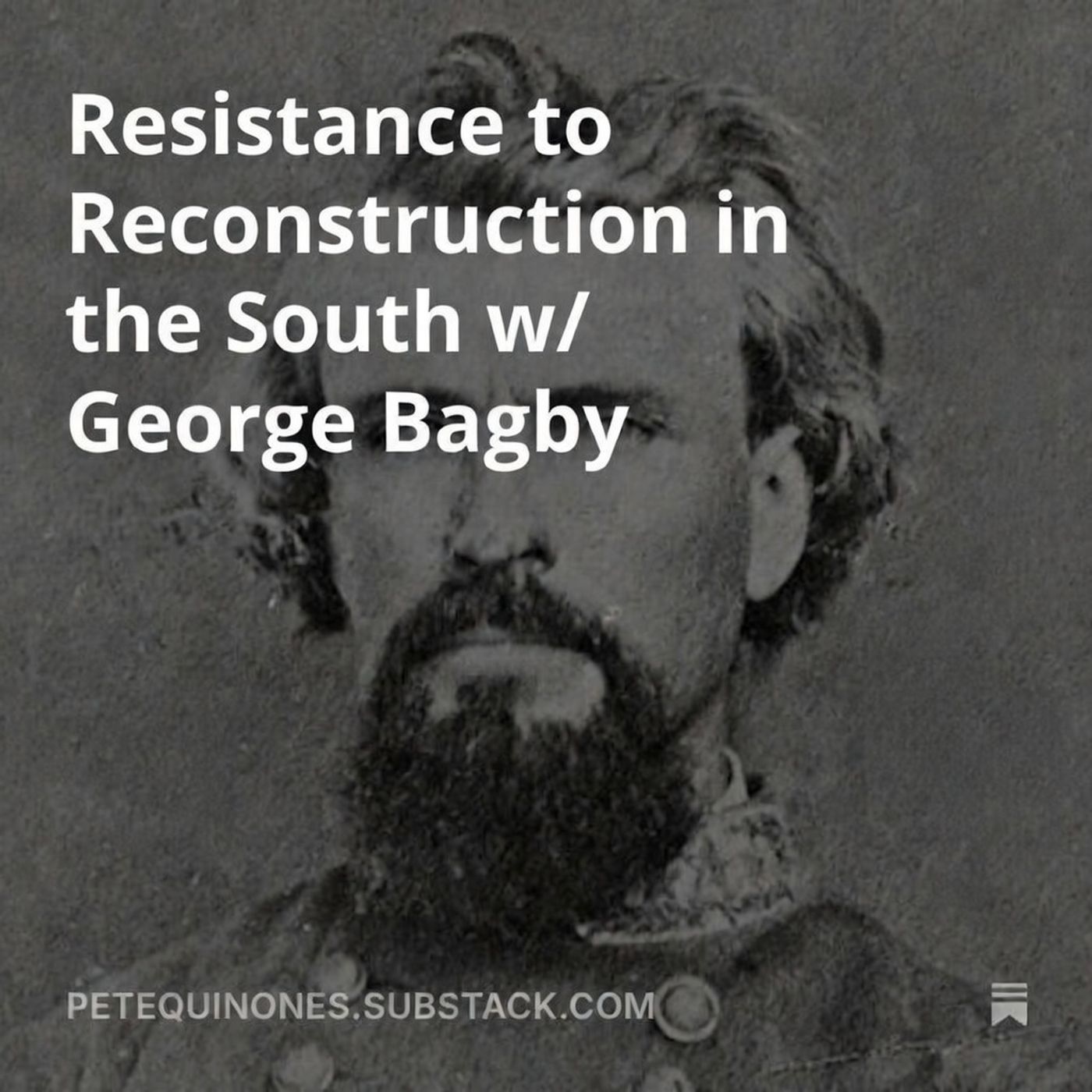
Resistance to Reconstruction in the South w/ George Bagby
105m 44s
The interview with George Bagby examines the dire conditions in the American South after the Civil War. The region was economically devastated, with a quarter of military-age white men dead, all banks failed, and the population thrust into a barter economy. A key outcome was the "proletarianization" of both freedmen and the majority of white small farmers, who were forced into sharecropping. This system offered less economic security than slavery, as it provided no care for those unable to work. Northern "carpetbaggers" arrived with capital, restarting industries like sugar and preventing worse famine, but they also assumed political power. This was due to the 14th Amendment barring former Confederates from office and the imposition of martial law by Radical Republicans. Military districts, overseen by Union generals, suspended civil liberties like habeas corpus, creating a period of federal control marked by significant social and economic upheaval.
I want to welcome everyone back to the Pikenianna show. I'm here with George Bagby. How are you doing, George? I'm doing well. I've been traveling a lot today and I'm back at home again and ready to talk reconstruction. Awesome. Awesome. First time on the show, please tell everybody a little bit about yourself. Tell them your story. Yeah. I call myself George Bagby. I am a content creator. I'm a guest on a lot of other people's shows. And I've got a YouTube channel on which I've recorded a lot of readings. That's just what I do mostly on my YouTube channel. I have a small press that I've started called Tall Men Books. You can get more information about that through my pinned posts on my Twitter handle. My Twitter handle is @TallMenBooks. I've republished or initiated the first publication of six books now with several more in the works. My focus so far has been mostly on the reconstruction of the Southern States after the Civil War. So my first book that I republished was Walter L. Fleming's Civil War and Reconstruction in Alabama. And I have published another number of other books on the subject. Awesome. Awesome. Well, that's what we're here to talk about today. We're going to talk about reconstruction. And we're going to get the history of that, the background behind it. And we're going to lead up to the reaction that some men in the South decided to take. So why don't you tell us a little bit about what the conditions were right after the war ended? Indeed. Well, the conditions immediately following the war are extremely uncertain and quite dire in most Southern communities. So let me outline to what it's like. The South has virtually no cities with the exception of New Orleans. New Orleans is exceptional for so many different reasons. That's a sizable city. But the rest of the southerners live out in rural conditions and are engaged directly in agriculture. That is the vast majority of the Southern population. The vast majority of white southerners own farms up until the Civil War. This is an important thing to understand. We have a competing narrative about American history that was popularized by the genius, the travel writer and landscape architect of Frederick Law Olmsted. Frederick Law Olmsted traveled around the Annabelle himself and popularized a mistaken idea that white southerners could be divided into two groups. And those were the aristocratic landlord, lords of all creation, who lived in palaces and owned hundreds of slaves, a piece, and the poor white trash who predominated in the rural districts. That's a mistaken idea about the Annabelle himself. The vast majority of white southerners were what we might describe as small holding human farmers. We know from the 1860 census, which gives us a huge amount of detailed information about this period. We know from the 1860 census that somewhere between 20 and 25% of southern whites-- that's just the whites-- owned slaves. Of that number, a small percentage in the single digits are what we might describe as planters. So those are the lords of all creation, and also the very famous southern elites that were statesmen and military leaders and things like that, people like Andrew Jackson and Thomas Jefferson were of that planter group. So they were a very important group, and they did tend to own large numbers of slaves. But the vast majority of southerners were just small farmers who owned their land outright. After the war, initially, the condition of the slaves is in question until the reconstituted southern governments ratified the 13th Amendment, and the 13th Amendment ends slavery in mid 1865. Up until that point, there is an awful lot of speculation that there is going to be some kind of compensated emancipation or some kind of colonization effort headed by Washington, DC-- some plan for the freedmen in their future. That never materializes. There is never any plan. What happens is they are emancipated, and then everyone tries to decide what happens next. And this results in an awful lot of conflict and dissatisfaction. The visceral impact of the war is that somewhere around one quarter of the southern male population of military age is dead in 1865. A quarter of the white male military age population is dead. Another 20% or so are wounded and returned home. They've survived their wounds. A great number of those are amputees. So we're talking about, at minimum, the loss of about 40% of the useful labor of the white population. There's argument about some of these numbers, but that's a modest survey. I'm low-balling this. That starts crossing over into 20th century numbers, where you'll see 30% of the male population just gone. Indeed. It's absolutely devastating. Another big problem that pops up afterwards is the radical dispossession of a lot of the small property owners. So the fact that the elites get dispossessed is not very surprising because they bet their lives, fortunes, and sacred honor on independence, and they lost. So the elites' property, their mansions, their bank accounts, their portable possessions, all of those things get seized as a matter of course in the war. But what happens after the war is very drastic. It's the gutting of the middle class in the South, basically. The confiscation of the capital, most of which is held in land, not to say that the end of slavery and the uncompensated emancipation is also a massive blow at Southern capital. I'm just bypassing that here. What happens immediately after the war is the federal government imposes four years of back taxes on the property owners. So this affects the white farmers predominantly. And those that cannot pay-- and this is an extremely tall order for most of them being that their sons are dead or they have their limbs amputated. They can't bring wealth out of the land. And then there's the portion of them that had slaves that are accustomed-- they have a track of land. And the way to get wealth out of it is to work the slaves on it. That's not working for them anymore. That they don't have that labor relationship worked out. And this is extremely inefficient at this time. So that means that a huge number of farms go up for tax sales in the first couple years after the war. You have a massive movement of the white population from freeholding farmers into people who's only asset is their ability to labor for wages. So you see the proletarization of a massive number of whites in the South. And this, in effect, puts them on the same economic level as the freedmen. And this is an important thing to understand. Because previous to the war, 75% to 80% of white property owners and their family members-- I'm counting in their women and children in that figure-- like 75% to 80% of white southerners-- didn't own slaves. They lived on independent farms, the vast majority of them. There is a subset that are squatters, that are vagabonds, that move from place to place, and live in the mountains, don't necessarily have title to the land. That they're on. There is always a group of people like that, but they are a minority. There's another minority that are working people that work for wages that have useful skills. Most of these people are in cities exempting them. The vast majority of white southerners are farmers. They are reduced to working for wages. Now, another one of the problems in the post-war South is that all of the banks have failed. Every bank in the South fails in 1865. So I try to point this out to folks when I take them on tours. I will walk through the financial district in the French Quarter in New Orleans, where all the Annabelle and Banks were. And the buildings are all still there. They're this a very interesting street corner. And I describe to them the importance of these banks in an agricultural society and the disproportionate role strangely enough, considering southern attitude, the Jeffersonian attitude towards banks. They don't like banks. They are very suspicious of the activities at banks. Banks are nevertheless an extremely important element in an agricultural society, where the majority of the population only sees profit once a year at harvest time. Then as now, farmers are disproportionately reliant on credit for their day-to-day operations. They aren't like working people that get paid weekly or monthly or by monthly or whatever it is. They don't have money flowing through so often. Now, this made them averse to a consumer sort of economy, because they don't have a lot of money flowing through. People out on the farm, far away from a city, might not ever handle money. It was quite possible, if you lived as an independent farmer, that you would very seldom or never handle currency. You might settle your accounts once a year when you went to the market with your crop in the city. But nevertheless, they were reliant on credit. They were reliant on lines of credit. So at the end of the war, the failure of all the banks meant that the entire population was reduced to a barter economy. At the exact same time, the entire population loses access to credit, has no financial institutions they can work with. Most of them have lost all their capital, unless they've managed to hold onto the farm by hooker by crook, or they've buried gold in their backyard. Most of them have no capital. And this is the precise moment at which the United States, as a unified entity, is totally embracing a free labor economy, where everyone is supposed to be receiving wages for services rendered. That doesn't work. That is highly dissatisfying to everyone involved. What that meant was that the proletariat, the people who only had labor to exchange for their livelihood, they don't have any other capital, they don't have land, they have to make contractual arrangements to work on a farm, to work for someone who owns a farm, for a long period of time, not for a week, not for a month, but for a harvest season, for a whole season until after the harvest. And they don't get wages at the time of the harvest. Instead, they get a portion of the profits of the harvest. So they have to market it, and it's dependent on what the crop is going to sell for. In exchange for that contractual arrangement, they basically get a form of labor very analogous to slavery with several bad features that weren't there in slavery, to be quite frank. For instance, you have people that are reliant upon you that cannot perform labor. You have young children. You have an amputee son who's a war veteran. He lost his legs or something. He can't perform another day's work in his life. He's reliant upon you. You have a superannuated relative in your family. You have your grandmother who lives with you, who's reliant upon you. But in slavery, they are all accounted for taking care of. I know that people get really bent out of shape about this. Don't take my word for it. Just go read about it. Go read Eugene Genovese. Go read Roll Jordan Roll. Go read Stan Lane Ingramman. Time on the cross. Go read Ulrich Phillips. American Negro slavery. Go read about how the institution of slavery worked. People that were injured as slaves couldn't be killed. That was against the law and it was treated as murder. Just because your slave gets injured or gets sick, you still have to take care of them. When your slave gets old, you still have to take care of them. There are examples, there are really weird examples of people selling a superannuated slave and giving a stipend to the buyer. So it's actually a reverse sort of transaction. Instead of the buyer giving the seller money, the seller is actually giving the buyer money because it costs money to maintain the life of the slave. We have examples like that. Normally it's impossible to get rid of an old slave or an injured slave. You just have to take care of them. Under slavery, they have housing, they have food, they have some measure of care and provision, whether or not they can do the work. In the system of sharecropping, if you can't do the work, you get no benefits. Therefore, sharecroppers that have dependence of the amputee's son, the superannuated grandmother, they have a big drain on their resources. So in sharecropping, they would get a cabin, not surprisingly. It was probably a former slave cabin. They get rations, not surprisingly. This is identical to the former slave rations and they get less benefits. If you get injured on the job, well, hopefully you've got a family member that cures whether you starve to death and they will take you into their hut and they will feed you whatever rations they can spare. For this reason, very interestingly, in the Federal Writers Project in the 1930s, when the Roosevelt Administration sends journalists out to interview former slaves and ask them about their lives, you get a lot of very interesting information from these oral accounts. These are very elderly slaves, former slaves at that point. They frequently talk about the period of reconstruction as a time where they're very happy to be free, but they also speak of the time as worse than slavery, economically, far more stressful, more uncertainty, things like that. So sharecropping is a dreadful situation. It's important to understand that the vast majority of the former slaves are forced. I don't think it's wrong to use the term forced, at least in an economic sense. If they did not want to starve, they had to enter into one of these contractual labor agreements that many of them thought as worse than slavery and from a certain perspective, we might say that's reasonable to think of it that way. But also the vast, not vast majority, but 60 to 70% of the white population is reduced to that status as well. So they formally, before the war, were talking about 75, 80% of the white population owned their own farms and are not engaged in slavery. After the war, 60 to 70% of them become sharecroppers. So this is a massive reduction in economic status. Okay, enough of the labor problems. Suffice to say that it's so dissatisfying that a great number of the freedmen who are formally slaves are inclined to leave their labor agreements when they see what the conditions are like. And given that they've been filled with all sorts of promises about life and freedom and the advantages of a free economy working for wages, of course, no one in the North can imagine a free economy without wages. No one in, I guess nobody in the world had really done much of that before in an agricultural society like the South. There's so much about that that doesn't make any sense, but no one was really thinking about how it was going to work at the time. They said, no, it must happen now for humanitarian purposes. We don't have time to plan. So they got what they asked for and then with these problems result. A lot of these freedmen leave their contracted conditions of employment. Now they also can't sign a contract. Most of them are making marks. They're making an X and there's some kind of some some places they they try to notarize this and stuff like that. There's a certain legal procedure that's possible, but this is also all going on in very remote locals through the South, which is not it's not easily accessible. So they're wandering away and leaving the landholders in a terrible situation. So the ones that are that were able to hold onto the land overwhelmingly white, virtually all of them white and who else is in the picture at this point. You have a really important group of of new white southerners that we refer to as carpet baggers. Now, it's another term that people get all been out of shape about. Let me explain. A carpet bagger is a northerner who comes south during or immediately after the war to take advantage of the circumstances in the post war south. And I would like to I would like to acknowledge the benefits of this initially. The south is berift of capital. It is extremely important that we have investors coming in who can pay wages, who can afford to rebuild things without banks involved. They come down from all over the place. They have a little money. They show up at a tax sale. They can make aggressive bids and they can buy and former cotton plantations for pennies on the dollar. And they can afford to pay the wages of the operation. And they're able to keep the economy of the south running. So I want to acknowledge that if the carpet baggers had not come south when they did, had not injected the capital into the economy and gotten the farms working again when they did, then we would have seen far worse famine in the south. There would have been a farmer suffering. Are you going to go over or do you know who would have been the money behind some of these people? I mean, it sounds like an 1800s version of what BlackRock is doing now. Yeah, well, they become landlords all around the south. They start some very prosperous businesses. Carpet baggers come in and restart the sugar industry, which is extremely profitable and requires industrial plant to operate. You have to grind and granulate the sugar on the premises of the plantation. And today, the sugar mills are in close proximity and well spaced out in sugar country. You can't take the sugar very far before you have to process it. It spoils too quickly. So they rebuild this stuff and they get this industry working again. And because it's such a high profit industry, they're able to pay the workers wages down there. So they become a new capitalist class in the south, but they have, they've got another advantage as well. Not only are they economically ambitious, but they are the only white people in the south that are allowed to hold office. Thanks to the 14th Amendment. The 14th Amendment says that former officials and military leaders in the Confederate states are not allowed to hold office. And this means that anyone that has any connection and no one has to dig very far to find connections. Virtually all southerners were engaged in the purchase of war bonds. Virtually all white southerners were engaged in the war effort, if not their own sons going off to war. And it was their nephew, it was their cousin. It doesn't take much of an accusation. I don't really know how that would work legally to connect these people to the Confederate War effort. But they're basically disenfranchised from participating. And to make it even worse, once Congress takes over, once the radical Republicans in Congress take over reconstruction, once they initiate the impeachment of President Johnson, which is its own story, the south is treated as conquered military territory and subjected to martial law. And the southern states are divided into military districts. And though they have a nominal civil government, the military governors who are all former union generals, and sometimes very brutal union generals like Philip Sheridan who burned up the Shenandoah Valley. Philip Sheridan was put in charge of Louisiana and Texas, which was military district number seven, maybe. I forget the numbers of the districts is much easier to say Louisiana and Texas. But Philip Sheridan was put in charge of that area and he could overrule any executive in the area. He could overrule the governors, he could overrule the mayors, he could overrule any executive decision maker in the area. So he was ultimately the guy in charge and they didn't have trial by jury, they didn't have habeas corpus. This is all very important. I remember when I had a fellowship with the World War II Museum and we all got sent to Hawaii. I was part of various discussions and lessons about martial law in Hawaii. And I had all of these leftist public school teachers moaning and groaning about how civil rights got suspended in Hawaii for so long during the war with the Japanese. They were so paranoid about Japanese Americans and I said, well, you're forgetting another episode of this reconstruction. And they had never heard that there was martial law in the south after the Civil War that lasted so long it lasted until 1876 when the last pieces of it were finally dismantled. But what was the name of that act? I can't remember. It was named after a German, I think. What was the name of the act that basically made all property part of the state? I used to know it by heart. I don't know this one. It's been years, years, years. I'll try and look it up by you go on. Okay. All right. So we've talked a lot about the legal, the industrial circumstances of the post-war south. Things are extremely bad and also very uncertain. You may remember Lincoln very famously in his second inaugural address. He says that he wants to bind up the country's wounds with malice towards none and charity for all. And he also makes a couple of important communications the month of his assassination. When he's talking about pardoning Confederates, he was always very consistent about the Confederate Army's disbanding and the Southern States sending the representatives back to Congress. The idea being that they never left the union. They're still in the union. Session is impossible. This is one of the things that makes studying reconstruction, maddening and very irritating for virtually everyone. And I understand the frustration people have here, but I also think it's very important and I'm trying to, I'm trying to popularize it. People need to know about these things. It's that it doesn't make any sense, the way that it was done. It really doesn't make any sense. The Southern States under the authority of Congress after they've defanged President Johnson, they're treated as conquered military territory. And the representatives voted on by those Southern governments immediately after the war. They immediately elect former military and Confederate officials because those are the leaders of the voting population of the South. The men in uniform and in office in the Southern Confederacy during the Civil War are the actual leadership of the South. When they get sent to Congress in 1865, the radical Republicans who've been running every thing in the federal government for the last four years and are extremely bitter and paranoid about the assassination of Lincoln, they deny them their seats and send them home. Now this, this in a certain level, this makes good sense because, I mean, I mean, we can understand why this is happening. Georgia elected former vice president Alexander Hamilton Stevens as their senator. And we expect him to join that he is Stevens and and Senator Sumner of Massachusetts. Is he actually going to sit in the same body as those men? No. They will murder him before they allow that to happen. And so it's no surprise that they closed the door for these people. But does that mean that the Southern States actually left the union? Well, it's an academic question. In short, they're treated as conquered military territory. Now we get to a very interesting part. Let's shift gears. At this point in time, Republican leadership with people like the famous, the famous hater of Congress, Thaddeus Stevens, the brutal and bloodthirsty, Thaddeus Stevens of Pennsylvania. And people like Charles Sumner of Massachusetts, who pressed in Brooks famously cained back before the war. And other radicals, Benjamin Butler, the famous general Benjamin Butler, famous, famously nicknamed beast, Butler by the indignant women of the South who he had insulted and given his men license to sexually assault in New Orleans. He becomes Senator from Massachusetts as well. These vindictive radical Republicans start making utterly preposterous and irresponsible speeches, claiming that the white population of the South, the disloyal ex-confederates, our traders deserve the hangman's news, should be expelled from the territory, should be forced to immigrate. They are openly talking of ethnically cleansing, conquered, southern territory, and seizing all the property and transferring that to the freedmen. In doing so, they will make the loyal freedmen a permanent Republican voting base in the South. And the party of the Union, according to Thaddeus Stevens, who spoke very openly about this, the party of the Union will be the American party dominating all of the federal government going forward with that permanent stock of voters. Now this is very interesting because we talk these days about ethnic loyalties of demographics to political parties. This is something that is talked up quite a bit at that time. So it's very useful to look at that and to look at promises and patronage that are involved with that, even during reconstruction. It's a very useful object lesson. However, and this is a very important point, this is an existential sort of pledge. The continued existence of an entire distinct demographic in the United States is threatened by this proposal. Now they are not talking about exterminating them. They're talking about forcing them to immigrate, but that is ethnic cleansing. And how many people might die under these circumstances, being that they're already facing famine. The Union Army is already distributing rations, military rations to the civilian population in several southern regions. Interestingly, and I don't want to get sidetracked on this. The reconstruction governor of Mississippi later on, several years later, estimates that a significant portion of the black population of Mississippi starves to death in the years following the end of the war. That's still a big open question. We don't really understand what's going on there. We don't have those stories. We don't know. Over in South Carolina, something like one-tenth of the black population of South Carolina disappears between 1860 and 1870. That's tens of thousands of individuals. There is some reason to think that they starved at some point either during the war or immediately after. It wouldn't be at all surprising to discover that is true, but the problem is we don't know that for sure. So we can't say that for sure. But we do know that there are large portions of the black population that disappear in the records in this period. They were there in the senses of 1860. They aren't there in the senses of 1870, and we do not know what happened to them. We assume they're dead. Or they're across the country under another name, which is possible, but also unlikely. Anyway, that is Steven's Charles Sumner. They talk about 40 acres in a mule for every freedman. That would require the confiscation of property in the South, the dispossession of ex-confederates in the South. The radical Republicans say this is all justified based on treating ex-confederates as traders. They have no rights. They have no citizenship. We don't have to charge them in a court of law and do a legal procedure. We can just confiscate. However, most irresponsibly, most cynically, and I must insist on this point, this was a cynical ploy. This was a political move to win a short-term loyalty of the black southern population. Because none of these irresponsible credons who promise these things in Congress, people like Benjamin Butler, people like that, he is Steven's. None of these bloodthirsty credons ever actually put a bill to vote on the subject. So if it was a serious political proposal and they actually wanted to do it, they actually wanted to do the purgation of cool acts in the South. They never put their money on the table and actually made a serious proposal to do it. And this meant that it was nothing more than a demagogic rumor of incredible political consequences. All right. So the next stage, if you will, the Republican Party during the war in 1862, a bunch of elite Philadelphiaans form a fraternity. I like telling stories of fraternities. It's an awful lot of fun. This one still exists. It's called the Union League and it's in Philadelphia and it's one of the premier elite fraternities that still exists today. I understand they can keep their membership of a certain caliber through their very high initiation prices. If you want to join today, it might cost you 50 grand or something just as an initiation fee. They keep the rifer app out that way. But they have an awesome clubhouse and things like that. It's pretty cool just as a fraternity. But they were formed. They called themselves the Union League. They were a Republican club and they were formed as a fraternal aid association to help union veterans and to support the war effort in particular Lincoln's reelection. And then during Reconstruction, they became a very important force of Republican politics in the South, which is an important sidetrack. The Republican Party did not exist in the South in 1860. It did not have any organization in the South. Now some people say, well, if they could have just grabbed enough people to formally incorporate as the Republican Party in Southern states, the neighbor, Hamlin, and would have gotten a few votes in the Southern states. Well, maybe so, but they didn't even have that level of organization to recognize the Republican Party in states like Virginia, in states like Georgia, in the states that became the Confederacy and border states like Kentucky. Abraham Lincoln did not receive a single vote in 1861 or in 1860, when he ran, he was inaugurated in '61. There is no organization on the ground. The Union League had the resources, had the connections with the elites that they planted the Republican Party on the ground in the Southern states by organizing two, well, let's say three important groups in the South. Number one, the newly enfranchised Friedman. No surprise. Okay. Hey, y'all sign up here. We're going to get you 40 acres in a mule. We're going to seize the property of the ex-Confederate whites. And we're going to give it to you. And you'll all be free farmers. Okay, so it's a massive land grab redistribution plan, massive wealth transfer plan. Okay. Second group is carpet baggers from the North, many of whom are already Republicans, but not all. Okay. I'm interested in giving the carpet baggers their due. All right. We can understand why seveners hated and loathe them why it became a by word, et cetera, et cetera. They weren't all Republican radicals and they did serve a useful economic role. Okay. Third is what we call scallow eggs. The scallow eggs are Republican or they become Republicans. They are ex-Confederate Republican converts who join the Republican effort in this on the state level and later on the federal level in the South. Among them are some really interesting people. People like General James Long Street, Lee's trust trusty lieutenant. People like, oh, I'm forgetting his name now, Edward Porter Alexander. There he is. The chief of artillery and the army of Northern Virginia, other other people. General William Mahone of Virginia, one of the great stalwarts of the seizure of Petersburg becomes a Republican during reconstruction. We call these men scallow eggs and that is another term of disaprovation, another slur. It's like a synonym for trader, okay. Seveners who become Republican. Okay, so those are the people the Union League is appealing to. The Union League organizes herimilitary groups across the South to make things even more hairy. The federal garrisons in the Southern states are made of mostly United States colored troops. So the federal soldiers that intervene on behalf of the Republican state governments in the South now that the ex-confederate Democrats have been proscribed and forbidden to participate. The state governments, the local governments become Republican dominated. If you could just imagine what would happen in a place where you have outlawed the opposition party. They cannot vote. They cannot run for office. They must apply for a presidential pardon to participate. They have no habeas corpus. They have no trial by jury. If they have a problem, they have to go to the Union general who's in charge of the court's marshal who, you know, as a Confederate, they killed that Union general's nephew. They killed that Union general's brother. They've got a lot of bad blood and he is not going to give them a fair shake. And under these circumstances, everyone would agree that's natural, more or less. You could not expect a fair shake in this system. And the freedmen who own nothing, who are 80 to 90% illiterate, who do not know the law, who do not have any tradition of civic responsibility. They haven't been trained for this role. And I'm not here to disparage them. Okay. I'm here just to try to explain what's going on. They are now the electorate. They have the ability to elect officials. Now let me explain what this results in. Not only is the Union League arming freedmen, organizing them into paramilitary groups led by demagogic carpetbackers. So nor the nurse who have just come down, just bought property, can run for office, are now leading armed groups of black freedmen with the rallying cry, 40 acres in a mule, for every freedman. Let's seize it from the white farmers. And the government, the nominal government is made up of Republicans, voted in by the freedmen. The white electorate who ran everything up to this point are disenfranchised, are forbidden to participate, are turned around and sent home when they are elected, nominally. They are put in this alarming, terrifying situation where they are listening to speeches in their towns. They're listening to speeches saying, we will dispossess the white population. We will force them into exile. We will see them all leave. To give you an example of the results of this ploy, you see really wild characters like Henry Clay Wormeth elected as governor in Louisiana. Henry Clay Wormeth is a guy that I have some affection for as a Louisiana character. And I like characters in my own state. Henry Clay Wormeth is one of the most infamous men ever elected to office in the United States. He was accused of stealing his company's payroll. He was in an Illinois regiment in the war. For whatever reason, I believe he got a presidential pardon. I don't know the details of his court martial, but he was court martialed for corruption. He was released and reinstated. Weird situation. So a man of controversy at the least, okay, whether or not he actually did something during the war. He becomes a carpet bag character in Louisiana. He's only in his 20s. I forget just how old he is when he's elected governors, but he is a young firebrand. The center of politics at the time and also the post-war capital of Louisiana is New Orleans. Baton Rouge has been utterly destroyed and it's years before the Capitol moves back up the river. New Orleans is Capitol. In New Orleans, why would he speak to a white audience? They've all been disenfranchised, basically, okay? His speeches, in his speeches, he promises that he will as governor invent a machine that will trade the blood of a black man for a white man's blood. So he will make them white on the inside. He repeats this promise a couple of times. And when he's speaking to a group of white Republicans, he plays it off as a great joke and they all laugh, not surprisingly, because he never had any intention of doing anything on that front. No one imagined such a thing was possible, but it does give us a little insight into what did the black electorate want? They want it to be like white people. They wanted to be competent, educated, you know, equal on the inside. That's what they wanted and that's what they voted for. And they got Enrique Wormeth, who becomes a multi-millionaire on a salary of like 20,000 a year or something. He becomes a multi-millionaire in his first couple years. And newspaper, newspaper interview him about this. He says, "Yeah, I'm corrupt. Corruption is the fashion. Everyone's doing it. I just do it better and you're jealous." So he's really in your face about it. He has the audacity and my goodness is the man audacious. You can't help but admire his spunk, his brazenness. He writes a memoir after his term of office and he does something very interesting. He describes his tumultuous administration where he has finally impeached, even though he's the Republican Carpet Bag governor, the Republicans themselves have too much problem with him and they impeach him and replace him with arguably the first black governor in American history. PBS, Pinchback, PBS Pinchback, an interesting Louisiana character, not elected but was Lieutenant Governor Under Warmeth and was what was it? Governor Pro Tempor of Louisiana, first black governor in America because Henry Clay Wormeth was removed from office by impeachment. Death writes in his memoirs that his opposition is so scary that the white population of Louisiana should be thankful it was him and not someone else. He describes the New Orleans Tribune Party. So the New Orleans Tribune starts out as Le Union which is the very first African-American owned newspaper in America. It started in 1862 during the Federal Occupation of New Orleans as a French newspaper directed at the African-American French-speaking population of New Orleans. So these are really interesting set of people. There are a lot of freedmen among this group. They've been free for many years before the Civil War. They have resources and a free source is to start a newspaper. They are literate and they are writing in French specifically for the French, the French literate black population of New Orleans. So this is a very niche set of people. They're all Roman Catholic as well, which is also very interesting. They're all black but they're all Roman Catholic. Their editorial line is fascinating. They reform after the war as a dual language newspaper. They start writing in English and they call themselves the New Orleans Tribune. Their editorial line is that the post-war south should take as its model, Haiti, which is not surprising because that is where these people came from. What they propose is a race war and they're proposing it in print and black and white in New Orleans. They have enough clout to distribute their paper to every registered Republican in the state of Louisiana at state expense. They got a subsidy from the Carpebag government to distribute this newspaper all across the state. That's how they're able to stay in business and evidently it was a pretty good business. Henry Clay Wormeth, they're also distributing it to people in Congress. They're distributing it to the Republicans up in Congress in T.C. They're publicizing all kinds of propaganda. Henry Clay Wormeth says, "Okay, you all don't like me. You think that I'm so bad. This was your alternative." I was holding them at bay so that they couldn't do what they wanted and we all know what happened in Haiti. You can't hate me too much. Andy's got a point. Henry Clay Wormeth who survives until the Huey Long administration before he dies and is quoted disparaging Huey Long. Thanks Huey Long as an amateur. A very funny guy. I like to utilize Henry Clay Wormeth at Metaree's Cemetery. So promises made. The radical Republicans are making these outrageous, very dangerous promises. The Union League has formed. They have paramilitary groups. They are intimidating people on election day. They are marching in the street. They are doing military drills. They are saying they will confiscate property by force if necessary. There is no legislation for this, but everybody knows that the situation is increasingly dangerous. And then something very interesting happens. And now I need to shift gears once again. The clan. Now this is going out all over the internet. So I want to be very clear here. I am interested in the history of the period and I'm trying to explain what's going on. And I'm trying to give clear exposition. When people talk about the clan, people get very emotional. I would like to say at the outside, I encourage you to believe whatever you want to believe about the clan. And I'm not here to tell you otherwise if you feel that it was something I want you to believe that it was that thing. Now I'm going to try to talk about what was going on. I want to be clear based on my understanding of the evidence. And I've worked a lot in this. So I think I know something about what I'm talking about. In 1866 or thereabouts in Polaski, Tennessee, a member of the bar had a meeting with other elites from the neighborhood. So he was an ex-confederate. His friends were all ex-confederates. And they decided that they were going to form their own secret paramilitary, vigilante, organization. And they picked as their name the Ku Klux Klan. Now there is an awful lot of debate among the scholars about just where the name came from. I don't mean to go into that right here. But there were actually several paramilitary civil defense, you might say. Now I'm already in trouble, civil defense. They were advocates for the interests of their communities. Most of them had military experience. They didn't have to train for this. They already had weapons. They didn't have to make special efforts to arm. They already had experience and skill. But they formed secret societies for the defense of their communities in this time of great uncertainty and a special threat. In Louisiana, the Klan did not predominate. It was an organization called the Knights of the White Camilia. And there were other organizations as well. The Knights of the Golden Circle is another organization that seems to have its roots before the Civil War. But it seems to persist. Very interestingly, the guy in Polasky who organized the Klan allegedly, he was a very prominent member of the Masonic Lodge. And so they already know, oh, here we go, Judge Thomas M. Jones. That was his name. He was prominent in the Freemasons. So they already knew a lot about secrecy and how to keep their initiation and activities, and they incorporate some of that. It's not the same thing. The Klan is not the Freemasons and no one should confuse the two. But they obviously pick up on a number of those traits of a secret society and initiation and ritual and things like that. The Klan is mostly active in the upper south. It's very active in Tinesi, of course, where it's formed, Alabama, Northern Mississippi, North Carolina. It is not active in Virginia as an example. And Virginia is really a special case for many reasons. Very first southern state to re-enter the union on equal terms. First southern state to have the military withdrawn and the restoration of civil law, the end of martial law, the restoration of trial by jury. So Virginia is a very special example. And that certainly has something to do with the lack of the presence of the Klan there. These things are connected. If you don't have civil law and if the enforcement of the law is not equal among the citizenry, then vigilanteism arises in a vacuum of executive power. Organization is a necessity and inevitability. People will organize and fill that vacuum. And the Klan is an example of this commonly understood political principle about order in society. Now in that statement, I'm probably beyond the pale for normies right there. So be it if you want to blacklist me for that, that's fine. That seems to me what's going on. And plenty of historians of the period would agree. Interestingly, I republished, or I published actually for the first time a collection of monographs by Walter L. Fleming. I titled it Southern Concerns, the shorter writings of Walter L. Fleming. In that volume, Fleming is talking about the organization of the Klan. And he says there are a great many examples of the organization of ethnic interests, even in secret in the history of Europe. And he names several. In particular, I think it's fascinating. He names Italian groups and German groups. I don't have them in front of me right now, but that is a very interesting point that he makes. And he says, this is a European characteristic. Europeans do that. And no one should be surprised that it happened under these circumstances in the South after the war. So that's a curious thing right there. They weren't just going to take it lying down. Okay, so what did they do? Here is a very practical element in the Klan's campaign of intimidation and violence. And whatever we might think about the justice of this, I want to be clear, it was a campaign of intimidation and violence. And it was outside of the law. And the law had been withdrawn in some sense. Even without all that taken to account, it was a campaign of intimidation and violence. What's going on? Okay. One of the most practical elements going on here is the unfaithfulness of sharecroppers. We talked about this at the beginning of our conversation. The sharecroppers have been initiated into this new makeshift industrial regime for an economy that is overwhelmingly agricultural and has no capital and no one has the credit to pay wages. It's impossible. Under this regime, many of the former slaves are describing conditions that they call worse than slavery and they are peons and no one denies this. Okay, this was utterly miserable condition to be in. They were promised far more and the demagogues in their communities are saying you don't have to put up with this. And they say, okay, I am skipping town. I am getting up and I'm leaving. Now what can they go to? I'd like to make one thing quite clear. Northern states do not want them there in our taking serious political and practical measures to keep them from coming. At the very same time, and this is another confounding thing about reconstruction, at the very same time that the Republican congressmen in Washington are saying that all the slaves have been freed and all the slaves are citizens and with the 15th amendment, they all have the right to vote. They are enforcing military territories who they say are conquered provinces to ratify amendments to the Constitution. That makes no legal sense at all. But they are unwilling to do those things in their own native states. States like Ohio and Indiana, states like Oregon prohibit the immigration and settlement of free blacks. And that was the case before the Civil War. So these laws eventually come off the books nevertheless. These northern states remain incredibly antagonistic to Friedman immigrating. And there's virtually none of that that happens. That happens mostly with the phenomenon we call the Great Migration that happens decades later. Anyway, mostly in the 20th century actually. Anyway, the clan. The clan goes to faithless sharecroppers, black sharecroppers, primarily. Okay, there are cases of the clan attacking white people that is mostly carpet baggers and scallowags. But the clan goes to faithless sharecroppers to intimidate them. And how do they do it? Well, it's the characteristic view that we have if we have any cultural impression of this at all. They dress up as ghosts. They ride around, they hoot and holler. They are impersonating the ghosts of dead Confederate soldiers on a mission of vengeance. That's what they're doing. That's how they describe themselves. This is all very interesting. Let me read you an example of a clan communique. So the clan, they're very interested in playing off the superstitions of the Friedman population. So they dress up as ghosts. They seemingly go in for a slight of hand and magic tricks. For instance, a clansman shows up at a sharecropper's hut. There's some reason that he goes there. We don't really know why the clansman goes there. But the clan is very targeted in their actions, apparently. We have the testimony of the sharecropper on this measure. Congress opens an investigation and we have an awful lot of testimony about the activities of the clan. The clansman shows up at the sharecropper's cabin and asks for a drink. He's dressed in white sheets with a pointy white hat. So he's dressed rather like a ghost, kind of ghostly looking. He picks up a bucket of water and apparently drains the entire bucket of water and asks for more. So he performs something that apparently looks like a superhuman feat. He says, "I haven't drunk a drop since Chikamago." Okay. So it's like he's the ghost of a dead Confederate and he's thirsting like Lazarus in the parable. He's thirsting in hell, roasted over fire or something. And he performs these things and there are accounts. We have testimony. This is testimony given to a congressional committee by sharecroppers, by Friedman and the South. That clansman can dismember themselves. They pick up their limbs off the ground and carry them away. They can take off their heads and walk around headless. So there are these spooky Halloween magic tricks that they're said to perform. They burn crosses. This is one of their tricks. I don't know why this has any special significance, but this is something they're very well known to do. They ride around on horseback with flowing robes and torches in hand, hooting and hollering and pledging vengeance on those that violate the code. You know, honor doing what you say you're going to do. Here is a clansman communicate. Now imagine every spelling is every spelling possible is made with a K. Okay, so they're being kind of ham, ham fisted on this. They're playing up the absurdity on some level. These are obviously literate people, but they're also they're playing something up and making a game out of it. The Ku Klux Klan are called upon to custigate or kill any colored cusses who may approve the constitution being concocted by the contemptible carpet baggers at the capital. Okay. So just as just as an example. The clan runs a muck around the south. They have massive rallies. Sometimes in the daylight in places like Huntsville, Alabama, there is a huge clan rally in the daylight. Thousands of people show up. And they are saying. They're saying that they do not want outsiders in their government. They do not want outsiders running their communities against their own interests. They are particularly indignant about illiterate members of their state government and local government in particular school, school officials being illiterate. This is a really interesting thing. One of these one of these clan messages occasionally that the clan will publish things in southern newspapers to let their intentions be known and to make warnings and threats. One of these one of these communicates famously says that ignorance is the curse of God and that any illiterate member of the school organizations, which is obviously freedmen that were appointed to those positions by a friendly Republican administration. Any illiterate member of the local or state government needs to resign or flee. And the threat is quite obvious. And this of course works its way out in extra judicial lynchings of offenders. So it's quite clear here what's going on. But I'd like to make something a little more clear and that is class differences in the white population. C. Van Woodward in his excellent work, The Strange Career of Jim Crow, which everyone should read, it's very short and it's very clarifying. It's about the origins of segregation. C. Van Woodward writes about the class distinctions regarding the freedmen in the post-war south. He writes that the slave owners, the former slave owners, who are mostly of the old southern elite set. We could describe them as aristocrats. They have a distinctly conservative line towards the freedmen. So the minority of dispossessed southern elites have a very conservative approach towards the former slaves and tend to favor their political integration, their social integration. If the slaves will stay in America, if the freedmen pardon me, if the freedmen have a destiny as American citizens, there must be some training for them to be responsible citizens. And however you want to call this, the former slave owners had as in slavery a paternal feeling towards the former slaves. As they did when they were actually slaves and they were actually responsible for their basic necessary needs of life, they continued to feel that way after a man's patient. So they tended to take a more conservative political line. Now in spite of this, we see elite southerners in a couple of states join these vigilante organizations. But I think a good example of the sort of southern elite involved in the clan would be Nathan Bedford Forest. Nathan Bedford Forest, famous cavalry commander, military genius, hero of Tennessee, was a self-educated archpreneur who engaged in many forms of business, including slave trading, which put him kind of at the bottom of southern polite society. All right, slave traders were not welcomed into the higher circles in the south. Nevertheless, Forest is a fascinating character. He forms cavalry units in the war. He brings his capable slaves with him on his campaigns. He offers his slaves' manumission for their service. They serve loyally by his side. They fight by his side under his own authority. He arms them and trains them and they fight along his side. When Forest is finally dyes and is buried in Memphis, after the war, he is buried with a procession of black freedmen in Memphis who fondly remember him. That's fascinating episode in the saga of Nathan Bedford Forest. And in recent years, he and his wife were disinterred in Memphis. By a vibe or not. Their grave is, I visited his grave. He and his wife's grave recently. They're at a barrage at a Confederate museum in Columbia, Tennessee. Is that the sons of Confederate veterans establishment there in Columbia? I believe that's what it is. It's also the statue. Did they rescue that? I got into history because I like the people that I read about. I disagree with plenty of them. It's not that I agree with everything they said or did. But they're dynamic. They did something. What did you do? Are you the equal of these people? Who among us could claim to be their equal? So it just rinsed my heart to read about things like that. But anyway, yes, a very important point. Yeah, it's quite the contrast to his recent history, the fate of his corpse. That forest was the wizard of the clan in Tennessee. He did not found it, but he came to be in charge of it. Very interestingly, the clan, though it has elites in it initially, we talked about the judge in Polasky that allegedly formed it. And it attracts southern elites in certain areas. Once the violence gets underway, southern elites are increasingly alarmed by it and increasingly disinclined towards it. Now, the sources that we have about forest and his role as the imperial wizard of the clan, which is a very high official in the clan. The clan has lots of really wild names. A regular member of the clan is a ghoul. Officers in the clan are called grand exalted cyclops, a titan, a wizard. It has all these really wild names. Again, the purpose is to play off of superstitions. And communicates from the clan frequently read like dispatches from demons in hell. And they play up that aspect. They speak in code. They're talking about days and hours and they're publishing these things in newspapers. So members of the clan will know what they're saying, but no one else will know. And they talk about the dismal hour, the hour of hellfire, the caves of the wicked. And they use like all sorts of weird mythological terminology that's actually a code that the members would understand, but no one else would. So it's a curious thing. Anyway, the regular member being a ghoul like a ghost, like a zombie, right? It tells you a bit about what the act was all about and how they were playing off the fears of the freedmen in particular. But what was I saying? So forest attempted to disband the clan in 68, 69. This was not successful. Now the reason for it is very interesting. And that is because the dispossessed small farmers were particularly antagonistic towards the freedmen. Now let's remember just what happens to them. And let's have a bit of understanding. Things don't happen in history just because you can divide all of humankind into people who are pure of heart, who have no ill motives in their soul. And there are people who are incredibly evil and can only do wicked things. And they must be utterly destroyed and cannot be negotiated with. That is a completely blinkered view of humanity. That's not how people are. People are all mixtures of good and evil. Every person has a dark part in them that can come out in certain circumstances. Okay? We're all sinful. We're all falling. Okay, this is this is a basic Christian understanding. And some of us are more virtuous than others as well. Okay? But none of us are totally good. And a true saint, a saint, will tell you that he has evil in his heart. A true saint will go to confession for this. Okay? So let's keep that in mind. The Ku Klux Klan is made of human beings who are doing things in response to circumstances that we can understand. There I go again saying something that is extremely controversial. I think that this is obvious. I truly do. I think this is obvious. And that doesn't mean that I think that lynching people is a good thing. I don't think that extra judicial killing is a good thing. I don't want that. I think that should be avoided at great sacrifice. It should be avoided. But also we need to understand the circumstances and reconstruction are unprecedented. When have Americans lived under circumstances such as these? And we can understand why people are doing what they're doing. All right. So when forest attempts to disband the Klan, it is unsuccessful. Initially, okay, forest again calls for the disbanding of the Klan. When the military government ceases in the South after the election of Brotherford B. Hayes, or at least the corrupt bargain that makes Brotherford B. Hayes the president. Okay? That is when the Klan is disbanded. But it's first, the first attempts of Southern elites to disband it fails. And that is because the white population of the South that didn't own slaves before the war, they have been reduced to the same level as the former slaves economically. And they've been reduced to a level lower than them politically. And they are resentful. And these are precisely the people, especially the lower class. Okay? And I want to be frank about this. I mentioned Frederick Law Olmsted, the great Northern genius who designed Central Park in New York City. And it's called the Father of Landscape Architecture. A remarkable man, a great American travel writer, I don't really call him a historian. He was mistaken on too many things and is too much of a bad influence in that regard. But genius. And Frederick Law Olmsted came up with the term poor white trash to describe the lower levels of white Southern society, Annabelle and society. These people are quite vindictive. And they are, I think, more represented among the ranks of the clan. Now they're the foot soldiers, if you will. All right? And they do not have scruples when it comes to violence. So they are more of the Scotch Irish persuasion. So they're representing a certain element of that heritage, which is a fighting heritage, which is a much more independent sort of heritage, has a long history of being on the outside of law and polite society and things like that. They are used to, as they are today, by the way, they are used to very unfavorable comparisons between them and the African American population. And they don't like that. And they are quite active in the clan. All right. So this leads, as I said before, to a massive congressional investigation. And that produces a huge amount of information that we have on the clan. It's got to be a dozen volumes of testimony. I've seen condensed versions of it. It's an awful lot to wade through. I would recommend sources on that, but everything is out of print. So give me a chance. I might bring some back into print. But that'd be awesome. Yeah. I'm really hoping to get flimming volumes about documents related to reconstruction back into print again. Who likes reading primary sources on reconstruction? Folks raise your hands for me. I'm working for you. I love doing these nerdy autistic things. And I don't know who I'm doing it for. Encourage me folks. Go buy my books. But anyway, I'm sure you could send to me asams. You could sell them through the certain institutes. Yeah. I'm sure that I would just have to keep going. I don't want to bring the hammer down on them here. I don't want anyone going and persecuting them because they're buying books from me. But I'm making headway on that front. Interestingly, Nathan Bedford Forest actually testified to the Congressional Committee. And they did not know at that time nobody knew that he was the imperial wizard of the clan in Tennessee. Yet they had the Congressional Committee had the good fortune to get his testimony concerning the clan. And they asked him questions about it and he answered. And my knowledge of this, I've read, I have not read his testimony. I do not have that book. I've read quotes from his testimony and the assessment of historians on his testimony. The idea of the historians, the consensus that I've read of the historians is that he did not purger himself in his testimony. He claimed ignorance on number of points, but he did not purger himself, nor did he reveal his role in the clan, which is really quite clever. He was a very cunning man and he handled himself well. Anyway, here's a quote from Forest on the composition of the clan. My information was, okay, that's interesting. It's like, oh, well, I don't actually know like other people told me. My information was that they admitted no man who was not a gentleman and a man who could be relied upon to act discreetly, not men who are in the habit of drinking, boistress men or men liable to commit error or wrong. All of that is pretty fascinating because although I've really gone after the boistress Scotch Irish here, the mountain people where clan activity is particularly egregious, we might say. Those are my people by the way, okay, I've got a lot of Scotch Irish ancestry and I'm not castigating them as categorically or anything. They're my people and I know the people I'm talking about. I'm familiar with them. The record of the clan is also something that speaks for itself. Some members did not reveal who was involved. They were very well disciplined. They would not give up their comrades. They maintained a strict secrecy. Their activities remain very obscure to us as does their membership. Now that's from this period. Now I want you to note, there are several incarnations of the clan. There are at least three and I'll tell you a bit about the second one in a moment just for the sake of clarity. It's important that I make that point later. The second Cluclux clan is distinct from the first and that's an important point. But it is very important to note that the Cluclux clan is active in states with martial law, states who are deprived of habeas corpus, trial by jury and regular civil government. The first Cluclux clan of reconstruction is disbanded when martial law is ended in those jurisdictions. And during that time, the clan does not reveal its membership and their actions remain very obscure and secret and are still a mysterious subject to this day. There actually aren't very many sources on them. We do have some really interesting material like oaths that were recalled by members after the disbandment of the clan. Newspaper communicates of the clan. Other interesting things, let's see. I'm looking for a quote or two now. Okay, here's some interesting things. These are not bits from the clan. This is from the Knights of the White Camilia, which was established in Louisiana and did exist in some other places like Texas. The Knights of the White Camilia had a preamble. This is a constitution adopted in 1869. So during reconstruction. And I'll just read some things here as an example. Whereas radical legislation is subversive of the principles of the government of the United States. Now, by radical legislation, they're talking about radical Republicans. Subversive to the principles of the United States as originally adopted by our fathers. And whereas our safety and our prosperity depend on the preservation of those grand principles and believing that they can be peacefully maintained, therefore we adopt the following. 1. Questions to be asked of the candidate. Do you belong to the White Race? 2. Did you ever marry any woman who did not or does not belong to the White Race? 3. Did you ever promise to marry any woman, but one who belongs to the White Race? 4. Do you believe in the superiority of your race? 5. Will you promise never to vote for any one, for any office of honor, profit or trust, who does not belong to your race? 6. Will you take a solomoth never to abstain from casting your vote in any election in which a candidate shall be opposed to a white man attached to your principle unless we're prevented by severe illness or any other physical disability? All right. So we see the basic racial antagonism involved here. And this is not, it doesn't seem to me at all surprising given the circumstances. This was their form of government in status quo ante. And defeat in the war did not change their minds. And to go back in conclusion, I'm trying to wrap things up here, to go back to a earlier point. I see, now I've lost my train of thought. I'm sorry. Take your time. You're providing a ton of information that is valuable. Thank you. I'm missing the point that I was searching for just then. So let me, let me instead wrap up another loose end. And that is the second plan. So as I said before, and this is an important thing to note, when the military garrisons are finally withdrawn from the South in 1876, the plan is disbanded. Now we have it on several authorities that it is so including union Republican authorities who have been rounding up literally rounding up thousands of people suspected of membership in the clan in the 1870s. This is, this is so egregious. This is such a wild abuse of criminal power in the reconstruction South that entire towns, all the able bodied men in these towns are getting away. They get spooked that there's going to be a raid by federal forces to round up people suspected of participating in clan activities. And they all skip town. So this increases the uncertainty and the dynamism of the time. There are stories of farmers that are working with a saddled horse nearby in case Marshalls show up trying to arrest them. The vast majority of these people accused of membership or participation in the clan, this is over 90% of the ones arrested are released without any conviction. There isn't enough evidence about them. So this is a really extraordinary period. Congress passes special legislation to enable this. The radical Republicans are interested in rounding up these people. They are very unsuccessful in doing so. Once military reconstruction ends with their election of Rutherford Hayes, the troops are withdrawn and the clan dispanse. Now I wanted to give you a resource on that. I'm going to quote from 100% American, the rebirth and decline of the Ku Klux Klan in the 1920s by Thomas Pegrum. This is a mainstream work. He does not claim to be partisan actually. He's quite the opposite. The Ku Klux Klan was liquidated. Here is the quote, "Hirum Evans." Who was the imperial wizard of the clan in the 1920s? So he is the leader of the second clan. He said, "The old clan was liquidated when its work was finished. The new clan has no essential connection with it." Thomas Pegrum also says, "The second clan was born in 1915. It did not prosper until 1921." Many of our visions or cultural impressions of the Ku Klux Klan come from vintage news real footage of the clan with American flags marching on the national mall and such things. Really wild things. The brain just freezes up at these images. We don't know what to make of them. We don't know what's going on. In a large degree, we really don't know what that is all about. It's its own subject. It's an interesting subject, but it ought to be distinguished. These are people that are a generation removed from reconstruction. Also, whatever else we might say about the clan, and there's so much more that could be said about it. The second clan is much more active in the north. The north is where the clan actually takes over state governments. Like Indiana, the second Ku Klux Klan actually takes over the government of Indiana and I believe the government of Oregon as well. Being where I am and not claiming any knowledge of a place like Oregon, I look at the modern radicalism and vigilanteism in Portland, for instance. I think, "Oh, they have always had this disposition. They've just changed their ideology or something." I don't know knowledge of what goes on out there. I think it's a beautiful place and I wish it better than paramilitary groups marching around and causing disruption. With all that said, I appreciate your tolerance of my long rambles here. It's a fun subject. I like talking about reconstruction and I hope that this has been somewhat enlightening for our audience here. Absolutely. There were things that you had mentioned that I had no. I thought I had a good understanding of reconstruction and there was a lot there that was enlightening. Thank you. You have an open invitation to come back on the show whenever and we'll just figure out another topic. I've heard you speak on other topics. I've heard you speak on diverse topics. It doesn't always have to be on the south or something related to American history. I heard the one that Mr. Burton redid recently. You're reading of a letter on Zionism and that was impressive. Indeed. That one has been very popular. I was really lucky to find Whitney Webb's article and it certainly want to give her credit there. I was just reading material that I had found. I'm very interested. People often ask me about more resources on political Zionism in America. If you know of more articles that should be publicized, I would love to hear from you. Go find me on X and DM me and tell me what other things I should produce on political Zionism in America or Zionism among the evangelicals. I would like to know about it. Yes, thank you. I appreciate that and I do want to make further efforts to let people know more about these things. Well, remind people where they can buy your books or anything else you want to point them to. Yes, thank you. I have a YouTube channel. If you look for George Bagvy on YouTube, you can find me there. I read a variety of essays, mostly occasionally I will monologue on a special subject. I have Twitter handle at Talman Books, which I'll send to you, Pete. Hopefully, you would mind putting that on the description of the video so that people could find it. And to my Twitter profile, you will find links where you can purchase the books that I have republished, including the Civil War and Reconstruction in Alabama by Walter L. Fleming and also history of reconstruction in Louisiana by John Rose Ficklin among other volumes. And thank you very much. I know, of course, let's do this again very soon. Thank you. I appreciate it. Have a good evening. Thank you. It's a pleasure to join you.
Podcast Summary
Key Points:
Post-Civil War Southern society faced economic devastation
Both freed slaves and many white farmers were economically reduced to sharecropping, a system often viewed as harsher than slavery due to lack of security for the injured or elderly.
Northern "carpetbaggers" provided essential capital to restart the economy but also formed a new political class, as former Confederates were disenfranchised.
Reconstruction involved martial law, with military governors overriding civil authorities and suspending rights like trial by jury.
Summary:
The interview with George Bagby examines the dire conditions in the American South after the Civil War. The region was economically devastated, with a quarter of military-age white men dead, all banks failed, and the population thrust into a barter economy. A key outcome was the "proletarianization" of both freedmen and the majority of white small farmers, who were forced into sharecropping.
This system offered less economic security than slavery, as it provided no care for those unable to work. Northern "carpetbaggers" arrived with capital, restarting industries like sugar and preventing worse famine, but they also assumed political power. This was due to the 14th Amendment barring former Confederates from office and the imposition of martial law by Radical Republicans.
Military districts, overseen by Union generals, suspended civil liberties like habeas corpus, creating a period of federal control marked by significant social and economic upheaval.
FAQs
George Bagby is a content creator, frequent guest on shows, and runs a YouTube channel with readings. He also founded Tall Men Books, a small press focusing on Reconstruction-era publications.
The South faced dire conditions: widespread bank failures, a collapse into a barter economy, and loss of credit. Many white farmers lost their land due to back taxes, reducing them to wage labor or sharecropping.
Sharecropping was a labor system where workers received a portion of harvest profits instead of wages, often under harsh contracts. It provided minimal security, with no support for injured or elderly dependents, leading many to view it as worse than slavery economically.
Carpetbaggers were Northerners who moved South after the war, investing capital to rebuild industries like sugar and agriculture. They helped prevent famine by restarting the economy, but also became a new capitalist class and held political power due to disenfranchisement of former Confederates.
The 14th Amendment barred former Confederate officials and military leaders from holding office, disenfranchising many white Southerners. This allowed carpetbaggers and others loyal to the Union to dominate political positions in the South.
The South was divided into military districts under martial law, with Union generals like Philip Sheridan having ultimate authority. This suspended civil rights such as trial by jury and habeas corpus, treating the region as conquered territory.
Chat with AI
Loading...
Pro features
Go deeper with this episode
Unlock creator-grade tools that turn any transcript into show notes and subtitle files.
 PodcastTranscript AI