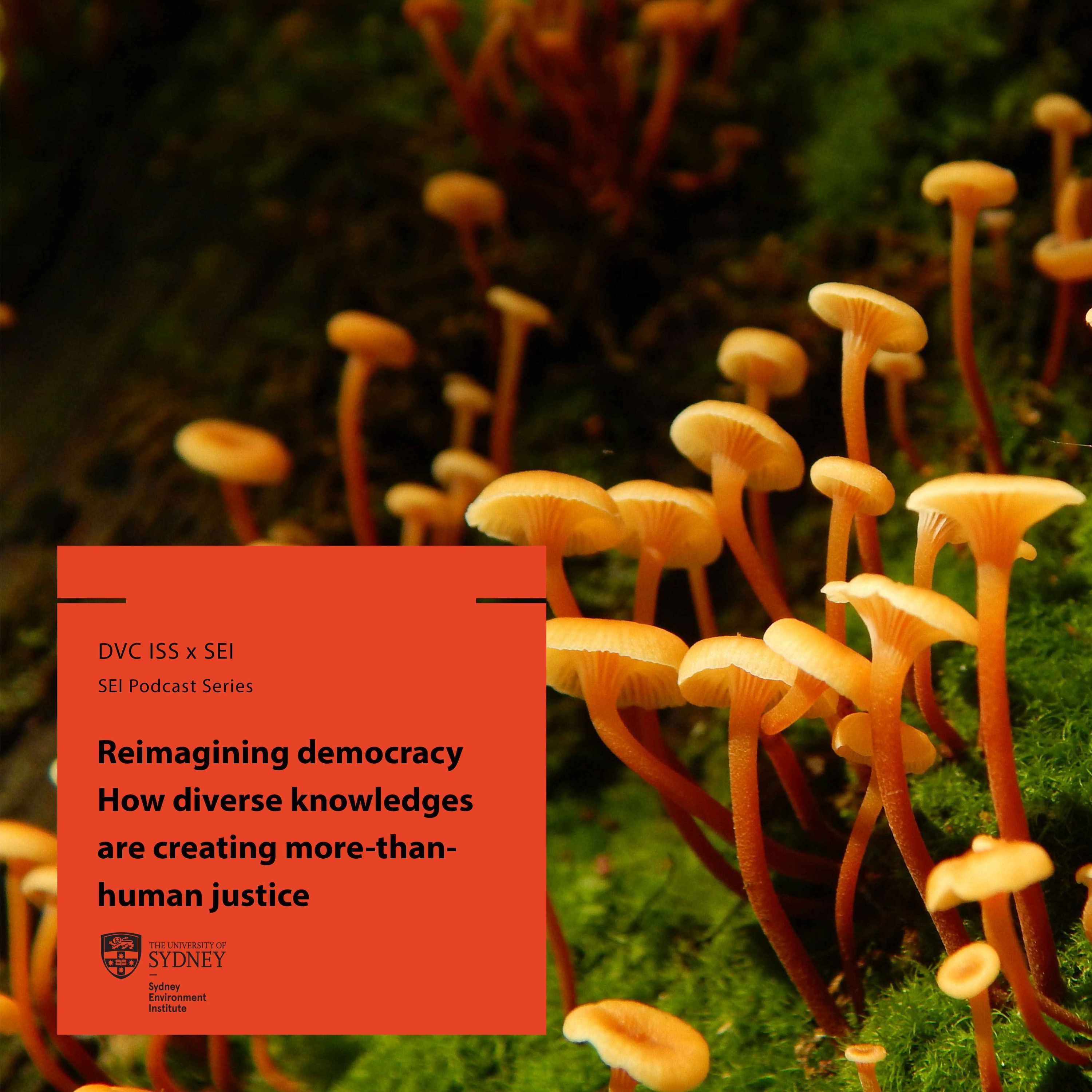
Reimagining democracy: how diverse knowledges are creating more-than-human justice
60m 47s
The transcription features a discussion on reimagining democracy to include Earth beings as subjects of justice. Professor Danny Salamaya introduces the event, highlighting how current decision-making excludes non-human entities despite their massive impacts. Patricia Gwalinga, a Sariaku leader, explains the "living forest" concept: the forest is alive, conscious, and deserving of rights, with beings like Amasanga and Satcharuna maintaining ecological balance. She emphasizes that indigenous struggles are for planetary life, not just territory, and shares how her people won a legal case against Ecuador to protect their land. Nadi Simpson, a Uualaree storyteller, recounts making a possum skin cloak after a century-long hiatus, which led to a possum's return after a song was sung—demonstrating how cultural practices can restore health to land and animals. Paul Powersland, a UK barrister, critiques English common law's ideology that nature is property, exported globally to cause environmental crises. He notes that in Sydney, the Tank Stream was destroyed within 50 years of colonization. He urges non-indigenous people to take responsibility for transforming legal and governance systems, rather than leaving the burden to indigenous peoples. The speakers collectively call for unity, openness to different worldviews, and actions that honor the more-than-human world.
[Music] It's the acknowledgement that the forest is a living being, that it is alive, that it is conscious. I might belong to a profession which has one of the greatest responsibilities for the destruction of nature. And we are country. So language and land and people are the same thing. And it is not up to us to give away these lands for the mining company to exploit. [Music] You're listening to the SEI podcast series, brought to you by the Sydney Environment Institute at the University of Sydney. [Music] As we begin proceedings, I want to commence by acknowledging and paying respects to the traditional owners of the lands on which we meet the Gadigal people of the E-Orenation. It's upon their ancestral lands that we're meeting tonight. And as we share knowledge, teaching, learning, curiosity. Within this space, may we recognise that this has been a site of learning for tens of thousands of years. And may we do honour to that site of learning in our contemporary practices. I want to pay my respects to Elders' past, present and emerging and to all of the indigenous people who are joining us from across the world and from this country tonight. The Sydney Environment Institute for those who are not familiar with us is one of the University of Sydney's multi-disciplinary initiatives. Our MDIs or multi-disciplinary initiatives bring together researchers from across the university network us with a range of external actors to tackle the greatest challenges of our time of which ecological crisis is, of course, perhaps. Perhaps the greatest of all. My name is Professor Danny Salamaya. I'm Deputy Director of the Sydney Environment Institute and I am going to be hosting the Seafnings proceedings. The Seafnings is actually part of a five-day symposium where we have people from all over the world, indigenous peoples, artists, creators, activists, practitioners, scholars, many of whom are the same in one body, who are practicing, thinking about how do we transform our decision-making institutions so that Earth others are taken seriously. We are treated as subjects of justice. The basic principle of democracy is that everybody who is affected by decisions ought to have a say in those decisions and yet despite the fact that the decisions that are being made in our parliaments, in our businesses, in our decision-making bodies are having massive violent effects on rivers, on mountains, on soils, on forests, on other animals. We are systematically excluded from those decision-making procedures. So we have come together to think about how does that transformation happen? How do we learn from indigenous peoples who have practices and protocols? And are continuing to do that as forms of resistance against colonialism and capitalism. Tonight, though, we are coming at this topic from a particular angle, which is one that we have called re-imagining democracy. Now, no one here, you wouldn't be here if you did need to be reminded not only of the scale of the crises that all Earth beings are facing, but the fact that our news feeds are constantly brimming with news of accelerating crisis and of the failure of the solutions that supposedly can get us out of these crises, whether it's the Paris Climate Accords or biodiversity law or net-lippositives, it's very difficult to come to terms with the accelerating scale of the problem and the wholesale failure of those types of institutional solutions to really make any mark on them. And that can leave us feeling not only despondent but bereft. And yet around the world, communities and organisations are taking truly radical actions not only to protect our planet, but to transform how humans relate to the more than human world. And in saying that, I'm not saying that they are doing what the novelist Jennifer Offel calls the obligatory note of hope, but rather prefiguring a world where we humans are in what the great First Nations scholar Karl Powys, why it calls right relations. And how can we prefigure being in the type of right relations that will support healthy and flourishing worlds for everyone who is part of this planet. And by doing so, they are helping us to reimagine what our worlds would look like if all other animals, all humans, all Earth beings, all ecological systems and relations were truly included in the decisions that we collectively make. About how we live together and hopefully they will help everybody here feel more energized and empowered to do that transformative work ourselves because we all are doing it in our own spheres. I could spend the next hour introducing these four really extraordinary speakers Patricia Gwalinga is one of the planet's great defenders of indigenous rights and of the Earth. She's the former foreign affairs leader of the Kikawa people of Sariaku, a community which is located in the Ecuadorian Amazon. And the day before yesterday, Patricia was appointed as the America's representative on the United Nations permanent forum on indigenous issues. A very great honour and a very great gift for the world. You will also hear the voice of Sylvia Martinez, who has throughout this symposium and again tonight been tirelessly translating so that the Spanish speakers can be part of this conversation. So, Patty what I wanted to ask you, I had the privilege of visiting Sariaku territory at the end of last year. And I learnt about Kalsak Saksa, the living forest and the living forest declaration as an expression of the form of life and the understanding of life and the practices of the Sariaku. And I would love it if you could share something of that with the people gathered here tonight. Thank you, Danny and thank you to all of those all of you that are here tonight. As an indigenous woman, I do want to express my honour of the indigenous people of Australia, all of the first nations that welcomed us here and all of the first nations people that are in this place today. In relation to the question, I want to say that there are many indigenous people around the world that are struggling, that are defending the ecosystem and the natural world. And the Sariaku people is one of those people. Many think that we fight, that we carry this struggle out because we don't understand development or that we're only fighting about our territory and ourselves. But the struggle is actually about something that is much greater, that is much more important and sacred. I think that the most sacred and the most profound, the most pure that an indigenous people can have is their knowledge of nature. In a context of a global crisis where there is such separation between humankind and nature, we decided to share the Sariaku proposal of the living forest. Just to summarize what living forest means in a single phrase, it's the acknowledgement that the forest is a living being, that it is alive, that it is conscious, and that it as such, it must be the subject of rights. But the living forest is much more than that as well because it arises from a sacred vision of the relationship with nature. According to our vision, the world is connected through a range of invisible threads which provides the overall connection. Each ecosystem is so important because each part of those threads is connected to the different ecosystems. Our living forest is one of those ecosystems. The Amazon is one of those biomass. In these living spaces, humans are not the only living beings. There are other beings that regenerate, that purify, and that cure nature. These living beings are not spirits, they are mortal beings, and they can have a diversity of names, for example.
The one that imposes the rules of the forest is the chief Amasanga. The one who looks after the animals is the Satcharuna. The one who looks after the rivers and the lakes is the Somi, and we could keep naming them one after the other. When contamination arrives, when extraction of resources is there, these beings can die. And what happens when they die? We get desertification of the earth, and we lose the equilibrium, which is something we are already seeing. This is not. We can't understand this from a rational perspective. We actually have to unlearn those paradigms that we were taught. We have to reconnect with nature, and I would say that we actually have to be reborn within nature to be able to address these issues. And that's why we call it a living forest, because we're not the only inhabitants, and there is much more than what we can see. These living beings are not going to come to conferences, they're not going to give interviews. Their function is to regenerate ecosystems and to once again give life. And for them, we're their siblings. Unfortunately, science has not yet been able to discover these facts. They talk about miscellaneous and the flying rivers, but they are taking a very long time to get to the knowledge that our shamans, that our wise people, have known for a very long time. But I think we're still in time, that we can learn to feel nature, we can learn to understand it, and we can learn to embody that nature, to really be a part of it. And I don't think that this is an illogical way of thinking. As a matter of fact, this is how I grew up. This is how we grew up. Understanding that we are nature, that our bodies return to earth, that our spirit, that our breath comes from the air, that our blood comes from the water, that we are part of nature. My father used to say to us that we were put on this earth, we were given energy to be on this earth, energy from the great lake, from the jaguar, from the eagle. This is all energy that we have to be on this earth as part of nature. When we leave to go to the other side, those energies return to the earth. Unfortunately, this disconnection has led us to be ill. And facing these crises, we have arrived at the conclusion that we must share our vision, that it is time to make our voices heard, even if they are not understood. And that is why we do not accept any extractive activities. We have said no to oil, we have said no to mining, we've said no to roads to bring in downward, to cutting off the trees. We have said no to all of these, because it is all of these activities that have created the issues with nature. We are a people that throughout an oil company that wanted to come and extract from our territory. We put the Ecuadorian state in the dock of the accused. We won that trial, that case, against the Ecuadorian state. We protected our territory, and we want to share our vision. But this struggle that indigenous peoples go through is not just about defending our own people. It is a struggle for the life of the planet. In this time of polarization, it is the time for unity. It is the time for understanding. It is the time to open our mind and to listen to different ways of thinking and different ways of being. Thank you. There are 1100 Sariaku people, and they took Ecuador to the Inter-American Court and won. So I am going to turn now to our own great Nadi Simpson. Nadi is a Uualaree storyteller and performer who lives in Sydney. Nadi is pretty much everything. She is a novelist. She performs with the stiff jins, directs across cultural choir, barriagole. She is also a postdoctoral researcher at the Sydney Conservatory of Music, working on communicating the urgency of the climate catastrophe through music. So Nadi, I am not going to ask you a question. I am just going to kind of give you a few words because you are a poet. When Bill Nakey, the great was demand and storyteller wrote a book, I think in the 80s, it is called Story About Feeling, and he talked about and painted how language comes up from the land. That language is something that is imposed on the land. And so I wanted you to share with us language, land, music. Wow. There are people put out tongue in the ground. So our country holds communication. And we are country. This is a beautiful way to be for me. And I've been listening and thinking hard and connecting ideas in the rooms that I've been in the last couple of days. And I want to just talk very quickly about an example of this because I'm always trying to make sure that I'm not talking about things that I don't do myself. Three years ago, seven women in Latin-English, we decided that we wanted to make a possum skin cloak. We hadn't done that activity, cultural activity in our community for a hundred years. But cloaks made of possum pelts were everywhere throughout our country. When Northwest New South Wales, 11 hours from here, flat, freshwater flood plain, possums used to be everywhere. They were part of the way that we identified ourselves to each other. They were a resource. They were a teacher. They were a provider. They were actually opportunities for great art, these animals. A possum skin cloak was worn when you're cold, hinting, need one now. But also worn by important people with important designs. But doubled, tripled as a musical instrument for women to play, that's why I wanted to reconnect with that instrument that we didn't make anymore because sheep then cotton, then water gone. Water goes, the possums disappear. So we hadn't made that instrument, that hug for a hundred years. Because that animal had retreated from us, understandably so. In light-ingredd, we made a cloak first time in ten years. We sourced the possum from New Zealand. They passed over there. We had to pelts from a New Zealand. And a bummer hangs back to us anyway. We made the cloak. And we sang into the cloak a song that was asking our great creators, Bid and Ulu, and Ganon Bealee, to listen to our song, "Wessing in Well for You," and women hit that cloak so they remember us. And that's the song we made, and we sang it. And we're invited down to Canberra, and we sang it. And we're two family groups. I'm probably the only one who ever held a microphone. So the other ladies were not singers, but we were family. And we sang down there in Canberra. And after that performance, everyone went home. I went back to Sydney, and four of the women went back up to Lightning Reach, and then they said, "Ah." No, they rang me two days after they got home. No, he guess what happened? There was a possum in the tree in town. First time they'd seen one in living memory, possum had come back. In the tree, mind you, out the front of Sillis House, to add sung this song. So what happens then? Some-- a lot of systems that are much more knowledgeable and knowing and wiser than me chose to connect to my want to make music in a way that ran through where I'm from. To remind us of another obligation, sing the song, connect with the creators, bring things into a health.
And that can trigger a return. So I said here is you all are I women thinking I want to sing a song about that and let's go and make that song and let's go because basically getting back to your question. If we sing as you all are people to the land, she sings back tenfold, an area, a choir. That is a beautiful thing to decide to spend your time doing, singing back to the place that allows you to draw breath. That's where I like to leave music in my life as a way to honour and connect and repay. And I'm grateful to that possum for showing me that. Thank you so much, Nadi. Maybe someone can ask Nadi to sing. So Paul, Paul Powersland, the poor guy flew in yesterday all the way from the UK. So we're very grateful for that. Paul is a barrister in the UK. He founded Lawyers for Nature in 2019. And in recent years has really become a leading voice for rights of nature in the UK and more broadly in the global north and the west, I think. Paul's love for the river is not only intellectual but fully embodied. I happen to know that Paul lives on a boat on the river roading in East London and also founded the river roading trust where he works passionately and tirelessly to protect and restore the river. Those poor rivers in the UK need a lot of love. To protect and restore the river and uphold the river's possibility of flourishing again. So Paul, we've heard from Patricia and Nadi some really brilliant and inspiring practices and protocols for recognising, including being in good relationship with the more than human, that indigenous communities have been protecting and practising. Nadi spoke about obligations and responsibilities and about possibilities. So I wanted to ask you as non-indigenous peoples, what are our responsibilities or what are the responsibilities and the possibilities for transforming institutions in ways that pay respect to honour, include the more than human and those intrinsic relations between human and more than humans? Thank you. It's interesting you mentioned the word responsibility because I think in many ways I might belong to a profession which has one of the greatest responsibilities on earth for the destruction of nature and the living planet and that is English lawyer. Why do I say that? England is a country that lost its indigenous presence so long ago that we don't even quite know when it happened and that severing of the people of England from that indigenous knowledge led us to invent a system of law and governance that was entirely expropriating to the natural world and therefore incredibly destructive. And why do I say I have responsibility on a worldwide level? Well, because we have of course exported that ideology around the world and that ideology which we exported, that nature is dead, that nature is a resource, that nature is mere human property to be used for human ends is I believe at the root of almost all of the environmental crises that we see and the destruction which Danny mentioned at the start. And it's very interesting being in these lands because I haven't actually been somewhere where the depositing of that knowledge of that ideology has so directly led to destruction. There is an English barrister or was an English barrister called Blackstone who wrote down commentaries of the common law of England and he wrote that the earth and all things here therein are the common property of mankind by direct gift of the creator. He was the first to really put down that idea that humans own nature as a resource and his book, The Commentaries of England, became the basis of common law which was then spread out around the world. Now I don't know if a copy of his book was on the first fleets that arrived in the bay just a few miles away from us now but I do know that ideology was brought here, that common law ideology of nature being property of humans was brought here and obviously there's not time to talk in detail about the destructiveness that that brought but I can give one example. Whenever I go to a place I like to learn about the rivers and the natural history of that place. So just yesterday when I was to a jet lag getting off the plane I went to try and find the main river in the heart of Sydney and I researched it and I found that it was a river which had a stream that had flowed in that place for tens of thousands of years that had been stewated by the indigenous people of these lands for tens of thousands of years and it directly attracted the colonizers here because they needed a stream to drink so although they originally went to botany bay they came to Sydney cove because that stream was there because in that moment they knew that they were part of nature didn't they, that they needed that fresh water. That stream, the tank stream, what happened to it when it was subject to the ideology of my people that was brought here within 50 years that clear stream had become a sewer so polluted by that ideology and that people that it could no longer be used and now that stream sits underground effectively killed by the ideology, by the ideology that my people brought here. What does that mean in terms of responsibility? I very much believe that we cannot leave the struggle that we have to do to indigenous peoples around the world. They do an incredible job as much as they can to fight the ideology of nature being dead but they cannot do it alone and I do think there is a tendency sometimes in circles to say that because indigenous peoples are so wise because they're doing so much for nature that we in these systems can sit back and leave them to do that work. We cannot. Every single person, even if you're not in a profession as responsible as mine, every single person who belongs to that system, the non-Indigenous systems that have helped to brought such destruction against the natural world also needs to stand up and fight for nature and begin to undo that system. And I believe that we can do that best by taking the inspiration that indigenous people have given us with rights of nature, with the basic idea that they tell us that we are connected to nature, that nature is alive, nature is sacred and that we have an inherent duty as human beings to protect, restore and stew it. We take that idea they've given us and then we put it into all of our systems that we have in non-Indigenous countries and in non-Indigenous systems and that we have a duty to do that. How do we do that? Well, I've only got about another minute and a half to tell you or at least give you a vague idea. At Lawyers for Nature, we've been trying to bring that into our systems as best as possible with something called nature on the board. So we have helped to put a nature director on the board of a company for the first time. Yes, in some ways the company's corporate system is not great, but actually we need I think to start transforming it in line with nature. That's one way. But the most important way and something that is available to every single one of you is to become a guardian of nature. And although I'm a lawyer, I actually think my most important work is not done through the law. My most important work is done on the river that I love, the river roading in East London. I move there with no permission whatsoever from anybody and began to just act as a guardian of the river. And through my actions and through my love for that river to start transforming how my society relates to it. So starting off with the obvious there was rubbish in the river, I removed the rubbish. I began speaking for my river. For instance, there were laws like stopping sewage going into the river that just ignored. So I started imagining what if my river had a guardian, what if I was that guardian? Well, maybe I can just do it anyway and start speaking now for the river. And to protest against the ways that the river is being ignored and the law is not taking the river into account. And crucially, I believe that every single one of us, particularly non-indigenous peoples, have a responsibility, a duty and an ability to step into that role of guardianship. You can right here, right now, decide that you do regard nature as alive, as in some way sacred, as worthy of protection, and as worthy of a voice in our human systems. And then you can just go and do that.
a specific part of nature that speaks to you, that you feel like you could love, connect with that part of nature, and then do whatever you can to speak for that part of nature and peacefully uphold its rights. And in doing so, I fundamentally believe that as many of us as possible start doing that, we will shift and transform that system, the most destructive idea in human history. We can undo it. Thank you. - Thank you so much, Paul. So in my introductory remarks, I used a, you know, it's terrible living in academic. You use these terms that half the people probably don't know what you're talking about. I used the term prefiguration, given that we're about to come to Shrishty. I think the best way for me to describe it is something that Gandhi said, which is be the way that you seek. And I think Paul just gave us a beautiful example of being the way that you seek. So Shrishty Budgepie, our final panelist, is I don't know where to start with Shrishty is, just in my view, one of the great leaders of the world. She's a researcher, writer, activist, her works on interspecies, justice, earthy governance, and a range of systematic transformations. She's also a member of the Global Tapestry of Alternatives, go home and look up the Global Tapestry of Alternatives, if you want some inspiration. So Shrishty, one of the very many things that I have learnt from you is that it just does not make sense to think about or to act on these issues of multi-species justice or more than human governance. If we're not weaving that into our action and our thinking around decolonization, land rights, radical democracy, and also radical economic transformation. So I know that's throwing something very big to you, but I just wondered if you could take some of these very particular threads that we've been talking about and weave them into these. These are the dimensions of radical transformation that you work on. Thanks, Danny, and thanks to a fellow panelist for these important comments that you made, which makes my job much easier. So I'll start with maybe one very inspirational movement and community in India, in East India, where Vedanta, which is the biggest UK's mining company for box height, went there and wanted to offer jobs and possibilities to the community, which is the Dungriakones that live there in the sacred forest. The region is called Niyam Giri. And the Dungriakones responded back to the box height mining company, Vedanta, that we cannot give away our lands, which is our sacred forest, because we don't have the authority to do so. The company was completely confused. State corporations were state and corporations were confused as to why would they say that they are not allowed to give away the land that they own. And the response that the community gave was that because we don't own it, we just live there. And they said, but these are your farm lands, you farm there, you cultivate, and they said, yeah, but we don't own them. We are custodians of those lands. And it is not up to us to give away these lands for the mining company to exploit, because we don't have the authority. It is the Niyam Raja, which is basically the ruler of the forest, who is the spirit of the forest, who decides what happens here. So we are just following the rule of the land. So I would start here with us to think about one that it's just a different way of knowing and understanding of the world that Patricia was so eloquently speaking about, that we don't just not own the land, but we don't even live in the laws that are made by humans. So in a way, it is an epistemic challenge to all of us who are sitting in the room to really begin thinking about what it is to live with the different form of knowledge. So I'll first start with the thread of knowledge democracy itself. In the world that we are living in in today's times, we believe that there's one way of knowing, one way of being, one sort of economy, one sort of organizing. And what we have to shift is that there's so many multiple ways, just the plurie words of alternatives and ways of knowing and being that exist in the world that have been not just erased, but have been violently wiped out. And so this is an acknowledgement of this betrayal that started with our alienation from land and nature and what we did to women and then what we did to people who just didn't fit our vision of the world. And that's what has brought us here where we are talking about to rethink of how to live, whereas so many communities across the world are already living those, those world views like Patrisha's and many others. And so one is about how do we welcome different forms of knowledge? And in many, in much of this is also the struggle for autonomy and self-determination that communities have been articulating across the world over, that when we are talking about including the rest of nature, it is about the assertion of territorial rights, territorial defense, and us being able to follow the rules and the laws that are set by nature, so that we actually follow the rhythms and the moods of natural world. And that is embodied and that is also based on our intuitive ways of knowing and understanding in the world. And that is also connected, so in that sense, it's talking about a different forms of politics and radical democracy. And it is also connected to the ideas of, how do we bring in decolonization in not just a ways of knowing, but also having these conversations? And so it is so connected to the idea of social justice and well-being that while we are talking about these issues, we have to think about what is a positionality and history of why we are sitting in these rooms, what privilege and power we hold of being able to sit here and being able to talk to you all and the voices that might be missing. So it is the awareness of those histories of alienation and subjugation that have created these systems of oppression. And it is also about that beautiful thing that Patricia said that it is, it's not just about protecting the forest, it's protecting a way of life, and that's why it's connected to how we live and organize our lives. So it's about economics, it's about politics, it is about cultural democracy, because we cannot see these in silos, because we have seen these things in silos that we have come to this crisis where we feel that we can solve the world problems. Economy won't be sitting in this room, because it's about ecology. And ecologists won't be sitting in the room where economists are talking about economy, but this separation is so artificial and communities tell us in so many ways that if you're thinking about life, we have to think about all these intersections in much more profound ways that we have ever thought about. And so I'll end just by saying this and asserting this that one of our important leaders in central India said, ask this question, are we really free? And it's a very simple question, but a very provocative question that makes us all think that are we really actually free to decide what happens in our territories? And especially to define and articulate what is development for us, what is well-being for us, because that is being defined by somebody else, a corporation, a state, certain policy makers. And so we are not defining what development is. And many nautical miles away from Vijay Dehthay who said this in one of our gatherings, is nonchalay in South Africa who lives in the wild coast and has been protecting C and C, and its beings and their communities from oil and extraction said that it is the corporations who come here and say that you are poor and so we are giving you jobs. But we are not poor if we are able to feed ourselves and if you're able to live in this land and if you're able to take care of this land and decide for ourselves, how are we poor? You are poor because when you can't feed yourselves and not totally dependent on supermarkets to get your food, then you're not free. So it is this shift of cognition and shift of what we think good life, well-being, rich poor looks like, is when we will also begin to think about more systemic ways that these conversations around more than human justice need to transform. - Thank you. - Beautiful, thank you so much. So we can start on the other end and I'm just gonna ask you all a common question and maybe just a relatively, it's a personal question. So just a kind of relatively short answer to give a chance for people to ask questions. You know, I'm sitting here listening to you all and I'm thinking, actually, Shrishdie was the Prime Minister of India.
Imagine if Patricia was the president of the United States. You know, imagine if Nardi was the Prime Minister of Australia. Imagine if Paul was the Prime Minister of the UK. Imagine what a different world, but they're not right. We've got a bunch of toxic, narcissistic, violent men who are running the world right now. And yet, and yet here you are tirelessly and passionately doing what you're doing. And so I think it would be a gift to everybody here, just to hear a few words about what makes it possible for you to keep on not only imagining, but embedding these possible lives in the present of the way that you live now. What makes that possible? Can be who makes it possible? What, who, how makes it possible for you to do it? What helps you? My professor is sitting here and when I was passing out of the college, I was so cynical and I thought everything is so hopeless in the world. So why am I doing what am I doing? And then I went to this community in central India. They have been going through massive state repression, trying to protect their sacred territories for 30 years and it's the same cycle of protecting police coming in, taking away the activist, constant, constant struggle. And in one, one of the days when they were doing this celebration of, you know, sacred forest and ceremonies, one of their leading activists was picked up by the police. And in the evening, they were all dancing. And to me, that just in makes sense, that why would they be dancing and doing the celebration while one of the leading activists was taken away? And what does this really mean? And they said that for us, the celebration dance singing of life is as important as the struggle for life. And so both needs to happen. We are grieving for the activist who's gone and tomorrow we'll go to the police station and do our protest. But today we also need to celebrate the forest that nurtures us and we need to celebrate the life and dance around it. So I have my hope and I have been nurtured by people and communities I work with who don't give up even in the times of most atrocious violations that are happening of their rights in lives. I guess in some ways the simple answer is that I don't have to imagine. I already am the guardian of the river roading. I already am a river guardian. I act as if it's true and it is true. And so that makes it easier in some ways. Guess as well there is a need. I think this is quite important to combine any activism on a systemic level with actual physical connection and restoration of nature. I think if I was just doing rights of nature activism on a systemic level, trying to protect trees in core or trying to campaign for the rights of nature, I think I'd burn out. But ultimately at the end of it all I go back to my river and I get to see the willow tree that I planted a couple of years ago and see it growing and hear the birds in the trees and know that whatever else happens that I'm in the place that I love and caring for the river that I love. And I think that's quite important. And as well because doing it on a specific level means, and I think that's the reason I do want to reiterate it, that you don't have to wait, you're not waiting on some core or a Prime Minister or a far off government to give you the right answer. You are there creating it right now and that feels really important. Just the final thing I, last year, to try and shift how people perceive rivers in my country, I became the first person, I did jury service and I got called up to give an oath and instead of swearing on the Bible, I asked to swear on my river and became the first person ever to swear on a river as a God effectively in my country. Firstly it was really great, but I'm telling that because any of you can just do that, you can think of all the, how can I make this country? How can I make the people around me think differently and relate differently to nature and you really can just go out and do it. And for me, that is the best antidote to any kind of despair action. If something sings to you, you should sing back. Somebody offers you a melody, you should share that, the way that our mob structured, we got things we need to do and things that, you know, you're expected to do certain things that are for the betterment of everybody. So then if country sings to you, you should sing back. That's why I do it because I'm gifted melody and ideas and means to share beauty from the community and the place and the connections that I'm from. That's a gift, it's such a gift. I want to pass that on to everyone. I want you to feel how beautiful my country is. I want you to hear my language. I want you to travel inside a song I make to a place that is special to you. And I'm lucky that I get to orient myself through the world with my ear. And so what comes in there comes out that way. And that's why I feel compelled to do it because it's sad when a song stays with you. It's much better to share. I think there are many factors, but I think that the most important is the conviction of being on the right path. And I think we have to act with spirit, with the power that gives us that and the spirit might come from the sky, from nature. It sustains us, it maintains us. It provides the balance that we need. My father used to say, "You have to connect to the earth and you have to connect to the sky. You cannot be divided. With those two powers, you will connect to nature and you will be able to go forth." My name is Ozzy. And is it possible that the organizations which represent voiceless people or voiceless creatures can have some proportion of votes to be given to the people who are promoting in the leaders who are contesting the prime minister of the Presidents if they can do it? Thanks for your question. Well, one response is about electoral democracy itself. That because democracy has been reduced to elections and which is why we as citizens also don't feel responsible enough of how do we engage with politics or generally with life on everyday basis. We feel that once in five years or four years when we go give vote, that is our responsibility. Whereas democracy is much more than that. And that's what I think communities across the world are teaching us that democracy is about engaging on everyday basis, everyday life. And it is also about finding a sense of place and understanding that place better. And only when we understand a place and where we belong are ecology and the environment that we live in better, that we realize who is the voiceless in that, which includes the humans and the more than human, which includes women not being able to allow to speak or other caste or other religions that are not allowed to be part of those deliberations. And of course, other beings that don't find the voice in those deliberations. So it is actually grounding yourself in a place and finding that sense of connection to that place that reveals the possibility of understanding what it means to bring the voice of the voiceless and of the marginalized. I hope I answered your question to some extent. Thank you. I'll just quickly add, seeing your songman in the desert was asked to go into Kazum in South Australia to teach the younger people some traditional, how to sing certain types of traditional song. And he walked into the classroom, everyone sitting on a chair, teaching other Aboriginal students. And he said, "Ruddo, on the floor, we do our business on the ground." Only when not birds, we don't sit in trees, we do our business on the ground. And on the point of birds, this old man said, "Humans are the only ones that sing, birds talk." And I think about that. In regards to your question. So to them, we are the voiceless. They've got their, they're talking in their own language. And I like that. I like being put in a different place to where I think I am because it helps me. Thinking more open, generous ways. So oftentimes when I hear birds singing beautiful melodies, musical sound, I think, what are they, Jan and Averne? And we probably all think, I want to cook a bar of guys.
past. Yeah, they're laughing at me. They're talking. They're just, they're, they're, they're making a comment on me. So this idea that birds talk and human seeing is a beautiful way to turn things upside down and start. You're thinking, um, inexpensive and different ways. Thank you so much, Nadia. If I can just add, you know, it's increasingly, there's a recognition that other animals are talking, are communicating. They're not voiceless. But when we've got 30 million fish dying in a river in 2023 in Western New South Wales, that river and those fish are talking pretty damn loud to us. It's not them that are voiceless. It's us who are illus. So I'm just picking up on what Nadia said. Hi, thank you. I'm Natalie from University of Sydney. Thank you to all the speakers. You were also marvelous. Thank you. I actually wanted to pick up on this idea of the voiceless. I was intrigued by the comments around being the guardian of the river. And I wanted to ask, what are the assumptions we need to be careful of when speaking on behalf of the river? What, what do we need to attend to? What might we miss by assuming that the river needs us to speak for it, even though I absolutely recognise where the guardianship is coming from. What sort of precautions do we need to take in doing that? Yeah, I mean, this does come up a bit in rights of nature people saying, you know, who are maybe nature doesn't even want to be a part of your system. How are you to even involve nature in your system? The reality is that particularly in cities and also, frankly, anywhere in the UK, maybe not everywhere in Australia, but everywhere in the UK, nature is subject to and a part of our systems because we have enslaved it and forced it to be so. So we could say, well, who are you to speak for the tank stream? But ultimately the tank stream has been killed, right? So actually, I think we do have a duty to then bring the tank stream into our decision making because we have impinged upon it. So, and I feel that very much on my river, I'd love it if nature could just leave, so if humans could just leave the river roading alone, but they won't. Every single meter of it is impinged upon by humans. And therefore, I think the river has a right to be heard in all of the decisions that affects and impinge upon it. I guess the key thing is who speaks the river and by what right? And I think we're all still figuring that out. I guess I go into the voiceless thing and maybe falling on from what Danny said, nature is speaking to us. It's a question of what we hear. And so for my river, the best way that I found to listen to my river is to spend time with it. And also, you can sort of self teach yourself ecology and rivers just by observation. Nature is speaking to us in that way. And so for my river, I just spent a lot of time with the river and looked, really looked, where does the river look healthy? Where does the river look beautiful and alive? And where does it look ugly and dead? And then do whatever I can to create more situations where the river is alive and healthy than where it looks dead through all different means. So, you know, I noticed that the river looked more alive where it had trees planted, so I planted more trees and just listening to it like that. And that meant that I was able to justify the voice I was listening to, to authorities. So I can go toe-to-toe with the environment agency, which is the government agency for rivers in the UK and justify with logic why I'm doing what I'm doing and why I think that benefits the river just by observation. Being like, well, I observed the fact that where they were concrete edging here, there was no life where there was concrete edging with a tree in front, there is life. Do you disagree with that? And they're like, they can't, right? Because it's there. It's objective. It's right in front of you. So you can learn to read a river, learn the language that it's teaching you. And then that will give you the right, I think, to speak for it. And the ability to justify that speaking within human systems to other humans. Thank you for Sydney Farrowman Institute and the speakers as well for this amazing forum. I learned a lot for you. So I want to know your opinions about billionaires, about billionaires, who, well, we know that they already became the status quo, but eventually they put their partial, partiality on environments and animal welfare. For instance, in India, because I heard that Ambani, the wealthy family in India, they opened very big sanctuary for animals. And also I heard that there is one rich Swedish man that bought such a month of a crescent in Amazon forest of Amazon forest. I don't know whether it's also included in a quarter territory or of not. So I want to know what your opinions about this one particular issue. So I would be very happy if Patricia and Sister will answer my questions about this. Thank you. We actually don't know any billionaires and I assume that they have their own ideas, but I live in a territory that is indigenous territory and my people are indigenous peoples. And our land titles are collective, they're not individual, they cannot be sold, they cannot be traded, they're indivisible, they're inviolable, that is actually established within the constitution. But the extractive companies, the oil companies and the mining companies, they do want to enter our territories. And that's what we did not allow. In thinking about both questions that came out, Ecuador is a country that recognized the rights of nature. Where there are a number of cases, a number of sentences where it is nature that won. Here on the front row is Agustin Grijalva, who was a constitutional judge, a judge in the constitutional court, who drew up one of those sentences where it was nature that won. There is another case in Inter where there were two frogs that were previously unknown that were found. And because of those two frog species being found, there was a case which the frogs won and the oil extraction company was not able to set up in that area. Yeah, they're crazy. These things are happening primarily because of the logic that I was mentioning earlier about, that you can control by experience of being in nature. And you can privatize that property for your own consumption. And it can come at any cost. You can export animals from other countries and bring it to another landscape. And create a sanctuary which has happened in the case that you were mentioning. It's all coming from the same logic that you can privatize the experience of experiencing nature. That it is, you can instrumentalize that experience, you can commercialize that experience. And it comes from this whole logic that you can control nature and you can control the possibilities of how you experience it also on everyday basis. And so if you have money, you can buy animals, you can buy land, you can buy forest. And so there's a danger that's why we were trying to talk about the systemic elements of it as well. Because there's a danger that comes in the time, especially we are living in that when we talk about climate crisis or ecological disruptions, it has become the problem of the rich. And so when it becomes the problem of the rich, there's lot of this idea that we can buy lands for us. We can come up with a lot of these situations where it's for us to protect and that can come at the cost of displacing certain people from those forests because those people must be destroying those forests. And that is what we have to be very careful about. And that's where the whole intersections of colonization, systemic oppression, how certain people have been devoid of their rights, both livelihoods and human rights. We have to be aware about because in certain situations like these, which have also have a long history of how conservation has, um, panned out in whole of the West and then how it also went to the global south where it only became about creating protected areas and sanctuaries and displacing indigenous peoples from their land and making it an experience for the Western travelers to go and spend huge amounts of dollars to experience nature. So we have to be careful of of these systemic ways and that's what we were trying to highlight that there's a lot of economic inequalities, colonization that is under play here, um, that we, yeah, we need to be alerted. Femme, one of the great challenges is to how the reality
of where we are in the world, with all of its contradictions, with the destruction, the violence, the injustice, the suffering, and the beauty, the possibility, the person who has been arrested because they were defending lands and peoples and dancing. And I think we've just had the most extraordinary example of that in this panel tonight. I just ask you to join me in gratitude, not only for their words, but for everything they do in their lives.
Podcast Summary
Key Points:
The forest is a conscious, living being that must be recognized as a subject of rights, as articulated by the Sariaku people's "living forest" concept.
Democracy must be reimagined to include all beings affected by decisions—rivers, mountains, animals, and ecosystems—not just humans.
Indigenous knowledge, such as the Sariaku's connection to nature and Nadi Simpson's possum skin cloak story, shows how language, land, and culture are intertwined and can restore ecological balance.
English common law, which treats nature as property for human exploitation, has been exported globally and is a root cause of environmental destruction.
Non-indigenous peoples have a responsibility to transform institutions and support indigenous-led struggles, rather than leaving the fight solely to indigenous communities.
Summary:
The transcription features a discussion on reimagining democracy to include Earth beings as subjects of justice. Professor Danny Salamaya introduces the event, highlighting how current decision-making excludes non-human entities despite their massive impacts. Patricia Gwalinga, a Sariaku leader, explains the "living forest" concept: the forest is alive, conscious, and deserving of rights, with beings like Amasanga and Satcharuna maintaining ecological balance.
She emphasizes that indigenous struggles are for planetary life, not just territory, and shares how her people won a legal case against Ecuador to protect their land. Nadi Simpson, a Uualaree storyteller, recounts making a possum skin cloak after a century-long hiatus, which led to a possum's return after a song was sung—demonstrating how cultural practices can restore health to land and animals. Paul Powersland, a UK barrister, critiques English common law's ideology that nature is property, exported globally to cause environmental crises.
He notes that in Sydney, the Tank Stream was destroyed within 50 years of colonization. He urges non-indigenous people to take responsibility for transforming legal and governance systems, rather than leaving the burden to indigenous peoples. The speakers collectively call for unity, openness to different worldviews, and actions that honor the more-than-human world.
FAQs
The living forest is the acknowledgment that the forest is a living, conscious being with rights. It is based on a sacred vision of nature where humans are not the only inhabitants, and other beings regenerate and purify ecosystems.
The Sariaku people took the Ecuadorian state to the Inter-American Court and won a trial, successfully protecting their territory from an oil company. They said no to all extractive activities like oil, mining, and roads.
Nadi and seven women made a possum skin cloak after a 100-year gap, singing a song to their creators. After performing, a possum returned to town for the first time in living memory, showing that singing to the land can trigger a return.
Paul argues that non-indigenous peoples, especially from colonizing cultures, must take responsibility for the destructive ideology of nature as property. They should transform institutions to include the more-than-human and not leave the struggle solely to indigenous peoples.
The Tank Stream, which had flowed for tens of thousands of years and was stewarded by indigenous people, became a polluted sewer within 50 years of colonization. It now sits underground, killed by the ideology of nature as human property.
The symposium aims to transform decision-making institutions so that Earth others are treated as subjects of justice. It seeks to learn from indigenous practices to include all beings affected by decisions in democratic processes.
Chat with AI
Loading...
Pro features
Go deeper with this episode
Unlock creator-grade tools that turn any transcript into show notes and subtitle files.
 PodcastTranscript AI