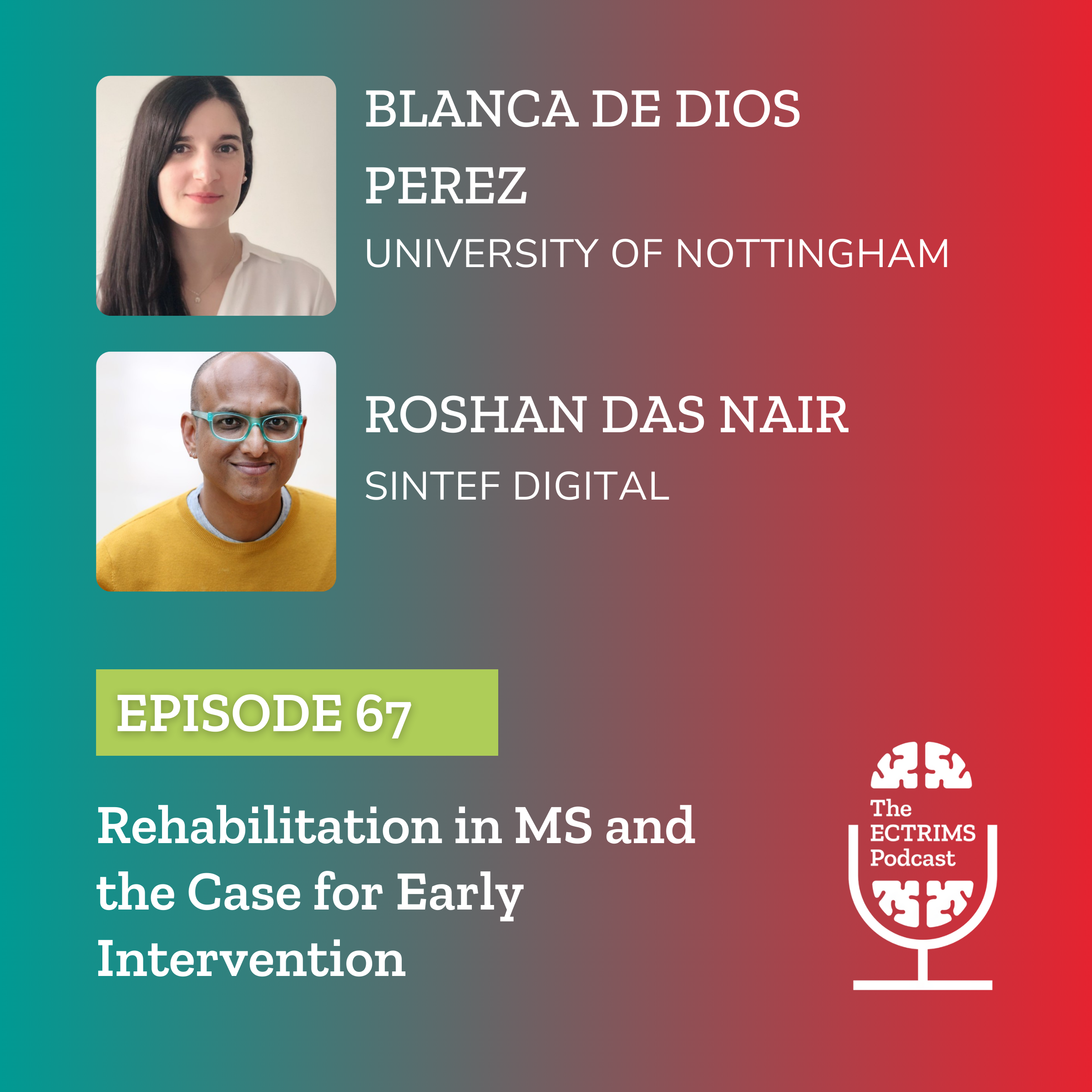
Rehabilitation in MS and the Case for Early Intervention
22m 23s
The discussion emphasizes that rehabilitation for multiple sclerosis (MS) is a comprehensive, personalized approach aimed at enhancing independence, participation, and quality of life. It moves beyond physical exercise to encompass cognitive, vocational, and mental health support. The integration of rehabilitation into MS care from the outset is vital, advocating for a collaborative "community of care" model that includes healthcare professionals, patients, peer networks, and community resources rather than relying on clinical services alone. Key research advancements focus on vocational rehabilitation, holistic management of co-occurring symptoms, and leveraging digital tools for assessment and treatment delivery. However, successfully implementing these evidence-based strategies into routine practice remains a significant hurdle. Overall, rehabilitation is positioned as a fundamental component of MS management, empowering individuals to take an active role in their health and daily living.
[Music] Our rehabilitation is a personalized process of learning and adaptation that empowers individuals with MS to maximize their independence, participation and overall quality of life. We've usually focused on physical activity or managing mood or cognition, but we are acknowledging that actually work is good for health and we need to help people not just to be alive, or moving, but actually participating in society and work is an essential area. From my perspective, my ideal would be we have different people connected to provide support to each other, so it's a community of care. It's not one individual's responsibility to provide care because that is going to be very challenging. So we should be focusing on certain outcomes that have a practical impact on their everyday lives to ensure these interventions are actually targeting what is important for them. Hi, my name is Blanca de Diospereth, and I'm a senior research fellow at the University of Nottingham. Hi, my name is Roshan Dasnir. I'm a professor of clinical psychology and neuropsychology from the University of Nottingham in the UK, and I'm a senior research scientist at Centef in Norway. And I'm Brett Drummond, your listening to the Actrums podcast, the official podcast from the European Committee for Treatment and Research in Multiple Sclerosis. Rehabilitation is a vital but sometimes under-recognised part of MS care. It acts as a bridge between long-term clinical management and the everyday strategies that people with MS can use to stay active, independent and engaged in life. From physiotherapy and occupational therapy to cognitive training and mental health support, rehabilitation helps to medical care into practical action. At Actrums 2025, rehabilitation has been in the spotlight, with the conference being a joint conference with rehabilitation in MS or RIMS. It was an opportunity to highlight innovative approaches and new evidence on how targeted strategies can improve quality of life in people living with MS. While in Barcelona, I sat down with my guests for this episode, Roshan Blanca, to explore how rehabilitation connects the clinic to daily life and how it empowers people living with MS to take an active role in managing their disease. Roshan Blanca, thanks for joining me. Thanks for having us. So as Actrums 2025 was a joint conference with RIMS, some people may not be hugely aware of what RIMS is, so I think as a starting point, can we introduce what that organization is? Sure. RIMS is the international network for best practice and research in multiple sclerosis rehabilitation. We bring together healthcare professionals, researchers, patient organizations from across Europe and now further afield to enhance activity, participation and autonomy for people living with MS. We aim to develop and promote evidence-based rehabilitation that enables people with MS to live full, active and independent lives. And we aim to raise the profile of MS rehabilitation, deepen understanding of its importance at every stage of the condition and encourage strong collaboration between researchers and clinicians. I believe keep our friends to support the collaboration that Roshan spoke about refers as well to the special interest groups in RIMS. So we have established several special interest groups to advance rehabilitation research and practice. We have topics such as mobility, blood, air, bowel and sexuality, mood and cognition, communication and swallowing, occupation and patient autonomy. We tend to develop projects sometimes for each sick or sometimes we collaborate with each other and it's an excellent opportunity to explore rehabilitation from a multi-domain component. I think one of the other things just to delve into quickly and you talked about a few there, but when we were discussing this podcast episode and I said we want to do a podcast on rehabilitation in MS, you both said that's a relatively large field. How are we going to narrow that down? I think a lot of people associate the word rehabilitation with exercise and it's a lot more than that and that's been cleared through the conference. Can you give us an idea of what really the term rehabilitation encompasses? Sure, rehabilitation is a personalized process of learning and adaptation that empowers individuals with MS to maximise their independence, participation and overall quality of life. It's definitely broader than exercise, definitely exercises, one component of rehabilitation, but we have different types of rehabilitation. For example, we have rehabilitation related to symptoms like cognition, being a problem for people with MS, so we have cognitive rehabilitation. But we also have rehabilitation related to function. So for example, for people who struggle with work, they, we have vocational rehabilitation. So as I mentioned at the start, this was a joint conference. Why is it so important that we have joint ectrumes when conferences? Why is it important that we have that embedded in the overall ectrumes program? I think ectrumes is a great conference that focuses in immunology, the simulifying treatments, epidemiology, so it focuses extensively on the treatments and dreams focuses on the rehabilitation process. So having the joint meeting offers an opportunity to attract a broader audience with some presentations on topics that may be of interest. Patient centre topics, so maybe the patients could be quite interested about the areas covered during the room's conference, because it gives us an opportunity to interact what the treatment effect is of these medical areas, the pharmacological area, as well with the rehabilitation process to focus on how can we improve quality of life or mobility or the ability of the person to remain at work. So I think it brings the opportunity to get together to illustrate the relevance of rehabilitation in the field of MS research. It's not just the treatment. It's also helping the person to live better and develop potentially wider collaboration projects between the medical side and the rehabilitation side so that we can move forward to help people with MS live better. Absolutely, and I as rehab champions, we always look for an opportunity to shout out, loud about rehabilitation. We're proud of the work that we do. We see the value of the work that we do as rehabilitation professionals. And I think particularly joining forces with MS, there's so much clinicians, healthcare professionals have to learn about various aspects of MS care. And we want to be there to remind people that rehabilitation should really be front and central for patient care, not just towards the latter parts of people's journeys with MS, but right from the start. So rehabilitation is should not be an afterthought. It should be something that's integrated within personalized care that we have for people with MS. And I think it's interesting to mention that it's patients will be interested in this these sessions as well because I think it really ties in with key things that we constantly hear from people in the MS community, which is we want a way that we can take control of our disease. We're interested, we champion the fact that we want to know more about the disease process, we obviously want more therapies that are going to help us, but what can we be doing now to improve our lives? And it sounds to me like the rims and rehabilitation fits into that perfectly. No, absolutely that is part of our mission statement. We want to develop and promote evidence-based rehabilitation that enables people with MS to live full, active and independent lives. I want to just unpack that slightly because I think evidence-based is a crucial word in them because we see, you know, in the age that we live in where access to information online is so easy. We obviously have a patient population who are very engaged in trying to find out things. There are often things promoted that aren't necessarily evidence-based, so how important is it that I think everyone meets here in a space where also there's, you know, neurologists and healthcare professionals who are going to be having a lot of these appointments to be able to work through it so that they know as well what is the best evidence that's coming out for all of these things and what do we need to, you know, be careful about promoting because the evidence isn't there. No, absolutely. And I think again, this is one of the reasons why being here at Ekrem's Rims is such a fantastic opportunity because it is a safe space. It's a great space where you can present new ideas and new findings from research, but it's also a space where you have your colleagues and your peers who are there to, you know, identify what some of the challenges are and have a discussion. We may not always agree about the way in which we've gone about finding something, but the key thing is that we're able to defend and defend robustly the work that we've done. And it is through that argumentation process that we actually develop and that's how science develops also. And this is a great opportunity for us to do that. So what are some of the new fields of research in the rehabilitation space? Again, there's going to obviously be a lot but interested in the ones that you're particularly focused on at the moment, that are having a large impact in the care of people living with MS. So from my perspective, one of the key areas that is starting to attract a lot of attention is the area of vocation or rehabilitation. So enabling people with illnesses or disabilities to remain or return to work, we've usually focused on physical activity or managing mood or cognition, but we are acknowledging that actually work is good for health and we need to help people not just to be alive and moving but actually participating in society and work is an essential area of another part of our identity and it helps us with our self-esteem. So I think it's quite interesting to see that over the last few years we've seen more studies focusing on how can we help people with multiple sclerosis to remain at work and what can be done and is a complex area of rehabilitation that involves a wide range of stakeholders. So recently we've been seeing a bit more of these research being published. And it is, I mean, it does have so many different impacts, doesn't it? The ability to stay in employment impacts on cognition, which you've already mentioned, you know, reduces social isolation being in an area where, and you know, from a psychological point of view and we know people living with MS again have a lot of mental health challenges. It is a critical area that those strategies can be identified. Absolutely. Just reflecting on some of the sessions that we had as part of RIMS, we've organised a few scientific sessions here at HEPTRIMS. One of the topics we had was around mental health and work psychological well-being. A couple of things to say about that. One is mental health should be considered again an integral aspect of people's care pathways, not just as an afterthought, or not waiting for something for symptoms for mental health problems to emerge, but also proactively thinking about how to prevent some of those things from emerging later. The second aspect, I wanted to highlight was the fact that we've talked a lot about symptom management over the years, but now we're beginning to realise that perhaps, you know, we need to move broader than just symptom management because different people with MS present with multiple symptoms at the same time. So we need to think about the synergistic effects of these symptoms and think of the individual as a whole and figure out, okay, how do these multiple symptoms interact to to prevent an individual from engaging in meaningful activities and how do we approach that from a slightly different angle rather than just focusing on individual symptoms. And the third symposium that we're going to be having as part of the RIMS symposium here at HEPTRIMS relates to digital technologies. And I think that's a new and emerging field that's coming up. Looking at how digital technologies can be used to assess to identify problems as they emerge, but also using digital technologies as a vehicle to provide interventions for some of these problems that people with MS experience. And finally, of course, using digital technologies also as a way to assess the impact or the outcomes of these treatments. Is there anything in that digital technology space that you can see being implemented, sort of as a routine practice in the next year or two or a week further away from these being? I'm really pleased you brought that up because one of the big challenges we've got, and this is not just an rehabilitation, but across healthcare sectors, is implementation. There is a considerable amount of time, effort, funding that's devoted to the development of interventions and the testing of interventions, which is absolutely crucial. But simultaneously, we need to think about, okay, if this intervention is found to be effective, how does it get implemented within our healthcare services or within communities? And unfortunately, that's the part I think that has been lacking for a while. And we're beginning to see changes in that sphere also, for example, one of our keynotes at one of the room sessions, spoke specifically about the need for developing evidence of effectiveness of interventions, but also thinking about implementing some of these. And to come back to your question about whether these have been these digital technologies have been implemented, I can give you a concrete example of some of the work we've been doing in Nottingham. We developed a digital technology to assess cognitive problems for people with MS as part of routine care. So now there are six hospitals in the UK that have implemented this simple technology. People just get a link on their mobile phones. It takes them about 15 minutes to complete. They can do this in their homes. The key thing is that the neurologist or the MS nurse specialist or the treating clinician will have results about the individual's cognitive difficulties when they go in for a routine assessment. The two things about this is that one, it highlights the, you know, the importance of thinking about some of the invisible symptoms and some of these invisible symptoms like fatigue or cognition. Don't often get picked up or don't get discussed. And the second thing is that it gives patients the agency, it empowers them to actually ask about cognition. And once we've identified there is a problem, there's something that can be done about it. I think, as Rochana is saying, the use of technologies to provide rehabilitation is becoming increasingly important. And we see that there is a large number of people in need of rehabilitation, but not necessarily a large number of health care professionals and clinicians with the skills to provide this support. So if we can use digital technologies to screen who is at risk or to identify the key areas where people might need some support, we can use these technologies to try as people in a way that some of them might be able to self-manage through some resources or information. And then others might be referred to the specialist professional occupational therapies or phishing therapies that can provide them more one-to-one rehabilitation for those who have more complex needs. So this is an area that loads of different rehabilitation programs are exploring at the moment. Okay, interesting. Moving, I guess we talked about some digital technologies there and the difficulties with implementation, but if we think more broadly in your ideal world, what does the framework look like in terms of how health professionals work together in the management and clinical care of people living with MS to make sure that these rehabilitation strategies are implemented, what should sort of the process be from diagnosis and throughout care to ensure that the people living with MS are getting the entire holistic treatment that they may need? Gosh, that's a big question. Let me try and unpack that a bit. Yeah, I think one thing I'd like to say is that I don't think this should be the responsibility solely of health care professionals because if we're going to bank on just health care professionals to provide some of these services, we do know that many of our countries we have a crisis in our health care settings. We don't have enough staff. We don't have enough resources to provide it. So if we're going to rely on one job workforce to provide a package of care, then we're going to disappoint a lot of people because what is going to happen is you're going to have a very long waiting list to get some of these services. So we need to start thinking a little broadly about how we provide packages of care for people. The challenge we've got is that something like rehabilitation needs to be highly personalised and highly individualised. So to a certain degree, we would like to co-opt the support of the individual with MS. I know people with MS have got a lot going on but there is good evidence to show if people take control of their own health, we have better outcomes. The second group of people I would like to kind of involve over here is the community, the larger MS community. Again, we've done studies to show that when people engage with the wider MS community, they reap the benefits of it. Not everyone is ready to engage with it but you know if they can and when they want to engage, if they do engage, they do get benefits from it. And also providing as someone with MS providing support, peer mentorship to somebody else, that in itself is beneficial for the person with MS. So that's the second group, the other the community, the MS community. The third group I'd like to bring into the fold is social care and the community. So both formal and informal support from within the community. What I would like to do is I would like training centres, I would like to see Germans being more welcoming of people with disabilities. We need to understand that people are different and people have different needs. So Germans are not just for one particular demographic, they need to be open to accepting people with different types of limitations. And then of course, then we have the healthcare professionals. So from my perspective, my ideal would be we have different people connected to provide support to each other. So it's a community of care, it's not one individual's responsibility to provide care because that is going to be very challenging. And I think as well, the focus should be on what is meaningful for the patients. Sometimes with rehabilitation interventions are complex, they involve multiple components, stakeholders and if we look only on to the clinical outcomes, it can be quite difficult sometimes due to the individual nature of the intervention to see changes in certain outcomes. However, what is meaningful for the patient is it to be able to go on holidays with the family and be able to be physically fit to perform certain activities, is it to be able to travel to work. Well, you both did a fantastic job of answering what was a big difficult question. And I think one of the key messages to come out of that is there's an importance that there is awareness of rehabilitation at every level. And I think that you sharing your insights and your expertise across this podcast will definitely do that. So I thank you both for taking the time out of a really busy meeting to share that with you and to share that with us, I should say, and also in helping making sure that we have the room sessions at the conference this year. Thank you very much. Thank you so much. Thanks everyone for listening. Once again, I'm Brett Drummond, host of this podcast episode and co-founder of MS Translate, an independent resource centre that aims to simplify the complex wealth of information about MS for the greater MS community. The Occurums podcast is produced and hosted in collaboration with two key partners, MS Translate and the MS Journal. Appeared in international journal that focuses on MS, neuromyelitis optica, and other related autoimmune diseases of the central nervous system. The 2024-25 Occurums podcast series is supported by educational grants from Alexian AstraZeneca Rare Disease and Novatus. Educational grant providers have no input in the podcast content. You can read more about the topic of this latest podcast episode and more on the Ektrums website, ektrums.eu. Do subscribe to the Ektrums podcast on your favourite podcast channels and follow Ektrums on X, LinkedIn, Facebook and YouTube.
Podcast Summary
Key Points:
Rehabilitation in MS is a personalized, multi-domain process focused on maximizing independence, participation, and quality of life, extending beyond just physical exercise to include cognition, vocational support, and mental health.
Integrating rehabilitation into MS care from diagnosis is crucial, requiring a collaborative "community of care" involving healthcare professionals, patients, the MS community, and social support systems, rather than relying solely on clinical services.
Emerging research areas include vocational rehabilitation, holistic symptom management, and the use of digital technologies for assessment and intervention, though effective implementation into routine care remains a key challenge.
Evidence-based practice is essential to ensure rehabilitation strategies are effective and to empower patients to actively manage their condition.
Summary:
The discussion emphasizes that rehabilitation for multiple sclerosis (MS) is a comprehensive, personalized approach aimed at enhancing independence, participation, and quality of life. It moves beyond physical exercise to encompass cognitive, vocational, and mental health support. The integration of rehabilitation into MS care from the outset is vital, advocating for a collaborative "community of care" model that includes healthcare professionals, patients, peer networks, and community resources rather than relying on clinical services alone.
Key research advancements focus on vocational rehabilitation, holistic management of co-occurring symptoms, and leveraging digital tools for assessment and treatment delivery. However, successfully implementing these evidence-based strategies into routine practice remains a significant hurdle. Overall, rehabilitation is positioned as a fundamental component of MS management, empowering individuals to take an active role in their health and daily living.
FAQs
RIMS is the international network for best practice and research in multiple sclerosis rehabilitation. Its mission is to develop and promote evidence-based rehabilitation to help people with MS live full, active, and independent lives.
Rehabilitation for MS is a personalized process that includes cognitive rehabilitation, vocational rehabilitation, and support for symptoms like mood and fatigue. It aims to maximize independence, participation, and quality of life.
Vocational rehabilitation helps individuals with MS remain or return to work, which is essential for health, identity, and self-esteem. Work participation reduces social isolation and supports mental well-being.
Digital technologies are used to assess symptoms like cognition remotely, provide interventions, and measure outcomes. They help screen for risks and enable self-management or referrals to specialists.
An ideal framework involves a community of care, including healthcare professionals, the individual with MS, the MS community, and social support. This collaborative approach ensures personalized and sustainable care.
Mental health should be proactively addressed in care pathways to prevent issues and support overall well-being. It is crucial for managing the synergistic effects of multiple symptoms in MS.
Chat with AI
Loading...
Pro features
Go deeper with this episode
Unlock creator-grade tools that turn any transcript into show notes and subtitle files.
 PodcastTranscript AI