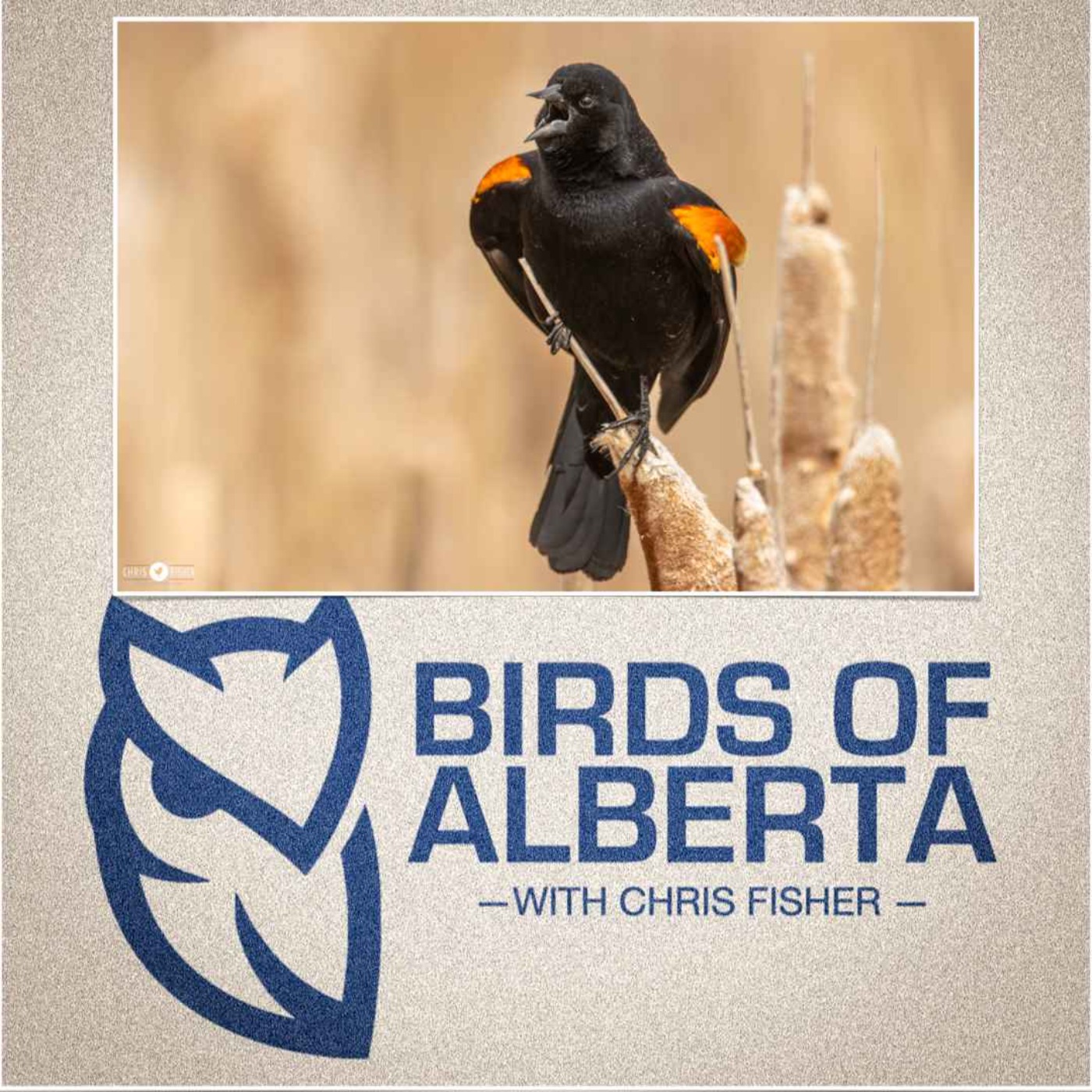
The podcast distinguishes between active bird watchers and casual observers, noting that many birds, like the Red-winged Blackbird, are easily seen in Alberta. This bird is highly recognizable, especially the male with its black feathers and red shoulder patches (epaulets) used for territorial defense. They inhabit wetlands, where females weave watertight nests from cattails and raise young, while males guard the area through vocalizations and displays. The episode clarifies that North American blackbirds belong to the Icteridae family and are unrelated to the European Blackbird (a thrush) mentioned in the Beatles' song, highlighting global naming complexities. Red-winged Blackbirds are polygamous, resilient, and abundant, with populations in the millions, thriving even without special protection due to their hardy and assertive nature, making them a familiar sight for all.
Welcome to the Birds of Albert, a podcast I'm Chris Fisher, co-author of the best selling field guide birds of Alberta. You know when you first come out to the world as a bird watcher you're gonna find out a whole bunch of people. We'll start sharing their encounters with birds with you. Pretty soon you'll notice that the observers of birds tend to fall in two non-overlapping categories. Those who watch birds and those who see birds. Watching birds is often times about detail and effort and it usually involves deliberately going out and looking for them. To observe or meet most of the 300 or so birds of Alberta honestly requires a bit of effort and heading out to undisturbed native habitats such as our wetlands, grasslands, forests and fents. It isn't easy but the effort part of the rewarding process as prior to even going you might have to consult rare bird alerts or e-bird noises friends and social media boards. And for quite challenging birds you might even have to work on listening to their songs well in advance to maximize your chances in the moment when your world of preparedness collides with their world of daily needs. The entirety of that process and the many ways it can positively reinforce someone's life or some of the many reasons that people who get into birds sometimes get a little nuts about bird watching. But there are also people you will meet who see birds. They notice them during their busy days driving a work looking into their backyards or cleaning their cars. There are a lot of birds that pass through Alberta every year hundreds hundreds of millions in fact. So there is always a chance that some will be noticed by someone even if that someone has no interests in nature whatsoever. Now as you might expect most birds that are most easily seen tend to hang out where we hang out and it's not in their nature to conceal themselves from view. In fact they are as self-promotional as the most super-siliest Instagrammer on your timeline. And we certainly also have some birds here that show the good and bad that comes with being conspicuous iguis and perhaps the the very best showcase of this is in one of our most common and one of our most often seen birds of Alberta the Red Winged Blackbird. Red Winged Blackbirds are really one of the most commonly seen birds of Alberta and fairly well known to anyone who has stepped foot outside. Both male and female kind of have an all-purpose body design they don't have overly pointed wings or overly pointed tail. They're about the size of Robin. The females are a little bit more drably plumage they look a little bit like a large version of a streaky sparrow and oftentimes they get overlooked for that very reason. It is the males however that seldom go unnoticed. The male Red Winged Blackbird is extraordinarily distinctive. It is all black and sports very red conspicuous shoulders or epilots as they are sometime referred to. The fancy name epilot is in reference to an ornamental shoulder piece that we typically see on military coats or jackets. So think of a central American dictator with those prominent gold shoulders and you got a pretty good idea of the purpose and the function of the shoulders of a male Red Winged Blackbird. Both male and female Red Winged Blackbirds have a very similar bill. It is pointy but not too pointy. It's really nature's multi-tool. It's more than capable of cracking sunflower seeds that they find stopping in your backyard bird feeder but it's also just pointy enough to probe deeply into the cat tailheads to get out the insect larvae that they so value particularly in early spring. All told, science tells us there's at least 22 different subspecies of Red Winged Blackbirds in North America that is not unusual for a species that is so wide ranging across the entire continent but truth be told no one really knows the specific details of difference between those 22 subspecies of Red Winged Blackbirds. They all tend to look very similar indeed. Two known surprise First Nations people who would have been very familiar with Red Winged Blackbirds called them the bird with the very red shoulder. Some First Nation languages would have a name 26 letters long the Miss Condini Magane Shehin which is an absolute mouthful the super caliphad realistic expi alla dosha's name of the bird world. So while Red Winged Blackbirds are sometimes encountered in in backyards and agricultural fields particularly early in the spring and late in the fall migrants they are one of our earliest and latest migrants as early as mid April and then some will hang around certainly well into October and sometimes even to November before they leave to the south but they're most commonly associated with Alberta's slews our classic wetlands of the Prairie Pothole region but certainly they occur well throughout the province even well into the Northern Boreal Forest regions. But it is really in those classic wetland slews that Alberta is so well known that Red Winged Blackbirds are just so conspicuous and so at home and that's of course where they nest everyone and every bird and and every coyote knows that that is where they are nesting indeed so because their habitat of choice while wet does not really provide much other protection other strategies are employed to protect the nest and the eggs and the fledglings when they are at their most vulnerable. The nest is really quite an incredible device it's it's made by weaving really nothing but cat tails together you know cat tails are the entire world for Red Winged Blackbirds when they are in Alberta and the nest is principally made by the female and we do have a hard time seeing them in the summertime but if you should go for a walk over a frozen wetland in the middle of winter when the cat tail marshes are much more accessible you do find them standing tall in and among the cat tail stands at that time of year. What you'll find in the nest is an incredibly woven structure and it is in fact watertight and because it's made with not only the reads of these cat tails but some of the down soft down as well that these watertight nests are very snug and cozy and comfortable and in fact they they truly look like a work of roadside folk art. So with the nest well hidden or as hidden as it can possibly be in a cat tail marsh the rest of the breeding strategy of Red Winged Blackbirds depends on quite frankly a polygamous breeding strategy which means that one male Red Winged Blackbird would likely breed well with up to 15 in many cases females so the males really do tend to like to play the field in a sense but really it's the female well their play is not for the field it's it's actually for the marsh itself they choose the best possible habitat and and quite frankly default to whatever male is busy flashing and fighting over that particular bit of real estate. So while the female Red Winged Blackbirds are busy incubating the eggs in their little cantaloupe shaped nest tucked away in the cat tails the the males are particularly vocal and visual in their defense of the wetland marsh that they are claiming not only against other rival males which are busy doing the same thing but any potential threat that might walk through the cat tails or fly overhead or quite frankly walk on by or drive on by the local area. These males are really Alberta's best mercenary defense contractor that we have and they're their biggest weapon for their defenses is really their attitude they're quite pugnacious they're always quite vocal their song or what amounts to a song is used to intimidate other males by keeping them away from their prize little patch but so too is an ultra aggressive mindset and those epilots that we mentioned earlier
The epilots, the red shoulders in particular, is referred to red agnostic signaling, which really is just a fancy way of saying that that red is like a red light, meaning stop, don't go there. I'm tough and you're not, and stay the heck away. And so this behavior, whether it's its visual intimidation or the near continuous conch, or re-songs that we hear echoing across our marshes, really one of the most diagnostic wildlife voices that we have in Alberta, this just keeps the males ultra busy and that is why they're, their sole contribution to the reproductive cycle is protecting the territory so that the females can take really all the parenting duties from incubation to feeding the young and seeing that they successfully fledge. Now even though our red winged lockbirds are really quite popular there, they're nowhere near as popular as the beetles and the beetles. Road a very famous song that appeared on their white album way back when entitled Blackbirds. And the classic opening line, Blackbirds singing in the dead of night, is one of the most popular lines ever written about birds by anyone at any time for any bird, but because it is so universally well known, the song has not only delighted, it has also confused many. You see in Blackbird, Paul McCartney was writing and singing about the European Blackbird, not our North American Blackbirds. See the European Blackbird of the song is actually a thrush and has a lovely voice that would be so very nice to hear in the dead of night. Unlike the not so lovely voices of our Blackbirds which are not thrushes, their voices would give anyone nightmares if they were heard in the dead of night. So our North American Blackbirds are in the family Icteridae and they typically do not have nice vocals like the thrushes do. And while the red winged Blackbirds voices kind of tolerable to the ear, that of the yellow headed and the rusty Blackbirds and the crackles, well, their voices are downright grating. So don't think of our Blackbirds like their Blackbirds, but think of the European Blackbird from the song as our American Robin. They are both closely related and look and act an awful lot alike. Got it? Okay, but we aren't done just yet. Hold on to your phones, folks. So Europe also has a Robin and that European Robin is after which our North American Robin is named. But yeah, you guessed it, these two Robins are not even closely related in spite of their look alike red breasts. As their Robin is not a thrush, which as you will remember ours is a thrush. Their Robin is a kind of chat, which is a type of old world fly catcher. And you know where this is going. Don't you? Yes, we also have a yellow-breasted chat in Alberta, but it is of course not at all related to their Robin, which is a chat. So our chat is not related to their chat, but in fact our chat now has been recently placed in the family Iqtaridae. Iqtaridae? Now, now wait a minute now. Didn't we hear that word already? Yes, yes we have. Blackbirds, our North American Blackbirds. Not their Blackbirds mind you. Only our Blackbirds are in the family Iqtaridae. So what you are probably hearing is that our chats are members of our Blackbirds because they both belong to the family Iqtaridae. Right? Well, not quite. You see, while our Blackbirds are in the family Iqtaridae, spelled with two eyes, one at the start and one in the middle of that name, and chats are also members of the family Iqtaridae, but spelled with three eyes, one at the start and two in the middle of that name. Yeah, yeah, yeah, that's right. There are two bird families with the same name Iqtaridae, but spelled differently. But here's finally some good news. Taxonomists showed some rare good judgment in having the family Iqtaridae and the family Iqtaridae as each other's closest relatives. So in conclusion and, and please hear me out on this, our Blackbirds are not related to the European Blackbirds, which are thrushes, like our Robin, but their Robins are not thrushes, they are chats. But their chats are not related to our chat, which is more closely related to our Blackbirds, which of course are not closely related to their Blackbirds, which were the birds made famous by the Beatles. And so we just painfully established that there are multiple birds with the name Blackbird that aren't even related. But perhaps even more interesting and hopefully much less confusing is that there are also birds in Africa that are all Black, sport red epilots, and are also highly vocal and highly territorial. You know, when I was recently in Tanzania, I was struck at how similar the fan-tailed widowbirds are to our Redwing Blackbirds. They are really one of nature's best doppelgangers, even though they diverge genetically over 50 million years ago. But their similar habitats seems to have influenced their convergent evolution, and it isn't by accident. Both species hang out in pretty similar type of areas. You can see either widowbirds or Redwing Blackbirds, breeding and courting and fighting, over tall grasses, reeds, and cat tails, and otherwise very, very open environments. And these habitats have clearly influenced the appearance and behavior of these birds, as both species are polygamous, and sexually dimorphic, with the males appearing very gaudy with all Black plumage and red epilots, and the females being very cryptic indeed. Even if you could never make it to Africa and visit the birds there, now when you go to look out at the Redwing Blackbirds in Newall County, you might as well be looking out at the widelbirds of the Nungorogoro Crater. In Alberta, the Redwing Blackbird is really an important bird since it gets noticed by those who really don't notice birds most of the time. So many times upon hearing of my interests, I've had people come up to me and ask, "Hey, Chris, what's the name of that Blackbird with red on its wings?" Well, at least I can offer to them a name that makes sense and a name that they just might remember for a while. The Redwing Blackbird is also important because unlike so many other species, it really isn't highly negatively impacted by most of what we do. In fact, with their unruliness, they almost seem to show a flagrant level of disrespect towards us. That among birds is unusual and eye for one. Well, I admire their pluck and presence. So even though they're not even a protected species like most of our other birds by legislation, provincial or federal, they boast huge numbers. Something like 180 million in their North American population and more than 30 million here in Canada. Now, part of that reason no doubt is that Redwing Blackbirds are anything but delicate. They seem to refuse to let anything or anyone slow them down. And, inappropriately, their distinctive worldview might best be wrapped up in the rural Canadian slang expression of giver. See, Redwing Blackbirds are, to me, the giver bird. Anastahawk flies by their territory. Just giver. Like musical talent, but you need to defend this marsh? Just giver. Make a nest with nothing but cat tails? Just giver. Occupy every last slew in Alberta? Just giver.
Although I think we just got a giver to the Red Wing Blackbirds and given their due, they are certainly among the most common birds we have and they sure know how to put on a show for everyone to enjoy whether they're watching birds or seeing them new for the very first time. There's just no doubt that the Red Wing Blackbird does interesting things with an interesting look and with an interesting voice that just might get many more of us to develop an interest in the birds of Alberta.
Podcast Summary
Key Points:
Bird observers fall into two categories
The Red-winged Blackbird is a common, conspicuous bird in Alberta, known for the male's distinctive black plumage and red epaulets, which serve as aggressive territorial signals.
Red-winged Blackbirds are polygamous, with females building intricate, watertight nests in cattail marshes and handling all parenting duties, while males defend the territory.
There is taxonomic confusion
Despite not being legally protected, Red-winged Blackbirds thrive in large numbers across North America due to their adaptability, resilience, and assertive behavior.
Summary:
The podcast distinguishes between active bird watchers and casual observers, noting that many birds, like the Red-winged Blackbird, are easily seen in Alberta. This bird is highly recognizable, especially the male with its black feathers and red shoulder patches (epaulets) used for territorial defense. They inhabit wetlands, where females weave watertight nests from cattails and raise young, while males guard the area through vocalizations and displays.
The episode clarifies that North American blackbirds belong to the Icteridae family and are unrelated to the European Blackbird (a thrush) mentioned in the Beatles' song, highlighting global naming complexities. Red-winged Blackbirds are polygamous, resilient, and abundant, with populations in the millions, thriving even without special protection due to their hardy and assertive nature, making them a familiar sight for all.
FAQs
Watching birds involves deliberate effort and detail, often requiring planning and going to specific habitats. Seeing birds is noticing them incidentally during daily activities without active pursuit.
Male Red-winged Blackbirds are all black with conspicuous red shoulders (epaulets), which serve as a visual warning to rivals. They are highly vocal and territorial, especially during breeding season.
They are most commonly associated with Alberta's wetlands, particularly in the Prairie Pothole region, but can be found throughout the province, including boreal forests.
Females weave nests from cattails, creating a watertight, snug structure that is well-hidden in marshes. These nests resemble roadside folk art and provide protection for eggs and fledglings.
They follow a polygamous breeding strategy, where one male may breed with up to 15 females. Males defend territory aggressively, while females handle nesting and parenting duties.
No, Red-winged Blackbirds are not related to the European Blackbird from the Beatles' song. The European Blackbird is a thrush, while North American blackbirds belong to the family Icteridae.
Chat with AI
Loading...
Pro features
Go deeper with this episode
Unlock creator-grade tools that turn any transcript into show notes and subtitle files.
 PodcastTranscript AI