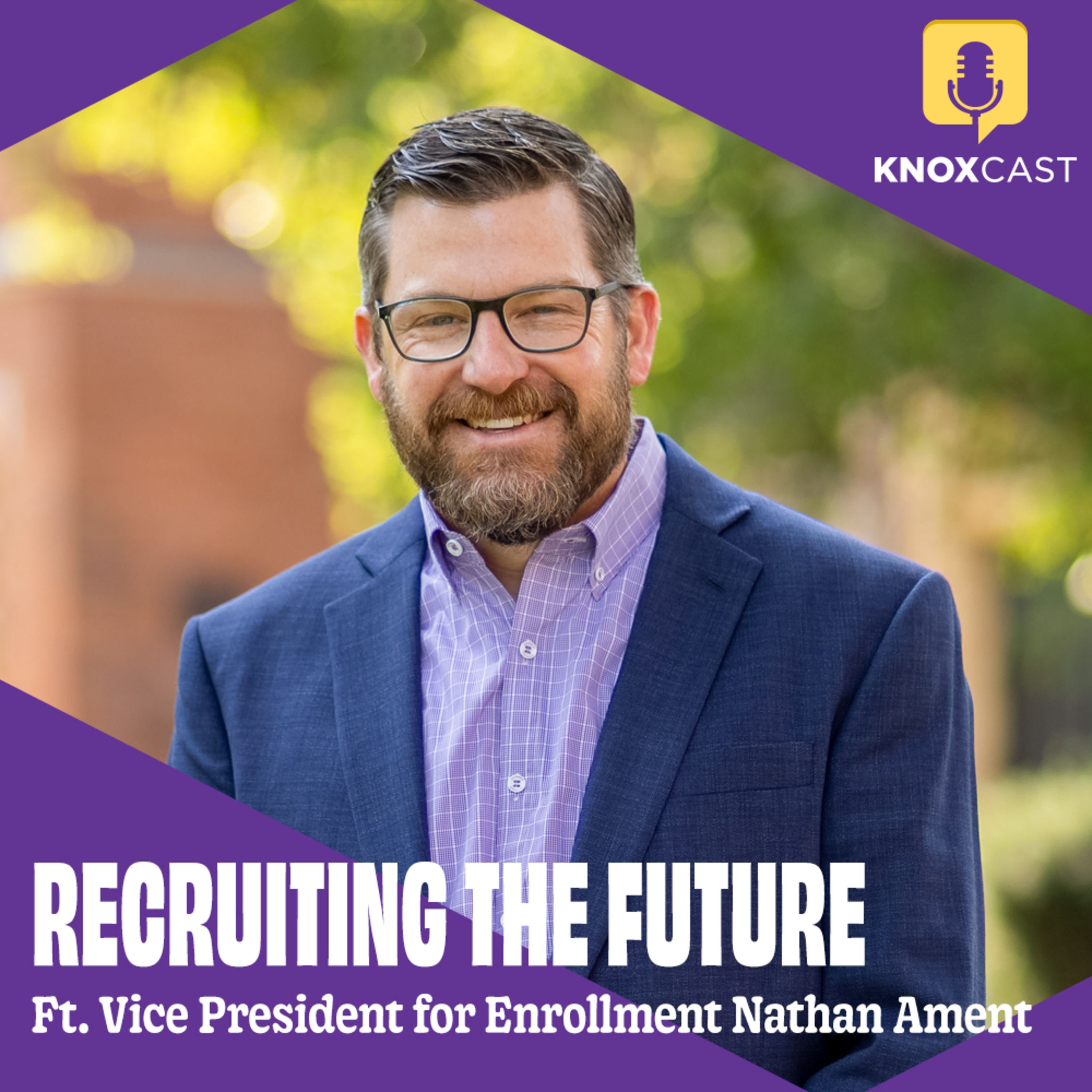
[music] Welcome to the KnoxCast for ReTalk to the community about all things Knox. My name is Mitch Prennes, and today we have the privilege of speaking with Vice President for Enrollment at Knox College, Nathan Ament. In his role, he led Knox's recruitment efforts, which resulted in this year's incoming class of 2028 to stand as the college's third-largest class of new students in its history. He talked to us about how Knox has continued to attract new students, and the quirks of showing off our amazing campus to the world. [music] Nathan Ament, how are you doing? I'm doing well, Mitch. How are you? Doing good. It's a beautiful day here in August, and I think we got some heat coming around the corner, which I'm not thrilled about because August is one of those months where I always look forward to it, thinking that falls around the corner, and then you get these 90-degree weeks, and you're like, "It's like lying to you." But you know that. That is like one thing that I was shocked by when we first met early on, was that you grew up really close to me, or at least I don't know if you grew up in Yorkville, but you are from Yorkville, right? So you grew up-- A generation Mitch family farmer grew up on a met road, if you can believe that. So-- Really? I didn't know that. Yeah, just out the Orsanoi. Is that Illinois? I would have guessed that's not just a coincidence. That must be a family name road there. Oh yeah, it was named after ours. That's where I grew up. And so we were the first farm there on the road, and so they named it after the immense. But like it goes-- That's cool. I mean, if you-- we don't have enough time on this podcast to talk about all this, but we were the first marriage in Kendall County, Illinois, and then had to flee the farm for the Black Hawk War. Really? Yeah, at one point. So like our family goes super far back into that area of the state. And probably there was some immense out in your area, like in Sanwich and things like that, but yeah, that's where it was. Just south on Route 47, he takes straight out of your Illinois. It-- a met road right there. That's all-- I'm going to have to make a trip there sometime because my sister lives up in a Samanak. And yeah, Yorkville was always considered like big city for where I grew up. Like it was-- I love that. Is it considered a suburb? Would it be considered a suburb? I think it's like the far western edge. I kind of like sugar grove probably would be right there, but it definitely is now with the housing and all the subdivisions and things. Yeah, yeah. That was like, okay, when you get up into Yorkville, it's like an hour in shopping. Like we have stores up here. It's pretty cool. But I was-- I-- from the moment I found that out about you, I was like, I think this guy is going to truly get knocks. Because, you know, not-- you know, Galesburg is, to me, always a big city, but for a lot of people who come here is definitely smaller than what they're used to if they come from Chicago or from Indianapolis or whatever. And I think you are perfectly qualified to understand the surrounding area and the type of people who are attracted to this college. Before we get too far into specifics, I wanted to give you a second just to kind of give some background on what you do. I should have mentioned you are the vice president for enrollment here at Knox. And we have a really exciting class coming in in just a few weeks. Can't believe it. But yeah, if I-- just give you a couple minutes here, go through your history. Like how did you get to where you are today? Sure. Yeah, and I appreciate being able to join the Knox cast. So as a fellow podcaster myself, Mitch, this is kind of weird to be on this side of the mic, if you will. But yeah, excited to be here going into month, whatever, like 14, I think, of being here at Knox. I came in June of 23. I've had a long career in enrollment management. This is the seventh institution I've been a part of, started my career at Augustana College, which is my alma mater. So just up the road here in the Quad Cities, fell into college admissions counseling though. Didn't you don't go to school for admissions counseling? So I started out as a music education major at Augustana College. I started out thought I'd be a high school band director. Did that for a year. Didn't really like it at much. And just took a job in the admissions office at Augustana because of friend of mine said somebody quit. And it was this time of year, it was August, and they're trying to put people in the road. And I said, I'll do that for a year while I look for a band director job. And now 24 years later, here we are. So yeah, most of my experience has been at small private liberal arts schools in the Upper Midwest. The one institution where I was at Lawrence University of the Napolitano Wisconsin did combine my college admissions experience also with my music background because I was a director of admissions for the music conservatory. So that was pretty cool. But I came to Knox from what I call what we call our southern sabbatical. So I'm just down in Louisiana for five years at Loyola University, New Orleans was also the vice president for enrollment down there. But yeah, we were looking to come back. Our family is still primarily up here in the Midwest. My boys are in high school. Now I do have one that's going to be a freshman at Lawrence University here in a couple of weeks. But they both said they wanted to go to school in the Midwest, want to be back here. We were kind of done with the heat and humidity, although you asked my wife in January, you might get a different story. Yeah, I mean, and again, Galesburg, Western Illinois has an extended family that lives in like good hope just south of here. Oh, that's a small town. Yeah, so kind of knew that this area was special. I actually thought because my dad graduated from Western, I thought that he had term coined the term for gottonia. And then I discovered that it actually was a real thing. And now it's coming back with that. Yeah, with that for gottonia times. But, you know, we like it out here and had always specific to Knox. Just always had a great reputation, right? The Knox was just this place where kids were just really, really smart. And that's the word smart just kept coming up. The word small kept coming up as well, especially when I was recruiting against Knox. But then this opportunity came along to follow somebody who had been here for a really, really long time. And that is always a little daunting. But, you know, I met this new president, I mean, we can't need. Really, we kind of hit it off. And that's really important. I've been in higher ed and enrollment management enough to, if you don't have a supportive president. And then subsequently a supportive board that is behind that president. It's not even worth entertaining. So I knew pretty quickly when I was chatting with Andy, chatting with the search committee. And then some of the board members that there was a commitment here to push Knox into this next frontier. Which is scary. I mean, it's really scary with the demographic slide coming up. And all the things that we have, but Knox's reputation has always been there and always been out there. But it's just a matter of kind of modernizing things a little bit. Yeah, that point of modernizing. And as a former student myself who was here during a different presidential administration, there's definitely a different feeling to what's going on on campus right now. Whether it's just from branding to just the approach of different events on campus or the way that admissions is reaching out to prospective students, it does kind of feel like a new era of Knox a little bit. What about that for your job? Like when you look at how you approach students who are interested in coming to a liberal arts space? What about that is like the biggest benefit for you that the college is hitting this moderate like visual and you know, just reset button a little bit. I mean, a number of things the branding is something that is probably visually the most stunning and was completely different. I've been joking around a little bit and it's kind of like the save by the bell marketing. And then it's in your face. It's very, it's got a heavy, heavy nod to 80s to the 80s. Kind of like the old MTV logo a little bit, the original one, but I was skeptical because I wasn't part of designing that. I was kind of handed that when I first saw it, but then as we produced some materials and put it out there and saw it kind of in the wild. Yeah. Yeah. Yeah. Yeah. Yeah. Yeah. With high school students, the story that I love the most is somebody was at a college fair, one of our new, we have a regional counselor now down in St. Louis. And he said that somebody kind of eyed the college fair table and then looped all the way back around the high school gym and came back and grabbed the marketing materials because they're like, this is cool. Like this looks totally different than any of the stuff that we're seeing at all these other hundreds of tables. Yeah. And we're coming back for it. So we've leaned into that. But we're also just trying to meet students where they are. And be specific about talking to the students and making sure that they understand what we have to offer and seeing if it's a good fit. And if it's not, that's cool. We can still be friends, but we need to make sure that, you know,
they have all the information in front of them. But we're trying to do that in different ways. We're also just trying to do things very, very quickly. Small part of the LBAR, it's colleges have always been kind of hold themselves up as this super prestigious and like, you know, this ivory tower a little bit. And slowly, I would say over the last 10, 15, 20 years, that's broken down. There are so many schools where there's plenty of opportunities. There's plenty of spots available for students to come in. And, you know, they really, it's just a matter of it's going to be the fit or not. But the student is trying to figure out that quickly. They're trying to, they need to have a decision quickly. They don't want to wait months for an admissions decision. But then they're also worried about affordability. And that's something that we had such strong board of trustees support on this year was going in and saying, "Listen, we have to put more money out there. We have to make the scholarships competitive." And they just weren't within the marketplace. We partnered with a new firm called EAV, not a new firm to hire Ed, but a new firm to Knox. And they're basically the Cadillac of the industry. And they did a complete ridiculous analysis of the past couple of years worth of data and was able to say like, "No, you need to bring, you need to put the scholarships at this amount and it will get you this many students." And now we've overshot it a little bit with the amount of students because it's worked that well. What is that, what is the exact number coming into this next year of the new student? We are recording this. I can probably, I don't think we're any, and their auspices, this is live, right Mitch? So, I mean, we're recording this August 22nd. I'm a numbers guy, so I like the call fund of that. Always. As of right now, I'm looking at 413 first-year deposits in that comparison to 257 at this time last year. Which is 61% increase. And that's incredible. And I, you know, looking at that number, and for anybody who's not familiar with what we were referencing with the visual changes, you know, you might see on social media channels or on any physical prints that there's like some additional colorways kind of added to some of our prints, some like pink corals, some like lighter shades of purple. You may have seen that. So, if you've seen any of that out in the wild, that is what we're referencing here. But I'm also curious like as somebody who has just come to the college within the last year, I'm sure that when you first stepped onto this campus, there was, you know, a lot of students that you talk to who come here for the first time, talk about that first moment where they see Old Main or where they see the Gizmo and, you know, students in there interacting with one another or just the general kind of like small vibe of the college, right? It's very homey. It's very like there's a lot of history around here, right? When you first came here and and and Saul Knox and maybe who had seen it in the past, but like as a soon to be member like in last May, last June, was there something that immediately stuck out to you like, okay, like I get it? I think it's interesting that you use the word homey because that's really what it was and I again, my I was a sitting vice president at urban school in a very southern city that is historic, right? Like New Orleans is very, very historic, but it was in a city and so I would say my first impression of this campus was that it was small and homey and kind of comfy in a way that was awesome. Like it was so cool to see a residential like and that's who that two Knox has been for years, for decades of like small residential and focused on community. I was here in April of 23, which was one of those times where we had an April snow storm. It was like eight degrees two days before and then it was like snowing, right? Yeah, of course. And when I came for my interview, we'd actually just done a tour with my own family of all these other colleges. So I had just been on five other colleges in the upper Midwest and so I really had that experience and it just felt like people knew each other. You know, yeah, we don't have a big gigantic beautiful cafeteria that's two stories tall with the waterfall, right? You know, and all this other stuff that may be a nod to my own mother, but it really, it really just felt like these students are here and they're interacting with each other and there's nowhere to hide and you could see how they really got to know each other. But then the other thing and this is one of the pillars of our success this year with the international student number basically tripling. Even last year when I was here for my interview, just seeing that diversity and seeing the international student, seeing the flags, right, of all the countries that are represented. I'd known that a little bit about Knox that it was an international school, but didn't really understand how one, how deep it was and then to how it was possible. And that's been fascinating to me is like, oh, it's because of the train. Yeah, the train's kind of a big part of it, right? You can't really escape it. You can, but it's like, oh, it's really easy for a student to get here and I had a tour guy that I had lunch with during my interview and she was from like Shanghai or something and she or Singapore, excuse me. And she said, yeah, it takes me only 26 hours to get home. Holy cow. 26 hours. Like that's crazy. And she's like, no, it's not that big a deal. I just, I walked down the street, jumped on the Amtrak, I go down to Union Station, I jump on the blue line, I go to O'Hare, I fly to San Francisco, and then I fly to Singapore. Wow, that's for Galesburg, right? Yeah. To like come here and be like, you have a commitment to this institution. There must be something special about this college that you're willing to only quote unquote, travel 26 hours for home to be here. So when you, you know, got done with those initial tours and you kind of had those feelings in mind, and now you're looking a year later, right? You've had success bringing this gigantic class to campus over 400 students. When you when you were developing your plans on like, okay, this is how I want to sell noxious, how I want to bring students here. Did you feel like there was sort of this like natural advantage since you yourself kind of felt that sort of like draw just from stepping onto campus yourself, like showcasing that to new students doing tours or whatever. Does that kind of feel like, okay, we got that in the bag at least, you know? I mean, we get in the bag enough, I would say, but we're also always trying to improve and optimize. That's been my mantra for my entire career, but I've certainly turned institutions around like a couple of my especially my last couple ones we had pretty immediate success. But I would say here for sure, yes. Most institutions, I've heard this pretty much every interview I've been on, right? And it's board of trustee members or it's alumni or it's even faculty that will say, if we just told more students about it or if they just got here, they would understand that, like that would sell the place. We're like, every college says that, right? Like every college, how do you differentiate yourself? But I really did feel, but looking at from my lens of like what needs to happen in 2023 or 2024 to get in front of students and to get noticed and to cut through the clutter, Knox was not doing, right? Doing a couple of things, something that we weren't doing anything here, but we weren't taking it to the next level and say like, no, we need to be aggressive, we need to be out there, no, we need to purchase more names or we need to be in these strategic areas and analyze this data. Or we need to get an admissions decision out in less than two weeks. We should not waste three months to do that. Or we should know all the things that we did this year was send out the Knox box. We were like, is the Knox wanting to bring that up? The Knox box has been a big hit. Huge hit. And then I didn't even think about it. It's just like, yeah, I built it into the budget and I said, we're going to send it to international students and everybody was like, wait, what? They're like, we'll be, yeah, like they come, right? And they pay tuition and whatever else. So we started sending Knox boxes overseas and whatever else. And it just was this incredible reaction of like, oh my gosh, this college really does care about me. And there's some really cool things here. And just to interject there on the Knox box for people who may have never seen one, it is a purple box that comes in the mail. And inside of it is like a welcome letter and like messaging. And then there's a Knox socks, Knox popcorn on a stick, Knox rocks, which are like pop rocks, right? And then coffee beans, right? Yeah, from In Keepers. Yeah. And then what else am I missing? Is there anything else in there? Knox socks. Don't forget the Knox socks and the Knox Fox on like a key chain. The Knox box. So we have this whole like Dr. Seuss little insert that talks about all those things. But at that is to, we send that to every student that's been admitted, which is a little, you know, progressive because then very expensive. But a lot of schools will send something like that once the students submit their deposit or commits to enroll. We're trying to get after them when they get admitted and basically send them something that's a celebration, right? They send something that they can visually see and experience both a little bit of taste of the college but the taste of Galesburg. Galesburg is really important. I mean, it's completely, it surrounds this campus and is, you know, everybody, what I think is also really cool. A lot of people, faculty and staff live.
in this town so they're committed to the success of NOx. But getting your student or your child far enough along that they get admitted to a college and they're going to get admitted to a lot of colleges but get admitted to a college and then be able to like have something that comes in the mail that then recognizes that achievement is a big deal and especially at a school like NOx which pulls in a lot of students I think right now we're in the high thirties as far as the percentage of first generation families like that's a really really big deal and they get this big purple box that shows up and they just open it up and there's literally like confetti on the bottom and like all this like it's trying to celebrate and really and really hold up that this is a really big accomplishment and we would love for them to choose NOx as opposed to saying they should feel lucky to be at NOx is like no we want a new part of our community. I love the touch on that point on Galesburg too because I imagine for anybody in any college trying to bring people in the community is a huge element of that right because even though some students may rarely go into town there are others who go into town all the time right whether they have a car or using a bike whatever I'm curious like when you were looking at the prospects of selling Galesburg right like showing people Galesburg what were like what were always the key highlights like what were the things that always got people's eyes to light up and what were some of the special things that maybe people didn't realize that you would utilize in different messaging or even on tours or whatever. Just the there's so many things here right that the downtown has really come a long way and then there's kind of a resurgence within the downtown and that there's seminary street which is cute for parents to walk downtown maybe the students don't really some students might want to but even when the parents are visiting that's cool all the coffee shops but then also that there is big box shopping here that's available you know you can drive 10 minutes or take the bus and you can be at target you can be at Walmart there's a colds you know and so it doesn't feel like even though maybe when you drive out here from Chicago or you drive up from the Piori Airport and you've flown in you're like wow they're really is legit nothing out here and there's even so much out here there's gigantic windmills here I think they're collecting the wind nothing wrong with windmills but if we're here in the prairie and then you get here and they're like okay there's there's enough here that like it feels like a little bit of a city that we're not in the middle of nowhere but then also that there's a commitment to the arts whether that's the performing arts of the orfium or the visual arts at some of the museums or even like the pottery aspects or some like the community art center that's at the downtown corner there that there's there's things here but it's a small town like don't back away from that like it's still a small community and you're it's not a major metropolitan city but it's safe but accessible you know looking at nox as a historical institution to you know we've talked about some of the new approaches right whether it's visual or just the speed at which y'all are working or whatever that is I'm curious like how the traditional aspects of the college still plan because I know when I was sold on nox and like when I came on my tour as much as I was excited about what I was seeing there were some of these like historical things about the college that are just so undeniably like cool whether that's old main itself flunk day you know the trimester system some of these just like ingrained elements of the college how is it is it difficult to balance the new with the traditional when you're like showcasing the college or do you feel like they're they both play as a benefit in different ways yes yes um you really have me thinking because I have so many things going through my head about like how we are trying to blend that and that's really you kind of hit on what we're trying to do right now every college has traditions mentioned right like every college does I think sometimes colleges I mean their market interiors want to back away from that occasionally we are leaning into it I would say obviously flunk day is something that comes up that's an easy one but I would say the interesting thing that we've done over the course of this last recruitment cycle is we actually did lean into the term system or people call it trimester system but what we're doubling down on moving forward into this next recruitment cycle is talking about the experiential learning side of things the immersive education that they get and then how the trimester system basically the term system supports that like it's the foundation that this house is built on like you wouldn't be able to do some of these things if it wasn't for hey you're only taking three classes a term it moves really really fast but you're going to have time to do some other things or you can only quote unquote take ten weeks off and go do a term somewhere else and then come back and you don't have to be gone for 16 weeks so one of the things that I find just super fascinating is so many of these things are just happening at knocks that like a lot of people literally or not like other people don't know about right and I'm constantly being surprised all the time of what our provost is telling me like oh yeah this is just happening like an offhand comment I'm like Mike you're killing me like like I you I need to know more information and we need to get that out there but I think those immersive terms knocks also was hit very hard by the pandemic let's just not lie about that like knocks was very very strict I would say are very cautious when it came to the pandemic and so I was probably coming from New Orleans coming from the south was probably at least two or three years ahead of like being open being having visitors on campus having classrooms open and so when I got here I'm like oh okay this is where we're at and we don't need to get everything kind of open back up again and tell people more about immersive terms it the pandemic hit immersive terms and experiential learning right in the gut right because you can't do that when you had when you had everything locked down so I think we're just kind of getting started again I'm pushing those out and I'm talking with that but yes you know we are with the one the thing I love and what kind of what my basically one of my principles are about enrollment management recruiting is like discover who you are as an institution and then just lean the heck into it right and knocks is done that and the way that I know that they've done that and we will continue to do it is that when I talk to alums from the 60s or the 70s or whatever their experience is on the whole I would say 85 to 90 percent of their experience back in the 70s is almost the exact same type of experience that a student is having right now well there's that we're trying to fix that we're trying to fix that but like they that they're having right now and so that to me shows that holy cow like this place knows who it is it's been successful it's been able to educate students and put out alums that are very very successful in every freaking industry out there and then they can go back and talk and open doors up for they can talk to incoming students they can talk to current students and open up doors for graduating knock students because their experiences are the same we're not trying to change our path so many schools right now Mitch are trying to change who they are to quote unquote adapt within the industry adding grad programs adding online or whatever like knocks is a small private residential community and who values students opinions brings them into the campus or into the classroom and puts them alongside the faculty and research projects and whatever it is right and they have broken down some of those formalities one of the things is really interesting here is that you know you don't call dr. printis dr. printis you call Mitch right like I mean you just that this is professor you know Mitch and that right there I think is just an indication about how the faculty and the community cares about the students and wants to bring them alongside instead of saying like oh you're here just to like do my research or something. Yeah I love hearing that because I think I would worry that like alumni would hear like oh we're going to approach students in a different way to bring them to the college might think that like oh we're not going to stick true to those like traditional values but it's it's awesome to hear that really that is the strength of it right because it creates a huge set it exactly kind of create this like cohesive and cohesive alumni base that has that common thread so it's not like pre-covid post-COVID or any of that like everybody has these experiences that have been similar for decades upon decades that when you talk to somebody like you said from the 70s from the 80s like anyone from those errors you have those like things you can relate to and that's that is really neat. You know we're we're heading into a new school year here new academic year and for you we're very close to being you know close to job done on the class that's coming in and now you know going to the next cycle right like what the next the next group of let's see what class would that be the class of 20s 29 would be the next one you're recruiting for? That's crazy. What what
part along the trail from the beginning of the process to the point where you're refreshing your data every 10 minutes to see how many you're getting. What part along there for you is most satisfying? Like what do you enjoy the most about the process? Up until this year, I would say that the, the most satisfying point was always on, you know, the end of the day on May 1st, because that's a national decision decision deadline date, right? Where we knew kind of how what the class was going to look like. It was like that's when the deposits all came in and whatever else. And then then at that point, we're like, okay, I kind of know what it is. And but now I can move on to plan for the next cycle. Seeing this now as a parent and trying to help my 18 year old boy along at home, I'm now realizing that I have more of an appreciation for that move in day and the emotions that are running through that day and how big of a day that's going to be for a lot of these families. I always was sort of like, okay, yeah, if I'm here for that day, great, if I'm not whatever, like I always want something else I have to do or in a meeting or whatever else, but like I just haven't appreciation because we are going to, so to put in perspective like our opening day here, even though I know we have students on campus athletes moving early, international students moving in over the Labor Day weekend, but like our official move in day is Tuesday, the 3rd of September. And then they're going to be here for orientation and they start classes on the night. My son Noah moves into Lawrence, who's also on the Tri-Mister schedule on September 9th. So like I'm going to go through all of that here and then I got to turn around and like become dad and like move all this stuff up there. And it's just such a mixed bag of emotions as a parent of like your kids ready, right? Like we're ready. We're ready for him to go on to this next chapter. We're excited. This is the good fit for him where he's going to be going. And I know all of our family, hopefully all of our families, you know, think that as well, but like it's your kid. Right? And like going out and you hope that you've done all the right things and that they are ready. And then you're not going to have them around and like as a parent of teenager, like they're really, really rough right when they're first become a teenager. And then they kind of come around and they're kind of cool to hang out with and just do dynamic your family kind of changes, you know? I know I've told you this offline, but like we're a Disney family. So like the four of us, I have a younger son as well who's high school junior now. Like we go to Disney just the four of us, my wife and the two boys and like just to not have that little dynamic of the four of us at home anymore. Like that's something that's going to be different. So anyway, yes, I think this year, particular September 3rd is going to be a big day for us to see all these families move in and all the things we have planned for them. And one of the things that Knox has done pretty, it's a pretty cool thing that they do here is that we do the goodbye. Every college has their official like time. They say goodbye. At Knox, we then take the parents up to the president's home, a couple of blocks north here. And we have a Y&G's reception and some of the local restaurants come in and have samples and stuff. And senior staff, we get to participate in that and go meet with these families and chat with them and stuff. So I think that's going to be pretty cool and kind of probably an out of a body experience for me just slightly, but it'll still be cool at the same time. It'll probably be very satisfying for you to see the class, right? To see the families and the students on campus here and to just see the product of your work, right? I mean, to see the outcome of all the changes made or all the, you know, mailings made or whatever it is like to see them here, I imagine is going to be very satisfying. I remember last year at the convocation because we have convocation in the first day of classes, right? And like every good small part of the work school, we have all the regalia, like it feels very Harry Potter-ish, right? Like all the things very academic by member sitting on the stage looking out onto the south lawn, right? And looking out and seeing the new students and some of the other students, you know, for opening, basically opening convocation to the start of the academic year last year. And I remember walking up this stage and then having to be walking right next to Andy. And I said, "Aday and Day is like, I get to work here next year." Yeah. There are not enough kids out there on the south lawn, so that will be cool to see that, right, to see that there just will be more students here. And then we're going to do it again, Mitch, and that we're going to do it again. And we're just going to bring in more students here, so we can get back to that 1414-15 number that's in the strategic framework that the president and the board have sent out to say like, "This is where we need to be healthy again." And we're excited, you know, it's going to be really exciting to see that. I think it's going to be exciting for the alums. And I think it will be exciting for the students that are coming in because success can get success. And you kind of get that buzz and you get that momentum going. And students all talk to each other. And they'll talk to somebody that's a year younger than them or whatever else. And so this will be this is going to be a really, it already is, but it's going to continue to be a really cool chapter here at Knox. And it's exciting to be just a part of it. It is. It is. My last thing here for you. You know, we mentioned early on that, you know, you're part of your own podcast series, The Lunchcast, which is, which is all about admissions, right? Like it's all about admissions. And you had mentioned early to the like early, you know, the early entry into admissions was something that kind of almost just came about. There's an opportunity. You took it, you know, you originally were in music and then you got into admissions and all that. And now you're at a point where you're having a very successful time at a college and doing your job extremely well and going into season 8, like there is a true passion and an ongoing love for the admissions process, right? Like to talk about it. So just looking at the career path to this point and where you're sitting now, like what is it about college admissions and the process that keeps you so involved? The students, I know that's super cliche and I'm supposed to say that, right? But it really is the students. And I got a boost of energy this year by going through it with my own child. But just how every year, and I'm going to harken back to the, how we start this conversation, which is farming, right? One of the things that I absolutely and I almost became a farmer, like it was, I was this close. Just couldn't do all the science courses. It's a lot to it. And the one of the things I loved about farming, and I remember my first couple of years in admissions, I said, it's so cyclical, right? Like farm, it's very seasonal and just about the time you get tired of a season, then the next ones here. And that's how it is with college admissions. But it's also a new set of circumstances every year, you know, like with farming, you get the weather, right? Like you never know what the weather's going to do. With college admissions, you never know what the market's going to do. This year was probably, even though we've had huge success here at NOx, it was the hardest year of my career because of the mess that was created by the Department of Education with the FAFSA rollout. I would say it was even harder to our industry in admissions than the pandemic because it was just so all over the board with this botched rollout. So we, you know, you never know what's going to come at you and that keeps it interesting. But then it's a new cropper, a new set of students every year that comes in that have different expectations, have a different set of circumstances and they're just different humans. And that's really fun to see. And now, especially that I'm having friends of my own, you know, friends from college, and I just had one visit the other day, that their son is a rising senior and is looking at NOx and just to see like this really does matter. How we treat the families and how the information that we send out really does matter. And that's all they're getting. And so seeing that all from the parent perspective and that, I got all the emails and I was looking at everything in secret shopping just gave me a passion for saying how can we do this better, how can we make the industry better. It's an interesting time for NOx. And there's a lot of students who'll be here in a couple of weeks and a lot of that's thanks to you. And honestly, congratulations on having such a successful recruitment cycle. You know, I mean, it's as an alum and now a staff member, it's very, it's such an amazingly positive thing to see those numbers go up so much. It makes, it makes my heart feel good. I'm happy to see NOx thrive and I'm really excited to see where we're going to be in about three years because this place might be needing to build new buildings or something to pull these students and it's my goodness. It's pretty cool. So congrats on all the success. Thanks for coming on here and chat. Thanks for having me, Mitch. Well, there you have it. Thanks again to Nathan for joining us on this episode. His job is extremely demanding and clearly it's being done very well. That's it for this episode. On the NOx cast. If you have any thoughts on today's episode or any episode or just have an idea for a great next guest, email us at
[email protected]. Thanks to Andy Crawford and the NOx Jazz program for providing the music for our intro and outro. Thanks for listening.
 PodcastTranscript AI