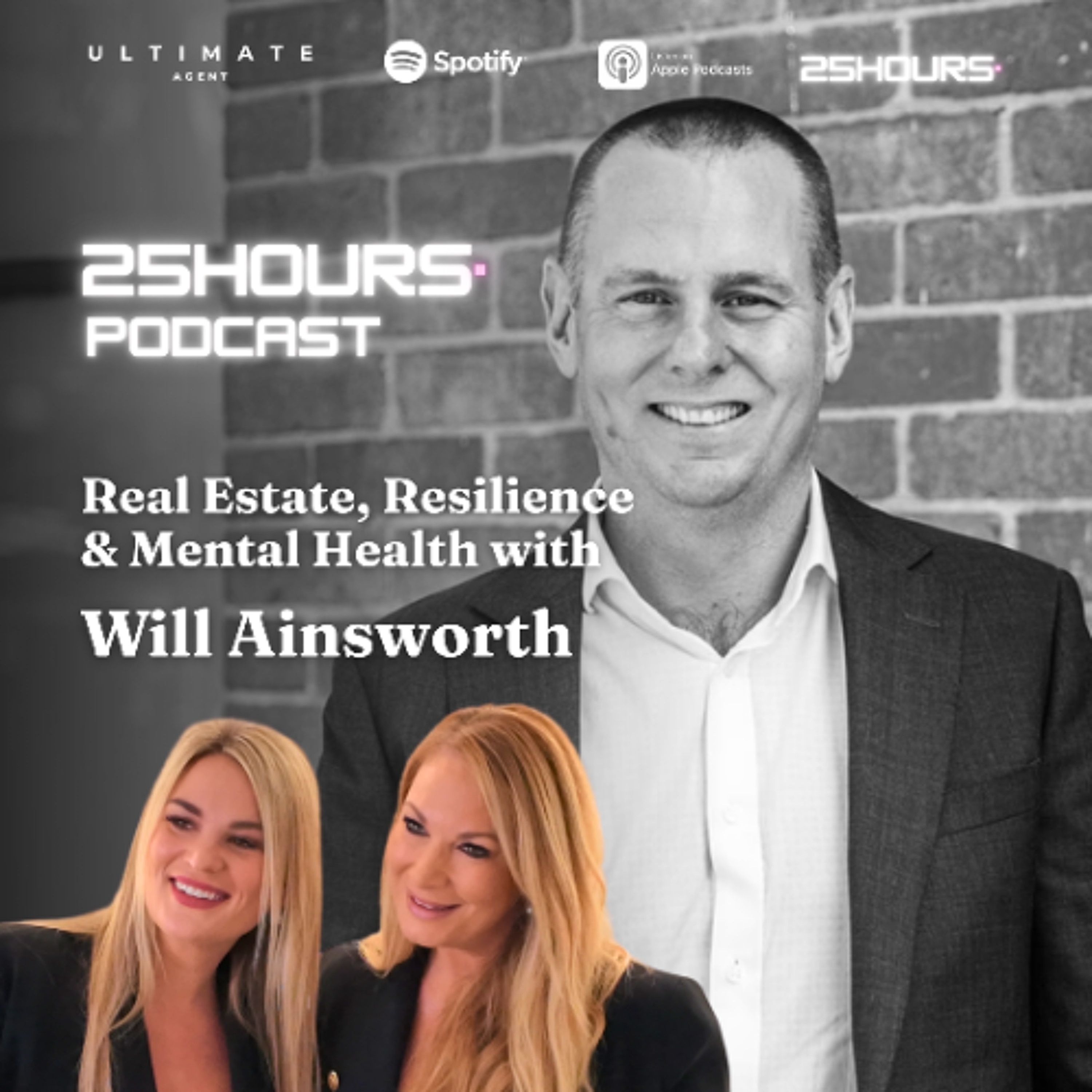
Real Estate, Resilience & Mental Health with Will Ainsworth
from 25 Hours with Immy Callister & Lisa Novak
45m 10s
In this episode of *25 Hours*, host Lisa Noyback and Amy Callister interview Will Ainsworth, a seasoned real estate agent with over two decades of experience. Will shares his journey from being a “black sheep” forced into the industry by his father to becoming a top agent through discipline and habit-building, such as starting with 10 daily calls. However, he candidly discusses the dark side of his success: a relentless drive for perfectionism and external validation that led to severe burnout, depression, and suicidal thoughts. Will reveals that a clash between his demanding work life and personal struggles (including a marriage breakdown) culminated in a mental breakdown, prompting him to check into a mental health facility. He describes warning signs like irritability, fatigue, and poor decision-making that he ignored due to his competitive nature. At the clinic, he learned from other patients—often intelligent professionals who also couldn’t switch off—that mental health struggles are common and not shameful. Will criticizes the real estate industry for glorifying high earnings at the expense of well-being and urges a redefinition of success. He advocates for seeking help, noting that many agents privately reach out to him about their struggles. Ultimately, Will’s story highlights the importance of vulnerability, balance, and prioritizing mental health over relentless achievement.
Welcome to 25 hours. A podcast designed to maximise your time. You're joined by your host Lisa Noyback and Amy Callister. Okay guys, today on 25 hours we are joined by Will Ainsworth, a respected agent with more than 20 years in the industry and endless properties sold behind the numbers is a career that has built on resilience, relationships and the responsibility of guiding people through some of the biggest decisions of their lives. As head of residential South Garland, Will shares the lessons, pressures and personal experiences that have shaped his journey in real estate. Will, welcome to 25. Thanks Lisa and you mean it's really nice to be asked to come on and have a chat with you both. Well you're an absolute super. How long have you been doing real estate now? Will? 21 years. Oh she looked good for that. Do you know what I mean? Like? Yeah, I was five years old when I got into it. So yeah. You're not too hanging after all the years in the saddle. You know, after all those deals are done all the vendor and negotiations. But maybe I think that's where we should start. Let's shape our four-hour listeners. Let's help them understand a little bit about when you got into real estate and how did your career grow to where it got to today? Got into real estate because my dad forced me to because I had nothing else on the horizon. I'm the youngest of four kids and I used to refer myself as the black sheep of the family. My other three siblings went to uni and smart and did the standard thing and I was a garbo and worked at pubs and basically worked. So I could have forward to go out on Friday Saturday and Sundays and then I got to about 23, lost my license for dream driving, went overseas for a year and came back with no money and dad said you're getting into real estate. I was like, "Well, no, no, thank you." And he said, "Well, you're lent 40 grand off me being overseas, so you need to pay it back somehow and you've managed to convince me for 23 years to give you whatever you want and you seem to wriggle out of everything so I think you'd be good at it." So that was it and I said, "I can't study, I can't do this agency." And he said, "They come into my office and every day until you complete it." And I did and he rang up and he was a lawyer in Jolong and he rang up one of his clients who was an agent and got me a job and that's all she wrote. The rest is he's. Well, he's he. So you built your career to a point where you were ranking among some of the top agents in the country. What habits and not negotiables do you think actually helped you to reach that sort of elite level? Well, habits is a huge one. I'm a big fan of the book Atomic Habits and I believe in building small habits over time and then increasing those rather than just saying, "I'm going to make 50 calls a day because I don't think many other than James Tossivan can sustain that." So I actually did start fairly small and just said, "I'll just make 10 calls before lunch time and did that." And then by the time you've got to the 10th year in the zone, 11, 12, 20 and that's sort of how I built some consistency and habits in what I do. It's not a healthy motivation but even what I mentioned earlier, I had a point to prove. I felt like I was a bit useless as a person and I'd found something that I was half decent at so I sort of just put my head down and my bum up and just did anything I needed to do. Only I worked seven days for eight to ten years, didn't take a holiday and just kept on grinding. But it was all about numbers. I don't really think too much other than meeting KPIs that I set for myself and working back from how many listings I need, how many appraisals, how many calls I have to make to get those appraisals and it's all just a numbers going. There's a lot of grind and hustle in that and I think that's where I really want to take this podcast because one of the things that we'll also recently went viral on his social media for all the right reasons other than that nude you shared a couple of weeks ago, but he did go viral for all the right reasons. But as always you've talked about the pressures of mental health and I think what I want to do is take this podcast to a true place of around mental health because I think a lot of people in sales, it is the most industry full of rejection, high pressure. But there's also this pursuit of perfectionism will, like what success looks like and then you can reach it and you're still not happy. So what I wanted you to talk about is like in the pursuit of this dominance to become the best of the best and outperform your dad and show your dad your worth and finally rank in the top. When did you kind of first fully realise that that success doesn't align to happiness or it doesn't create that fulfilment? I actually think I always knew it but there was probably more dominant mindsets in my head about having to, you know, I'm super competitive and I think it's a personality trait that a lot of agents have is like you mentioned. Just not having an off switch really. And so one of the problems with this job is it never ends so you can just keep on working and you work follows you because of all got basically our work in our pocket and I just did that. I just thought well I'll just do more and more and more and at some stage down the track I'll have success and that success unfortunately was defined by other people. The companies I worked for, the franchises I worked for, the directors I worked for, they kind of all set what success looked like for me and I didn't know any difference so I just, when I'm not going to just achieve it I'm going to absolutely smash it and but I always knew in my mind that it wasn't really a healthy state to be in but when you've got the mindset of some like me or it's just I don't care what anybody else or I don't care what goes on underneath I'm just going to keep on keeping on. It's not until you have a big burn out or depression or something like that that it's too late. It's your force to yeah. It's not just slow down but just stop. Yeah and look you know it's it's it's this unusual industry because if you're working in sales as a real estate agent you are naturally driven and I find that so many of us are just so hard on ourselves like I'm sure if you lined up 20 real estate agents that were you know let's say in the top 5% in the country right if you lined us all up we're all going to have very very similar traits and it's like a funny little bit psychopathic but you know it's this it's this funny industry where if you're not listing you go what's wrong with me the first person we blame is ourselves and then when you are listing you are so busy and you're so consumed that it it's almost like it's I guess it's almost like a drug in a way you know isn't it it's like more more more more and actually it's nothing to do with greed it's just that we're just naturally driven people but the problem with the more more more more is eventually you are going to burn out and I know that you've been extremely candid and open about that you've also been very courageous in sharing that you actually did eventually check yourself into a mental health facility and I would really like to talk about that if you're open to that I know that this was not an easy decision can I just ask you well what what actually was happening in your world at that time like how did this happen it's not necessarily work related that's certainly attributed to it or contributed to it but it was my personal life and my work life clashing so therefore I had you know if you're working really hard and you get home and you've got a happy place at home then you can kind of have a bit of a mental holiday and vice versa in this scenario I'd I was under a lot of pressure from every aspect of my my life to the point where yeah I basically had a mental breakdown and had to I had to have some kind of help and I didn't know what that was because when you're in that sort of head space you're not you can't really compartmentalise and make decisions for yourself so I was sort of told that that's the best thing for me to do and one thing I've always been is I'm not afraid of admitting when I'm wrong I'm not afraid to admit when I'm not right or when I'm unwittingly.
well or anything that a lot of people have kind of shame over, particularly agents that have egos, which we all do. And I think you probably have to have one to a degree to be decent at this job, but I think there's also sort of gears that you can go in and use your ego to your strengths but then also have some vulnerability and say, you know what, I need help, I need to put my hand up because this is not gonna end well. And did you just get to the point we felt everything was just overwhelming? Like was it just, because I think, you know, when people share about that vulnerability and, you know, the truth is male suicides, it's still very high in our country. And from my former reporting days, if anybody really knows about those type of things, while mental health is talked about, suicide is not because of copycat suicide. So as a reporter, you're not actually allowed to report on those things that breaches made your regulations and raw, but did you just feel to the point that you just, was it somebody else intervening and then you accepting that help or was it just kind of saying at that time, I'm not okay? And we know they're saying it's okay to not be okay, but. - Yeah. - You know? - Yeah, so it was obviously in the midst of a marriage breakdown and work and having young kids that, like all kids, that are hard work. So I get that's why I said before, my home life was a real challenge and then going to work was almost an escape, but really work was also really challenging. So it was kind of what's the, what's the better of the two evils, so to speak? So I was suicidal and I ended up getting my, contacting my brother and just telling him that I needed help and he sort of came down and did what he needed to do and sort of took over from there. - Your brother. - Yeah. - Is all right. (both laughing) - Yeah. - So looking back, were there any sort of signs? I mean, not obviously this is, this is not, we're not doing this podcast to make this hard for you. This is by no means anything other than we just, we'd love to be able to if we can assist other people because we are an industry where I think everything on social media and everything on the outside all looks glossy and fabulous sports cars and agents walking around without socks on and you know, everything's all looking very glamorous. But sometimes and often there's a lot that goes on on the inside and I think that's the terrible thing about our industry is that everything all looks like it's white-picket fences. But really what goes on behind the scenes can be something extremely different. And I know recently we had Simon Colen, who's one of the countries, if not the country's most successful buyers agent. You know, you see someone like Simon doing these multi-million dollar deals on all these flashy shows and you think, "God, if only I had his life." But the reality is, Simon was very candid about it. You know, there's, it's a shit show on the inside for, you know, a lot of it. And as I said, I think our industry is really bad portraying the bad things that happen in our industry as well. People only talk about the good things. Were there any warning signs that maybe you might have ignored just in case we can help anyone else out there? - Oh yeah, there's plenty of them. I mean, irritability, just constant fatigue, decision-making was quite poor, as far as my mind was very foggy at times. And I'd get quite tired at sort of two o'clock in the afternoon, three o'clock when in the past I'd be all good. And I thought, maybe it's just 'cause I'm getting older, I don't know, you never know. And average sleep, motivations low. But the trouble with, again, the personality like mine is I see that as a challenge in my brain and I go, I'm just gonna push through that. And that is, I mean, it's one thing to acknowledge it, but then to actually take action on that is really difficult when you've got, like we mentioned before, this success target into the future. I'm gonna meet it, I'm gonna beat it, no matter what. And you avoid all the ignore all of those signs, which is, if anyone's listening out there, if you've got signs of it, well firstly, you need to say medical help, I'm not a psychologist in the new year to even know Amy probably thinks she is. - Yeah, but I'm, yeah. - Yeah, yeah, sorry. - Um, so. - I'm media. - Yeah, yeah. But I think it comes down to also, who's at the top? So if you're in a franchise, the franchise, all the directors, or I think there's a lot to be answered for when it comes to owners of businesses and owners of franchises. So just, I don't know how to say it, but just give us a fucking break, you know? - Just, it's not, yeah, I know it's wearing business for profit and, but what expense, you know, I don't, I don't. - I just love, I love Will, sorry to cut you off, but I just love what you've just said there. And I have always been a big advocate of, listen, you know, if you're in real estate sales and you want to do really, really, well, there's no doubt as I said, we are highly competitive people. However, there's got to be a limit here. And this is where our industry has been horrendous. You go to these real estate conferences and all we hear about for the most part is, how am I going to be a million dollar rider? How am I going to be a two million dollar rider? How am I going to be a four million dollar rider? I remember I was speaking at a conference down in Melbourne and there was a multi million dollar rider who got up on stage and he said, I used to be a four to five million dollar rider. I've just had my best year ever. I've written two million dollars in GCI, which is still a shit ton of money, but he said, I've claimed my life back. I've claimed my life back and that for me is success. And I know, Amy, we had Tom Panos on the podcast. And Tom had talked about it. And I was like, that is gold, what you just said, about how success in real estate, we need to actually redefine what this means. Because people are burnt out, right? It's not all about what is the most amount of GCI you can earn. And that is how success, and that is how success should be measured in this industry. I'm sick of it. I'm actually sick of it if you want to be true to be told. And it's an, I am a multi million dollar riding agent. But, you know, I'm mindful that people get burnt out. It's the expectations of the industry lease though and the fear of losing that deal. And it's very hard. Like even today, I had someone write back to me. You know, I just wanted Amy to give you some, like me some feedback around like, buy a feedbacks and service and how long it should take me to get back to a buyer. And like, I wish we could go back to the days of business hours. Like I honestly wish to do. And expectations that that's not replied to or that a seller's not going to be pissed off that you would, I agree exactly what I just don't know what the fix is. Because I'll be, you know, very candid in. I'll sit here and say, well, I set up shortcuts and I do all these things and I just have text replacements. For the truth is, I'm on my phone replying to people. I'd answer a call at 5 AM if I had to. Because that expectation becomes a rolling ball. What kind of you checks me the other night? Oh, that was just a personal conversation. So the photo that came up was inappropriate. It was definitely a lot of the sort of photo. But I don't switch off. And look, I will be honest. I do love my job and people that I work with become friends and but it's that expectation or that fear, you know, that supercharge is real estate. But I don't know with all these technologies coming into place. It's and what I mean by that is auto responders. I'm still surprised Apple hasn't launched her like, I'm currently out of office. I'll check your message. I'll be in touch tomorrow. Like it's quite interesting, but they have all those integrations. But there's huge stuff coming. Manus obviously, Meta's just bought Manus. Now this one will I'm actually asking for a friend, but when you were in the mental health ward, what was the best advice they gave you and to improve your mental health? And this friend might be me. Do you know the best advice was actually the other people in there? I was actually stunned. I expected what you would probably think on a movie where there'd be people wheeled around in straight jackets. Like why would you do that? Why would you do that? And sitting out in the smokers lounge with everyone else at the Jolong Clinic, highly intelligent people, a lot of people with PTSD who had been in the army, or they were baristas and doctors. And they were actually super intelligent people who have all kind of got a similar trait. And that is that they just don't know when to switch off. And it's even more important.
interesting because they're a super intelligent but not intelligent enough to read their own science which is quite interesting but so I learned a lot from them because there were repeat visitors you know I was only there once but there were people that you know been there for six months or it was their fifth time in there and it that wasn't really any answers to it as such it was more just the comfort of knowing that I'm not crazy it's yet kind of okay to not be okay it's not kind of okay it's bloody okay to not be okay and that kind of gave me the reassurance and I was like well if I fall back to where I was I can always go back it's not that I have a not that I want to be in that state but I mean I don't see any reason you know we get sick we go the doctor you get mentally sick you go and see the equivalent I don't see how there's any issue or any weakness or to be honest I it's quite pathetic that people don't acknowledge that that's what's going on for them and I understand mental illness is not something you can easily diagnose because it's not visible and so people overlook it or don't want to acknowledge that they've got some kind of mental illness but the facts are if you're not feeling right you probably do like that's yeah I put those posts up on social media over the last 12 months I would have had 30 to 40 other real estate agents contact me in the space of probably 48 hours saying that they're really struggling and that they don't know where to go don't know who to see and that's just people with enough courage to actually reach out to me so goodness knows how many others there are and so like you mentioned at the start you mean it's it's like an epidemic it's really concerning it is yeah it's actually it's and it's quite funny this I don't tell this story often but my dad when I was younger he I've got put in an all-girl school but for all other reasons that you wouldn't believe just kidding but um he put me it's so I went to Skeg's Dilinghurst which was like this you know top premium Sydney girls school but I honestly believe he just put me at Skeg's Dilinghurst because if you thought if things didn't work out the cross is just around the corner but every day I used to have to like I literally had to get on a bus and a ferry and my dad used to love it because it couldn't trough it they'd shut the doors I'd have to have a code in and he's like see him out all the best um but every day I used to get off the bus and this is that but there was a homeless guy and he used to wear his pants on the outside right and I used to buy I don't know why one morning I bought him a coffee but I used to and he ended up walking me to school for like two of my last 10 year years at school and he was so intelligent he'd run one of the most successful businesses I obviously don't want to say who it is because he's recovered now but um and I used to ask him like so many questions as to how he got there and like he was this man that had millions of dollars and here he is standing in the middle of the city with his underpants on the outside of his pant on his thing and he he I do believe he ended up getting help um in the end there was a whole other thing when I got caught walking with a homeless man to school every morning in my Dilinghurst uniform but that's a whole other side to it but you know it's you don't have to be crazy or damaged or feeling to a point that that you're a broken person because you experience that but I think the hard part is how do we fix it and I don't know if anyone can answer that but if you could today that would be great because it would be good for our listeners thank you please answer it. Just in three words, well if you could. Please don't turn me that's a question, I don't have the answer to it. I personally think this is not the answer but it's hopefully goes to it like I mentioned before. I think we need to stop as owners of businesses or people that work for us or with us we just need to stop pushing them and I get as I said we're running a business so I'm not you know I'm not disregarding that I'm very mindful of it but at what cost you know what do we do it well at the end of the day what are we doing this for I know we're doing it to make a living I've never been money driven ever I just happen to work for me real estate and therefore the money came it's never really been a driver for me and I'm sure it is for a lot of others and I know you get used to it and that's how life goes but if you don't have your health then what's the what's the point of money I don't I don't trust it yeah yeah 100% and look you know again it's just like what I was saying before we're in industry that we everything is based around GCI everything is based around that you are if you are in the top 100 R E B you're successful this is this is what we're led to believe and if you're not then are you unsuccessful like that's the question right I don't see the top 100 surgeons being published in like a journal anywhere or blasted all over social media or I don't know we're in industry that's just full of that and you know as I said we we have we are trained that if you are writing a million dollars or more you are successful as a real estate agent and so the pressure that is on people individually as real estate agents is absolutely enormous it's just enormous and I think that's kind of where it's got to stop is it maybe that we need to retrain people because the people that get into that category they're in that top 1% you know many of us are just turning around going I'm actually exhausted and listen I love what I do and I have energy from here until tomorrow and thankfully I do touch wood like I have a healthy mind most of the time but you know I I know though when it's just enough and I know when I've just got to check out for a little bit just to refill my tank and I don't it doesn't take me much but everybody is different will I want to ask you just before you go on I would venture to say and this is the top 100 if they're listening to this this is not individually pointing you out I would say that a higher percentage of the top 100 would have more mental health issues than the bottom 100 so I I think that the more that the higher percentage of agents as I say you know 20% do most of it and 80% don't I reckon the top 20% in the country would have by far a higher concentration of mental health issues than than the lower so therefore that's where it starts if I'm doing this podcast I'm doing this with you and I've had some level of success over 20 years and I'm talking about this I think it takes for those others to open up as well and stop wearing the no socks and driving the Bentley's and all that sort of shit because the more people try and look like they're successful I believe them they're probably more mentally damaged than anybody else so I just I just think that the people just need to stop the bullshit and just be their authentic cells because I believe that trying to be someone you're not how much energy would that take like trying to wear a mask all day and be someone you're not that that's it that in itself would be I've tried to do that when I was younger yeah try and replicate the agents you listen to try and be them it's exhausting it's exhausting and it's not sustainable and I've always been a massive advocate of that you know anyone that knows me you rewind back to the beginning of my journey into sales which is not that long ago seven years ago when I started doing those videos and people saying they're unprofessional I was like I don't give a shit they're me like and if you don't like that that's okay I don't care it's just me being me trying to do my job but you know people that want you're 100% absolutely 100% accurate like be yourself that is it and I think people really struggle right there and I think you know we've almost just cracked the divinci code right there alone because if you do just take the mask off and just be yourself guess what people are gonna like you and if they don't that's okay as well I'd rather be the only expectation you have is yourself right it's the one we talk obviously about officers but it's the pressure you put on yourself or that you perceive that that's gonna make you happy by getting there you know or that's gonna fulfill you well looking back now on your success what would you what would you like to do to probably if you were to change or implement things differently what are you doing different now to kind of change the way that because you're still operating at an incredibly high level or it's not like you've quit sales and you know you've come back and you're obviously still performing probably at a gift that most agents would love to but what do you practically do every day now to try and make sure that your buckets are full like your life is full you've got time for will time for your you know family and time for things outside of real estate as well. Delegate no there's a lot of sense to what I'm saying is that there's you know there's a lot of newer younger agents that work in my business
that would love to do an open home. I don't wanna do an open home. Why would I do an open home if somebody wants to do one? So to me, it's looking at the team as a team and saying, well, what is it that you wanna learn? What aspect of real estate are you trying to discover or get better at? And so I give that to them and let them do that and let them make mistakes and let them fail if you wanna call it that and then help them. It's like when you're kids, you're helicopter parents, like let the kid fall out of the tree. If they're not that high up in the tree, then they're gonna know what height is and they're gonna know what fear is and it's gonna stop them the next time. It's the same with agents. Let them learn, let them fail because that's what we've all done. And they have the motivation to go and do 10 open homes on a Saturday. I couldn't be fucked. - No fair. - Yeah. - And it's. - Sorry, him. I was just gonna say one tip on that is my turn, Lisa, Lisa, stop cutting me off just kidding. For our listeners, we're really trying here not to talk over each other 'cause we do know it's not good for the podcast recording. So we appreciate your patience as we stop talking over each other. The one thing actually I thought this was a really cool tip we all to give our listeners and then Lisa promised you get to go. Well, the one thing that I've really found, you know how when your phone banks up because you're sitting in a listing presentation or you're with a client, there's actually on iPhone now, you can use a code, you can look it up on chat GPT and after a certain amount of rings, like I've been sitting here, obviously, I'm so popular, everybody wants a piece of meat. But my phone has officially run seven times, okay? That gets overwhelming at the end of the day because then we're gonna finish this podcast. But now I know that phone has been diverted next to Peyton who will pick up that call and action that client request and be like, "Immis currently sitting in a podcast, can I help you?" So if anybody needs a little bit of help in delegating and especially for agents with their phone, I might put a little bit more details in the description but you can definitely use the chat GPT effect and say, "How do I get my phone "to ring a certain amount and then divert?" And you simply call that number and it'll turn the diversion on. - So that's what I've done for, I did that for probably 10 years. We called it the bat phone. It was in the office with my team and it would ring five times. If it's a vendor, I'd probably answer it. It was a new client, I'd probably answer it as a buyer. I'd let it go through the keeper. - Yeah, love the bat. - Yes, so I change my message bank every day and I look at my appointments for the day and if I've got my last appointment finishing at say 4.30, I'll say at the end of my message bank and from 5.30 pm onwards, I won't be answering any phone calls. I'll get back to you tomorrow. And so then I can leave, even though the calls are still coming through, mentally I've acknowledged, okay, they now know that I'm not gonna return their call, so I'm okay with that. But if not, I think all that person's gonna be going, "Oh, that guy doesn't care," or he's not returning my call. So I just have a cut off at the end of each day and just say that's when I'm not gonna be returning any calls by that time. - It's actually really powerful. - And it's fine. - I love that. I love that. So Amy, I just want to be clear, so we all divert our phones to pay to them. Is that what you're saying? - Yes, actually, she would really enjoy that. She, ever since I've had this new thing, and I hope you're listening to right now, Pa, 'cause that's hilarious. I'm like, "I love this thing." And she's like, "Yeah, I don't. I actually don't. I've done nothing all day. You've asked me to do all of these things." And I actually have the team to run and the team to look after and all your phone's done, and his all day is ringing. And I'm like, "It's so good, isn't it?" She's like, "Ai, that." - Okay, don't have that though, Amy. Everyone has a receptionist or somebody else in the business. I recommend my team to divert their phone on their days off to reception, or if they've got a meeting that's gonna go for over an hour, just until reception, I'm diverting my phone to you for two hours. They don't have to answer any different, but then they can just take messages. I don't see any issue with that. - Yeah. I just hadn't set it up. Like I just, because I was always like, I wanted clients to know I was accessible and available, and we worked so hard to drive business, but Pays so talented, like she's so good. When they get on to her, they're like, "I don't really need to talk to us, "just looking for this." And then I come out and Pays written me a list of like, so she really does now, is take my call, it's just kidding, she doesn't. But she's like, "I've spoken to this person, "this person, this person, this person, could you call back?" But it does really help, because the idea that you have to run, really say, alone and manage everything is really exhausting, you know, it is exhausting. And you know, I talk about the not negotiables, which it's still a bit of a work in progress. I'm not gonna lie, because yes, Amy, you're right, you can sit there in a listing presentation, and I've always got my phone there, because I need to watch the time, 'cause I've got to make sure, I'm never gonna look at my watch, right? Will you get this? Like it's just rude. And so my phone's there, so at least I can keep a checker time. Like today, I've had an appointment every single hour. So I've had to run to schedule, I've had listing appointments by appointments, I've been all over the place. But while the phone's sitting there and I've got my clock there, I'm also saying every bloody message coming through, if I've forgotten to put it on do not disturb. You know, and the anxiety levels going through the roof. But I've talked before about the not negotiables, and I love the fact that you just, you know, divert your phone at 5.30, like literally cool us to you. I think that wouldn't work for me, but there's something out there that will work better for everyone, right? The not negotiables work well for me, as I said, I just need to check out for a little bit, and I'm re-energised and I'm good to go. But I made the dime estate last Friday night. We have family dinner every Friday night, 6.30 to 8.30, not negotiable. And I leave my phone in the kitchen, but I was washing up and I saw this client, I was trying to get this listing, and she was ringing, ringing, ringing, and I thought, oh, she must be calling to tell me I've got the listing. So I snuck into the bedroom, and I quickly called her back. I did what I said I'd never do. And she asked me a million questions, and I was on the phone to her, but 45 minutes in my very precious family time that I don't get much of, and then she called me on Monday morning to say, sorry, I'm going with another agent. See, that's the point. That's exactly the point. Honestly, and I was just like, who incidentally did ridiculously cheap commission. But I just thought you are a full Lisa. Why did you allow someone to come into your precious family time? And sucked into you for doing that, but it's so important, right? It's so important. I do that as a self filtering mechanism, so I'll tell people, I'm just about to step into a family dinner, so in five minutes, if they don't respect that, I don't want their business. No. And so the way they give me the answer or the respect around my time versus theirs actually gives me whether I want the business or not. So they go, oh, no, no, no, no, no, no, no, no, no, no, no, you go and speak to the family. I hope you have a great time. You give me a call back when you're ready. That's a good human being who I want to work with. And if they keep asking me for 45 minutes about stuff, I'm probably going to cut a short anyway, because I just don't really want to deal with someone like that. But I throw out almost difficult challenges for indoors or potential vendors to see how they react based on their personality profile. And what they, are they going to micromanage me or are they going to expect me to return calls at every hour? And by the way, I do, which is silly. I might put on the message bank, I won't respond to 5.30, but if it rings at 6.30 and I don't have the kids here, I'll answer it. But I've given myself the out. Should I want to not answer it? That's okay. But I can if I want. - And I know, we're on that setting a boundary. I do know you've got a very important appointment to do. So I want to wrap up obviously 25 hours with this very important question. To our listeners right now, it is that time to like and subscribe. So you always never miss an episode. Well, before we go, I want to ask you, if you-- - And I am single now, yes. - Yes, okay, fantastic. That Tinder bio will also be in the link in the bio, ladies and gentlemen. He's just given me that nudge to make sure it's in there. We'll have his Instagram, Facebook, Tinder, and LinkedIn also for those-- - My life is sassy, ladies wanting to connect, you know? - You might want to answer those calls we'll after, six minutes. - Yeah, I don't know if you should be diverting those through to the reception. - Maybe he should update his voice, Mel, too. If you are 10 out of 10 or anything above a 7 out of 10, I will be returning your call straight away. No, just kidding. I want to ask you, you've obviously been through a lot. You've risen to the height as high, so you've transformed into one of the best agents in the country, you've hit the lowest of lows, you've come back and absolutely nailed it, everything. But if there's any agent out there secretly struggling, or if you would look at Will right now, is this little five year old boy, you know, because that's how you would answer the same sort of question. What advice would you give them, you know? - Are we showing that struggling in their own head, or real estate was? - Both. - Both. - They're struggling in real estate, a difficult one to answer, 'cause everyone's at a different phase of their career. Again, I don't focus on outcomes, I focus on what I can control, and that is how many people can I say?
I dial, not how many people answer the phone. So I, everyone of my objectives in real estate is what are the, the controllables and what am I able to control? So I used to want at least 150 properties a year. I knew that I listed every one in every four appraisal. So I had to do 600 appraisals a year. And so I work off a 10 month year, that's 60 a month. And that's two a day. You break it down into business days and it's like 2.3 a day. How do I find 2.3 appraisals? Then I work from there. So if I do 2.3 appraisals a day every day for a year, I'm going to list 150 properties. I'm going to sell 130. But I'm not saying do those numbers. I'm just saying work out the numbers that you want to do and just focus on achieving that. And it's different for all different people. In your personal life, I'd like to think everyone listening has someone close to them, a friend, a family member. I like to look at it and say, if my best friend had some troubles, I would hope that he would come to me. So why the hell am I not going to him? So there are people everywhere around you that want to help. They just don't know that you need it. You would help anybody. So why wouldn't-- Well, I was looking more at Lisa at that. Yeah, well, she would be better. I would probably go to her too. She's a little bit more mentally sound. You'd probably divert it to pay it and go, you just-- I would put you on to pay. Yeah. But the best thing that you can do is talk to somebody. And that person, whoever they may be, I'm sure they're trusted by whoever it is. They're hopefully going to help you find the next iteration of who's going to help you and the problem with mental health, with psychologists and psychiatrists. There's not enough of them in there just booked out for months and months and months. So when you're in that headspace, even trying to logistically go to your GP and then book that in, and it's quite a long process. So there's got to be some intervention in the meantime. And that is telling people and then telling your work. You don't have to tell them that you've got a mental health issue. You might just need to say, I just need to take some time out for work. And then taking a step back and putting the bandaid on while you're waiting, then go and seek the medical help. And obviously, I'm not going to move forward from there because whatever help you get a diagnosis is up to them. But I just think that the first step is just to talk to someone that you trust and love. So true. And I think that is really so, so important. Yes, there are people out there. And I think that's really important. There's a very important message there, guys. And that is, anytime like I've ever seen anyone put anything out onto Facebook, where they feel like they've got no one around and next minute this community just smothers them in love. And it's quite incredible. There is always a way to-- I might be opposed to night on that. Always see what happens. There is always-- but there is always help out there. There is always someone that you can pick up the phone to. That's going to help you. Will you've been-- I don't know if Brave is the right word, but I'm going to get you anyway. You have been extremely brave. I like the word courageous even better in. You have been seriously so successful in your career. And we're very grateful that you've come on and shared this really, really important message with people. But thank you for opening up. We really, really do appreciate it. You're an absolute legend. You really are. You're right, I am. [LAUGHTER] I love it. But now, jokes aside, well, I couldn't have had the opportunity to broadcast this to how the five people at least into your podcast every now and then. There's actually only three. It's just actually you, me and Lisa. Yeah, Paten. Yeah, Paten, who will of course have to-- after she takes my calls. So the millions of people at least in that jokes aside, I couldn't have a chance to broadcast this without you both doing what you've done and building an audience and putting out the good word that so many others don't. So I think it's just credit to you too for actually going, you know what, I think this is what the industry needs. So let's find some poor sucker who's going to open up and talk about it. So well done to you too. I'm very impressed. And I came straight to you for that poor sucker. We'll be good. Thank you very much. Correct, correct. Well, ladies and gentlemen, thank you from the bottom of my heart for joining us for another 25 hours episode. Will, thank you. You are truly one of a kind. And what you've done today is give a lot of people not only hope, but the courage to be and understand it's OK to not be OK. Thank you, everyone. Thank you. Thanks, guys. [MUSIC PLAYING]
Podcast Summary
Key Points:
Will Ainsworth, a real estate agent with 21 years of experience, entered the industry after his father forced him to pay back a loan, discovering a natural talent for sales.
He built success through small, consistent habits (e.g., 10 calls before lunch) and a relentless work ethic, working seven days a week for years without holidays.
Will emphasizes that success in real estate often does not align with happiness, as the industry’s focus on competition and perfectionism can lead to burnout and mental health struggles.
He experienced a mental breakdown due to pressures from both work and personal life (marriage breakdown, parenting), leading to suicidal thoughts and admission to a mental health facility.
Warning signs of burnout included irritability, fatigue, poor decision-making, and low motivation, which he initially ignored due to a driven personality.
Will advocates for redefining success in real estate away from purely financial metrics, and stresses the importance of seeking help for mental health issues without shame.
He found solace in connecting with other patients at the clinic, who were often highly intelligent but struggled to switch off, reinforcing that it’s “okay to not be okay.”
Summary:
In this episode of *25 Hours*, host Lisa Noyback and Amy Callister interview Will Ainsworth, a seasoned real estate agent with over two decades of experience. Will shares his journey from being a “black sheep” forced into the industry by his father to becoming a top agent through discipline and habit-building, such as starting with 10 daily calls. However, he candidly discusses the dark side of his success: a relentless drive for perfectionism and external validation that led to severe burnout, depression, and suicidal thoughts.
Will reveals that a clash between his demanding work life and personal struggles (including a marriage breakdown) culminated in a mental breakdown, prompting him to check into a mental health facility. He describes warning signs like irritability, fatigue, and poor decision-making that he ignored due to his competitive nature. At the clinic, he learned from other patients—often intelligent professionals who also couldn’t switch off—that mental health struggles are common and not shameful.
Will criticizes the real estate industry for glorifying high earnings at the expense of well-being and urges a redefinition of success. He advocates for seeking help, noting that many agents privately reach out to him about their struggles. Ultimately, Will’s story highlights the importance of vulnerability, balance, and prioritizing mental health over relentless achievement.
FAQs
His father forced him into it after he returned from overseas with no money and owed $40,000. His father believed his ability to 'wriggle out of everything' would make him good at sales, so he got him a job with a client who was an agent.
He built small habits gradually, like starting with 10 calls before lunch and increasing over time. He also focused on numbers, setting KPIs, and working backward from goals like listings needed.
He always knew it, but competitive drives and external definitions of success (from companies and franchises) pushed him to keep working. It took a major burnout or depression to force him to stop.
Pressure from both his personal life (marriage breakdown, young kids) and work life clashed, leading to suicidal thoughts. He contacted his brother for help, who took over and arranged care.
Irritability, constant fatigue, poor decision-making, brain fog, tiredness in the afternoon, low motivation, and poor sleep. He saw these as challenges to push through rather than signs to seek help.
The comfort came from other patients—highly intelligent people with similar traits who didn't know when to switch off. They showed him it's okay to not be okay and that seeking help is like seeing a doctor for physical illness.
Chat with AI
Loading...
Pro features
Go deeper with this episode
Unlock creator-grade tools that turn any transcript into show notes and subtitle files.
 PodcastTranscript AI