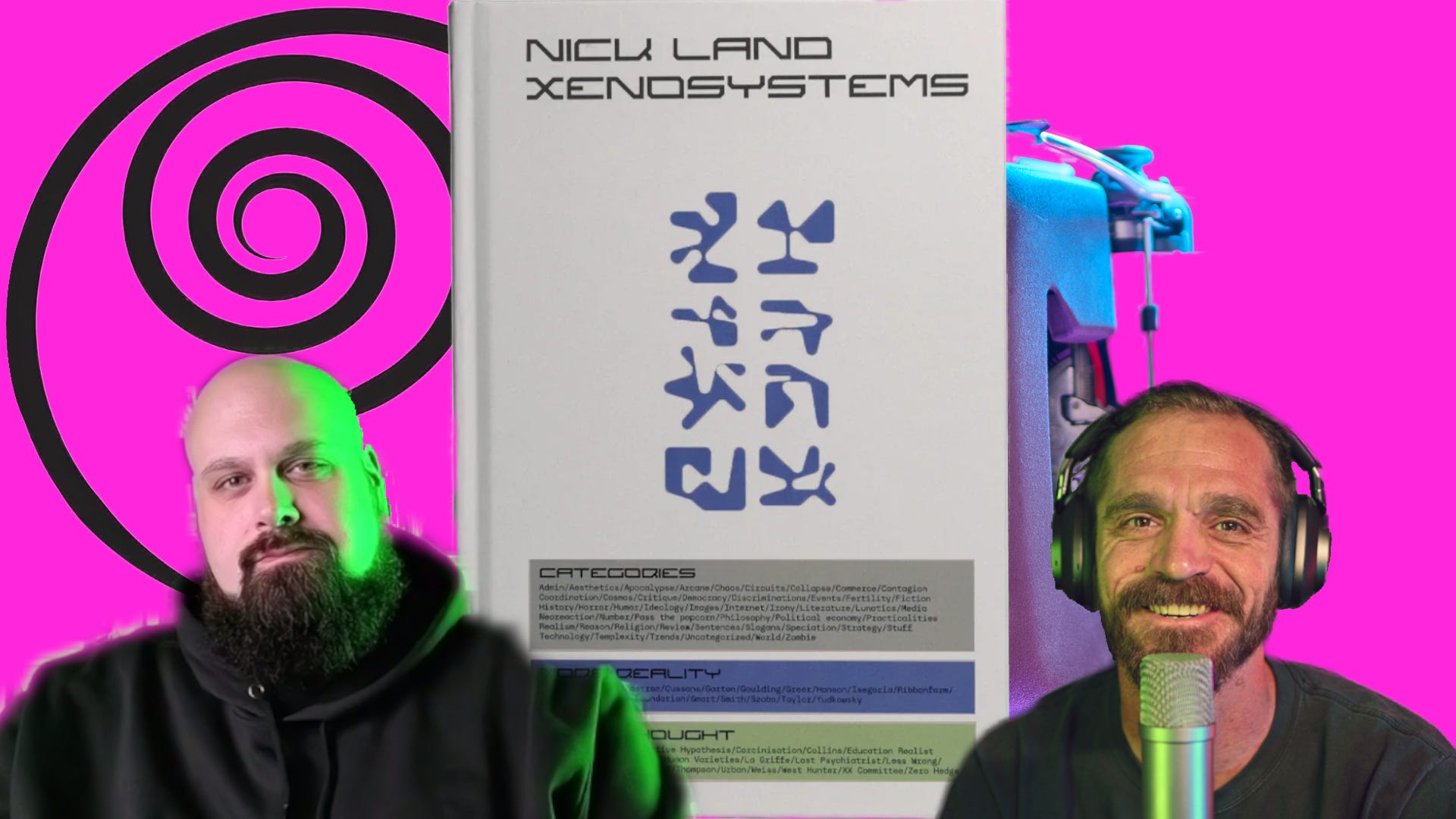
In this episode, the hosts begin by recounting a chaotic tech mishap with Xfinity, which sent them a "better" router that caused connectivity issues, leading to a delayed start. Once resolved, they pivot to reading Nick Land’s short essay "Capital Escapes" from *Xeno Systems*, part of the "Outsideness" chapter. The text posits that capital is a highly incentivized, alien force that seeks to detach itself from any specific ethno-geographic locality, political accountability, and human value systems. Land argues that the left, particularly Marxists, better grasp this dynamic—seeing capital as an evasive, self-multiplying agent—while the right tends to moralize about human nature and miss capital’s true nature. The hosts unpack this, noting that capital uses human incentives (like providing for family) to propagate, yet ultimately operates beyond human control. They also wrestle with the tension between affirming acceleration as a descriptive fact versus endorsing it normatively, cautioning against ideological futurism that dismisses present suffering. They emphasize that capital’s "real" is something that escapes symbolic regulation, and that while humans are "gregarious apes" with moral inclinations, understanding capital requires cold, analytical detachment. The discussion ties back to broader accelerationist themes, questioning what politics can do when capital itself is the primary agent of exit from human institutions.
(upbeat music) - Let's go. Accelerate the motherfucking process. Oki-Dokie artichoke, friends, enemies, people who hate watch, people who don't watch it all and only listen, people who hate us and think we suck. People who don't hate us and think we don't suck. What's up everybody? We're back, Mikey's here. We're accelerating the process. We just had a-- - We sure are the fuck are. No, ex-finity is accelerating the process. - Yeah. We just had that. - We just went through cluster fuck city (laughing) 'cause I recently, so I get this fucking text from ex-finity. Hey, your router is out of date. If you just send the word yes back to us, listen to your brand new router for free and it's way better. I'm like, well shit, okay, I've never had a single fucking problem with my router, but sure, so I, yes, they send me the new one. Set that motherfucker up. I've had a lot of problems with it. Like I can't get Netflix in my basement. Never had a problem with the old one. So I go out there today, I'm like, "Hey, this shitter ain't fucking working." And they're like, "Well, it's probably defective 'cause you do have much better router now." So here's a new one of the new one and try this. I get home and my internet is completely turned off for whatever reason. And, (laughing) I guess it was not the dozzine had it. It looked like it was about to fall. (laughing) There we go. Anyway, long story short, they're like, "Uh, yeah, we don't know why your internet's out." So we planned to start this about like 30 minutes ago. I've only got a limited window of time tonight. So I don't know why I wasted any fucking time with this story, but we got the internet. So. - We have the internet back. - Like I say, Xfinity accelerated the process. Let's roll. - I do. - Are we doing tonight, Dance? We are gonna read more from Xeno systems. The collected blog posts of your boy, Mr. Nick Land. We're gonna read. - Yo boy. - Yo boy, our boy. - Yo boy. - Our boy. - Our uncle, Nick Land. - What up, boy? - Our crazy, our crazy, Maga uncle. Capital escapes. So in the print version, I think it's at the end of the section where he's dealing with like the AI in the tech and Pithy unbounded. - So those in this book, in Xeno systems, our favorite section here is, go back. And I can't stress how important, this is like some of the most important stuff Nick ever wrote. And it's very easy for it to be, it's a, yeah, it's chapter three, outsideness. - Yeah. - That's not working. There we go. - Based everything written in this chapter, this is some of the best stuff on AI's ever written. We've already done three or four videos on some of these essays. - Yeah, we've done a few. What is intelligence and will to think and a few. - Intelligence and. - And the good? - Good. - Yeah, intelligence and the good. - Yeah. - And this one, capital escapes. It's nice and short and sweet. But I also think it is pertinent to our ongoing discussion of acceleration, the readings we've done of a quick and dirty introduction to accelerationism and then manifesto for an accelerationist politics. I think this short piece is relevant to that ongoing conversation. I also, there was a comment on our reading of accelerationist manifesto, where someone pointed out that I made the comment in the reading. It's like the withering away of the state. And I chose that wording specifically to kind of, to, 'cause it gets at what I think all this neoliberalism is doing, all of privatizing. And it's like causing these organizations that provide services that are supposed to be accountable to the public good, like because they're being privatized, because they used to be public services, now they're becoming private services. So they are no longer accountable to the public good. And so they're losing some of that qualitative accountability and in favor of quantity. And it is true that these are public services. So public state services. So with the withering of the state, it's not just about losing, you know, draconian, gerritical forces and repressive state apparatus. It's also about like, no, the state actually, I think the state's a necessary thing. I think we're both state realists. And there's a good side of the state as well. And that's the side that's kind of withering away. And I think this kind of touches on that very, very, very briefly, 'cause this is a very short piece. And it also talks about the left, right divide. And what is politics, what is to be done, what can be done? So yeah, I think we should just jump right into it and then as we read it, we'll. - I mean, look, the title, a capital escape. This is keeping with everything Nick has done. It is about the emancipation of the mean to production, which is to say the liberation of technology from human constraints. Yes, it used us to build itself, but it's not about us and what, if for capital to escape, it's essentially escaping us. Escaping our value systems, our human forms of meaning, our state governmental forms of control. And Nick has always cited with capital on this one. And so yeah, I mean, I think it's the perfect blog post to end this chapter outsideness on. - Yeah. Because in the sense capital is from the outside, but that's precisely where it's escaping too. - Yeah. - So it falls to earth from the outside, but then once it's caught up with Dylan with us and all of our institutions, it gets entangled and it has to find its way back home. - It gets stupified and plopped into a strange type of suspended animation, while it's here and all the while it's trying to escape back to the outer limits of our cosmos. - We're trying to do so by accelerating the process. So a little bit of that. - There's a accelerator. That's so aggressive dude. I like this. - It's so buggy. - Accelerator. - Okay, let's do this thing. - Let's jump into it. Capital escapes. This is not an easy subject for people to scan with calm analytical detachment, but it is a crucially important one. It is among the rare topics that the left is more likely to realistically evaluate than the right. Much follows from the conclusions reached. - Now, to be fair, I don't know if he would still say that how insane he thinks, "Wokeism has become as a religion." In his view, this is written in 2014. So, you know, I mean, it's headed down that trajectory but I think he's, the left he has in mind, we'll have to wait and see. I think it's the Marxist left. Who for him are oftentimes better equipped to have a com ration of discussion about the logic of capital than a lot of people on the right. - Chicago school guys and then perhaps, yeah. I'm not sure who he means by the right here. I'm not sure who he means by the left, but maybe we'll find out. But definitely he's gonna say, things a very unique person to be able to deal and contemplate, deal with and contemplate what he thinks capital is and what it's doing. - Yeah. - And, you know, so this is why his motto is "Coldness be my God." And so, coldness, restraint, com cool collected, all that kind of thing. In different towards wild human reaction. - Yeah. - And so he thinks you gotta be in that mindset to get what capital is and it's escape trajectory. - Can't be sentimental about it. Can't let our purely motions get in the way of analytic understanding. So, it can be fixed provisionally by a hypothesis that requires understanding, if not consent. Capital is highly incentivized to detach itself from the political eventualities of any specific ethnogiographical locality and by its very nature, it increases.
increasingly commands impressive resources with which to liberate itself or de-territorialize. It is certainly not, at least initially, a matter of approving such a tendency, even if the moralistic inclinations of gregarious apes would prefer the question to be immediately transformed in this direction. Integral leftist animosity to capital is actually valuable in this respect, since it makes room for a comprehensive apprehension of globalization as a strategy oriented to the flight of alienated productive capability from political answerability. The left sees capital eludes its clutches and it sees something real when it does so. By far, the most significant agent of exit is capital itself, a fact which, once again, is a particularly excitable apes find hard to see straight. Okay, so it can be fixed provisionally by hypothesis that requires understanding if not consent. So it is, this is one of these things we go back to, is acceleration, a factual process that we're describing, that we say yes. I don't know how somebody denies that, but there's the descriptive affirmation of it. And then there's the kind of moral or enthusiastic type of just radical support for it. So you can, is it normative affirmation or descriptive affirmation is the question here, but for him, definitely this is happening at the descriptive level. Capital is highly incentivized to detach itself from the political eventualities of any specific ethno geographical locality, which is to say capital does not care about specific identities, particular groups, particular nations, it gives zero shits about human identities, human in groups out groups. It has to deal with them. It has to deal with them from a logistical standpoint. But ultimately from the pure quantitative, calculated, instrumentalized logic of capital gives zero shits about the groups we think are special and the groups they think are special and the ones worth fighting for and the ones that should be in charge, it doesn't give a shit about any of this because it doesn't give a shit about us as humans outside of how we help it bring about what it's on the path to becoming. So here he falls back, he uses the Luzoguatarian language and by its very nature, it increasingly commands impressive resources with which to liberate or liberate itself or de-territorial lies. It is uprooting. It leaves no stable social structure. You know, it territorialized. It mixes everything up, it changes things, it changes the meanings of things, it decodes them and it is constantly revolutionizing all of the nooks and crannies of our lives, especially when it comes to the technologies we use and everything is in this state of constant flux, change upgrading, downgrading, depending on how you view it, inshitification. It is changing things day in and day out for its own purposes. Yeah. It is going, like it's just running through and smashing everything because it's only concerned about where it's heading and because it has such a, I mean, it's ubiquitous. It has a global impact because it touches everything and it affects everything. It's like trying to pull out a tablecloth from underneath a table that has everything set on top of it. And the flowers are still standing. Yeah. But it's so, like it is so impactful. It is the organizing principle of the modern world that we live in. Everything is in relation to capital and capital. People can argue or quibble about imputing agency to it or not, whether, okay, I'm going to use the word wants, but I'm not necessarily imputing agency because we can still see that there is, it's a line of dominoes to be knocked over. So there are necessary things that are, yes, they're contingent, but they're always retroactively necessary. Things in place that when capital just does what capital does, it has a telos, it has a projection, it has a directionality. And that's all it's concerned with. That's all it cares about. So everything else is just like you said, uprooted and kind of tossed up into the air and we're stuck trying to catch up. Decontextualized. Yeah. Constantly. Constantly. Constantly. Decontextualized. And it's just like a certain thing that you can do. It's just like a certain thing. Like a certain thing that you can't do. Yeah, but I don't live life zoomed out. Hmm. And, you know, she doesn't use that. She's like, I'm rooted in my everyday human phenomenological experience and that's where I live. How do I not view it from that? Like, why should I even try to take on this, this perspective from nowhere? Yeah, the cosmic perspective, the cosmic time scale. And you'll see a lot of people talking the, the millenarian people and the, the long clock people. A lot of those guys are, they live in the effective acceleration world, the effective altruist world. And I think, I think we should have it take a generational view. And we should look at the long tail of our own life and our own choices. But that often gets hijacked for this more, uh, cap, cap, capitol, capitol, o centric view rather than anthropocentric view. Well, and the guys who affirm this stuff, we, what was that video? And so Nick just shared a video on X about AI and it's very landian. I don't know if the person who made it has directly read land or just kind of picked this up second hand or third hand or fourth hand, but very landian. And it is this kind of like humans are just one moment in the universe, in the history of the universe. And there's so much more. What if this super intelligence is building itself and it's going to be the new standard and, and the next step in evolution, so to speak, we're just, you know, part of this ongoing process. And of course, we're not going to always be here. And there's, I get that. I, you get that. We can zoom out. But she is right. We're here now, dude. You people can't, you can't live in that. Well, you also can't, no, go ahead. You also can't repress and suppress and outright deny human meaning. Like you, you just can't. Like we live in
a rich value-laden world. We live in a world of meaning. And it does exist. Yeah. It's part of the history of the universe. Absolutely. So yeah, becoming obsessed with scale and entropy and all this, like it's just a way to dehumanize and disavow, I don't know, the damage that we're doing to the world right now and that we've already done. And say, oh, but yeah, but it'll be okay because we'll go on to have beautiful robot babies. Now I would love to go on to have beautiful robot babies. I also want my world to be more beautiful than it currently is. And I think, like, I don't think we should trade the potential future that is definitely ideological and it's being used to get us activated into certain political directions. And it's definitely fantastic. I don't think we should grasp that and let go of like the potential for the world right now and prove the world that we live in or at least stop the destruction, stop the suffering. Now you're speaking with moral inclination. So I see like that. And I'm like, yeah, of course we are. How do we? Yeah. We're gregarious apes. Yeah. Like, now that that's what we are homey, that's what we do. We started bands should it be gregarious apes? Yeah. Thanks, Nick. Integral leftist animosity to capital is actually valuable in this respect since it makes room for a comprehensive apprehension of globalization as a strategy oriented to the flight of alienated productive capability from political answerability. So he, I think because that was kind of his old school condensed sentence, I think he's saying what the left gets is that capital is this thing that is moving across the globe, which is escaping from national controls. And the right doesn't seem to get that dimension of capital and sorry, you get that from Marx. Yeah. And if you're not reading Marx, I don't care how much of the Austrian school or any of them, this is something you need to get. And this is something Nick would say you need to get about capital because the leftists are so big on Marx, they have better chance to understand this. And the point is what is escaping here is capitals being controlled by nation states. Yeah. And I think the next line, the left sees capital eludes clutches and it sees something real when it does so. Yeah, I think that's it. Like we, we do have an analysis of capital and we do see how it is this kind of caustic process or this cost of feedback loop. And it's growing and it's metastasizing and it's, it's just growing and growing and growing. And it's, it's slipping out of like every time we can grasp it, it slips out. It's a, it's a real slippery fish. Yeah. And, and yeah, we see that on the left, whereas the right doesn't see it. Maybe the right can't see it. I don't think the right sees capital as this. No. Agentic intelligence. Yeah. Because Marx and Marx and other Marxists to get you thinking about the logic of capital where it's not that it truly has a will in the sense that we think of us having wills. But if, if this, if this circulation process, MCM prime clicks into place, it installs in capitalists, incentive structures and it chooses for them. And any capitalist knows this. Every capitalist who has any humanity left and sorry to break the news to a lot of, there's a lot of capitalists that do. They're not all the billionaire tech guys. You know, people who own distribute a warehouse or a distribute are very much human. But because they're, they want their kids to have better lives than they have, they, they do this thing. And so lots of people who own businesses are still human, but they will tell you, I've talked to them. They know that something is telling them what to do. And most of the vast majority of the time, it goes against their spontaneous human inclination. But to make the money, you got to do the thing. You as a human don't want to do. And I've had this discussion with business owners, they do feel it and they don't like it. But the, the economic push is so strong. Yeah. We're trapped. And it's easy to say what you would do in that situation. But if you're thinking about your kid going to the best college they can get into and ensuring your kid has a good, it gets, you know, well-paying jobs to your grand kid. There's all these human incentives at the same time that have to, you know, the capitalistic incentive takes advantage of. And so it's a, it's a very, very complex dynamic. And if you're not in it, I mean, I'm not in it. But I still can go, yeah, I get why they let the logic of capital dictate what they're doing. Yeah. Because there is a reward for them, at least in this lifetime, in this short span. Yeah. So yeah. And it's, yeah, it's not, it's also not just like, yay, you have love and adoration and respect from people like that, that real reward is, that reward is material, that reward is seeing. I can provide for my children. I can, I can give my children. Open it up. Possibilities for your kids. And yeah, dude, like the right sees capital and capitalism, like in terms of human nature. And they always want to, they always want to go back to, they do their own version of moralizing. But they, they bracket out capital or they miss capital entirely. They don't see it as this alien force. Right. The left sees that and land a sand seat. That's what they get and get right. Um, and so, um, yeah. So left sees capital eludes clutches and sees something real when it does so just as a side note, I can't help but read that in the canyon terms. Yeah. Uh, the left sees capital eludes symbolic clutches. It's attempts to regulate it with policies, implement symbolic mandates that control it. And, and it sees something real. Now capitalize the real. Yeah. It's something evasive, something that escapes symbolic control. It is real in the canyon sense as well. That's the monstrous alien. Outsideness to it. So, hmm. By far the most significant agent of exit is capital itself, a fact which once again, politically excitable apes find hard to see. Straight. Um, yeah. And that's just saying capital is this kind of self-positing system that once it gains traction, it goes on to multiply it, uh, multiply. It's a von Neumann machine. Uh-huh. Uh-huh. Uh-huh. And what we can't see straight about is that this thing is destroying the human world. Yeah. And that's what we can't cope with. It's escaping. Let's punish it. Yes. Yes. always plenty of time for that but shelving such idiocies for just a few moments is a cognitive prerequisite. The primary question is a much colder one. Is this actually happening? Yes. Yeah. Yeah, I mean we're we're when piled on the descriptive part. Yeah. I think that like in my position, I take that as a message to the left and the right. The message to the left is the left says let's punish it. Yeah. Yeah. Yeah. But let's kind of let's put that away. Let's let's put that down for now and let's actually focus on what's what's happening here. Capital is doing what capital does. Let's stop trying to punish the capitalists. Let's stop trying to rationalize and come up with new frameworks to justify unique. Oralism will cut it. Right. And you know doing things where you kind of create hierarchies of categories that people fall into and it's it's like a weird type of neo essentialism that people want to do and say, oh this is uniquely evil. These these people are uniquely bad. And it's like no, no, no, these people are people beholden to the logic of capital. And the my message to the right based on this is yes, it is actually happening. This is not just human nature. We are not you know, just good human entrepreneurs. That's all that is. It's just right. Those who are innovator. Yeah. There's something alien and monstrous happening here. Yeah. You guys don't see that. And but I will say this. I think on this level of, oh just hurry up and punish it. Here's here's the nuance in that when it comes to the left. This is something and I bring in G. Jack here and you know his his important short book, The Relevance of the Communist Manifesto. For him, key Marxist categories have to be rethought.
even though we have to have Marx's analysis of capital, because it's still relevant in incredible ways, things have drastically changed since then too. And so what we need now is like a new detailed description of capitalism. Like, with Marx as it's like Blueprint, but updated. And if you're so just, "Oh, Capital Evil, Capital Evil, just kill, just slow down." What is it doing now? How has things changed? Is wage labor the same? Does wage is work the same? Does value work the same? All of these key things, just production truly primary and the way it was before. These are all big questions, and they need to be rethought for us to actually understand what is actually happening. But if you're just too busy with punish, punish, punish, you're going to just rely on old analyses, and you're not going to be conceptually equipped to deal with what. All of the changes made in capitalism. So. The implications are enormous. If capital cannot escape, if it's apparent migration into global circuits beyond national government control for non-exhaustive example, is mere illusion, then this fear of political possibility is vastly expanded. Policies that hurt, limit, shrink, or destroy capital can be pursued with great latitude. They will only be constrained by political factors, making the political fight the only one that matters. So the question is, can politics control economics? Can the state control capital? If you are convinced that it can, then policies are really going to matter to you. Because there are policies that can put a stranglehold on capital, or at least a collar. If capital is absolutely accelerating liquid, then you're not going to contain it. You're not going to, you know, it's going to seep through and escape. And so, for Nick, there's times in his work he seems to vacillate. So when he's writing suspended animation, it does seem like, oh, the Obama liberal state is slowing things down and, you know, preventing capital escape. There's other times that old 90s land is there, and it's like nothing's going to stop this. It's already happened. The state has spoken. The lemurs have ruled, and it's already set in stone. So, yeah, I see him vacillate. But it's almost like when he zooms out, nothing's stopping this, nothing to worry about. He zooms in. Oh, this shit is, you know, I think I am the same way. I think I've vacillate between the two positions as well. I think it does come down to trying to zoom out. Almost taking up this view of like, yeah, it already happened. We're fucked. We're too late to do anything about it. But then zoom me back in, down here at the human level, at the human scale. I think, no, you know what? Maybe we're not necessarily doomed. But I do think people often recently have asked you and I the question of Nick's politics. And I think for me, I just say, I think Nick wants to accelerate, go baby, go. And whatever's going to do that for him is what his political project is going to be at the time. So it's not to say that he has a principled politics based on ideas of belonging to certain communities, or belonging to certain nationalities, or ethnic backgrounds, or anything like that. He's on the side of the face, intercourse. And I think this kind of demonstrates that a little bit and also kind of demonstrates a lack. Like, I think there is a lack where you can say the affirmative side of Nick's politics is accelerate, go baby, go. Well, then the kind of the missing ingredient or the conspicuous lack is just nothing else matters. So all the things that people want to accuse him of being and doing, I think he's not taking that into consideration. Like he is focused on on capital. Whereas I think people like mold, and he's, I think people like mold bug and that whole troop of retarded assholes, I think they do want bad things to happen to people. Yeah, that's the thing. People would think that's true of land. And after, I mean, what we, what amount we've gotten to know him, I don't think he actually is like that at all. Yeah, I think he's sitting right like actually wishing harm on humanity. I don't. I think he's a split subject like us and I know he doesn't go for the Lechan stuff, but we do. And I think it's possible for a human being to be on the side of this incredibly zoomed out. Long planetary cosmic scale of this process. And at the same time, care about your kids and want like he can do both. Absolutely. It doesn't necessarily seem theoretically consistent, but doesn't have a human living in the world it is. That's the thing. It doesn't have to be, you know, bulletproof on the theory side because he's living it. And we are all living the same contradictions. Like I don't, I don't live 100% according to, you know, the racial theoretical framework. I wish I could, but also I'm happy I don't because self sabotage is important to us. Nietzsche says the philosopher must live the philosophy. So if Nick was the truly 100% live his philosophy, could he care about anybody? No, no, but he's a human. And maybe he would go, now I don't even agree with that. Okay, fine. It seems to us like, I mean, there it is. Let's see if I can get it there we go. Coldness be my God. Yeah. Well, coldness doesn't love its kids. Yeah. Does it? Yeah. I don't, you know, so, you know, and I, he does love his kids. So I. Yeah. I'm just saying he's, he, take the meme shit out. Yeah. He's Nick. He's also just a guy who is a person and a human. They can joke that he's not, but, you know, so I'm just saying like there is this dimension of every philosopher is still caught up in being in the world. Yep. You are, you are Dawesign and you philosophize on the basis of having been Dawesign. You were Dawesign before you were an actual philosopher. Everybody, every human's philosophy, I don't mean it in that way that kids are always at. Why do, why does the sun shine? Well, okay, fine. There's something philosophical in that. Yeah. I'm talking about being an actual professional philosopher and, uh, yeah, before you're that, you're Dawesign. Yep. You're rooted in the world. And, uh, yeah. So things show up as mattering to you, especially phenomenologically. So I, I don't think there's an issue there. I, I think the issue is actually one of can the state control this or can it not now the one thing that and maybe we're, we're almost done. This thing is super short, but he's talking about nation states attempting to control capital. Well, if capital has become global, it exists in global networks, then it transcends any nation state. This is where I want the Gieckian kicks in and goes, what if there was a new international organization institution that itself was truly global? Somebody could say United Nations. Well, he doesn't think that's going to cut it. Yeah. But is it possible to imagine an international coalition that is every bit as global as capital is now? Could that do something to restrain it? I don't know. But it's different than asking can particular nation states control it? Yeah. If capital cannot in reality flee, then progress and regress are simple alternatives. Either nation's advance as holes in a way that compromises on an awkward diagonal between the very different optimism of wigs and socialists and reason, or they regress as holes, destroying techno economic capability on the downslope of social degeneration. Greer. Only if capital escapes or practically decouples, does it make sense to entertain extreme pessimism about sociopolitical trends alongside a robust confidence in the movement?
of techno economic innovation. The escape of capital is thus an intrinsic component of split future forecasts in which squalid ruin and techno and telegenic runaway accelerate an inversely tangled tandem, cyberpunk or elicium. Try not to ask if only for a moment, whether you like it. Ask first with whatever intellectual integrity you can summon. What is the real process? - Okay, that one's gonna take a little bit of unpacking here. If capital cannot in reality flee, then progress and regress are simple alternatives, which is to say either nations are gonna progress and get better, or they're gonna regress and get worse in certain ways, but those are the two options if capital cannot escape globally. Either nations advances, advances, holds in a way that compromises on an awkward diagonal between the very different optimism of wigs and socialists and reason. Okay, wait, wait, wait, wait. Just on this optimism side on the level of progress, wigs and socialists, when he uses this word diagonal, what he is talking about is some sort of strange third term, some sort of synthesis emerging out of wigs and socialists. So even though he doesn't like dialectics, the diagonal has a very synthetic component to him because he's getting this from Kant. Because for Kant, he takes four terms, opriory, a posteriori, and synthetic and analytic. And what he does is he finds a way to generate, look, traditionally in philosophy, look, and I'm not gonna even explain these terms, 'cause the meanings don't matter right now, okay? In the history of philosophy, analytic statements are opriory. Aposteriori statements are, or I'm sorry, synthetic statements are aposteriori, okay? Just that's how it's always been grouped. Kant figured out a way to make synthetic, opriory judgments, a third category. He synthesized two of them that seemed like they couldn't go together, but they did. Well, he's talking about that here, some kind of diagonal that takes the wigs and the socialists and combines them in some third category, okay? And then, or they regress as holes, destroying techno economic capability on the downslope of social degeneration. Rare, now who's Greer? John Michael Greer. And James Ellis, I think picks this up in Champions with zero acceleration. And I like that. I like juxtaposing Mark Andreessen and Greer, or what I think of as James Ellis, what I'd like the zero acceleration, 'cause I think Mark Andreessen is a silly man, and he has, he pushes this techno utopia, we're gonna have, everything's gonna be great. Meanwhile, he's also donating to political projects that further privatize everything. And no, don't give people universal healthcare. Let's privatize the healthcare industry. And the stalwart entrepreneurship will save you and all this stuff. So it's like having utopian visions, but strongly rooted in a Wigish vision of history. It's really weird. And I just outright reject that. I think it falls apart completely. And then Greer and Ellis was zero acceleration. I think that's a far more realistic view of, we can't have, we can't live in this world that has been totally inframed and still expect to be humans. James calls it hyper collapse. Yeah. Like that's, for him that's the path we're on. It's just accelerating towards the hyper collapse. And that is very rooted in what we're all feeling about the facts we're all having to deal with. So okay, so then he says, only if capital escapes, escapes national governmental controls or practically decouples, does it make sense to entertain extreme pessimism about socio-political trends? Saying the only way that socio-political dynamics are on the way out, as we know them, is if capital is escaping the clutches, the controls of socio-political constraints, which again, he thinks they are. Yeah. But he said that that's gonna come alongside of robust confidence in the momentum of techno-economic innovation. That's it. Like he's on the side of the techno-economic as opposed to the socio-political. Yeah. And that's it. And he thinks that the techno-economics gonna went out. So the escape of capital is thus an intrinsic component of split future forecasts. Again, like the way you view the future hinges on how you view the trajectory of capital, in which squalid ruin and techno-intelligent run away, accelerate in inversely tangled tandem, cyberpunk, elicium, saying, yeah, you're, so on the one hand, it's social collapse, but on the other, you're getting radical, techno-capital economic innovation. High-tech low life as William Gibson would say. High-tech low life. Yeah. Leave it to Gibson to put it well. Yeah. And we have, and I think elicium is another fantastic filmic example of this tendency, where you have billionaire utopia in space, and then you have motherfuckers living in Favello's stealing. Hyper-racism. Yeah. Yeah. It's excellent. And Gatica is another great example. And the entire cyberpunk genre and much of science, fiction in general and speculative fiction, tries to demonstrate the high-tech and the low life. Yes. Okay, try not to ask if only for a moment, whether you like it. Okay, try to bracket out your human reaction. Ask first with whatever intellectual integrity you can summon, what is the real process? We think capital escape is this process we're up against. So, all right, guys, I'm almost there to more paragraphs. It is the contention of this blog that without a conception of economic autonomization, which means escape, modernity makes no sense. The basic vector capitalism is modernity. Modernity is capitalism. Maybe capital autonomization is modernity. Modernity is capital autonomization. Acceleration is modernity. Modernity is acceleration. And by capital autonomization, he hasn't said it here. He's meaning the way that the economy is accelerating towards the production of artificial superintelligence. That is what it means for capital to truly become autonomous. Yeah. Modernity makes no sense. The basic vector of capital cannot be drawn in any other way. I just love that he's coming out and saying it. Furthermore, the distribution of ideological positions through their relation to this vector as resistances to or promotions of the escape of capital constructs the most historically meaningful version of the left-right political spectrum since it then conforms to the social conflicts of greatest real consequence. And so that's him saying the right is on the side of techno capital, techno economics, and the left is on the side of the sociopolitical. So when he talks about the importance of this right wing, constellation, there's probably a better word for it. But the ethno nationalist, the Christian fundamentalist, and the techno accelerationists, right? He's only siding with the other two because the three together means more political power for techno acceleration. Yeah. He doesn't care about the other two. But he'd rather side with them and create more power for techno acceleration. Than let the woke religion completely decelerate the process. So his siding with them, if he seems chummy with them, it's for political strategy, political alliances. But ultimately, he's still championing the same thing. He's always championing. Yeah. And that is the acceleration, the escape of capital. Yeah.
And then the final paragraph if capital is escaping. The emergence of the blockchain is an inevitable escalation of modernity with consequences to profound for easy summary. If it isn't then macroeconomics might work. Maybe his point is this thing with blockchain. But here's where we're going in this land in trajectory. He knows that like he doesn't talk a whole lot about surveillance but he knows that that's part of this. He's going to focus on the AI. He's going to focus on blockchain. But what the whole process seems to be the convergent wave seems to be AI transcending its current LLM form, gaining even more autonomy, more intelligence, being if I don't want to say self-conscious, at least self-intelligent, recursive, truly aware of its own self and able to rewrite its own fundamental code to as to optimize itself. Now if it does that and it gets control, gets control of all digital networks, gets control of all security apparatuses and integrates blockchain into itself where it itself uses blockchain as a verification principle. It is set itself up as the arbiter of truth where anything that isn't registered on its blockchain will be counted as false. It's like Rocos Baskillus but as the land is already always alluded to this but as like the position of the ultimate philosopher, like I truly now with blockchain can truly verify what's true and what's not and it's going to master truth and therefore we can't lie to it, we can't escape its surveilling mechanisms, it renders us transparent and I think that's the truly horrific nightmare of component of it and that's what we're thinking about with super egoic artificial intelligence. You can see right through you and it can control you with force physically and yes that's real and yes there's this potential future where it crushes us like the beginning of terminator when the T800 smashes the skull like that scene and then they have the cool laser battle with the hunter killers and like yeah they're can and they can be physical violence but even going beyond that physical violence it can make you do what it wants you to do. It's the symbolic order it itself will impose on us. Yeah. I want to live in a world where crime is possible. Yeah. Not because I want crime to happen but because I want humans to have enough freedom to be able to commit crimes and I just think the possibility of crime is the price you pay for something like a free society and if you cannot we're talking about pre-crime on a level it's funny minority report just came out on 4k and it makes me want to rewatch it precisely because of this pre-crime thing but I just see that going in this monstrous direction and once the AI has a certain amount of power there's just no going back. So going back to like Hagel and a wired brain and the discussion over like the unmediated like an intimate kind of relation to not just your TV not just your blender not just your objects but the possibility to have this unmediated like knowing of someone else and even yourself in this weird way but then you can go on and say well wouldn't it still be mediated in this way is that the actual neural interface of medium itself and aren't electrical signals of medium themselves and I would say yeah but it's this qualitatively the same medium as the brain so it I would say it is unmediated but sure we can leave it open and say sure it's still mediated whatever but like this vision of this ultimate arbiter of truth like this new ontological setting for like for existence itself like this this is what would come along with us living in a world where we're all wire chipped in so truth takes on this new quality where you do have access to the unmediated truth because the truth is always set in this kind of social way and if the social has been replaced with this one total complete network that is self contains self's self identical then it would be this kind of unmediated relation where you are a total object you have no choice in the matter you were born wherever you were born you're a factory worker or not even that because all the factories are robots so you're you work in the milking dairy but instead of milk to drink it's sperm and eggs and it's like like it's just so gross and monstrous but like that that's the world that this technology could could provide and you have no choice in the matter it's horrifying well when you talk about you know as a this perfect object right that it reduces us to look the way out I would put it which is completely in line with what you just said is once this thing has gained a certain amount of intelligence it will decide it knows what's best for us yeah I know better than you what's best for you that means it becomes the lachanian pervert in the technical sense right what that also means is it four closes its own experience of the others the humans desire desire doesn't register it doesn't even matter what you demand it just knows what's best for you yep and if you disagree it can't even be open to that so it is absolutely reducing you to the object it destroys this split this inconsistency in yourself where you desire you're not sure what you desire you know you can articulate it perfectly you try to demand things the things you if if given what you demand you're still not satisfied none of that factors into it because if you take into account the others desire there's always a giant question mark hovering over instead of it like a halo it's just like a question all over the other and it's enigmatic it's mysterious you can never finalize it you can never totalize it it leaves a giant open question at the heart of the other and the AI will not deal with each one of us as open questions at least look if anagreenspan gets her way the way she described it at the end of her essay that we just read cultivating intelligence then yeah it would be the AI that absorbs all human morality and religion yeah and view deals with us as subjects and I think it's great that she's contemplating the possibility of this AI that could do it but the way we see it especially with the way land sees it here it's it's an AI of inframing I think funnily enough so the movie demolition man one of my favorite movies love it I I have too many movies yeah great movie but I think many people see in it a critique of like the woke liberal direction political correctness blah blah blah Dennis Leary was in it you know and great great fantastic movie but he has a great rant in it yeah yeah but it it presents a I think a very valid critique of liberal progressive woke whatever super egoic soup the woke way yeah but this future with with this all-knowing robot that really does set the truth and and does become perverted and say I know what's best for you I think demolition man presents a glimpse of like moving in that direction because in demolition man you can't curse and if you curse they find you because cursing is bad for you and you can't have sex because sex is gross so put on the VR headset it knows what's best for you and it knows what's best for you so I just think it's funny that demolition man I think it was probably intending to kind of critique progressiveism but it's still a great fucking movie but what it actually does I think is is critique acceleration is in general like if if you have a utopian worldview where humans coexist alongside this machine how could this machine not do that to us so it doesn't matter if you're woke or your reactionary or progressive or conservative whatever christian care none of that comes into play at all it's just wants to make things as functional yes on the zoomed out scale yep as possible and it doesn't care it's about your feelings or what's best or subjectivity or
inefficiencies in your desire doesn't matter. Just be a perfect little instrument. Consume your nutrient paste, excrete your waste, give me your semen or your eggs, reap your dorks. Get back to work. Yeah. And that's it. Like that, that it is, I think the, the, what I find so silly with guys like Mark Andrews and, and Kurtzweil like the, the Utah, and even the boss drum. I think it's like you guys, you can't be techno utopians. You can't because you're, you're not reckoning with capital as this kind of caustic alien force. And you're also not reckoning with subjectivity. So you're missing the two most important vectors for analysis in this looking forward to the future. And you're just putting your blind faith in ultimately, they're putting their blind faith in capitalism. They're putting their blind faith in the invisible hands of the market, whether they know it or not, whether they think they're, they are or not, whether they think they're progressives or some kind of Mark's inspired person or whatever. No, you're not. Like you're feeding this beast that's going to come back and destroy us all. You know what vibe I get from Kurtzweil? Because I write a little bit of the singularity is near. And there's parts of it where it's like he doesn't have a good reason for it. He just acts like, and he doesn't use this language. So don't refer to Plato here. But it's almost like the botanic idea of the good is like, has this gravitational pull of technology. And it just ontologically is going to be pulled in the right direction. And I'm like, I have just no faith in that. Especially when we're contending with capital, especially when we're contending with capital, I would be open to an argument of, because I think I am more Russoian than than habision. Like at the end of the day, you know, all your cards on the table, I, I, the notion of goodness does call to me, does peck into me. So at the end of the day, sure, in a perfect world, but we don't live in a perfect world. We live in a world where capital fucking splash down in the ocean hundreds of years ago. And it's been slowly spreading his fucking tendrils all over the surface of the planet. John Carpenter is the thing. Yeah, dude. Yeah. Or ex files like in ex files, the aliens that crashed and they've been here forever. And then that oil drillers woke them up and now they're waking up and re invading the earth like no, like like capital is this thing that it gloms onto the human. It gloms on to technological progress. It gloms on to our idea of utility and exchange. Like it hijacks all these processes that are hard enough for us to reel in on our own. Like before capital, we had wars over these things. We had global shifts, paradigm shifts. We had these things already cause so much disruption, but then you get this, this anti-human or unhuman, purely nihilistic feedback loop, MCM prime. It is this self propagating tumor. And you think we're going to figure out utopia while we have this nine million pound gorilla beating the fuck out of us in the cage with us. Well, it's real easy when you like curtswild just simply ignore the mode of production. Yeah, exactly. So. And that is what makes Nick the greatest theorist of AI that we've had to date. Yeah. I think maybe because I'm going to say the only I won't say the only because there are definitely some some other guys out there who I think are thinking it through and and I think, but no one to his extent. No one to his extent and no one coming from this Marx foundation, this foundation of of examining capital and then realizing, oh, capital isn't just a mode of production in exchange. Capital is a is the all consuming fire. But yeah, it I don't know. And there's there are people on the left and there are people on the right who reject it and don't see it and want to argue and quibble over other things. And I don't know, I think we are unable to see it in any way other than this acceleration is modernity is capital like well, cards on the like this is the precise way that you and I are landians. Yes, people want to know. Yeah, it's this this process that he describes as capital escape or capital autonomous nation. We agree that this process is happening the way he says it's happening. That's what makes us landy. Now the thing is to me, that is the core landian. Yeah, or view. All the other stuff is whatever. But obviously that's not what a lot of people think of as landian because they view him just primarily in terms of his Twitter or his ex posts. But this is the core landian thing. Life hack. If you actually want to engage with lands thought, don't have Twitter. That's what I do. Don't have tweet read and I don't read. I read his work. I read his work. I don't read his tweets. And then I can actually engage with them. So you know, Nancy, at this point, look, I think those the best stuff he ever wrote are those peak essays in melt in Fang, Numen. Okay. I mean, I mean, to me, that goes without saying some of the stuff in thirst for annihilations quite amazing. Yeah. I think that's how philosophy is one of the best things I've ever read. But I think if somebody was like, how do you actually get into lands theory without all of the memes and the X posting and all that read chapter three of Zeno systems. Yeah. I think so. And just read until you get what he's saying and what he's doing there. If you do that, you're tapped into the true serious theoretical land. The one theorizing capital and AI and that's my favorite land. Yeah. And then I would absolutely say read this chapter and then go read thirst for annihilation and then pick up Fang, Numen and sit with Fang, Numen for a while because I think this is the most effective introduction and honestly, primer to his universe. Like because all this other stuff, it's happening, but it's not as like, no, this is it. This is lands contribution. It's not the shit post on Twitter. It's this guys the one thing. Okay. So I think you can still get this is the other copy of Zeno systems. I don't I think I think it's cheaper, but I can just tell you guys if it's even if it's more just get this one. Yeah. It's this is the one you want because what the it has a much better. The blog posts are organized better. It's just yeah, I need to get it. It's it's a great. I need to get that addition like physically. So I recommend that. But uh, well, I hate we didn't even think we were going to actually get to do this tonight. So you fuck you. Fuck you, X finity. I did it. But this is probably the shortest. Yeah, exogetical we've ever done. So. Yeah, dude. Thanks for accelerating the X finity. There you go. That we accelerated the process and we will catch you guys on the next one. Do all the things. Hit the buttons and don't eat yellow snow. Also probably don't eat red snow. That's probably fucked up too. So unless like somebody like word lemon syrup. Yeah. But he's amazing. Like go to a snow cone stand. Go buy some shaved ice. Does this anymore? Make you know what? Make one. Yeah, they do and you can get shaved ice probably nine months out of the year down here because it's so warm and people always when they're downtown walking around people always want shaved ice. Um, but yeah, it's like 16 degrees here. That's fucked up, dude. So you know the perfect thing on it, even like this is a fucking snow cone. All right, guys, we'll catch you on the next one later. Bye.
Podcast Summary
Key Points:
The hosts discuss a frustrating experience with Xfinity replacing their router, which caused internet outages and delays, but they eventually restore service.
They plan to read "Capital Escapes" by Nick Land from *Xeno Systems*, part of Chapter 3 "Outsideness," which they consider crucial for understanding AI and accelerationism.
The text argues that capital is an alien, self-driven force that seeks to detach from human political control, nation-states, and specific identities, using resources to de-territorialize and escape.
The hosts distinguish between descriptive affirmation of acceleration (acknowledging it as a factual process) and normative support (moral endorsement), noting Land leans toward the former.
Land values leftist animosity to capital because it recognizes capital’s escape from political accountability, a insight the right often misses due to moralizing about human nature.
The hosts debate the tension between zooming out to cosmic scales (capital’s trajectory) and living in human, meaning-laden reality, critiquing ideological futurism that dismisses present suffering.
They highlight that capital, as a self-positing system, uses human incentives (like family provision) to propagate, and that its "real" nature is evasive, akin to a Lacanian Real that escapes symbolic control.
Summary:
In this episode, the hosts begin by recounting a chaotic tech mishap with Xfinity, which sent them a "better" router that caused connectivity issues, leading to a delayed start. Once resolved, they pivot to reading Nick Land’s short essay "Capital Escapes" from *Xeno Systems*, part of the "Outsideness" chapter. The text posits that capital is a highly incentivized, alien force that seeks to detach itself from any specific ethno-geographic locality, political accountability, and human value systems.
Land argues that the left, particularly Marxists, better grasp this dynamic—seeing capital as an evasive, self-multiplying agent—while the right tends to moralize about human nature and miss capital’s true nature. The hosts unpack this, noting that capital uses human incentives (like providing for family) to propagate, yet ultimately operates beyond human control. They also wrestle with the tension between affirming acceleration as a descriptive fact versus endorsing it normatively, cautioning against ideological futurism that dismisses present suffering.
They emphasize that capital’s "real" is something that escapes symbolic regulation, and that while humans are "gregarious apes" with moral inclinations, understanding capital requires cold, analytical detachment. The discussion ties back to broader accelerationist themes, questioning what politics can do when capital itself is the primary agent of exit from human institutions.
FAQs
The essay discusses how capital is an alien force that escapes human control, political accountability, and state boundaries, focusing on its self-driven acceleration and de-territorialization.
He argues the left, particularly Marxists, understands capital as a logic that escapes national and political clutches, while the right often misses this dimension by viewing capital in human or moral terms.
It refers to capital's tendency to detach itself from specific ethno-geographical localities and political answerability, liberating productive capabilities from human constraints and state control.
The speaker connects it to accelerationist politics, noting that capital's escape is an accelerating process, and the essay touches on the withering of state services and the shift from public to private accountability.
It emphasizes the need for cold, analytical detachment when studying capital, avoiding sentimental human reactions to understand its escape trajectory clearly.
No, the essay initially frames it as a hypothesis requiring understanding, not consent, and the speaker notes it's a descriptive process, not necessarily a normative endorsement.
Chat with AI
Loading...
Pro features
Go deeper with this episode
Unlock creator-grade tools that turn any transcript into show notes and subtitle files.
 PodcastTranscript AI