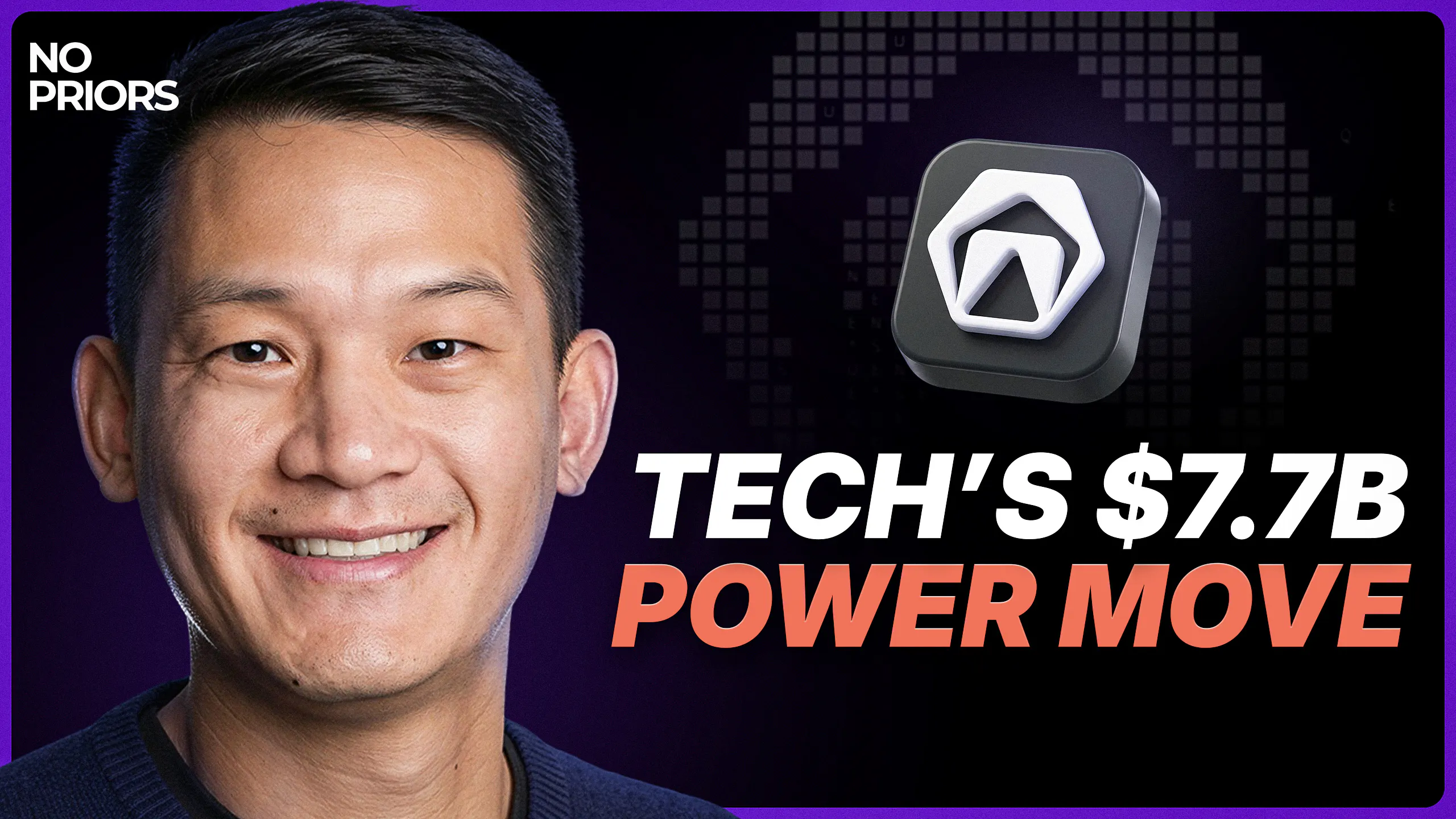
Re-Founding Incumbents for the AI Era with Sequence Holdings Co-Founder and CEO Michael Lee
from No Priors: Artificial Intelligence | Technology | Startups
42m 44s
Sequence Holdings is a private equity firm built on a radical rethinking of how technology transforms businesses. Rather than investing in startups or pursuing incremental improvements, it partners with established, high-value companies—like insurance brokers and banks—to re-found them into market leaders using frontier AI and deep engineering integration. The company operates as a permanent holding entity, enabling long-term alignment between capital, strategy, and execution. By focusing on organizational physics—such as centralized, dense operations—Sequence can build reusable platforms like Atlas, which standardizes workflows, improves agent performance, and reduces underwriting time by up to 94% at its bank pilot. A core innovation is the shift from celebrating investors to celebrating engineers, creating a culture where talent, ownership, and human-centric change drive results. Unlike traditional private equity, Sequence operates with extreme scarcity—only one deal per year—ensuring deep focus, quality, and long-term commitment. The firm identifies management teams already committed to technological change and equipped with strong industry fundamentals. Its success in the banking sector—where loan processing time dropped from 30 to 11 days—demonstrates tangible results. Sequence’s model, rooted in ownership, quality, and operational transformation, may ultimately offer a more sustainable and impactful approach to AI-driven change than traditional investment models.
Every company on the planet has a celebrated persona.
In a world where you believe that alpha comes from engineering and AI,
you need to create a culture whereby the celebrated personized engineer.
And that's what's required.
You think about your typical investment at a fund,
and you're typically trying to figure out how do we start to package
the cell listing in three years.
That is just a very different framing for how we think about technological transformation
and what more of the investments you're willing to bring to bear here.
What we do is scarce.
We're trying to do one deal per year.
That's it.
Our job is to do one.
Hi, listeners.
Welcome back to No Priors.
Today, I'm here with Michael Lee, co-founder and CEO of Sequence Holdings.
They just announced the largest AI take private to date
with the Dell Family Office of Baldwin for $7.7 billion.
We talk about this, the Sequence Story,
how AI transformation is actually going to permeate the economy
and what transfers from public investing to private equity to operating.
Welcome, Michael.
Michael, thanks for doing this.
Thanks for having me.
You started Sequence Holdings,
which is a permanent holding company that works with management teams
to buy and re-found their businesses to be market leaders with AI.
We should talk about that and it's a very exciting model,
but you also announced this big transaction in Baldwin.
Tell us about it.
Yeah, we started the company 20 months ago,
really with an eye towards,
can we partner with world-class businesses and management teams,
working closely with our frontier engineering team,
to forge market leaders?
The brokerage space is an area that we've been spending a lot of time
on since the founding of the business.
We've met dozens of insurance brokers and Baldwin was truly
end of one of all the insurance brokers that we've met.
It's been a privilege or less a few months.
It's been a lot of time with Trevor Baldwin and the management team,
and we can not be more excited about the journey that lies ahead
between us, the Baldwin team and the Dell Family Office
that supported us in this transaction.
I want to zoom all the way out to a little bit about your
background, you and your co-founder, Alex,
how this idea for sequence came about,
because you've been an investor,
now a hybrid investor operator.
Tell me about how you arrived at the idea to begin with.
You know, when I first joined Lumpine in 2017,
one of the first areas as I asked to cover was AI.
That's actually quite early.
Yeah.
It was, as I'm sure you recall,
it's kind of when AlphaGo came out,
it's actually when the first transformer paper came out,
and there was a lot of excitement at the time
around what would be commercially viable
if you scale these architectures.
And at the time, these were convolutional neural nets,
Gans, Ellis, Tim's, and the like.
And yeah, I think we all know how the story ends,
which is we obviously saw a lot of exciting things come out of it.
But as you scale these architectures,
they're degrading effects over time to scale.
You know, I share that context,
because when the models came out,
or Chatchee B.T. came out at the end of '22,
you know, what became obvious to me,
at least is that the world of forever changed.
You know, we finally had an architecture
that we knew could scale infinitely.
Now, whether or not that was possible,
what would come from that was not clear.
But we did know that we could scale with compute
that the architecture would improve.
And, you know, like an investor,
I started to think about what were the impacts to the world.
And I kind of felt strongly that AI would have
an uneven impact on the economy.
There are certain parts of the economy
that I felt that AI just wouldn't impact at all.
Right? Take restaurants, golf courses,
things like that. There are certain industries
that I just felt like a startup would win.
Right? Take coding, for example.
Like, conviction and sequence going to go
by an outsourced coding services business
feels like a terrible idea,
which you will give money to cognition or to end the topic.
But there as a student of business,
there have always been certain industries
where I felt like they incumbent at all the advantages.
And that could be brand, that could be scale,
network effects, regulatory.
And in light of what is going to be the biggest
technological shift or over our lifetime,
I felt very strongly that if you could acquire
the right incumbent and hair thin advantages
of being that incumbent,
could forge the market leader.
And the kernel of that idea is the one
that really is upon which sequence was founded upon.
Came up with the idea in early 23,
had a handful of people try to get me
to leave one pond and go do it then.
Just wasn't the right time for me.
And then I remember going for a walk with my wife in 24,
letting her know that hey,
it's pretty rare in life to be in the middle
of the most important technological change of our lifetime.
Having the kernel of idea,
I felt very strongly about
and feeling very strongly that
and I could pull together the team to go and pull it off.
And so that's why we could start a sequence.
And couldn't be more excited about kind of
what we've been able to achieve today
and kind of what we see ahead of us.
It's a super first principles approach
to what is the macro change
to this happening technology,
how's going to impact the economy.
But many investors,
at least venture investors,
if you're like,
oh no, incumbents have a bunch of advantages.
I guess it's just not for us.
How did you think about, you know,
scale and the idea of being able to engage with or even own incumbents?
That's a, I guess you could just do things,
but since that's an ambitious premise.
I think it's more just,
it's the business model that meets the opportunity today.
So like if you take a giant step back,
you know, at least at sequence,
when you think about what's happening with AI today,
we think we're living through the equivalence
of the next industrial revolution.
And, you know,
what we generally see at most enterprises,
what I typically see from a lot of the software companies
that are producing AI agents today,
is this giant push to give small machines
to every human in the human assembly line.
And to speed up work.
And like, there's nothing wrong with that.
That's great. It's better than nothing.
But as you know,
when you have machines that can work 24/7,
they can scale with electricity,
that can accomplish what no individual human or group of humans can do,
the right answer is to think about how you start to reorganize
what an organization should be
to meet the opportunity of what's available to you with technology.
And that's the context palm tree sitting in.
And I think for the, really in the first time,
we have a real opportunity here to partner with amazing companies,
with great leadership teams,
partnering with our platform and our engineering team,
and really thinking critically around
how do we reorganize the organization,
how do we lean into what's best
in terms of what the technology can do,
what can humans do,
and rethink how we can compete in these areas industries.
And I think it's just really more of an opportunity
piece more so than an ambition piece in that.
Like, I just think this has to happen.
And I don't see it a natural way for it to happen
unless you do it through our approach.
Can you talk a little bit about the structure of the company,
like why a permanent holding company,
you know, what does ownership enable you to do
that being a, you know, a vendor or a partner, doesn't?
Yeah, I think there's two parts to that question.
So in terms of like the holding company structure itself,
you know, when I thought about what is required
to accomplish what sequence holding wants to do,
which is how do we partner with world-class organizations,
how do we bring frontier engineering to bear,
how do we build a platform that we can share across all
of our portfolio companies,
doing natural way to do this through a holding company?
How do we build a business whereby we can forge market leaders,
how do we align the duration of capital
with the sustained investment and operational commitments
that are going to be required to drive the transformation end to end?
How do we create an organization that culturally
is oriented around forging market leaders not deploying capital?
And lastly, like, how do you create the right structure upon which
you can take the retain earnings in your business,
the rethink about how do you support your existing companies
and net new investments?
And so when I think about the opportunities in front of us,
the only natural way to go do this was through a holding company.
In terms of your second question around, like, ownership,
you know, let's maybe just play this out through an example.
Let's say that your incredible business,
yeah, I won't pick on one.
Let's say we're a Fortune 500 company.
You have unlimited resources.
The, if I challenge you to say, hey,
you're the CEO of this Fortune 500 company today
and your job is to refound yourself,
you're stuck with three options.
One is, I'm going to go do it myself.
The structural challenge with that, and it's not a bad one,
it's just, it's possible to recruit and retain the town
and require to go and do this refounding.
And the, the answer to that's actually much more obvious
than people think, which is every company on the planet
has a celebrated persona.
So let's take Blackstone, for example,
an incredible organization, one that I admire a lot,
and in fact, I make every person a sequence
for you can, can't, king of capital.
But the celebrated persona Blackstone is the investor.
And that's why they're able to aggregate
the greatest investors in the world.
In a world where you believe that alpha comes from engineering
and AI, you need to create a culture
whereby the celebrated persona is the engineer.
And that's, that's what's required.
It's the reason why, why does Palantir exist?
You know, I'm sure Alex Carp would hate how I would describe this,
but it is foundationally an organization
that has aggregated world-class engineers
that celebrates the engineer.
And, and foundationally what they do is it's a rapper
to sell it to other organizations that are not able to get that talent.
So that leads to me to my second point.
So if you can't get the talent to do yourself,
then there's this huge multi-trolling dollar industry
that I got formed called the services industry.
And these are great companies,
Accenture, McKinsey, Palantir,
that have, do celebrate the engineer,
that do celebrate change in technology.
But the challenge that you have when you partner with a services provider
in terms of rethinking and refounding your business
is an incentives problem.
Services companies optimize for kind of three things.
Getting in your wallet, staying in your wallet,
growing the share of your wallet.
It is a path towards incrementalism.
To compound that, services providers can't actually change the things
that you really need to really kind of meet the moment.
How do you change how the people are organized
who's working in these organizations and the incentives?
And so if you can't do it yourself.
So if you can't use vendors and you have the third option,
which is what a lot of people do,
which is they go buy software.
The challenge with buying software is twofold.
The obvious one is that it's beta.
If it's available to everybody,
it's available to everybody.
I think the part that's more nuanced
that I think people often miss
is that if you and I were starting a software company,
the thing we would optimize for is,
what is a workflow that's reasonably homogeneous
that exists in a lot of places?
And then how do we install it fast enough,
but deeply now such that we can sell a lot,
it's sticky.
Those are the genetics that we--
- Structurally yes, that sounds very attractive.
- That'd be the genetics of what we'd look for.
What that means though is that you're always
going to sell to a workflow as it's designed today,
as a humans are set up in that human assembly line today.
It's the only way you can sell a product.
You can't sell a product around a new human assembly line
that doesn't exist today because that's how you think it is.
And so when we think about why does our motion work,
it's how do you have ownership so therefore you're aligned?
How do you bring, create an organization
like sequence holdings that celebrates
and engineer and bring frontier engineering to bear?
And then three, how do you drive a long-term horizon
in economic models such that we're aligned with management
around how do we think about how do we forge
the best version of this company possible
based on the technology that's available today?
And so that's how we think about our business model.
It's why we think it works.
And the early evidence from kind of bank south
and kind of what we've observed in the field today
have proven that out today.
- I want to talk a little bit about bank south as well,
but in, you know, you have a team that includes
a bunch of like scale and volunteer DNA.
You are trying to keep the quality bar really high.
What is compelling to the team,
the engineers at work at sequence?
- I think it's a bunch of things.
I think the first is really it's an opportunity
to kind of work on the companies that actually
are the capillaries upon which people interact with.
You know, the AI model companies are phenomenal.
We would not be here today if it weren't for Anthropic,
OpenAI, XAI and the like.
But the reality is is like the impact
to everybody's day to day lies really are going to be impacted
by the companies that serve them today.
And so for us, it's the opportunity to partner
with really important companies that play an important role
in the economy and really thinking about
how do we bring world-class technology to bear
to deliver differentiated experiences
for their customers.
And I think that mission is like quite powerful.
I think, you know, when I think broadly
about the two engineering personas
that we typically hire from, I think, you know,
called the Ford Employed Engineers.
The, I think that the thing that appeals to them
is the opportunity to be really aligned
with the value that they create.
And I think that's an extremely rewarding experience.
And I think the ability to drive the type of change
that would not be possible
if you were a service provider is quite appealing.
I think the other hand, which is probably not as fun
for venture capitalists to think about is like, you know,
when I talk to application software engineers,
it's, hey, we're one of the few business models
in the world that's completely immune
to what the model is going to do.
As the model performance is improved,
we celebrate here at Sequence
and that like that gives us more tools
to bring to bear in the companies that we partner with.
And like there's no real existential risk
to whether or not our business will be around.
And I think those were kind of things out of appeal.
I think the mission is probably the thing
that drives it at the end of the day.
But I do think there are tangibles
when we talk with candidates
that have been quite appealing
for kind of what we're trying to build.
- I remember when you first told me,
hey, we think we're gonna go by a piece of a bank
and partner with the bank south team.
I might have reacted with some mild horror
about the difficulty and regulatory concerns around that.
It's like Michael, you must know that there's a reason
that banking is not a popular private equity sector
traditionally.
Tell us a little bit about how you chose financial services
and then what you've learned
in the bank south partnership so far.
- Yeah, so I think it's worthwhile to take a step back
and thinking about how did this investment come to be
and then maybe the tackle kind of how and why
it's been kind of the perfect place
for us to start our business.
So when we started this business,
we called it March of last year
when you first kind of wrote the first investment
the sequence, you know, we had a cold start problem, right?
So it's the holding company models of weird business.
Like without money, you can't do a deal.
If you don't have a deal, you can't hire engineers.
You can't hire engineers and want us to give you money.
Thankfully, you know, you were willing to support us.
You know, we were able to get a handful of engineers
to come work with us,
but yet we were stuck with kind of the cold start problem
with nothing to really do.
And one of the things that we were debating at the time
was do we just go buy something to prove to the world
that we can buy something and change it
or do we wait for the right asset?
And as I think you know, we've always had a bias
towards scale and enterprise.
Unfortunately, there are not a lot of investors in the world
that want to give you hundreds of millions of dollars
so you will buy an enterprise
to see whether or not your technology works.
So what we decided to do is to go and take on a customer
and you know, call the dear friend, Jamie Reynolds,
he's one of the co-founders of a year.
And basically frame for him,
hey, like here's the problem that I've run into.
And very fortunately, he has family happens to own a bank
down in Georgia.
And that's how it became our first customer.
And that started off August of last year.
In fact, it was August 4th, it was my anniversary.
I remember skipping it.
And it was an incredible experience.
And so from August to about November,
like kind of late November of last year,
basically operating in a services motion.
And like really started to tackle
kind of the key workflow that existed at the bank.
Fortune to us, you know, the family asked us at that point in time
whether or not we'd become a permanent partner.
And that's how it became our first investment.
We ended up closing the investment in March
took us a little while to kind of negotiate everything
as well as get fed and OCC approval.
But I think it's, I share all that context to say
that like operating in a services motion
and then being an investor,
we saw a night and day difference, right?
It's a lot of things.
One is from an engineering perspective.
You know you're gonna be here for a long time.
So the level of complexity and depth
that you're willing to take on
a service being a service provider
knowing that you'll eventually leave
and have to leave behind applications
that other people have to maintain
is dimensionally different.
The second thing is just a lot of excitement
from the employee base around,
hey, these people are here to support us for a long time.
So how do you push the most ambitious version of this?
And then three is like really,
we can take a long-term orientation around like,
what do we want this bank to look like?
Three years, five years, 10 years from now
and how do we lay the technological foundation
such that we're always benefiting from model performance?
And that's what we've been able to do.
In a weird way, the bank was the perfect pilot
for what we need to do to validate our business model.
It was an ability to bind to minority stakes
so adventure skills type check
to operate in a real enterprise like environment.
And in a weird way,
the regulated nature of the bank
was a feature not a bug.
One of the nice things about a regulated institution
is that how it operates is well defined.
The data hygiene is excellent.
There are well-defined rules around
how your business is supposed to operate.
And so if you think about that context,
it actually works extremely well for agents.
That's one piece.
The other piece has really important for banking,
which has been quite a learning for us
in terms of how we think about investing.
It's a centralized nature of it.
So when we think talk at Sequence
about companies we're looking for,
we talk a lot about organizational physics.
We like organizations that are quite dense
and the operations are centralized.
So anything you build can be advertised over a large base.
So like take a bank, for example,
a bank may have a bunch of different branches
but all the underwriting happens centrally.
So everything we build at headquarters gets advertised
over all the branches that they're working with.
You contrast that with I think a lot of the roll ups
that we see out in the marketplace today,
which I think is an awesome strategy,
but there's a lot of complexity with it.
You have the inter-grade different systems.
You have to send engineers to a number of different places.
You have to standardize operating procedures.
You have to standardize cultures.
And for us, the nice thing about the bank
is that while it's a large organization
with $100 million plus of sales,
like the physics of the business are quite dense.
And therefore, we've been able to make
a lot of progress in a short period of time.
There's a central nervous system.
There's a ledger, there's some key processes.
There are levers you can pull economically.
Exactly right.
Why insurance brokerage?
So the brokerage space has been an area
that we've been spending a lot of time
and since the founding of sequence.
It fits a lot of the things that we look for.
And so what do we look for broadly
when we're as an organization?
We think about one is scale the market.
You know, what we do here is sequence doesn't scale.
So if we're going to make an investment,
we need it to count.
We want it to work on companies that we think
we can build into $100 billion plus companies.
I mean, you're not going to do this 10 times a year.
No, we're not an investment shop.
We partner with great companies to force leaders.
The second thing that we cared a lot about is,
is it an industry where the incumbent has all the advantages?
And I'm happy to go into that in greater detail.
And then three is, if we think about what the organization does
and what AI is good at today,
and we think about the overlap,
can we build something special?
And the broker's industry in a lot of ways fits all that.
It's a $2 trillion plus of premiums per year
going to carriers, the brokers take a vague on that.
And it's been an industry that has minted dozens
of very skilled companies, large companies over time.
In addition to that, it's just been a wonderful industry
that's been really hard for startups to compete in.
And it's for reasons that are less obvious
to people than people think.
If you think about the insurance value chain,
just three parts to it.
You have the carriers, you have the distribution partners,
and then you have the customer.
The carrier has makes money two ways.
You have underwriting, which is I price risk.
I hope to pay out less claims and what I receive.
And then the other part of the business is investing.
The insurance industry since the beginning of time
has almost made no money underwriting
and has made the principal amount of their money
through investing.
So what that incentivizes is asset gathering.
So getting high quality growth for an premium
is the name of the game.
And so that's why the broker's industry is so powerful.
Another interesting feature about the brokerage and industry
is that your customer doesn't actually pay you.
The carrier does.
So if you think about the nature of the business,
which is a very relationship-centric business,
growth retention rates are 90%.
Anything about the fact that a broker doesn't really compete
on price is a very difficult issue for startups
to get into.
So if you think about what's perfect for sequences,
it's a huge market.
You have companies that are largely immune to startup risk.
But what if it could partner?
with the right one. And that's what the opportunity at Baldwin presented, which is a scale that
a scale that asset with a centralized technological foundation and a world class leadership team that
is both ambitious but also extremely excited about what's possible today with frontier technology.
What can you say about what is a generalizable or shared promote like a platform technology
perspective across the different companies?
Yeah, so I think if you take a step back, we think about our shared platform capabilities
as too broad and too broad areas. One is Atlas, which are our platform, which I'll tell
you about here more in a second, and then our engineers and we have a playbook for how
we work with companies. This is an art, not a science. I often joke internally that we
have two problems here at Sequence. We have an engineering problem and a human engineering
problem and a human engineering problem is much more difficult than an engineering problem.
So if we think about the engineering problem, we think about Atlas. So what is Atlas today?
Atlas is our platform that we have built at the bank that we think that we expect to generalize
over industries over time. And part of that is an observation that a number of our engineers
have had from their prior lives, both a scale, volunteer and others, which is if you break
down the business to its atomic units, 80% of its largely homogenous and 20% of it is
vertically specific. And so if you think about what is Atlas, Atlas is basically our platform
that both does a number of things. One, it helps improve the speed to which we can deploy,
improves agent performance, improves our build rates for our own engineers, and ultimately
it's a builder platform that allows the operating company engineers to build upon. There's
four layers to it. So the first layer is the data ontology. So think about that as just
simply, how do we define the organization, the motion of that business in code? And
that's extremely important with the way that we talk about internally is how do we make
the business legible the models, right? How does a business, how does an agent know that
this customer is the same as the customer in this system here? And how the properties
of that customer interrelate with the claims or the loan policies that are associated
with it. The layer on top of that is our agent builder, which is basically how do we build
high performance agents grounded in ground truth, kind of kind of the things that we think
we hear and read a lot about. The third component to it is what we call lattice, which is our
orchestration engine, which is like, how do we actually instrument workflows using the
agents that we've built? And on top of that, at the top is what we call artifacts, which
is basically our application builder that sits on top of everything that we've built.
And so if you think about what we've built in terms of Atlas and what we've built here
at the bank, foundationally, all the core infrastructure we've built is reusable at Baldwin
and any future company that we do. And so that's like a core component of what we've built
to date on the playbook side from an engineering perspective. Yeah, like I think this part is
is an art, not a science. You know, I think one of the nice things about having great talented
engineers from places like Scaliye and Palantur that they have developed the playbook. But
you know, what we do is different. You know, I would say that, you know, one of the learnings
that we've had with the bank post the investment is how much more hyper attuned we need to
be and sensitive to how employees feel, which is like there's, you know, as exciting as
it is, it does draw a lot of anxiety around like, what does this mean for us as an organization?
And the key thing for us to sequence is how do we make people feel like what we do when
we bring to bear here is how do we make elevate what you do here at the job? How do we exercise?
What is the best parts of being a human? How do we think about making your job more
fun, taking away really the wrote kind of repetitive work out of your workflow and how do we
make feel make you feel like your organization's winning? And like that playbook is something
we're going to continue to refine. I think we've learned a lot here at the bank. We expect
to learn a lot here at Baldwin and like that's going to be a key component of what compounds
of our time for us to sequence. What do you think is going to be special for you guys
over time here that's very hard for, let's say, more traditional large buyout shops to replicate?
Right? Because I don't know a single one that doesn't, I think, at least think about AI
transformation today. And like much of what they do from a returns perspective is probably
dominated by, you know, underwriting consolidation to platforms, multiple expansion, some financial
engineering. But I do think, you know, people have like, let's say portfolio value teams.
So how do you draw the distinction more strongly between, we're not investing shop. And like,
here's what we think it's still hard for other people to do with us. So I have a lot of
admiration for all the big private equity firms. I used to work at Apollo. I have a lot of friends who still work at all these various firms. I think
they will continue to do great. But I deeply believe that we have a very different business.
Right. If you think about your typical private equity firm, they are set in a fund structure,
the fund structure economics are such that an incentive is easy to deploy capital. They're
in the business of finding great assets, pricing them attractively, putting the right capital
structure in place, doing sufficient amount of value creation to generate the required
rate of return to satisfy their LP base. Our business is very different. Our business
is around how do we find world-class organizations run by exceptional people and taking an
extremely long-term horizon around how do you force the market leader? And what we do
is, it's different by virtue of that. Now, I think there's a, the pointed question
you, I think you're getting to is can private equity firms over time do radical AI transformation
through their motions? And I think many will definitely make a lot of progress on this
front. I certainly think private equity firms are incentivized. They have the resources,
they have the capabilities to start to go and make meaningful progress on this front.
I do however think that there are a number of limitations that they do run into. And
I think many will find ways to solve parts of these. You know, one is like, how do you
recruit world-class engineers to come work at your firm? It's really difficult to do.
Your typical P firm has designed itself to celebrate the investor. And when I look at
my great engineers, they want to be in the room when decisions are made. They want to
have a say in terms of like, hey, like whether or not this is a good or bad business. My
guess is if you go to your typical large cap buyout firm and be highly unusual to find
a 25-year-old engineer have any say in terms of that investment profile. So I think that
will be challenging. I think the second part that's challenging is just to time horizon.
The reality is if you think about your typical investment at a fund, they'll tell you it's
a long time horizon. We're typically trying to figure out how do we start to package the
sell listing in three years. That is just a very different framing for how we think about
technological transformation and what are the investments that you're willing to bring
to bear here. And I really think the last thing is just, you know, for us, we just have
an extreme, extreme focus on quality of business and team. And it's not to say other private
equity firms do not. But what we do is scarce. That's it. We don't have a deployment cadence. I don't have a group of investors and
LPs are telling us, "Hey, like you guys were under invested in the year. Our job is to
do one." And if that means that we don't do any this year, that's fantastic. And it's
just like a very, I think a very focused and deliberate approach that's just very different.
We're going to touch a very small surface area of the world. And I expect all these other
private equity firms to continue to do great. But I do think there are core differences
in terms of the genetics of the companies that we've built.
I hope to hold sequence equity for, you know, the rest of my life. So, you know, go forth.
What just one more question on your own underwriting and the scarcity. It must be true that
every CEO in their earnings calls of the last few years has talked about AI. I think
people recognize the change. I think people genuinely want to invest in these capabilities
for their companies. What are you looking for in management teams where you say like we
can help you become a leader, or even a more dominant leader?
You know, I think you can learn a lot about a management team just in terms of like how
do they play the game in the industry, upon which they grew up in? And like that's just
like a core part of what we look for, which is at the end of the day, sequence has wonderful
engineers. We have a very talented investing team. By the day, like I have no expertise
running a broker. I have no expertise running a bank. We're heavily reliant on the management
team to be the best at their craft and competing in their respective industries. And like that's
a core component of like how we evaluate management teams. The second piece, which is kind of
more kind of central native to what we do is what we do is difficult. Like change in
transformation is hard. And as I alluded to earlier, like the human engineering piece,
it's like the hardest problem that we're going to work on. And so when we think about the
management teams that we want to work with are management teams that have been excited
about technology that have already started to put the groundwork on the play the foundation
on driving change. These are going to be small things around being in the cloud, like centralizing
your data infrastructure. It probably means that you've already started to install open
AI or and/or anthropic across your organization. You're making those efforts. And it tells
you a lot about the individual who is willing to go ahead and do that at a point in time
we're still like not obvious to go do. There's a lot of noise about like, is there any
real ROI on AI today? Yeah. And then also there's a lot of angst and anxiety and understanding,
you know, how do you how do you get your employee base excited about the fact that this is where
the world is going? And we're going to be at the forefront of it. And so, you know,
I think Baldwin is a perfect example of that. You have, you know, Trevor Baldwin and
exceptional CEO, he was early in terms of driving and the topic end to end within Baldwin.
They are on a single instance of applied epic, which is your AMS, which is functionally
called the core operating system and insurance broker. And these are not easy things to do.
It takes a lot of intent kind of investments and change to go and do that. And so when
When you think about what is it that we look for, management teams is good.
exactly that. Are you great at what you do on the field? And then too, have you already
been driving the change in terms of adopting technology and leading into what's possible
today?
I remember when we first started talking about the sequence thesis, I was actually like
a little mixed on the idea of roll ups. I just said like, hey, you know, there's the
technology piece. There is change management. There's operating the actual company. And
then there's underwriting. And then there's deal making, right? There's like, there's
a lot of pieces go, I believe that this is the, this is a way that enormous businesses
can change and go win industries. And then I think it's much, much harder than people
think. And I think it's better at scale. And I remember you describe, you and Alex described
that to me much more clearly where they're like, actually, we think change management
and operating the business is going to be the hardest part. And we have to assemble
the team to go attack. But we're also going to partner with people. And as a, as a zero
to one venture person, I'm like, ah, with incumbents, but I, I, I, I now believe that is
the correct path with the right management teams, of course. What have you actually already
accomplished at the bank, if anything? And then what is giving you confidence on doing
this at more scale?
Yeah. As I mentioned earlier, you know, you know, post investing in March, we took a
giant step back. And we thought about as we look forward over the next decade, what
does like the leading community bank look like? And so we break down a community bank into
as simple as parts, it has three parts of the business. You have a part of the organization
that hunts for deposits, the part of the organization that hunts for loans. And then you have the
core apparatus in the middle today that works very closely around how do we underwrite
deep, underwrite loans and ensure that we don't we're giving loans to the right people
in the community, such that we're servicing the community in the right way. But we're
also creating kind of the right economic model for banks out. If you think about what we
have done today is if you think about your average bank, historically speaking, loan volumes
grow linearly with call it middle and back office headcount for no other reason than the
fact that like processing alone is a complex endeavor and it does require a lot of individuals
to be involved as a part of that process. Well, we have spent a lot of time on since we've
got involved with the bank is how do we not only improve underwriting, but how do we ensure
that all the people at the organization are focused on the things that they're best at.
And so how do we get the underwriting team to stop spending time in terms of inputting
numbers, but spending much more time on loans that have exceptions? Well, we've done
since we got involved in the bank, for instance, March. And so it's been called roughly six
months since we first invested. Well, we've done now today is we've built a system that
can take on all consumer loans within the organization. So the average consumer underwriting
today has decreased by 94% since we got started in March. Another good example of kind
of what we've done the timeline, the timeline. So that's really powerful. We've started
to roll out commercial loans underwriting over the last few months and we've functionally
have taken the average loan at the bank, which used to take 30 days to go into end to
11 days. I share that to saying that why is that powerful and why doesn't matter? Is
that fundamentally what we've done with the tools is that we've allowed the organization
to be able to take on a significantly more loan volume than was ever possible before
with the same amount of headcount. This is purely luck. I'm not going to say sequence
at anything to do with this, but in Q2 of this year, relative to Q1, loan volumes doubled
at the bank. Historically, the bank would actually turn away business in that like the
middle and back office, you know, while everyone is working really hard, has limits to how
much bandwidth that they can take on. Given the systems that we've built actually, the
bank was actually able to handle all the loan volume, not change their underwriting standards
at all. In fact, where it was able to do this with a significantly smaller underwriting
team than what had existed prior to our investment. And reason why the underwriting team is smaller
is one person retired and one person out moved into the front office. And I think that's
just exemplary of kind of what is it that we do, which is like how do we ensure that the
right people are in the right places? How do we get them to work on the things that
they enjoy working on? And how do we allow the organization to do more with less? And
what that is resulted in is that every individual at the bank today gets to spend time on what
they do best. Loan officers are spending more time in the field versus writing credit
memos. The credit underwriters are working on the hardest and most complex loans versus
thinking about how do I figure out whether or not we should issue a loan for a boat when
the person already clearly has enough money. And that's what we've achieved at the
bank so far. And as we look forward, we think we've laid the foundation for what should
be a really exciting roadmap ahead around spending up new products and new businesses,
giving new tools to the loan offer figures and relationship managers such that they can
sell more products. And then how do we start to think about delivering a differentiated
customer experience that no one else in the industry can do?
So when we met, you were leaving the private business at Loan Pine, a career investor.
What is the biggest surprise or realization having started a company?
I get asked this question from friends of mine in the investing business. And, you know,
maybe like if you take a giant step back, the level of empathy I have for founders today
versus even when I was running the private business as Loan Pine is like just night and
day. It is remarkable to see people take an idea from nothing to something. It is not
easy to attract people to come join you on your journey. It is not easy to attract capital
to join you on this journey. But it is exceptionally fun and rewarding. And I have an immense amount
of gratitude to the people who supported us at the beginning, like yourself, like Joe
and Drew at E.C. and to all of our early employees. And, you know, what I'd say is that it is
the highs are highs, the lows are low. There are days where it is extremely exceptionally
lonely. But I cannot be having more fun. And all I have to say is that everything that
Elon and Jensen talk about in terms of being exceptionally painful is exceptionally true.
But it has been a lot of fun.
I love this partnership of equals, sequence holdings and the Dell family office. Tell me
about how this happened.
It is a great story. You know, as you can imagine in a take private scenario, you do need
to have certainty of capital. And as ambitious as we are and as amazing our partners are,
most people don't have billions of dollars around to support an equity commitment letter
for our take private. And so, you know, we started spending time with a number of partners
in the market to think about approaching Baldwin together around kind of exploring that these
said we brought to bear. We got introduced to the Dell family office. And, you know, I
have to give Michael Dell, Dan Batar, who is the head of Global Direct Investing and
Transmetic Credit for working closely with us to underwrite the deal, underwrite our
technology platform or technology transformation motion and supporting us in this transaction.
They've been wonderful partners to us. We are going to be cool controlling this at Baldwin
together and we expect to be partners for a long time.
So you have been a private market semester, a public semester, an operator, you know, I
guess you know how you're doing take private. How do you think your career has affected
like the way you predict markets, the way you look at markets and the unrolling of this
technology? I think I've been very fortunate in my career to have the opportunity to wear
a lot of different hats and learn the different crafts of investing. You know, so I worked
at Goldman coming out of college. I went to work at Apollo, which was just like an awesome
experience learning how do you structure or deal? How do you think rigorously around capital
structures? How do you understand credit agreements and documents? How do you design management
and incentive plans and like really learn the blocking talent of like private equity?
The opportunity to go to Lone Pine was really an opportunity to start to study the best
companies in the world. You know, what's amazing about Lone Pine and work in an organization
that I guess to look at the full public company universe and have the difficult challenge
to figure out what are the best companies in the world is just an amazing aperture to learn,
right? Like why what makes Nvidia great? What makes Microsoft great? What makes Visa great?
And I think you learn, you know, just maybe an overused term today, like a real taste
for like what is a great business? And then you also learn to appreciate the benefits
of long term compounding. And that was a really, really powerful kind of five years that
I did at Lone Pine around studying the greatest companies in the world and like really deeply
internalizing that the greatest companies in the world to compound at rates that no one
ever thinks that they can. The opportunity to kind of go and build out the private investing
business at Lone Pine was really an opportunity to start to spend time at the frontier of technology.
Spending time with founders working on really hard problems that like other people didn't
really see seeing what it takes for someone to will something to not from nothing to something.
And then really getting really, really deep in terms of understanding where technology
is taking the world. And so if I reflect on like how and why I think about the world
that I do, it's it's kind of the amalgamation of these experiences, which was like, how do
I think about kind of an owner, the benefits of ownership? How do I think about that with
the taste of what is a great business and having a real appreciation for the benefits
of long term compounding with like, man, like here's what's possible if you marry that
with world class engineering and frontier technology. And like I think that's, you know,
the that experience has really what colors how we think about investing here at Sequence
Holdings, which is like, how do we marry kind of all the skill sets and the best of what
I think are kind of the key domains for my best investing career?
you've never been officially an early-stage venture
capitalist. What do you think that this class of asset managers
misses? If I were to take a giant step back and if I were to
rethink how I would approach private investing today, if I were
ever to go back into it, which I won't, but is just finding
exceptional people working on hard problems in big markets. If
I've learned anything in terms of my experience as sequins,
spending time with other founders today, is that ideas are cheap
and execution is really hard. And truly exceptional people
will always figure out how to make something work. And that may be
because they bring someone on board that highlights a weakness
that they have. It may be that they're able to, with enough
persistence, get the right people to come support them and
something that everyone else thinks is crazy. And so if I were to
go back and do it again, I think betting on exceptional
people is the kind of the only thing that matters. I just think
that the vast majority of other things, whether it's the greatest idea
we've ever seen, like the greatest hottest traction we've seen in
a short period of time, like I think are important signals. But
in the day, this is a people business, particularly early on.
And people working on who are highly ambitious on really hard
problems that are in very large markets, you should back them all
the time, even if it seems crazy. Because I think the, you know,
the upside convexity of backing those people largely offset
kind of the rest. That's a very, isn't that the most
purest venture attitude? I think that's exactly right. Mr.
Michael Lee, private equity and public markets guy is saying
back great people in huge markets. That's exactly right. I
think that's the name of the game. And I think that's also true in
public markets as well. Like if I think back and I reflect on
like the best investments that we've made at Lone Pine, if I
think about the, the best companies I've been in the market
today has been like go find exceptional people. Like I think
the best example that is like, I remember meeting Jensen
Huang in 2017. It's kind of crazy to think at the time, like
today, that like, it wasn't what it is today. And he has been
remarkably consistent, clarity of thought, incredible execution,
been able to surround himself with the smartest people in the
world who are extremely loyal and has constantly figured out
ways to kind of refound his business to compete in a ever
changing market. And find exceptional people working in big
markets. And I think whether it's early stage or late stage, I
think most people will be surprised to the upside in terms of how
that always plays out. This is a great note to end on. Thanks so
much, Michael. Thanks for having me.
Podcast Summary
Key Points:
Sequence Holdings partners with world-class management teams to re-found businesses using frontier AI engineering, creating market leaders rather than simply investing.
The company operates as a permanent holding firm to align long-term strategic vision, ownership, and operational culture with sustained transformation.
A core belief is that AI will disrupt economies unevenly, and success lies in acquiring incumbent businesses with strong organizational advantages like brand, scale, and regulatory moats.
The business model rejects traditional private equity approaches by focusing on deep, long-term transformation—prioritizing human engineering and organizational change over short-term returns.
Sequence’s platform, Atlas, enables reusable engineering frameworks across industries, improving agent performance, workflow orchestration, and developer productivity.
The firm prioritizes management teams already engaged in technology adoption, with proven intent to drive change and align employee incentives with innovation.
Unlike traditional private equity, Sequence has a scarcity-driven model—only one deal per year—ensuring deep focus, quality, and long-term ownership.
The company’s success hinges on celebrating the engineer as the central persona, fostering a culture of technical excellence and operational agility.
Summary:
Sequence Holdings is a private equity firm built on a radical rethinking of how technology transforms businesses. Rather than investing in startups or pursuing incremental improvements, it partners with established, high-value companies—like insurance brokers and banks—to re-found them into market leaders using frontier AI and deep engineering integration. The company operates as a permanent holding entity, enabling long-term alignment between capital, strategy, and execution.
By focusing on organizational physics—such as centralized, dense operations—Sequence can build reusable platforms like Atlas, which standardizes workflows, improves agent performance, and reduces underwriting time by up to 94% at its bank pilot. A core innovation is the shift from celebrating investors to celebrating engineers, creating a culture where talent, ownership, and human-centric change drive results. Unlike traditional private equity, Sequence operates with extreme scarcity—only one deal per year—ensuring deep focus, quality, and long-term commitment.
The firm identifies management teams already committed to technological change and equipped with strong industry fundamentals. Its success in the banking sector—where loan processing time dropped from 30 to 11 days—demonstrates tangible results. Sequence’s model, rooted in ownership, quality, and operational transformation, may ultimately offer a more sustainable and impactful approach to AI-driven change than traditional investment models.
FAQs
Sequence Holdings partners with world-class management teams to re-found businesses using frontier AI engineering, aiming to create market leaders by transforming operations and leveraging AI to improve efficiency and performance.
The structure enables long-term alignment with management teams, allows ownership of businesses for sustained transformation, and creates a culture where engineers are celebrated, not just investors.
Sequence focuses on deep, long-term operational change with a strong engineering presence, rather than short-term returns. It prioritizes quality over scale and celebrates engineers as the core of its culture, unlike traditional PE firms focused on capital deployment and underwriting.
It has a large market size, incumbents with strong advantages, a centralized and dense operational structure, and a high barrier to entry for startups—making it ideal for AI-driven transformation by reorganizing workflows and enhancing underwriting.
Atlas is a reusable AI platform built to standardize and scale AI deployment across industries. It includes layers for data ontology, agent building, workflow orchestration, and application development to improve speed, performance, and efficiency.
Sequence looks for management teams already engaged with technology, such as adopting cloud infrastructure or AI tools, and evaluates their proactive leadership in driving change and fostering a culture of innovation.
Chat with AI
Loading...
Pro features
Go deeper with this episode
Unlock creator-grade tools that turn any transcript into show notes and subtitle files.
 PodcastTranscript AI