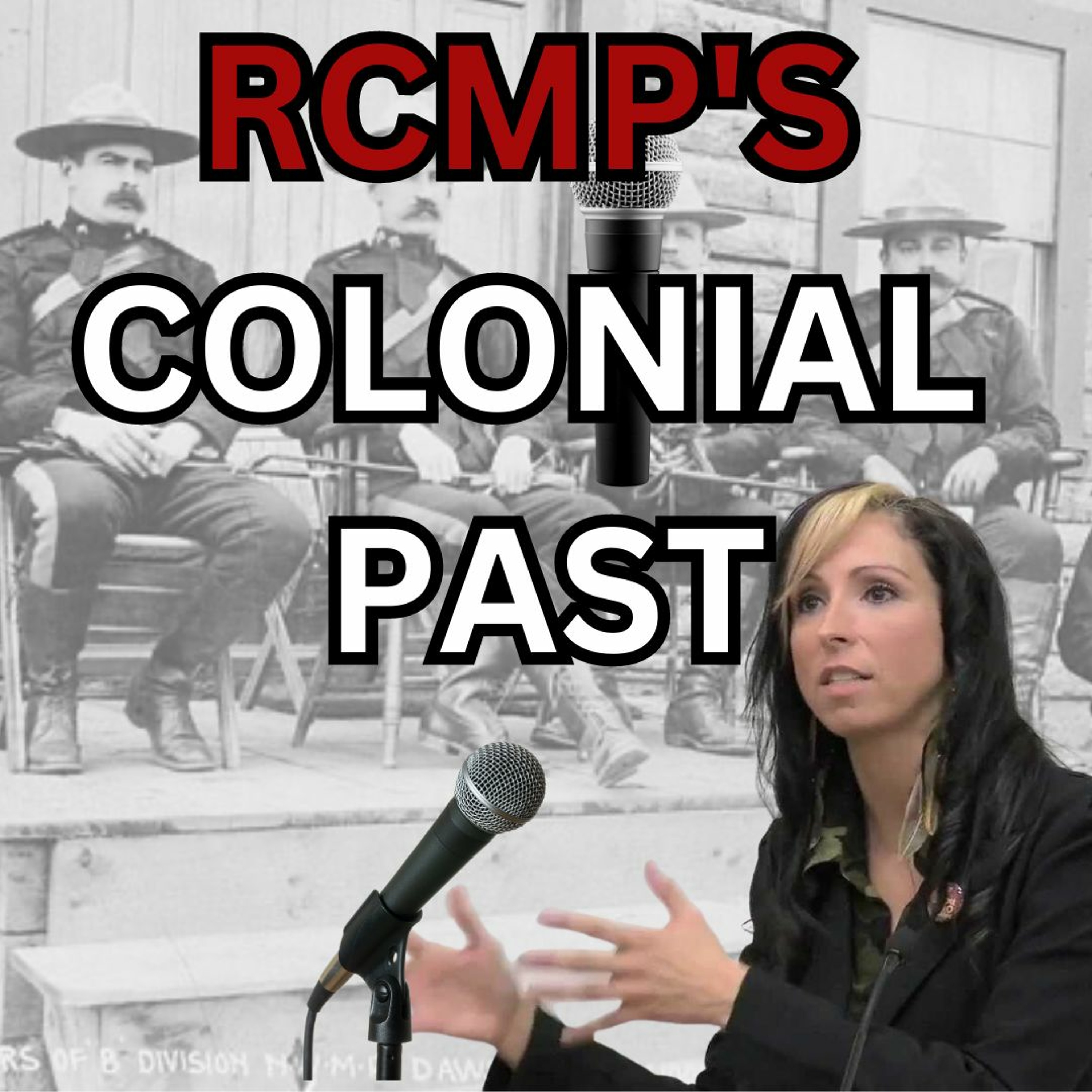
The transcription discusses the RCMP’s 150th anniversary, contrasting its official narrative of progress and service with critical historical and contemporary perspectives. The RCMP celebrates its growth from a small mounted force to a modern organization, pledging to evolve and build trust. However, the podcast host, Dr. Pam Palmer, and experts like Dr. Sean Carlton and Dr. James Daschuk, challenge this view. They argue that the RCMP’s origins as the Northwest Mounted Police were rooted in colonial and capitalist interests, serving to suppress Indigenous peoples and enforce dispossession. Initially, the force had positive relations with First Nations, protecting them from whiskey traders, but quickly shifted to enforcing oppressive policies like the pass system and residential school attendance. This pattern continues today, as seen in militarized raids on Indigenous land defenders. The podcast highlights scandals, including sexual abuse, failures in investigating missing Indigenous women, and the Portapique massacre, suggesting the RCMP’s problems are systemic. The experts call for a critical reflection on this history, urging Canadians to see the RCMP not as heroes but as a colonial force that has consistently prioritized state and corporate interests over justice.
[Music] Today and in the months to come, we are celebrating the 150th anniversary of the Royal Canadian Monopolis, a momentous milestone. What started as a 300% core of Countrymen on Horseback has grown to a world-renowned organization of more than 30,000 employees from all places, backgrounds and experiences. As the Albert RCMP, we have the privilege of providing policing services in urban and rural municipalities, in First Nations and Métis settlements, and in remote areas across this province. Whether it be civilian employees working in units throughout our organization, special tactical teams in the field, or the officers and employees living and working in your communities, you are what drives each and every one of us to uphold the safety and well-being of Albert. [Music] RCMP 150 RCMP 150 RCMP 150 Today in honor of the 150th anniversary of RCMP, we have gathered all of our employees from Public Service and Voice, civilian members, regular members, volunteers, you name it, they are all here, we gathered on the bridge, we have got members from all different sections and units in the RCMP and just here to celebrate the anniversary of the course. I think what we are doing is honoring our past, seeing where we have come from, how we have evolved, how we have developed over the years, how we have continued to meet the ever increasing needs of our communities, but we are also looking forward to the future about where we can take the course and how we can better serve the kids. [Music] Warning, this podcast covers issues of police-related brutality, racialized violence, sexual abuse, and criminality. It may be disturbing to some listeners. In case it wasn't obvious, 2023 marks the 150th anniversary of Canada's National Police Force, an iconic institution that started out as the Northwest Mountain Police, became the Royal Northwest Mountain Police, and then transformed into the Royal Canadian Mountain Police, the RCMP. And just in time for summer tourism season, you can expect to see RCMP members dressed in their iconic red surge. The red surge is the dress uniform of the RCMP, which consists of military style red tunic, a high neck collar, and blue pants with a yellow stripe down the side. On the RCMP 150 website, you can also find a list of celebratory events from parades and barbecues to horse races in the musical ride. There's even, get this, "Ameet the Mounty Day." Yet, you don't see much hoopla on the ground in our communities, or in the national media for that matter, an understandably so. This anniversary comes on the heels of numerous RCMP scandals and failures, from billion dollar class actions by female RCMP officers for sexual abuse and sexual harassment by male RCMP officers, to critical failures on the ground, which contributed to the mass casualty in Port-a-Pague Nova Scotia. Not to mention, their role in the crisis of murder to missing Indigenous women and girls, either as the RCMP who failed to properly investigate the disappearances and murders, or as the perpetrators of sexualized violence themselves. The RCMP are not very popular these days. Were they ever? Hi, my name is Dr. Pam Palmer, and I'm the host of this podcast, "Criminals on Patrol," where we expose criminality, corruption, and cover-ups in policing. I'm an Indigenous lawyer, professor, and author, on a quest to expose what goes on behind the thin blue line of policing, in a push for transparency, accountability, and radical change. Our first target, or excuse me, I should say, season, focuses on the Royal Canadian Mounted Problem. In our last episode, we asked the question, were the RCMP and its earlier iterations of the Northwest Mounted Police, friends to native peoples, or were the RCMP enforcers in the Colonial Project to get rid of the Indian Problem once and for all? In episode two, a Colonial Past, we will start our investigation into the RCMP as a force by diving into the historical research and consulting with the experts. I also contacted the RCMP before creating this season, requesting an interview on all of the subjects that we'll cover in this podcast, but they declined to participate. So in fairness, I'll make sure that their voices are included through publicly available information. So let's jump right into it. This year marks 150 years since the creation of Canada's National Police Force. Established by an act of parliament on May 23rd, 1873, Canada's first National Police Force was created for the preservation of peace and the prevention of crime. We originally called the Northwest Mounted Police, the force evolved over the years, becoming what we now know today as the Royal Canadian Mounted Police in 1920. We are an organization of dedicated people, proud of our accomplishments, rich in history, tradition and culture, and we continue to evolve. We acknowledge the mistakes of our past and are using them to drive positive change for the future. Today, with its Vision 150 plan, the RCMP makes a new pledge to become a more modern, inclusive and healthy organization, one that builds trust and confidence. And we pledge to do all this while continuing to fulfill our primary mandate of keeping people safe. That was Officer and Charge of Richmond RCMP, Chief Superintendent Dave Schohan in a promotional video on RCMP TV. Yes, in fact, they have their own YouTube channel called RCMP TV. Such like Deputy Commissioner Curtis Sublocky, Commanding Officer of Alberta RCMP's comments in the opening clip, it's clear the RCMP are promoting the idea that its organization has a history in which we can all be proud and that their sole purpose has always been our collective safety. But given all the bad press over the last few decades, I thought I should seek out the perspectives of some historical experts to give me a better insight into the RCMP's colonial past in the hopes that it might tell us something about what they're up to today or if they have a future. One of those experts is Dr. Sean Carlton, an assistant professor in the Department of History and Indigenous Studies at the University of Manitoba. He has his bachelor's and master's in history from Simon Fraser University and he got his PhD from Trent University. Dr. Carlton has numerous scholarly articles on Canada's colonial history and a new book from UBC Press called Lessons in Legitimacy, Colonialism, Capitalism and the Rise of State Schooling in British Columbia. He is a well-known historical expert and you've all likely seen or heard him in the media commenting on Canada's colonial history and settler-indigenous relations. I rely on his research in my own work and agree with his political analysis on many of the issues facing Canada. So I asked him, "What's up with RCMP 150? Should we be commemorating them?" This sort of feels like the RCMP version of "Copaganda" to me. Are they truly heroes on horses, deserve it of their iconic status in Canada's history? Well this is what Dr. Carlton had to say. Well, I mean, as a historian, I think it's important for Canadians to understand the role of, well, first the Northwest Mounted Police and then the RCMP as a colonial paramilitary force in its historical context. And commemorations are always times to reflect on history and understand the deeper history that is there. And so I think the 150 anniversary of the RCMP is a great time to kind of grapple with some of these pressing questions. And I think it's important not to have any illusions also about the law and the role of police in particular, right, to buy into the mythologies that we see about the Mounties as sort of do-good or red-coded riders of the planes, bringing law and order to the West that we see in like, you know, I grew up in the 90s and there was this show with Paul Gross called "Do South."
And it was like a do-good or mountain going to Chicago, I think, would play up the stereotype of the Mounties. And I think that kind of pop culture, perception of the Mounties really skews the history. It allows people to not really understand the more complicated origins of the force, that the job that they were created to do, to play more correctly, is serving and protecting the interests of colonialism and capitalist accumulation in Canada. And I think that this is also an important time because this has been made very clear actually in recent years, right? With the series of raids in Unseated, but in territory, right? The RCMP raids of Lutzoden, land defenders in Northwestern, British Columbia in 2020, left many Canadians, I think, rightly shocked and angered. - And that's pretty much what I've heard too. And what I've found in the research that I've done. Social media is literally full of Canadians, expressing shock at the videos they see of heavily armed RCMP officers looking like SWAT teams or military forces moving in on unarmed, peaceful, indigenous land defenders with dogs and snipers, helicopters and armed vehicles. How on earth did we get here? Is this the RCMP gone rogue or the RCMP doing what they were created to do? - So these images of the RCMP dressed in camo gear and armed with automatic rifles arresting unarmed, indigenous peoples clash with that popular mythology of the Mounties, right? And that stark contrast between galloping Mounties of the musical ride and the militarized police force sent in to be the muscle for an energy company has led a number of Canadians in recent years to view the RCMP in a different light. And so the 150 anniversary and these recent events, I think are colliding at a time where it's a good time to really look into this history and reconsider the future of the force, right? History proves that the mythology of the Mounties doesn't hold up, right? Far from a sort of one-off event, the RCMP's operation in what's so different territory is part of an ongoing pattern of police and military units being used by governments in Canada to suppress indigenous resistance and clear the way for continued capitalist accumulation by colonial dispossession. So we really need to take this opportunity to understand that history and look more deeply into the origins of the force, to understand these recent events not as anonymally, but as part of this ongoing pattern of police violence and that these really shouldn't be seen as aberrations, but as rather something that the force has always been doing since it's founding in the 1870s. - I think that's exactly it. So many Canadians have been educated to believe in the mythology that they can't process the reality right before their very eyes. Dr. Carlton pointed out that the RCMP as an institution goes beyond that of a police force simply created to keep settlers safe. There appears to be other interests at play. - So the Northwest Mountain Police then get renamed the Royal Northwest Mounted Police in 1904 and then the RCMP in 1920, so there's that kind of continuity. And my argument is that from the beginning, right? They continue to play that role as serving and protecting Canada's capitalist status quo. And sometimes the police get, we talk about the Department of Indian Affairs, we talk about Indian agents, we talk about church officials and their involvement in indigenous communities as agents of colonization. But whether we're calling the Northwest Mountain Police or the RCMP depending on the historical time period, they also need to be understood in what I call the church state police partnership in really policing settler capitalism and ensuring that it continues. And so I think from the origins to the ongoing relationship here, it's not just the early days of the Northwest Mountain Police, but the forces also been used for a variety of other things, not just war and conflict but signing treaties, ensuring after the War of 1885 that the past system, which restricted mobility for indigenous communities was enforced, it worked with the Indian agents to restrict that mobility, also to separate communities so that they couldn't organize and resist ongoing colonization. Police played that particular role, but their role of surveilling, right? It also continues. They were very active in surveilling Red Loft, one of the founders of the League of Indians, after the First World War, right? They were very concerned about indigenous political organizing. And then other things, like I don't think there has been enough written about the RCMP and their role acting as true and officers, taking children to residential and day schools, which I talk about in my work, arresting parents who refused to send children to these government funded schools or church-run schools, or one of the examples that I look at is residential school burnings or arsonists, right? The goal of the RCMP was not to investigate why children, as young as eight, would want to burn down their school to escape. The history of the RCMP is much darker than we'd been led to believe, that the world has been led to believe. Like Dr. Carlton said, this is exactly the time, during RCMP 150 celebrations, to really reflect on the link between the RCMP's colonial past and its colonial present. In our last episode, you heard a clip from Dr. James Dashchak, who is a well-respected professor at the University of Regina with a PhD in history, also from the University of Manitoba. His book, Clearing the Plains, Disease, Politics of Starvation, and the Laws of Aboriginal Life, published by the University of Regina Press in 2013, was named one of the 25 most influential Canadian books of the last 25 years. It also won the Governor General's Medal for scholarly research in 2014. This book contains some very important history that we were not taught in school. His research has also informed my ongoing work in this area. When I spoke to him, Dr. Dashchak seemed to suggest that the predecessor of the RCMP, the Northwest Mountain Police, were friends to first nations, and I have to admit, I had one eyebrow raised when I heard this. Friends? I mean, after everything Dr. Carlton said, could we be looking at two conflicting historical counts of the RCMP here? So I decided to dig deeper and ask what Dr. Dashchak meant by this. I talked to him about the Northwest Mountain Police and their transition into the RCMP and their role in the colonization of what would become Canada. Were they friend or foe? The Northwest Mountain Police switched over to the Royal Canadian Mountain Police into the 20th century. I think it was 1920, 1921, something like that. The Northwest Mountain Police came west. I actually think as a force for good. In the aftermath of the Rupert's Land Transfer, there was a jurisdictional vacuum. Hudson's Bay Company had run basically the territory north of the 49th parallel as a quasi-government, as a monopoly government, probably for 50 years. When Rupert's Land was transferred or when the land shifted over to Canada, there were still no treaties at this point. There were almost no Canadian officials in what is now a prairies north of the 49th parallel. American whiskey traders moved into hits a tapy Blackfoot country and were truly running rock shot. There are umpteen cases of violence of-- I don't know, like to think of the whiskey traders as the moral fiber of the Medi-Ean drug cartel. Probably the turning point in this was what is known as the Cypress Hills Massacre. There was a large number of Nicoda people who were killed by whiskey traders. And to settle the scandal back in Eastern Canada, the Northwest Mountain Police was organized. And they made a march west and it was truly a comedy of errors. They weren't prepared for anything. But that was really the first presence of Canadian authority to speak of outside of Winnipeg. The militia, the British army, had occupied Winnipeg in the aftermath of the Red River resistance. But out here in Saskatchewan and Alberta, the police were probably the first representatives of Canadian authority, the British Empire, all that stuff. And they shut down the whiskey trade almost overnight. They were probably only, I don't know, 273,000 mounies at first. The mounies, I honestly think, that for the first decade of their tenure here in the west, they were, from what the documents say, had good relations with First Nations people. They were involved in the treaty negotiations. In Treaty 7 territory, they handed out treaty payments in American dollars, interestingly enough. And even in the time of the famine, I just mentioned the depopulation of the Cypress Hills. Fort Walsh, which is a Northwest Mountain police post, in the Cypress Hills, was the humanitarian aid center. And in 1882, 83, 2,500, 3,000 people were depended
on the Mounties for Rations. The Mounties I think provided rations in good faith. Where the turning point was, then in 1883, as that railway program is moving west, the responsibility for the Northwest Mountain Police shifted from the Department of the Interior to the Department of Indian Affairs. What that meant was that Indian Department officials were now the authority over the police. And there are documents that show that the police were not happy about this, because they understood just how draconian the Indian Department is running things. So given this history, I asked him, how did the Northwest Mountain Police go from allegedly being friends to first nations to breaking the law, trapping Indians on reserve, and shooting and hanging native people? In other words, how did they go from helping to hurting? Maybe this is the process of colonialism of establishing a settler colonial state. But like I said, for the first decade, there were good relations, like all the written accounts report that indigenous people respected the police. And like I said, the police were not happy about withholding rashes. And here another example, I just mentioned Fort Walsh, Humanitarian Aid Center. There's a history park there now. In the winter of 1882, 1883, in fact, it was New Year's Eve, 1882. The chief whose name is Big Bear, the last significant holdout from treaty, came to Fort Walsh, basically said, like you guys win, where do I put my mark on treaty? Big Bear's granddaughter had just died of starvation. Big Bear was provided with food, his community was provided with food and told to march north. Over the course of the winter and spring, the police were ordered to dismantle Fort Walsh. And like I said, that was a humanitarian center of humanitarian aid. They were ordered to dismantle Fort Walsh and rebuild that at Maple Creek on the railway project, like on the railway project, to protect the railway from indigenous people. So if you want to think of a switch in roles and switching responsibilities, that's it in three or four months. The Mounties went from being the advocates of First Nations people to being, I guess, the agents of their oppression. Okay. At this point, I had a hard time wrapping my head around this super quick transition. Literally, in the matter of a few months, the Northwest Mount of Police went from serving in a protective capacity for indigenous peoples, protecting them against lawless whiskey traders, to quickly turning against indigenous peoples in order to facilitate colonization, apparently at any cost. Killings, pangs, withholding rations, enforcing the past system, forced relocations, residential schools, and so on. So I asked Dr. Daschak, how could this be? As the settler state, if you will, is being set up, is being established as the past system is being imposed. And again, the police did not at first want to impose the past system. But they did. They obeyed their orders. As society, as I guess Canadian settler society took hold, the role of the police certainly changed. Right? And here's just an example, I guess, in a physical level. Sexually transmitted diseases were very rare among police officers. By 1884, 132 of 557 police officers were on sick call from sexually transmitted diseases. Their officers were so upset about this, they were talking about charging the officers for their medical care. So think about the shift from advocate, again, to a presser. And there's probably new people who are coming, as Northwest Mountain police, their new officers arrived because that had original crew of officers, either aged out, would have taken on different roles or gone back to Ontario or Quebec or wherever they might have come from. Well, documented several accounts of rations being withheld. In fact, one that comes to mind is that poundmaker First Nation, your battleford, the agent has said rations have been withheld for 41 days. Everyone's off hunting because you can't subsist on nothing. Right? So I guess as this system, as that society takes hold, people just forget, possibly forget the humanity. But with holding of rations, these sexually, I was going to say, improbriety, sexual violence, okay? All of those things were not government policy. I think they were an example or a representation of how much power each individual person and authority had over entire communities. Right? There was no stopgap, there were no checks and balances. In fact, in the aftermath of the resistance of 1885, there were a whole bunch of parliamentary committees, Senate committees and that kind of thing. And there were a number of Indian department officials who were either reprimanded or fired outright for, like I'm going to say, using old school terminology, keeping two women in their house, just taking total advantage of the situation. And I think the lesson for us is, in a situation where there's no reigns on power, where there's no checks and balances, there's going to be a small percentage of humanity that's going to take total advantage of it. So, you know, it wasn't all of the officials, but certainly some of it. Okay, I can understand that this wasn't law per se, and I can also understand that it wasn't done by every single person. But was it sanctioned by people in authority? At what point does it become unofficial policy? So clearly, if some people were being fired, but some were not, how do we know what was sanctioned and what wasn't? How much did Sir John A. MacDonald, Canada's first Prime Minister know about all of this? Well, that's the thing. This is not government policy, even though, for example, I can think of MacDonald's sign. I wouldn't say MacDonald wrote the annual reports of the Department of Indian Affairs that went into the Sessional papers, but he signed them off. And I can think of one instance, I think it was 1883, at a farm near Edmonton, he praises, I think it's Indian agent Anderson or Farman Structure Anderson, for re-caring bacon that had gone back. So he re-smoked rancid bacon, and he's kind of complimenting him on his economy. So he knew what was going on, even though it wasn't official policy. This is the one bad apple example, right? But there's no rains on the apples. But from the time of the treaties with the decline, and people didn't lose their health, they had their health taken away from them. Like, you'd have to be blind not to see that. There has never been a time in 140 years where health outcomes of First Nations people here in Saskatchewan or anywhere else have been equal to settlers, right? So the imposition, say, of the past system, that institutionalized poverty. All right. So let's look at the timeline. Canada was established in 1867. Six years later, the Northwest Mountain Police was established in 1873. Three years later, the Indian Act was enacted in 1876. In 1904, King Edward confers the title of Royal to the Northwest Mountain Police, making them the Royal Northwest Mountain Police. And finally, the Royal Northwest Mountain Police became the RCMP in 1920. That's 150 years of the RCMP in Canada. So after listening to both historical experts, Dr. Daschuk and Dr. Carlton, it would appear that the histories they present don't really conflict after all. The bulk of their research findings and my own are very consistent. Both experts highlighted the colonial agenda, the Northwest Mountain Police and the RCMP's role in this agenda, and some of the harms that it caused native people. And regardless of whether or not we agree that the Northwest Mountain Police were initially friendly to First Nations, according to these experts, they ultimately came to serve a bigger agenda. Canada's so-called Indian policy, which was focused exclusively on colonizing Indian lands, resources, and peoples. But okay, I hear you. I know some of the comments are going to say, "Hey, but we're a long way away from those early days of the Northwest Mountain Police." Perhaps some of you think we should cut the RCMP a break. Surely we can't hold the RCMP responsible for what happened in the 1800s, can we? Okay, so let's wipe out those early days. Let's start in the 1900s. If you were an intern without a pass, the RCMP had been empowered to disingenuously and knowingly use the sections of the criminal code for prostitution and vagrancy to criminalize people off-reserved. So originally they told people to return to the reserve, but later on they would use those sections of the criminal code, allegedly, because there's no provision, there's no act, there's no order and counsel, there's no regulation, there's nothing. All of those were
would be contrary to treaty anyway, but they didn't even give themselves the pretense. - In 2004, the RCMP formally apologized for the part it played in the Indian residential school system. In 2011, the RCMP appeared before this commission intended a report that spelled out what we did, but what did we do? One way to understand what we did is to read the report where we say, among other things, that we were the police of jurisdiction in many areas where schools operated. We were expected to respond to requests to enforce the law as it then was, which included transporting students to the schools, searching for, apprehending, and returning students who ran away from school, locating families who refused to send their children to school and informing them of their obligations. - What was the past system? What was the residential school system? And what ruled the RCMP play legally or otherwise in suppressing, oppressing, and dispossessing indigenous peoples of their lands, resources, and sometimes their lives? Join me next week for the third episode of Criminal's Ampetrol to hear from documentary filmmaker Alex Williams and others to help us answer these questions. In the meantime, you can find additional resources on our website at www.criminalsampetrol.com. There you will find our cop blog, which provides a summary of each episode and the links to the sources that I used, as well as where you can buy some of the books mentioned. Like Dr. Sean Carrollton's book, Lessons in Legitimacy, or Dr. James Dashchuk's book, Clearing the Plains. And if you think this podcast is a valuable resource, there are lots of ways you can help support me in developing it. You can like, comment, and share each episode. You can subscribe to the podcast. You can give five star ratings and good reviews if you like it. And in order for us to compete with the well-funded multi-million dollar police PR budgets, you can support us financially through the Patreon, Bimyacoffee, or Kofi apps. Links are in the description box below. I'm Pam Palmetter. Thanks for listening. (upbeat music)
Podcast Summary
Key Points:
The RCMP is celebrating its 150th anniversary in 2023, evolving from a small mounted force to over 30,000 employees.
The RCMP is promoting its history as a proud tradition of service, but critics highlight a darker past of colonialism, violence, and failures.
Historical experts argue the RCMP was originally a colonial paramilitary force, serving settler interests and suppressing Indigenous resistance.
The force’s role shifted from initial protection of Indigenous peoples against whiskey traders to enforcing oppressive policies like the pass system and residential schools.
Recent events, such as raids on Indigenous land defenders, are seen as part of an ongoing pattern rather than aberrations.
The podcast critiques the RCMP’s current problems, including scandals, sexual abuse, and failures in cases like missing Indigenous women and the Portapique massacre.
Summary:
The transcription discusses the RCMP’s 150th anniversary, contrasting its official narrative of progress and service with critical historical and contemporary perspectives. The RCMP celebrates its growth from a small mounted force to a modern organization, pledging to evolve and build trust. However, the podcast host, Dr.
Pam Palmer, and experts like Dr. Sean Carlton and Dr. James Daschuk, challenge this view.
They argue that the RCMP’s origins as the Northwest Mounted Police were rooted in colonial and capitalist interests, serving to suppress Indigenous peoples and enforce dispossession. Initially, the force had positive relations with First Nations, protecting them from whiskey traders, but quickly shifted to enforcing oppressive policies like the pass system and residential school attendance. This pattern continues today, as seen in militarized raids on Indigenous land defenders.
The podcast highlights scandals, including sexual abuse, failures in investigating missing Indigenous women, and the Portapique massacre, suggesting the RCMP’s problems are systemic. The experts call for a critical reflection on this history, urging Canadians to see the RCMP not as heroes but as a colonial force that has consistently prioritized state and corporate interests over justice.
FAQs
The RCMP is celebrating its 150th anniversary in 2023, marking the creation of the force in 1873 as the Northwest Mounted Police.
The red surge is the RCMP's dress uniform, consisting of a military-style red tunic, a high neck collar, and blue pants with a yellow stripe down the side.
The anniversary is controversial due to numerous scandals, including sexual abuse lawsuits, failures in the Portapique mass casualty, and involvement in the crisis of missing and murdered Indigenous women and girls.
The force was created in 1873 to preserve peace and prevent crime, particularly to stop American whiskey traders and establish Canadian authority in the West.
Initially, the RCMP had good relations with Indigenous peoples, providing aid and stopping the whiskey trade, but later they enforced colonial policies like the pass system, residential schools, and forced relocations.
Vision 150 is a pledge to become a more modern, inclusive, and healthy organization, building trust while continuing to fulfill its mandate of keeping people safe.
Chat with AI
Loading...
Pro features
Go deeper with this episode
Unlock creator-grade tools that turn any transcript into show notes and subtitle files.
 PodcastTranscript AI