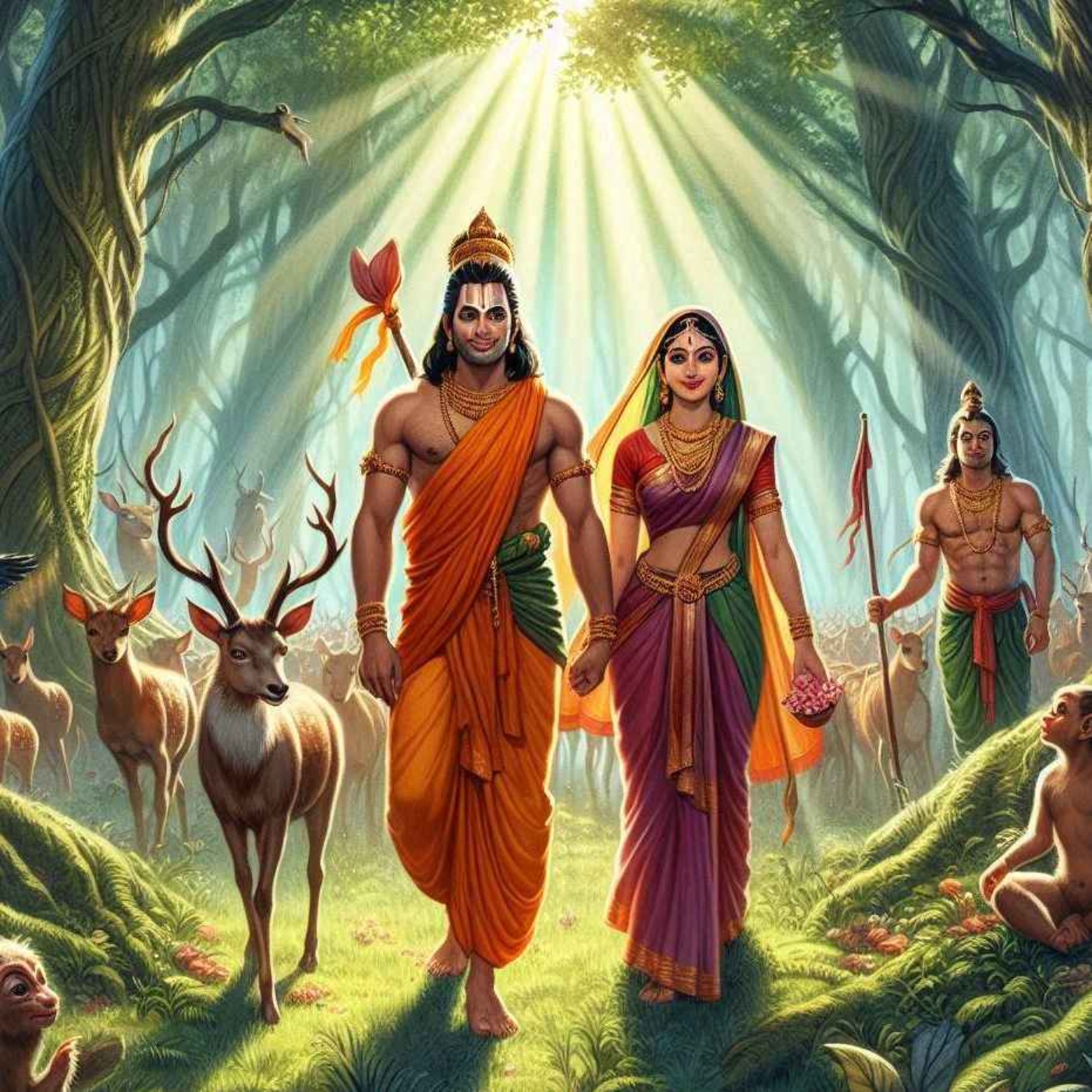
The sage Valmiki asks Narada to name a man embodying all virtues, and Narada identifies Lord Rama, briefly recounting his life story. Later, while walking, Valmiki witnesses a hunter kill a male crane, causing its mate to lament. Spontaneously, Valmiki utters a curse in a poetic meter, creating the first sloka. Lord Brahma then appears, revealing this was divine will and commissioning Valmiki to compose the Ramayana in that poetic form to narrate Rama's story. Valmiki meditates, learns Rama's full history, and composes the epic of 24,000 verses. He later teaches it to the talented twins Luv and Kush, who travel singing it. Their song reaches Ayodhya, where King Rama hears it, feels a strange familiarity and deep emotion upon seeing the boys, and invites them to court to hear the poem composed by Valmiki about his own life.
Welcome to your friends to the first episode of The Stories of the Ramayan. It was the time of the Tretayug, the great sage Valmiki asked Narada, "Tell me my Lord. In the present time, who do you think is the most knowledgeable, the most handsome of strong character and values, is loved by all, the most beautiful and the kindest of all who doesn't have any enemies and is the strongest, the most valiant and the most powerful man in the world." Narada smiled and said, "My dear Valmiki, it is very difficult to find a single man who poses as all the qualities you mention. However, I know of such a human being, the great king of Ayodhya, Lord Rama. Born of the Ikshakuth dynasty, Lord Rama is such a man who not only possesses the qualities you mention, but many, many more. He embodies the best of all virtues and is the best king a man has ever seen. Narada then narrated the tale of Rama. His inauguration as the crown prince, his exile to the forests, the abduction of Sita by raven, the search for Sita with the help of Hanuman and Sugriva, the crossing of the ocean, the killing of raven, the fire test of Sita, and finally Rama's return to Ayodhya. Then Narada predicted, "In Lord Rama's kingdom, his subjects will enjoy the most prosperous, peaceful, and the most enjoyable time ever. There will be no wars, no sufferings, no pain. Lord Rama will rule his kingdom for 11,000 years before leaving his mortal body. Those who listen or read the tales of Lord Rama will cleanse themselves of all sins and will enjoy a long and happy life." After Narada left the hermitage, Valmiki went out on his stroll with his disciple Bharadwaj. He walked by the banks of the river Tamasa and was enchanted by the beauty of the surroundings. He called his disciple and said, "Bharadwaj, did you notice how beautiful this place is? The bank is free of any mud or muck. The river water is as clear as the mind of a pious man. The water is inviting me to take a dip. Please, please get me my bark clothing. I want to swim in these waters." Bharadwaj handed his guru the tree bark clothing. Valmiki walked along the bank to find the clear area to take his dip. He noticed at a distance a red-headed crane couple singing lovely tunes and mating by the river. In the adjacent bushes, he noticed a tribal hunter aiming his arrows at the bird. Before Valmiki could say anything, the hunter shot his arrow and hit the male bird. The fallen bird shuddered in pain with blood gushing out of his wound. The helpless female crane circled her mate and lamented the loss of her partner with painful whales. Valmiki's heart broke to see this painful sight. He looked at the hunter and said, "Hunter, you kill the crane and broke a couple in love for this. You will never prosper in life." Valmiki was startled to hear his own words. The words came out of his mouth in the form of a beautiful couplet. He looked at Bharadwaj and said, "Did you hear what I said? Don't you think this beautiful couplet is worth singing with music? Let me tell you. Henceforth, this form of words will be called "slokas" or poetry." Bharadwaj agreed. Valmiki came back to his hermitage, but his mind kept on mulling over the incident by the banks of Tamasa. The poem he uttered evoked many thoughts. Why did this happen to him now? Is there any reason? As he was discussing about the genesis of the sloka with his students, Lord Brahma appeared before him. Valmiki greeted him with respect and offered him fruits and rings, but the thoughts of the birds and the poetry still didn't leave his mind. Brahma smiled and said, "My dear Valmiki, it was because of my wish you uttered the beautiful verse. Henceforth, such couplets will be known as "slokas." Using such beautiful slokas, I want you to compose an epic poem narrating the story of Lord Rama's journey. The story that not other narrated to you. Don't worry. Insolence that are unknown to you will reveal themselves in due course. Whatever you say in your poem will be the truth. Your creation, the Rama Yana will be read and sung on this earth as long as the earth lives and you will live forever in the minds of the people. Saying so, Brahma disappeared. Valmiki then sat down to meditate and learned the details of Lord Rama's journey from his birth till the establishment of his kingdom. When he knew everything, he began to compose his poem, the Rama Yana. His compositions consisted of 24,000 slokas or couplets and was divided into seven condos or books. After completing the epic poem, Valmiki thought, "What could be the best way to spread the word?" Then one day, two young lads visited him, love and Kush. Love and Kush paid their respects to Valmiki and said, "Oh Lord, Valmiki, we understand you have composed the most beautiful poem ever written and are looking for someone to sing the song to the people. We brothers, singers and would feel honored if you could teach us your song." Valmiki was impressed by the melodious voice of the brothers. Their princely looks and gentle manners melted his heart in an instant. He accepted love and Kush as his disciples and began to teach them the song of Lord Rama. The gifted boys picked up the song with ease and soon began to sing the tale of Lord Rama to their listeners. The poem with its varied content capable of evoking several diverse emotions, touched the hearts of anybody who listened. The boys started by singing the song to the sages and forest dwellers who were mesmerized by their voice. The showered gifts on the two boys and urged them to sing it again and again. The boys then moved out of the forest to the capital city of Ayodhya. The morning sun seeped through the palace windows along with the cool breeze. The city of Ayodhya was slowly waking up. Lord Rama, the king of Ayodhya, woke up in his bed and looked at the open window. A delightful melody wasted in through the hanging drapes. It was a song. Rama walked to the window and looked out. Two young boys strumming their venas in their hands, walked down the streets singing a beautiful song. Rama tried to listen intently, then chanting melody, the beauty of the lyrics kept him standing by the window for quite some time. He heard his name being mentioned in the song few times. The boys were singing his praise that is have to be rewarded, he thought. Ram called his
God, bring those two boys to my court. I'd like to listen to their song and reward them. When Lord Ram entered the court, the boys were waiting. The moment Ram's eyes fell on the boys, he felt a strange tug in his heart. The boys looked so familiar, he thought. Did he see them before? Who are you boys? He asked. What do you come from? And what were you singing? I am love, said love. And I am his brother, Kush. We live in the forest in our cottage. Lord, we were singing the story of your journey composed by our Guru, the great sage, Valmiki. Ram was still looking at them. The boys were handsome and seemed to be radiating an ethereal glow. Their voice was sweet like waters from a fresh mountain spring. As he watched the boys, he felt a flood of emotion overwhelming his senses. His eyes marched and his voice became heavy. So when the boys finished introducing themselves, he failed to speak. There was a moment of awkward silence in the court. Love broke the silence. If you'd allow us, we'd like to sing the song to you. Yes, please, said Ram, waking up from his trance. I'd love to listen to the poem composed by Lord Valmiki. That's why I fetched for you. Please, please begin. Love and Kush strung a chord on their Vina and began to sing the song of Ram. The stories of the Ramayana is written, directed and told by Shudiptha Bhomik. Original music and sound design by Anirban Chakraverthi. Audio engineering by Shomhen Paul. Find us online on all podcast platforms and social media.
Podcast Summary
Key Points:
Sage Valmiki inquires about an ideal man, and Narada identifies Lord Rama, narrating his epic journey.
Moved by a tragic scene of a hunter killing a crane, Valmiki spontaneously composes the first poetic verse (sloka).
Lord Brahma appears, instructing Valmiki to use this poetic form to compose the Ramayana, the story of Rama.
Valmiki composes the epic and teaches it to the twins Luv and Kush, who later sing it in Ayodhya.
King Rama hears their song, is deeply moved, and invites them to his court, feeling an inexplicable emotional connection.
Summary:
The sage Valmiki asks Narada to name a man embodying all virtues, and Narada identifies Lord Rama, briefly recounting his life story. Later, while walking, Valmiki witnesses a hunter kill a male crane, causing its mate to lament. Spontaneously, Valmiki utters a curse in a poetic meter, creating the first sloka.
Lord Brahma then appears, revealing this was divine will and commissioning Valmiki to compose the Ramayana in that poetic form to narrate Rama's story. Valmiki meditates, learns Rama's full history, and composes the epic of 24,000 verses. He later teaches it to the talented twins Luv and Kush, who travel singing it.
Their song reaches Ayodhya, where King Rama hears it, feels a strange familiarity and deep emotion upon seeing the boys, and invites them to court to hear the poem composed by Valmiki about his own life.
FAQs
Narada identifies Lord Rama, the king of Ayodhya, as possessing all virtues like knowledge, strength, kindness, and being loved by all, with no enemies.
The tale includes Rama's inauguration as crown prince, exile, Sita's abduction by Ravana, the search with Hanuman and Sugriva, ocean crossing, Ravana's killing, Sita's fire test, and Rama's return to Ayodhya.
Valmiki spontaneously uttered a poetic couplet in anger after seeing a hunter kill a male crane, which he later named 'slokas' and was inspired by Lord Brahma to use this form for an epic.
Lord Brahma commanded Valmiki to compose an epic poem narrating Lord Rama's journey using slokas, assuring him it would be truthful and immortal, known as the Ramayana.
Luv and Kush were two young brothers who learned Valmiki's Ramayana and sang it beautifully, eventually performing it in Ayodhya, captivating listeners including Lord Rama.
Lord Rama was deeply moved by their song, feeling a strong emotional connection to the boys, and requested them to sing in his court, where he was overwhelmed with emotion.
Chat with AI
Loading...
Pro features
Go deeper with this episode
Unlock creator-grade tools that turn any transcript into show notes and subtitle files.
 PodcastTranscript AI