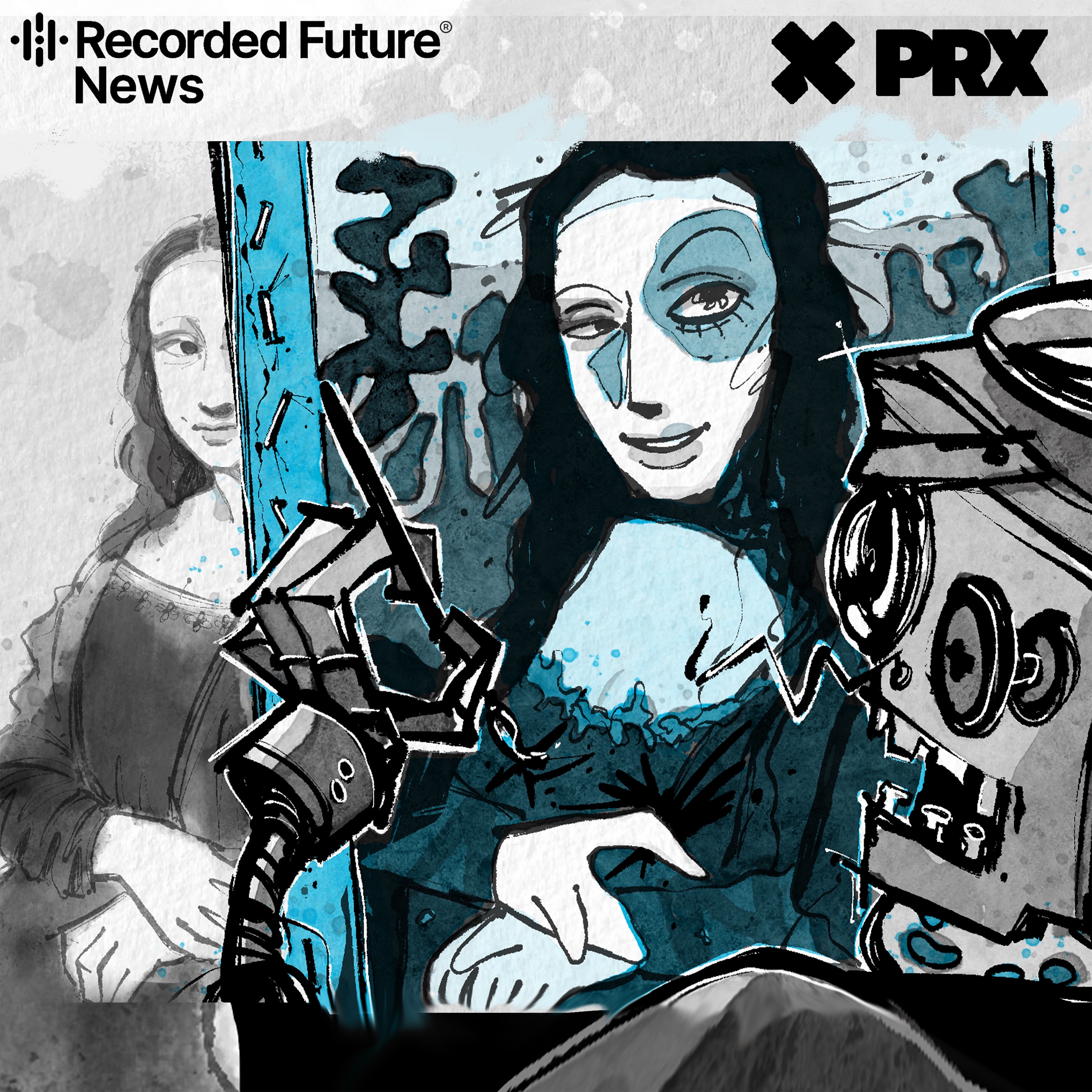
This episode of *Click Here* examines how generative AI is reshaping creativity and intellectual property. Artists like painter Kelly McEarnin discovered their work was scraped without permission to train AI image generators, leading to lost commissions and existential distress. AI companies argue their use of scraped data is legal under "fair use," claiming they transform the material into something new, but artists counter that their copyrighted expressions are being copied. Courts are divided: a 2025 ruling against authors who sued OpenAI left parts unresolved, while a historic $1.5 billion settlement against Anthropic favored creators. The law, rooted in 1976, struggles to address modern AI. Meanwhile, musician Ben Jordan (the Flash Bold) developed "data poisoning" tools like Poisonify and Harmony Cloak, which add imperceptible noise to audio files, corrupting AI training data. These methods aim to make scraping so costly that companies opt to license music fairly. Jordan emphasizes that while technology may spark an arms race, the goal is not to destroy AI but to ensure artists are compensated. The episode highlights a broader tension between innovation and the rights of creators in the digital age.
[BIRDS CHIRPING] From Recorded Future News and PRX, this is Click Here. [BIRDS CHIRPING] There used to be a word for this when someone took your work and passed it off as their own. We called it "forgery" or "playdurism." It was clear and at least in theory, settled. But now, some of the biggest companies in the world are doing something that looks a lot like it. And they're calling it "innovation," the new, new thing. "Generative AI" is trained on the internet, which is another way of saying it's trained on us. On millions of pieces of human creativity, paintings, songs, voices, all scraped, absorbed, and reassembled into something that feels new or at least passes is new. The top result isn't even my art. It's art made from my art. If a program could do that, what's the point? So what do you call it when the line between original and imitation just disappears? From Recorded Future News and PRX, this is Click Here. A podcast about how technology is changing everything. This week, Karen Duffin looks at what happens when creativity itself becomes raw material. It's forcing artists to ask themselves what it means to create when their work is training the machine. And what happens to that machine when humans try to break it? You can fight back with the same technology that they're exploiting you with. That's after the break. Stay with us. Looking for more of the cyber security and intelligence coverage you get on Click Here, then check out our sister publication, The Record from Recorded Future News. You'll get breaking cyber news from reporters in New York, Washington, London, and Kiev among others. And you'll see for yourself why it attracts hundreds of thousands of page views every month. Just go to the record.media. [MUSIC PLAYING] I'm Karen Duffin, and this is Click Here. If you are an artist, you know how long it can take and how hard it can be to develop a style that's all your own. A painter with a particular palette, a band with a signature sound. And it took time, but artist Kelly McEarnin did just that. I work in watercolor and acrylic wash. And my work is vibrant and surreal. Kelly is a painter in Nashville, and goes by the pronouns they them. Their work blends human and abstract images, capturing introspective and almost spiritual themes. I've done some work for Dark Horse Comics. I've also worked with Avnesens, the band. I've done some comics as well. A few years ago, they started getting tagged in images on Instagram and X. Not too unusual. They have tens of thousands of followers. But when they clicked through and looked at the images, it was confusing. When that started to happen, I didn't really understand what that was about, especially because it didn't look like my work, but it was using my name. It didn't take long until they found their answer. I discovered that more than 50 of my paintings had been scraped to use as training data for AI image generators. Kelly's art had been vacuumed up along with billions of other images for anyone to play with. Users could open this image generator and ask it to make AI paintings in the style of Kelly McCurnen. And then these programs will generate images, several images created with my style based on these 50 or so paintings that were scraped. Apparently, a lot of people were doing this, because now, when Kelly Googled their name, the top result isn't even my art. And that's a big part of the problem is, if somebody can just generate something that looks pretty and good enough, they're not going to hire me. I felt violated. I was upset to see this happening. I was even more upset that it had happened without my consent, and that not a single one of these people who were using my name as a style prompt had even thought to ask me how I felt about this. Kelly had done the nearly impossible for 15 years by then. They made a living mostly supporting themselves as an artist, along with some teaching. But after this database came out, we started seeing the small projects fall away. The three or four projects in a month might pay my rent, turned into one to zero, like complete crickets. But the impact for Kelly wasn't just financial. It was almost existential in a creative sense. Their style, their voice, it used to feel uniquely theirs. I really question the point of not just my work, but of creating art at all. It was pretty dark at the end of 2022, really just kind of-- yeah, what's the point of everything I'm going to make is going to be scraped and used to essentially displace me? Almost immediately, Kelly started asking what you might be asking yourself right now. How is this legal? And that is a question Kelly and other artists have recently started asking the courts to answer. An unprecedented class action lawsuit, along with two other visual artists against AI companies. A group of prominent authors is suing the company behind Chad J.P.T. says he and thousands of other writers have been ripped off. In 2023, Kelly became a lead plaintiff in a class action lawsuit, along with other artists. That same year, a group of authors sued open AI on similar grounds, including journalist Tana Hasse Cotes and comedian Sarah Silverman. Both suits alleged copyright infringement. There are people who are saying, because all of this comes from stolen, pirated art. Well, companies actually should pay because they were trained on people's works, right? Matt Blaschick is a lawyer who studied technology and copyright. He's at the University of Michigan. And he says the arguments go like this. On one side, Kelly and other artists argue that these AI systems couldn't exist without their work. And on the other side, AI companies say that what they're doing is legal. They point to a corner of copyright law called fair use. Essentially, it says you can use other people's art as long as you're referencing remixing or building on the source material. Like when a singer like Weird Alley Anchorage writes a song like "Eated." ♪ Don't you tell me you're full, don't eat it ♪ Even though it mirrors Michael Jackson's song "Beated," so closely. ♪ But you want to be there, don't be there ♪ ♪ Be there, be there, don't be there ♪ Something like that is generally considered fair use. It's based on something original, but so thoroughly remixed that in a sense, it's something new. And that is what AI companies are banking on in their defense. But there's also another argument here, baked right into the essence of copyright law. Something much trickier to discern. Copyright access to expressions, not ideas, so some people would claim. Does copyright 101? In other words, copyright protects the exact thing you made. But not the style behind it, which leads the courts to answer two big questions. First of all, do they actually copy your expression? Do they take what's yours and then they're implemented in the copy? And the other question is, whether the two works are substantially similar, right? Is the new work. Does it look like the one you created? Did the system take something that's recognizably yours? And is what it produces not just close, but too close? ♪ ♪ And these are hard questions for any court to answer. Harder still, when the law they're leaning on, hasn't really been updated since 1976. That's when Congress codified the idea of fair use. 50 years ago, back when phones had chords and music came on eight tracks. The internet wasn't even a thing yet. AI less than a glimmer. And now that same law is being used by courts to make sense of a world it never anticipated. Because as companies like Suno and the non-profit Lyon change how we make and consume art, it's forcing courts to consider questions that lawmakers in 1976 could never have imagined. Like, who gets credit when a machine learns from your work? If your work is one of one billion that went into the market,
dataset, which then results in the creation of a new painting, a new image, a new song, what kind of credit would be even accessible to speak of, and what kind of compensation would be appropriate? So far, courts haven't given a clear answer. In early 2025, a judge ruled against that group of authors who made claims similar to Kelley's. But parts of their case have yet to be decided. Kelley's case is still in process. On the other hand, Anthropic agreed to pay a $1.5 billion settlement after a judge found the company trained its AI on millions of pirated works. It's reportedly the largest copyright payout in history. And with such mixed legal messages, it leaves artists in a difficult spot, wait for answers, or find ways to fight back. There is a potential that this actually poisons the overall algorithm. As you give it something to train, and as it learns from that, then it actually gets worse at training. That's when we come back. Stay with us. How are weight loss drugs changing our world in Spain have just a few short years? Weight loss jabs have become so prevalent in our culture that they've transformed the way we live, move, and eat. Restaurants are serving smaller portions, and there's more protein-rich food in grocery stores. Does all of this speak to a renewed obsession with skinniness? Listen to the global story on BBC.com, or wherever you get your podcasts. It is called internet. I used the worldwide web information superhighway. Cyber security. Why do things go fire? Quick. Here. Ben Jordan is a musician known as the Flash Bold. He's also a popular science YouTuber. And his fight against AI is a little different, a little more well punk rock. Because instead of going to court, Ben started experimenting. A few years back, he figured out how to stop microphones from recording his concerts without his permission. The trick is something called adversarial noise. And so I was like, OK, what if we just have a really loud ultrasonic tone that a phone's a microphone or a Google home or an Amazon Echo could pick up, but a human can't hear? Think of it like a dog whistle. Humans can't hear it, but machines can. So Ben started bringing ultrasonic sensors to his shows and turning them on while he performed. If you're pointing a phone at me and listening to be playing the guitar or something, it will just jam the microphone and it'll sound like a distorted mess and you won't be able to hear anything. In other words, to a person, the music sounded great, but to a machine, it's unusable. And that got Ben thinking. If he could scramble a recording, could he take it one step further and scramble the data AI systems learn from? Is it possible to do that in a way where we actually encode a file with noise that humans can't hear? However, AI algorithms that are training on the data would hear this. So he went back to his computer and started tinkering with sound files, adding layers, hiding signals, building what are essentially booby traps for AI. There's really sinister ways of doing this. It's just that AI hears music very differently than we do. And somewhere between those two areas, there's room for something to fit that actually out the case, the data for AI while keeping it completely sounding untouched to human ears. Here's what he means. Humans hear music as sound, but AI reads it as an image. Before AI systems can learn from a song, they have to translate that song into images, a kind of visual map with peaks and valleys, lines and blobs. So Ben didn't need to wreck the song. He just needed to tamper with the picture the machine is reading. And the result to us, to humans, the music sounds untouched. To the AI, it's a mess. So here we go. We can upload my original song here. [MUSIC PLAYING] And here is Soono's AI-generated extension. There's a name for this approach, data poisoning. The idea is simple. Feed the AI system bad information, so it learns the wrong thing. Ben's creation is a tool he calls Poisonify. So the way that this works is it confuses it, so it thinks that the drums might be a piano, and it thinks that the guitar might be a harmonicon, and it thinks the vocals might be a trumpet. And so it's just kind of useless for training. It'll sound wrong, and it'll sound messy. [MUSIC PLAYING] Ben doesn't plan to release Poisonify to the public. For one, it takes a lot of energy to use. Encoding an entire album takes about two weeks of non-stop processing. But he does see it as a proof of concept. And he's taken what he's learned and collaborated with other researchers like the makers of Harmony Cloak, which works on a whole different level. What it mostly does is it takes harmony or melody and just makes it unrecognizable noise. It's no longer something you would want to listen to. While Poisonify is teaching AI the wrong instruments, Harmony Cloak is teaching it the wrong music altogether. So a song that sounds like this gets scraped by AI and ends up sounding like this. [MUSIC PLAYING] The idea is that if you do it often enough, the entire data set will be corrupted, essentially poisoning the entire well. Ben envisions a future when musicians layer their work with these kinds of AI poison pills. As it earns from that, then it actually gets worse at training because now you have adversarial noise or a poison pill in the database. But he says it's not that these technical changes will stop AI companies. They aren't likely to give up without a fight. It's that he hopes they make it just uncomfortable enough that the companies decide it's easier just to work with artists than go around them. I do believe that this could launch an arms race, because if Suno has to cough up so much money to protect against technology like this, that they'll just start licensing music and paying musicians, then success. Like the idea is not to destroy AI. The idea is just to get musicians fairly compensated. More so than anything. And in the meantime, he keeps making his music. The thing that AI can't do is take away the enjoyment of making music. That's why I'm not threatened by it one bit. It can't take away me sharing it with people that I love or even people who are in my community. That was caring, Duffin. This is Click Here. (upbeat music) Click Here is a production of recorded future news and PRX. Today's show was written and produced by Megan Dietri, Sean Powers, Erica Gaita, Zach Hersh and Casey Georgi. It was edited by Karen Duffin and Sarah Koveito and fact-checked by Darren Ancrum. Original music is by Ben Levingston with additional music from Blue Dot Sessions. Our staff writer is Lucas Riley, our illustrators Megan Goff, and our sound designers and engineers are Jake Cook and Jesse Nicewanger. Find us on X or Facebook at Click Here Show. Or leave us a voice message at 6615CH Talk. Sometimes we'll turn those moments into reporting, sometimes into a conversation, and sometimes into a future story you'll hear on this show. I'm Dena Templereston and thanks for listening. - Support for this program comes from Recorded Future. In cybersecurity, the biggest risk isn't what can be seen, it's what gets missed. Recorded Future analyzes billions of signals to help organizations stay ahead of threats. Recorded Future, know what matters, act first. If you're looking for a daily guide to cybersecurity news and policy, sign up for the Cyber Daily from Recorded Future News. It serves up the day's most interesting and important cybersecurity stories from our sister publication The Record and then aggregates all of the big cybersecurity stories you might have missed from news outlets around the world. Just go to the record.media and click on Cyber Daily to get all you need to know about the world of cybersecurity right in your inbox.
Podcast Summary
Key Points:
Artists like Kelly McEarnin are losing income and creative control as AI systems scrape their work without consent to train generative models.
AI companies defend the practice under "fair use" copyright law, but artists argue it infringes on their copyrighted expressions, not just ideas.
Legal outcomes are mixed
Technical countermeasures like "data poisoning" (e.g., Poisonify, Harmony Cloak) scramble audio or visual data to confuse AI training, potentially forcing companies to license work fairly.
The core conflict centers on outdated copyright law (1976) struggling to address AI's mass scraping and replication of human creativity.
Summary:
This episode of *Click Here* examines how generative AI is reshaping creativity and intellectual property. Artists like painter Kelly McEarnin discovered their work was scraped without permission to train AI image generators, leading to lost commissions and existential distress. AI companies argue their use of scraped data is legal under "fair use," claiming they transform the material into something new, but artists counter that their copyrighted expressions are being copied.
5 billion settlement against Anthropic favored creators. The law, rooted in 1976, struggles to address modern AI. Meanwhile, musician Ben Jordan (the Flash Bold) developed "data poisoning" tools like Poisonify and Harmony Cloak, which add imperceptible noise to audio files, corrupting AI training data.
These methods aim to make scraping so costly that companies opt to license music fairly. Jordan emphasizes that while technology may spark an arms race, the goal is not to destroy AI but to ensure artists are compensated. The episode highlights a broader tension between innovation and the rights of creators in the digital age.
FAQs
The podcast explores how generative AI is trained on human creativity, including art, songs, and voices, often without consent, leading to artists like Kelly McEarnin losing income and questioning their purpose.
Kelly found that over 50 of their paintings were scraped to train AI image generators, and users could create art in their style without permission, causing their name to appear in AI-generated results.
AI companies claim fair use, arguing that they transform the original material into something new, similar to parody or remix, and that copyright protects specific expressions, not styles.
Data poisoning involves feeding AI systems corrupted data, like adding ultrasonic noise to music that humans can't hear but scrambles AI training, making the output useless.
Ben created Poisonify, which adds adversarial noise to music files, confusing AI into misidentifying instruments like drums as piano, without affecting human listening.
The case is still ongoing, but a similar authors' lawsuit was partially dismissed, while Anthropic paid a $1.5 billion settlement for training on pirated works, showing mixed legal results.
Chat with AI
Loading...
Pro features
Go deeper with this episode
Unlock creator-grade tools that turn any transcript into show notes and subtitle files.
 PodcastTranscript AI