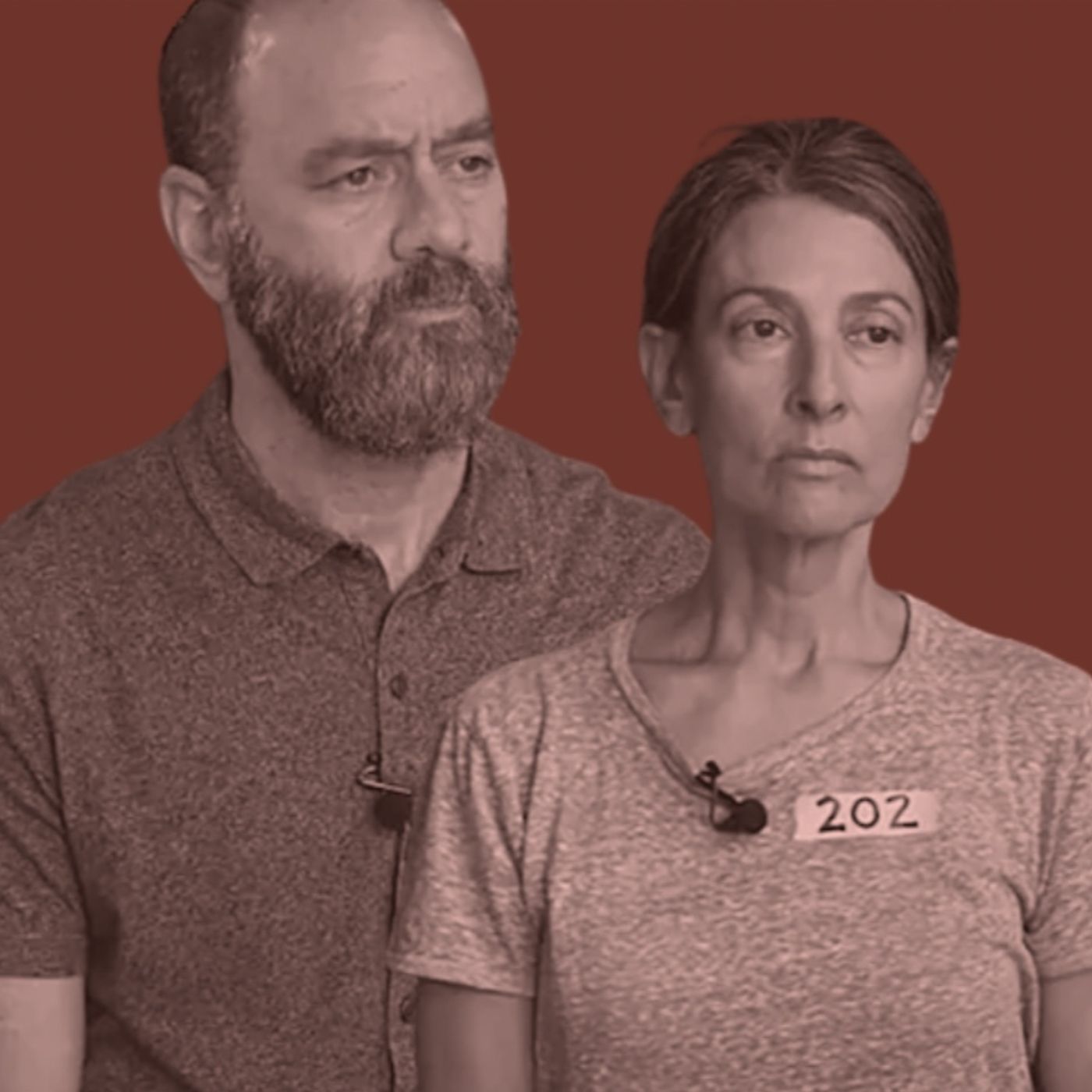
Rachel Goldberg-Polin and Jon Polin: How Torah Gives Us Faith and Hope
69m 44s
Rabbi Saxe's unique Torah commentary combines traditional wisdom with modern intellectual currents, providing a valuable resource for engaging with Torah while staying connected to contemporary thought. The Rabbi Saxe Chumish integrates his commentary seamlessly with the Torah text. Simchat Torah, a holiday celebrating the completion of the yearly Torah cycle, lacks explicit scriptural or Talmudic basis, evolving from centuries of customs. It symbolizes finding redemption within exile and embracing unity amidst human brokenness. The holiday reflects the Jewish people's ability to interpret and create meaning, bridging past and present through Torah study and lived experiences. Rabbi Saxe's legacy, exemplified in his Chumish, emphasizes the fusion of timeless Torah teachings with contemporary life, echoing the theme of finding divinity in human actions and interpretations.
Transcription
10764 Words, 58976 Characters
You know what made Rabbi Saxe distinctive? He created Torah commentary for this generation,
people who want to engage thoughtfully with the world while staying rooted in tradition.
He didn't ask you to choose between serious Torah study and intellectual engagement with
contemporary ideas. Instead, he showed how Torah wisdom can engage with philosophy,
science, ethics, the big questions thoughtful people care about. Now his approach is available
in complete Chumish format. It's called the Rabbi Saxe Chumish, and his commentary is integrated
right with the Torah text alongside Rashi and Unkelis. If you're someone who wants Torah study
that engages seriously with the intellectual currents of our time, this is the Torah commentary
for our generation. Now available at KorinPub.com. That's K-O-R-E-N-P-U-B.com or at your local bookstore.
And I'll just add just on a personal note, I have seen the Rabbi Saxe Chumish. It is really
incredible and I think Rabbi Saxe as a translator in the greatest sense of the word. When I say
translator, I don't mean somebody who took a word from one language and rendered into another
language. What I mean is somebody who is able to translate ideas and values in a way that
preserves the timelessness and eternity of those ideas yet is able to translate them in a way that
resonates for our generation. I have seen the Rabbi Saxe Chumish. I have learned it. I have
studied from it and I could not recommend it more to our listeners. This should be in every Jewish
home. It's now available at KorinPub.com or at your local bookstore by the Rabbi Saxe Chumish now.
Hi friends and welcome to the 1840 podcast where each month we explore different topic
balancing modern sensibilities with traditional sensitivities to give you
new approaches to timeless Jewish ideas. I'm your host David Beshevkin and today we have a special
Simchastora episode. This podcast is part of a larger exploration of those big juicy Jewish ideas.
So be sure to check out 1840.org. That's 1-8-F-O-R-T-Y.org where you can also find videos,
articles, recommended readings and weekly emails. Simchastora from its very inception was an extremely
and is a very unusual holiday. It is celebrated at the tail end of the high holidays going through
after Rosh Hashanah, after Yom Kippur, after Sukkis, after Hoshanah Rabbah, after Shmini Atsaris,
that final day especially in the diaspora where we celebrate two days. Simchastora is that final
day and it is a celebration of the completion of the yearly Torah cycle where every single Shabbos
the Torah is read in shul, a portion of the Torah known as the weekly parshah, and we finally
finish the entirety of the Torah each year. It's scheduled to work out that we finish at that final
day of Sukkis. So we begin in the Shabbos after Simchastora, we begin again and read Shabbos
Beratius. Now the evolution of this holiday is incredibly, incredibly strange. My dear friend
Professor Chaim Seiman, the author of the book Halacha, a fantastic work and of course a former
guest on 1840, wrote a brilliant article available on Lair House entitled "The Inverted Halacha of
Simchastora" and the entire article really centers and highlights how strange of a holiday
Simchastora in fact is. It is not mentioned in the Torah, it is not mentioned in the Talmud,
while people do find illusions for it in the Medrish, it is not explicit in the Medrish either.
Really so much of the holiday and the way that we give aliyos, call people up to the Torah, the
additions that we make in davening, a lot of it does not have a very strong basis in halacha,
less so than any other holiday that we celebrate. And it is not even the only holiday that celebrates
the joy of Torah. Normally we associate that with Shavuos, which is celebrated any months prior and
it celebrates the giving of the Torah. The entirety of Simchastora seems to be based on customs,
on folk practice, on minhagim that developed over centuries to kind of give us the Simchastora
experience that we have today. After presenting kind of the evolution of the celebrations of
Simchastora, Professor Seaman ends with like a reflection of why this strange holiday is so central
and kind of culminates the entire High Holidays experience. Beginning in the preparations of
Elul, getting ready for Rosh Hashanah and then Yom Kippur. Sukkis, Hoshanah Raba, Shmini Atseris,
the final celebration that kind of takes us into the winter, to the darkness of winter,
is Simchastora and he writes as follows. "In addition to offering a release from the intensity
of the High Holidays, Simchastora reaffirms the community's dominant values. The celebrations,
whatever their excesses, literally and figuratively revolve around Torah. Today has obtained its
character through a millennium of iterative dialogue between popular custom and halachic
sensibilities. Further, some of the most halachically problematic practices have not survived while
others were transformed as they were absorbed into quasi-eficial halacha. Moreover, the
light-heartedness of Simchastora is impossible absent its proximity to the awe of Yom Kippur.
The symbolic function of the Kitl or Yom Kippur Nusuch can only be meaningfully inverted within
a community that assigns them deep, normative significance. The day's halachic abnormalities
stand out specifically against the backdrop of rigorous halachic compliance. Finally,
Simchastora recalls that religious life becomes possible when the unfathomable Ain Sof,
the infinitude of God's transcendence, is manifest in human action and society. The
season that began slechot night centered on the image of Vayyaret Hashem Ba'unon, God appearing
obscured in mists of clouds, descending on the mountain's peak to speak with Moshe while the
people stand far below, concludes with a day that owes its character to popular imagination. The push
and pull of popular instinct, rabbinic meditation, and communal acceptance constructs a holiday
exemplifying that Minhug Avocenu Biadeno, our ancestors' customs are in our hands. It is we,
the Jewish people, ultimately, who so to speak, invent and give material presence to that amorphous
Anon of Godliness that descends beginning on slechot night, and it becomes more and more real
and more and more tangible until the eventual culmination of Simchastora, a holiday that is almost
entirely a reflection of invented practices of the Jewish people, of customs that end up becoming
part and parcel of the Divine Halacha. It is a very moving exploration of the day of how this day
is actually the kiss that shows the divinity that inherently courses through the veins of the Jewish
people, of how Knesses Yisroel, the collective body of the Jewish people, are the ultimate expression
of divinity, and through our very practice, even without command, without any clear textual basis,
but the customs that have accrued over the years are the ultimate expression of the Torah,
not only that we were given, but the Torah that's uniquely expressed through our lives.
And that's what Simchastora is all about. If Shavuas celebrates the Torah that we were given,
Simchastora celebrates the Torah that we create through our lives, through our experiencing,
wetting the very fabric of our lives to divinity, that the story of our lives is part of the story
of the Torah, and that our customs and interpretations and translations and the way that we bring
Torah into our lives and then speak through our lives is the ultimate expression and the ultimate
revelation of the Divine, beginning with those misty clouds of God saying, "Vayer et Hashem be'anan,"
that God comes obscured in those clouds. We give them tangible expression through our customs,
our interpretations, the Torah that emerges only through human experience and human interpretation
and human perspective. And when I think of the strangeness of Simchastora, it is nearly impossible
to divorce that dichotomy, that halachic dichotomy that we see in Simchastora from the experiential
element of how a holiday that we call Simchastora, the joy of Torah, is now eternally intertwined
with one of the most horrific and tragic days in Jewish history, October 7th, when Hamas massacred
Jews in the state of Israel and unleashed the anti-Semitism and the brokenness and the ugliness
that we still see, unfortunately, throughout the world, a level of hatred and anti-Semitism
that I don't think could have previously been imagined by people of our generation.
And I think how could a day hold such polar opposites? How can we have a day literally called
Simchastora, the joy of Torah, that is now stained with Jewish martyrs and Jewish blood,
with tragedy, with exile, with pain? And I think if there's any day that can hold that dichotomy,
it is the day of Simchastora. Because Simchastora is a day that is a uniquely human invention that
reflects the uniquely human contribution to the celebration of Torah, to the development of Torah,
to the expression of Torah in this world. And there is nothing more human than holding wholeness
and brokenness together. There is nothing more human than being able to stand with sadness and joy
intertwined past and present. Different feelings intermix that form the complexity of the human
experience. And if there's a holiday that celebrates our interpretation of Torah, our
confrontation with Torah, our revelation of Torah, then there is some quiet beauty to the fact
that this is also the day that is forced to hold both pain, suffering, and joy. Because it is only
in that perspective, in that world of human brokenness, that we're given the task of unifying
and finding divinity, even when it seems absent and distant and finding redemption and joy,
even when we seemingly are surrounded by sorrow. It reminds me of the ending to a prayer that we
say on Yom Kippur that I've been thinking a lot about lately. It's sung now at weddings in Israel,
a prayer that is, at once, mournful and hopeful. It is called, "Titayin Acheres La Amecha," give hope,
give a future to your nation. And it is typically inserted in the Yom Kippur Davening right after
we finish the description of the Avoda of the service of the Coen Godzal on Yom Kippur. And
this is a beautiful, beautiful prayer that is famously put to the tune of Nachemu.
.
.
That prayer ends with a very beautiful plea where it says, "Tidrosh G'ulah L'Galuseno."
"Tidrosh G'ulah L'Galuseno." The word "Tidrosh" means to seek, but it comes, you can hear it from
the word, like the word "draash," like to create, to interpret. "Interpret G'ulah L'Galuseno." Find
redemption within our exile. That is different than asking for the exile to end, which surely we do.
This is a prayer that I think is even deeper. It's saying even before it ends, even when we have
the suffering and the pain together, "Tidrosh," through interpretation, "G'ulah L'Galuseno,"
construct, find meaning, find redemption within our exile. And it's that drusha, it's that capacity
of drash that I believe our modern-day Simkhastora reflects. It's the sentiment that was once expressed
by the Friya Dikkar Rebbe. The Friya Dikkar Rebbe was the Six Rebbe of Labavich, of Chabad.
It was the father-in-law of the global face of Chabad, who's typically known as the Rebbe,
Rev. Menachem Ender Schneerson. His father-in-law was the Six Rebbe of Chabad, the Raiyats. And he
famously said, quoting really from the first Rebbe of Chabad, Rev. Schneer Zalman, the Balatania,
who said once that, "You have to live with the times." And everybody was like very confused.
What does it mean, "You have to live with the times"? That's not something you would hear from
Chassidah Shereba. What do you tell me, "You have to live with the times"? Should I have to address
"Kul" now? I have to use the contemporary slang. What was the Rebbe trying to impart to the Chassidah
by telling them, "You always have to live with the times"? And the Friya Dikkar Rebbe quoted
someone, an interpretation, that says, "When he said, when he implored, 'You have to live with the
times,' it means that every day you have to live with and experience one's own life, the weekly
Torah portion of the week and the specific section of the weekly Torah portion that's connected to
that day, that literally to look through the Torah as a lens of interpretation to build meaning and
understand your own life and to look at your life, so to speak, as a window and a lens to understand
the Torah." This, I believe, is what we are celebrating on Simhah's Torah, the capacity to
live with the times, the capacity to interpret our lives through Torah, and the capacity to
interpret Torah through our lives, to feel that each moment in each step we take, we're taking
the same steps as our forefathers, as Avram Yitzchak and Yaakov, the struggles of the Imahos,
of Sara, Rivka, Rukhel and Lea, the personalities of the Torah come alive when they're not just
figures of the past, but they're windows to understand our own lives and the own steps that
we're taking, and then we take our own lives and we use them to understand and build the glory of
Torah and the interpretations of Torah. This is the ultimate fusion, the ultimate drusha, so to
speak, is finding that fusion between our lived experience and our daily lives and the timeless
and eternal words of the Torah, and it's in that fusion that Simhah's Torah emerges, a day that has
the unique capacity to hold both pain and suffering, and it's with that perspective that it is really
my incredible privilege to introduce today's episode, which was recorded closer to those
times of slichos that God was appearing, so to speak, in the cloud. We had the opportunity
to partner with the Rabbi Saxe legacy that has just published Rabbi Saxe's incredible
interpretation of the entirety of the Torah, published by Koran publishers, another one of our
partners, as well as the Simhah's Torah Challenge, an absolutely wonderful initiative that you could
learn more about if you go to SimhahTorahChallenge.org, Simhah's spelled with a T at the end, SimhahTorahChallenge.org
that is really trying to bring out and encourage the weekly study of the Torah, and we came together
to celebrate the publication of the Rabbi Saxe Chumish and were joined in conversation by two
incredible people who really need no introduction, Rachel Goldberg Polin and her incredible husband
John Polin, who lost their incredible son Hirsch after being kidnapped by Hamas in Gaza on October
7th, and then murdered after being held hostage for far too long. I thought it was uniquely appropriate
to have a celebration of Rabbi Saxe's Chumish, one that it just bristles with wisdom and insight
that you can take on every single page as you begin and we all begin our Parshah journey,
living with the times and reading the weekly Parshah each and every week. I look at the legacy
of Rabbi Saxe as the person who gave us the language of learning how to fuse our own life
experience and perspective of living in the modern-day world and wed it to the timeless and
internal ideas of the Jewish people in the Torah. Rabbi Saxe was the translator par excellence,
not because he knew how to take a word from Hebrew and render it into English, but he knew how to
translate the ideas, the wisdom, the perspectives and values of Torah into the parlance and language
of contemporary society. And it's for that reason that Rabbi Saxe's legacy continues so strongly
today. He gave us a new language. It's why Rabbi Saxe's works are now more popular than ever in
Israel, because he gave us the gift of language. He gave us the gift of translation of learning
how to take the Torah and infuse it and integrate it and weave it into the fabric of our own experience
and lives. And that is why, at least on a very personal level, Rachel Goldberg Pollan and John
Pollan in many ways have served a similar role, I believe, for the Jewish people. They endured a
tragedy and a crisis that would seemingly be so unfathomable and so remote that it would never
be able to be translated into the experience that would galvanize the entire world. But I look at
both of them in the way that they shared their experience, the way they shared their hope,
the way they continue to share their hope and their prayers, the way they look at the Jewish
people, I believe, gave us a window of interpretation. They gave us language for how to process the
horrors of what we have all collectively experienced as the Jewish people, but a family who experienced
it so acutely and retained the capacity to speak, to translate, to share, to uplift, to inspire
is a family that I think embodies what it means to live with the times, to use the words of Torah
and Tfilah to process our lives and experiences and to use our life and experiences to open up
and to make the words of Torah and Tfilah shine even brighter and even wider, which is why it is
my great privilege to introduce our conversation for the launch of the Rabbi Sax Chumis published
by Cohen Press, our conversation with Rachel Goldberg-Poland and John Poland. It is a tremendous
privilege to be sitting today with John and Rachel for the launch of the Sax Chumis and on a very
personal note, the way that you both have kind of translated your experience for the wider Jewish
people to hold on to to make sense of this moment. It really is an incredible privilege. So thank you
once again for joining us tonight. I wanted to open up with a question that I very often share
at my Shabbos table. I have recently discovered that people do not like being asked to share a
Devar Torah at the Shabbos table. I haven't made so many friends that way. So instead, I kind of
open up the palette and I say, look, I don't need a Devar Torah, but I very often ask,
do you have a favorite story or parasha in the Torah? We're here to talk about Rabbi Sax's
masterful translation and I wanted to begin by understanding your relationship to the Chumish
and with a very simple question, do you have a favorite parasha story in the Torah?
So first, I just want to thank the Fifth Avenue synagogue for inviting us to this tremendous
occasion and to the wider Sax family and to you, Rabbi, for having us for this conversation.
That's me putting off answering your question. First of all, I like the manipulative way of
if your people won't answer by giving you a Devar Torah. It's a very smart way to just say,
all right, let's make a left. John and I were talking about this. There's a reason that Ben
Bogg Bogg says, turn it and turn it. Everything's in it. You can't really ask a people to continue
reading something over and over and over again unless every time there's something else magical
hiding in there. But what I was thinking about when you were asking your question, instead of
my favorite story, I was thinking of my favorite theme because it's something that I find really
fascinating is the theme that we find sort of starting in Shemot and that goes through Bameed
Bar, this theme of complaining because really what is happening there? And I think what's really
happening is that Bane Israel, the children of Israel who have just been released from bondage
and slavery and not having any agency are really coming into themselves and trying to figure out
what does it mean to be free and what does it mean to be a nation? And I find it fascinating,
the amount of complaining that goes on and the lack of digesting the miraculous that is constantly
happening, this rejection of the reality that they have this built-in awning that's moving with them.
And at night, there's a bonfire in the sky every night so everybody's warm and everybody can read
if they want to, whatever they've brought with them, all those reading materials. I think about
the fact that they've just witnessed the most unbelievable miracles in front of them, that
the Nile turns to blood, that there are frogs everywhere, that all of the firstborn in the
entire nation of Egypt die, including all of the firstborn of all of the cattle and all of the farm
animals. I think about, remember the mana? It was Starbucks dropping three times a day from the sky
and yet people were like, we want to go back and be slaves. We don't like it out here. There's
something very fascinating to me about the constant lack of recognition of godliness that
they were encountering. And I think that it's something that we are all always feeling that
we're striving to attain today. Kalvahomer, they were not able to do it when it was happening
in such a vibrant, obvious way. So there's something about that that to me has always been
very fetching. I absolutely love that response. No complaints from that response. That was really,
really masterful. John, do you have? I do have an idea and because you have taken the liberty of
expanding how you ask the question at your Shabbat table, I'm going to take the liberty
and how I answer it as well, which is Rabbi Sacks was talking at the beginning of the night about
prophets. And although we're here to mark the launch of his Khumash, I actually want to go to
Niveem in my answer. And I'll say proudly that part of what inspires me to turn to Niveem is our
daughter Orly just studied for a year in Medrashah. And at the beginning of the year, she made a new
friend, Ayelet, and they decided that they would spend the year and they would get through the entire
Tanach, all of the Bible together as Yechharutah. And they did. And her going in depth into Niveem
made me realize it's been a long time since I've done that. And so I've gotten a little bit more
into Niveem. And I also, of course, am always looking for lessons, inspiration for our time.
And so I'm going to turn to a crazy story, which is Yechhezkal in Bikata Azzamot, the Valley of the
Dry Bones, which the whole story is 1214 Psukim. But as a reminder, for those who may not know,
it's this crazy story of God having this conversation with Yechhezkal and Yechhezkal having
this vision of the Valley of Dry Bones. And this is in a time when the Jewish people have been
battered and bruised. It's actually in the story of Yechhezkal that we see the words
Avdatikvatenu. We have lost hope that we now know is in our Hatikvah anthem. And as many people
know the basics of the story, Yechhezkal is instructed to prophesy and to breathe Ruach into
this Valley of Bones. And in front of his eyes, the Valley of Bones is restored. Life is restored.
And they stand up. And the people of Israel who had Avdatikvatenu lost hope stands up. And I think
that's relevant for us today. But I actually want to go on and say that a few Psukim, a few sentences
after the story, there's another crazy story in Yechhezkal where God instructs Yechhezkal
to take a stick and to write on this stick, something, and you'll correct me if I make
mistakes here, but instructs Yechhezkal to write something like about Shevit Yehuda on the stick,
and then instructs Yechhezkal to take another stick and to write something about Shevit Yosef
on that stick. This is at a time where the Jewish people were living separately, multiple tribes
with multiple leaderships. And Yechhezkal is instructed to take these two sticks, and they
blend together into one stick. And Hashem says, God says to Yechhezkal, something like "Vasiti
otam le goyechad." I took the two tribes, the separate tribes of the Jewish people,
and blended them into one. And I thought, that's also amazing, right? Here we are sitting in New
York, and we've talked a lot about the support that we and all the hostage families have received
and continue to receive from diaspora Jewry. And I've been building this thesis about how,
if I just go back in Jewish history recently, to May 14th, 1948, till today, I feel like for a
long period of time, there was this notion of diaspora Jews support those poor Israeli Jews
across the ocean. And in more recent times, there's been this concept of, well, Israel's flourishing
in high tech, and we could support diaspora Jews. And what we're seeing now is, we are more intertwined
than we have ever been before. This notion that what happens in Israel, my friends in America,
who have hardly been engaged with Israel, now feel it viscerally, for good or for bad. And we
read Tanakh, and there are lessons for us today as we sit here at Fifth Avenue Synagogue.
That really is remarkable and incredible. As you're going forward to not ask me to correct
you on any, put me in a really tough spot right there. A common refrain that I've said many times
on 1840 is, the purpose of Judaism is not to fight anti-Semitism, but we fight anti-Semitism
in order to focus on the purpose of Judaism. Rabbi Sacks articulated it in a similar way.
The only sane response to anti-Semitism is to monitor it, fight it, but never let it affect
our idea of who we are. Pride is always a healthier response than shame. And I'm curious,
we've been in this period, in this era for 703 days, what brings you Jewish pride,
where you feel like you are tapping into the purpose of Judaism and perhaps more complex,
but in an honest way, what over this period has brought you Jewish shame, where you feel,
we're not locked in, we're not aligned. So I actually am going to maybe turn the question
in the reverse and start with shame so that we could end on a higher note.
There are things that I look around among our people and I'm ashamed. There are some decisions
that we've seen our leaders in Israel make that distress me. There are what I hope is still a
fringe of those in Israel who are taking it upon themselves to do what they think is right for
justice. And they're wandering into Palestinian villages and burning fields and lighting cars
on fire and doing things that I'm ashamed that they're doing. There's a quote from Victor
Franco that has become in the last few hundred days to be a little bit associated with Hirsch
because he's used it as a mantra and he taught others the mantra. Victor Franco says something
else that's much less quoted than that is, nobody has the right to do wrong to others,
even when wrong has been done to them. And I feel like we need to listen to those words and
heed those words. But I want to speak about the pride part and we are just bereaved parents.
We don't work for the Ministry of Foreign Affairs of Israel. We get asked to speak about
anti-Semitism and we say, we're just parents who live in Israel. We don't know. But I also
am always quick to point out that I'm not going to go through the litany of those things we should
be proud of. But I do like to talk particularly to young people who I think are reeling on
college campuses and so on and remind them, we come from a long line of proud accomplishments,
people who have put a ton of good into the world. I mean, we Jews. I mean, we diaspora Jews. I mean,
we Israeli Jews, the top accomplishments in academia and law and medicine and technology.
And there is a lot that we should be proud of. We have punched way above our weight in terms of
contributions of goodness to the world. And we still do. And so for any of us who feel like
there are others who are pushing us into a corner, trying to make us feel something other than pride
in who we are. I recently said to a group of college kids in Washington DC, just put your
shoulders back, put your head up. If you wear Yamaha, keep wearing it. If you wear a Star of
David, keep wearing it. Put a Mazzaza on your dorm room door. And I know it's easy for me to say
I'm not the one sitting there and doing it and dealing with the consequences, but just be proud.
And I think there's lots of reasons to do it.
I think also on a personal level, each of us, especially at this time of year during the month
of the Elul, I'm very proud of coming from a tradition and heritage that acknowledges that we
always should be striving internally to push ourselves to be better. That introspection
and soul searching, which if we do it in the right way is actually supposed to be hard. It's
not supposed to be kumbaya. It's actually, if we have an honest moment, each of us can go over
this past year individually, quietly, and we know where we miss the mark. We know what we should be.
I don't know that we have to use the word shame, but disappointed. We can all do better. And I think
all the more so in this valuable time that we have before Yomhadin, before Rosh Hashanah, before
Yomharata Olam, now is the time to turn and ask ourselves, what are we as individuals, not even
as our larger community, where we have so much to be proud of. And we do have improvement areas.
And I think acknowledging that, not having the chauvinism of saying, "We're amazing. We're always
right. We do everything," and that it is not a binary situation. It's much more nuanced and that
we should use that energy right now to push ourselves to do better. Really, really incredible
and moving. Rabbi Sacks once wrote that crises happen when we attempt to meet the challenges
of today with the concepts of yesterday. That's something I've been thinking about, for sure,
quite a bit since October 7th, of what are the new skills the Jewish people need to learn in order
to not just survive this moment, but to thrive in the wake of all of the pain that we've been
carrying as a people. What do you feel are the strategies of right now that the Jewish people
need to learn? And is there anything that you feel like we need to unlearn in this moment?
I'm going to answer this question through the lens of a thought on the Jewish people
and a quick thought on the Israeli people. When it comes to the Jewish people, I will say that
on Yom Ha'atz mode, Israeli Independence Day this year, we were at an event at President Herzog's
House. Home was filled with ambassadors from all over the world and religious leaders from all over
the world. And a representative of the Israeli government gets up to speak and goes on for five
minutes to effectively say, "What was us? We are victims. The world doesn't like us. The world is
against us. This is our fate. It's terrible. And I wanted to jump out of my seat." It's true. We
have a history of victimhood. Rachel and I know very well victimhood. That cannot be the speaking
point, the talking point for our people, to the world. What was us? We are victims. Yes,
that's true, but we are an independent people. We have a sovereign nation today. We have agency.
And while we have a history of being victims, while we have a recent history of being victims,
that cannot define us. We must move beyond victimhood and get way more into my prior answer
of what we've done and what we continue to do for which we should be proud. So that's one thing that
I would like to change. I want to say something about Israel. And this might be controversial,
but that's okay. For 77 years, we have known war, sometimes more, sometimes less. And we've tried
periodically other paths and found reason to say, "It doesn't work. I don't want us to continue on
this path of this is our fate. We will be at war. We're in a tough region. This is what we've got
to deal with." We have a narrative. We have a history. We have a Bible that we use as our guide.
There's a group on the other side who has a narrative and a history and a Bible that they use.
And we could shout for 77 more years that our narrative and our history and our Bible
justifies something. And they could shout it for 77 more years. And I don't want that. And I know
I'm sounding simplistic and idealistic, but I want to pick a date. It could be September 10, 2025.
That could be January 1, 2026, where we all get together and we agree we are going to stop out
shouting each other about our pasts. And we are going to move forward to our future. And it might
take 10 years or 20 or 50 years to come up with a solution. But we must start actively working
towards that solution. I want it for my kids. And I want it for my kids' kids. And we need it.
And it's not easy. But that's not a reason to not start on that path. And that's my wish for
the Israeli people. See why I like him? Okay. I would just like to point out that we are sitting
in front of the ark. It makes me feel very important. I've never been this close. I want to
point out, especially because this is something I learned from something Rabbi Sacks wrote,
which I thought was really moving, which is the Hebrew word for crisis is mashbear,
which the modern Hebrew word is mashbear, the root is shever. Shattered. There's a shatteredness
when we're in a crisis. We are in a crisis right now. If anyone was doubting, we're in a crisis,
all of us. What Rabbi Sacks points out is that biblically, in the Hamish, in the Torah, mashbear
actually means birth pangs, labor pains. It's the same word because when many people in this room
can tell me that I'm right, when you're in the moment of true physical labor pains, it is a crisis
to your body. It is a crisis that can feel that you're at the end, that something's going to tear
you apart. And actually, it's an opportunity for birth and light and something better. And so when
I read that Rabbi Sacks said that, it implanted itself in me. And I think that my ardent prayer
for all of us is that we are in this moment of mashbear and broken shatteredness and crisis
that is going to birth something really alive and filled with light.
Once I've spoken and then I've handed it off to Rachel, I feel like I need to stop. But I want to
say one more thing. And I've been quoting this particular quote of Rabbi Sacks for a long time,
but it's about crisis. And I think it encapsulates everything I've taken a long time to say so far.
And that is that Rabbi Sacks wrote also about crisis. The test of a society in crisis is whether
it emerges cynical and disillusioned or strengthened in its rededication to high ideals. And I think
that is what it's all about. It's so easy to be cynical and to be disillusioned. But the response
as we get through that cynicism and that disillusionment is how do we do good in the world? If we could all
take that lesson out of crisis goes a long way. Well, that's exactly a beautiful segue to my
next question, which this is a quote from Rabbi Sacks that I found very prescient for the moment
that we're in now, where he wrote that the real test of a nation is not if it can survive a crisis,
but if it can survive the lack of a crisis. And my question is, there are people in this room
who remembers other periods of tragedy and difficulty for the Jewish people that have
shaped us and allowed us to move forward. When you think back and God willing that day will come
where the Jewish people and the world will be able to live in peace. What do you hope is the
enduring lesson of October 7th for the Jewish people that we should be taking with us and reflect
with us God willing in times of peace with a lack of crisis. Something that we've very much been
witness to. It is not at all a cliche. It is absolute unity and solidarity that we have felt
across all of the different textures and styles and brands of Judaism. All the labels
have fallen off the jars. We have seen the most beautiful coming together and the scaffolding
coming from the most unusual places. We had already in November of 2023,
Charedi communities reaching out to us in Israel, asking for me to come and speak,
for John to come. We went to certain communities where the ad more of a certain community never
has a woman even entered the building and he had me come with John. He said, we're all in so much
pain. I need for you to explain to me what's happening. He didn't read the news but he knew
bad things were happening so we were explaining to him what was happening. We've had tremendous
love and respect showered on us by communities that I don't think normally would do that to us
in the diaspora all over the world and the other hostage families have really talked with us about
how embraced they have felt. These are people who are Israelis who have never really left the bubble
of being secular Israelis and they really don't know what an observant Jewish community,
especially outside of Israel, feels like. What it feels like to be part of a community,
not just part of a nation, not just part of a country, but part of a Hamish community
and that is something that I'm praying. Obviously, I'm praying every single day
that in the blink of an eye, caherifying that these hostages come home and that all this deep
immense suffering that we are all experiencing on different levels in different ways that it ends
but that that endures, that somehow that unity where people have been willing and open and hungry
to just say, really the Haftalerecha Kamoha, really I love my brother as myself and I am
praying that we don't lose that when this horrible chapter, this dark chapter, finally ends.
My answer is the same but I'll still take a stab for a minute at it which is, you know,
I talked earlier about the interwoven connection now among the Jewish people and Israel and
Diaspora and Rachel alluded to some of the specific things that we've experienced and I
think it's really true and I think it's for a few reasons. You know, I remember in 1979 I was
nine years old and my family went on a trip to Israel and it was the biggest deal in the world.
Like for months before there was this excitement about getting on a plane and going to far away
Israel and at Hillotora North Suburban Day School in Skokie, Illinois, the principal
Robert Brackenstein requested that I bring back a bag of dirt from Eretz Israel because it was
so special. It wasn't like today where people go back and forth like it's nothing. Technology enables
a lot of this. We could sit here right now and flip on the Kotel Cam and see what's happening at the
Kotel and I'm avoiding using this October 8th Jew term but I have friends, many of them, who on October
6th 2023, they were supportive of Israel in some passive small way and now for good or for bad,
they are intertwined. These are lawyers and doctors who have their peers asking them questions
about Israel and decisions that the Israeli government is making and things that are happening
in Israel. Like it or not, we are interwoven right now and as Rachel said, I just think the
challenge is when we come through this, how do we maintain that and how do we maintain it as a
source of strength and pride rather than anything negative? I'm chuckling in my head because we have
a friend who recently we were talking to and she said, "I'm so sick of Achdut!" by which she meant
the word, not the concept, right? There's so many people talking about Achdut, unity. What do we do
with it? And I kind of agree with her. Like let's cut back a little bit on the word and just do it
and just make it happen and just perpetuate it. So I want to ask a question exactly building on
those last two points, which is Rabbi Saxe very often, it's a recurring theme and it predates Rabbi
Saxe, but Rabbi Saxe would always implore people to look at their very own lives as a text that our
life can be seen as a chapter and the generations is all coming together and looking at our lives,
not as an opportunity to earn a dollar, but to look at every moment as another letter in the scroll,
so to speak. And I was thinking of that analogy when we study Chumish, when we study the Torah very
often, you come across a text or a story that's very difficult, that's hard to understand. And
before I get to my question about those specific texts in the Torah, I wanted to know very practically
exactly that point about the difficulty of Achdut or maybe the ease of Achdut in the abstract.
You over the last 703 days have had interactions with the spectrum of the Jewish people that most
people do not have in a lifetime. And undoubtedly, every Jew has the Jew who triggers them, who they
don't want to be like them, they want to move away from them. I'm curious, when you come to a text
of a Jewish soul, you meet a Jew, it triggers you. It's not the way I want to raise my family,
it's not the kind of Jewish life that I like. And we could attach a bunch of labels and everybody
has their own label for the other Jew. I'm curious for you, when you interact with Jews who trigger
you, who bother you, how do you find meaning in that text? How do you find meaning in that verse?
What do you do to extract that joy and connectivity from Jews when everyone I think has Jews either
for ideological reasons or social reasons or personality reasons that they don't like? So
how do you, so to speak, learn and find meaning in the text of individual Jews who at first glance
do not really make sense to you? Rachel, which Jews do you like the least?
We have definitely had this interesting journey filled with despair and misery and pain that's
very difficult to describe in these past 703 days. And we also have had this tremendous opportunity,
as you said, to encounter all of these different people. And what's so unfortunately fortunate
is that our pain is so touchable that I've only felt connection with people all across
from one end of sort of what it means or what brand or flavor of Jewishness to another extreme.
And I haven't had so much difficulty. The interesting thing is that even when people
have very different worldviews, when Hirsch was still alive and we were meeting with leaders
quietly, we always did it quietly because we both felt that that was a way that would open doors
more. And it definitely did. And it continues to do that for us. And I remember sitting with people
who sometimes would say things that felt so counter to how I see the world, how John sees the world,
how Hirsch saw the world. And yet we would sit in rooms with them and they cried with us because
they could see themselves in us. They could see what it meant to be a parent in our situation.
And it brought a universality to the situation. And so I haven't had trouble like that
in these times. And to be honest, I think maybe because of the trauma, it's hard for me to remember
what I did before, but I probably wasn't as patient as I should have been, as open as I could be,
and as loving as I have the potential to, because I wasn't in the situation that I'm in now,
where now I greet people and I know that they also have pain. Maybe I have a different brand
of pain and I've been through an unusual type of pain. But what I've really grown to learn
is that everyone is carrying their sack of pain with them. And so I haven't had that sort of challenge
of how do I handle this person who's in front of me? I'll give two examples of where I have been
challenged and how I thought about it in my interaction. The first example I'll give is
the Chare Di community in Israel. I think they need to serve the country. I think they need to
serve in the military when able. And if not, we need to find other national service for them.
That being said, the system today is such that they generally don't do those things.
And that's what's been set up. That's what they've inherited and that's what they live in. And
within that, as Rachel talked about, we have been recipients of that community doing what it is that
they know how to do and that they believe that they can do the best contribute to Israel today.
And that's learning and prayer. And it's not a show. I've gone into rooms of Chare Di where I
think, "Come on, you need to be serving the country." Yet I get swept up when I see an elderly rabbi
leading to hill him with tears in his eyes, a room full of his students joining in with tears
in their eyes because a hostage family is sitting in the room with them and getting their brachot,
their blessings. And there's something really beautiful in that and they're doing it in the
way that they think best contributes. And similarly, I can share that within the family of the broad
group of hostage families, there are differences of opinion. There have been from the beginning
and there still are about what needs to be done to bring home the hostages. We have been in a camp
that is the military is set to create conditions to be able to do a deal from a position of strength.
I think that they've done that. I think that we have, as a country and as a government,
missed some opportunities. There are families who from the beginning and still today think no deals,
only military force is what's needed to bring home the hostages. I totally disagree with that,
but I know these families and I know that while we disagree completely, our objective is the same
and I try to step back and say, "Who says I'm right?" And it's hard, but I just in all of these
scenarios remind myself that there are different conditions set for each of us that make us
think and act differently, but we do oftentimes have shared goals that don't get talked about
enough beneath all of the noise. Thank you. Thank you for that. I'm curious coming back
to the text of the Torah. Are there specific verses from our tradition that you almost instinctively
move towards, maybe whisper, maybe mumble, when you are looking for strength, when you are looking
for hope in your darkest moments, where in the Torah do you turn? What are the verses and experience
from our canon that you turn towards in order to find strength? Truly, there are so many. I
considered bringing tonight my sidur that I use, my prayer book that I use every morning. I've been
a davener for many years, which I've been so grateful that I have that foundation because
I feel like when what happened on October 7th happened, I didn't feel like I was approaching
a stranger when I was calling out to God for help. You know how sometimes you're not nice to your
neighbor who's the dentist, and then suddenly on a Shabbos afternoon, you think, "Oh my gosh,
I feel like I need a root canal, and how can I knock on his door? I'm not friends with him."
But I completely felt that I had access to the Master of the Universe, the second that this
unwound. And I have said with such kavana, so much of my Tfilah, but the sidur I use is the sidur
that was translated and annotated and commentated on by Rabbi Sacks. And it is his gorgeous
translation. And as we know, every translation is an interpretation. Every translation is an
interpretation. And I really felt that when John and I a couple of weeks ago, we went to a friend's
house and I had forgotten my sidur. And when I went to daven, when I went to pray in the afternoon,
they had a burn bomb sidur on the shelf. Remember those? And I was like, "Sure, I'll use that,
and I'll glance at the English." And I felt like I was reading something completely from another
religion almost. I mean, it just didn't. The English for me, it's my mama Lushan.
So even though I daven in Hebrew, I love to read the English. And when I read what Rabbi Sacks says,
he reads into words and he translates things in such a meaningful way for now. When I say
ashray, when you're saying, you know, are there lines, I mean, I literally could tell you 50
lines, but people know every day when I say ashray, and I get to, "Karovat Hashem Lekol Korav Lekol
Hashir Yikru Vahmet." I do this. I'm doing this. "Karovat Hashem Lekol Korav Lekol Hashir Yikru
Vahmet." And I'm on the number and I stop and I say, "Hashem, I'm close to you. Be close to me.
Be close to me. I'm calling you out in truth. Help us. Help us. Not just us. Us."
And I'm saying it was such a Kavana and I know that it's there. I know it's going up. I know it
is there. And I had this magnificent teacher in Richmond, Virginia named Lea Sgeist, who taught
us a class about Tfilah. And she's talked about how Tfilah is like humidity that goes up into the air
and then at a certain point enough accumulates in a cloud and then it rains down. And the thing is
sometimes those those Tfilot go up in the air and they accumulate and sometimes they move
and then they rain down somewhere else. And I know that the Tfilot that I said for Hirsh were
accepted and they are up there and they are raining down. I know that some of the hostages who came
home in January came home because of the Tfilah that we have all been doing. People say to me,
"You prayed and God didn't answer you." And I say, "I prayed and God did answer me. He just didn't
answer me the answer that I think that I wanted, but he answered." And I think that there are
so many pieces of the Tfilah and of the Khamish that speak to me on this point, but I'll give John a turn.
So we were asked a question similar to this hundreds of days ago, not as eloquently Rabbi,
but we were asked a question similar to this and I'm going to give my same answer
in Shacharit in our morning service towards the end of the service. We say,
now this is written by the psalmist thousands of years ago and it's sort of a comparison
of the Jewish people to our enemies historically and it ends with
[Speaking Hebrew]
They embrace horses and chariots as a tool of war is the connotation [Speaking Hebrew]
and we mention and work in the path of God. [Speaking Hebrew]
They've historically all keeled over and fallen [Speaking Hebrew]
and we have stood up and been strengthened and again we are living in a really challenging time
and I talked about some of the things that I'm ashamed about and I know there are things that
we're doing because we need to do them, but I remind myself and I try to hope this for all of us
that we use the tools of war as a defensive mechanism to accomplish something not as the end
in itself and we keep on the path that we have been on as a people for thousands of years,
it is what has kept us going as a people and let's make sure that we keep that course
and not fall over and become like those that we've vanquished historically.
You know you touched on Tfilas so I'm going to go wild. I just want to say one more thing
because it's another line that I think everyone is familiar with so it might speak to people.
Many times we have gone into what I think the before me would have been very scared.
Part of what's tragic or maybe it's empowering about having what happened to us happen
is that it scared the fear out of me. It scared the fear out of me and there was one time when
John and I had to divide and conquer when Hirsch was still alive so John had to go to one country
and I had to go to a different country and I had to meet with someone scary and I remember
that morning davening and they had said come alone without a phone and it was to save Hirsch
so I was fine with it but before I left the place where I was staying I took a small piece of paper
and I wrote a pasuk on it, I wrote a verse on it, I wrote adosham livalo yiram maya seliyadam
and I put it in my bra because I knew they were going to check me
and there's something about standing in front of an adam who's scary and just knowing adosham
livalo yiram this man can do nothing to me and it was really helpful.
So we have time for one concluding question and I wanted to end with a quote that for me
touched me in a very deep place from Rabbi Saxe where he is commenting on the struggle
between Yaakov and Asov and the angel of Asov and they're struggling and right before kind of
let's go Yaakov turns to him and asks for a blessing and Rabbi Saxe formulated it in such a
moving way it stays with me forever and I want to read it to you. Rabbi Saxe wrote sometimes all
the pain and tears lift you to a much higher and deeper joy when you say to the bad times
I will not let you go until you bless me. We've been seized by some really dark and difficult times
and I wanted to know what do you hope when you look at these times what is the blessing what is
the hope that you would like the Jewish people to walk away from from this moment. A really
prominent part of that piece part of that story of first of all who is Yaakov struggling with who
is that wrestling with is it an angel of God is it him struggling with himself which both
Maimonides Rambam and the Kabbalah say it's him struggling with him we all have that we all know
who we're struggling with but for me the most beautiful moment comes right after he says
I won't let you go until you bless me and then the sun rises the sun rises there's light and the
name change of Yaakov that had been curvy that's the show rush of the word and it changes to Yisrael
Yashar el straight to God and what's beautiful about that is if you know if people are familiar
with that story is he permanently is limping the rest of Yaakov or Yisrael's life he's broken
but he goes on and we can all limp ahead and we will and the sun will rise
sometimes no one's best to just say nothing
really on behalf of everyone here on a very personal level I had a friend who coined a phrase
that we often talk about love at first sight but there are some moments and some people who give
you hope at first sight and for what you have done for the Jewish people dovening with you
praying with you learning with you and serving as a translator of the most horrifying experience
but in a way that can marshal and give strength to the Jewish people you have given me and I have
no doubt everyone here hope at first sight and we are so grateful a round of applause for John
and Rachel Paul I don't think I've recently had an experience that I can remember where I was so
mesmerized by someone else's capacity to take the most terrifying the most impossible of circumstances
and still be able to translate it into hope and there was a point at the very end of the interview
and you can go on YouTube and literally watch this moment where in that very last question
I quote something from Rabbi Saxe and you can see Rachel Goldberg Polin mouth and continue the
translation she knew it by heart already and it was the words of Rabbi Saxe when he was reflecting
on the death of his father where he repurposes in just one sentence the fabric of the story
in the fight between Yaakov and Asov where the angel of Asov is fighting with Yaakov and Yaakov
won't let go and he looks at the angels as I will not let go of you until you bless me and Rabbi
Saxe writes as follows and as I began this quote this is when I saw Rachel she knew the words already
she lives with this Rabbi Saxe writes you lose a parent you suddenly realize what a slender thing
life is how easily you could lose those you love that out of that comes a new simplicity and that
is why sometimes all the pain and tears lifts you to a much higher and deeper joy when you say to
the bad times I will not let you go until you bless me and it's that capacity to take the bad
times with two hands take all the suffering take all of the pain take all of the alienation and
everything that we carry as human beings and insist that I will not let you go until you
bless me that's what it means to live with the times that's what it means to live every day
of your life and say I am not going to let go of this moment until I find some meaning until I find
some purpose until I find some motivation to bring more blessing into the world and I believe that
that's everything that Rachel and John have done through their experience mourning the tragic loss
of their incredible son Hirsch and that they continue to do in interpreting their experience
and giving us language and us inspiration to look through that very same window and find
meaning tijrosh gula legalo saynu find some sliver of redemption some sliver of hope within those
moments of exile within those moments of pain and within those moments of suffering and that is
the joy of Simcha's Torah that's what the day I believe symbolizes more than anything it is the joy
it is the Simcha that Torah allows us to take even the darkest points in our life and be dourish
and interpret and find meaning that no moment of our life is ever completely black no moment of our
life is never completely ours to interpret and find a sliver of hope and that is why as we begin
our journey post-Simcha's Torah to begin living with the times I invite each of you to begin
such a journey of interpreting our lives through Torah and interpreting Torah through the lens of
our lives and in that weaving together of that lived Torah the Torah of life and the Torah of
revelation the static timeless Torah that God gave us at Sinai it gives us that anchor in our day
to day lives and there's no joy there's nothing that gives more confidence like you are walking
on stable ground and that is the joy that Torah gives us that is the joy that the Jewish people
and being a part of the Jewish people can give us and that is the joy of the journey the ultimate
challenge which is taking the capacity of Simcha's Torah and living the rest of our lives with that
vision and that fusion so I invite all of you to join and to study each week the weekly parasha
there are so many resources available and we of course will try to send out as many as possible
but the most important resource is you the reader the interpreter the dourish the person who's
carrying what we all carry and taking all of that taking all of our experience and saying I will not
let you go until you bless me so thank you so much for listening and of course thank you to our
partners in making this happen Koran publisher sacks legacy the Simcha's Torah Foundation we are
so grateful to all of your partnership and support and thank you of course to Rachel Goldberg Poland
and to John Poland this episode like so many of our episodes was edited by our incredible friend
Dina Emerson thank you so much Dina if you enjoyed this episode or any of our episodes
please subscribe rate review tell your friends about it you can also donate at 1840.org/donate
it really helps us reach new listeners and continue putting out great content we rely
on our listening community if we have helped enrich your life help us continue doing our work
donate financially subscribe on youtube subscribe on podcast channels all of this helps us grow and
we are so appreciative for our community and of course you can also leave us a voicemail of
feedback or questions that we may play in a future episode that number is two one two five eight two
1840 once again that number is two one two five eight two 1840 if you'd like to learn more about
this topic or some of the other great ones we've covered in the past be sure to check out 1840.org
that's the number one eight followed by the word 40 f o r t y .org you'll also find videos articles
recommended readings and weekly emails thank you so much for listening and stay curious
hey
oh
oh
oh
oh
oh
oh
oh
oh
oh
Podcast Summary
Key Points:
Rabbi Saxe's distinctive Torah commentary engages with contemporary ideas while staying rooted in tradition.
The Rabbi Saxe Chumish integrates his commentary with the Torah text.
Simchat Torah celebrates the completion of the yearly Torah cycle without explicit basis in Torah or Talmud.
The holiday's evolution reflects a dialogue between popular custom and halachic sensibilities.
Simchat Torah symbolizes finding redemption within exile and unity in human brokenness.
Summary:
Rabbi Saxe's unique Torah commentary combines traditional wisdom with modern intellectual currents, providing a valuable resource for engaging with Torah while staying connected to contemporary thought. The Rabbi Saxe Chumish integrates his commentary seamlessly with the Torah text. Simchat Torah, a holiday celebrating the completion of the yearly Torah cycle, lacks explicit scriptural or Talmudic basis, evolving from centuries of customs.
It symbolizes finding redemption within exile and embracing unity amidst human brokenness. The holiday reflects the Jewish people's ability to interpret and create meaning, bridging past and present through Torah study and lived experiences. Rabbi Saxe's legacy, exemplified in his Chumish, emphasizes the fusion of timeless Torah teachings with contemporary life, echoing the theme of finding divinity in human actions and interpretations.
FAQs
The Rabbi Saxe Chumish is a Torah commentary designed for engaging with contemporary ideas while staying rooted in tradition. It integrates Torah wisdom with philosophy, science, ethics, and big questions.
If you seek Torah study that engages with intellectual currents of our time, the Rabbi Saxe Chumish is the commentary for our generation.
Simchastora is the celebration of completing the yearly Torah cycle. It marks the end of Sukkot and reaffirms the community's values around Torah.
Simchastora is based more on customs, folk practices, and minhagim rather than strong halachic foundations. It celebrates the joy of Torah creation.
Living with the times means interpreting our lives through Torah and Torah through our lives. It reflects the fusion of contemporary experiences with timeless Torah teachings.
Rachel Goldberg Polin finds the theme of complaining in the Torah, particularly in Exodus and Numbers, intriguing. It reflects the struggle of the Israelites in transitioning from slavery to freedom and nationhood.
Chat with AI
Loading...
Pro features
Go deeper with this episode
Unlock creator-grade tools that turn any transcript into show notes and subtitle files.
 PodcastTranscript AI