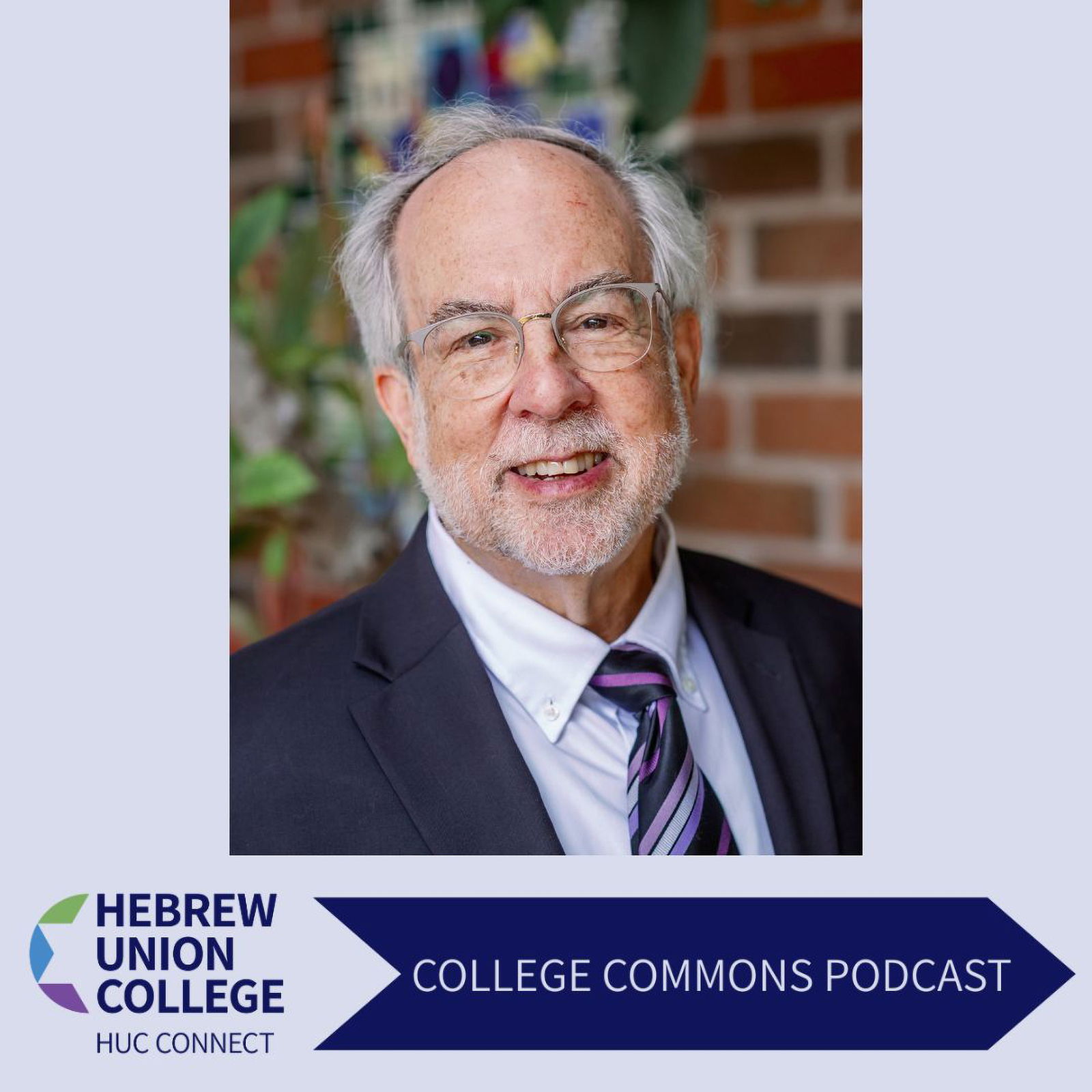
Rabbi Ed Feinstein, a prominent figure in the Jewish community, succeeded Rabbi Harold Schulweis and stresses the significance of rabbis learning collaboratively. He encourages rabbis to address challenging topics in sermons to engage congregants and provide hope. Feinstein emphasizes the need for rabbis to balance speaking their truth with preserving community relationships, citing his own experience discussing Donald Trump in a sermon. He underscores the role of storytelling in sermons to make sense of complex issues and motivate listeners. Drawing inspiration from various religious traditions, including Christian sermons and Jewish teachings, Feinstein highlights the power of narratives in framing circumstances. His approach reflects a commitment to guiding communities towards understanding and hope, advocating for a blend of heart and head in sermon delivery.
Transcription
4753 Words, 26093 Characters
Welcome to the College Commons podcast, passionate perspectives from Judaism's leading thinkers,
brought to you by HUC Connect, the Hebrew Union College's online platform for continuing education.
I'm Joshua Holo, your host, and you're listening to our special series "From the Pulpit,"
discussions about influential sermons and speeches with the rabbis who gave them.
Welcome to the College Commons podcast and our conversation with Rabbi Ed Feinstein.
Ed Feinstein came to Valley Best Shalom in 1993 at the invitation of the renowned Rabbi Harold Shawweiss of Blessed Memory,
whom he succeeded as the congregation's senior Rabbi in 2005.
Rabbi Feinstein now serves on the faculty of the Ziegler-Rubinical School of the American Jewish University,
the Wexner Heritage Program, and the Shalom Hartman Institute in Jerusalem.
And he also lectures widely across the United States.
He's the author of several books, and he enjoys a well-earned reputation as a wonderfully engaging lecturer and storyteller,
and as one of this generation's great sermonizers, Ed Feinstein, thank you so much for joining us on the College Commons podcast.
Thank you, Josh.
Before we talk about sermons, I want to talk about rabbis.
You gave a high holiday sermon seminar at the Hartman Institute in 2023.
And before you got into the meat of what you wanted to impart, you referred to the power of rabbis learning together.
Because you said, "Our work is deeply insular."
This, coming from a senior Rabbi at one of the flagship congregations of the conservative movement in the second largest Jewish city in all of diaspora,
that is to say, coming from a position that doesn't seem insular at all.
What does it mean for the rabbinic position to be insular and does insular amount to isolation and loneliness?
That's a wonderful question. And the answer is, yes, it does.
In rabbinical school, we are taught to learn in Javruta.
You never learn Talmud by yourself. You always learn it with a partner in order to check your own subjectivity against the perspective of a partner.
But when we come into the community, now I'm responsible for this congregation, this institution.
And as you well know, the landscape is not easy. There is tremendous drop-off of membership, of support.
And so a rabbi is holding on. And sometimes we get way too competitive in the way that we think about this.
We're trying to hold on to my institution's success, my institution's integrity.
It's the boundaries. And rabbis do this against each other way too often. So what I suggested to those rabbis,
that particularly in this moment, which is so fraught and so difficult for rabbis, politically sensitive, emotions are raw,
opinions are hard-held. At this very moment, we need to go back to the model of Javruta.
We need to go back to a model of learning and growing and preparing together so that we can support each other through this process.
I want to pick up on that sense of risk and putting yourself out there in a complicated, challenging world, literally from the pulpit.
In that self-same seminar, you addressed the classic rabbis dilemma. Do I sermonize on safe topics or do I, as the questioner asked?
Speak my truth. You in this seminar came out categorically on the side of speaking one's truth.
And you argued that the embodied lived experience, not the cloister, is the realm of the rabbi.
And in this regard, I want to make sure everybody knows that you walk the walk. In 2018, I believe it was, you gave a widely viewed sermon about Donald Trump.
You took care to point out that you agreed with some of his policies at the time, but then you proceeded to level a searing critique of his tone, his methods, and his undercutting of the quality of civic discourse.
I want to ask you to articulate two things about that sermon for us. What did you get right in that sermon? Be it in its content, or perhaps about yourself, or about your community?
And second, what did you get wrong in that sermon?
Thank you. That's a very interesting question.
The rabbi has a set of conflicting values standing before her. On the one hand, I feel this deep need to speak my truth. That's the prophetic voice within the Rabbinate.
And on the other hand, there's a priestly voice within the Rabbinate. I need to preserve my community. I want to hold on to the people that I can affect.
I don't want to lose touch. Many of them are my dear friends. And more than that, my responsibility is to help raise a generation of Jews. And if I lose them, I won't have that opportunity.
And so I'm caught between these two impulses. And today, especially this year, it's even more acute than it was then. Really seriously. How do we speak about Israel? How do we speak about Gaza? How do we speak about America and American democracy? How do we speak about all of the issues that are pressing upon us at this moment?
You know, this temptation to turn your back on all of it and to say, I'm going to talk about the perennial issues. I'm going to talk about the inner life. I'm going to talk about the liturgy. I have this nightmare that there's a young person who came to synagogue.
Maybe they're sitting in the second to the last row and sitting there in clothes that don't look like the clothes people come to shulin. But they came because they had an impulse to come and be with the Jewish community on Yantuf.
And they're waiting for me to say something about how this vast and powerful Jewish moral tradition speaks to the world. And I failed them.
And they walk out saying, my tradition, my religion, my faith has nothing to do with the world that I live in, the world that gives me such consternation and so much pain.
I worry about that one. As much as I worry about the older member of the synagogue who sits in the very front of the synagogue and gets upset at me because I speak about politics and I speak politics that are not his or her politics.
That's the dilemma that we're caught in. We've recording this a few weeks before Oshashana. And every rabbi in America right now, they're all fretting about exactly what to say and how to say it.
In 2018, I had watched the rise of Donald Trump. I had watched the beginning of his first administration. I was watching the way that the country was developing where he was bringing us.
And I felt this acutely to myself. I wanted to do two things in that particular talk. Number one, I wanted to give a context.
And I found that context in a marvelous book by the historian John Meacham called the Soul of America, which was his response to Trump without mentioning his name at all in the book.
He talks about that American politics has always been drawn between two impulses, one toward hope and one toward fear. I said in a sermon what Meacham implies in the book is that Trump represents the category of fear.
And I talked about hope recovering hope and that that was one piece of to give a narrative for the moment we're sitting in that gives us a way of understanding it and seeking a way to maybe even begin to ameliorate it. That's what the sermon was about.
But then I felt I needed to do one more thing. And the image in front of me was that my grandchildren might come to me some years from now and they said you have the biggest pulpit in the community.
And this was going on about you. What did you do? What did you do?
When we tell kids about the civil rights movement of the 1960s, we like to point to the picture of Abraham Heschel marching alongside Martin Luther King.
The fact is that Heschel was widely condemned in the Jewish community and most rabbis, especially most rabbis in the South, but even rabbis across the country preached a kind of ameliorist approach to civil rights.
We don't go too fast and don't go too much. And same thing happened when we talked about LGBTQ+ people, rabbis said, you know, go slow. I worried about what I would have to say to my grandson or my granddaughter.
What did you say? And so I came out and I said to the community, this isn't about policy. There are policies I agree with and policies I disagree with.
This is about something rich deeper called character. I quoted some historians that the character of the American president influences deeply the character of our political society and beyond that deeper into the society.
And I said, the character of this man is poisonous to the social bonds that hold us together because his ethic is an ethic that he learned in the hardcore, hardball world of New York real estate.
And you can't bring that to bear on a polity that depends upon a certain degree of trust among citizens. And I made that claim. That was the argument that I made. Anything you would change from that?
I've thought about that an awful lot. At this moment, I'm glad I gave that talk. We lost some members. People left. People yelled at me. I gave the sermon several times because that's how our synagogue works.
It was a fellow who stood up and began screaming at me from the congregation.
You know, I think that it was the right sermon to give at the right moment and I'm proud that I gave that sermon. The funny thing is that the Trump part is six minutes of a 35-minute sermon.
I mean, I really tried to make this not a liberal sermon, but a sermon about America and America's future. I'm going to try to do the same thing this year.
This is what I think what I recommend to rabbis and friends of mine. We have to give people a narrative that helps them see where we are and what we can do.
That helps give them back a sense of their own efficacy and a sense of hope. What's really happened in this culture is that there's a great deal of hopelessness.
And hopelessness pushes people into very difficult places, pushes people into passivity and privatism. I mean, I'll hide behind the walls of my home.
I'll hide behind the gates of my community. I'm not going to engage the public. I'm not going to worry about the society or the world outside.
I'm going to take care of my own. And that is number one poisonous to a democracy. But more than that, that's a violation of the moral ethic of the Jewish people.
We were commanded, ye brachah, be a blessing. Be a blessing to the world. That's what we're in the world to do.
But in order to be a blessing, you have to have a sense of your efficacy. And in order to have a sense of an efficacy, you have to have a narrative that tells you where you are and what you can do in the world.
And that's what I think rabbis need to be doing this year.
Let's talk about narratives for a sec. Are you game for a thought experiment? Of course. I knew you'd say yes. I think that the power of storytelling is axiomatic.
I think we intuitively appreciate how a story draws us in and satisfies us. Or in the case that you're describing moves us and motivates us.
So rather than ask you to rapsodize on the power of storytelling in a vacuum, I'd like to ask you to focus on the power of storytelling from the unique perch of the pulpit.
And more than that, I'd like to ask you to articulate the power of storytelling from the pulpit by comparing and contrasting it to the power of music also from the pulpit.
I am a cancer patient. Thankfully, I'm healthy, but I had two very, very difficult bouts of cancer. And I spend an awful lot of time in oncologist's office.
The funny thing about the oncologist's office is people talk and they tell stories. And I notice this right away.
You walk into a gastroenterologist's suite and no one talks to you. No one cares to know why you're there. You walk into infectious disease. No one's going to talk to you.
But you walk into an oncologist's office and as soon as you sit down waiting for your turn to see the doctor, someone comes over and says, "Who are you? What do you have? What are they giving you? And what are you doing about it?"
And I notice this every time I walk in the office because cancer diagnosis is so emotionally devastating. And the story has the potential of giving us the power to make sense of it.
It's a narrative frame in which this event, this condition now makes some sense. It has some meaning. And at least by telling you the story, by telling you the story, I'm making sense of my condition.
By telling you the story, I'm gaining a sense of efficacy in the situation.
That's what we Jews have always done. Look, the Bible is not a book of discursive philosophy. The Bible is a book of stories because the Bible is trying to make sense of the world that the Jewish people lived in in that era.
And the Talmud is full of stories, making sense of the world that we live in. Storytelling is about making sense. Rabbis have always been a mageed that is a storyteller because our job is to help our communities make sense of the world outside and of the inner world.
And that's what we do. That's the power of the pulpit. That's the power of the sermon. I want you to make sense of this. And I want to move you by giving you a narrative that's going to make you see this in a certain way so you'll be moving in that direction.
That's what we do. Termins are a combination of heart and head. I think music has a different role. I think music is pure heart. Music moves us. Music just touches us.
And that's the very beautiful, beautiful power of music. The problem is, of course, if I can be a little critical of my friends, we tend to get stuck in yesterday's music.
Right. You come to synagogue and this music. And it was once beautiful music, touching music. It was music that touched the heart. But now it's music of two generations, three generations ago. This is this great story of the new young cancer who comes to change something.
And everyone screams at them, no, you can't change that because that was Moses's melody that you know, it was written in 1780, you know, is it's Levin Dovsky or Solomon O'Rossi or some cancer Debbie Friedman, right?
We give over the power of music to our music professionals and we ask them create music that moves my spirit as I'm praying. And I think that's such an important role, such an important role in the community.
And the rabbis role is to tell me a story that gives sense to my life, sense to my inner life and sense to my outer life and makes me feel like it can hope again.
The College Commons podcast belongs to HUC Connect, the online platform for continuing education from the Human Union College.
HUC Connect includes webinars, syllabi for community learning and master classes for HUC alumni with interviews, expert panels and classroom materials on topics ranging from the arts to civil society, Israel and much more.
Check us out at huc.edu/hucconnect. Now back to our interview.
The reference you made before to Abraham Joshua Heschel evokes a question about the relationship of clergy across religious lines.
The modern sermon as a literary and rhetorical form has some commonalities across all religions and some differences.
What have you learned about sermonizing from other religious traditions?
I teach sermon giving in seminary to rabbinical students.
And I read a lot of sermons and again I'm interested in the power of a sermon to frame a circumstance to frame our situation to give it structure and meaning and to help people find meaning in those circumstances.
I read a lot of Jewish sermons, I read a lot of Christian sermons, Buddhists don't have sermons, but they do have lessons and I read those as well.
I'm just very interested in the way that sermon givers, orators have a way of framing circumstances.
You think of the greatest sermons, greatest sermon American history was the "I Have a Dream" speech of Martin Luther King.
You look what he's doing in that sermon. He makes an incredible claim. Here's a man who has spent great deal of time in jail.
Here's a man who has witnessed his friends and colleagues beaten and humiliated and oppressed.
Here's a man reaching for freedom and he stands in front of the Lincoln Memorial of all places, the holiest place in America.
And he says to this community of quarter of a million people, "I haven't given up on the United States of America. The United States of America has goodness within it and I'm going to find it and I'm going to spark it. I want to make it right."
It's such an incredible statement of hope I have a dream. It's just such a powerful narrative.
For that moment, I would suspect for this moment of American experience as well. That's what sermons can do. I'll look for them anywhere I can find them and I can confess to you that I've copied.
You don't copy the sermon because you have to give it in your own voice, but you can take out trucks and sermons, you can take out ideas and texts and ways of thinking from sermons.
And that's I think it's important for those who give sermons to do that.
Speaking of great sermonizers, you succeeded Rabbi Harrel Shulloise, one of the greats.
And on Rosh Hashanah 2015, the first year of his absence from the Valley Best Shalom Bima, you gave a sermon in his honor.
The topic of your sermon was the loss of faith or sanctity in the face of modernity.
modernity's subversion of the sacred despite our concomitant yearning for the sacred.
You paraphrase Rabbi Shulloise saying, "If we can no longer find the tradition's sacred values in a narrative about God," he taught.
Let's turn the process around and root a new narrative of God in our sacred values.
The goal of Judaism, Shulloise argued, is not to make us believe in a God above.
It never was. The goal of Judaism is to make us vessels of divine holiness here on earth.
It's not about God, but Godliness, about the sacred values we express in our conduct of life.
I was struck by this, both the beautiful homage to Rabbi Shulloise and your own words and, as you said, your gleaning of the tropes.
In this particular pericopy, it sounds like Rabbi Shulloise was sort of discussing reform Judaism, a way of reforming our very religious sensibility.
Is that to partisan a way to put it?
No, first of all, you need to understand that Harold Shulloise was a man who belonged to no movement.
He's an alumnus of Yashiva University, orthodox.
Went to JTS, conservative, was an acolyte of Mordahai Kaplan at JTS, Reconstructionist, taught at HUC.
When I first came to LA as a graduate student, I took his class at then the University of Judaism, conservative,
but he taught the same class the day before at HUC.
He didn't see himself as part of any movement.
He saw himself as a Jew in the world, trying to figure out how I'd be a Jew in the world after the Holocaust.
Harold, if you belong to any denomination, it's a denomination of post-Holocaust, thoughtful Jews.
But I wouldn't say non-orthodox because Yitz Greenberg and David Hartman were two of his closest colleagues and friends,
and you will find some of the same tropes in their thought, their both Orthodox rabbis, Gene Borowitz, Reform Rabbi, Harold Shulloise.
These are wonderful, wonderful thinkers who led the community in that generation after the Holocaust and had to confront the Holocaust.
The stimulus to almost all of them, I wouldn't say this about Hartman, but certainly Greenberg, Shulloise Borowitz,
was the writing of another post-Holocaust theologian named Richard Rubens, who said in 1960,
"How can you go on believing in the same God you always believed in when you've just seen Auschwitz?"
And all of them had to answer that question, and the trope that you'll find in all of them, all of them.
Most notably, for example, Yitz Greenberg's magnum opus called the Triumph of Life.
All of them are going to say, "Look, we can no longer toured toward heaven and see a God who's up there, who's going to take care of us down here."
As Greenberg puts it, "That God has told us we are now responsible."
Hartman says, "This is the second or third era as the Greenberg of the covenant in which we are now responsible."
Zionism for Hartman, he made Olyon 1970, is the most powerful example of Jews taking responsibility for their own fate in the world.
Show ice when one step further as an acolyte of a disciple of Mardach-Hai Kaplan, I used to ask him all the time, "Harold, you believe in God?"
And he'd say, "Look, even if I did," he said, "I can't say anything about God. That's what my monodies teach us.
An infinite God is beyond our language, beyond our capacity. What can I know? I can know what God expects of me.
So I am going to live the godly life. And the godly life is as close as I need to get to divinity.
I feel the divinity when I heal the sick and I feel divinity when I teach the child and I feel divinity when I gather the community to protect."
Yeah, this is where show ice. All of these guys belong to a denomination of their own.
Right? And they all gave us the same message that we are responsible now and that it is an acts of human moral courage and responsibility that you will feel the revelation of the divine.
And I love that. I really enjoy that. I miss him because we were very, very, very close.
The truth is, Professor Hollow, I will tell you, this was his office before he passed away. And I still feel him here.
I turn to him all the time and I ask him, "All right, what do I do now?" And he's still present to me.
I know that would violate his theology. It doesn't bother me because I still feel like this presence is around.
It's just one of these religious characters who really changes the narrative. It just is your whole way of organizing your world and what the world demands of you at this moment.
Well, if I may, be so bold to take interviewer's prerogative. As you know, I grew up in the shul in the heyday of Rabbi Shulways. And I was too young to appreciate his sermons, but I knew I was supposed to because he was already a Dwyanne. He was already an international figure.
And the one thing I remember from him was that he used to seamlessly pause and ask a question of the congregation without an Iota of rhetorical question. It was all a real question.
He would wait until someone would raise their hand and answer and yell out the answer and he would say, "Yes, no, he would engage."
That's what I remember from him. So I want to ask you, for the purposes of this interview, from a sermonizing perspective, a technical perspective, a practitioner's perspective, what did you learn from Harold Shulways about the art of sermonizing?
Oh, mine. I was going to just end here for a second and say, "When I was a kid, I actually spoke with him once. He was his giant, but I asked him, I'm drawn to the rabbit. But I have so many questions. And I don't know if I believe enough to be a Rabbi."
And he turned to me and he said, "It's not necessary to be a Balchuvah. It's necessary to be a Balchila." That is translation. A Balchuvah means someone who owns the answers. And we use that word to represent someone who is sort of born again as a Jew.
But he said, "No, it's more important to be someone who asks the deepest questions."
And I think that's first or generational. I think that is really the most powerful description of, first of all, modern Judaism and second of all, post holocaust Judaism.
And if I could give an advertisement for the movement where you reside, Reform Judaism has asked the best of questions. Unfortunately, the rest of us have been more shy.
But I find in the writing of the Reform movement people who were relentless in their questioning. So that's my deep admiration for the Reform movement, as he did, as he had the same attitude.
We have to ask these questions. And we have to be ready for the answers that we might find. Because when you ask a question, and if you do it sincerely, it's not just a technique, but if you really ask a question, you're ready to be surprised by the answers that come back.
And he was always remarkably open to what would end up coming back at him in those discussions. It was just wonderful.
Harold believed, as do I, of course, that a rabbi has this very, very sacred responsibility to speak the truth. This is the most courageous man I ever knew, because he spoke his truth.
And he believed that we have an obligation to speak our truth. And that the world needs to hear truth. The world is starving for truth.
And that's what we're here to do is speak a truth. And not to be afraid. That's one of the things he believed. And he believed that rabbis have this sacred opportunity to speak truth.
What drove him out of his mind was hearing a talk where the person didn't say anything. That idea that we have this sacred opportunity to say something important to a community, to offer ideas that matter, to offer inspiration that changes people and guides people and energizes people.
This was his huge conviction. The funny thing about show ice, I could tell you this, in person, he was a very shy man.
He was not a personable guy. First of all, he was completely bereft of small talk. It was so funny having lunch with him, because he couldn't talk sports or cars or your friend or gossip. He hated that.
The only gossip he wanted to know is have your red Martin boober, you know, and he was very shy. Once he got on the pulpit, that was his energy, because here was a place where he could share with the community, great ideas, great truth.
He's the sermons to work out his truths. And it was marvelous to spend time with him. Marvelous to sit behind him where I sat for so many years and watch him do this. Think with him. Think through it with him. It's just remarkable.
Well, it's been marvelous for me to have the pleasure of a conversation with you and our long collegial relationship at such a joy. Thank you for taking the time for joining us. It was really a pleasure.
It's an honor, really, Josh. We hope you've enjoyed this episode of the College Commons Podcast, available wherever you listen to your podcasts.
And check out HUC Connect, compelling conversations at the forefront of Jewish learning. For more information about all that HUC Connect has to offer, visit huc.edu/hucconnect.
[MUSIC]
Podcast Summary
Key Points:
Rabbi Ed Feinstein succeeded Rabbi Harold Schulweis at Valley Beth Shalom in 200
Rabbi Feinstein emphasizes the importance of rabbis learning together to combat isolation and loneliness.
He advocates for rabbis to speak their truth in sermons, even on sensitive topics, to engage congregations and foster hope.
Summary:
Rabbi Ed Feinstein, a prominent figure in the Jewish community, succeeded Rabbi Harold Schulweis and stresses the significance of rabbis learning collaboratively. He encourages rabbis to address challenging topics in sermons to engage congregants and provide hope. Feinstein emphasizes the need for rabbis to balance speaking their truth with preserving community relationships, citing his own experience discussing Donald Trump in a sermon.
He underscores the role of storytelling in sermons to make sense of complex issues and motivate listeners. Drawing inspiration from various religious traditions, including Christian sermons and Jewish teachings, Feinstein highlights the power of narratives in framing circumstances. His approach reflects a commitment to guiding communities towards understanding and hope, advocating for a blend of heart and head in sermon delivery.
FAQs
Rabbis learn together in order to check subjectivity against a partner's perspective and support each other.
Rabbi Feinstein emphasizes the need for rabbis to work together, learn, grow, and support each other.
Rabbi Feinstein felt a deep need to speak his truth and address issues of character and societal impact.
Storytelling in sermons helps make sense of circumstances, provide meaning, and inspire action.
Rabbi Feinstein highlighted the importance of embodying divine holiness on earth over traditional beliefs in a sermon honoring Rabbi Shulloise.
Chat with AI
Loading...
Pro features
Go deeper with this episode
Unlock creator-grade tools that turn any transcript into show notes and subtitle files.
 PodcastTranscript AI