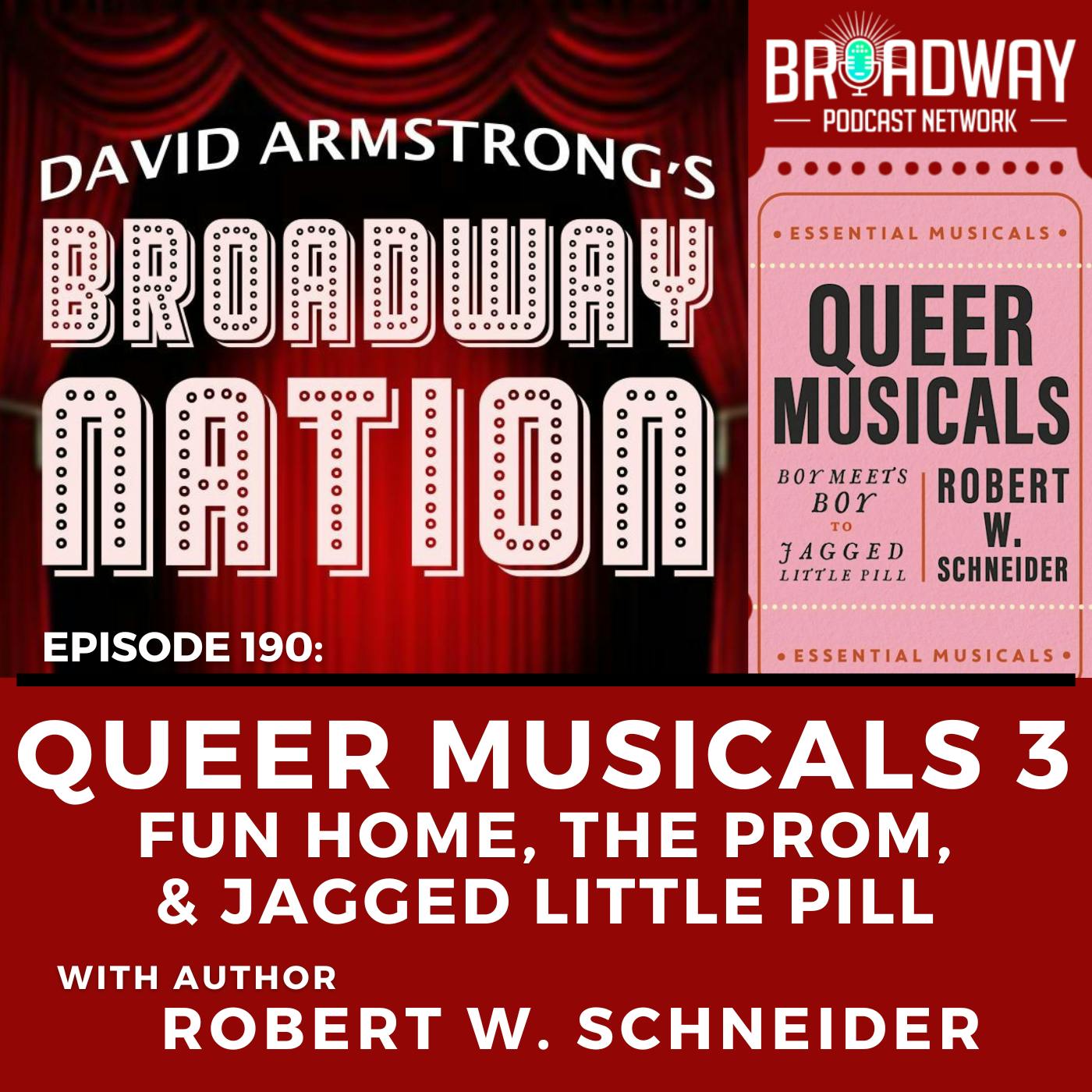
QUEER MUSICALS 3 — FUN HOME, THE PROM, & JAGGED LITTLE PILL
from BROADWAY NATION
33m 29s
In this episode, David Armstrong and Rob Snyder discuss three 21st-century queer musicals: "Fun Home," "The Prom," and "Jagged Little Pill." "Fun Home" is hailed as groundbreaking for portraying lesbian identity as innate, not a choice, and for its innovative structure where three actresses play the same character at different ages—each facing a distinct life crisis. The show, based on Alison Bechdel's graphic novel, successfully enhanced its source material by adding emotional depth. "The Prom" is seen as a flawed but important show, undermined by marketing that couldn't decide how to handle its queer themes; its focus on celebrity antics overshadowed the teen lesbian love story that is its heart. The conversation notes a major cultural shift in casting: from the old fear of casting openly gay actors to the current backlash against straight actors playing queer roles, as seen with James Corden in the film adaptation. Finally, "Jagged Little Pill" is praised for its effective jukebox format and Diablo Cody's book, but criticized for its producers' mishandling of a controversy over a character's non-binary identity. Their initial denial of the character's non-binary status, despite evidence, made the situation worse and serves as a cautionary tale for future productions navigating representation and public relations.
"Hey, I'm Ariana Grande. Hi, I'm Ziddi Arevo, and you're listening to the Broadway podcast network. Visit bpm.fm to discover them." Welcome to another episode of Broadway Nation, the podcast that tells the remarkable story of how immigrant, Jewish, queer, and black artists invented the Broadway musical, and how they changed America in the process. I'm David Armstrong, and this is the third part of my conversation with Rob Snyder, the author of the recent book, "Queer Musicals, Boy Meets Boy to Jagged Little Pill." And on this episode, we move into the 21st century with the musicals, "Fun Home, the Prom," and "Jagged Little Pill." If you missed the first two episodes in this series, you may want to catch up on those before listening to this one. Broadway Nation is made possible, in part, through the generous support of our patron club members, such as longtime member Judy Hucka. If you enjoy this podcast, your support will be greatly appreciated as a crucial part of keeping Broadway Nation rolling along, and they'll be information at the end of the episode about how you two can become a patron. Here we go. So let's talk about "Fun Home." We've had lesbian characters in a musical prior to this. Yes. When was that? Falsettos. You had them in falsettos. Right. The Lesbians next door. Lesbians next door. You had them in Wild Party on the periphery. That's it, they're mostly on the periphery, or they're used as like a punchline, like in the producers when he's like, "Here's Shirley Marco, it's my lighting designer." You know, it's always pushed to this side. And one of the things I always found so fascinating was like in film and TV, for a very long time, like Lesbians were looked at as more bisexual than anything, that like lesbianism was a choice. And I was like, I never really see that with like gay, like male gay characters, but like tons of like film and TV. If it's a lesbian character, it's like, it makes you feel like lesbianism is a choice. "Fun Home" was the first to be like, it's just like gayness and guys. It's the same thing. And to do it with such creativity and with such intelligence. It's a really good show. I actually really like fun home. Absolutely. A terrific show. You talk about the various incarnations of it, and it had to change form several times, especially in the way it was staged. Yeah. It's based on a graphic novel written by Alice Invecto. She had a very interesting life. She was growing up in a small town in Pennsylvania. At the same time, she was discovering that she was gay. She started to put the pieces together that her father was also gay. And he was having affairs with guys on the side. And she never had a chance to talk to him about this shared identity that they had. And he ended up taking his own life. You know, it's so funny. I work a lot in the town where the becktles grew up. And they are like, no, he didn't take his own life. It was a car accident. They're very protective. Wow. It's really fascinating. And so her graphic novel was about that. Like what she wished she could have told her father. When they started staging it, it was really a lot about her. And everything had like a graphic novel comic book feeling to it. And then as time went on, as they developed it, they realized it was more effective as a memory play. And that the graphic novel wasn't as important anymore. It was just that happened to be her job, not the central idea or theme. And it ended up really beautiful. It's I think it's a beautiful show. I thought it was interesting that she noted that she had almost nothing to do with the creation of the show and was sort of didn't want to have anything to do with it. But then what did she say when she saw it? I thought that was really interesting. She was like, this is what I was trying to articulate. That she felt she had done well in the graphic novel. But the musical. Listen, the graphic novel is great. It's very intellectually stimulating. What the musical added was a heart. She loved her dad. She had great love for him. And I think you kind of see that in the graphic novel. But there's a difference between reading it and looking at that picture and seeing it three-dimensional and hearing it. And that I think just elevated it. So I think this is a case where what's that thing they always say, you know, don't musicalize something unless it enhances the source material. This is one of those things. They knew to the source material. Yeah, exactly. And to me, this is one of them. There's a lot of musicals where that's not the case. But for me, this is one where you're like, yes, this is an improvement upon the source material or more effective than the source material. You didn't notice her at first, but I saw her the moment she walked in. She was a delivery woman. She came in with a hand-card full of packages. She was an old-school butch. Someone just came in the door like no one I ever saw before. I feel. I feel. I don't know where you came from. I wish I did. I feel so dumb. I feel. your swagger and your bearing just right close your wearing your short hair and your dungeries and your lace-up boots and your keys. Oh, your ring of keys. And you also say or quote somebody I can't remember that usually when a leading character is divided into three different actresses or three different actors at three different ages, the show doesn't work and yet somehow this show makes that work. Yeah, because I think all three of them are so distinct. We have never seen this in a show before. There's young Allison who was 11 or 12 and played by the great Sydney Lucas who I still think should have won the Tony for her performance. She was so great. And you're watching, you know, sexuality develops, you know, a lot during puberty. That's not talked about in musicals. Usually when you meet a queer character they're older realizing this was saying, look, if you're young and you're going through these feelings they're valid, they're natural. That's pretty important. Then you had the middle Allison who had accepted her sexuality but hadn't ever acted on it. And that's important. Like that first time. And then you had older Allison, you know, looking back on all of this who would become her own fully formed person. So all three they all feel like three separate characters that are just sort of unified by the same name. And I think that's there are shows where you have seen multiple ages of a particular character. And I don't think it works because there's really no major differentiation. But what they did with each of these three is each three of them is going through a major life crisis, a major hurdle. And that becomes interesting. They just don't feel like three emotions. It's not like a prism where you turn it emotionally and you get a different side. These are three very distinct characters going through three very different conflicts. And that's incredible. That's very interesting. So they each have their own story in a way. They each have their honestly, you could have taken any one of those three women's stories and written your own show about it. That's how powerful it is. There's a show that I am thinking of where there are multiple people playing the same character at different ages. And it's not effective because there's really no differentiation between them. Other than age. Other than age. And you're like, well, then what's the point of this? But fun home, I think, really solved that. So now we have another lesbian musical or another musical with lesbian characters at the center of it back to back in a way with a few years in between, but still the prom. So talk a little bit about the prom. It's interesting because this and jagged little pill, both are what appear to be gigantic hits and then sort of don't really follow that trajectory. Some of this has to do with COVID in both cases. Yeah. So the prom really broke my heart because I saw it and I loved it. And the audience surrounding me loved it. And what made me sad was there really wasn't a lot of people in that audience with me when I saw it. Did you get to see it on Broadway? I did. Yes, I did. I mean, it has its problems, like every show has its problems. The big problem for me and the prom is the lead character is the least interesting person on that stage. And it's not really a show about a lesbian. It's a show about campy Broadway celebrities. And I don't think they ever, I think that balance is a little wonky. However, this was a show that suffered because of its marketing. They could not figure out how to market this show. And I think that also stemmed, though, from the beginning of what story are we telling? And I think because the story was a little confusing in terms of what its priorities were, I think marketing didn't know what to do with that either. And so at first they kind of ran away from the queerness, then they embraced it for a hot second, then they ran away from it again. They didn't know what it was. And that makes me really sad because what I think it is is a really timely story for high schoolers that, you know, not everybody, I hate this term, but what they call them flyover states. But like if you're going to high school in New York or California, you're most likely in an area where people are a little bit more sophisticated. It's not for everybody. And I think a show like the prom is so important because it shows people all across the country and all across the world. You're not different. You're not alone in this. And so for that, I wish it had a bigger life because I think it could have done a lot of good. It's very interesting because I had somewhat the same reaction. I really loved the show when I saw it. And I think I saw it early in the run. But then I would talk to people who saw it later and they would just be very unenthusiastic about it. And I was sort of like, well, I really liked it. I mean, it worked for me. I'll never forget this. I remember I went in to see it for the first five minutes I had on like, you know, my director hat or my drama turgical hat. I'm like, that makes no sense. And what is this? And why is that? And then minute six, I lost it. And I just sat back and I smiled. And I loved every second of it. What I think is interesting is the balance that you pointed out. And as you talked about in the book, the balance between the two stories was probably not successfully navigated because I think that's why people had such diverse reactions to it.
of which track did you buy into? And I agree with you, the young people's track was less interesting, which of course, then the creators are probably then leaning on the other track, which is inherently interesting and funny. But the story, the heart of the story is really in the other, is with the two girls. Yeah, and what's funny is, is that in the two girls, the girlfriend, Alissa, she has the best song. She's the more interesting at the two. Emma is the girl's name. I wish that they would have focused in a little bit more. I think it just would have been more powerful. I still loved it. And one of the main reasons I wanted to include it in the book was think to La Cache, where they were like, oh, no, no, no, we can't. The public has to know that these lead actors are straight-- to the backlash of the prom, where it was how dare you cast a straight actor in a gay role. There were so many gay actors who could have played this role. And to me, in that 40-year jump is fantastic and fascinating. Unlike a lot of my students, I'm a believer in whoever's best for the role plays the role, regardless of-- That's just me. To have seen that is not just you, Rob. OK, great. Thank you. Thank you. Thank you. I always do the same thing. I'm like, do you just not want the story told? Like, what's more important that the story is being told or the story is being told with the people that are accurately represented? Sure, that would be great. I'd rather the story told. And what's so fascinating you're talking about when they made the film version of it. And James Corden played the role-- I'll call it the Nathan Lane role, because I-- It is the Nathan Runt Lane role. No one will ever say this out loud, but those two characters are clearly based on Nathan Lane and Patula Pong. Oh, of course. We are going to prove that in this day and day, Shpinkay isn't a crime. This is our moment to change the world. One lesbian, lesbian, lesbian. And on time. We're going to help that little lesbian, whether she likes it or not, when you're a legendary fest behind. First, you have the distress. And you have the distraught. We're going down to where the necks are red. And lack of dentistry thrives. Why sing and dance when you can take a stance? And know your true name, changing life. We're going to march until that hunger's sly. The end of that corner of the maze. You don't got to have a PhD in sight, to know that people count out two of us in the van. We're going to teach them to be more PC. The minute our group arrives, that's life. Those fist pumping. Bible pumping. Spam eating. Cousin loving. Cousin pink. So the slumping finger wedding. Who's your happy? This is the only way. The learn compassion. And better for sure. Once we have less, start changing life. Now let's go start a fight. I'll tell you a very funny story. The couple of days after the prom movie was released, I was interviewing Nathan Lane. And I said, how you doing today? He's like, I'm doing great. He's like, I got the best reviews of my life for a movie I wasn't in. [LAUGHS] Because every-- Like, that should be Nathan. And I'm going to be honest with you. I actually liked James Corden's performance. I was like, I don't know what the problem is. I'm with you. And I was sort of flabbergasted by everyone's critique of it because he gave the same exact performance in every movie he's ever bit in. So how could you say he was a gay stereotype? It's like, well, then he was a gay stereotype in Into the Woods as well. That's what he is. I was like, he is. That's who he is every night on television. Yeah. I mean, what would Nathan Lane have been great? Yes, because age-wise, it would have made more sense and all that stuff. But who cares? James Corden was fabulous. I liked him. But that to me was just that backlash. You know, it used to be, oh god, we can never have a gay guy play a gay guy. We've got to have straight guys do it. Two, oh my god, how dare you not put a gay guy. I don't know. And it's 40-year jump. I think that's kind of cool. Yeah, that is very interesting. I don't agree with it. But I think it's kind of cool that that discussion's happening. Well, and those same issues will figure in a similar way into the last show you covering your book, which is Jagged Little Pill. Don't go away. Rob and I will be back with more Broadway nation right after this quick break. [Music] Hi, this is David Armstrong. And if you're enjoying this episode, I strongly suspect that you will want to read my new book, Broadway nation, How Immigrant, Jewish, Queer, and Black Artist invented the Broadway musical. On sale now, wherever books are sold, and I'm very happy to report that the early reviews have been terrific. The esteemed author, Jeffrey Block, says that Broadway nation is a fascinating, comprehensive and timely gem of a book that more than lives up to its promise of delivering no less than five books in one, Kudos to David Armstrong. And Tony Award-winning lyricist David Zippel says that David Armstrong's insightful history of the evolution of the Broadway musical and its creators is captivating and comprehensive as well as indispensable. The book is of course available on Amazon, but I recommend that you go to the publisher's website, Bloomsbury.com, where you will currently receive a 10% discount. Again, like the podcast that inspired it, the book is titled Broadway Nation, How Immigrant, Jewish, Queer, and Black Artist invented the Broadway musical. Now back to the show. Those same issues will figure in a similar way into the last show you covering your book, which is Jagged Little Pill. Again, a show which, as we talked about earlier, I loved, I thought, won the Tony Award in that year and was incredibly successful in a genre that I generally don't like and think is, and it's very hard to do. What I will say about that is Jagged Little Pill did probably the most difficult thing you can do, which is make a successful story using in a jukebox format, one that was really engaging. And really multiple stories. Every hot button issue was covered in that show. I remember seeing it in Boston when it was out of town and I loved it. I loved it. I was like you, which was like, I think I knew two songs of hers going in and I went with somebody who was much younger than me. And he had no, he didn't know how Alanis Morissette was. And at the end, he couldn't believe it was a jukebox musical. He thought all the songs were written for it specifically. So I was like, this is a great testament to the power of Diablo Cody's book, which was so good. Absolutely. But to me, on the backstage end of things, it's like a handbook on what not to do. This show, this show opened to Can of Worms and that can is still open today. We're seeing it actually right now, I think with the maybe happy ending, casting controversy, you know? Yeah. I think those producers, it was their first time navigating cancellation and it was very heightened because of COVID. I think they always went down the wrong. They had two choices and unfortunately, I think they always went down the wrong path. And now other shows when they get into similar sticky situations are able to look at what they did on Jagged Little Pill and go the opposite way. But I mean, this show brought up so many discussions about the industry, how it works for our lovely listeners who were not aware. There's a character in the show in Boston. There were a couple of lines about her being non-binary. And when they took the show from Boston to New York, they were like, we're covering too many things. We're going to get rid of things that really aren't essential to the plot. And one of the things they got rid of was the character was non-binary. So those three lines she had cut away wasn't an issue. The non-binary community went crazy. They were like, how dare you? And what the producers, I think, should have said was, we think this is a really important issue that deserves its own story. And we don't have the time to tell it appropriately and effectively in this particular version. I don't think everyone would have been happy, but at least made sense. What they said instead was, well, she was never non-binary. And in this day and age, as the kids say, did you keep the receipts? So then they started printing all of the screenshots of conversations about how she's a non-binary cat. And so then they were backed into a corner. Then it opened up another amazing conversation, which was, well, why don't we just keep the character non-binary and then get rid of the actor because she is binary? Then it's like, well, now we're stuck with two problems. Either one she can sue for wrongful term in it. Like, I think people forget there's a business here. And she's stopping the show every night. [Music]
♪ And you forget about me ♪ ♪ Mrs. Duplacity ♪ ♪ I hate to give 'em so much ♪ ♪ To live up to ♪ ♪ It was a slap in the face ♪ ♪ How quickly I was replaced ♪ ♪ And now you think in me ♪ ♪ When he sucks you ♪ ♪ 'Cause I love that you made ♪ ♪ That we made rules and made ♪ ♪ But I'm making it enough for you to be open wide ♪ ♪ No ♪ ♪ And every time I speak his name ♪ ♪ 'Cause you know why you told me to be there ♪ ♪ 'Til you die ♪ ♪ 'Til you die ♪ ♪ But you're still alive ♪ ♪ And I'm here ♪ ♪ To run by you ♪ ♪ Oh, I miss you ♪ ♪ When we're here ♪ ♪ It's not fair ♪ ♪ To deny me ♪ ♪ Of the cross I've been through ♪ ♪ Gave me a little ♪ ♪ Yeah, yeah, yeah ♪ ♪ How to know ♪ - Listen, he did, you ought to know, and as soon as it was over in the middle of the second act, she had a thunderous standing ovation. They were literally engraving her name on the Tony award. - Which she indeed did win. - And she won it. - And she won it. - In spite of all this controversy. So the idea that you're gonna replace that actor when they're stopping the show and going to win the Tony award, you know what I'm saying? - One thing everybody knew about that show was, hey, Lauren Tannen is gonna win the Tony award for this. That's the one thing everybody knew. So now you're telling us we have to get rid of her? - And on top of that, I'm sure the authors and the producers are saying, well, we wrote the show in the first place. So now you're telling us that we can't write this character the way we wanna write it. - That's the next big argument that comes out of it at what point does it stop being the writers? She's not a real person. This is a character they created. - You're talking about Erasier. Well, who are you erasing up? - A fictional character that we wrote. - And we wanna change it to a man or change it to a pumpkin. We get to do whatever we wanna do. Or cut it all together. - It's there. So now that brings up that discussion, which is at what point does an author not own their material anymore? And then on top of all of this, which made me really annoyed, was the virtue signaling because there were people, so Jagged Little Pill opened, had this controversy. It closed down when COVID was happening. We didn't get back to Broadway for like a year or something. Was that right? Like there was no Broadway for a year. - More. - And when it came back, there were people in Jagged Little Pill who said, we are because our non-binary brothers and sisters are being maliciously maligned, we are not gonna rejoin this production. They weren't rejoining the production because during the pandemic, one of them booked a television series. They weren't coming back anyway. And the other one was having a musical written for them. They weren't coming, so they used that as an example. And I'm like, what the, what is this? What is, so to me, Jagged Little Pill, in terms of its story, isn't really that forward for queer, just not. It's everything around it. It's everything around it that has now created this huge conversation. What stories can you tell, when can you tell them, who can tell them? - Who gets to be in them. Who gets to be in them. And that to me, I think is gonna, I think that's a conversation that it's gonna be ongoing for us quite some time. And like I said, you know, you're seeing it on maybe happy ending where the producers bent over backwards to tell everybody, our whole show is, our two leads are Asians, Asian-American. Like that's the big thing there. They're a-a-p-a-pi. That's it, that's it. And then Newcasten comes around and they put in someone who's not a-a-pi. And then suddenly, now what do we do? - Yeah, the only thing I would question there with another discussion about that show, which of course is a fantastic show. - Oh yes. - Is that Darren Chris does not, unless you're told that he's Asian, you don't know he's Asian. - But that was the thing. It was like, look what we've done. Okay, great. Then if you're really proud of that, you have to stick with that. But then you can't go, well, now we're gonna place a non-Asian actor in the role and not understand why people are angry at you. You know, you've made this whole big McGillah out of it. And so I think that's something producers are gonna be dealing with for quite some time, which is if you wanna talk that talk, then you're gonna have to walk that walk all the way through. But then on the flip side, the writers have casting approval. And the writers, I believe one of them is Asian. Like they don't get to have a say in the casting anymore. Helen Shen, Helen who plays opposite him, that's her boyfriend. - That's her boyfriend, your boyfriend? - Exactly, I'm sure that was a big factor in why he was taking over because, well, he's around all the time and everybody loves him and he's a great, he doesn't seem bothered. And he's gonna get to play opposite Helen, which would be then its own sort of story. The two, they're not having a wide friend. The partners are playing opposite each other on Broadway, which is usually a story people wanna participate in. - Oh, you could market the heck out of that. And the reason I wanted to include Jack a little pill was because it instigated all of these discussions. - Right. - Who can tell the story, who can change the story, who's story is it? - And it happened to be through a queer or non-binary character. And I think that's kind of interesting. - Yeah, very interesting. - And so looking back now, and I assume you finished this book more than a year ago. - Yeah, that's right. - That's summer, yeah. - So as you've now are out talking about it and remembering what you wrote and looking at what you wrote, any reactions to that, any thoughts about it, not necessarily things you would do differently, but is the conversation about it, what you thought it would be? - So far, I'm really happy with it because I'm getting a lot of emails and messages from people going, oh, I never thought of it that way before, or I didn't realize blah, blah, blah, or oh, I didn't know what boy meets boy was. Now I'm writing a whole paper on it, or I'm trying to get a production of bear going now. And that's what I want the book to do. I want people to appreciate the shoulders that we're standing on, much like I'm assuming, same with your book. You want people to appreciate. We're not the first and we won't be the last, but there's a rich history behind us that should be celebrated and so far so good on that end. I love notes, so if somebody reads the book and is like, I hated it, amazing. Tell me why you hated it and when I do the second additional try to fix it. - Exactly. - And how about you with your book, same thing? - Same thing, I love hearing from people about it. My book is a lot longer than your book, so I think I hear from a lot of people while I'm still in the middle of it. - Good, good. - Which is good, but yes, there's nothing I assume most authors feel this way. There is great satisfaction from hearing people respond to the book, both positive and negative. - Yes, yes. - And you know, we do theater and you get the instant reaction. But to like, you know, when did you finish your book, a year ago, two years ago? - About a year and a half ago now, yeah. - So you know, this is something from a year and a half ago that you wrote in solitary conf-- You know what I mean? Like you're by yourself. - You don't know what they're gonna like. You don't know what they're not, you're gonna enjoy. And then it just goes out there. And so to hear some sort of validation, and I guess I positive or negative, that's great. Like that makes me so happy, 'cause I mean, somebody's actually looking at the thing. - Right, and read it thoroughly. I love the couple reviews that I've gotten to come out. I've been very gratified when it's clear that they have invested the time in reading the book and reading it with carefully, a careful reading of it. - And to be on a show like this, and I've been on a couple of other programs where the questions are so deeply researched. You're like, oh my God, somebody actually read this thing. You know, you're like, oh shoot, I hope they liked it. I hope I didn't bore them. - Well, I do. - You pride myself on actually reading all the books of the authors that I have on. Somebody told me the other day, the Terry Gross only reads the first third of every book. And I understand the time constraints behind that, but I just wouldn't do that. I wouldn't feel comfortable talking about it. And in fact, I want to read the book. And I'm somewhat selective about what authors I choose to interview, 'cause I want to make sure I want to read the book they wrote. - Well, I cannot tell you how much I appreciate you taking time to read my book and to have me on and to talk about it. I mean, it's just been absolutely fantastic. And like I said, your book is really marvelous. And I'm so happy that we're coming out with these two things side by side. And I could not be in greater company, like I said before, I'm so honored. - I feel exactly the same way. - Rob Schneider, thank you so much for being on Broadway Nation today to talk about queer musicals. - Thank you, David, my pleasure. ♪ Your uncle died ♪ ♪ You're feeling low ♪ ♪ You've got a very old mama ♪ ♪ But you don't know where to go ♪ ♪ You're my boy needs ♪ ♪ His final best ♪ ♪ You got, you got, you got to give them the best ♪ ♪ Wow, come to the fun home ♪ ♪ That's the best old funeral home, baby ♪ ♪ The best old fun home ♪ ♪ And he's just a dinosaur and each Greek ♪ ♪ The best old fun home ♪ ♪ Me and him, everybody's a redemption ♪ ♪ You've got no reason to roam ♪ ♪ You's a best old funeral home ♪ ♪ It is what it is ♪ ♪ Ooh, ooh, ooh, what it is ♪ ♪ What it is now, baby ♪ - If you love this podcast and like to delve even deeper into the world of Broadway musicals, I invite you to become a patron of Broadway Nation. For as little as $7 a month, you can receive access to a whole world of exclusive features, including new original episodes, not available anywhere else, including a five-part scene.
on the Broadway musicals that receive the Pulitzer Prize for drama. And all patrons will receive on-air shout outs and acknowledgements in recognition of your vital supports. To join, simply go to BroadwayNationPodcast.supercast.tech. That's all one word, BroadwayNationPodcastSUPERCAST.tech, or simply click the link in the show notes to this episode. BroadwayNation is written and produced by me, David Armstrong, special thanks to Powell's mocks for his help with editing this episode and to the entire team at the Broadway Podcast Network. ♪ Come to the fun hole ♪ ♪ There we'll parking down the street ♪ ♪ Here at the fun hole ♪ ♪ Fighting friends that can't be beaten ♪ ♪ You'll like the fun hole ♪ ♪ In our hearts there's a backwards speech ♪ ♪ That's why we meet at this pole ♪ ♪ We're the Doctor, funeral home ♪ ♪ What it is, what it is ♪ ♪ Do what it is, what it is now baby ♪ ♪ Do, do, do ♪ (upbeat music) Can you identify an alphabet just from her defying gravity war cry? Can you name every actress in the wicket to Waitress Pipeline? Or just the phrase "which switch" mean anything to you? Well then, good news. (laughs) My name's Quincy. And my name's Kevin. And we're the host of Sentimental Men. We're here to talk and maybe scream about our favorite women in musical theater, The Witches of Wicked. So if spending a Friday night in a no-good deed rabbit hole on YouTube sounds like your idea of a good time, then Sentimental Men is the podcast for you. And with guests like Jessica Vosk, Lucy Jones, and Stephanie J. Block, chances are we've already got an episode with your favorite alphabet. Orglinda, like Laura Belbundi, Brittany Johnson, and Mackenzie Kurtz. So pause your riff compilations, put down your copy of the Grimory and give Sentimental Men a listen. You can find us on the Broadway podcast network or wherever you listen to podcasts.
Podcast Summary
Key Points:
"Fun Home" is praised for being the first Broadway musical to treat lesbian identity as innate rather than a choice, with three distinct actresses playing the protagonist at different ages, each with their own separate story.
"The Prom" is critiqued for an unbalanced focus—more about campy Broadway celebrities than its lesbian teen leads—and suffered from confused marketing that hurt its potential impact, despite its important message for isolated LGBTQ+ youth.
The casting controversy around "The Prom" film (James Corden as a gay character) highlights a 40-year shift from "straight actors must play gay roles" to "only queer actors should play queer roles."
"Jagged Little Pill" succeeded as a jukebox musical with a strong book by Diablo Cody, but became a case study in PR missteps, especially when producers denied a character was originally written as non-binary, leading to backlash and ongoing industry discussions about representation.
Summary:
" "Fun Home" is hailed as groundbreaking for portraying lesbian identity as innate, not a choice, and for its innovative structure where three actresses play the same character at different ages—each facing a distinct life crisis. The show, based on Alison Bechdel's graphic novel, successfully enhanced its source material by adding emotional depth. "The Prom" is seen as a flawed but important show, undermined by marketing that couldn't decide how to handle its queer themes; its focus on celebrity antics overshadowed the teen lesbian love story that is its heart.
The conversation notes a major cultural shift in casting: from the old fear of casting openly gay actors to the current backlash against straight actors playing queer roles, as seen with James Corden in the film adaptation. Finally, "Jagged Little Pill" is praised for its effective jukebox format and Diablo Cody's book, but criticized for its producers' mishandling of a controversy over a character's non-binary identity. Their initial denial of the character's non-binary status, despite evidence, made the situation worse and serves as a cautionary tale for future productions navigating representation and public relations.
FAQs
'Fun Home' is a musical based on Alison Bechdel's graphic novel, exploring her discovery of her own sexuality and her father's hidden homosexuality, which ultimately led to his suicide.
Each actress portrays a distinct version of Alison at different life stages—young, middle, and older—each facing unique conflicts, making them feel like separate characters rather than just age variations.
The show struggled with balancing its story between campy Broadway celebrities and the central lesbian romance, with the lead character being the least interesting and marketing failing to clarify its focus.
There was controversy over casting straight actors like James Corden in gay roles, sparking debate about whether representation or storytelling is more important, though many felt the story itself was valuable.
It successfully integrated Alanis Morissette's songs into a compelling original story by Diablo Cody, covering multiple hot-button issues, with some audiences not even realizing it was a jukebox musical.
The show cut lines indicating a character was non-binary when moving from Boston to Broadway, leading to backlash. Producers mishandled it by denying the character was ever non-binary, despite evidence.
Chat with AI
Loading...
Pro features
Go deeper with this episode
Unlock creator-grade tools that turn any transcript into show notes and subtitle files.
 PodcastTranscript AI